


测绘学报 ›› 2026, Vol. 55 ›› Issue (2): 222-235.doi: 10.11947/j.AGCS.2026.20250385
王少华1,2( ), 梁浩健1, 苏澄1,2, 徐大川3, 周亮3, 秦昆4
收稿日期:2025-09-16
修回日期:2026-01-16
出版日期:2026-03-13
发布日期:2026-03-13
作者简介:王少华(1983—),男,博士,研究员,研究方向为地理空间优化与模拟、地理空间智能、时空大数据分析及GIS关键技术。 E-mail:wangshaohua@aircas.ac.cn
基金资助:
Shaohua WANG1,2(), Haojian LIANG1, Cheng SU1,2, Dachuan XU3, Liang ZHOU3, Kun QIN4
Received:2025-09-16
Revised:2026-01-16
Online:2026-03-13
Published:2026-03-13
About author:WANG Shaohua (1983—), male, PhD, researcher, majors in geospatial optimization and simulation, geospatial intelligence, spatio-temporal big data analysis, and key GIS technologies. E-mail: wangshaohua@aircas.ac.cn
Supported by:摘要:
随着城市化与数字化进程的加快,城市资源配置、应急管理设施和商业设施布局的重要性愈加凸显。传统方法虽然在静态场景下取得了重要进展,但在应对高维度和动态地理时空数据时显现明显的局限性。近年来,人工智能技术,尤其是深度强化学习(DRL)方法为城市设施配置优化提供了一种思路。DRL通过在环境中不断交互学习,能够处理复杂的序列决策问题,并在地理大数据的支撑下展现出较强的自适应性和智能化优势,从而有效弥补传统方法的不足。然而,其应用仍面临模型训练成本高、对数据质量依赖强等挑战。未来研究应致力于优化DRL算法结构,提高模型训练效率,增强其在不同场景下的泛化能力,并探索DRL与其他智能优化方法的融合,以进一步拓展其在城市设施配置优化领域的应用深度和广度。
中图分类号:
王少华, 梁浩健, 苏澄, 徐大川, 周亮, 秦昆. 耦合时空大数据和人工智能的城市设施配置优化研究进展与展望[J]. 测绘学报, 2026, 55(2): 222-235.
Shaohua WANG, Haojian LIANG, Cheng SU, Dachuan XU, Liang ZHOU, Kun QIN. Advances and prospects in urban facility allocation optimization through coupling spatio-temporal big data and artificial intelligence[J]. Acta Geodaetica et Cartographica Sinica, 2026, 55(2): 222-235.
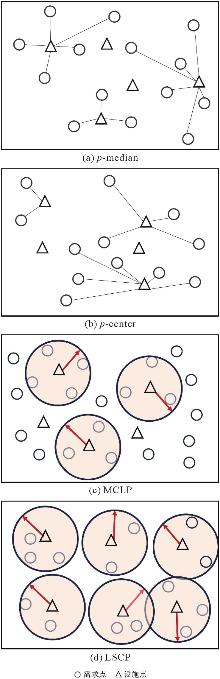
图1
典型城市设施配置优化模型"
表1
人工智能技术适应性"
| 技术类别 | 求解效率 | 可扩展性 | 泛化能力 | 可解释性 | 对数据质量依赖度 | 适用问题类型 |
|---|---|---|---|---|---|---|
| 精确算法 | 慢 | 差 | 弱 | 强 | 低 | 简单/中等规模的静态离散选址问题 |
| 近似算法 | 较快 | 中等 | 中等 | 中等 | 中等 | 可接受次优解的静态选址问题 |
| 启发式算法 | 快 | 强 | 弱 | 弱 | 中等 | 静态或简单的多目标、组合优化问题 |
| 深度强化学习 | 中等/快 | 强 | 中等/强 | 弱 | 高 | 动态、序列决策、复杂环境下的实时优化问题 |
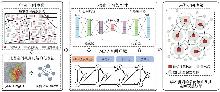
图2
城市设施配置优化的人工智能(AI)模型构建框架"
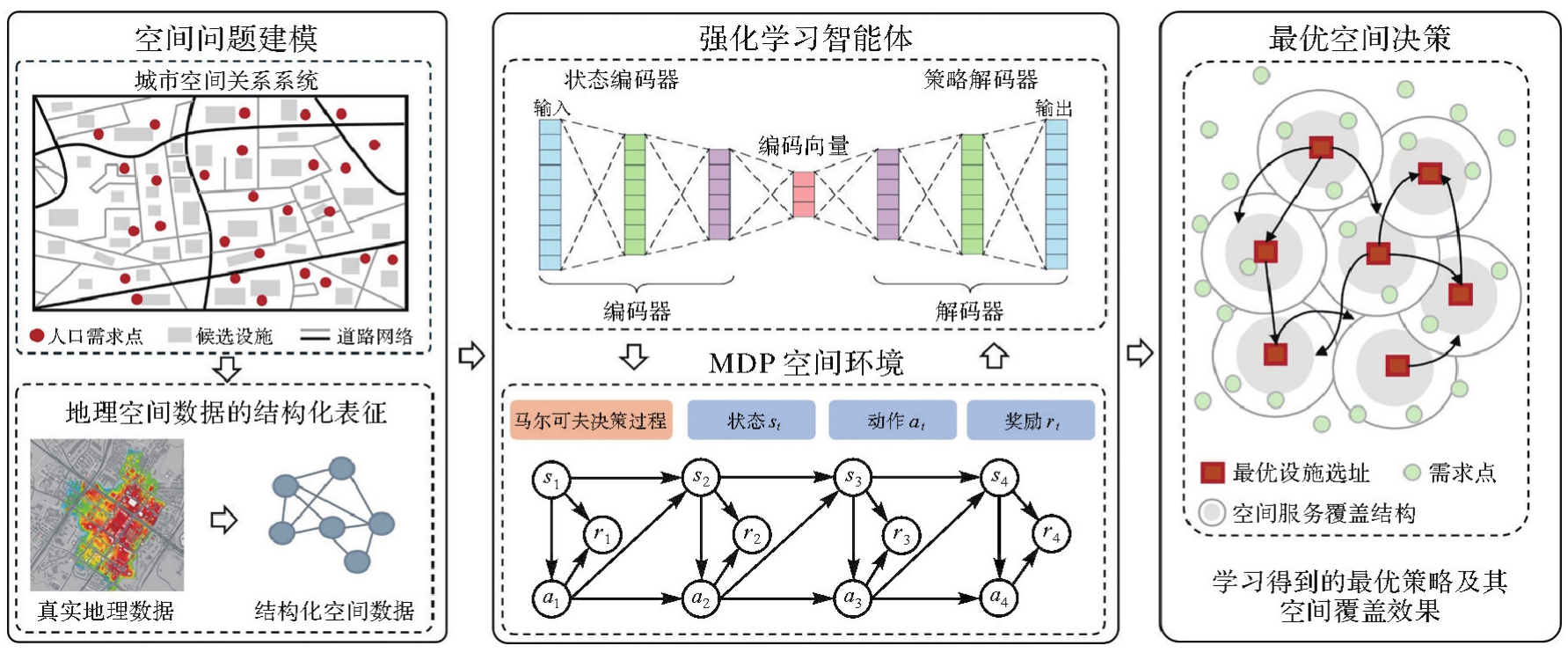

图3
基于人工智能的城市设施配置优化流程"

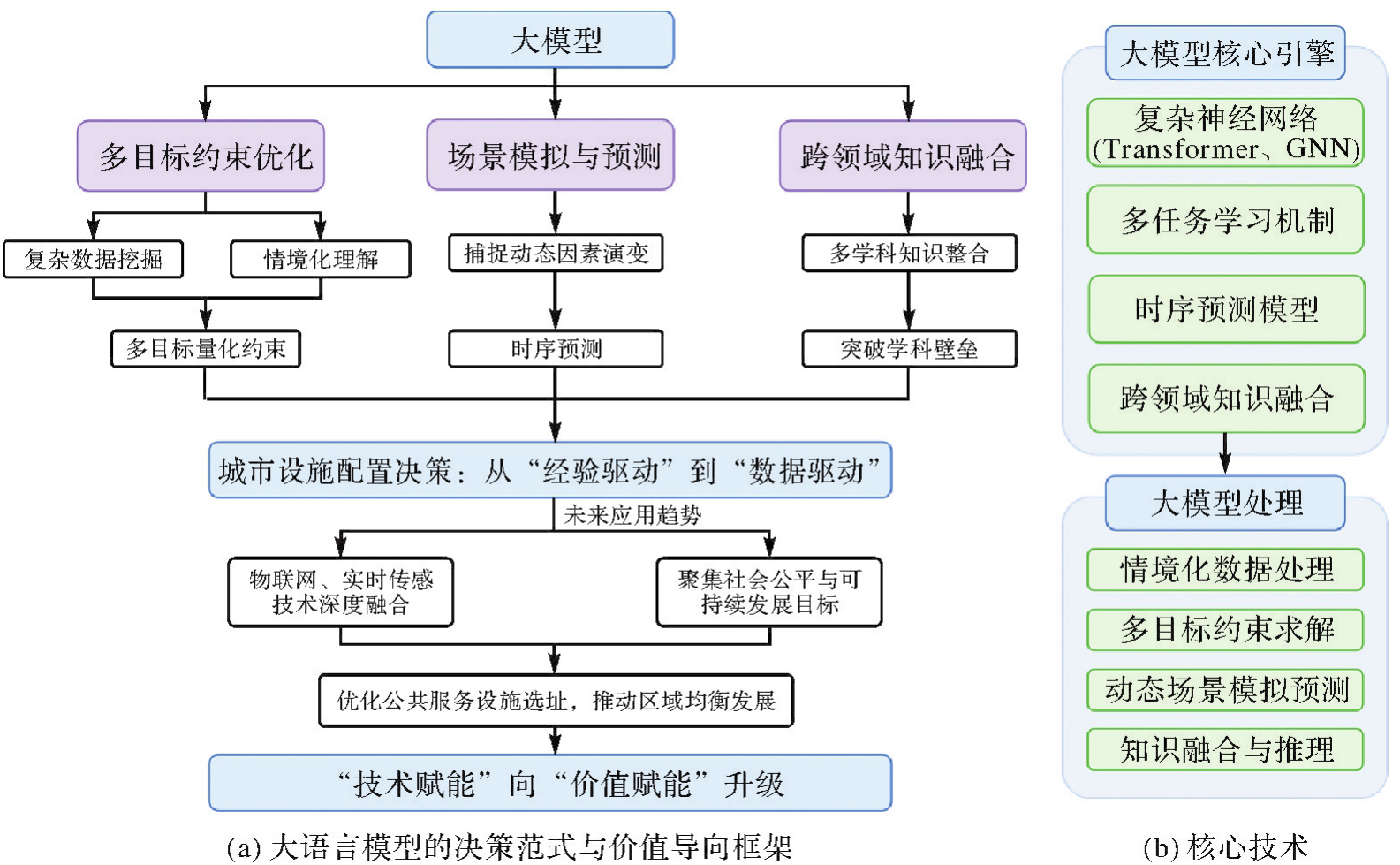
图4
城市空间优化大语言模型"
| [1] | CAO Kai, ZHOU Chenghu, CHURCH R, et al. Revisiting spatial optimization in the era of geospatial big data and GeoAI[J]. International Journal of Applied Earth Observation and Geoinformation, 2024, 129: 103832. |
| [2] | WU Xiaohuan, DONG Weihua, WU Lun, et al. Research themes of geographical information science during 1991—2020: a retrospective bibliometric analysis[J]. International Journal of Geographical Information Science, 2023, 37(2): 243-275. |
| [3] | 黎夏, 刘小平, 李少英. 智能式GIS与空间优化[M]. 北京: 科学出版社, 2010. |
| LI Xia, LIU Xiaoping, LI Shaoying. Intelligent GIS and spatial optimization[M]. Beijing: Science Press, 2010. | |
| [4] | 周亮, 党雪薇, 周成虎, 等. 中国建设用地的坡谱演化规律与爬坡影响[J]. 地理学报, 2021, 76(7): 1747-1762. |
| ZHOU Liang, DANG Xuewei, ZHOU Chenghu, et al. Evolution characteristics of slope spectrum and slope-climbing effects of built-up land in China[J]. Acta Geographica Sinica, 2021, 76(7): 1747-1762. | |
| [5] | MURRAY A T. Contemporary optimization application through geographic information systems[J]. Omega, 2021, 99: 102176. |
| [6] | SANG Lingling, ZHANG Chao, YANG Jianyu, et al. Simulation of land use spatial pattern of towns and villages based on CA-Markov model[J]. Mathematical and Computer Modelling, 2011, 54(3/4): 938-943. |
| [7] | ZHANG Liping, ZHANG Shiwen, ZHOU Zhiming, et al. Spatial distribution prediction and benefits assessment of green manure in the Pinggu district, Beijing, based on the CLUE-S model[J]. Journal of Integrative Agriculture, 2016, 15(2): 465-474. |
| [8] | XIA Yutong, CHEN Huanfa, ZUO Chengchao, et al. The impact of traffic on equality of urban healthcare service accessibility: a case study in Wuhan, China[J]. Sustainable Cities and Society, 2022, 86: 104130. |
| [9] | CHURCH R L, MURRAY A T. Business site selection, location analysis, and GIS[M]. New York: John Wiley & Sons, Inc., 2009. |
| [10] | 刘瑜, 詹朝晖, 朱递, 等. 集成多源地理大数据感知城市空间分异格局[J]. 武汉大学学报(信息科学版), 2018, 43(3): 327-335. |
| LIU Yu, ZHAN Zhaohui, ZHU Di, et al. Incorporating multi-source big geo-data to sense spatial heterogeneity patterns in an urban space[J]. Geomatics and Information Science of Wuhan University, 2018, 43(3): 327-335. | |
| [11] | 吕永强, 于新伟, 杨朔, 等. 基于多源地理大数据的城市多中心识别方法[J]. 自然资源遥感, 2023, 35(2): 132-139. |
| LÜ Yongqiang, YU Xinwei, YANG Shuo, et al. Identification of the polycentric urban structure based on multi-source geographic big data[J]. Remote Sensing for Natural Resources, 2023, 35(2): 132-139. | |
| [12] | ZHANG Wengang, GU Xin, TANG Libin, et al. Application of machine learning, deep learning and optimization algorithms in geo-engineering and geoscience: comprehensive review and future challenge[J]. Gondwana Research, 2022, 109: 1-17. |
| [13] | KARPATNE A, EBERT-UPHOFF I, RAVELA S, et al. Machine learning for the geosciences: challenges and opportunities[J]. IEEE Transactions on Knowledge and Data Engineering, 2019, 31(8): 1544-1554. |
| [14] | 黄波, 吴波, 刘彪, 等. 空间智能:地理信息科学的新进展[J]. 遥感学报, 2008, 12(5): 766-771. |
| HUANG Bo, WU Bo, LIU Biao, et al. Spatial intelligence: advancement of geographic information science[J]. Journal of Remote Sensing, 2008, 12(5): 766-771. | |
| [15] |
张永生, 张振超, 童晓冲, 等. 地理空间智能研究进展和面临的若干挑战[J]. 测绘学报, 2021, 50(9): 1137-1146. DOI: .
doi: 10.11947/j.AGCS.2021.20200420 |
|
ZHANG Yongsheng, ZHANG Zhenchao, TONG Xiaochong, et al. Progress and challenges of geospatial artificial intelligence[J]. Acta Geodaetica et Cartographica Sinica, 2021, 50(9): 1137-1146. DOI: .
doi: 10.11947/j.AGCS.2021.20200420 |
|
| [16] | LIANG Haojian, WANG Shaohua, LI Huilai, et al. A trade-off algorithm for solving p-center problems with a graph convolutional network[J]. ISPRS International Journal of Geo-Information, 2022, 11(5): 270. |
| [17] | UM J, SON S W, LEE S L, et al. Scaling laws between population and facility densities[J]. Proceedings of the National Academy of Sciences, 2009, 106(34): 14236-14240. |
| [18] | ZHONG Yang, WANG Shaohua, LIANG Haojian, et al. ReCovNet: reinforcement learning with covering information for solving maximal coverage billboards location problem[J]. International Journal of Applied Earth Observation and Geoinformation, 2024, 128: 103710. |
| [19] | 梁浩健. 基于深度学习的地理空间优化问题算法研究[D]. 长春: 吉林大学, 2024. |
| LIANG Haojian. Research on algorithms for geospatial optimization problem based on deep learning[D]. Changchun: Jilin University, 2024. | |
| [20] | LÜ Guonian, BATTY M, STROBL J, et al. Reflections and speculations on the progress in geographic information systems (GIS): a geographic perspective[J]. International Journal of Geographical Information Science, 2019, 33(2): 346-367. |
| [21] | LIU Yu, LIU Xi, GAO Song, et al. Social sensing: a new approach to understanding our socioeconomic environments[J]. Annals of the Association of American Geographers, 2015, 105(3): 512-530. |
| [22] | 程昌秀, 沈石, 李强坤. 黄河流域人地系统研究的大数据支撑与方法探索[J]. 中国科学基金, 2021, 35(4): 529-536. |
| CHENG Changxiu, SHEN Shi, LI Qiangkun. Big data support and method exploration about natural and human systems research in the Yellow River Basin[J]. Bulletin of National Natural Science Foundation of China, 2021, 35(4): 529-536. | |
| [23] | 裴韬, 刘亚溪, 郭思慧, 等. 地理大数据挖掘的本质[J]. 地理学报, 2019, 74(3): 586-598. |
| PEI Tao, LIU Yaxi, GUO Sihui, et al. Principle of big geodata mining[J]. Acta Geographica Sinica, 2019, 74(3): 586-598. | |
| [24] | NYIMBILI P H, ERDEN T. GIS-based fuzzy multi-criteria approach for optimal site selection of fire stations in Istanbul, Turkey[J]. Socio-Economic Planning Sciences, 2020, 71: 100860. |
| [25] | 刘艳芳, 方飞国, 刘耀林, 等. 时空大数据在空间优化中的应用[J]. 测绘地理信息, 2019, 44(3): 7-20. |
| LIU Yanfang, FANG Feiguo, LIU Yaolin, et al. Application of spatio-temporal big data in spatial optimization[J]. Journal of Geomatics, 2019, 44(3): 7-20. | |
| [26] | TU Wei, LI Qingquan, FANG Zhixiang, et al. Optimizing the locations of electric taxi charging stations: a spatial-temporal demand coverage approach[J]. Transportation Research Part C: Emerging Technologies, 2016, 65: 172-189. |
| [27] | 王璞. 多源数据融合下城市设施的选址推荐和区域需求研究[D]. 苏州: 苏州大学, 2021. |
| WANG Pu. Research on location recommendation and regional demand of urban facilities based on multi-source data fusion[D]. Suzhou: Soochow University, 2021. | |
| [28] | QIN Kun, ZHOU Qing, WU Tao, et al. Hotspots detection from trajectory data based on spatiotemporal data field clustering[C]//Proceedings of 2017 ISPRS Geospatial Week. Wuhan: ISPRS, 2017: 1319-1325. |
| [29] | SUN Yeran, FAN Hongchao, BAKILLAH M, et al. Road-based travel recommendation using geo-tagged images[J]. Computers, Environment and Urban Systems, 2015, 53: 110-122. |
| [30] | SUN Yeran, MOSHFEGHI Y, LIU Zhang. Exploiting crowdsourced geographic information and GIS for assessment of air pollution exposure during active travel[J]. Journal of Transport & Health, 2017, 6: 93-104. |
| [31] | KONG Yunfeng. Variants of location-allocation problems for public service planning[M]//New thinking in GIScience. Singapore: Springer Nature Singapore, 2022: 309-318. |
| [32] | XU Yanyan, OLMOS L E, ABBAR S, et al. Deconstructing laws of accessibility and facility distribution in cities[J]. Science Advances, 2020, 6(37): eabb4112. |
| [33] | 张恒才, 陆锋, 陈洁. 网络空间移动对象模型的应用与发展[J]. 地球信息科学学报, 2013, 15(3): 328-337. |
| ZHANG Hengcai, LU Feng, CHEN Jie. Advance in moving object data modeling under geographic network environment[J]. Journal of Geo-information Science, 2013, 15(3): 328-337. | |
| [34] | LIU Kang, GAO Song, LU Feng. Identifying spatial interaction patterns of vehicle movements on urban road networks by topic modelling[J]. Computers, Environment and Urban Systems, 2019, 74: 50-61. |
| [35] | CHURCH R L, WANG Shaohua. Solving the p-median problem on regular and lattice networks[J]. Computers & Operations Research, 2020, 123: 105057. |
| [36] | TU Wei, YE Haoyu, MAI Ke, et al. Deep online recommendations for connected E-taxis by coupling trajectory mining and reinforcement learning[J]. International Journal of Geographical Information Science, 2024, 38(2): 216-242. |
| [37] | TU Wei, GAO Wei, LI Mingxiao, et al. Spatial cooperative simulation of land use-population-economy in the Greater Bay Area, China[J]. International Journal of Geographical Information Science, 2024, 38(2): 381-406. |
| [38] | LIU Kang, QIU Peiyuan, GAO Song, et al. Investigating urban metro stations as cognitive places in cities using points of interest[J]. Cities, 2020, 97: 102561. |
| [39] | 刘瑜, 张晶, 邬伦. 空间数据工程理论框架研究[J]. 地理与地理信息科学, 2003, 19(1): 12-15, 24. |
| LIU Yu, ZHANG Jing, WU Lun. Geo-spatial data engineering: a theoretical framework[J]. Geography and Geo-Information Science, 2003, 19(1): 12-15, 24. | |
| [40] | HAKIMI S L. Optimum locations of switching centers and the absolute centers and medians of a graph[J]. Operations research, 1964, 12(3): 450-459. |
| [41] | CAO Kai, ZHANG Wenting, WANG Tianwei. Spatio-temporal land use multi-objective optimization: a case study in Central China[J]. Transactions in GIS, 2019, 23(4): 726-744. |
| [42] | 宋正娜, 颜庭干, 刘婷, 等. 新重力P中值模型及其在城市综合医院区位决策中的实证检验——以无锡市为例[J]. 地理科学进展, 2016, 35(4): 420-430. |
| SONG Zhengna, YAN Tinggan, LIU Ting, et al. A new gravity P-median model and empirical test in urban comprehensive hospital location decision making: take Wuxi as an example[J]. Progress in Geography, 2016, 35(4): 420-430. | |
| [43] | ABUBAKAR Z, EJIMA O, MUSTAFA A, et al. P-center problem of fire stations in Sokoto Metropolis[J]. Asian Journal of Mathematics and Computer Research, 2017, 18(3): 143-151. |
| [44] | HUANG Meng, FANG Zhixiang, WEIBEL R, et al. Dynamic optimization models for displaying outdoor advertisement at the right time and place[J]. International Journal of Geographical Information Science, 2021, 35(6): 1179-1204. |
| [45] | SHARIFF S S R, MOIN N H, OMAR M. Location allocation modeling for healthcare facility planning in Malaysia[J]. Computers & Industrial Engineering, 2012, 62(4): 1000-1010. |
| [46] | HASHIM N I M, SHARIFF S S R, DENI S M. Allocation of relief centre for flood victims using location set covering problem (LSCP)[C]//Proceedings of 2021 International Conference on Mathematics, Statistics and Computing Technology. Bangkok: IOP Publishing Ltd., 2021. |
| [47] | WU Qiang, DU Zhili, ZHAO Yingwang, et al. Optimal location of water level sensors for monitoring mine water inrush based on the set covering model[J]. Scientific Reports, 2021, 11(1): 2621. |
| [48] | 钟耳顺. 深度地图——论地图学与神经科学的结合[J]. 武汉大学学报(信息科学版), 2022, 47(12): 1988-2002. |
| ZHONG Ershun. Deep mapping—a critical engagement of cartography with neuroscience[J]. Geomatics and Information Science of Wuhan University, 2022, 47(12): 1988-2002. | |
| [49] | VASILYEV I L, USHAKOV A V. Discrete facility location in machine learning[J]. Journal of Applied and Industrial Mathematics, 2021, 15(4): 686-710. |
| [50] | LIANG Haojian, WANG Shaohua, LI Huilai, et al. Sponet: solve spatial optimization problem using deep reinforcement learning for urban spatial decision analysis[J]. International Journal of Digital Earth, 2024, 17(1): 2299211. |
| [51] | WANG Shaohua, LIANG Haojian, ZHONG Yang, et al. DeepMCLP: solving the MCLP with deep reinforcement learning for urban facility location analytics[C/OL]//Proceedings of 2023 Spatial Data Science Symposium. Santa Barbara: Center for Spatial Studies, University of California, Santa Barbara, 2023 [2025-08-20]. http://dx.doi.org/10.25436/E2MK55. |
| [52] | ZHANG Di, MENG Huan, WANG Moyang, et al. A multi-objective optimization method for shelter site selection based on deep reinforcement learning[J]. Transactions in GIS, 2024, 28(8): 2722-2741. |
| [53] | QAYYUM A, USAMA M, QADIR J, et al. Securing connected & autonomous vehicles: challenges posed by adversarial machine learning and the way forward[J]. IEEE Communications Surveys & Tutorials, 2020, 22(2): 998-1026. |
| [54] | ZHENG Jiayi, WANG Shaohua, LI Shijie, et al. Towards conversational spatial optimization: an llm-driven decision support system for geospatial facility location problems[C]//Proceedings of the 14th International Workshop on Urban Computing. New York: ACM Press, 2025. |
| [55] | ZHANG Zeyu, DAI Quanyu, BO Xiaohe, et al. A survey on the memory mechanism of large language model based agents[J]. ACM Transactions on Information Systems, 2025, 43(6): 1-47. |
| [56] | 王湉, 范峻铭, 郑湃. 基于大语言模型的人机交互移动检测机器人导航方法[J]. 计算机集成制造系统, 2024, 30(5): 1587-1594. |
| WANG Tian, FAN Junming, ZHENG Pai. Large language model-based approach for human-mobile inspection robot interactive navigation[J]. Computer Integrated Manufacturing Systems, 2024, 30(5): 1587-1594. | |
| [57] | YANG Xi, CHEN Aokun, POURNEJATIAN N, et al. A large language model for electronic health records[J]. NPJ Digital Medicine, 2022, 5: 194. |
| [58] | MAI Gengchen, JANOWICZ K, HU Yingjie, et al. A review of location encoding for GeoAI: methods and applications[J]. International Journal of Geographical Information Science, 2022, 36(4): 639-673. |
| [59] | 张新长, 华淑贞, 齐霁, 等. 新型智慧城市建设与展望:基于AI的大数据、大模型与大算力[J]. 地球信息科学学报, 2024, 26(4): 779-789. |
| ZHANG Xinchang, HUA Shuzhen, QI Ji, et al. Progress and prospects of new smart city construction: AI-based big data, big models and big computing power[J]. Journal of Geo-information Science, 2024, 26(4): 779-789. | |
| [60] | 高松. 地理空间人工智能的近期研究总结与思考[J]. 武汉大学学报(信息科学版), 2020, 45(12): 1865-1874. |
| GAO Song. A review of recent researches and reflections on geospatial artificial intelligence[J]. Geomatics and Information Science of Wuhan University, 2020, 45(12): 1865-1874. |
| [1] | 李鹏, 张家涵, 汪志翰, 王厚杰, 李振洪. 潮间带地形重建方法综述:现状、挑战与趋势[J]. 测绘学报, 2026, 55(4): 571-587. |
| [2] | 王家耀, 陈琳, 程士源, 王利军, 熊思奇. 人工智能赋能地图科学数智化[J]. 测绘学报, 2026, 55(3): 381-389. |
| [3] | 冉耘博, 杨雪, 周文豪, 吴承恩, 周宝定, 唐炉亮, 李清泉. 多维偏好增强型对抗深度强化学习驱动的行人路径规划[J]. 测绘学报, 2026, 55(2): 191-205. |
| [4] | 童小华, 黄荣, 曹佳瑞, 刘宸, 王蓉, 徐聿升, 叶真, 金雁敏, 刘世杰, 柳思聪, 冯永玖, 谢欢. 月球与近地行星三维形貌重建的智能方法综述:研究进展与未来挑战[J]. 测绘学报, 2025, 54(11): 1917-1933. |
| [5] | 宁晓刚, 张翰超, 张瑞倩. 遥感影像高可信智能不变检测技术框架与方法实践[J]. 测绘学报, 2024, 53(6): 1098-1112. |
| [6] | 燕琴, 顾海燕, 杨懿, 李海涛, 沈恒通, 刘世琦. 智能遥感大模型研究进展与发展方向[J]. 测绘学报, 2024, 53(10): 1967-1980. |
| [7] | 李树涛, 吴琼, 康旭东. 高光谱遥感图像本征信息分解前沿与挑战[J]. 测绘学报, 2023, 52(7): 1059-1073. |
| [8] | 王培晓, 张彤, 聂士超, 杨瑾萱, 王天骄. 顾及缺失值的因果图时空预测网络[J]. 测绘学报, 2023, 52(5): 818-830. |
| [9] | 杨必胜, 陈驰, 董震. 面向智能化测绘的城市地物三维提取[J]. 测绘学报, 2022, 51(7): 1476-1484. |
| [10] | 刘经南, 罗亚荣, 郭迟, 高柯夫. PNT智能与智能PNT[J]. 测绘学报, 2022, 51(6): 811-828. |
| [11] | 王家耀, 武芳, 闫浩文. 大变化时代的地图学[J]. 测绘学报, 2022, 51(6): 829-842. |
| [12] | 龚健雅, 宦麟茜, 郑先伟. 影像解译中的深度学习可解释性分析方法[J]. 测绘学报, 2022, 51(6): 873-884. |
| [13] | 刘瑜, 郭浩, 李海峰, 董卫华, 裴韬. 从地理规律到地理空间人工智能[J]. 测绘学报, 2022, 51(6): 1062-1069. |
| [14] | 王权, 尤淑撑. 陆地卫星遥感监测体系及应用前景[J]. 测绘学报, 2022, 51(4): 534-543. |
| [15] | 李德仁, 徐小迪, 邵振峰. 论万物互联时代的地球空间信息学[J]. 测绘学报, 2022, 51(1): 1-8. |
| 阅读次数 | ||||||
|
全文 |
|
|||||
|
摘要 |
|
|||||
