


测绘学报 ›› 2026, Vol. 55 ›› Issue (7): 1293-1305.doi: 10.11947/j.AGCS.2026.20260070
• 地图学与地理信息 • 上一篇
柳林1( ), 裴冬梅1, 李万武1(), 唐修涛2, 武彬3, 金岩2
收稿日期:2026-02-24
修回日期:2026-07-15
发布日期:2026-08-18
通讯作者:
李万武
E-mail:liulin2009@126.com;liwanwuqd@126.com
作者简介:柳林(1971—),女,博士,教授,研究方向为GeoAI与深度学习、位置大数据挖掘与智能位置服务、移动行为分析与建模。 E-mail:liulin2009@126.com
基金资助:
Lin Liu1(), Dongmei Pei1, Wanwu Li1(), Xiutao Tang2, Bin Wu3, Yan Jin2
Received:2026-02-24
Revised:2026-07-15
Published:2026-08-18
Contact:
Wanwu Li
E-mail:liulin2009@126.com;liwanwuqd@126.com
About author:Liu Lin (1971—), female, PhD, professor, majors in GeoAI and deep learning, location big data mining and intelligent location-based services mobile behavior analysis and modeling. E-mail: liulin2009@126.com
Supported by:摘要:
如何优化消防站选址,提高消防应急救援效率,是城市化发展急需解决的问题。本文从消防站选址模型构建、求解和评价3个方面开展研究,优化消防站的空间布局。首先,基于站点的属性和消防响应需求差异,进行风险等级划分和响应时间设置,综合考虑费用、覆盖率、响应时效等因素,采用多目标层级优化建模方法建立数量-距离两级目标函数。然后基于路网定义路径距离测度,采用模糊非线性隶属度函数代替传统线性函数作为约束条件,构建基于路径距离的模糊多目标层级选址模型(R-NLSM)。最后,采用遗传算法(GA)和粒子群优化(PSO)算法并嵌入模糊隶属度函数进行模型求解。结果表明优化后整体响应覆盖率提高了16.69个百分点,所构建模型具有有效性和稳定性,同时提高不同风险等级与消防救援效率的匹配度,保证了高风险需求点的响应时效。
中图分类号:
柳林, 裴冬梅, 李万武, 唐修涛, 武彬, 金岩. 顾及风险等级的消防站选址多目标层级模糊优化模型构建及求解[J]. 测绘学报, 2026, 55(7): 1293-1305.
Lin Liu, Dongmei Pei, Wanwu Li, Xiutao Tang, Bin Wu, Yan Jin. Construction and solution of a multi-objective hierarchical fuzzy optimization model for fire station location considering risk levels[J]. Acta Geodaetica et Cartographica Sinica, 2026, 55(7): 1293-1305.

表1
火灾风险因子"
| 火灾风险因子 | POI类型 |
|---|---|
| 易燃易爆类 | 加气站,加油站,生产、储存及销售易燃易爆品的工厂及企业等 |
| 人群脆弱类 | 医院及诊所、养老院、各类学校及幼儿园等婴幼儿服务场所 |
| 重要场所类 | 县(区)及以上政府机关、公检法部门、科研单位、图书馆、博物馆、档案馆、外国派驻机构、历史文化遗迹等 |
| 人员密集类 | 市场和商场等经营场所,娱乐场所,酒店,机场、火车站、汽车站等交通枢纽 |
| 一般消防类 | 办公楼区,居民区,除化工厂外的公司企业、产业园区、体育休闲服务场所、生活服务场所4类之外的其他POI点 |
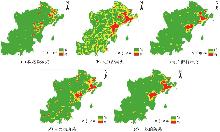
图1
需求站点核密度分布"
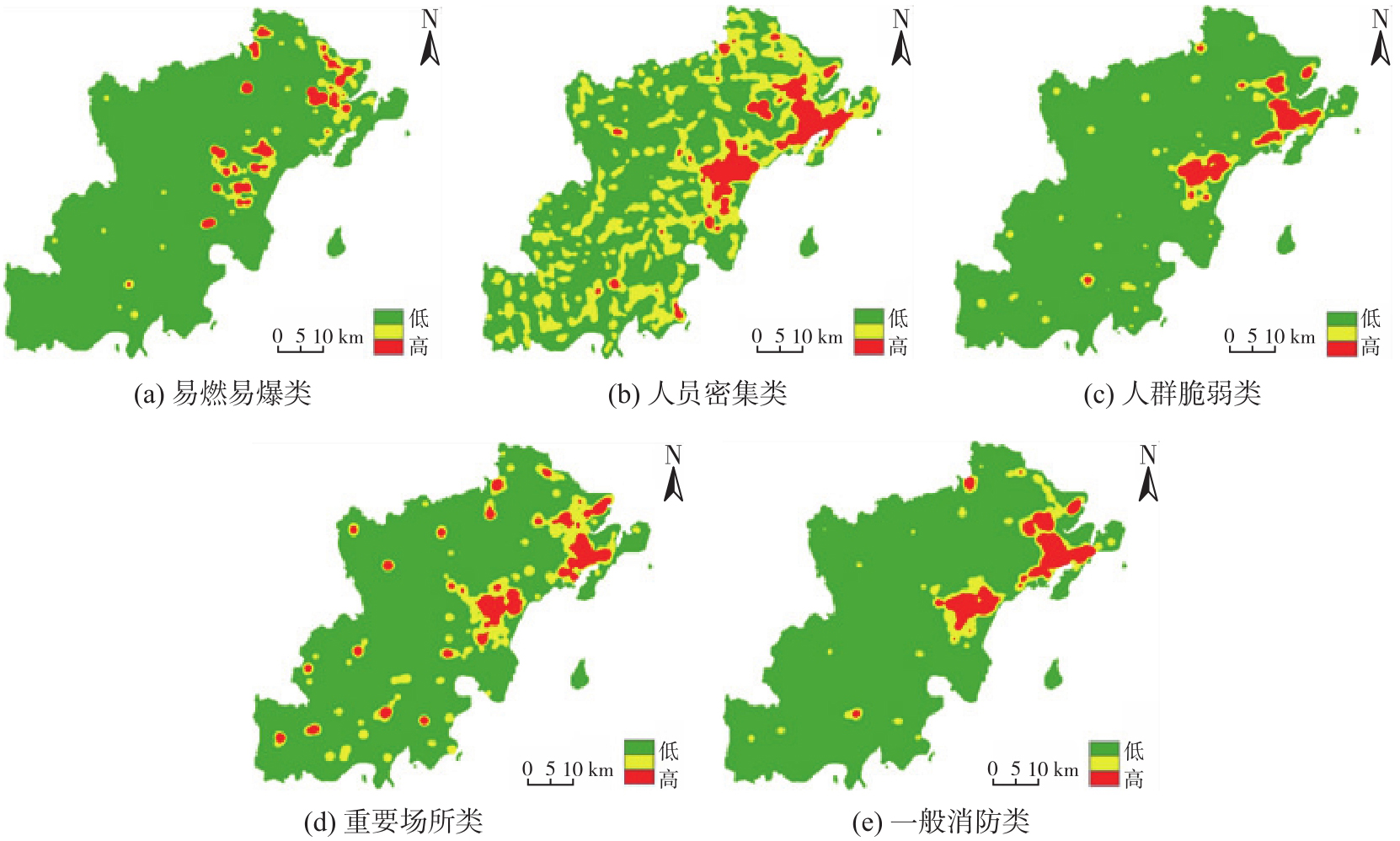
表2
各因子权重"
| 因素 | 权重 | 归一化权重 |
|---|---|---|
| 易燃易爆类 | 1.626 | 0.3 |
| 人群脆弱类 | 1.220 | 0.2 |
| 重要场所类 | 0.850 | 0.2 |
| 人员密集类 | 1.016 | 0.2 |
| 一般消防类 | 0.610 | 0.1 |
图2
火灾风险空间分布和等级"
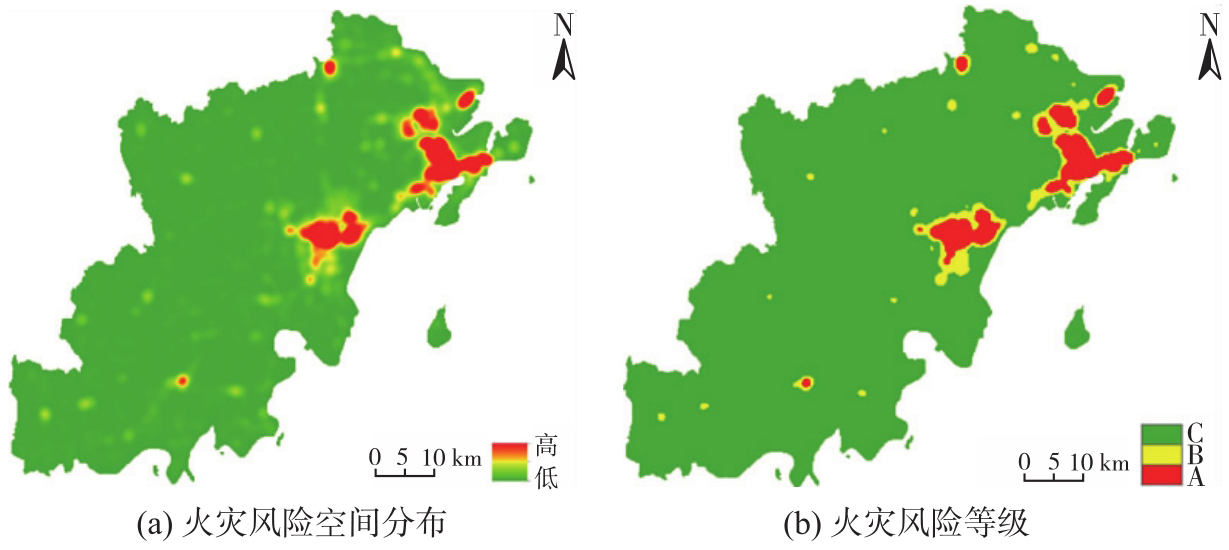
表3
消防火灾响应参考时间"
| 火灾风险等级 | 到达时间限制/min | 火灾地点距离限制/km |
|---|---|---|
| A | [4,5) | [4,5) |
| B | [5,10) | [5,10) |
| C | [10,20] | [10,20] |
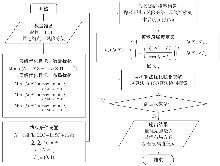
图3
模型构建及求解算法流程"

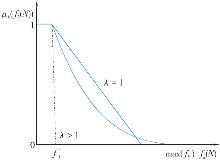
图4
模糊隶属度函数(λ≥1)"
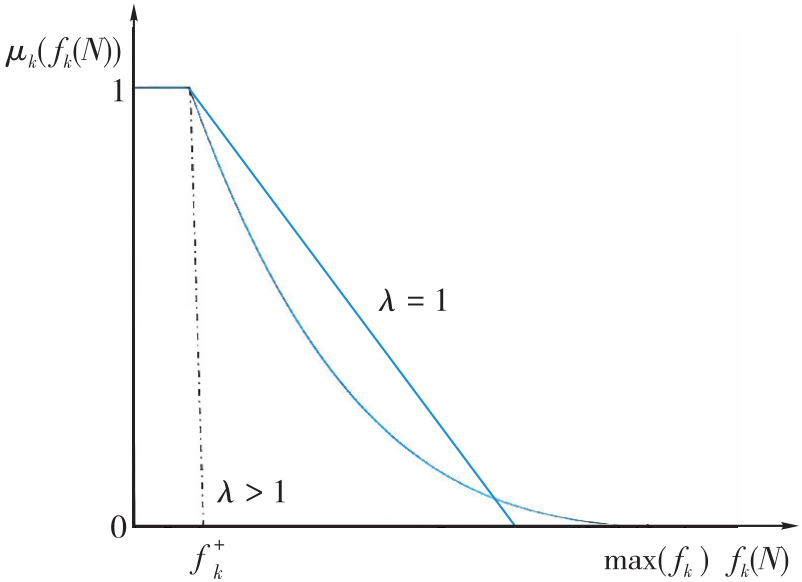
表4
系数λ的敏感性分析"
| λ取值 | 响应覆盖率/(%) | |||
|---|---|---|---|---|
| A级 | B级 | C级 | 总体 | |
| 1.0 | 70.40 | 66.22 | 51.27 | 61.86 |
| 1.5 | 87.79 | 77.62 | 54.59 | 69.00 |
| 2.0 | 100.00 | 92.23 | 61.21 | 83.13 |
| 2.5 | 98.67 | 67.65 | 61.43 | 68.69 |
| 3.0 | 98.61 | 72.23 | 58.39 | 70.39 |
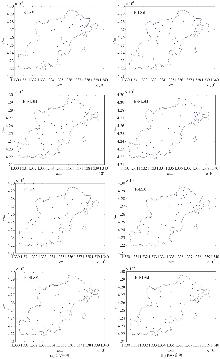
图5
两种算法优化后的消防站空间分布"
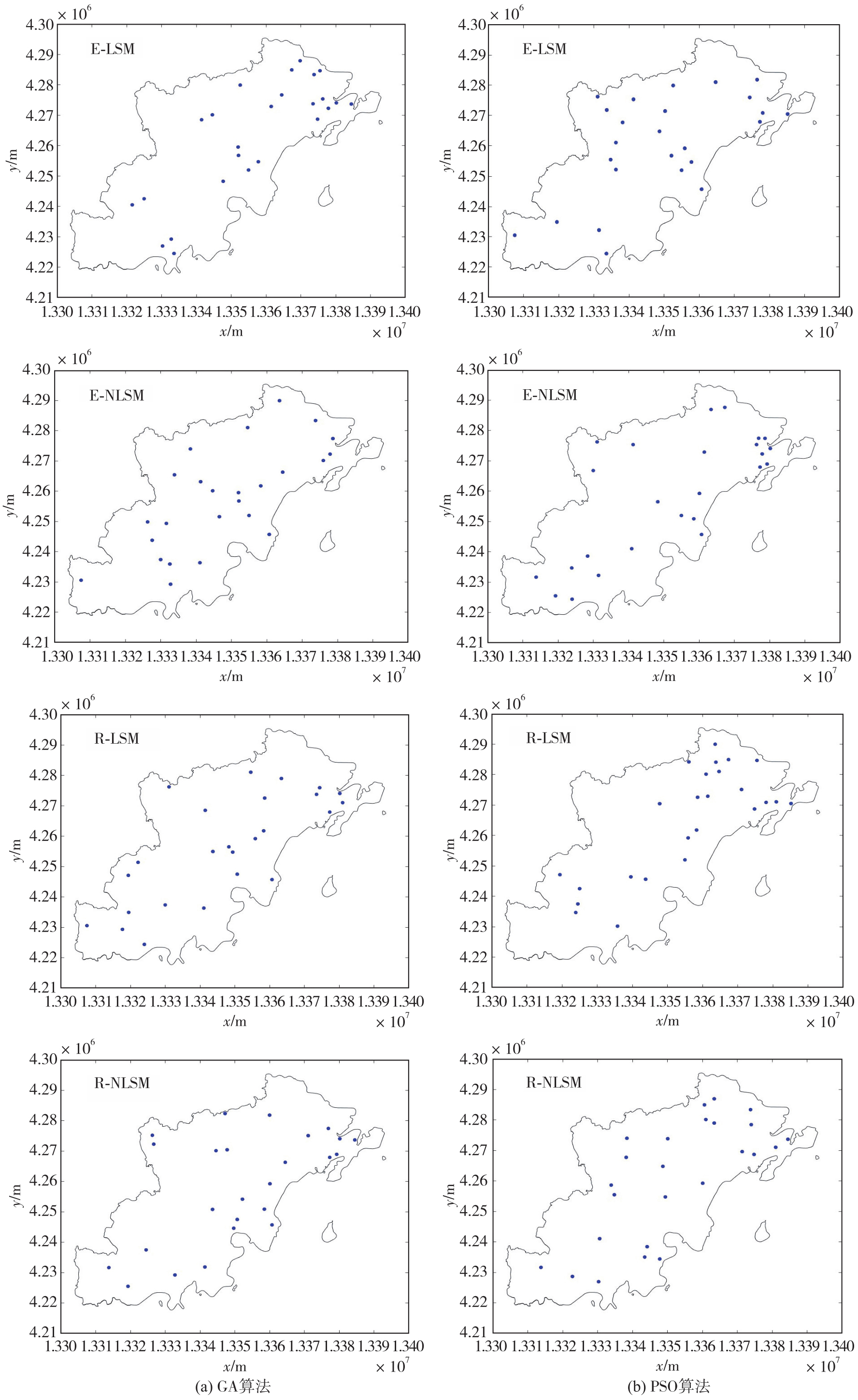
表5
本文模型与3种基准模型的覆盖率对比"
| 风险等级 | GA算法优化后覆盖率 | PSO算法优化后覆盖率 | ||||||
|---|---|---|---|---|---|---|---|---|
| MCLP | P-center | P-median | R-NLSM | MCLP | P-center | P-median | R-NLSM | |
| A | 100.00 | 100.00 | 100.00 | 100.00 | 100.00 | 100.00 | 100.00 | 100.00 |
| B | 90.51 | 93.62 | 89.99 | 92.23 | 78.88 | 84.67 | 89.69 | 90.42 |
| C | 47.87 | 50.70 | 53.10 | 61.21 | 60.15 | 57.53 | 58.41 | 59.56 |
| 所有 | 80.21 | 80.59 | 79.24 | 83.13 | 74.83 | 77.53 | 80.29 | 81.55 |
图6
本文模型与基准模型的优化结果对比"
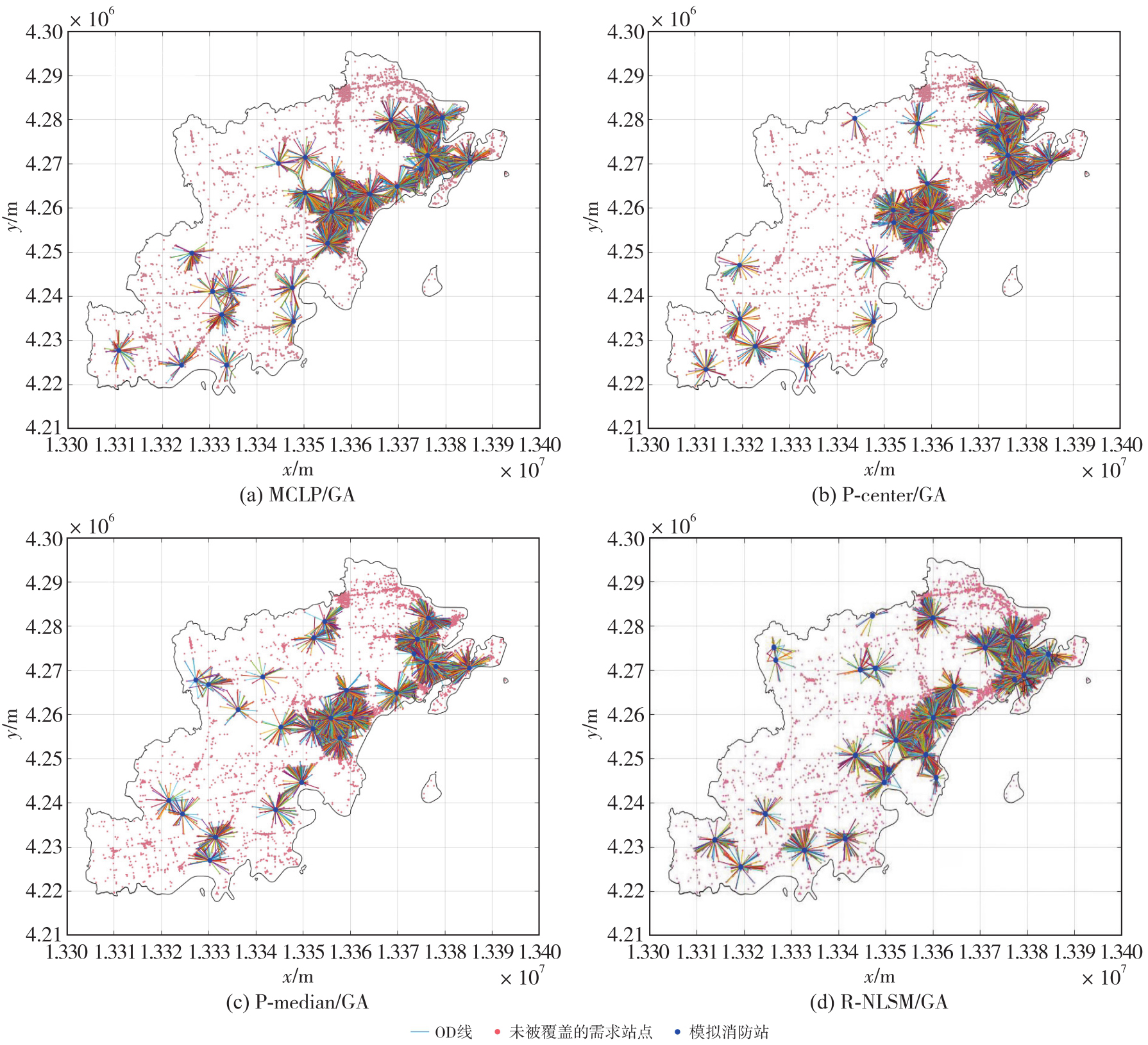
表6
消防站响应覆盖率"
| 风险等级 | 优化前覆盖率 | 优化后覆盖率(GA算法) | 优化后覆盖率(PSO算法) | ||||||
|---|---|---|---|---|---|---|---|---|---|
| E-LSM | E-NLSM | R-LSM | R-NLSM | E-LSM | E-NLSM | R-LSM | R-NLSM | ||
| A | 84.55 | 100.00 | 100.00 | 100.00 | 100.00 | 100.00 | 100.00 | 100.00 | 100.00 |
| B | 82.02 | 79.72 | 80.14 | 87.83 | 92.23 | 83.71 | 91.62 | 87.63 | 90.42 |
| C | 32.25 | 55.40 | 60.98 | 49.69 | 61.21 | 58.74 | 57.20 | 62.61 | 59.56 |
| 所有 | 66.44 | 73.97 | 76.00 | 76.90 | 83.13 | 77.37 | 81.49 | 80.89 | 81.55 |
图7
4种模型优化后消防站的响应覆盖对比"

图8
两种算法求解的不同风险等级需求点的覆盖对比"
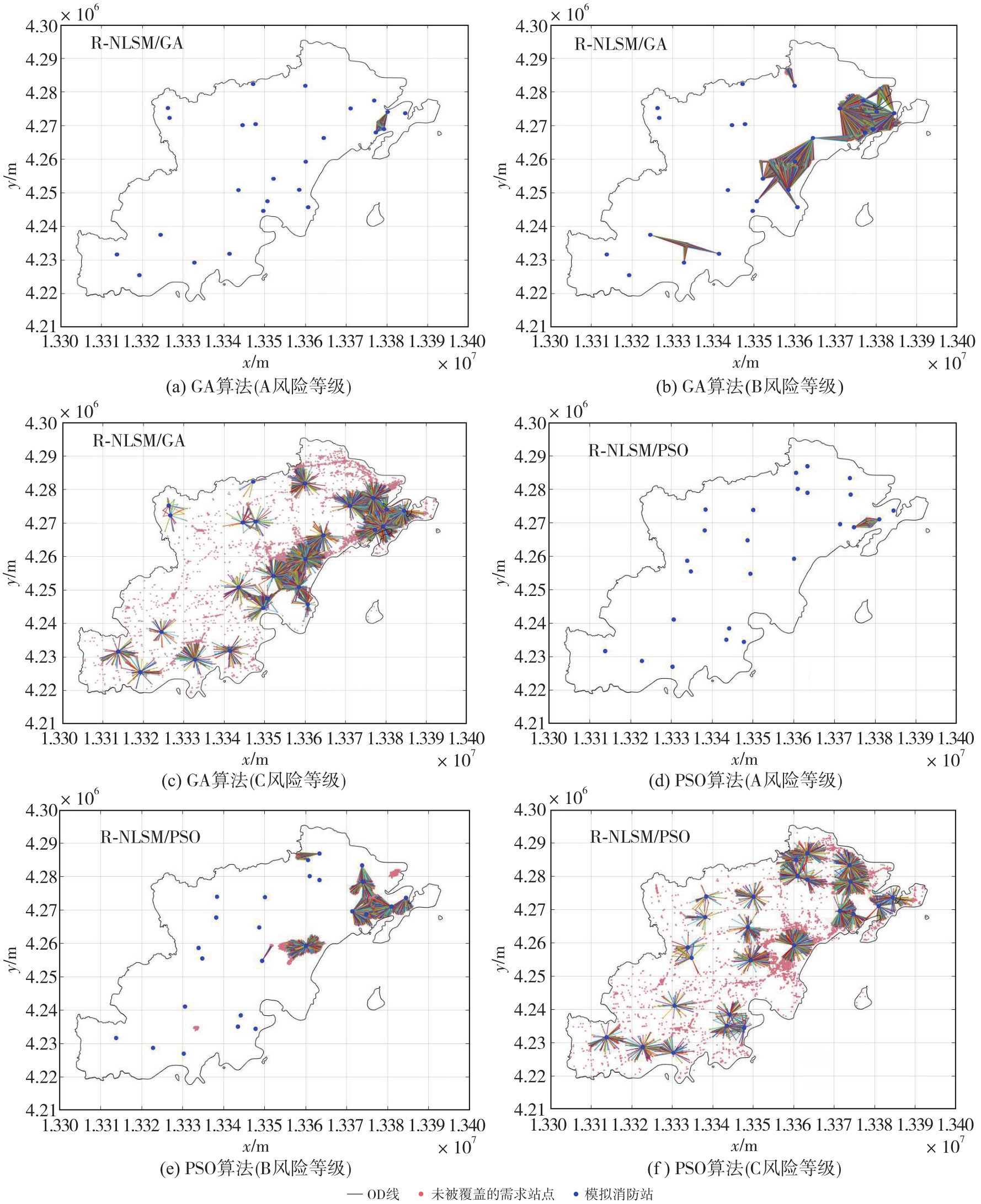
表7
两种算法求解时间对比"
| 模型 | GA算法 | PSO算法 |
|---|---|---|
| E-LSM | 48.67 | 77.58 |
| E-NLSM | 46.67 | 76.24 |
| R-LSM | 45.02 | 70.90 |
| R-NLSM | 42.90 | 70.41 |
| [1] | 马小林, 昌伟伟. 基于事故致因链的天津港“8.12”火灾爆炸事故分析[J]. 安全, 2022, 43(5): 56-61. |
| Ma Xiaolin, Chang Weiwei. Analysis on Tianjin Port “8.12” fire and explosion accident based on accident causation chains[J]. Safety & Security, 2022, 43(5): 56-61. | |
| [2] | 太原冰雕馆“10•1”重大火灾事故51人被追责[J]. 中国消防, 2021(10): 39. |
| 51 people held accountable for the major fire accident at Taiyuan Ice Sculpture Hall on October 1[J]. China Fire Protection, 2021 (10): 39. | |
| [3] | 肖方. 强化责任担当抓好贯彻落实坚决遏制重特大火灾事故切实维护人民群众生命财产安全[J]. 中国消防, 2022(2): 7-9. |
| Xiao Fang. Strengthen responsibility and commitment, implement thoroughly, resolutely curb major and extraordinarily serious fire accidents, and effectively safeguard the safety of people's lives and property[J]. China Fire, 2022(2): 7-9. | |
| [4] | Ma Chengye, Song Mingxing, Zeng Weitao, et al. Enhancing urban emergency response: a Euclidean distance-based framework for optimizing rescue facility layouts[J]. Sustainable Cities and Society, 2025, 118: 106006. |
| [5] | Chen Yulong, Yao Jing, Wang Shaohua, et al. Location optimization of urban fire stations considering the variations in fire service demands: a bi-objective coverage model[J]. International Journal of Digital Earth, 2025, 18(1): 2454386. |
| [6] | Zhu Jingjing, Xu Xiangdong, Yang Xin. Spatial accessibility measurement of urban fire stations considering multi-path characteristic of road networks[J]. Journal of Transport Geography, 2025, 126: 104248. |
| [7] | 徐志标, 萧颖莹. 基于火灾风险评估的城市消防设施选址优化研究——以广东省高州市中心城区为例[J]. 上海城市规划, 2020(6): 117-123. |
| Xu Zhibiao, Xiao Yingying. Location optimization of urban fire facilities based on fire risk assessment: a case study of urban center in Gaozhou, Guangdong[J]. Shanghai Urban Planning Review, 2020(6): 117-123. | |
| [8] | He Qize, Xue Lin, Yang Yun, et al. Research on Chinese fire station optimal location model based on fire risk statistics: case study in Shanghai[J]. Applied Sciences, 2024, 14(5): 2052. |
| [9] | 裴冬梅. 基于模糊隶属度函数的消防设施布局多目标优化及求解[D]. 青岛: 山东科技大学, 2023: 1-77. |
| Pei Dongmei. Multi-objective optimization and solution of fire facilities layout based on fuzzy membership function[D]. Qingdao: Shandong University of Science and Technology, 2023: 1-77. | |
| [10] | Drezner Z, Brimberg J, Schöbel A. Dispersed starting solutions in facility location: the case of the planar P-median problem[J]. Computers & Operations Research, 2024, 169: 106726. |
| [11] | Zhang Yao, Wang Shaohua, Liang Haojian, et al. Dual hybrid frameworks combining graph convolutional network with decoding for covering location problem[J]. iScience, 2024, 27(5): 109803. |
| [12] | Ma Xiaoya, Zhang Xiaoyu, Zhao Xiang. Service coverage optimization for facility location: considering line-of-sight coverage in continuous demand space[J]. International Journal of Geographical Information Science, 2023, 37(7): 1496-1519. |
| [13] | Mu Wangshu, Li Changfeng. Optimization of urban greenway route using a coverage maximization model for lines[J]. Computers, Environment and Urban Systems, 2024, 112: 102155. |
| [14] | 刘勇, 刘宇轩, 马良. 基于算子学习的多目标深度强化学习模型求解消防设施选址问题[J]. 计算机应用研究, 2025, 42(2): 477-485. |
| Liu Yong, Liu Yuxuan, Ma Liang. Multi-objective deep reinforcement learning model based on operator learning for solving fire facility location problems[J]. Application Research of Computers, 2025, 42(2): 477-485. | |
| [15] | 尚春剑, 宁爱兵, 彭大江, 等. P-中心选址问题的一种降阶回溯算法[J]. 计算机应用研究, 2021, 38(03): 734-737. |
| Shang Chunjian, Ning Aibing, Peng Dajiang, et al. Backtracking algorithm with reduction for P-center location problem[J]. Application Research of Computers, 2021, 38(3): 734-737, 769. | |
| [16] | Yao Jing, Zhang Xiaoxiang, Murray A T. Location optimization of urban fire stations: access and service coverage[J]. Computers, Environment and Urban Systems, 2019, 73: 184-190. |
| [17] | Chen Mengmeng, Wang Kai, Yuan Yingfeng, et al. A POIs based method for location optimization of urban fire station: a case study in Zhengzhou city[J]. Fire, 2023, 6(2): 58. |
| [18] | 谢小川, 许建梅, 黎明. 基于海象算法的模糊多目标高校校区微型消防站选址优化[J]. 四川大学学报(自然科学版), 2025, 62(6): 1385-1398. |
| Xie Xiaochuan, Xu Jianmei, Li Ming. Fuzzy multi-objective optimization for micro fire station location on university campuses using the walrus algorithm[J]. Journal of Sichuan University (Natural Science Edition), 2025, 62(6): 1385-1398. | |
| [19] | Han Bing, Hu Mingxing, Zheng Jiemin, et al. Site selection of fire stations in large cities based on actual spatiotemporal demands: a case study of Nanjing city[J]. ISPRS International Journal of Geo-Information, 2021, 10(8): 542. |
| [20] | 王雅荣, 赵海鹏, 周慰涛, 等. 整合多因素影响的城市消防站布局优化实践[J]. 消防科学与技术, 2024, 43(4): 551-556. |
| Wang Yarong, Zhao Haipeng, Zhou Weitao, et al. Practice of optimizing the layout of urban fire stations by integrating multiple factors[J]. Fire Science and Technology, 2024, 43(4): 551-556. | |
| [21] | 陈振, 王伟贤, 李卓群, 等. 基于多因子约束P中值模型的充电桩布局优化研究[J]. 北京交通大学学报, 2021, 45(3): 93-99. |
| Chen Zhen, Wang Weixian, Li Zhuoqun, et al. Study on optimization of charging pile layout based on multi-factor constrained P-median model[J]. Journal of Beijing Jiaotong University, 2021, 45(3): 93-99. | |
| [22] | Jiang Yuncheng, Lü Aifeng, Yan Zhigang, et al. A GIS-based multi-criterion decision-making method to select city fire brigade: a case study of Wuhan, China[J]. ISPRS International Journal of Geo-Information, 2021, 10(11): 777. |
| [23] | 于志金, 徐澜, 陈霜霜, 等. 基于模型交点法的城市消防站布局规划[J]. 中国安全科学学报, 2022, 32(10): 178-185. |
| Yu Zhijin, Xu Lan, Chen Shuangshuang, et al. Research on urban fire station layout planning based on model intersection method[J]. China Safety Science Journal, 2022, 32(10): 178-185. | |
| [24] | Shahparvari S, Fadaki M, Chhetri P. Spatial accessibility of fire stations for enhancing operational response in Melbourne[J]. Fire Safety Journal, 2020, 117: 103149. |
| [25] | Levin M S. P-center problem[J]. Journal of Communications Technology and Electronics, 2025, 70(7): 360-387. |
| [26] | Nyimbili P H, Erden T. GIS-based fuzzy multi-criteria approach for optimal site selection of fire stations in Istanbul, Turkey[J]. Socio-Economic Planning Sciences, 2020, 71: 100860. |
| [27] | Yu Wenhao, Chen Yujie, Guan Menglin. Hierarchical siting of macro fire station and micro fire station[J]. Environment and Planning B: Urban Analytics and City Science, 2021, 48(7): 1972-1988. |
| [28] | He Junjie, Guan Xin, Lu Houjun, et al. Research on multi-objective hierarchical site selection coverage of fire station[J]. PLoS One, 2024, 19(12): e0309731. |
| [29] | Zuo Chenyu, Xu Yifan, Ding Lingfang, et al. ST-Map: an interactive map for discovering spatial and temporal patterns in bibliographic data[J]. Journal of Geodesy and Geoinformation Science, 2024, 7(1): 3-15. |
| [1] | 郭庆华, 杨泽坤, 齐志勇, 张艺轩, 程芷信, 刘康, 程凯, 陈昂, 杨璐忆. 测绘地理信息驱动低空经济:关键技术突破与产业发展[J]. 测绘学报, 2026, 55(6): 975-989. |
| [2] | 韩冰. 基于多源数据的急救需求时空特征及院前急救设施布局研究——以南京市为例[J]. 测绘学报, 2026, 55(6): 1131-1131. |
| [3] | 时满星. 中国中部地区公里尺度雷暴时数影响因素与建模研究[J]. 测绘学报, 2026, 55(6): 1133-1133. |
| [4] | 刘万增, 陈军, 章炜. 论地理信息保密的技术逻辑[J]. 测绘学报, 2026, 55(5): 826-837. |
| [5] | 周旭升, 谭永滨, 于忠海, 王维, 肖青云. 融合矢量结构特征的复杂建筑物形状识别方法[J]. 测绘学报, 2026, 55(5): 838-849. |
| [6] | 张亚. 联合POI语义和空间形态特征的城市建筑物功能分类方法研究[J]. 测绘学报, 2026, 55(5): 948-948. |
| [7] | 吴明光, 成梓铭. 顾及使用场景的绿色地图颜色生成方法研究[J]. 测绘学报, 2026, 55(3): 390-403. |
| [8] | 杨敏, 马宏然, 孔博, 刘鹏程, 艾廷华. 基于预训练模型的矢量海岸线形态模式判别方法[J]. 测绘学报, 2026, 55(3): 404-414. |
| [9] | 禹文豪, 曾子怡, 张一帆, 钱海忠. 融合欧氏空间邻近与拓扑邻接信息预训练模型的路网网格模式[J]. 测绘学报, 2026, 55(3): 415-424. |
| [10] | 禄小敏, 张志义, 闫浩文, 何毅, 苏小宁. 融合深度图信息最大化和多层感知机的建筑物群组模式识别方法[J]. 测绘学报, 2026, 55(3): 425-438. |
| [11] | 成晓强, 赵家威, 刘鹏程. 基于距离-相似性隐喻的空间交互可视化[J]. 测绘学报, 2026, 55(3): 536-547. |
| [12] | 王泽矫, 向隆刚, 王猛, 王兴娟, 刘清. 融合层级特征与多样化注意力的道路面与中心线协同提取网络[J]. 测绘学报, 2026, 55(3): 548-563. |
| [13] | 徐智邦. 实体城市的多层次边界识别、模式分析与扩张模拟[J]. 测绘学报, 2026, 55(3): 566-566. |
| [14] | 冉耘博, 杨雪, 周文豪, 吴承恩, 周宝定, 唐炉亮, 李清泉. 多维偏好增强型对抗深度强化学习驱动的行人路径规划[J]. 测绘学报, 2026, 55(2): 191-205. |
| [15] | 王立增, 程诗奋, 杨一涛, 王培晓, 陆锋. 局部-全局联合感知的时空自适应交通集成预测方法[J]. 测绘学报, 2026, 55(2): 206-221. |
| 阅读次数 | ||||||
|
全文 |
|
|||||
|
摘要 |
|
|||||
