


测绘学报 ›› 2026, Vol. 55 ›› Issue (8): 1465-1481.doi: 10.11947/j.AGCS.2026.20250471
• 地图学与地理信息 • 上一篇
刘万增1,2( ), 陈军1,2,3, 任加新3,4(), 张丰4, 黄丽娜5, 王新鹏1,2, 张晔1,2, 梁福逊6, 刘晓瑜7
收稿日期:2025-11-10
修回日期:2026-08-15
发布日期:2026-09-09
通讯作者:
任加新
E-mail:luwnzg@163.com;jaycecd@foxmail.com
作者简介:刘万增(1970—),男,博士,正高级工程师,研究方向为地理信息安全和智能化测绘。E-mail:luwnzg@163.com
基金资助:
Wanzeng Liu1,2(), Jun Chen1,2,3, Jiaxin Ren3,4(), Feng Zhang4, Lina Huang5, Xinpeng Wang1,2, Ye Zhang1,2, Fuxun Liang6, Xiaoyu Liu7
Received:2025-11-10
Revised:2026-08-15
Published:2026-09-09
Contact:
Jiaxin Ren
E-mail:luwnzg@163.com;jaycecd@foxmail.com
About author:Liu Wanzeng (1970—), male, PhD, professor level senior engineer, majors in geographic information security and intelligentized surveying and mapping. E-mail: luwnzg@163.com
Supported by:摘要:
针对地球科学领域“数据海量、信息爆炸、知识难求”的突出矛盾,现有以几何计算和状态识别为主的空间分析方法难以充分刻画时空场景的多维动态特征,因而在实际应用中仍面临关键目标“找不到”、演化过程“认不透”和功能效应“判不准”等问题。本文将时空场景视为具有明确地理语义、内部结构和演化规律的复杂动态系统,探讨时空场景认知的基本内涵与计算路径。在此基础上,融合心理学认知机理、领域知识与人工智能算法,构建以“要素识别—关系计算—结构推理—功能判断”为主线的混合智能认知链。以此为基础,提出大场景高效预判、小场景动态诊断、实景化精准核验等多维度认知方法。最后,以私挖乱采动态场景认知为例,说明了混合智能在实际业务场景中的应用路径与可行性。
中图分类号:
刘万增, 陈军, 任加新, 张丰, 黄丽娜, 王新鹏, 张晔, 梁福逊, 刘晓瑜. 时空场景认知的研究方向与核心任务[J]. 测绘学报, 2026, 55(8): 1465-1481.
Wanzeng Liu, Jun Chen, Jiaxin Ren, Feng Zhang, Lina Huang, Xinpeng Wang, Ye Zhang, Fuxun Liang, Xiaoyu Liu. Research directions and core tasks for cognitive understanding of spatio-temporal scenes[J]. Acta Geodaetica et Cartographica Sinica, 2026, 55(8): 1465-1481.
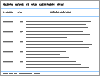
表1
传统空间分析与时空场景认知的区别"
| 比较维度 | 传统空间分析 | 时空场景认知 |
|---|---|---|
| 对象范围 | 地理要素、空间场、网络及其几何、属性和拓扑关系 | 具有明确地理语义、内部结构和演化规律的复杂动态系统,包括宏观遥感场景、动态视频场景和三维实景场景 |
| 基本构成 | 几何、属性、位置和拓扑 | 要素、状态、关系、结构和功能 |
| 输入数据 | 矢量、栅格、属性、统计及专题数据 | 遥感影像、视频、实景三维、专题数据、传感器数据及领域知识 |
| 认知过程 | 查询、量测、叠加、缓冲、网络分析和空间统计 | 场景感知、要素识别、关系计算、结构推理、功能判断 |
| 输出内容 | 几何量测结果、空间分布、统计指标及专题图 | 对象、关系、事件、行为、功能效应及演化规律等时空知识 |
| 服务对象 | 空间数据处理、专题分析及辅助决策 | 自然资源监管、城市治理、规划决策、应急响应及时空知识服务 |
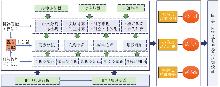
图1
时空场景认知计算思路"
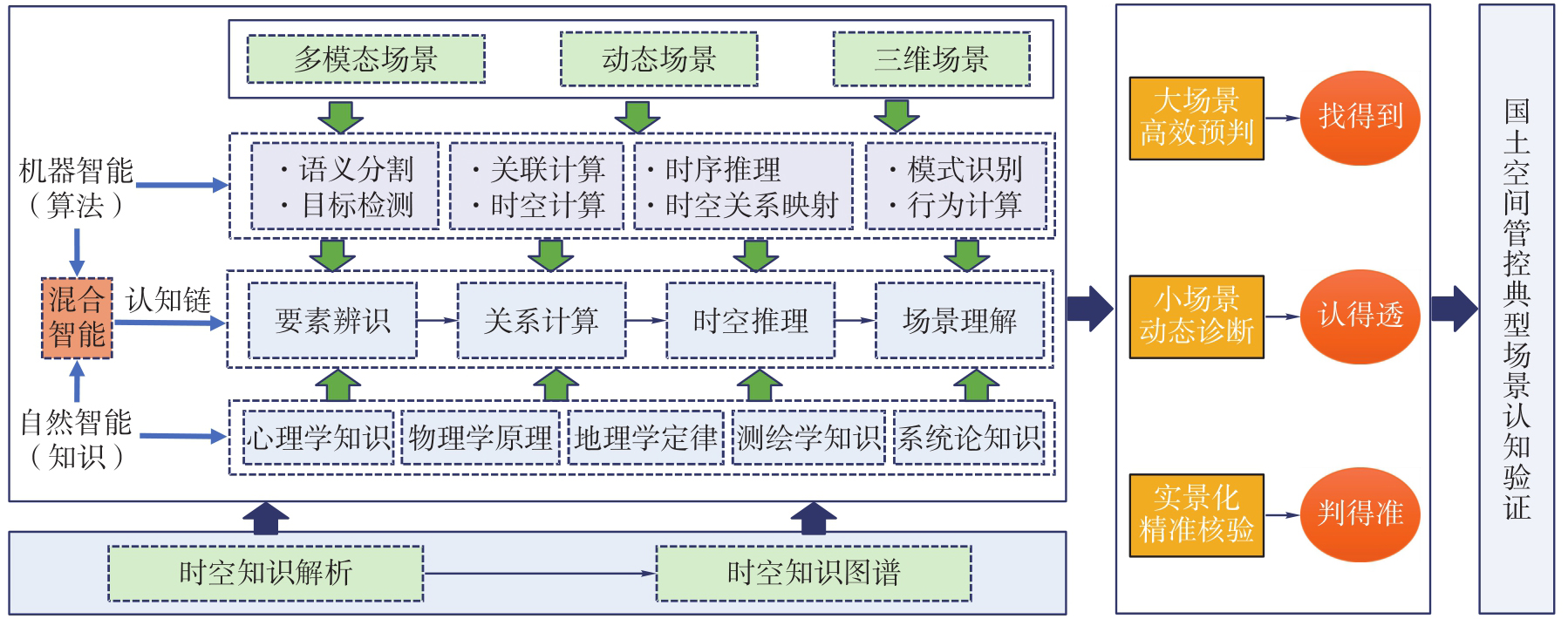
表2
心理学认知机制及其在时空场景认知中的计算映射"
| 心理学认知 | 可计算抽象 | 对应的模型实现及作用 |
|---|---|---|
| 知觉组织 | 相似性、邻近性、连续性和闭合性约束 | 构建要素关联权重、图邻接关系或结构一致性损失,支持局部要素聚合与整体结构识别 |
| 认知地图 | 对象、位置和关系构成的拓扑图式 | 将场景要素表示为节点,将空间、时间和语义关系表示为边,构建场景图或时空知识图谱 |
| 预测编码 | 先验预测与实际观测之间的误差修正 | 设置预测误差、时序一致性损失或异常分数,用于变化识别和动态场景诊断 |
| 注意选择 | 面向任务目标的信息选择与资源分配 | 通过注意力权重、显著性区域和目标门控机制突出关键要素及重要关系 |
| 记忆联想 | 历史经验、场景原型与当前信息的关联 | 通过记忆库、历史状态缓存和知识检索支持跨时态关联、案例匹配与推理决策 |
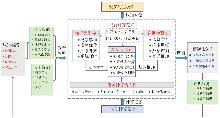
图2
时空场景认知计算技术架构"
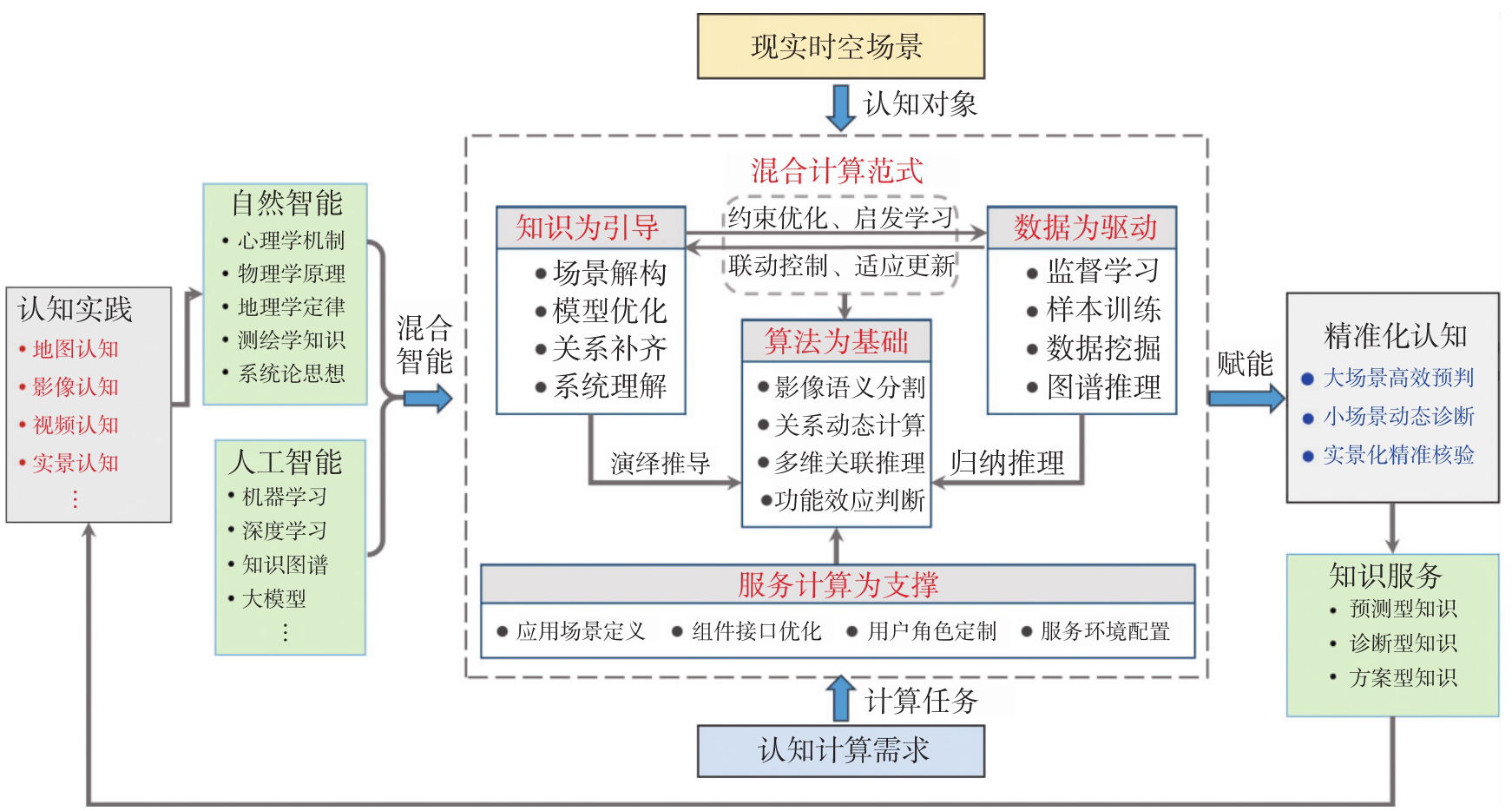
图3
时空场景认知计算模型"
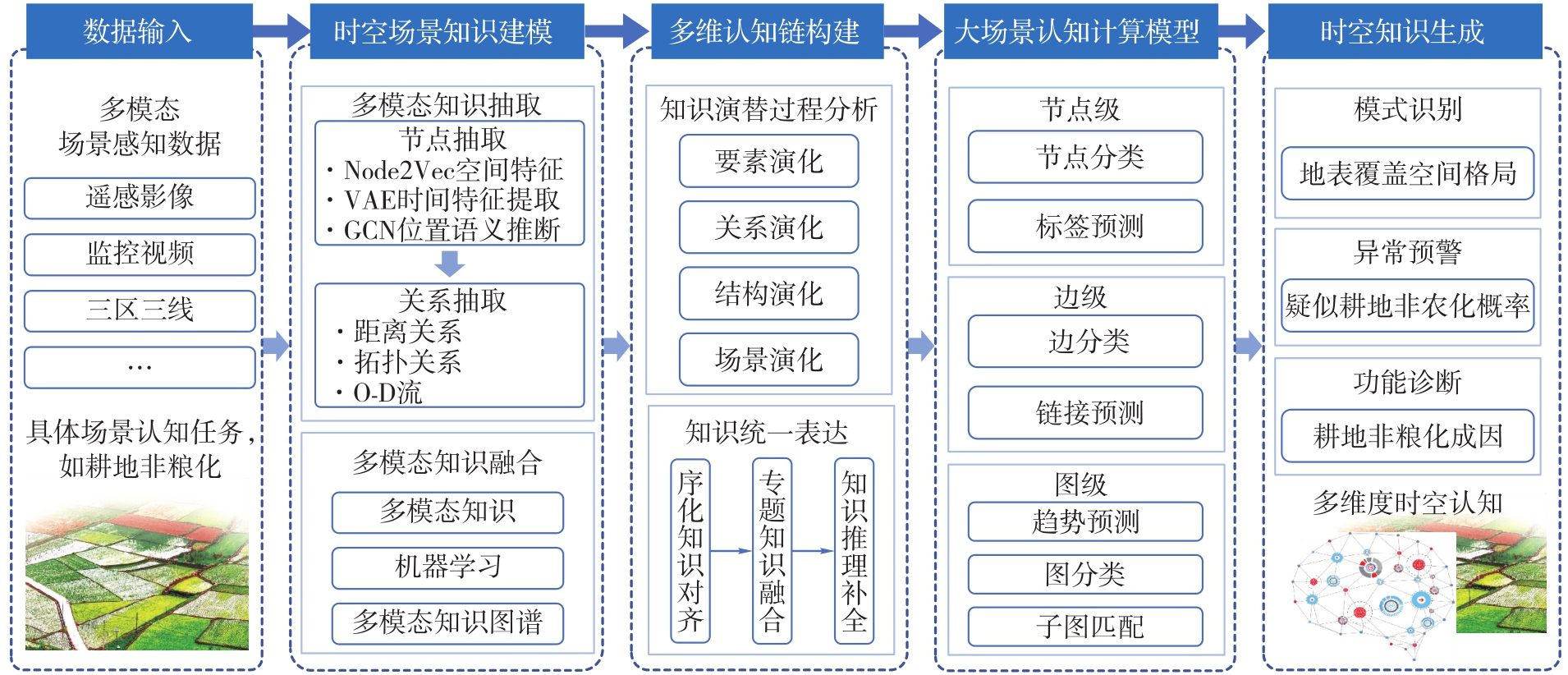
图4
动态时空场景认知计算"
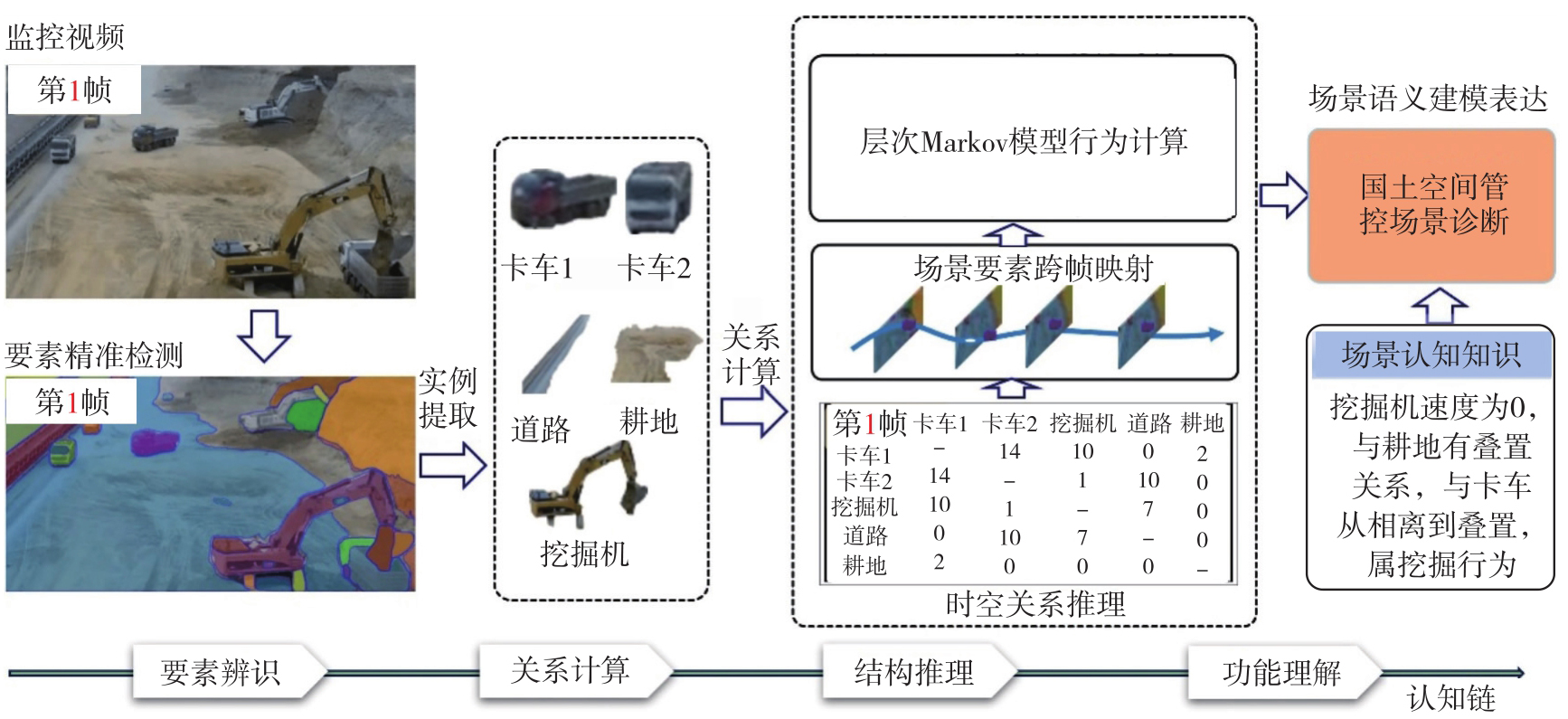
图5
三维时空场景认知计算"
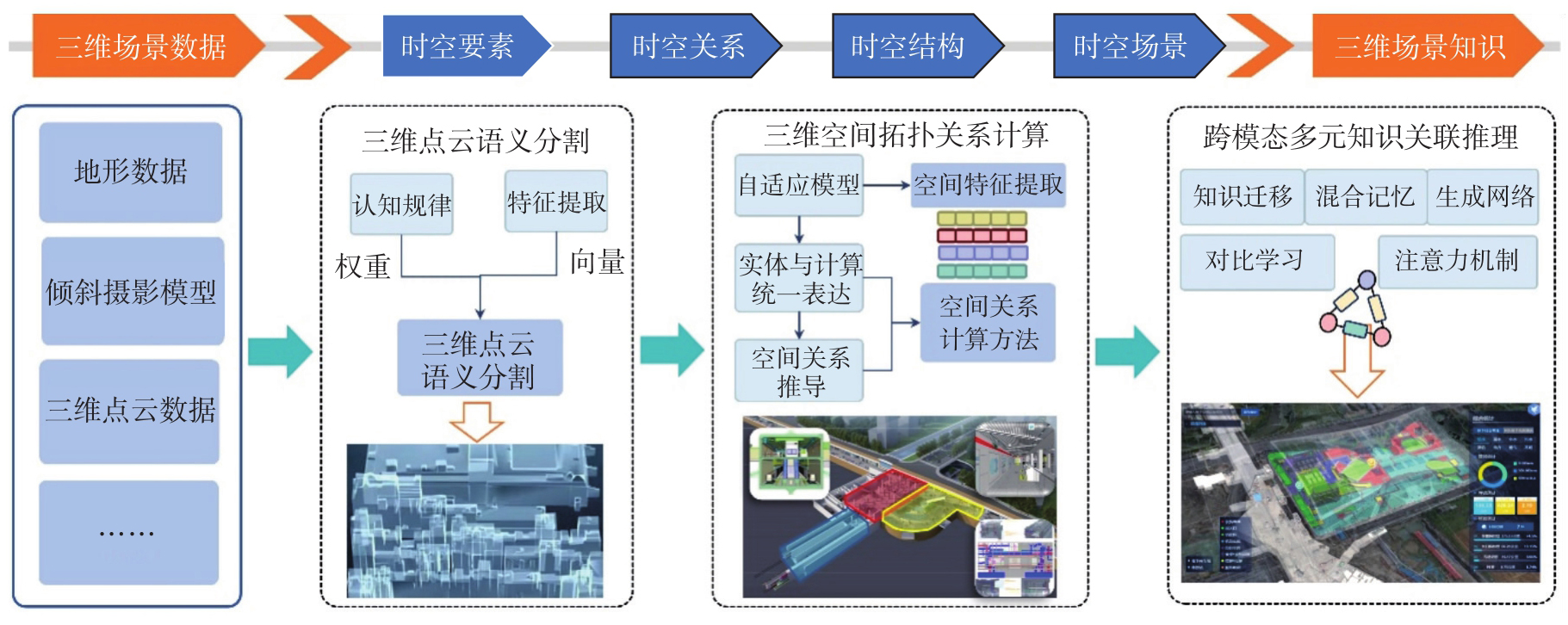
表3
不同模型在私挖乱采动态场景认知中的性能对比"
| 模型 | Precision | Recall | mAP@50 | mAP@50-95 |
|---|---|---|---|---|
| YOLOv5n | 82.65 | 85.10 | 91.15 | 75.55 |
| YOLOv6n | 86.15 | 81.56 | 90.08 | 76.30 |
| YOLOv8n | 81.76 | 86.98 | 90.44 | 75.70 |
| YOLOv9t | 81.31 | 84.86 | 90.02 | 75.92 |
| YOLOv10n | 80.47 | 82.58 | 89.16 | 74.50 |
| YOLO11n | 85.31 | 85.04 | 90.90 | 74.76 |
| RT-DETR | 77.11 | 81.85 | 82.07 | 69.13 |
| Mask RCNN | 87.55 | 88.47 | 92.91 | 74.51 |
| Mask2former | 84.69 | 85.47 | 86.88 | 74.25 |
| HIUFE | 88.17 | 88.69 | 94.47 | 78.66 |
| [1] | Lü Guonian, Chen Min, Yuan Linwang, et al. Geographic scenario: a possible foundation for further development of virtual geographic environments[J]. International Journal of Digital Earth, 2018, 11(4): 356-368. |
| [2] | 闾国年, 俞肇元, 袁林旺, 等. 地图学的未来是场景学吗?[J]. 地球信息科学学报, 2018, 20(1): 1-6. |
| Lü Guonian, Yu Zhaoyuan, Yuan Linwang, et al. Is the future of cartography the scenario science?[J]. Journal of Geo-information Science, 2018, 20(1): 1-6. | |
| [3] | Dey A K. Understanding and using context[J]. Personal and ubiquitous computing, 2001, 5(1): 4-7. |
| [4] | Warden T, Visser U. Real-time spatio-temporal analysis of dynamic scenes[J]. Knowledge and Information Systems, 2012, 32(2): 243-279. |
| [5] | Ren Jiaxin, Liu Wanzeng, Chen Jun, et al. HI4HC and AAAAD: exploring a hierarchical method and dataset using hybrid intelligence for remote sensing scene captioning[J]. International Journal of Applied Earth Observation and Geoinformation, 2025, 139: 104491. |
| [6] | Yin Shunxi, Liu Wanzeng, Chen Jun, et al. HIUFE: hybrid intelligence-based unauthorized farmland excavation scene cognition[J]. ISPRS Journal of Photogrammetry and Remote Sensing, 2025, 227: 276-296. |
| [7] |
陈军, 刘万增, 武昊, 等. 智能化测绘的基本问题与发展方向[J]. 测绘学报, 2021, 50(8): 995-1005. DOI: .
doi: 10.11947/j.AGCS.2021.20210235 |
|
Chen Jun, Liu Wanzeng, Wu Hao, et al. Smart surveying and mapping: fundamental issues and research agenda[J]. Acta Geodaetica et Cartographica Sinica, 2021, 50(8): 995-1005. DOI: .
doi: 10.11947/j.AGCS.2021.20210235 |
|
| [8] | 郑磊. 数字治理的效度、温度和尺度[J]. 治理研究, 2021, 37(2): 5-16. |
| Zheng Lei. The validity, temperature and scale of digital governance[J]. Governance Studies, 2021, 37(2): 5-16. | |
| [9] | 刘万增, 陈军. 时空信息的基本内涵与赋能机理[J]. 地理学报, 2024, 79(5): 1099-1114. |
| Liu Wanzeng, Chen Jun. The basic connotation and empowerment mechanism of spatio-temporal information[J]. Acta Geographica Sinica, 2024, 79(5): 1099-1114. | |
| [10] | 陈军, 刘万增, 武昊, 等. 基础地理知识服务的基本问题与研究方向[J]. 武汉大学学报(信息科学版), 2019, 44(1): 38-47. |
| Chen Jun, Liu Wanzeng, Wu Hao, et al. Basic issues and research agenda of geospatial knowledge service[J]. Geomatics and Information Science of Wuhan University, 2019, 44(1): 38-47. | |
| [11] | 邓敏, 王达. 自然资源时空大数据挖掘与知识服务研究进展[J]. 地球信息科学学报, 2025, 27(1): 27-40. |
| Deng Min, Wang Da. Research progress in spatio-temporal big data mining and knowledge services for natural resources[J]. Journal of Geo-information Science, 2025, 27(1): 27-40. | |
| [12] | 刘万增, 陈军, 任加新, 等. 基于混合智能的地图自动审核技术框架[J]. 武汉大学学报(信息科学版), 2022, 47(12): 2038-2046. |
| Liu Wanzeng, Chen Jun, Ren Jiaxin, et al. Hybrid intelligence-based framework for automatic map inspecting technology[J]. Geomatics and Information Science of Wuhan University, 2022, 47(12): 2038-2046. | |
| [13] |
陈军, 艾廷华, 闫利, 等. 智能化测绘的混合计算范式与方法研究[J]. 测绘学报, 2024, 53(6): 985-998. DOI: .
doi: 10.11947/j.AGCS.2024.20240131 |
|
Chen Jun, Ai Tinghua, Yan Li, et al. Hybrid computational paradigm and methods for intelligentized surveying and mapping[J]. Acta Geodaetica et Cartographica Sinica, 2024, 53(6): 985-998. DOI: .
doi: 10.11947/j.AGCS.2024.20240131 |
|
| [14] |
任加新, 刘万增, 陈军, 等. 知识引导的碎片化栅格地形图比例尺智能识别[J]. 测绘学报, 2024, 53(1): 146-157. DOI: .
doi: 10.11947/j.AGCS.2024.20230005 |
|
Ren Jiaxin, Liu Wanzeng, Chen Jun, et al. Knowledge-guided intelligent recognition of the scale for fragmented raster topographic maps[J]. Acta Geodaetica et Cartographica Sinica, 2024, 53(1): 146-157. DOI: .
doi: 10.11947/j.AGCS.2024.20230005 |
|
| [15] | 黄龙. 一种快速挖掘互联网问题地图图片的方法[J]. 测绘与空间地理信息, 2017, 40(11): 92-93, 96. |
| Huang Long. Research on the method of fast mining Internet problem map picture[J]. Geomatics & Spatial Information Technology, 2017, 40(11): 92-93, 96. | |
| [16] | Ren Jiaxin, Liu Wanzeng, Chen Jun, et al. SAFE: sensitive annotation finding and extraction from multi-type Chinese maps via hybrid intelligence and knowledge graph[J]. Geo-spatial Information Science, 2026: 1-26. |
| [17] | 任加新, 刘万增, 陈军, 等. 问题地图自动识别的关键问题与应对策略[J]. 时空信息学报, 2025, 32(6): 606-619. |
| Ren Jiaxin, Liu Wanzeng, Chen Jun, et al. Key challenges and countermeasures for automated recognition of problematic maps[J]. Journal of Spatio-Temporal Information, 2025, 32(6): 606-619. | |
| [18] |
刘万增, 陈军, 章炜. 论地理信息保密的技术逻辑[J]. 测绘学报, 2026, 55(5): 826-837. DOI: .
doi: 10.11947/j.AGCS.2026.20250540 |
|
Liu Wanzeng, Chen Jun, Zhang Wei. On the technical logic of geographic information confidentiality[J]. Acta Geodaetica et Cartographica Sinica, 2026, 55(5): 826-837. DOI: .
doi: 10.11947/j.AGCS.2026.20250540 |
|
| [19] | 陈军, 武昊, 张继贤, 等. 自然资源调查监测技术体系构建的方向与任务[J]. 地理学报, 2022, 77(5): 1041-1055. |
| Chen Jun, Wu Hao, Zhang Jixian, et al. Building natural resources surveying and monitoring technological system: direction and research agenda[J]. Acta Geographica Sinica, 2022, 77(5): 1041-1055. | |
| [20] |
陈军, 武昊, 刘万增, 等. 自然资源时空信息的技术内涵与研究方向[J]. 测绘学报, 2022, 51(7): 1130-1140. DOI: .
doi: 10.11947/j.AGCS.2022.20210643 |
|
Chen Jun, Wu Hao, Liu Wanzeng, et al. Technical connotation and research agenda of natural resources spatio-temporal information[J]. Acta Geodaetica et Cartographica Sinica, 2022, 51(7): 1130-1140. DOI: .
doi: 10.11947/j.AGCS.2022.20210643 |
|
| [21] | Tolman E C. Cognitive maps in rats and men[J]. Psychological Review, 1948, 55(4): 189-208. |
| [22] | O'Keefe J, Dostrovsky J. The hippocampus as a spatial map: preliminary evidence from unit activity in the freely-moving rat[J]. Brain Research, 1971, 34(1): 171-175. |
| [23] | Moser E I, Moser M B, McNaughton B L. Spatial representation in the hippocampal formation: a history[J]. Nature Neuroscience, 2017, 20(11): 1448-1464. |
| [24] | Rueckemann J W, Sosa M, Giocomo L M, et al. The grid code for ordered experience[J]. Nature Reviews Neuroscience, 2021, 22(10): 637-649. |
| [25] | Bowler J C, Losonczy A. Direct cortical inputs to hippocampal area CA1 transmit complementary signals for goal-directed navigation[J]. Neuron, 2023, 111(24): 4071-4085. |
| [26] | Wang Rubin, Wang Yihong, Xu Xuying, et al. Brain works principle followed by neural information processing: a review of novel brain theory[J]. Artificial Intelligence Review, 2023, 56(1): 285-350. |
| [27] | Chen D, Axmacher N, Wang L. Grid codes underlie multiple cognitive maps in the human brain[J]. Progress in Neurobiology, 2024, 233: 102569. |
| [28] | Dong L L, Fiete I R. Grid cells in cognition: mechanisms and function[J]. Annual Review of Neuroscience, 2024, 47: 345-368. |
| [29] | Hermansen E, Klindt D A, Dunn B A. Uncovering 2-D toroidal representations in grid cell ensemble activity during 1-D behavior[J]. Nature Communications, 2024, 15: 5429. |
| [30] | Nguyen D, Wang G, Wafa T, et al. The medial entorhinal cortex encodes multisensory spatial information[J]. Cell Reports, 2024, 43(10): 114813. |
| [31] | Wang C, Lee H, Rao G, et al. Multiplexing of temporal and spatial information in the lateral entorhinal cortex[J]. Nature Communications, 2024, 15: 10533. |
| [32] | Wen J H, Sorscher B, Jones E A, et al. One-shot entorhinal maps enable flexible navigation in novel environments[J]. Nature, 2024, 635(8040): 943-950. |
| [33] | Khona M, Chandra S, Fiete I. Global modules robustly emerge from local interactions and smooth gradients[J]. Nature, 2025, 640(8057): 155-164. |
| [34] | Whittington J C R, McCaffary D, Bakermans J J W, et al. How to build a cognitive map[J]. Nature Neuroscience, 2022, 25(10): 1257-1272. |
| [35] | Bai Qianqian, Chen Zhongpu, Luo Ling, et al. Endowing embodied agents with spatial reasoning capabilities for vision-and-language navigation[PP/OL]. V2. arXiv (2026-03-02) [2026-04-15]. https://doi.org/10.48550/arXiv.2504.08806. |
| [36] | Giuliari F. Spatial reasoning with graph neural networks[D]. Genoa: University of Genoa, 2024. |
| [37] | Gornet J, Thomson M. Automated construction of cognitive maps with visual predictive coding[J]. Nature Machine Intelligence, 2024, 6(7): 820-833. |
| [38] | Momennejad I. Memory, space, and planning: multiscale predictive representations[PP/OL]. V2. arXiv (2024-02-19) [2026-04-15]. https://doi.org/10.48550/arXiv.2401.09491. |
| [39] | Tao Yuan, Liu Wanzeng, Chen Jun, et al. A self-supervised learning approach for extracting China physical urban boundaries based on multi-source data[J]. Remote Sensing, 2023, 15(12): 3189. |
| [40] | Zhang Y, Liu P, Biljecki F. Knowledge and topology: a two layer spatially dependent graph neural networks to identify urban functions with time-series street view image[J]. ISPRS Journal of Photogrammetry and Remote Sensing, 2023, 198: 153-168. |
| [41] |
刘春, 贾守军, 吴杭彬, 等. 点云场景认知模式:泛化点云[J]. 测绘学报, 2022, 51(4): 556-567. DOI: .
doi: 10.11947/j.AGCS.2022.20220019 |
|
Liu Chun, Jia Shoujun, Wu Hangbin, et al. Scene cognition pattern of point cloud-generalization point cloud[J]. Acta Geodaetica et Cartographica Sinica, 2022, 51(4): 556-567. DOI: .
doi: 10.11947/j.AGCS.2022.20220019 |
|
| [42] | 郭舟, 杜世宏, 张方利. 基于高分辨率遥感影像的城市建设区提取[J]. 北京大学学报(自然科学版), 2013, 49(4): 635-642. |
| Guo Zhou, Du Shihong, Zhang Fangli. Extracting municipal construction zones from high-resolution remotely sensed image[J]. Acta Scientiarum Naturalium Universitatis Pekinensis, 2013, 49(4): 635-642. | |
| [43] | Torres R N, Fraternali P. Learning to identify illegal landfills through scene classification in aerial images[J]. Remote Sensing, 2021, 13(22): 4520. |
| [44] | Chen Yuting, Zhao Pengjun, Lin Yi, et al. Semantic-enhanced graph convolutional neural networks for multi-scale urban functional-feature identification based on human mobility[J]. ISPRS International Journal of Geo-Information, 2024, 13(1): 27. |
| [45] | Lü Qingzhou, Liu Wanzeng, Li Ran, et al. Classification of seismaesthesia information and seismic intensity assessment by multi-model coupling[J]. ISPRS International Journal of Geo-Information, 2023, 12(2): 46. |
| [46] | 任加新. 基于卷积神经网络的多尺度特征融合自适应智能“问题地图”识别[D]. 成都: 西南交通大学, 2019. |
| Ren Jiaxin. Adaptive intelligent recognition of“problematic map”based on multi-scale feature fusion and convolutional neural network[D]. Chengdu: Southwest Jiaotong University, 2019. | |
| [47] | 任加新, 刘万增, 李志林, 等. 利用卷积神经网络进行“问题地图”智能检测[J]. 武汉大学学报(信息科学版), 2021, 46(4): 570-577. |
| Ren Jiaxin, Liu Wanzeng, Li Zhilin, et al. Intelligent detection of“problematic map”using convolutional neural network[J]. Geomatics and Information Science of Wuhan University, 2021, 46(4): 570-577. | |
| [48] | Xiong Shuping, Zhang Xiuyuan, Wang Haoyu, et al. Mapping the first dataset of global urban land uses with Sentinel-2 imagery and POI prompt[J]. Remote Sensing of Environment, 2025, 327: 114824. |
| [49] | Tao Yuan, Liu Wanzeng, Chen Jun, et al. A graph-based multimodal data fusion framework for identifying urban functional zone[J]. International Journal of Applied Earth Observation and Geoinformation, 2025, 136: 104353. |
| [50] | Xu Yongyang, Zhou Bo, Jin Shuai, et al. A framework for urban land use classification by integrating the spatial context of points of interest and graph convolutional neural network method[J]. Computers, Environment and Urban Systems, 2022, 95: 101807. |
| [51] | OpenAI, Achiam J, Adler S, et al. GPT-4 technical report[PP/OL]. V6. arXiv (2024-03-04) [2026-04-15]. https://doi.org/10.48550/arXiv.2303.08774. |
| [52] | Devlin J, Chang M, Lee K, et al. BERT: pre-training of deep bidirectional transformers for language understanding[C]//Proceedings of 2019 Conference of the North American Chapter of the Association for Computational Linguistics: Human Language Technologies. Minneapolis: Minnesota Association for Computational Linguistics, 2019: 4171-4186. |
| [53] | Alayrac J, Donahue J, Luc P, et al. Flamingo: a visual language model for few-shot learning[J]. Advances in neural information processing systems, 2022, 35: 23716-23736. |
| [54] | Kirillov A, Mintun E, Ravi N, et al. Segment anything[C]//Proceedings of 2023 IEEE/CVF International Conference on Computer Vision. Paris: IEEE, 2023: 3992-4003. |
| [55] | Ravi N, Gabeur V, Hu Y, et al. SAM 2: segment anything in images and videos[PP/OL]. V2. arXiv (2024-10-28) [2026-04-15]. https://doi.org/10.48550/arXiv.2408.00714. |
| [56] | Chen Keyan, Liu Chenyang, Chen Hao, et al. RSPrompter: learning to prompt for remote sensing instance segmentation based on visual foundation model[PP/OL]. V2. arXiv (2023-11-29) [2026-04-15]. https://doi.org/10.48550/arXiv.2306.16269. |
| [57] | Ren Jiaxin, Liu Wanzeng, Chen Jun, et al. Word2Scene: efficient remote sensing image scene generation with only one word via hybrid intelligence and low-rank representation[J]. ISPRS Journal of Photogrammetry and Remote Sensing, 2024, 218: 231-257. |
| [58] |
刘万增, 陈杭, 任加新, 等. 基于混合智能的街景影像知识提取方法[J]. 测绘学报, 2024, 53(9): 1817-1828. DOI: .
doi: 10.11947/j.AGCS.2024.20220720 |
|
Liu Wanzeng, Chen Hang, Ren Jiaxin, et al. Research on knowledge extraction from street scene images based on hybrid intelligence[J]. Acta Geodaetica et Cartographica Sinica, 2024, 53(9): 1817-1828. DOI: .
doi: 10.11947/j.AGCS.2024.20220720 |
|
| [59] | Ren Jiaxin, Liu Wanzeng, Chen Jun, et al. HI-CMAIM: hybrid intelligence-based multi-source unstructured Chinese map annotation interpretation model[J]. Remote Sensing, 2025, 17(2): 204. |
| [60] | 武寒波. 基于深度学习的视频人体行为识别算法研究[D]. 济南: 山东大学, 2022. |
| Wu Hanbo. Human action recognition in videos with deep learning[D]. Jinan: Shandong University, 2022. | |
| [61] | Wang Cailing, Yan Jingjing. A comprehensive survey of RGB-based and skeleton-based human action recognition[J]. IEEE Access, 2023, 11: 53880-53898. |
| [62] | Nguyen H C, Nguyen T H, Scherer R, et al. Deep learning for human activity recognition on 3D human skeleton: survey and comparative study[J]. Sensors, 2023, 23(11): 5121. |
| [63] | Lovanshi M, Tiwari V. Human skeleton pose and spatio-temporal feature-based activity recognition using ST-GCN[J]. Multimedia Tools and Applications, 2024, 83(5): 12705-12730. |
| [64] | Shafizadegan F, Naghsh-Nilchi A R, Shabaninia E. Multimodal vision-based human action recognition using deep learning: a review[J]. Artificial Intelligence Review, 2024, 57(7): 178. |
| [65] | Wu Zhize, Sun Pengpeng, Chen Xin, et al. SelfGCN: graph convolution network with self-attention for skeleton-based action recognition[J]. IEEE Transactions on Image Processing, 2024, 33: 4391-4403. |
| [66] | Xing Yuling, Zhu Jia. Deep learning-based action recognition with 3D skeleton: a survey[J]. CAAI Transactions on Intelligence Technology, 2021, 6(1): 80-92. |
| [67] | Benmessabih T, Slama R, Havard V, et al. Online human motion analysis in industrial context: a review[J]. Engineering Applications of Artificial Intelligence, 2024, 131: 107850. |
| [68] | Ren Bin, Liu Mengyuan, Ding Runwei, et al. A survey on 3D skeleton-based action recognition using learning method[J]. Cyborg and Bionic Systems, 2024, 5: 100. |
| [69] | Wang Quanyu, Zhang Kaixiang, Asghar M A. Skeleton-based ST-GCN for human action recognition with extended skeleton graph and partitioning strategy[J]. IEEE Access, 2022, 10: 41403-41410. |
| [70] | Aote S S, Panpaliya S, Hedaoo N, et al. Object detection and trajectory prediction of unmanned aerial vehicle using deep learning[C]//Proceedings of 2024 Smart Trends in Computing and Communications. Singapore: Springer Nature Singapore, 2024: 225-235. |
| [71] | Rao M K, Ashok Kumar P M. Advanced object tracking in video surveillance systems with adaptive deep SORT enhancement[J]. Engineering, Technology & Applied Science Research, 2025, 15(2): 20871-20877. |
| [72] | Luo Xiaoyue, Wang Yanhui, Dong Junwu, et al. Complete trajectory extraction for moving targets in traffic scenes that considers multi-level semantic features[J]. International Journal of Geographical Information Science, 2023, 37(4): 913-937. |
| [73] | Yang Jiawei, Rahardja S, Fränti P. Mean-shift outlier detection and filtering[J]. Pattern Recognition, 2021, 115: 107874. |
| [74] | Wang Hong, Shao Wenbo, Sun Chen, et al. A survey on an emerging safety challenge for autonomous vehicles: safety of the intended functionality[J]. Engineering, 2024, 33: 17-34. |
| [75] | Nie Jisheng, Guo Xu. A target tracking method based on improved camshift algorithm[C]//Proceedings of 2020 IEEE 5th Information Technology and Mechatronics Engineering Conference (ITOEC). Chongqing: IEEE, 2020: 254-258. |
| [76] | Nayak V, Sonar B, Marali N, et al. Comparative analysis of neural trajectory prediction models for vehicle tracking[C]//Proceedings of the 5th International Conference on Recent Trends in Machine Learning, IoT, Smart Cities and Applications. Singapore: Springer Nature Singapore, 2025: 37-50. |
| [77] | Gil J P D A. Pedestrian tracking in image sequences with DeepSORT and YOLOv8: a comprehensive study and performance analysis[D]. Porto: University of Porto, 2024. |
| [78] | Zheng Binshuang, Zhou Jing, Hong Zhengqiang, et al. Vehicle recognition and driving information detection with UAV video based on improved YOLOv5-DeepSORT algorithm[J]. Sensors, 2025, 25(9): 2788. |
| [79] | Johnson J, Krishna R, Stark M, et al. Image retrieval using scene graphs[C]//Proceedings of 2015 IEEE Conference on Computer Vision and Pattern Recognition. Boston: IEEE, 2015: 3668-3678. |
| [80] | 张成华. 基于场景图的图像描述生成方法研究[D]. 大连: 大连理工大学, 2022. |
| Zhang Chenghua. Research on image captioning algorithm based on scene graphs[D]. Dalian: Dalian University of Technology, 2022. | |
| [81] | 李浩晨, 曹付元, 乔世昌. 基于自适应正则化的无偏场景图生成方法[J]. 计算机科学, 2023, 50(10): 104-111. |
| Li Haochen, Cao Fuyuan, Qiao Shichang. Unbiased scene graph generation based on adaptive regularization algorithm[J]. Computer Science, 2023, 50(10): 104-111. | |
| [82] | 李建辛, 司冠南, 田鹏新, 等. 多模态知识图谱的3D场景识别与表达方法综述[J]. 计算机工程与应用, 2023, 59(20): 35-50. |
| Li Jianxin, Si Guannan, Tian Pengxin, et al. Survey of 3D scene recognition and representation methods of multimodal knowledge[J]. Computer Engineering and Applications, 2023, 59(20): 35-50. | |
| [83] | Ost J, Mannan F, Thuerey N, et al. Neural scene graphs for dynamic scenes[C]//Proceedings of 2021 IEEE/CVF Conference on Computer Vision and Pattern Recognition. Nashville: IEEE, 2021: 2855-2864. |
| [84] | Lin Zhiyuan, Zhu Feng, Wang Qun, et al. RSSGG_CS: remote sensing image scene graph generation by fusing contextual information and statistical knowledge[J]. Remote Sensing, 2022, 14(13): 3118. |
| [85] | 康慷, 杨有, 张汝荟, 等. 无偏差场景图生成方法综述[J]. 伊犁师范大学学报(自然科学版), 2022, 16(3): 55-66. |
| Kang Kang, Yang You, Zhang Ruhui, et al. A survey of unbiased scene graph generation methods[J]. Journal of Ili Normal University (Natural Science Edition), 2022, 16(3): 55-66. | |
| [86] | 曾军英, 陈运雄, 秦传波, 等. 基于增强语义信息理解的场景图生成[J]. 电子技术应用, 2023, 49(5): 52-56. |
| Zeng Junying, Chen Yunxiong, Qin Chuanbo, et al. Scene graph generation based on enhanced semantic information understanding[J]. Application of Electronic Technique, 2023, 49(5): 52-56. | |
| [87] | Zhang Yong, Pan Yingwei, Yao Ting, et al. Learning to generate language-supervised and open-vocabulary scene graph using pre-trained visual-semantic space[C]//Proceedings of 2023 IEEE/CVF Conference on Computer Vision and Pattern Recognition (CVPR). Vancouver: IEEE, 2023: 2915-2924. |
| [88] | Chen Guikun, Li Jin, Wang Wenguan. Scene graph generation with role-playing large language models[J]. Advances in Neural Information Processing Systems, 2024, 37: 132238-132266. |
| [89] | Elharrouss O, Himeur Y, Mahmood Y, et al. ViTs as backbones: leveraging vision transformers for feature extraction[J]. Information Fusion, 2025, 118: 102951. |
| [90] | Sortino R, Palazzo S, Rundo F, et al. Transformer-based image generation from scene graphs[J]. Computer Vision and Image Understanding, 2023, 233: 103721. |
| [91] | Amuche C I, Zhang X L, Monday H N, et al. Advancements, challenges, and future directions in scene-graph-based image generation: a comprehensive review[J]. Electronics, 2025, 14(6): 1158. |
| [92] | Hassan M U, Alaliyat S, Hameed I A. Image generation models from scene graphs and layouts: a comparative analysis[J]. Journal of King Saud University Computer and Information Sciences, 2023, 35(5): 101543. |
| [93] | Monesh S. Review on scene graph generation methods[J]. Multiagent and Grid Systems, 2024, 20(2): 129-160. |
| [94] | 陈军, 高崟, 沈体雁, 等. 实景三维经济的基本内涵与发展方向[J]. 时空信息学报, 2026, 33(2): 141-154. |
| Chen Jun, Gao Yin, Shen Tiyan, et al. 3D economy: connotation and directions[J]. Journal of Spatio-Temporal Information, 2026, 33(2): 141-154. | |
| [95] | Wu Zongwei, Zhou Zhuyun, Allibert G, et al. Transformer fusion for indoor RGB-D semantic segmentation[J]. Computer Vision and Image Understanding, 2024, 249: 104174. |
| [96] | Ali Alnaggar Y, Afifi M, Amer K, et al. Multi projection fusion for real-time semantic segmentation of 3D LiDAR point clouds[C]//Proceedings of 2021 IEEE Winter Conference on Applications of Computer Vision. Waikoloa: IEEE, 2021: 1799-1808. |
| [97] | Zhou Y, Tuzel O. VoxelNet: end-to-end learning for point cloud based 3D object detection[C]//Proceedings of 2018 IEEE/CVF Conference on Computer Vision and Pattern Recognition. Salt Lake City: IEEE, 2018: 4490-4499. |
| [98] | Charles R Q, Hao S, Mo K C, et al. PointNet: deep learning on point sets for 3D classification and segmentation[C]//Proceedings of 2017 IEEE Conference on Computer Vision and Pattern Recognition (CVPR). Honolulu: IEEE, 2017: 77-85. |
| [99] | Qi C R, Yi L, Su H, et al. PointNet++: deep hierarchical feature learning on point sets in a metric space[C]//Proceedings of 2017 Advances in Neural Information Processing Systems 30. New Yor: Curran Associates, 2017. |
| [100] | Zhao Hengshuang, Jiang Li, Jia Jiaya, et al. Point transformer[C]//Proceedings of 2021 IEEE/CVF International Conference on Computer Vision (ICCV). Montreal: IEEE, 2021: 16239-16248. |
| [101] | Fan Siqi, Dong Qiulei, Zhu Fenghua, et al. SCF-net: learning spatial contextual features for large-scale point cloud segmentation[C]//Proceedings of 2021 IEEE/CVF Conference on Computer Vision and Pattern Recognition. Nashville: IEEE, 2021: 14499-14508. |
| [102] | Zeng Ziyin, Xu Yongyang, Xie Zhong, et al. Large-scale point cloud semantic segmentation via local perception and global descriptor vector[J]. Expert Systems with Applications, 2024, 246: 123269. |
| [103] | Zhang Rongting, Zhang Guangyun, Yin Jihao, et al. Mesh-based DGCNN: semantic segmentation of textured 3-D urban scenes[J]. IEEE Transactions on Geoscience and Remote Sensing, 2023, 61: 4402812. |
| [104] | Zheng X, Liu Y, Wang P, et al. SDF-StyleGAN: implicit SDF-based StyleGAN for 3D shape generation[J]. Computer Graphics Forum, 2022, 41(5): 52-63. |
| [105] | Yariv L, Puny O, Gafni O, et al. Mosaic-SDF for 3D generative models[C]//Proceedings of 2024 IEEE/CVF Conference on Computer Vision and Pattern Recognition. Seattle: IEEE, 2024: 4630-4639. |
| [106] | Shi Wenzhong, Yang Bisheng, Li Qingquan. An object-oriented data model for complex objects in three-dimensional geographical information systems[J]. International Journal of Geographical Information Science, 2003, 17(5): 411-430. |
| [107] | Yuan Linwang, Yu Zhaoyuan, Luo Wen, et al. A 3D GIS spatial data model based on conformal geometric algebra[J]. Science China Earth Sciences, 2011, 54(1): 101-112. |
| [108] | Li Lin, Luo Feng, Zhu Haihong, et al. A two-level topological model for 3D features in CityGML[J]. Computers, Environment and Urban Systems, 2016, 59: 11-24. |
| [109] | Zlatanova S. On 3D topological relationships[C]//Proceedings of the 11th International Workshop on Database and Expert Systems Applications. London: IEEE, 2000: 913-919. |
| [110] | 陈杰, 戴欣宜, 周兴, 等. 双LSTM驱动的高分遥感影像地物目标空间关系语义描述[J]. 遥感学报, 2021, 25(5): 1085-1094. |
| Chen Jie, Dai Xinyi, Zhou Xing, et al. Semantic understanding of geo-objects' relationship in high resolution remote sensing image driven by dual LSTM[J]. National Remote Sensing Bulletin, 2021, 25(5): 1085-1094. | |
| [111] | 高松. 地理空间人工智能的近期研究总结与思考[J]. 武汉大学学报(信息科学版), 2020, 45(12): 1865-1874. |
| Gao Song. A review of recent researches and reflections on geospatial artificial intelligence[J]. Geomatics and Information Science of Wuhan University, 2020, 45(12): 1865-1874. | |
| [112] | Huang Weiming, Wang Jing, Cong Gao. Zero-shot urban function inference with street view images through prompting a pretrained vision-language model[J]. International Journal of Geographical Information Science, 2024, 38(7): 1414-1442. |
| [113] | 刘伟. 人机融合:超越人工智能[M]. 北京: 清华大学出版社, 2021. |
| Liu Wei. Human-machine fusion: beyond artificial intelligence[M]. Beijing: Tsinghua University Press, 2021. | |
| [114] | 游雄, 田江鹏. 面向无人自主平台的战场地理环境模型研究[J]. 系统仿真学报, 2020, 32(9): 1645-1653. |
| You Xiong, Tian Jiangpeng. Research on geographical battlefield environment model facing autonomous platform[J]. Journal of System Simulation, 2020, 32(9): 1645-1653. | |
| [115] | 诸云强, 徐柱, 邓敏, 等. 时空知识图谱构建与服务关键问题研究进展[J]. 时空信息学报, 2025, 32(6): 593-605. |
| Zhu Yunqiang, Xu Zhu, Deng Min, et al. Research advances in key issues of spatiotemporal knowledge graph construction and service[J]. Journal of Spatio-Temporal Information, 2025, 32(6): 593-605. | |
| [116] | 陈军, 武昊, 刘万增. 自然资源“一张图”的技术内涵与发展方向[J]. 时空信息学报, 2026, 33(1): 1-12. |
| Chen Jun, Wu Hao, Liu Wanzeng. Technical connotation and research agenda of China's“One Map”for natural resources[J]. Journal of Spatio-Temporal Information, 2026, 33(1): 1-12. | |
| [117] | Zhang Jiadong, Hou Miaole, Chen Jun, et al. A CityGML ADE for modeling ancient Chinese timber architecture in 3D with semantic information[J]. Heritage Science, 2026, 14: 271. |
| [118] | Zhang Jiadong, Chen Jun, Fan Hongchao, et al. Shp2gml: semantic 3D model generation for Ming and Qing historical buildings at multiple LoDs using domain knowledge and multi-source data[J]. International Journal of Digital Earth, 2025, 18(2): 2564910. |
| [119] | Yin Shunxi, Liu Wanzeng, Chen Jun, et al. TopoFarm: a topology-annotated panoptic dataset for unauthorized farmland excavation scene representation[J]. ISPRS International Journal of Geo-Information, 2026, 15(3): 93. |
| [1] | 禹文豪, 曾子怡, 张一帆, 钱海忠. 融合欧氏空间邻近与拓扑邻接信息预训练模型的路网网格模式[J]. 测绘学报, 2026, 55(3): 415-424. |
| [2] | 刘嵩雯, 黄丽娜. 面向虚实融合的应急导航符号动态参量配置及其认知工效分析[J]. 测绘学报, 2025, 54(2): 385-396. |
| [3] | 刘万增, 陈杭, 任加新, 张兆江, 李然, 赵婷婷, 翟曦, 朱秀丽. 基于混合智能的街景影像知识提取方法[J]. 测绘学报, 2024, 53(9): 1817-1828. |
| [4] | 张付兵, 孙群, 马京振, 孙士杰, 温伯威. 融合全局和局部特征的建筑物形状智能分类方法[J]. 测绘学报, 2024, 53(9): 1842-1852. |
| [5] | 陈军, 艾廷华, 闫利, 刘万增, 李志林, 朱强, 高井祥, 谢洪, 武昊, 张俊. 智能化测绘的混合计算范式与方法研究[J]. 测绘学报, 2024, 53(6): 985-998. |
| [6] | 亢孟军, 陈舒颖, 翁敏, 苏世亮, 杜清运, 王少一. 场景化电子地图设计概念框架及实践[J]. 测绘学报, 2024, 53(11): 2064-2074. |
| [7] | 任加新, 刘万增, 陈军, 张蓝, 陶远, 朱秀丽, 赵婷婷, 李然, 翟曦, 王海清, 周晓光, 侯东阳, 王勇. 知识引导的碎片化栅格地形图比例尺智能识别[J]. 测绘学报, 2024, 53(1): 146-157. |
| [8] | 李华蓉, 郑嘉欣, 李天童. 室内POI显著度评价的Fisher判别法模型[J]. 测绘学报, 2023, 52(4): 679-688. |
| [9] | 孙立坚, 马志勇, 常迎辉, 郭庆胜, 张玉. 人群时空行为与城市昼夜人口空间集聚分析——以武汉市为例[J]. 测绘学报, 2023, 52(3): 464-477. |
| [10] | 李精忠, 毛凯楠. 典型时间规整算法支持下的建筑物形状相似性度量[J]. 测绘学报, 2023, 52(12): 2197-2208. |
| [11] | 王安东, 武芳, 巩现勇, 翟仁健, 刘呈熠, 邱越, 张寒雪. 一种城市路网多层次复合网格模式识别方法[J]. 测绘学报, 2023, 52(11): 1994-2006. |
| [12] | 陈军, 武昊, 刘万增, 单卫东, 张俊, 赵鹏军. 自然资源时空信息的技术内涵与研究方向[J]. 测绘学报, 2022, 51(7): 1130-1140. |
| [13] | 刘经南, 罗亚荣, 郭迟, 高柯夫. PNT智能与智能PNT[J]. 测绘学报, 2022, 51(6): 811-828. |
| [14] | 刘春, 贾守军, 吴杭彬, 黄炜, 郑宁, 艾克然木·艾克拜尔. 点云场景认知模式——泛化点云[J]. 测绘学报, 2022, 51(4): 556-567. |
| [15] | 姚翔宇, 黄丽娜, 于洋. 数字环境下面状要素分级设色的适宜方案分析[J]. 测绘学报, 2022, 51(2): 290-300. |
| 阅读次数 | ||||||
|
全文 |
|
|||||
|
摘要 |
|
|||||
