

Acta Geodaetica et Cartographica Sinica ›› 2024, Vol. 53 ›› Issue (12): 2316-2327.doi: 10.11947/j.AGCS.2024.20230035
• Marine Survey • Previous Articles Next Articles
Zhaoying WANG( ), Hongzhou CHAI(), Zhenqiang DU
Received:2023-02-13
Online:2025-01-06
Published:2025-11-06
Contact:
Hongzhou CHAI
E-mail:xdyy1211@163.com;chaihz1969@163.com
About author:WANG Zhaoying (1999—), female, postgraduate, majors in hydrographic surveying and charting. E-mail: xdyy1211@163.com
Supported by:CLC Number:
Zhaoying WANG, Hongzhou CHAI, Zhenqiang DU. Hierarchical modeling of sound velocity field based on improved BPNN[J]. Acta Geodaetica et Cartographica Sinica, 2024, 53(12): 2316-2327.

Fig. 1
Structure of the improved BPNN"


Fig. 2
Inertia weight decreasing curve"


Fig. 3
Step factor variation curve"


Fig. 4
Flowchart of 3D sound velocity field hierarchical modeling algorithm"


Fig. 5
The horizontal distribution of experimental data"


Fig. 6
Actual sound velocity stratified color map and profile in the study area"


Fig. 7
Sound velocity field modeling error stratification coloring"

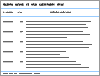
Tab. 1
Mean values of sound velocity errors in the training and prediction sets"
| 算法类型 | 声速误差/(m2/s2) |
|---|---|
| EOF | 0.461 016 |
| IBPNN_c | 0.251 132 |
| IBPNN | 0.032 693 |
| PSO-IBPNN | 0.022 245 |
| APSO-IBPN N | 0.024 198 |
Tab. 2
The time consumed in the modeling process"
| 算法类型 | 建模时间/s |
|---|---|
| EOF | 0.218 |
| IBPNN_c | 11 |
| IBPNN | 19 |
| PSO-IBPNN | 4786 |
| APSO-IBPNN | 2458 |

Fig. 8
Network loss value change"


Fig. 9
Test set sound speed prediction error line graph"

Tab. 3
Mean value of sound velocity error for each profil"
| 算法简称 | No.1 | No.12 | No.23 | No.43 | No.48 |
|---|---|---|---|---|---|
| PSO-IBPNN | 0.258 734 | 0.044 405 | 0.213 312 | 0.035 571 | 0.061 199 |
| APSO-IBPNN | 0.064 499 | 0.052 736 | 0.114 254 | 0.043 104 | 0.064 571 |
Tab. 4
The time consumed in the prediction phase"
| 算法类型 | 预测耗时 |
|---|---|
| EOF | 0.005 8 |
| IBPNN_c | 0.000 1 |
| IBPNN | 0.266 6 |
| PSO-IBPN N | 0.173 0 |
| APSO-IBPNN | 0.250 6 |
| [1] |
杨元喜, 徐天河, 薛树强. 我国海洋大地测量基准与海洋导航技术研究进展与展望[J]. 测绘学报, 2017, 46(1): 1-8. DOI:.
doi: 10.11947/j.AGCS.2017.20160519 |
|
YANG Yuanxi, XU Tianhe, XUE Shuqiang. Progresses and prospects in developing marine geodetic datum and marine navigation of China[J]. Acta Geodaetica et Cartographica Sinica, 2017, 46(1): 1-8. DOI:.
doi: 10.11947/j.AGCS.2017.20160519 |
|
| [2] |
辛明真, 阳凡林, 薛树强, 等. 顾及波束入射角的常梯度声线跟踪水下定位算法[J]. 测绘学报, 2020, 49(12): 1535-1542. DOI:.
doi: 10.11947/j.AGCS.2020.20190518 |
|
XIN Mingzhen, YANG Fanlin, XUE Shuqiang, et al. Constant-gradient acoustic line tracking underwater localization algorithm taking beam incidence angle into account[J]. Acta Geodaetica et Cartographica Sinica, 2020, 49(12): 1535-1542. DOI:.
doi: 10.11947/j.AGCS.2020.20190518 |
|
| [3] |
闫凤池, 王振杰, 赵爽, 等. 顾及双程声径的常梯度声线跟踪水下定位算法[J]. 测绘学报, 2022, 51(1): 31-40. DOI:.
doi: 10.11947/j.AGCS.2022.20210234 |
|
YAN Fengchi, WANG Zhenjie, ZHAO Shuang, et al. Constant gradient acoustic line tracking underwater localization algorithm considering two-way acoustic path[J]. Acta Geodaetica et Cartographica Sinica, 2022, 51(1): 31-40. DOI:.
doi: 10.11947/j.AGCS.2022.20210234 |
|
| [4] | 张盛秋, 杨元喜, 徐天河. 基于GNSS-A的海洋声速变化估计及其对定位的影响[J]. 地球物理学报, 2023, 66(3): 961-972. |
| ZHANG Shengqiu, YANG Yuanxi, XU Tianhe. Estimation of ocean sound speed variation based on GNSS-A and its effect on localization[J]. Chinese Journal of Geophysics, 2023, 66(3): 961-972. | |
| [5] | 徐博. 水下多AUV协同定位方法[M]. 北京: 国防工业出版社, 2019. |
| XU Bo. Cooperative localization for multiple autonomous underwater vehicles[M]. Beijing: National Defense Industry Press, 2019. | |
| [6] | 刘伯胜. 水声学原理[M]. 3版. 北京: 科学出版社, 2019. |
| LIU Bosheng. Principles of underwater acoustics[M]. 3rd ed. Beijing: Science Press, 2019. | |
| [7] | ZHANG L H, LIU X P, JIA S D, et al. A line-surface integrated algorithm for underwater terrain matching[J]. The Journal of Geodesy and Geoinformation Science, 2019, 2(4): 10-20. |
| [8] | MUNK W H. Sound channel in an exponentially stratified ocean, with application to SOFAR[J]. The Journal of the Acoustical Society of America, 1974, 55(2): 220-226. |
| [9] | DAVIS T, COUNTRYMAN K, CARRON M. Tailored acoustic products utilizing the navoceano gdem (a generalized digital environmental model)[C]//Proceedings of the 36th Naval Symposium on Underwater Acoustics. San Diego: Naval Ocean Systems Center, 1986. |
| [10] | 张旭, 张永刚, 张健雪, 等. 一种新的声速剖面结构参数化方法[J]. 海洋学报(中文版), 2011, 33(5): 54-60. |
| ZHANG Xu, ZHANG Yonggang, ZHANG Jianxue, et al. A new model for calculating sound speed profile structure[J]. Haiyang Xuebao, 2011, 33(5): 54-60. | |
| [11] | NISTAD J G, WESTFELD P. Improved techniques to resolve the water column sound speed structure for multibeam ray-tracing[J]. The International Hydrographic Review, 2022, 27: 35-54. |
| [12] | LORENZ E N. Empirical orthogonal functions and statistical weather prediction[J]. Scientific Reports, 1956, 409(2): 997-999. |
| [13] | 李洪超, 文汉江, 蔡艳辉, 等. 基于Argo浮标和EOF建立区域海水三维声速场的方法[J]. 测绘科学, 2012, 37(2): 74-76. |
| LI Hongchao, WEN Hanjiang, CAI Yanhui, et al. Modeling three-dimensional acoustic field in the ocean by using Argo and EOF[J]. Science of Surveying and Mapping, 2012, 37(2): 74-76. | |
| [14] | OU Zhenyi, QU Ke, LIU Chen. Estimation of sound speed profiles using a random forest model with satellite surface observations[J]. Shock and Vibration, 2022, 2022: 2653791. |
| [15] | YU Xiaokang, XU Tianhe, WANG Junting. Sound velocity profile prediction method based on RBF neural network[C]//Proceedings of 2020 China Satellite Navigation Conference. Beijing: Springer, 2020: 475-487. |
| [16] | LI Bingyang, ZHAI Jingsheng. A novel sound speed profile prediction method based on the convolutional long-short term memory network[J]. Journal of Marine Science and Engineering, 2022, 10(5): 572. |
| [17] | LEBLANC L R, MIDDLETON F H. An underwater acoustic sound velocity data model[J]. The Journal of the Acoustical Society of America, 1980, 67(12): 2055-2062. |
| [18] | DAVIS R E. Predictability of sea surface temperature and sea level pressure anomalies over the North Pacific Ocean[J]. Journal of Physical Oceanography, 1976, 6(3): 249-266. |
| [19] | TOLSTOY A, DIACHOK O, FRAZER L N. Acoustic tomography via matched field processing[J]. The Journal of the Acoustical Society of America, 1991, 89(3): 1119-1127. |
| [20] | NAJAH A, EL-SHAFIE A, KARIM O A, et al. Application of artificial neural networks for water quality prediction[J]. Neural Computing and Applications, 2013, 22(S1): 187-201. |
| [21] | 孙行, 黄泽纯. 面向复杂地形区气温场拟合的回归学习方法精度比较[J]. 测绘与空间地理信息, 2022, 45(5): 18-23. |
| SUN Xing, HUANG Zechun. Accuracy comparison of regression learning methods for fitting temperature fields in complex terrain areas[J]. Mapping and Spatial Geographic Information, 2022, 45(5): 18-23. | |
| [22] | WANG Junting, XU Tianhe, NIE Wenfeng, et al. The construction of sound speed field based on back propagation neural network in the global ocean[J]. Marine Geodesy, 2020, 43(6): 621-642. |
| [23] | 孙佳龙, 张杰, 唐玥, 等. 双种群约束QPSO-BP的声速剖面反演方法[J]. 测绘科学, 2021, 46(8): 127-134. |
| SUN Jialong, ZHANG Jie, TANG Yue, et al. Inversion method of sound velocity profile based on QPSO-BP with two population constraints[J]. Science of Surveying and Mapping, 2021, 46(8): 127-134. | |
| [24] | 胡合欢, 崔永胜, 周进忠, 等. BP神经网络在构建声速场中的应用研究[J]. 海洋测绘, 2015, 35(5): 67-70. |
| HU Hehuan, CUI Yongsheng, ZHOU Jinzhong, et al. Application of back-propagation neural network in establishing velocity fields[J]. Hydrographic Surveying and Charting, 2015, 35(5): 67-70. | |
| [25] | 李林洋, 徐天河, 王君婷, 等. 联合匹配场和神经网络的声速时间场构建方法[J]. 哈尔滨工程大学学报, 2023, 44(11): 2044-2053. |
| LI Linyang, XU Tianhe, WANG Junting, et al. A method for constructing sound velocity time field by combining matched field and neural network[J]. Journal of Harbin Engineering University, 2023, 44(11): 2044-2053. | |
| [26] | HUANG Jin, LUO Yu, SHI Jian, et al. Rapid modeling of the sound speed field in the South China Sea based on a comprehensive optimal LM-BP artificial neural network[J]. Journal of Marine Science and Engineering, 2021, 9(5): 488. |
| [27] | 周梦, 吕志刚, 邸若海, 等. 基于小样本数据的BP神经网络建模[J]. 科学技术与工程, 2022, 22(7): 2754-2760. |
| ZHOU Meng, LÜ Zhigang, DI Ruohai, et al. BP neural network modeling based on small sample data[J]. Science Technology and Engineering, 2022, 22(7): 2754-2760. | |
| [28] | 钱建国, 樊意广. 基于改进小波神经网络的GPS高程拟合研究[J]. 大地测量与地球动力学, 2022, 42(3): 253-257. |
| QIAN Jianguo, FAN Yiguang. Research on GPS height fitting based on improved wavelet neural network[J]. Journal of Geodesy and Geodynamics, 2022, 42(3): 253-257. | |
| [29] | RUMELHART D E, HINTON G E, WILLIAMS R J. Learning representations by back-propagating errors[J]. Nature, 1986, 323: 533-536. |
| [30] | DEMUTH H B, BEALE M H, JESS O D, HAGAN M T. Neural network design[M]. 2nd ed. Oklahoma: Martin Hagan, 2014. |
| [31] | 周丰年, 赵建虎, 周才扬. 多波束测深系统最优声速公式的确定[J]. 台湾海峡, 2001(4): 411-419. |
| ZHOU Fengnian, ZHAO Jianhu, ZHOU Caiyang. Determination of the optimal sound velocity equation for multibeam bathymetric systems[J]. Taiwan Strait, 2001(4): 411-419. | |
| [32] | SHI Y, EBERHART R. A modified particle swarm optimizer[C]//Proceedings of 1998 International Conference on Evolutionary Computation. Anchorage: IEEE, 1998: 69-73. |
| [33] | 黄洋, 鲁海燕, 许凯波, 等. 基于S型函数的自适应粒子群优化算法[J]. 计算机科学, 2019, 46(1): 245-250. |
| HUANG Yang, LU Haiyan, XU Kaibo, et al. S-shaped function based adaptive particle swarm optimization algorithm[J]. Computer Science, 2019, 46(1): 245-250. | |
| [34] | LI Hong, XU Fanghua, ZHOU Wei, et al. Development of a global gridded Argo data set with barnes successive corrections: a new global gridded Argo data set[J]. Journal of Geophysical Research: Oceans, 2017, 122(2): 866-889. |
| [1] | Han WANG, Yun XIAO, Huaikui GUAN, Weixuan SUN. An improved Butterworth gravity downward continuation method driven by entropy-PSO dual optimization [J]. Acta Geodaetica et Cartographica Sinica, 2025, 54(9): 1620-1632. |
| [2] | . Remote Sensing Image Change Detection Using Particle Swarm Optimization Algorithm [J]. Acta Geodaetica et Cartographica Sinica, 2012, 41(6): 857-863. |
| Viewed | ||||||
|
Full text |
|
|||||
|
Abstract |
|
|||||
