

Acta Geodaetica et Cartographica Sinica ›› 2026, Vol. 55 ›› Issue (8): 1452-1464.doi: 10.11947/j.AGCS.2026.20260063
• Photogrammetry and Remote Sensing • Previous Articles
Xiangyu Zhao1( ), Chunju Zhang1(), Yifan Pei1, Chenxi Li1, Jun Zhang2, Wei Xu3,4, Chun Lan5, Linfeng Lü1, Hongbo Liang1
Received:2025-11-24
Revised:2026-07-23
Published:2026-09-09
Contact:
Chunju Zhang
E-mail:2023110780@mail.hfut.edu.cn;zcjtwz@sina.com
About author:Zhao Xiangyu (2002—), male, master, majors in intelligent interpretation of remote sensing images. E-mail: 2023110780@mail.hfut.edu.cn
Supported by:CLC Number:
Xiangyu Zhao, Chunju Zhang, Yifan Pei, Chenxi Li, Jun Zhang, Wei Xu, Chun Lan, Linfeng Lü, Hongbo Liang. SCA-SAM: semantic segmentation for remote sensing images based on scale context attention and efficient SAM transfer[J]. Acta Geodaetica et Cartographica Sinica, 2026, 55(8): 1452-1464.
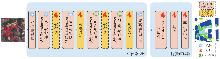
Fig. 1
Overall framework of SCA-SAM"

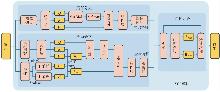
Fig. 2
Architecture of SCA module"
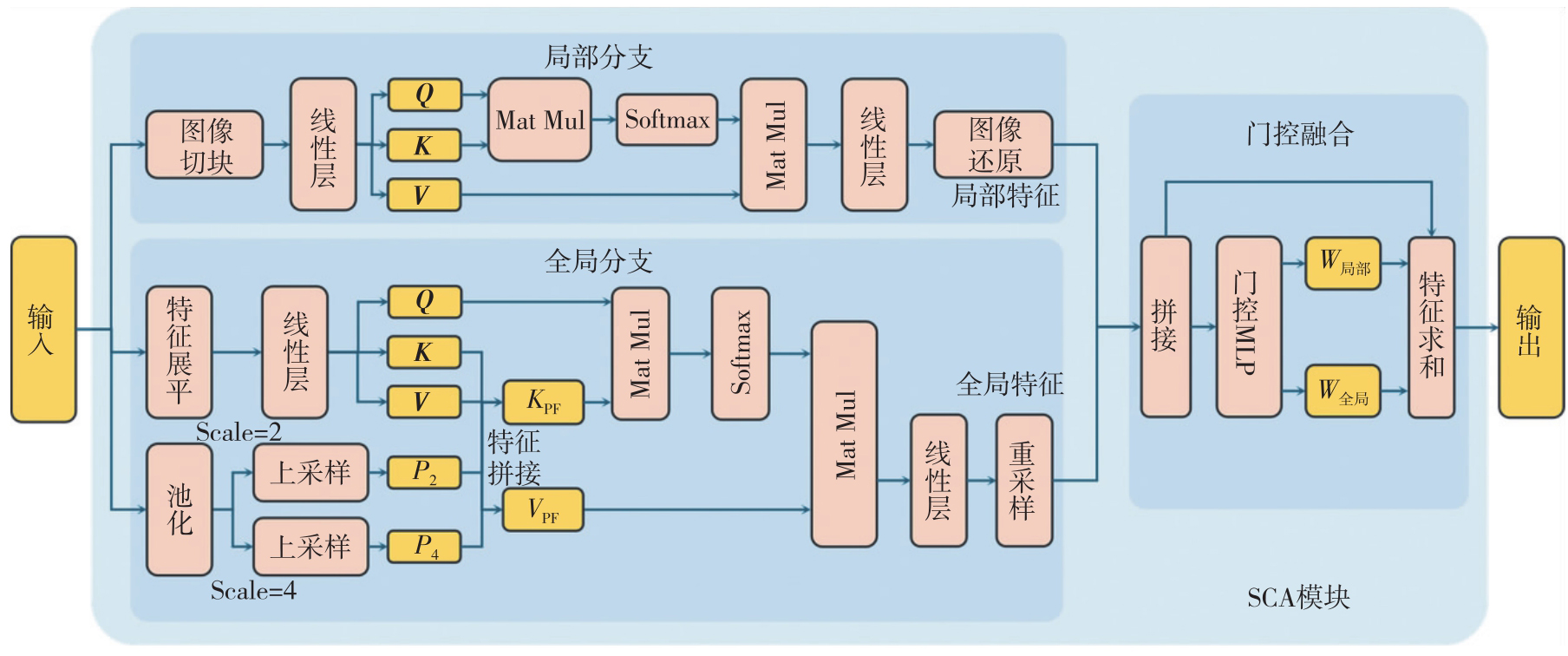
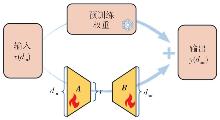
Fig. 3
Schematic illustration of LoRA"
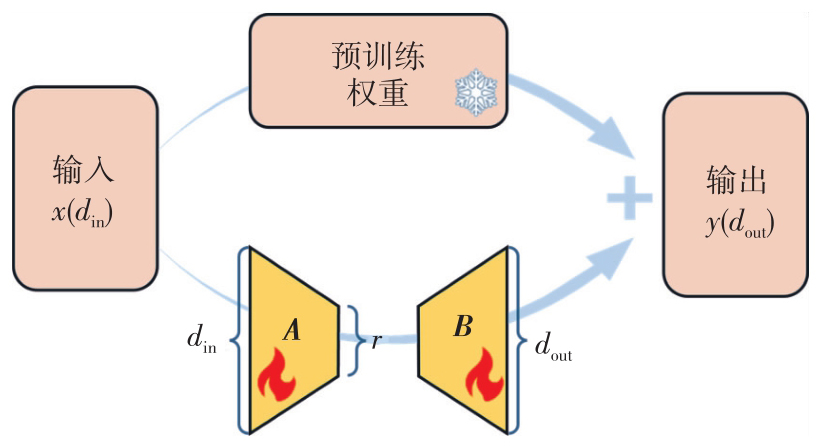
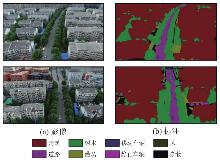
Fig. 4
Examples of images and annotations for the UAVid dataset"
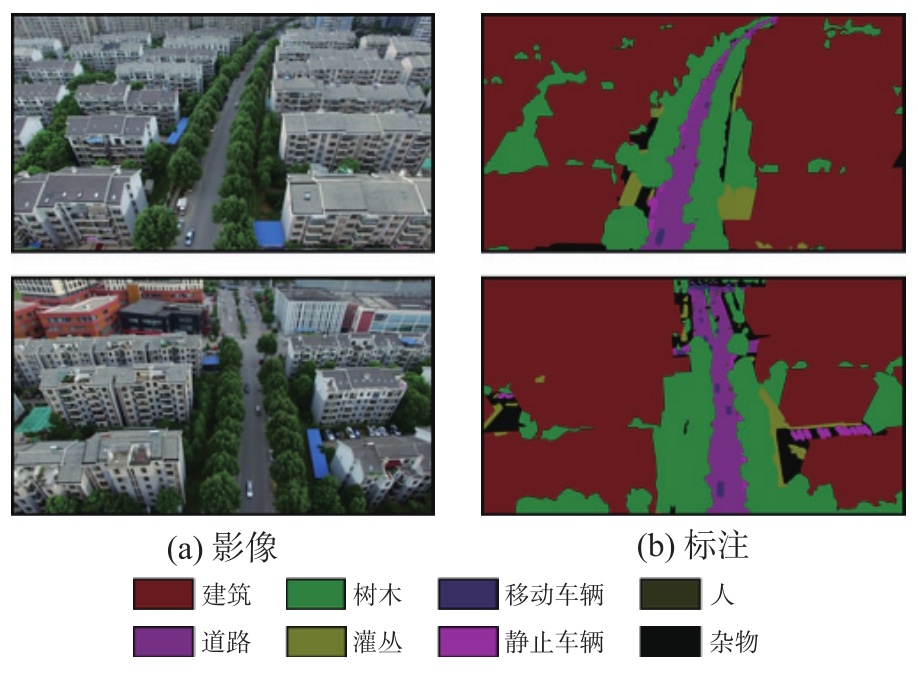
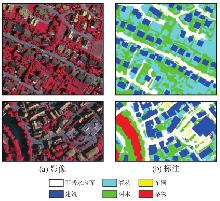
Fig. 5
Examples of images and annotations for the ISPRS Vaihingen dataset"

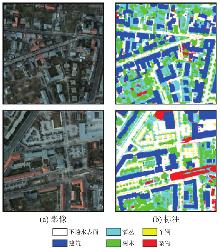
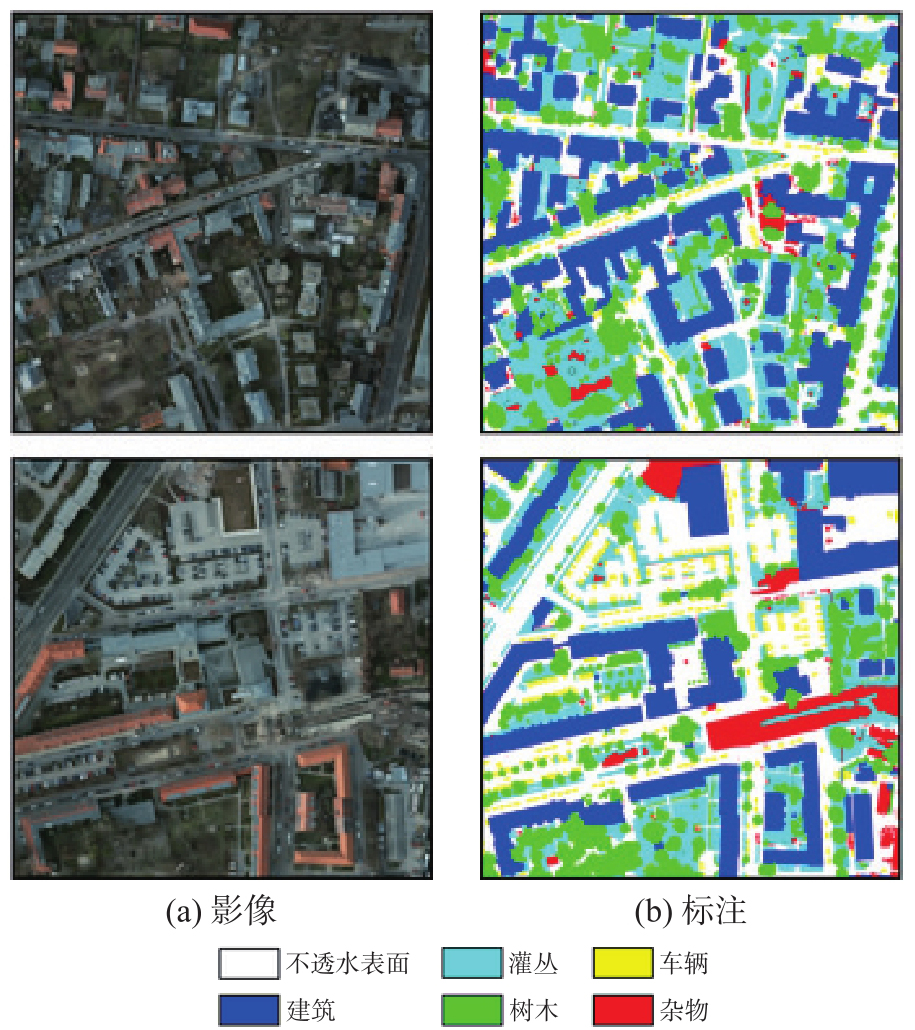
Fig. 6
Examples of images and annotations for the ISPRS Potsdam dataset"
Tab. 1
Quantitative comparison on the UAVid validation set"
| 模型 | IoU | mIoU | F1值 | OA | |||||||
|---|---|---|---|---|---|---|---|---|---|---|---|
| 建筑 | 道路 | 树木 | 灌丛 | 移动车辆 | 静止车辆 | 人 | 杂物 | ||||
| UNetFormer | 90.06 | 78.13 | 76.01 | 66.69 | 68.61 | 66.64 | 43.22 | 62.01 | 68.92 | 80.89 | 86.67 |
| SegFormer | 85.20 | 69.55 | 64.76 | 57.02 | 59.64 | 52.80 | 34.66 | 49.36 | 59.12 | 73.33 | 80.31 |
| DCSwin | 90.12 | 78.10 | 76.49 | 66.28 | 75.32 | 69.08 | 45.79 | 62.86 | 70.50 | 82.07 | 86.98 |
| CMTFNet | 91.70 | 80.74 | 78.24 | 69.12 | 75.72 | 69.42 | 43.59 | 65.48 | 71.75 | 82.82 | 88.27 |
| SAM(Frozen) | 88.94 | 74.06 | 71.94 | 56.60 | 71.12 | 62.10 | 40.04 | 56.03 | 65.11 | 78.00 | 83.84 |
| EfficientViTSAM | 90.41 | 76.47 | 77.51 | 68.14 | 69.01 | 65.64 | 37.69 | 62.73 | 68.45 | 80.35 | 87.10 |
| SAM-LST | 88.68 | 75.17 | 75.93 | 66.16 | 70.18 | 66.13 | 45.83 | 59.71 | 68.47 | 80.69 | 85.85 |
| RSAM-Seg | 92.12 | 78.98 | 78.11 | 68.88 | 72.19 | 67.90 | 42.31 | 65.48 | 70.75 | 82.10 | 88.15 |
| SCA-SAM | 92.56 | 79.80 | 79.14 | 71.96 | 76.62 | 72.42 | 49.24 | 65.86 | 73.45 | 84.14 | 88.83 |
Tab. 2
Quantitative comparison on the ISPRS Vaihingen validation set"
| 模型 | IoU | mIoU | F1值 | OA | ||||
|---|---|---|---|---|---|---|---|---|
| 不透水表面 | 建筑 | 灌丛 | 树木 | 车辆 | ||||
| UNetFormer | 88.43 | 92.97 | 74.29 | 82.06 | 81.38 | 83.83 | 91.07 | 91.86 |
| SegFormer | 88.95 | 92.90 | 74.85 | 82.28 | 81.01 | 84.00 | 91.17 | 92.04 |
| DCSwin | 87.21 | 90.39 | 73.92 | 82.45 | 80.72 | 82.94 | 90.57 | 91.23 |
| CMTFNet | 88.59 | 93.43 | 75.05 | 83.48 | 81.96 | 84.50 | 91.48 | 92.27 |
| SAM(Frozen) | 78.11 | 82.83 | 62.58 | 76.47 | 61.63 | 72.32 | 83.65 | 85.72 |
| EfficientViTSAM | 86.31 | 91.73 | 73.55 | 81.15 | 73.81 | 81.31 | 89.53 | 91.05 |
| SAM-LST | 86.44 | 91.04 | 73.96 | 82.71 | 76.37 | 82.10 | 90.04 | 91.20 |
| RSAM-Seg | 88.37 | 92.27 | 74.62 | 83.01 | 76.22 | 82.90 | 90.50 | 91.82 |
| SCA-SAM | 89.27 | 93.33 | 75.54 | 83.80 | 81.07 | 84.60 | 91.53 | 92.45 |
Tab. 3
Quantitative comparison on the ISPRS Potsdam validation set"
| 模型 | IoU | mIoU | F1值 | OA | ||||
|---|---|---|---|---|---|---|---|---|
| 不透水表面 | 建筑 | 灌丛 | 树木 | 车辆 | ||||
| UNetFormer | 84.30 | 90.73 | 76.38 | 79.02 | 90.77 | 84.24 | 91.33 | 89.54 |
| SegFormer | 84.54 | 90.57 | 74.47 | 76.51 | 88.07 | 82.83 | 90.48 | 89.02 |
| DCSwin | 85.17 | 91.35 | 76.25 | 77.41 | 91.05 | 84.25 | 91.32 | 89.72 |
| CMTFNet | 86.84 | 93.39 | 77.47 | 79.03 | 90.57 | 85.46 | 92.04 | 90.74 |
| SAM(Frozen) | 71.17 | 76.52 | 61.51 | 62.46 | 79.90 | 70.31 | 82.34 | 80.06 |
| EfficientViTSAM | 84.78 | 91.70 | 75.89 | 79.02 | 87.24 | 83.73 | 91.04 | 89.78 |
| SAM-LST | 82.59 | 87.65 | 74.72 | 76.90 | 90.49 | 82.47 | 90.27 | 88.26 |
| RSAM-Seg | 84.30 | 90.36 | 74.72 | 77.43 | 89.00 | 83.16 | 90.68 | 89.03 |
| SCA-SAM | 86.92 | 93.46 | 77.92 | 79.11 | 92.02 | 85.89 | 92.28 | 90.81 |
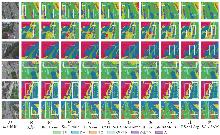
Fig. 7
Qualitative visualization of predictions on the UAVid dataset"

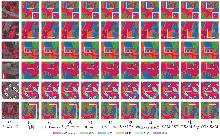
Fig. 8
Qualitative visualization of predictions on the ISPRS Vaihingen dataset"
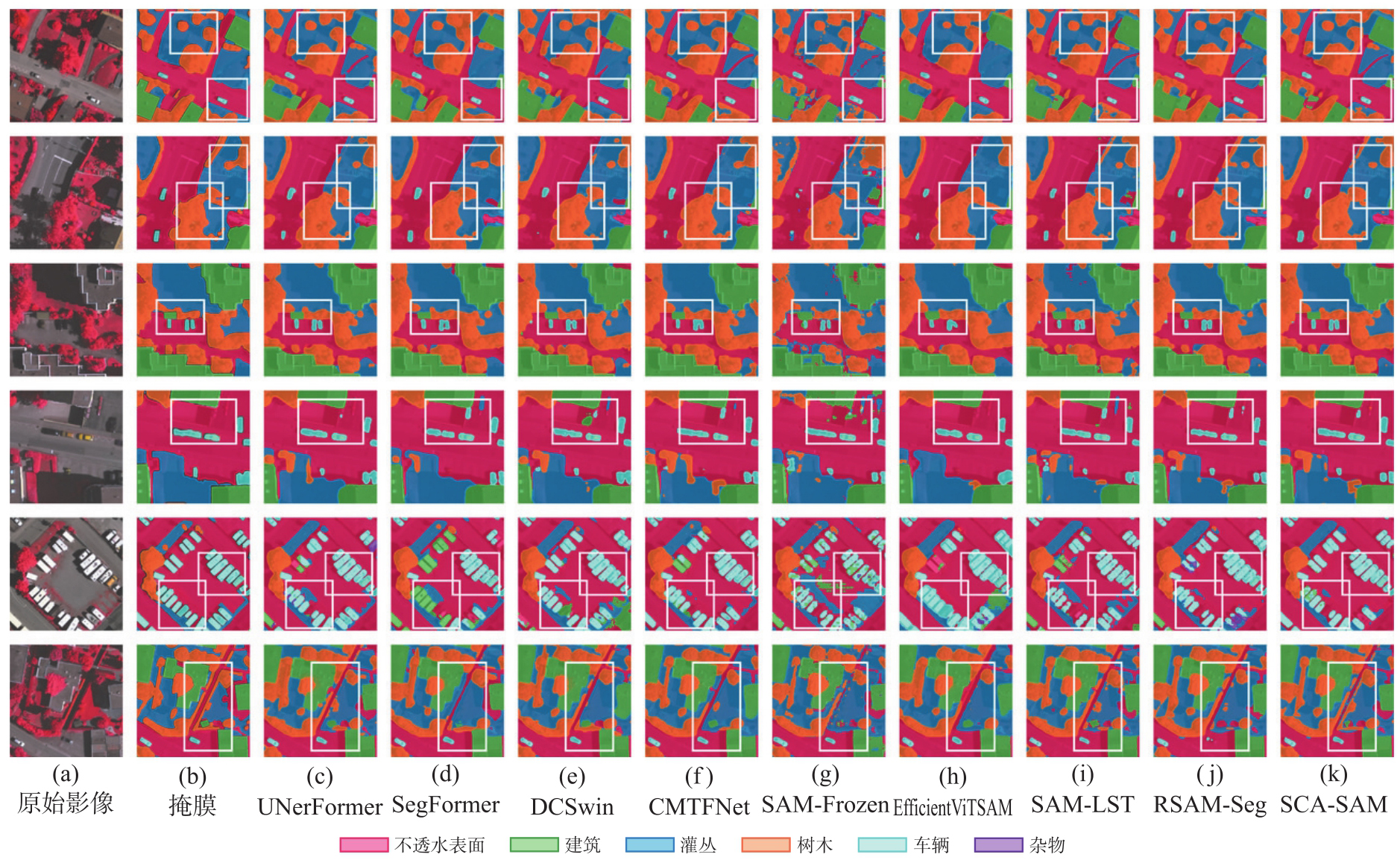
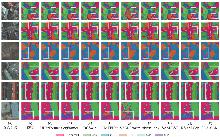
Fig. 9
Qualitative visualization of predictions on the ISPRS Potsdam dataset"

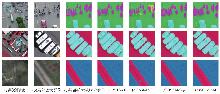
Fig. 10
Comparison on small objects and boundary regions"
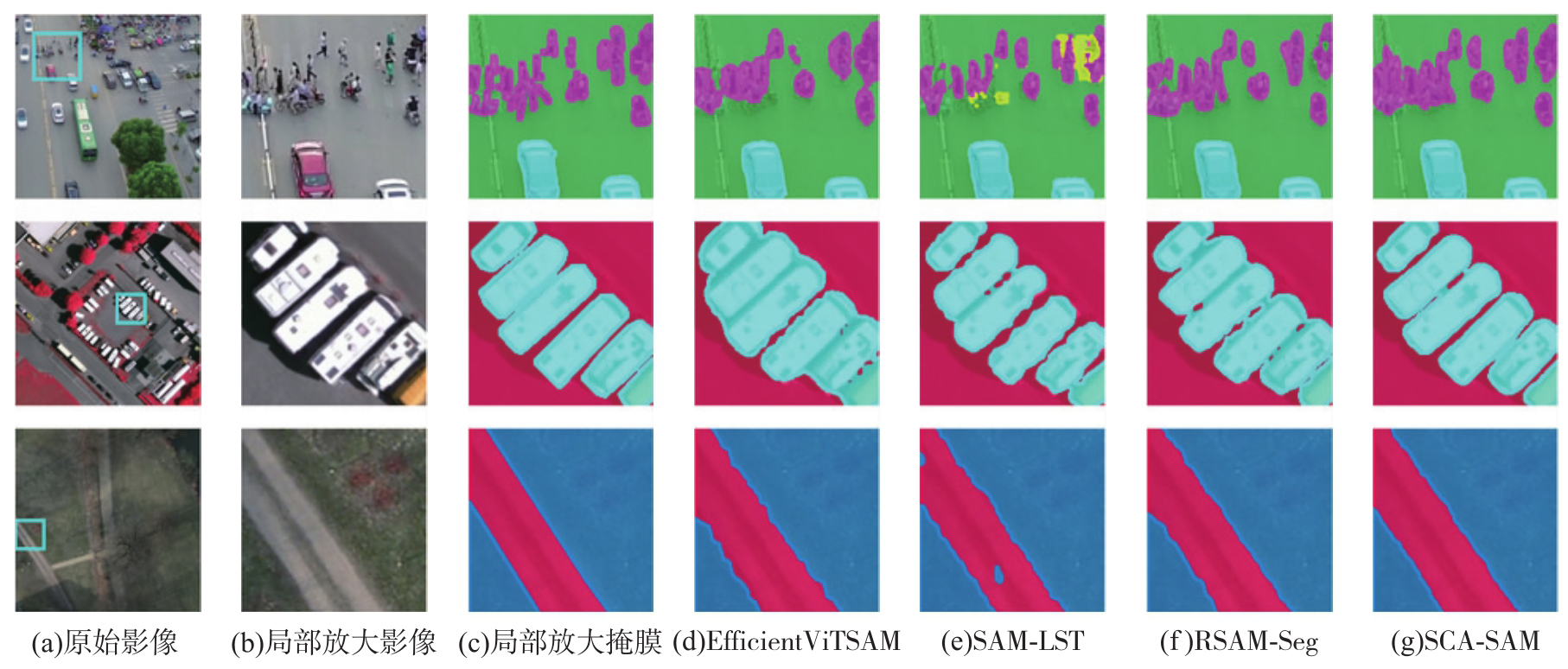
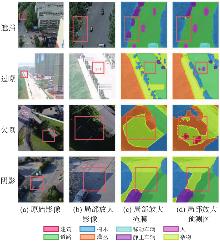
Fig. 11
Local magnification visualization contrast under imaging interference"

Tab. 4
Experimental analysis of model ablation"
| 试验组 | 训练策略 | 可训参数量 | 吞吐量(张/s) | 总参数量 | mIoU/(%) | |||||
|---|---|---|---|---|---|---|---|---|---|---|
| ViT | SCA模块 | 解码器 | 总可训 | UAVid | ISPRS Vaihingen | ISPRS Potsdam | ||||
| SCA-SAM | LoRA | 0.15×10⁶ | 1.48×10⁶ | 4.34×10⁶ | 5.97×10⁶ | 11.89 | 114.23×10⁶ | 73.45 | 84.60 | 85.89 |
| w/o SCA | LoRA | 0.15×10⁶ | 0×106 | 4.34×10⁶ | 4.49×10⁶ | 13.66 | 94.16×10⁶ | 71.99 | 82.61 | 84.12 |
| Full Train | 全训练 | 28.39×10⁶ | 1.48×10⁶ | 4.34×10⁶ | 34.22×10⁶ | 8.99 | 114.23×10⁶ | 75.05 | 84.63 | 86.34 |
| Full Freeze | 全冻结 | 0.00×10⁶ | 1.48×10⁶ | 4.34×10⁶ | 5.82×10⁶ | 12.01 | 114.23×10⁶ | 29.15 | 82.01 | 84.27 |
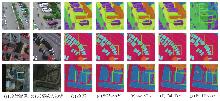
Fig. 12
Zoomed-in qualitative comparison of different ablation settings"

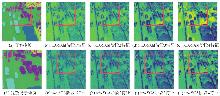
Fig. 13
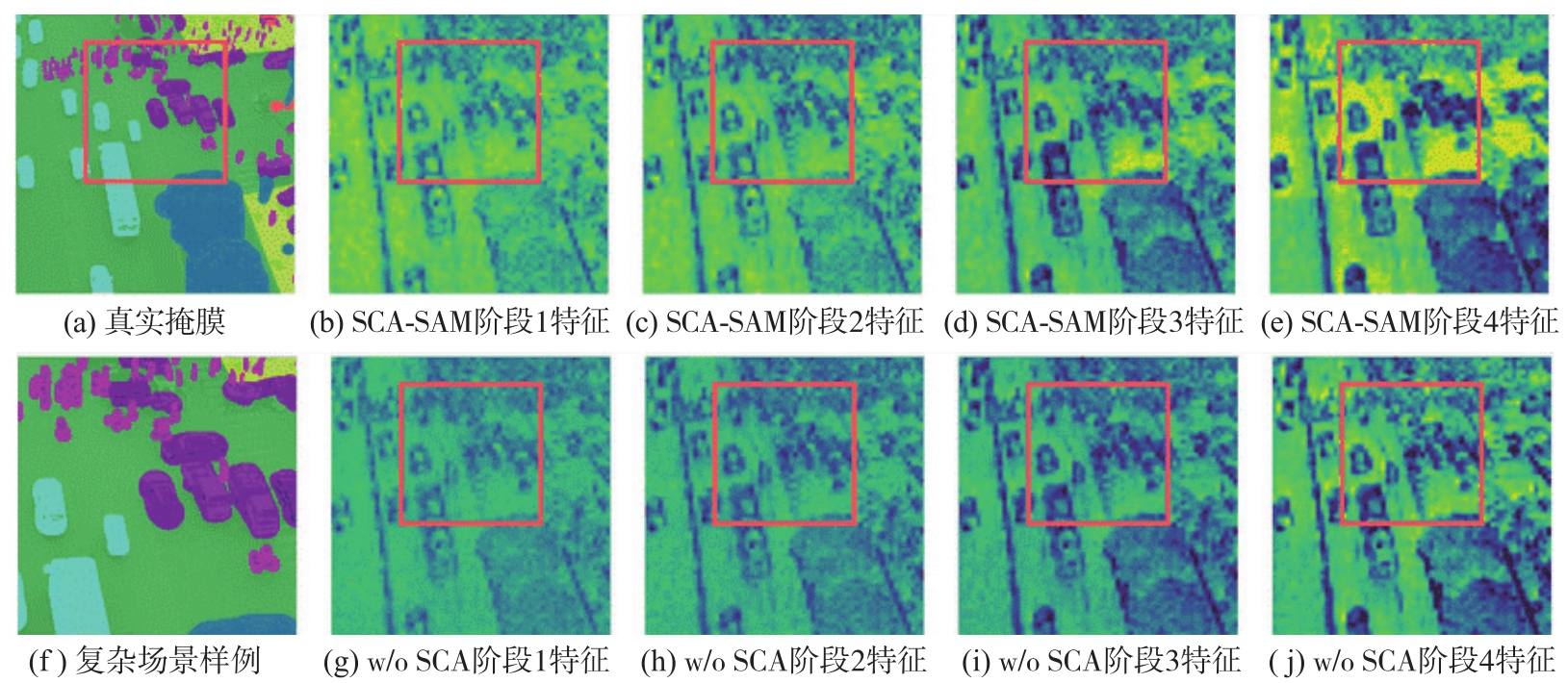
Comparison of multi-stage feature responses with and without SCA in SAM"
Tab. 5
Experimental analysis of loss ablation"
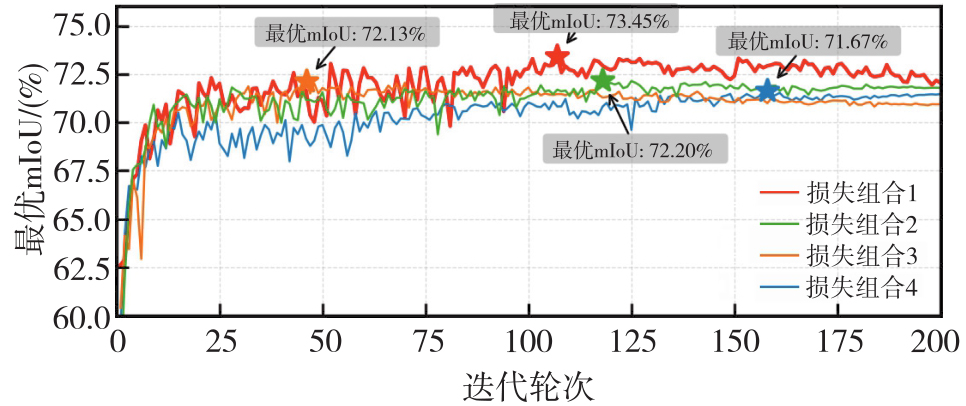
| 损失组合 | CB-FocalCE | Focal-Tversky | TopK-CE | IoU | mIoU | F1值 | OA | |||||||
|---|---|---|---|---|---|---|---|---|---|---|---|---|---|---|
| 建筑 | 道路 | 树木 | 灌丛 | 移动车辆 | 静止车辆 | 人 | 杂物 | |||||||
| 1 | √ | √ | √ | 92.56 | 79.80 | 79.14 | 71.96 | 76.62 | 72.42 | 49.24 | 65.86 | 73.45 | 84.14 | 88.83 |
| 2 | √ | √ | 92.14 | 80.98 | 78.57 | 69.58 | 75.47 | 70.25 | 43.77 | 66.82 | 72.20 | 83.13 | 88.61 | |
| 3 | √ | √ | 92.75 | 81.92 | 78.47 | 69.60 | 74.55 | 69.40 | 42.22 | 68.11 | 72.13 | 83.01 | 88.89 | |
| 4 | √ | √ | 92.48 | 80.70 | 77.78 | 69.49 | 73.24 | 68.77 | 43.92 | 66.96 | 71.67 | 82.78 | 88.47 | |
Fig. 14
Validation mIoU curves under different loss function combinations"
| [1] |
陈超, 梁锦涛, 杨刚, 等. 面向土地覆盖精准分类的遥感特征参数优选方法[J]. 测绘学报, 2024, 53(7): 1401-1416. DOI: .
doi: 10.11947/j.AGCS.2024.20230327 |
|
Chen Chao, Liang Jintao, Yang Gang, et al. Remote sensing parameters optimization for accurate land cover classifi-cation[J]. Acta Geodaetica et Cartographica Sinica, 2024, 53(7): 1401-1416. DOI: .
doi: 10.11947/j.AGCS.2024.20230327 |
|
| [2] | 蒋伟杰, 张春菊, 徐兵, 等. AED-Net:滑坡灾害遥感影像语义分割模型[J]. 地球信息科学学报, 2023, 25(10): 2012-2025. |
| Jiang Weijie, Zhang Chunju, Xu Bing, et al. AED-Net: semantic segmentation model for landslide recognition from remote sensing images[J]. Journal of Geo-Information Science, 2023, 25(10): 2012-2025. | |
| [3] | Wu Kang, Zhang Yingying, Ru Lixiang, et al. A semantic-enhanced multi-modal remote sensing foundation model for Earth observation[J]. Nature Machine Intelligence, 2025, 7(8): 1235-1249. |
| [4] | 杨明旺, 赵丽科, 叶林峰, 等. 基于卷积神经网络的遥感影像建筑物提取方法综述[J]. 地球信息科学学报, 2024, 26(6): 1500-1516. |
| Yang Mingwang, Zhao Like, Ye Linfeng, et al. A review of convolutional neural networks related methods for building extraction from remote sensing images[J]. Journal of Geo-Information Science, 2024, 26(6): 1500-1516. | |
| [5] | Long J, Shelhamer E, Darrell T. Fully convolutional networks for semantic segmentation[C]//Proceedings of 2015 IEEE Conference on Computer Vision and Pattern Recognition. Boston: IEEE, 2015: 3431-3440. |
| [6] |
伍广明, 陈奇, Shibasaki R, 等. 基于U型卷积神经网络的航空影像建筑物检测[J]. 测绘学报, 2018, 47(6): 864-872. DOI: .
doi: 10.11947/j.AGCS.2018.20170651 |
|
Wu Guangming, Chen Qi, Shibasaki R, et al. High precision building detection from aerial imagery using a U-Net like convolutional architecture[J]. Acta Geodaetica et Cartographica Sinica, 2018, 47(6): 864-872. DOI: .
doi: 10.11947/j.AGCS.2018.20170651 |
|
| [7] | 许泽宇, 沈占锋, 李杨, 等. 增强型DeepLab算法和自适应损失函数的高分辨率遥感影像分类[J]. 遥感学报, 2022, 26(2): 406-415. |
| Xu Zeyu, Shen Zhanfeng, Li Yang, et al. Classification of high-resolution remote sensing images based on enhanced DeepLab algorithm and adaptive loss function[J]. National Remote Sensing Bulletin, 2022, 26(2): 406-415. | |
| [8] | 柴华彬, 严超, 邹友峰, 等. 利用PSP Net实现湖北省遥感影像土地覆盖分类[J]. 武汉大学学报(信息科学版), 2021, 46(8): 1224-1232. |
| Chai Huabin, Yan Chao, Zou Youfeng, et al. Land cover classification of remote sensing image of Hubei province by using PSP Net[J]. Geomatics and Information Science of Wuhan University, 2021, 46(8): 1224-1232. | |
| [9] | Dosovitskiy A. An image is worth 16x16 words: transformers for image recognition at scale[C]//Proceedings of 2021 International Conference on Learning Representations. San Diego: Open Review.net, 2021. |
| [10] | Chen Wei, Bruzzone L, Dang Bo, et al. REST: holistic learning for end-to-end semantic segmentation of whole-scene remote sensing imagery[J]. IEEE Transactions on Pattern Analysis and Machine Intelligence, 2026, 48(1): 693-710. |
| [11] | Li Yansheng, Wu Yuning, Cheng Gong, et al. MEET: a million-scale dataset for fine-grained geospatial scene classification with zoom-free remote sensing imagery[J]. IEEE/CAA Journal of Automatica Sinica, 2025, 12(5): 1004-1023. |
| [12] | Kirillov A, Mintun E, Ravi N, et al. Segment anything[C]//Proceedings of 2023 IEEE/CVF International Conference on Computer Vision (ICCV). Paris: IEEE, 2023: 4015-4026. |
| [13] | Wang Di, Zhang Jing, Du Bo, et al. SAMRS: scaling-up remote sensing segmentation dataset with segment anything model[C]//Proceedings of 2023 Advances in Neural Information Processing Systems 36. New Orleans: NeurIPS, 2023: 8815-8827. |
| [14] | Yan Zhiyuan, Li Junxi, Li Xuexue, et al. RingMo-SAM: a foundation model for segment anything in multimodal remote-sensing images[J]. IEEE Transactions on Geoscience and Remote Sensing, 2023, 61: 5625716. |
| [15] | Liu Zhuoran, Li Zizhen, Liang Ying, et al. RSPS-SAM: a remote sensing image panoptic segmentation method based on SAM[J]. Remote Sensing, 2024, 16(21): 4002. |
| [16] | Zheng Linghao, Pu Xinyang, Zhang Su, et al. Tuning a SAM-based model with multicognitive visual adapter to remote sensing instance segmentation[J]. IEEE Journal of Selected Topics in Applied Earth Observations and Remote Sensing, 2025, 18: 2737-2748. |
| [17] | 刘思涌, 赵毅力. 微调SAM的遥感图像高效语义分割模型DP-SAM[J]. 中国图象图形学报, 2025, 30(8): 2884-2896. |
| Liu Siyong, Zhao Yili. DP-SAM: efficient semantic segmentation of remote sensing images by fine-tuning SAM[J]. Journal of Image and Graphics, 2025, 30(8): 2884-2896. | |
| [18] | Lu Xiaoyan, Weng Qihao. Multi-LoRA fine-tuned segment anything model for urban man-made object extraction[J]. IEEE Transactions on Geoscience and Remote Sensing, 2024, 62: 5637519. |
| [19] | Shan Zhe, Liu Yang, Zhou Lei, et al. ROS-SAM: high-quality interactive segmentation for remote sensing moving object[C]//Proceedings of 2025 IEEE/CVF Conference on Computer Vision and Pattern Recognition. Nashville: IEEE, 2025: 3625-3635. |
| [20] | Hu E J, Shen Yelong, Wallis P, et al. LoRA: low-rank adaptation of large language models[C]//Proceedings of 2021 International Conference on Learning Representations. San Diego: Open Review.net, 2021. |
| [21] | Lü Ye, Vosselman George, Xia Guisong, et al. UAVid: a semantic segmentation dataset for UAV imagery[J]. ISPRS Journal of Photogrammetry and Remote Sensing, 2020, 165: 108-119. |
| [22] | Gerke M, Rottensteiner F, Wegner J D, et al. ISPRS semantic labeling contest[C]//Proceedings of 2014 Photogrammetric Computer Vision. Zurich: [s.n.], 2014. |
| [23] | Li Sirui, Peng Linkai, Zhang Zheyuan, et al. TAGS: 3D tumor-adaptive guidance for SAM[PP/OL]. V2. arXiv (2025-08-27) [2026-01-10]. https://doi.org/10.48550/arXiv.2505.17096. |
| [24] | 罗健伟, 张银胜. DMFPNet:增强多尺度目标感知的双路径高分辨率遥感图像分割算法[J]. 地球信息科学学报, 2025, 27(5): 1195-1213. |
| Luo Jianwei, Zhang Yinsheng. DMFPNet: dual-path high-resolution remote sensing image segmentation algorithm for enhanced multiscale target detection[J]. Journal of Geo-Information Science, 2025, 27(5): 1195-1213. | |
| [25] |
刘帅, 李笑迎, 于梦, 等. 高分辨率遥感图像双解耦语义分割网络模型[J]. 测绘学报, 2023, 52(4): 638-647. DOI: .
doi: 10.11947/j.AGCS.2023.20210455 |
|
Liu Shuai, Li Xiaoying, Yu Meng, et al. Dual decoupling semantic segmentation model for high-resolution remote sensing images[J]. Acta Geodaetica et Cartographica Sinica, 2023, 52(4): 638-647. DOI: .
doi: 10.11947/j.AGCS.2023.20210455 |
|
| [26] | Wang Libo, Li Rui, Zhang Ce, et al. UNetFormer: a UNet-like transformer for efficient semantic segmentation of remote sensing urban scene imagery[J]. ISPRS Journal of Photogrammetry and Remote Sensing, 2022, 190: 196-214. |
| [27] | Xie Enze, Wang Wenhai, Yu Zhiding, et al. SegFormer: simple and efficient design for semantic segmentation with transformers[C]//Proceedings of the 35th Conference on Neural Information Processing Systems. Red Hook: Curran Associates, 2021: 12077-12090. |
| [28] | Wang Libo, Li Rui, Duan Chenxi, et al. A novel transformer based semantic segmentation scheme for fine-resolution remote sensing images[J]. IEEE Geoscience and Remote Sensing Letters, 2022, 19: 6506105. |
| [29] | Wu Honglin, Huang Peng, Zhang Min, et al. CMTFNet: CNN and multiscale transformer fusion network for remote-sensing image semantic segmentation[J]. IEEE Transactions on Geoscience and Remote Sensing, 2023, 61: 2004612. |
| [30] | Zhang Zhuoyang, Cai Han, Han Song. EfficientViT-SAM: accelerated segment anything model without performance loss[C]//Proceedings of 2024 IEEE/CVF Conference on Computer Vision and Pattern Recognition Workshops. Seattle: IEEE, 2024: 7859-7863. |
| [31] | Chai Shurong, Jain R K, Teng Shiyu, et al. Ladder fine-tuning approach for SAM integrating complementary network[J]. Procedia Computer Science, 2024, 246: 4951-4958. |
| [32] | Zhang Jie, Li Yunxin, Yang Xubing, et al. RSAM-SEG: a SAM-based model with prior knowledge integration for remote sensing image semantic segmentation[J]. Remote Sensing, 2025, 17(4): 590. |
| [1] | Jun Gong, Jianjun Luo, Shengnan Ke, Shibin Li, Weicong Chen, Le Qin, Shengjun Tang. An adaptive-pruning 3D Gaussian SLAM method for real-time high-fidelity indoor scene modeling [J]. Acta Geodaetica et Cartographica Sinica, 2026, 55(7): 1266-1277. |
| [2] | Qinghua Tan, Heng Qi, Hongyu Shi, Luliang Tang, Zihan Kan, Hong Yang, Lele Sun, Yafei Liu, Zhengxiong Gu. Multi-source low-altitude risk quantification and route generation in urban environments [J]. Acta Geodaetica et Cartographica Sinica, 2026, 55(7): 1306-1320. |
| [3] | Yuanyuan Ma. Spatiotemporal variation of surface velocity in typical regions of Antarctic ice sheet/ice shelf [J]. Acta Geodaetica et Cartographica Sinica, 2026, 55(7): 1326-1326. |
| [4] | Ze YOU, Liying WANG, Yiwei YU, Zhiwei QIN, Chunxi XIE, Yimo GENG, Xinao LI. A segment joint multi-measure interaction index for shield tunnel recognition in RMLS point clouds [J]. Acta Geodaetica et Cartographica Sinica, 2026, 55(6): 1101-1115. |
| [5] | Shuo LIU, Haili SUN, Ruofei ZHONG. A tunnel water leakage detection method based on multi-scale edge information fusion [J]. Acta Geodaetica et Cartographica Sinica, 2026, 55(6): 1116-1127. |
| [6] | Yin FU. Optical flow estimation based on multi-source remote sensing images modeling and dynamic evolution analysis of glacier flow field in Gongga Mountain [J]. Acta Geodaetica et Cartographica Sinica, 2026, 55(6): 1134-1134. |
| [7] | Bo ZHANG. Monitoring and analyzing the dynamics of glaciers and glacial lakes in the Mount Gongga by using SAR remote sensing [J]. Acta Geodaetica et Cartographica Sinica, 2026, 55(6): 1135-1135. |
| [8] | Ruoming ZHAI. Research on key technologies of indoor 3D reconstruction based on point cloud [J]. Acta Geodaetica et Cartographica Sinica, 2026, 55(6): 1136-1136. |
| [9] | Nan WU. Research on vegetation classification and biomass spatiotemporal evolution of coastal wetlands in Chongming Island by remote sensing [J]. Acta Geodaetica et Cartographica Sinica, 2026, 55(6): 1140-1140. |
| [10] | Pengcheng WEI, Guiyu JIANG, Hangyi SHEN, Haifeng HUANG, Rongling ZHANG. Millimeter-level surface deformation detection method based on high-precision laser point cloud registration [J]. Acta Geodaetica et Cartographica Sinica, 2026, 55(5): 866-880. |
| [11] | Yuzhun LIN, Shuxiang WANG, Jie RUI, Fei JIN, Jianfang JIANG, Xibing ZUO, Xiao LIU, Yujie ZOU. Road extraction method for heterogeneous data using sparse labels [J]. Acta Geodaetica et Cartographica Sinica, 2026, 55(5): 881-893. |
| [12] | Tiandong SHI, Ling ZHAO, Wenhao ZHAO, Ji QI, Hao CUI, Chengli PENG, Xinchang ZHANG. Controllable generation of high-resolution optical remote sensing image explicitly guided by spatio-temporal information [J]. Acta Geodaetica et Cartographica Sinica, 2026, 55(5): 894-908. |
| [13] | Zhengwen WANG, Juntao YANG, Zhizhong KANG, Yutao ZHANG, Xuzhe WANG, Xue ZHANG. A semantic-assisted method for constructing multi-floor indoor spatial topology models from 3D point clouds [J]. Acta Geodaetica et Cartographica Sinica, 2026, 55(5): 909-926. |
| [14] | Rui YU, Jie LI, Huihui LIU, Meiru WU, Liupeng LIN, Qiangqiang YUAN, Li ZHENG. Heterogeneous remote sensing change detection based on vision-language collaborative representation for flood disasters [J]. Acta Geodaetica et Cartographica Sinica, 2026, 55(5): 927-940. |
| [15] | Yingjie QU. Research on Earth surface reconstruction from multi-date satellite image based on neural radiance fields [J]. Acta Geodaetica et Cartographica Sinica, 2026, 55(5): 941-941. |
| Viewed | ||||||
|
Full text |
|
|||||
|
Abstract |
|
|||||
