

Acta Geodaetica et Cartographica Sinica ›› 2025, Vol. 54 ›› Issue (4): 736-748.doi: 10.11947/j.AGCS.2025.20240257
• Photogrammetry and Remote Sensing • Previous Articles Next Articles
Han HU1( ), Xiaolin GUO1, Lang XIONG1, Xuming GE1(), Haowei ZENG2, Qing ZHU1
Received:2024-06-25
Online:2025-05-30
Published:2025-05-30
Contact:
Xuming GE
E-mail:han.hu@swjtu.edu.cn;xuming.ge@swjtu.edu.cn
About author:HU Han (1988—), male, PhD, professor, PhD supervisor, majors in oblique photogrammetry and 3D GIS. E-mail: han.hu@swjtu.edu.cn
Supported by:CLC Number:
Han HU, Xiaolin GUO, Lang XIONG, Xuming GE, Haowei ZENG, Qing ZHU. Close-range photogrammetric differential rendering using geometry buffer for the material reconstruction of non-lambertian surface model[J]. Acta Geodaetica et Cartographica Sinica, 2025, 54(4): 736-748.
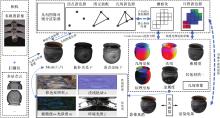
Fig. 1
The overall technical roadmap"

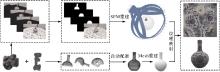
Fig. 2
Initial model reconstruction method for close-range photogrammetry based on handheld 3D laser scanner"
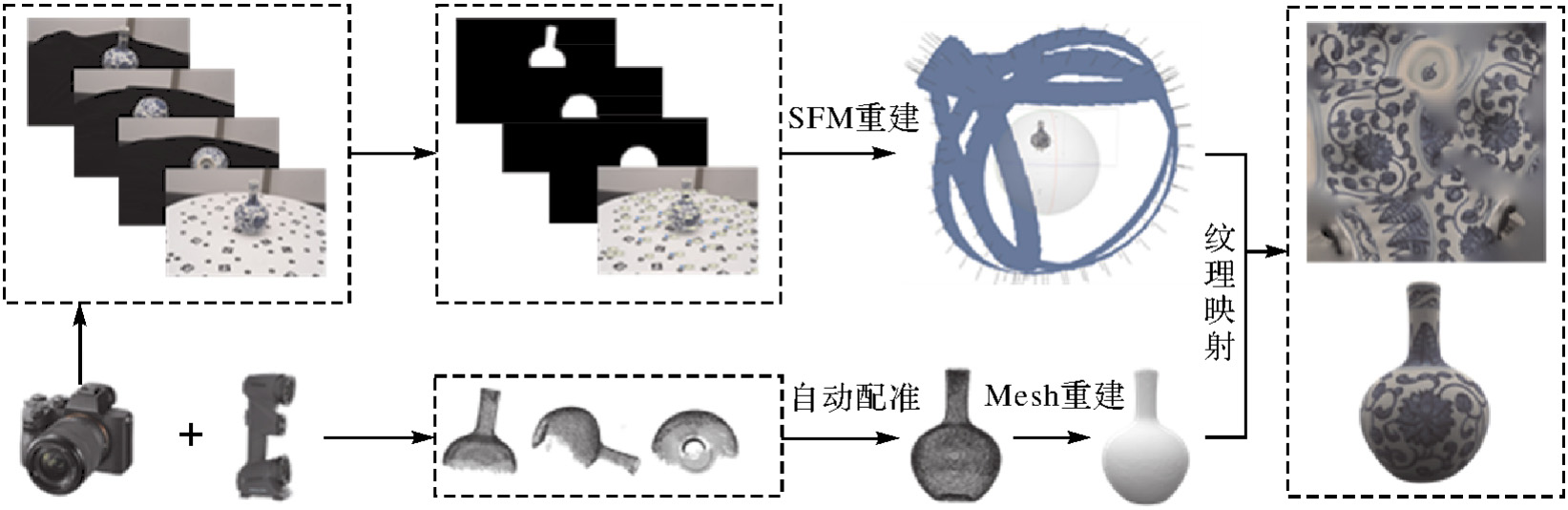
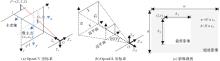
Fig. 3
The conversion relationship between virtual camera of local images and GPU rendering pipeline"
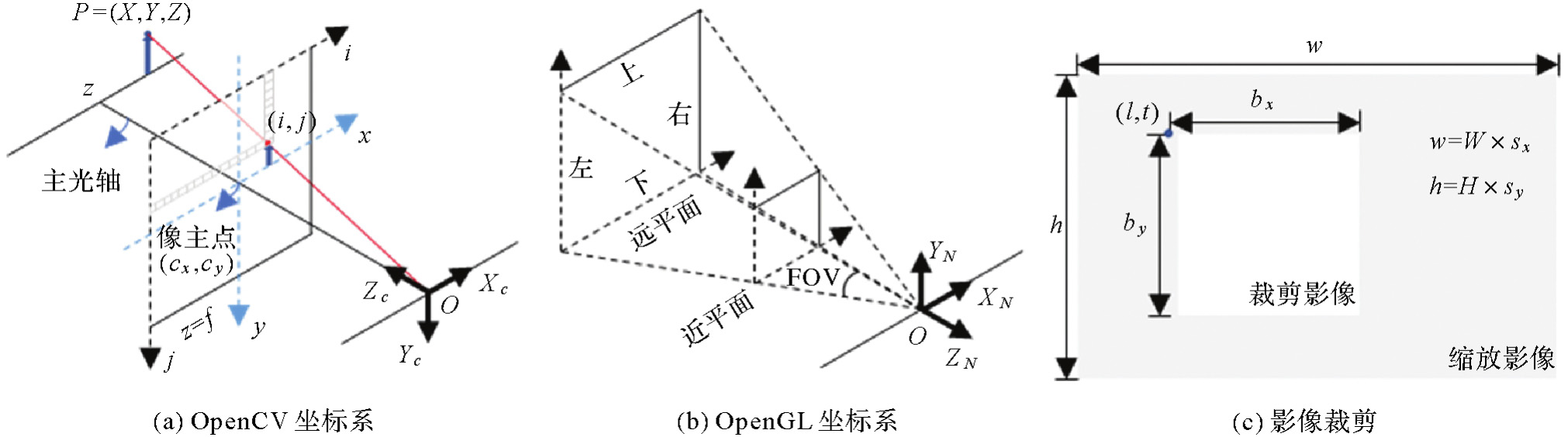
Fig. 4
Rendering equation split sum approximation calculation method"
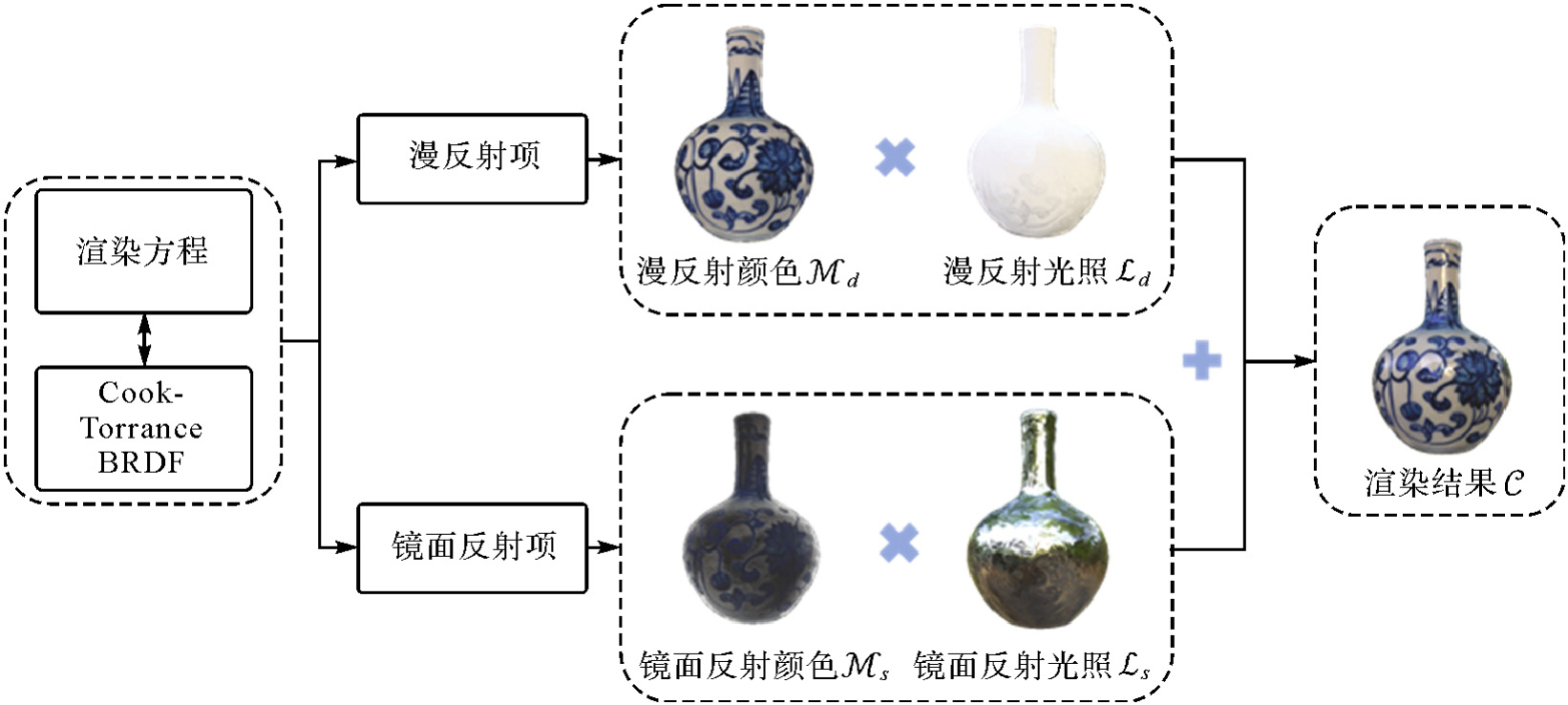
Fig. 5
Irradiance of HDR skybox image radiance pre-integration"
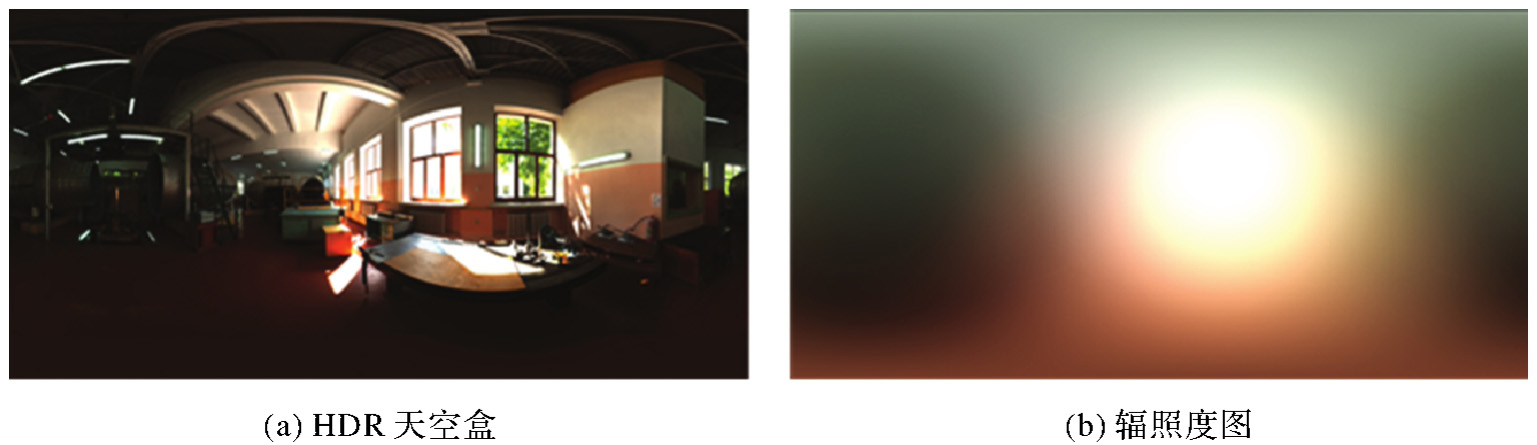
Fig. 6
Pyramid representation of specular term irradiance maps for different roughness levels"
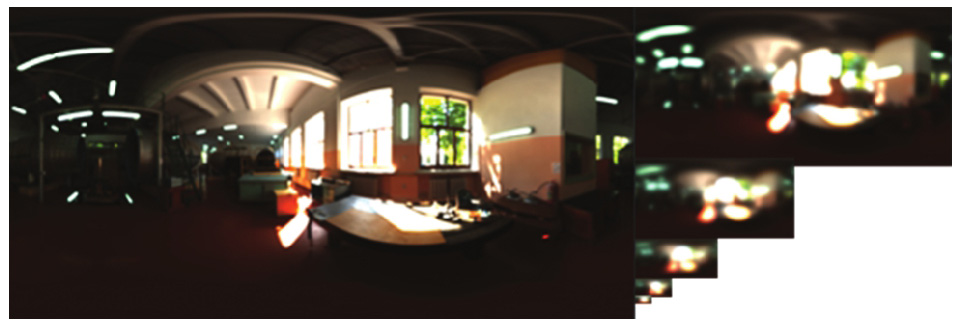
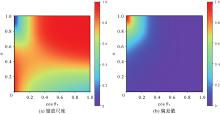
Fig. 7
Lookup table for specular term scaling and bias"
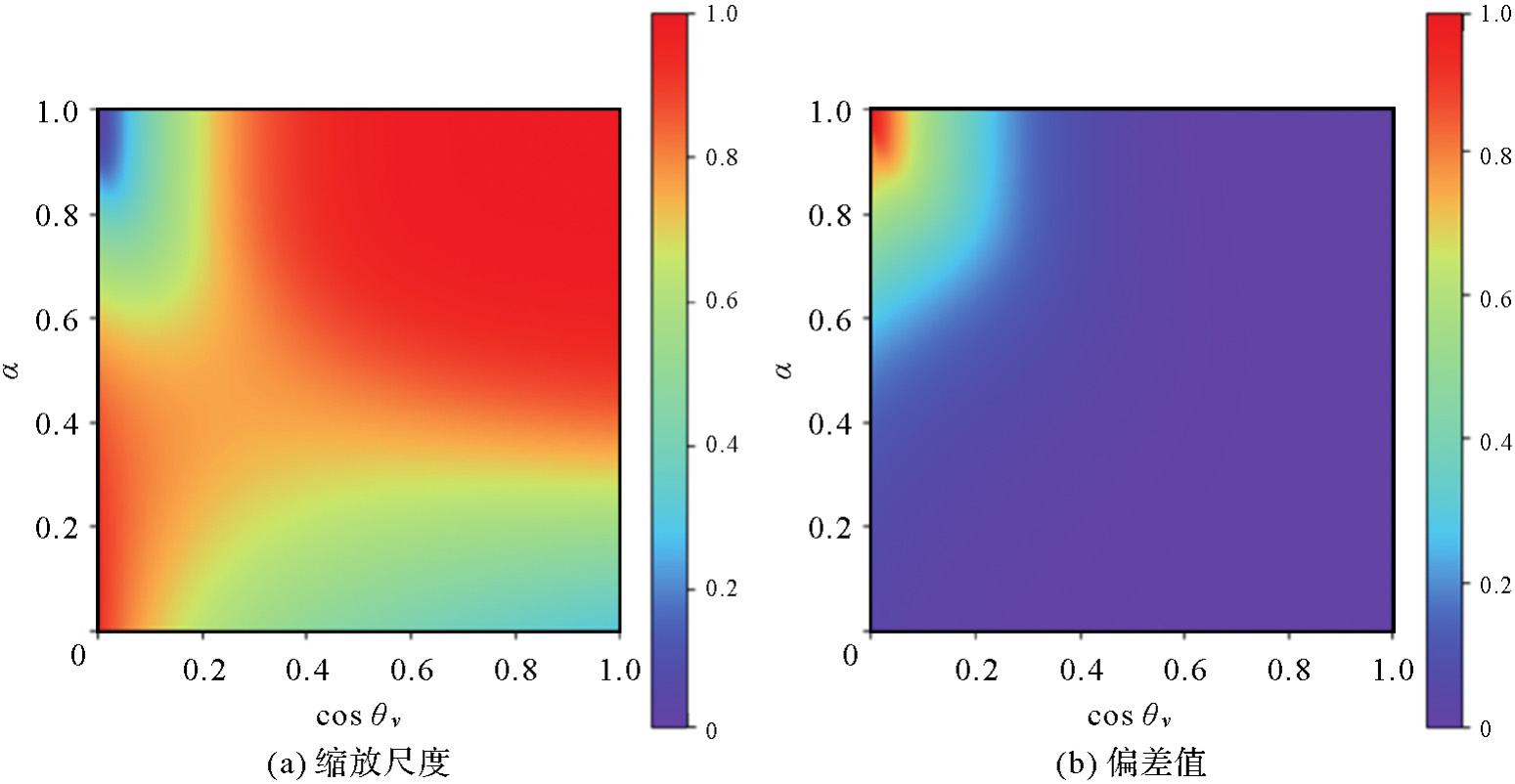
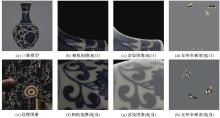
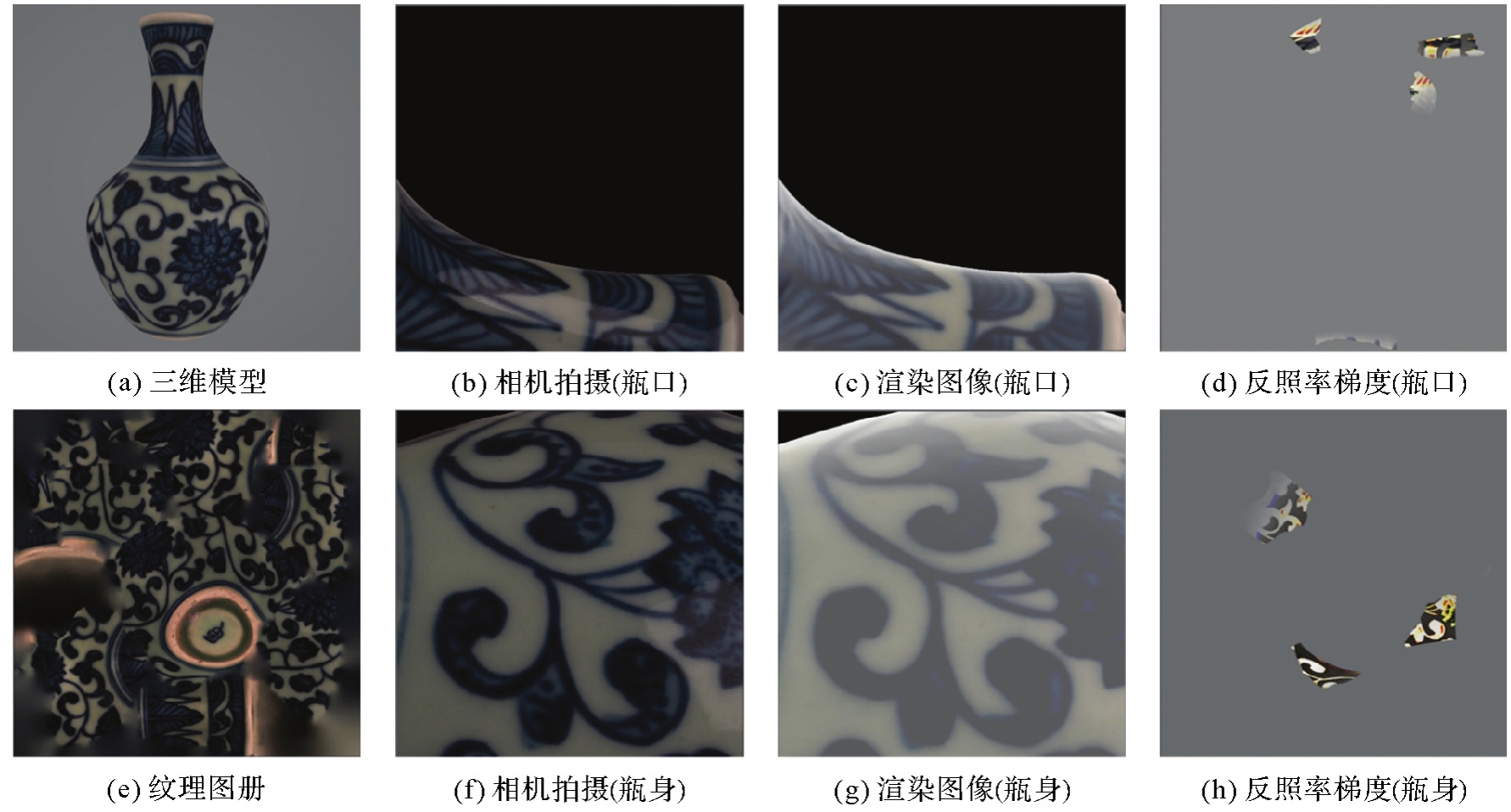
Fig. 8
Back propagation gradient visualization"

Tab. 1
Experimental data model parameters"
| 名称 | 模型尺寸(高×宽)/cm | 网格模型数量(顶点/面片) | 空三精度/像素 | 模型影像 |
|---|---|---|---|---|
| 花瓶 | 10×6 | 6.06×10⁵/12.11×105 | 1.44 |  |
| 碗 | 7×13 | 11.55×10⁵/23.10×105 | 1.11 |  |
| 锥形花盆 | 12.5×9 | 23.69×10⁵/47.29×105 | 0.52 |  |
| 罐 | 12×10 | 22.54×10⁵/44.91×105 | 0.58 |  |
| 桶形花盆 | 14×15 | 45.79×10⁵/91.57×105 | 0.77 |  |
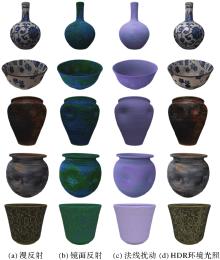
Fig. 9
Geometric material reconstruction results"

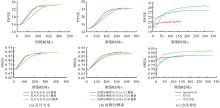
Fig. 10
Algorithm reconstruction efficiency and stability"

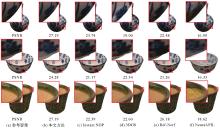
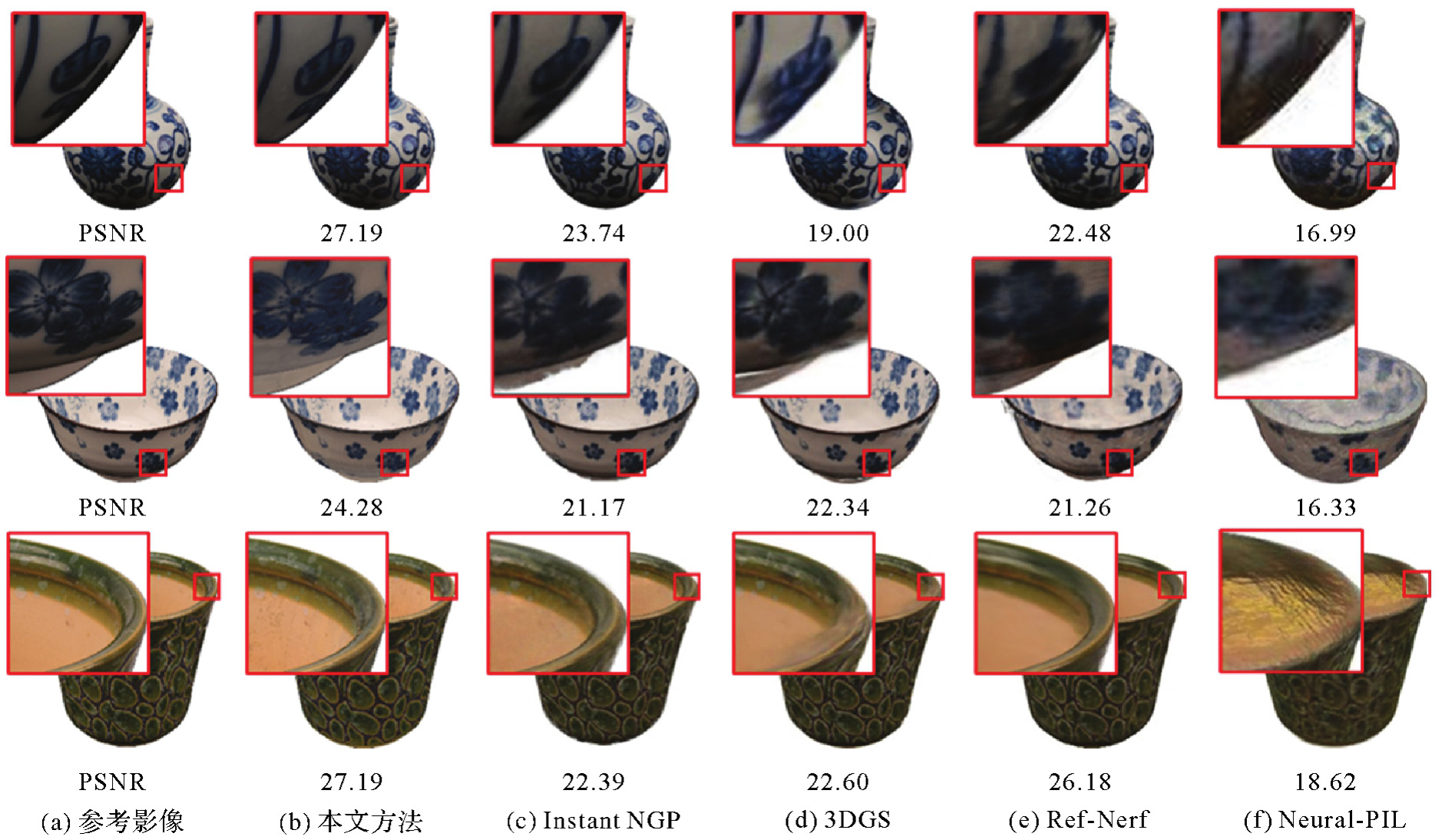
Fig. 11
Comparison of reconstruction results"
Tab. 2
Comparison of quantitative indicators of experimental results"
| 数据集 | 方法 | PSNR↑ | SSIM↑ | LPIPS↓ |
|---|---|---|---|---|
 | 摄影测量方法 | 14.61 | 0.81 | 0.13 |
| 3DGS | 17.03 | 0.80 | 0.11 | |
| InstantNGP | 18.26 | 0.79 | 0.15 | |
| Neural-PIL | 17.67 | 0.61 | 0.22 | |
| Ref-NeRF | 21.93 | 0.81 | 0.28 | |
| 本文方法 | 24.19 | 0.89 | 0.09 | |
 | 摄影测量方法 | 15.44 | 0.89 | 0.08 |
| 3DGS | 24.49 | 0.88 | 0.10 | |
| InstantNGP | 22.78 | 0.92 | 0.14 | |
| Neural-PIL | 18.69 | 0.56 | 0.33 | |
| Ref-NeRF | 21.75 | 0.82 | 0.31 | |
| 本文方法 | 27.56 | 0.91 | 0.09 | |
 | 摄影测量方法 | 20.24 | 0.85 | 0.14 |
| 3DGS | 29.01 | 0.86 | 0.14 | |
| InstantNGP | 21.99 | 0.87 | 0.24 | |
| Neural-PIL | 17.64 | 0.55 | 0.26 | |
| Ref-NeRF | 23.48 | 0.84 | 0.28 | |
| 本文方法 | 33.23 | 0.95 | 0.04 | |
 | 摄影测量方法 | 17.62 | 0.86 | 0.13 |
| 3DGS | 29.78 | 0.88 | 0.11 | |
| InstantNGP | 21.92 | 0.88 | 0.28 | |
| Neural-PIL | 19.06 | 0.60 | 0.20 | |
| Ref-NeRF | 26.37 | 0.88 | 0.26 | |
| 本文方法 | 28.93 | 0.93 | 0.08 | |
 | 摄影测量方法 | 19.43 | 0.85 | 0.12 |
| 3DGS | 25.56 | 0.82 | 0.13 | |
| InstantNGP | 23.04 | 0.84 | 0.31 | |
| Neural-PIL | 18.85 | 0.47 | 0.36 | |
| Ref-NeRF | 24.77 | 0.82 | 0.33 | |
| 本文方法 | 30.82 | 0.93 | 0.11 |
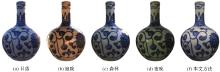
Fig. 12
HDR ambient lighting effect"
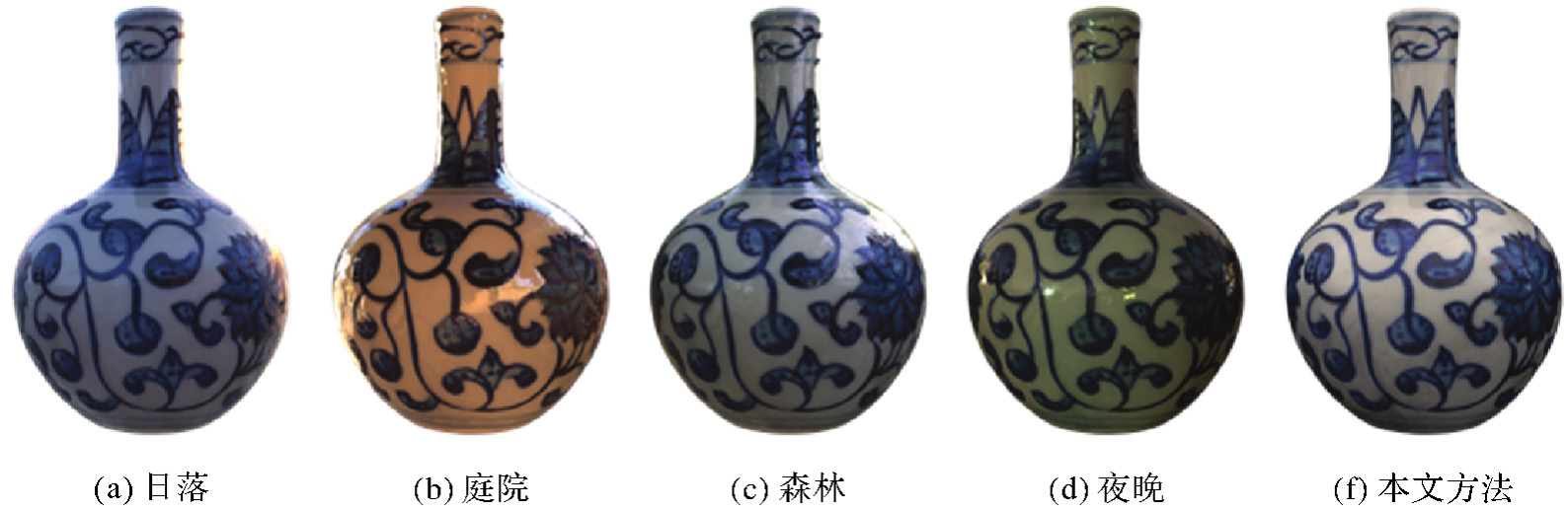
Fig. 13
Moving point light source illumination effect"

| [1] | WAECHTER M, MOEHRLE N, GOESELE M. Let there be color! large-scale texturing of 3D reconstructions[C]//Proceedings of 2014 European Conference on Computer Vision. Cham: Springer International Publishing, 2014: 836-850. |
| [2] | ZHOU Qianyi, KOLTUN V. Color map optimization for 3D reconstruction with consumer depth cameras[J]. ACM Transactions on Graphics, 2014, 33(4): 1-10. |
| [3] |
肖腾, 王鑫, 梅熙, 等. 摄影测量局部场景稳健合并的并行式运动恢复结构方法[J]. 测绘学报, 2024, 53(2): 332-343. DOI:.
doi: 10.11947/j.AGCS.2024.20220321 |
|
XIAO Teng, WANG Xin, MEI Xi, et al. Robust merging of subblock reconstructions for parallel structure from motion in photogrammetry[J]. Acta Geodaetica et Cartographica Sinica, 2024, 53(2): 332-343. DOI:.
doi: 10.11947/j.AGCS.2024.20220321 |
|
| [4] |
姜三, 马一尘, 李清泉, 等. 无序无人机影像的并行化SfM三维重建方法[J]. 测绘学报, 2024, 53(5): 946-958. DOI:.
doi: 10.11947/j.AGCS.2024.20230335 |
|
JIANG San, MA Yichen, LI Qingquan, et al. Parallel SfM-based 3D reconstruction for unordered UAV images[J]. Acta Geodaetica et Cartographica Sinica, 2024, 53(5): 946-958. DOI:.
doi: 10.11947/j.AGCS.2024.20230335 |
|
| [5] | 付琳, 洪海波, 王晰, 等. 基于逆向反射模型的非朗伯光度立体视觉[J]. 光学学报, 2020, 40(5): 151-161. |
| FU Lin, HONG Haibo, WANG Xi, et al. Non-Lambertian photometric stereo vision based on inverse reflectance model[J]. Acta Optica Sinica, 2020, 40(5): 151-161. | |
| [6] | MILDENHALL B, SRINIVASAN P P, TANCIK M, et al. NeRF: representing scenes as neural radiance fields for view synthesis[J]. Communications of the ACM, 2022, 65(1): 99-106. |
| [7] | MÜLLER T, EVANS A, SCHIED C, et al. Instant neural graphics primitives with a multiresolution hash encoding[J]. ACM Transactions on Graphics, 2022, 41(4): 1-15. |
| [8] | FRIDOVICH-KEIL S, YU A, TANCIK M, et al. Plenoxels: radiance fields without neural networks[C]//Proceedings of 2022 IEEE/CVF Conference on Computer Vision and Pattern Recognition. New Orleans: IEEE, 2022: 5501-5510. |
| [9] | XU Qiangeng, XU Zexiang, PHILIP J, et al. Point-NeRF: point-based neural radiance fields[C]//Proceedings of 2022 IEEE/CVF Conference on Computer Vision and Pattern Recognition. New Orleans: IEEE, 2022: 5438-5448. |
| [10] | KERBL B, KOPANAS G, LEIMKUEHLER T, et al. 3D Gaussian splatting for real-time radiance field rendering[J]. ACM Transactions on Graphics, 2023, 42(4): 1-14. |
| [11] | AZINOVIC D, MARTIN-BRUALLA R, GOLDMAN D B, et al. Neural RGB-D surface reconstruction[C]//Proceedings of 2022 IEEE/CVF Conference on Computer Vision and Pattern Recognition. New Orleans: IEEE, 2022: 6290-6301. |
| [12] | WANG Peng, LIU Lingjie, LIU Yuan, et al. NeuS: learning neural implicit surfaces by volume rendering for multi-view reconstruction[EB/OL]. [2024-04-20]. https://arxiv.org/abs/2106.10689v3. |
| [13] | YANG Bangbang, BAO Chong, ZENG Junyi, et al. NeuMesh: learning disentangled neural mesh-based implicit field for Geometry and Texture editing[C]//Proceedings of 2022 European Conference on Computer Vision. Cham: Springer Nature Switzerland, 2022: 597-614. |
| [14] | WIZADWONGSA S, PHONGTHAWEE P, YENPHRAPHAI J, et al. NeX: real-time view synthesis with neural basis expansion[C]//Proceedings of 2021 IEEE/CVF Conference on Computer Vision and Pattern Recognition. Nashville: IEEE, 2021: 8534-8543. |
| [15] | MILLER B, GEORGIEV I, JAROSZ W. A null-scattering path integral formulation of light transport[J]. ACM Transactions on Graphics, 2019, 38(4): 1-13. |
| [16] | HART J C. Sphere tracing: a geometric method for the antialiased ray tracing of implicit surfaces[J]. The Visual Computer, 1996, 12(10): 527-545. |
| [17] | TEWARI A, THIES J, MILDENHALL B, et al. Advances in neural rendering[J]. Computer Graphics Forum, 2022, 41(2): 703-735. |
| [18] | TUCKER R, SNAVELY N. Single-view view synthesis with multiplane images[C]//Proceedings of 2020 IEEE/CVF Conference on Computer Vision and Pattern Recognition. Seattle: IEEE, 2020: 551-560. |
| [19] | MÜLLER T, ROUSSELLE F, NOVÁK J, et al. Real-time neural radiance caching for path tracing[J]. ACM Transactions on Graphics, 2021, 40(4): 1-16. |
| [20] | CHEN Anpei, XU Zexiang, GEIGER A, et al. TensoRF: tensorial radiance fields[C]//Proceedings of 2022 European Conference on Computer Vision. Cham: Springer Nature Switzerland, 2022: 333-350. |
| [21] | 许威威, 周漾, 吴鸿智, 等. 可微绘制技术研究进展[J]. 中国图象图形学报, 2021, 26(6): 1521-1535. |
| XU Weiwei, ZHOU Yang, WU Hongzhi, et al. Differential rendering: a survey[J]. Journal of Image and Graphics, 2021, 26(6): 1521-1535. | |
| [22] | HU Han, DING Yulin, ZHU Qing, et al. Stable least-squares matching for oblique images using bound constrained optimization and a robust loss function[J]. ISPRS Journal of Photogrammetry and Remote Sensing, 2016, 118: 53-67. |
| [23] | ENGEL J, SCHÖPS T, CREMERS D. LSD-SLAM: large-scale direct monocular SLAM[C]//Proceedings of 2014 European Conference on Computer Vision. Cham: Springer International Publishing, 2014: 834-849. |
| [24] | VU H H, LABATUT P, PONS J P, et al. High accuracy and visibility-consistent dense multiview stereo[J]. IEEE Transactions on Pattern Analysis and Machine Intelligence, 2012, 34(5): 889-901. |
| [25] | FURUKAWA Y, PONCE J. Dense 3D motion capture from synchronized video streams[M]//RONFARD R, TAUBIN G, ed. Image and geometry processing for 3D cinematography. Berlin: Springer, 2010: 193-211. |
| [26] | GOURAUD H. Continuous shading of curved surfaces[M]//WOLFE R, ed. Seminal graphics: pioneering efforts that shaped the field. New York: Association for Computing Machinery, 1998: 87-93. |
| [27] | ZHU Qing, WANG Zhendong, HU Han, et al. Leveraging photogrammetric mesh models for aerial-ground feature point matching toward integrated 3D reconstruction[J]. ISPRS Journal of Photogrammetry and Remote Sensing, 2020, 166: 26-40. |
| [28] | KARIS B. Real shading in unreal Engine 4[J]. SIGGRAPH, 2013, 4(3): 1-21. |
| [29] | LAINE S, HELLSTEN J, KARRAS T, et al. Modular primitives for high-performance differentiable rendering[J]. ACM Transactions on Graphics, 2020, 39(6): 1-14. |
| [30] | HARGREAVES S, HARRIS M. Deferred shading[C]//Proceedings of 2004 Game Developers Conference. San Jose: [s. n.]. 2004, 2: 31. |
| [31] | 中观自动化科技有限公司. AtlaScan多模式多功能量测3D扫描仪[EB/OL]. [2024-04-20]. https://www.zg-3d.com/AtlaScan.html. |
| ZG Technology Co., Ltd.. AtlaScan multimodal multi-functional measurement 3D scanner[EB/OL]. [2024-04-20]. https://www.zg-3d.com/AtlaScan.html. | |
| [32] | CHENG H K, SCHWING A G. XMem: long-term video object segmentation with an Atkinson-Shiffrin memory model[C]//Proceedings of 2022 European Conference on Computer Vision. Cham: Springer Nature Switzerland, 2022: 640-658. |
| [33] | AGISOFT . Agisoft metashape[EB/OL]. [2024-04-20]. https://www.agisoft.com/. |
| [34] | KAJIYA J T. The rendering equation[C]//Proceedings of the 13th Annual Conference on Computer Graphics and Interactive Techniques. New York: ACM Press, 1986: 143-150. |
| [35] | WALTER B, MARSCHNER S R, LI H, et al. Microfacet models for refraction through rough surfaces[C]//Proceedings of the 18th Eurographics Conference on Rendering Techniques. Goslar: Eurographics Association, 2007: 195-206. |
| [36] | WANG Z, BOVIK A C, SHEIKH H R, et al. Image quality assessment: from error visibility to structural similarity[J]. IEEE Transactions on Image Processing, 2004, 13(4): 600-612. |
| [37] | ZHANG R, ISOLA P, EFROS A A, et al. The unreasonable effectiveness of deep features as a perceptual metric[C]//Proceedings of 2018 IEEE/CVF Conference on Computer Vision and Pattern Recognition. Salt Lake City: IEEE, 2018: 586-595. |
| [38] | BOSS M, JAMPANI V, BRAUN R, et al. Neural-pil: neural pre-integrated lighting for reflectance decomposition[J]. Advances in Neural Information Processing Systems, 2021, 34: 10691-10704. |
| [39] | VERBIN D, HEDMAN P, MILDENHALL B, et al. Ref-NeRF: structured view-dependent appearance for neural radiance fields[C]//Proceedings of 2022 IEEE/CVF Conference on Computer Vision and Pattern Recognition. New Orleans: IEEE, 2022: 5481-5490. |
| [40] |
朱庆, 张利国, 丁雨淋, 等. 从实景三维建模到数字孪生建模[J]. 测绘学报, 2022, 51(6): 1040-1049. DOI:.
doi: 10.11947/j.AGCS.2022.20210640 |
|
ZHU Qing, ZHANG Liguo, DING Yulin, et al. From real 3D modeling to digital twin modeling[J]. Acta Geodaetica et Cartographica Sinica, 2022, 51(6): 1040-1049. DOI:.
doi: 10.11947/j.AGCS.2022.20210640 |
| [1] | LEI Zhen, ZHANG Fan, XIANG Hanyu, YANG Chong, HUANG Xianfeng. Multiple view complete 3D model reconstruction of manually turned object [J]. Acta Geodaetica et Cartographica Sinica, 2023, 52(8): 1305-1316. |
| Viewed | ||||||
|
Full text |
|
|||||
|
Abstract |
|
|||||
