

Acta Geodaetica et Cartographica Sinica ›› 2025, Vol. 54 ›› Issue (8): 1404-1415.doi: 10.11947/j.AGCS.2025.20240318
• Geodesy and Navigation • Previous Articles Next Articles
Xiong PAN1( ), Longjie ZHANG1, Qingsong AI3, Lihong JIN2(), Mao CAI1
Received:2024-08-01
Revised:2025-07-03
Online:2025-09-16
Published:2025-09-16
Contact:
Lihong JIN
E-mail:pxjlh@163.com;2022018@wtu.edu.cn
About author:PAN Xiong (1973—), male, PhD, professor, majors in deep learning and satellite navigation positioning. E-mail: pxjlh@163.com
Supported by:CLC Number:
Xiong PAN, Longjie ZHANG, Qingsong AI, Lihong JIN, Mao CAI. Improved ABC algorithm for optimizing BP neural network in short-term clock bias prediction and application[J]. Acta Geodaetica et Cartographica Sinica, 2025, 54(8): 1404-1415.
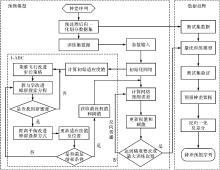
Fig. 1
Flowchart of short-term clock error prediction algorithm"

Tab. 1
BDS-3 satellite clock types"
| 类型 | PRN |
|---|---|
| MEO-Rb | C19、C20、C21、C22、C23、C24、C32、C33、C36、C37、C41、C42 |
| MEO-PHM | C25、C26、C27、C28、C29、C30、C34、C35、C43、C44、C45、C46 |
| IGSO-PHM | C38、C39、C40 |
| GEO-PHM | C59、C60 |
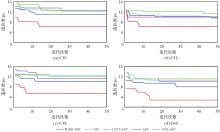
Fig. 2
Evolution of the fitness of optimal individuals with different algorithms"
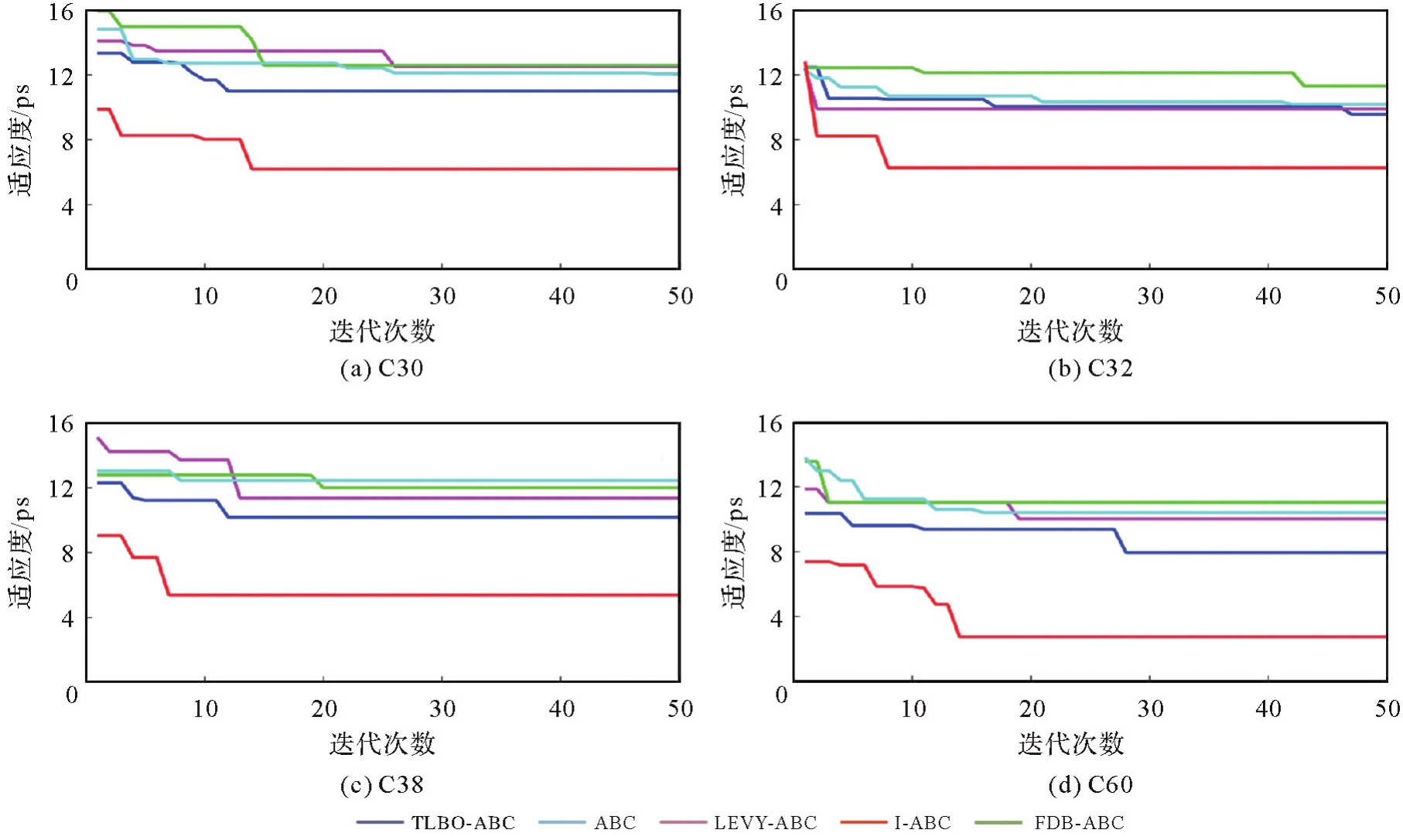
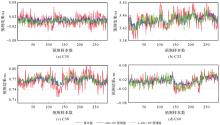
Fig. 3
Prediction results of the ABC-BP and I-ABC-BP"

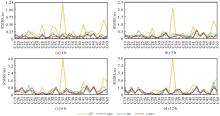
Fig. 4
Across all satellites for each model"

Tab. 2
Mean RMSE of all satellites"
| 预报时间/h | QP/ns | BP/ns | ABC-BP/ns | I-ABC-BP/ns | 相对于基准策略/(%) |
|---|---|---|---|---|---|
| 1 | 0.24 | 0.11 | 0.08 | 0.07 | 12.50 |
| 3 | 0.37 | 0.23 | 0.17 | 0.16 | 5.88 |
| 6 | 0.63 | 0.43 | 0.35 | 0.33 | 5.71 |
| 12 | 1.41 | 0.77 | 0.72 | 0.69 | 4.17 |
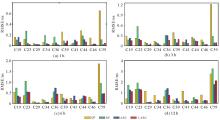
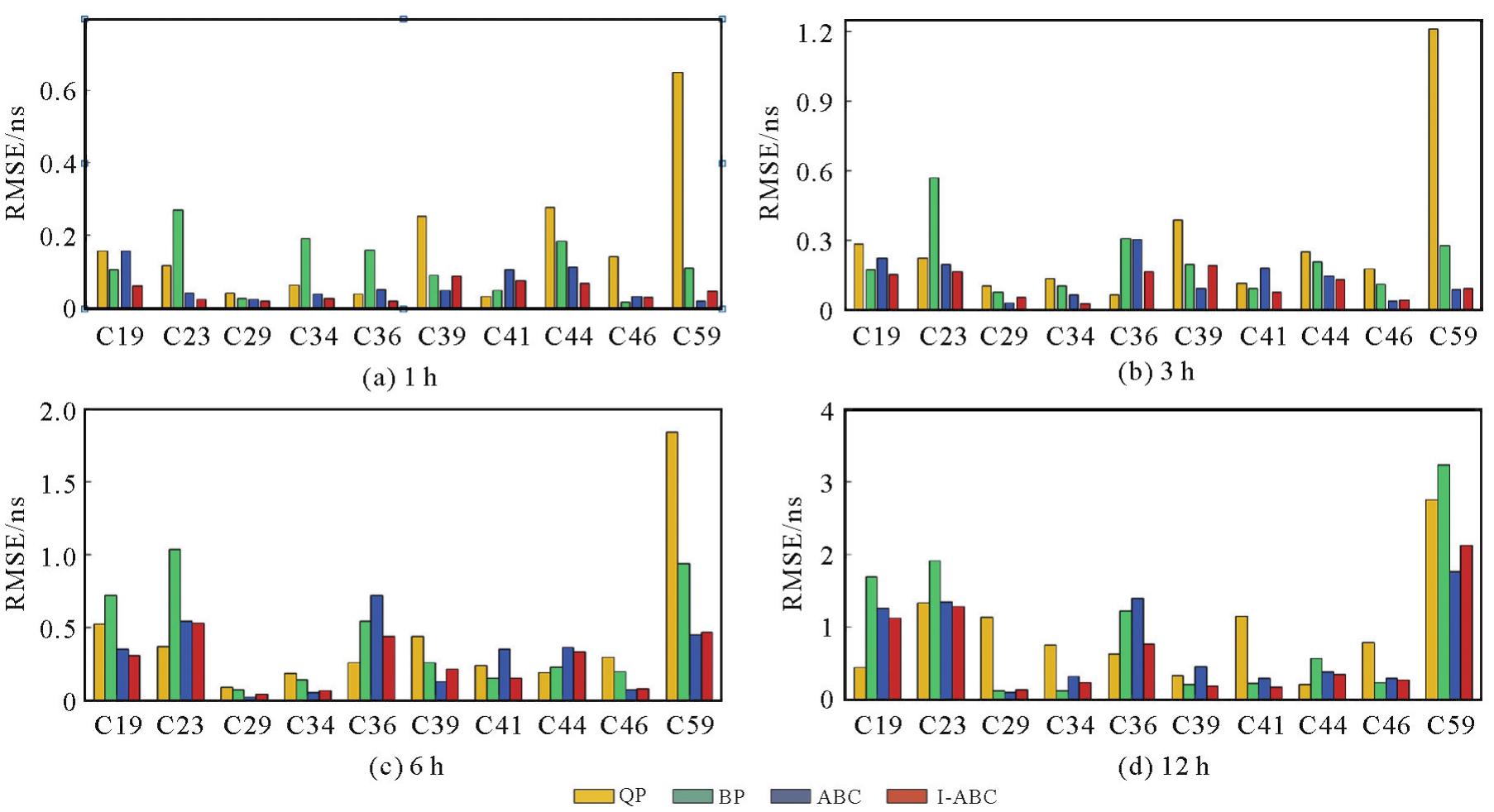
Fig. 5
RMSE for different orbits and satellite types across various models"
Tab. 3
Forecast results for different orbits and clock types under 1-hour"
| 钟类型 | QP | BP | ABC-BP | I-ABC-BP | ||||||||
|---|---|---|---|---|---|---|---|---|---|---|---|---|
| RMSE | Range | Mean | RMSE | Range | Mean | RMSE | Range | Mean | RMSE | Range | Mean | |
| MEO-Rb | 0.199 | 0.124 | 0.193 | 0.139 | 0.189 | 0.123 | 0.092 | 0.150 | 0.078 | 0.072 | 0.129 | 0.058 |
| MEO-PHM | 0.271 | 0.170 | 0.265 | 0.100 | 0.151 | 0.084 | 0.073 | 0.123 | 0.060 | 0.070 | 0.119 | 0.056 |
| IGSO-PHM | 0.107 | 0.076 | 0.104 | 0.079 | 0.112 | 0.073 | 0.071 | 0.089 | 0.065 | 0.071 | 0.087 | 0.065 |
| GEO-PHM | 0.462 | 0.284 | 0.454 | 0.076 | 0.133 | 0.062 | 0.035 | 0.097 | 0.011 | 0.071 | 0.154 | 0.048 |
Tab. 4
Forecast results for different orbits and clock types under 3-hour"
| 钟类型 | QP | BP | ABC-BP | I-ABC-BP | ||||||||
|---|---|---|---|---|---|---|---|---|---|---|---|---|
| RMSE | Range | Mean | RMSE | Range | Mean | RMSE | Range | Mean | RMSE | Range | Mean | |
| MEO-Rb | 0.276 | 0.336 | 0.251 | 0.292 | 0.469 | 0.255 | 0.205 | 0.377 | 0.163 | 0.200 | 0.398 | 0.153 |
| MEO-PHM | 0.412 | 0.529 | 0.362 | 0.195 | 0.352 | 0.153 | 0.141 | 0.364 | 0.078 | 0.118 | 0.319 | 0.060 |
| IGSO-PHM | 0.180 | 0.268 | 0.149 | 0.175 | 0.286 | 0.150 | 0.125 | 0.201 | 0.112 | 0.103 | 0.161 | 0.091 |
| GEO-PHM | 0.909 | 1.173 | 0.837 | 0.199 | 0.345 | 0.175 | 0.162 | 0.358 | 0.116 | 0.213 | 0.437 | 0.144 |
Tab. 5
Forecast results for different orbits and clock types under 6-hour"
| 钟类型 | QP | BP | ABC-BP | I-ABC-BP | ||||||||
|---|---|---|---|---|---|---|---|---|---|---|---|---|
| RMSE | Range | Mean | RMSE | Range | Mean | RMSE | Range | Mean | RMSE | Range | Mean | |
| MEO-Rb | 0.493 | 0.812 | 0.399 | 0.569 | 1.070 | 0.459 | 0.448 | 0.903 | 0.352 | 0.443 | 0.880 | 0.351 |
| MEO-PHM | 0.683 | 1.035 | 0.593 | 0.299 | 0.537 | 0.246 | 0.256 | 0.538 | 0.173 | 0.218 | 0.498 | 0.134 |
| IGSO-PHM | 0.276 | 0.453 | 0.238 | 0.268 | 0.440 | 0.239 | 0.202 | 0.391 | 0.147 | 0.151 | 0.296 | 0.118 |
| GEO-PHM | 1.628 | 2.257 | 1.456 | 0.555 | 1.203 | 0.440 | 0.538 | 1.226 | 0.389 | 0.557 | 1.351 | 0.396 |
Tab. 6
Forecast results for different orbits and clock types under 12-hour"
| 钟类型 | QP | BP | ABC-BP | I-ABC-BP | ||||||||
|---|---|---|---|---|---|---|---|---|---|---|---|---|
| RMSE | Range | Mean | RMSE | Range | Mean | RMSE | Range | Mean | RMSE | Range | Mean | |
| MEO-Rb | 1.166 | 1.847 | 0.808 | 1.074 | 1.941 | 0.912 | 1.051 | 1.846 | 0.861 | 0.998 | 1.763 | 0.825 |
| MEO-PHM | 1.414 | 2.385 | 1.127 | 0.473 | 0.858 | 0.398 | 0.416 | 0.909 | 0.302 | 0.381 | 0.820 | 0.279 |
| IGSO-PHM | 0.594 | 1.117 | 0.459 | 0.419 | 1.039 | 0.279 | 0.331 | 0.761 | 0.246 | 0.177 | 0.596 | 0.212 |
| GEO-PHM | 3.511 | 6.693 | 2.951 | 1.718 | 3.492 | 1.322 | 1.336 | 2.362 | 1.063 | 1.519 | 2.766 | 1.188 |
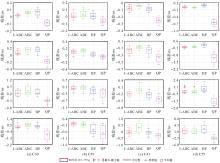
Fig. 6
Residual plots of different orbits and types of satellites under each model"

Tab. 7
Mean RMSE of all satellites"
| 预报时间/h | QP/ns | BP/ns | ABC-BP/ns | I-ABC-BP/ns |
|---|---|---|---|---|
| 1 | 3.64 | 0.24 | 0.21 | 0.20 |
| 3 | 3.70 | 0.56 | 0.44 | 0.32 |
| 6 | 3.77 | 0.72 | 0.68 | 0.47 |
| 12 | 3.93 | 1.06 | 0.84 | 0.71 |
Tab. 8
Statistical data on predicted product PPP positioning errors"
| 测站 | 纬度/(°) | 经度/(°) | 高程/m | E方向 | N方向 | U方向 | ||||||
|---|---|---|---|---|---|---|---|---|---|---|---|---|
| BP/cm | ABC-BP/cm | I-ABC-BP/cm | BP/cm | ABC-BP/cm | I-ABC-BP/cm | BP/cm | ABC-BP/cm | I-ABC-BP/cm | ||||
| UFPR | -25.448 | -49.231 | 925.8 | 13.36 | 10.23 | 9.33 | 5.27 | 4.81 | 3.04 | 10.89 | 7.93 | 6.54 |
| ABPO | -19.018 | 47.229 | 1 552.9 | 6.77 | 4.87 | 4.36 | 6.21 | 2.75 | 3.27 | 15.33 | 13.10 | 8.49 |
| ZAMB | -15.426 | 28.311 | 1 324.9 | 7.96 | 7.71 | 1.77 | 4.20 | 4.90 | 1.32 | 9.43 | 13.65 | 6.87 |
| POL2 | 42.680 | 74.694 | 1 714.2 | 1.49 | 6.71 | 1.05 | 4.64 | 5.21 | 4.14 | 9.31 | 6.72 | 4.23 |
| LICC | 51.500 | -0.175 | 88.7 | 5.85 | 6.75 | 5.21 | 3.25 | 2.22 | 2.59 | 9.73 | 13.16 | 5.73 |
| SCOR | 70.485 | -21.950 | 128.5 | 4.36 | 11.07 | 5.72 | 7.23 | 8.99 | 2.41 | 12.06 | 17.54 | 4.09 |
| [1] | 杨元喜. 北斗卫星导航系统的进展、贡献与挑战[J]. 测绘学报, 2010, 39(1): 1-6. |
| YANG Yuanxi. Progress, contribution and challenges of Compass/BeiDou satellite navigation system[J]. Acta Geodaetica et Cartographica Sinica, 2010, 39(1): 1-6. | |
| [2] | YANG Yuanxi. Resilient PNT concept frame[J]. Journal of Geodesy and Geoinformation Science, 2019, 2(3): 1-7. |
| [3] | YAO Yibin, YANG Yuanxi, SUN Heping, et al. Geodesy discipline: progress and perspective[J]. Journal of Geodesy and Geoinformation Science, 2021, 4(4): 1-10. |
| [4] | CHEN Jun, LI Zhilin, LI Songnian, et al. From digitalized to intelligentized surveying and mapping: fundamental issues and research agenda[J]. Journal of Geodesy and Geoinformation Science, 2022, 5(2): 148-160. |
| [5] | 毛亚, 王潜心, 胡超, 等. BDS-3卫星钟差特性分析[J]. 武汉大学学报(信息科学版), 2020, 45(1): 53-61. |
| MAO Ya, WANG Qianxin, HU Chao, et al. Analysis of the characterization for BDS-3 satellite clock error[J]. Geomatics and Information Science of Wuhan University, 2020, 45(1): 53-61. | |
| [6] | 潘雄, 赵万卓, 黄伟凯, 等. 基于优化自注意力神经网络的卫星钟差短期预报[J]. 中国惯性技术学报, 2023, 31(11): 1092-1101. |
| PAN Xiong, ZHAO Wanzhuo, HUANG Weikai, et al. Short-term prediction of satellite clock bias based on improved self-attention model[J]. Journal of Chinese Inertial Technology, 2023, 31(11): 1092-1101. | |
| [7] | XI Chao, CAI Chenglin, LI Simin, et al. Long-term clock bias prediction based on an ARIMA model[J]. Chinese Astronomy and Astrophysics, 2014, 38(3): 342-354. |
| [8] | YAN Xiong, LI Wentao, YANG Yufeng, et al. BDS satellite clock offset prediction based on a semiparametric adjustment model considering model errors[J]. Satellite Navigation, 2020, 1(1): 11. |
| [9] | 潘雄, 杨玉锋, 欧吉坤, 等. BDS-2卫星钟设计年限末期阶段性能评估与分析[J]. 大地测量与地球动力学, 2020, 40(10): 991-999, 1033. |
| PAN Xiong, YANG Yufeng, OU Jikun, et al. Performance evaluation and analysis of the final stage of BDS-2 satellite clock design period[J]. Journal of Geodesy and Geodynamics, 2020, 40(10): 991-999, 1033. | |
| [10] |
潘雄, 黄伟凯, 赵万卓, 等. 基于BiLSTM模型的BDS-3短期钟差预报精度研究[J]. 测绘学报, 2024, 53(1): 65-78. DOI: .
doi: 10.11947/j.AGCS.2024.20230082 |
|
PAN Xiong, HUANG Weikai, ZHAO Wanzhuo, et al. Research on short-term prediction accuracy of BDS-3 clock bias based on BiLSTM model[J]. Acta Geodaetica et Cartographica Sinica, 2024, 53(1): 65-78. DOI: .
doi: 10.11947/j.AGCS.2024.20230082 |
|
| [11] | 李方能, 梁益丰, 许江宁, 等. 基于鲁棒双参数指数平滑法的BDS卫星钟差预报[J]. 中国惯性技术学报, 2024, 32(7): 645-653. |
| LI Fangneng, LIANG Yifeng, XU Jiangning, et al. Prediction of BDS satellite clock bias based on robust two-parameter exponential smoothing method[J]. Journal of Chinese Inertial Technology, 2024, 32(7): 645-653. | |
| [12] |
李文涛, 颜雄, 夏磊, 等. BDS卫星钟差半参数平差模型异常数据探测与处理[J]. 测绘学报, 2020, 49(1): 55-64. DOI: .
doi: 10.11947/j.AGCS.2020.20180384 |
|
LI Wentao, YAN Xiong, XIA Lei, et al. Abnormal data detection and process by using BDS satellite offset semiparametric adjustment model[J]. Acta Geodaetica et Cartographica Sinica, 2020, 49(1): 55-64. DOI: .
doi: 10.11947/j.AGCS.2020.20180384 |
|
| [13] | HE Shaofeng, LIU Jiulong, ZHU Xiangwei, et al. Research on modeling and predicting of BDS-3 satellite clock bias using the LSTM neural network model[J]. GPS Solutions, 2023, 27(3): 108. |
| [14] | 黄观文, 崔博斌, 张勤, 等. 附加周期和神经网络补偿的实时钟差预报模型[J]. 宇航学报, 2018, 39(1): 83-88. |
| HUANG Guanwen, CUI Bobin, ZHANG Qin, et al. Real-time clock offset prediction model with periodic and neural network corrections[J]. Journal of Astronautics, 2018, 39(1): 83-88. | |
| [15] | YANG Yuanxi, MAO Yue, SUN Bijiao. Basic performance and future developments of BeiDou global navigation satellite system[J]. Satellite Navigation, 2020, 1(1): 1. |
| [16] | ZHU Jiangmiao, SUN Panpan, GAO Yuan, et al. Clock differences prediction algorithm based on EMD-SVM[J]. Chinese Journal of Electronics, 2018, 27(1): 128-132. |
| [17] | LÜ Dong, LIU Genyou, OU Jikun, et al. Prediction of GPS satellite clock offset based on an improved particle Swarm algorithm optimized BP neural network[J]. Remote Sensing, 2022, 14(10): 2407. |
| [18] | WANG Xu, CHAI Hongzhou. Developing an innovative high-precision approach to predict medium-term and long-term satellite clock bias[J]. Journal of Geodesy and Geoinformation Science, 2023, 6(1): 47-58. |
| [19] | 黄博华, 杨勃航, 李锡瑞, 等. 顾及一次差分数据结构特征的钟差预报模型[J]. 武汉大学学报(信息科学版), 2021, 46(8): 1161-1169. |
| HUANG Bohua, YANG Bohang, LI Xirui, et al. Prediction of navigation satellite clock bias considering structure characteristics of single difference data[J]. Geomatics and Information Science of Wuhan University, 2021, 46(8): 1161-1169. | |
| [20] |
吕栋, 欧吉坤, 于胜文. 基于MEA-BP神经网络的卫星钟差预报[J]. 测绘学报, 2020, 49(8): 993-1003. DOI: .
doi: 10.11947/j.AGCS.2020.20200002 |
|
LÜ Dong, OU Jikun, YU Shengwen. Prediction of the satellite clock bias based on MEA-BP neural network[J]. Acta Geodaetica et Cartographica Sinica, 2020, 49(8): 993-1003. DOI: .
doi: 10.11947/j.AGCS.2020.20200002 |
|
| [21] | ZHU Chonghao, ZHANG Jianjing, LIU Yang, et al. Comparison of GA-BP and PSO-BP neural network models with initial BP model for rainfall-induced landslides risk assessment in regional scale: a case study in Sichuan, China[J]. Natural Hazards, 2020, 100(1): 173-204. |
| [22] | 周凯红, 叶高威, 蒋青谷. 基于SSA-GA-BP神经网络的数显千分表非线性误差补偿[J]. 河南科技大学学报(自然科学版), 2024, 45(3): 1-8, 115. |
| ZHOU Kaihong, YE Gaowei, JIANG Qinggu. Nonlinear error compensation of digital dial indicator based on SSA-GA-BP neural network[J]. Journal of Henan University of Science and Technology (Natural Science), 2024, 45(3): 1-8, 115. | |
| [23] | MENG Caixia, WU Di, LEI Yu. Neural network satellite clock bias prediction based on the whale optimization algorithm[C]//Proceedings of 2022 Advances in Natural Computation, Fuzzy Systems and Knowledge Discovery. Cham: Springer, 2022: 1152-1160. |
| [24] | RAO R V, SAVSANI V J, VAKHARIA D P. Teaching-learning-based optimization: an optimization method for continuous non-linear large scale problems[J]. Information Sciences, 2012, 183(1): 1-15. |
| [25] | CHEN Xu, XU Bin. Teaching-learning-based artificial bee colony[C]//Proceedings of 2018 Advances in Swarm Intelligence. Cham: Springer, 2018: 166-178. |
| [26] | KAHRAMAN H T, BAKIR H, DUMAN S, et al. Dynamic FDB selection method and its application: modeling and optimizing of directional overcurrent relays coordination[J]. Applied Intelligence, 2022, 52(5): 4873-4908. |
| [1] | Wenyuan ZHANG, Jinsong PENG, Nadu WEI, Yu GAO, Shubi ZHANG. A short-term prediction method for Earth's polar motion using cascaded LSTM networks based on SSA denoising [J]. Acta Geodaetica et Cartographica Sinica, 2026, 55(1): 46-58. |
| [2] | GENG Jianghui, CHANG Hua, GUO Jiang, LI Guangcai, WEI Na. Three multi-frequency and multi-system GNSS high-precision point positioning methods and their performance in complex urban environment [J]. Acta Geodaetica et Cartographica Sinica, 2020, 49(1): 1-13. |
| [3] | WANG Yuebing, GAN Weijun, CHEN Weitao, LIAN Weiping, YOU Xinzhao. The Analysis of Precise Point Positioning of BeiDou Navigation Satellite System Application in Crustal Motion Monitoring [J]. Acta Geodaetica et Cartographica Sinica, 2018, 47(1): 48-56. |
| [4] | ZHAO Hong, TU Rui, LIU Zhi, JIANG Guangwei. Determination of Ocean Tide Loading Displacement Parameters by GPS Kinematic PPP [J]. Acta Geodaetica et Cartographica Sinica, 2017, 46(8): 988-998. |
| Viewed | ||||||
|
Full text |
|
|||||
|
Abstract |
|
|||||
