

Acta Geodaetica et Cartographica Sinica ›› 2025, Vol. 54 ›› Issue (8): 1416-1426.doi: 10.11947/j.AGCS.2025.20240361
• Geodesy and Navigation • Previous Articles Next Articles
Shaobin HU1( ), Qiujie CHEN1(), Yunzhong SHEN1, Xingfu ZHANG2
Received:2024-09-01
Revised:2025-06-27
Online:2025-09-16
Published:2025-09-16
Contact:
Qiujie CHEN
E-mail:hu08180815@163.com;qiujiechen@tongji.edu.cn
About author:HU Shaobin (2001—), male, PhD candidate, majors in time-variable gravity field estimation for gravity satellites. E-mail: hu08180815@163.com
Supported by:CLC Number:
Shaobin HU, Qiujie CHEN, Yunzhong SHEN, Xingfu ZHANG. An efficient discretization approach for the short-arc integral equation based on Adams and KSG integrators[J]. Acta Geodaetica et Cartographica Sinica, 2025, 54(8): 1416-1426.
Tab. 1
Information on the Kepler elements of the twin GRACE-FO satellites used for simulation"
| Kepler参数 | TLE历时 | 轨道倾角/(°) | 升交点赤经/(°) | 轨道偏心率 | 近地点幅角/(°) | 平近点角/(°) | 平运动速度/(圈/d) |
|---|---|---|---|---|---|---|---|
| GRACE-FO(A) | 19 350.78 | 89.00 | 162.51 | 0.001 5 | 243.05 | 116.92 | 15.24 |
| GRACE-FO(B) | 19 350.78 | 89.00 | 162.51 | 0.001 5 | 242.59 | 117.39 | 15.24 |

Fig. 1
Discretization coefficient matrices for both approaches and their corresponding differences"

Tab. 2
Statistical indicator of discretization coefficient matrices for position and velocity equations"
| 方程 | 指标 | CM | IM |
|---|---|---|---|
| 位置方程 | Max | 5.8×10⁻⁵ | 5.8×10⁻⁵ |
| Min | 0 | -9.0×10⁻⁸ | |
| RMS | 3.8×10⁻⁹ | ||
| 速度方程 | Max | 6.5×10⁻⁴ | 4.1×10⁻⁴ |
| Min | -6.5×10⁻⁴ | -3.2×10⁻⁴ | |
| RMS | 2.1×10⁻⁶ | ||
Tab. 3
The percentage of discretization coefficient differences within the range of specified multiple standard deviation for position and velocity equations"
| 方程 | 标准差倍数 | 百分比 |
|---|---|---|
| 位置方程 | 1倍 | 99.49 |
| 2倍 | 99.59 | |
| 3倍 | 99.62 | |
| 速度方程 | 1倍 | 99.81 |
| 2倍 | 99.84 | |
| 3倍 | 99.86 |
Tab. 4
Time cost for computing discretization coefficient matrices for the position and velocity equations using different arc lengths"
| 积分方法 | 位置和速度方程离散化系数矩阵求解时间 | |||||
|---|---|---|---|---|---|---|
| 1 h | 2 h | 3 h | 4 h | 5 h | 6 h | |
| CM-P | 0.15 | 0.63 | 1.37 | 2.54 | 3.94 | 5.58 |
| IM-P | 0.02 | 0.09 | 0.19 | 0.33 | 0.51 | 0.89 |
| 提升百分比-P | 86.7% | 85.7% | 86.1% | 87.0% | 87.1% | 84.1% |
| CM-V | 0.15 | 0.63 | 1.37 | 2.54 | 3.95 | 5.59 |
| IM-V | 0.01 | 0.05 | 0.10 | 0.17 | 0.27 | 0.47 |
| 提升百分比-V | 93.3% | 92.1% | 92.7% | 93.3% | 93.2% | 91.6% |

Fig. 2
The differences between the orbits integrated by the two approaches and the Kepler orbits"

Tab. 5
Monthly mean RMS of the difference between integrated orbits and Kepler orbits for different arc lengths"
| 弧长 | IMk5-P/m | IMk7-P/m | IMk9-P/m | IMk11-P/m | IMk5-V/(m/s) | IMk7-V/(m/s) | IMk9-V/(m/s) | IMk11-V/(m/s) | CM-P/m | CM-V/(m/s) |
|---|---|---|---|---|---|---|---|---|---|---|
| 1 h | 5.455 3×10⁻⁷ | 3.390 5×10⁻⁷ | 3.390 3×10⁻⁷ | 3.390 9×10⁻⁷ | 6.074 2×10⁻¹⁰ | 4.615 6×10⁻¹⁰ | 4.615 8×10⁻¹⁰ | 4.617 4×10⁻¹⁰ | 3.395 7×10⁻⁷ | 4.616 5×10⁻¹⁰ |
| 2 h | 6.326 3×10⁻⁷ | 3.581 6×10⁻⁷ | 3.581 3×10⁻⁷ | 3.581 5×10⁻⁷ | 6.214 1×10⁻¹⁰ | 4.453 2×10⁻¹⁰ | 4.453 4×10⁻¹⁰ | 4.454 6×10⁻¹⁰ | 3.608 9×10⁻⁷ | 4.458 0×10-10 |
| 3 h | 6.812 6×10⁻⁷ | 3.684 5×10⁻⁷ | 3.684 1×10⁻⁷ | 3.684 3×10⁻⁷ | 6.241 1×10⁻¹⁰ | 4.425 0×10-10 | 4.425 2×10⁻¹⁰ | 4.426 5×10⁻¹⁰ | 3.737 4×10⁻⁷ | 4.431 5×10⁻¹⁰ |
| 4 h | 6.145 2×10⁻⁷ | 3.716 2×10⁻⁷ | 3.715 9×10⁻⁷ | 3.715 9×10⁻⁷ | 6.224 4×10⁻¹⁰ | 4.426 8×10⁻¹⁰ | 4.427 3×10⁻¹⁰ | 4.428 4×10⁻¹⁰ | 3.807 3×10⁻⁷ | 4.436 3×10⁻¹⁰ |
| 5 h | 6.746 3×10⁻⁷ | 3.803 8×10⁻⁷ | 3.804 1×10⁻⁷ | 3.806 2×10⁻⁷ | 6.245 3×10⁻¹⁰ | 4.430 6×10⁻¹⁰ | 4.430 8×10⁻¹⁰ | 4.432 0×10-10 | 3.937 1×10⁻⁷ | 4.441 2×10⁻¹⁰ |
| 6 h | 6.821 1×10⁻⁷ | 3.901 1×10⁻⁷ | 3.901 6×10⁻⁷ | 3.901 5×10⁻⁷ | 6.248 3×10⁻¹⁰ | 4.433 8×10⁻¹⁰ | 4.434 0×10-10 | 4.435 5×10⁻¹⁰ | 4.102 5×10⁻⁷ | 4.447 3×10⁻¹⁰ |
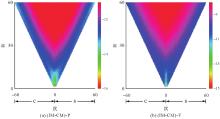
Fig. 3
The RMS values of the differences between the partial derivative matrices with respect to spherical harmonic coefficients at each degree and order from both approaches"


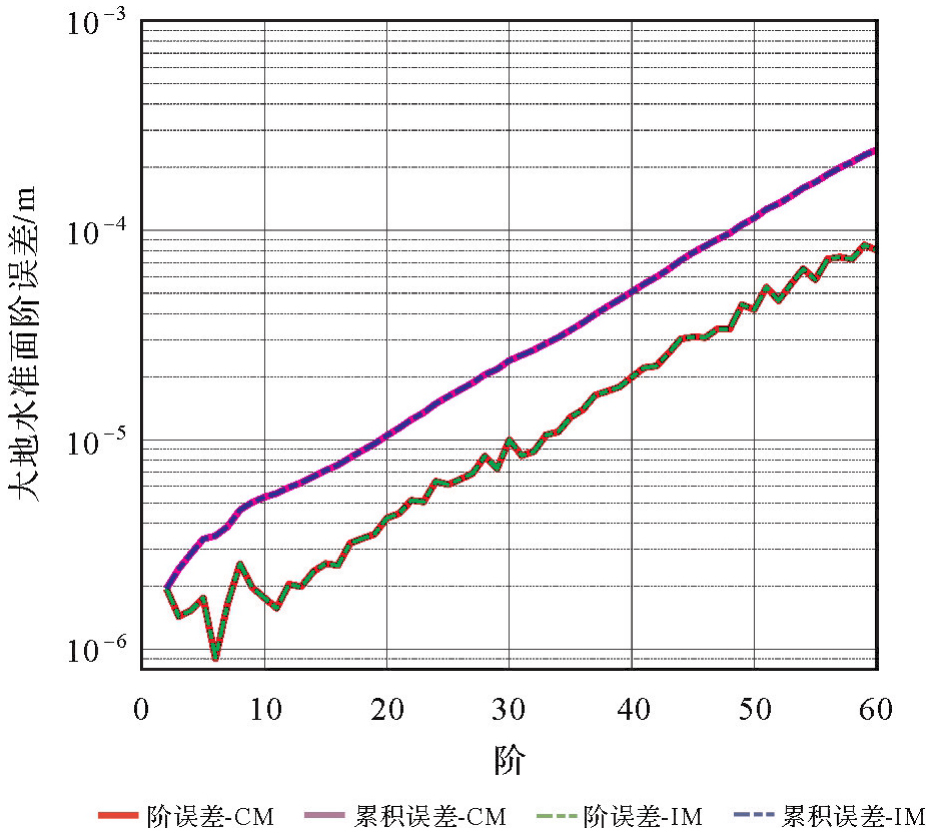
Fig. 4
The geoid degree error and corresponding cumulative error"
| [1] | TAPLEY B D, BETTADPUR S, RIES J C, et al. GRACE measurements of mass variability in the Earth system[J]. Science, 2004, 305(5683): 503-505. |
| [2] | TAPLEY B D, BETTADPUR S, WATKINS M, et al. The gravity recovery and climate experiment: mission overview and early results[J]. Geophysical Research Letters, 2004, 31(9): L09607. |
| [3] | 宁津生, 王正涛, 超能芳. 国际新一代卫星重力探测计划研究现状与进展[J]. 武汉大学学报(信息科学版), 2016, 41(1): 1-8. |
| NING Jinsheng, WANG Zhengtao, CHAO Nengfang. Research status and progress in international next-generation satellite gravity measurement missions[J]. Geomatics and Information Science of Wuhan University, 2016, 41(1): 1-8. | |
| [4] | KORNFELD R P, ARNOLD B W, GROSS M A, et al. GRACE-FO: the gravity recovery and climate experiment follow-on mission[J]. Journal of Spacecraft and Rockets, 2019, 56(3): 931-951. |
| [5] | 罗志才, 李琼, 钟波. 利用GRACE时变重力场反演黑河流域水储量变化[J]. 测绘学报, 2012, 41(5): 676-681. |
| LUO Zhicai, LI Qiong, ZHONG Bo. Water storage variations in Heihe river basin recovered from GRACE temporal gravity field[J]. Acta Geodaetica et Cartographica Sinica, 2012, 41(5): 676-681. | |
| [6] | MO X, WU J J, WANG Q, et al. Variations in water storage in China over recent decades from GRACE observations and GLDAS[J]. Natural Hazards and Earth System Sciences, 2016, 16(2): 469-482. |
| [7] | FATOLAZADEH F, GOÏTA K. Mapping terrestrial water storage changes in Canada using GRACE and GRACE-FO[J]. Science of The Total Environment, 2021, 779: 146435. |
| [8] | FENG Wei, XIONG Yuhao, YI Shuang, et al. Recent progress on hydrogeodesy in China[J]. Journal of Geodesy and Geoinformation Science, 2023, 6(3): 124-134. |
| [9] | GROH A, HORWATH M, HORVATH A, et al. Evaluating GRACE mass change time series for the Antarctic and Greenland ice sheet: methods and results[J]. Geosciences, 2019, 9(10): 415. |
| [10] | XIANG Longwei, WANG Hansheng, JIANG Liming, et al. Glacier mass balance in High Mountain Asia inferred from a GRACE release-6 gravity solution for the period 2002—2016[J]. Journal of Arid Land, 2021, 13(3): 224-238. |
| [11] | GROH A, HORWATH M. Antarctic ice mass change products from GRACE/GRACE-FO using tailored sensitivity kernels[J]. Remote Sensing, 2021, 13(9): 1736. |
| [12] | CHAMBERS D P, WAHR J, TAMISIEA M E, et al. Ocean mass from GRACE and glacial isostatic adjustment[J]. Journal of Geophysical Research: Solid Earth, 2010, 115(B11): B11415. |
| [13] | CHEN Jianli, TAPLEY B, SEO K W, et al. Improved quantification of global mean ocean mass change using GRACE satellite gravimetry measurements[J]. Geophysical Research Letters, 2019, 46(23): 13984-13991. |
| [14] | CHEN Jianli, WILSON C R, TAPLEY B D, et al. GRACE detects coseismic and postseismic deformation from the Sumatra-Andaman earthquake[J]. Geophysical Research Letters, 2007, 34(13): L13302. |
| [15] | ZHOU Hao, LUO Zhicai, ZHOU Zebing, et al. HUST-Grace2016s: a new GRACE static gravity field model derived from a modified dynamic approach over a 13-year observation period[J]. Advances in Space Research, 2017, 60(3): 597-611. |
| [16] | KVAS A, BEHZADPOUR S, ELLMER M, et al. ITSG-Grace2018: overview and evaluation of a new GRACE-only gravity field time series[J]. Journal of Geophysical Research: Solid Earth, 2019, 124(8): 9332-9344. |
| [17] | MAYER-GÜRR T, ILK K H, EICKER A, et al. ITG-CHAMP01: a CHAMP gravity field model from short kinematic arcs over a one-year observation period[J]. Journal of Geodesy, 2005, 78(7): 462-480. |
| [18] | MAYER-GÜRR T. Gravitationsfeldbestimmung aus der analyse kurzer bahnbögen am beispiel der satellitenmissionen CHAMP und GRACE[D]. Bonn: Institut für Theoretische Geodäsie der Universität Bonn, 2006. |
| [19] | YI Weiyong. The Earth's gravity field from GOCE[D]. München: Technische Universität München, 2012. |
| [20] | BEUTLER G, JÄGGI A, MERVART L, et al. The celestial mechanics approach: theoretical foundations[J]. Journal of Geodesy, 2010, 84(10): 605-624. |
| [21] | BEUTLER G, JÄGGI A, MERVART L, et al. The celestial mechanics approach: application to data of the GRACE mission[J]. Journal of Geodesy, 2010, 84(11): 661-681. |
| [22] | VISSER P N A M, SNEEUW N, GERLACH C. Energy integral method for gravity field determination from satellite orbit coordinates[J]. Journal of Geodesy, 2003, 77(3): 207-216. |
| [23] | DITMAR P, VAN ECK VAN DER SLUIJS A A. A technique for modeling the Earth's gravity field on the basis of satellite accelerations[J]. Journal of Geodesy, 2004, 78(1): 12-33. |
| [24] | DITMAR P, LIU Xianglin. Dependence of the Earth's gravity model derived from satellite accelerations on a priori information[J]. Journal of Geodynamics, 2007, 43(2): 189-199. |
| [25] | SCHNEIDER M. A general method of orbit determination, Report 1279[R]. Hants: Royal Aircraft Establishment, 1968: 1-4. |
| [26] | WANG Youcun, LI Min, JIANG Kecai, et al. Improving precise orbit determination of LEO satellites using enhanced solar radiation pressure modeling[J]. Space Weather, 2023, 21(1): e2022SW003292. |
| [27] | WÖSKE F, KATO T, RIEVERS B, et al. GRACE accelerometer calibration by high precision non-gravitational force modeling[J]. Advances in Space Research, 2019, 63(3): 1318-1335. |
| [28] | 游为. 应用低轨卫星数据反演地球重力场模型的理论和方法[D]. 成都: 西南交通大学, 2011. |
| YOU Wei. Theory and methodology of earth's gravitational field model recovery by Leo data[D]. Chengdu: Southwest Jiaotong University, 2011. | |
| [29] | CHEN Qiujie, SHEN Yunzhong, ZHANG Xingfu, et al. Monthly gravity field models derived from GRACE Level 1B data using a modified short-arc approach[J]. Journal of Geophysical Research: Solid Earth, 2015, 120(3): 1804-1819. |
| [30] | 陈秋杰. 基于改进短弧积分法的GRACE重力反演理论、方法及应用[D]. 上海: 同济大学, 2016. |
| CHEN Qiujie. Theory and methodology as well as application of GRACE gravity recovery using modified short arc approach[D]. Shanghai: Tongji University, 2016. | |
| [31] | MAYER-GÜRR T, KURTENBACH E, EICKER A. ITG-Grace2010: the new GRACE gravity field release computed in Bonn[C]//Proceedings of 2010 European Geosciences Union General Assembly. Vienna: EGU, 2010: 2446. |
| [32] | CHEN Qiujie, SHEN Yunzhong, CHEN Wu, et al. An optimized short-arc approach: methodology and application to develop refined time series of Tongji-Grace2018 GRACE monthly solutions[J]. Journal of Geophysical Research: Solid Earth, 2019, 124(6): 6010-6038. |
| [33] | ILK K H, FEUCHTINGER M, MAYER-GÜRR T. Gravity field recovery and validation by analysis of short arcs of a satellite-to-satellite tracking experiment as CHAMP and GRACE[C]//Proceedings of 2005 a Window on the Future of Geodesy, International Association of Geodesy Symposia. Berlin: Springer, 2005: 189-194. |
| [34] | MAYER-GÜRR T, EICKER A, ILK K H. Gravity field recovery from GRACE-SST data of short arcs[C]//Proceedings of 2006 Observation of the Earth System from Space. Berlin: Springer, 2006: 131-148. |
| [35] | 游为, 沈云中, 范东明, 等. 基于卫星轨道扰动理论的重力反演算法[J]. 地球物理学报, 2010, 53(11): 2574-2581. |
| YOU Wei, SHEN Yunzhong, FAN Dongming, et al. The algorithm of Earth's gravitational field recovery based on satellite's orbital perturbation theory[J]. Chinese Journal of Geophysics, 2010, 53(11): 2574-2581. | |
| [36] | 苏勇, 范东明. 利用短弧积分法和GOCE轨道数据确定地球重力场模型[J]. 地球物理学进展, 2014, 29(5): 2072-2076. |
| SU Yong, FAN Dongming. Gravity field modeling by using the short-arc integral approach and GOCE orbits[J]. Progress in Geophysics, 2014, 29(5): 2072-2076. | |
| [37] | SHAMPINE L F, GORDON M K. Computer solution of ordinary differential equations: the initial value problem[M]. San Francisco: W.H. Freeman, 1975. |
| [38] | 刘林. 航天器轨道理论[M]. 北京: 国防工业出版社, 2000. |
| LIU Lin. Orbit theory of spacecraft[M]. Beijing: National Defense Industry Press, 2000. | |
| [39] | 佘嘉博, 谭艳祥. Runge现象的研究[J]. 应用数学进展, 2019, 8(8): 1500-1510. |
| SHE Jiabo, TAN Yanxiang. Research on Runge Phenomenon[J]. Advances in Applied Mathematics, 2019, 8(8): 1500-1510. | |
| [40] | KANG Z, BETTADPUR S, NAGEL P, et al. GRACE-FO precise orbit determination and gravity recovery[J]. Journal of Geodesy, 2020, 94(9): 85. |
| [41] | XIA Yaowei, LIU Xin, GUO Jinyun, et al. On GPS data quality of GRACE-FO and GRACE satellites: effects of phase center variation and satellite attitude on precise orbit determination[J]. Acta Geodaetica et Geophysica, 2021, 56(1): 93-111. |
| [42] | YANG Fan, LIANG Lei, WANG Changqing, et al. Attitude determination for GRACE-FO: reprocessing the level-1A SC and IMU data[J]. Remote Sensing, 2022, 14(1): 126. |
| [1] | Wenyuan ZHANG, Mingxin QI, Shubi ZHANG. A non-uniform discretization GNSS water vapor tomography refined method considering water vapor distributions [J]. Acta Geodaetica et Cartographica Sinica, 2024, 53(12): 2282-2294. |
| [2] | SU Yong, FAN Dongming, YOU Wei. Analysis of Various Approaches for Gravity Field Recovery by Using the GOCE Satellite Orbits [J]. Acta Geodaetica et Cartographica Sinica, 2015, 44(2): 142-149. |
| Viewed | ||||||
|
Full text |
|
|||||
|
Abstract |
|
|||||
