

Acta Geodaetica et Cartographica Sinica ›› 2026, Vol. 55 ›› Issue (1): 114-123.doi: 10.11947/j.AGCS.2026.20250171
• Photogrammetry and Remote Sensing • Previous Articles Next Articles
Yu DANG1,2( ), Jianjun ZHU1(), Haiqiang FU1, Haitao ZHAO2, Haipeng CHEN2
Received:2025-04-07
Revised:2026-01-08
Online:2026-02-13
Published:2026-02-13
Contact:
Jianjun ZHU
E-mail:dang1001011@163.com;zjj@csu.edu.cn
About author:DANG Yu (1992—), male, PhD candidate, majors in intelligent interpretation of remote sensing. E-mail: dang1001011@163.com
Supported by:CLC Number:
Yu DANG, Jianjun ZHU, Haiqiang FU, Haitao ZHAO, Haipeng CHEN. Anomaly detection method for small-sample optical remote sensing constrained by diffusion characteristics[J]. Acta Geodaetica et Cartographica Sinica, 2026, 55(1): 114-123.
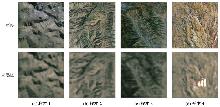
Fig. 1
Original images and reconstruction images of the benchmark method"

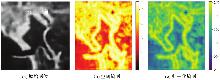
Fig. 2
Visualization of spatial entropy graph of the benchmark method"
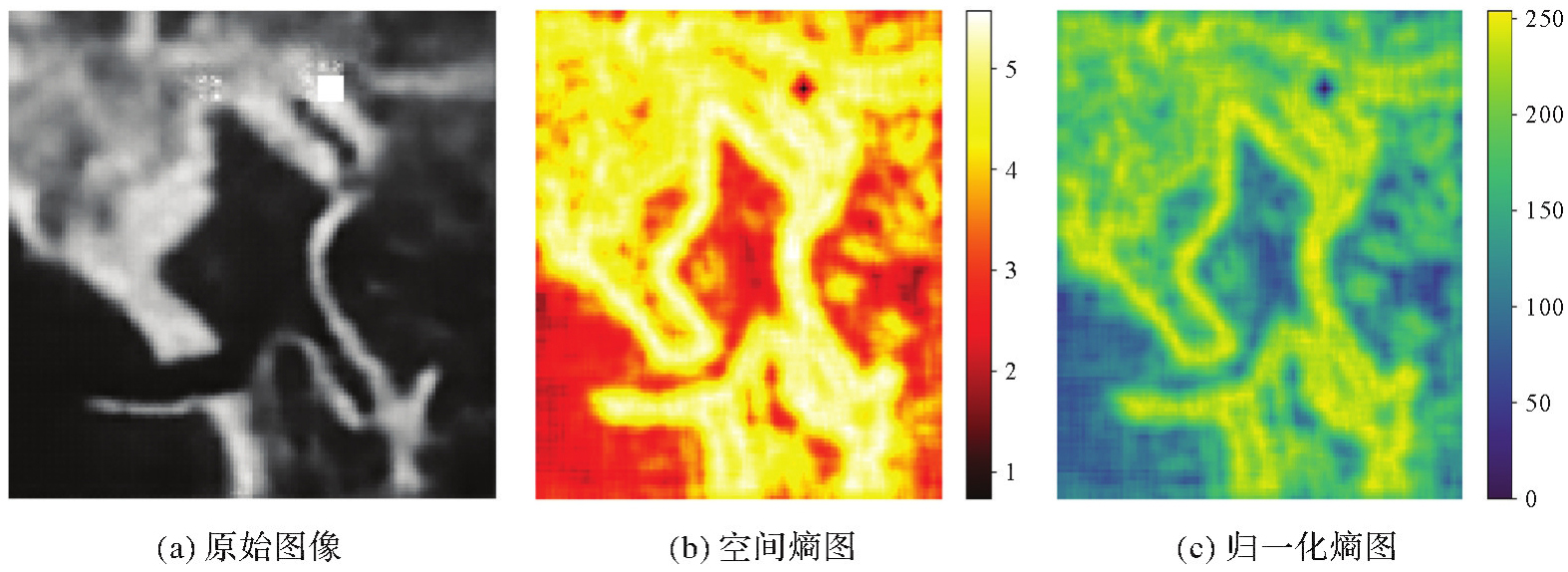
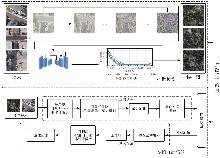
Fig. 3
Improvement method of constraints for diffusion features"

Fig. 4
Cosine similarity"
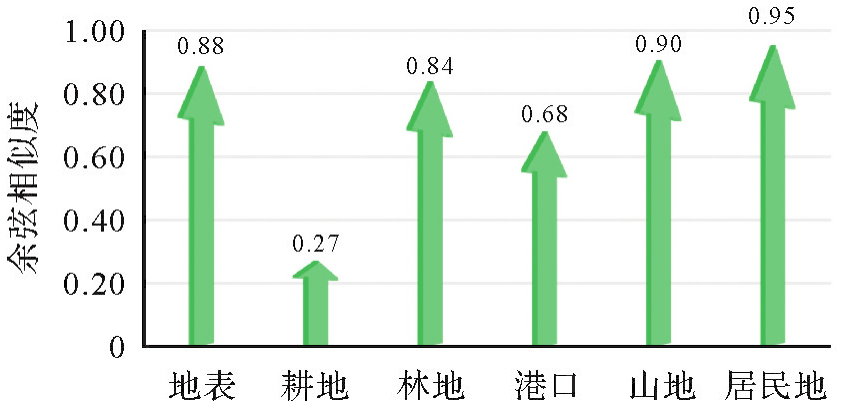
Fig. 5
Local binary pattern statistics"
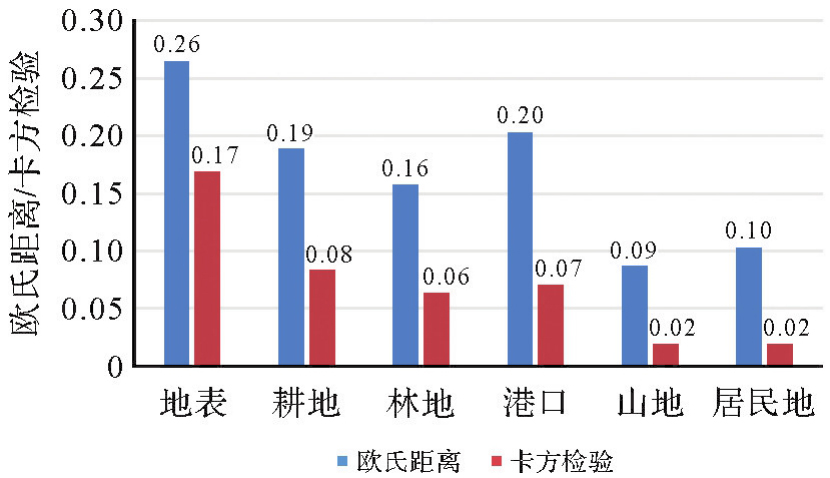
Fig. 6
Visualization results of improved method spatial entropy graph"
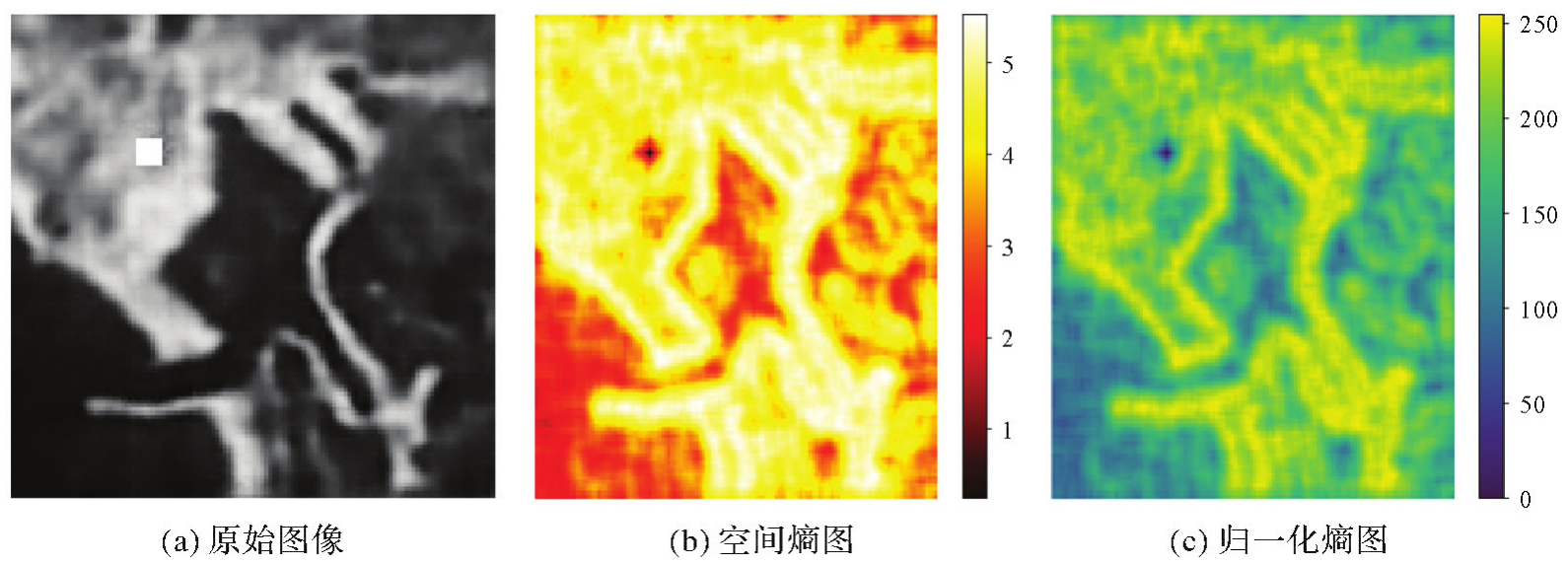
Fig. 7
Change in diffusion model loss function"
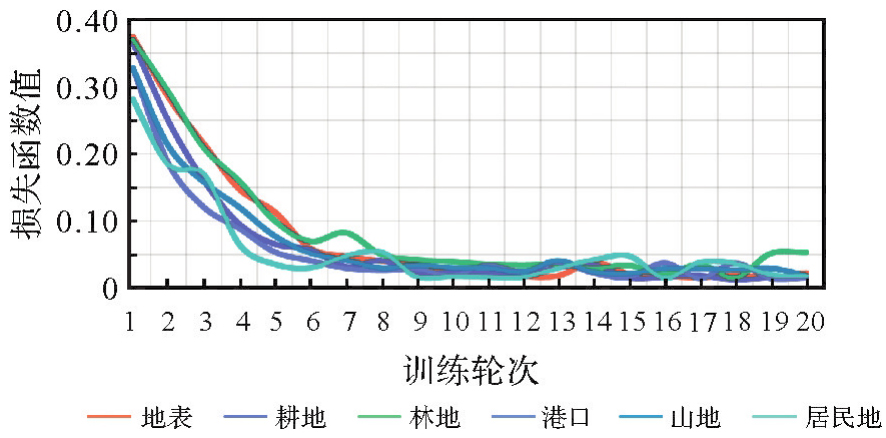
Fig. 8
Abnormal samples"
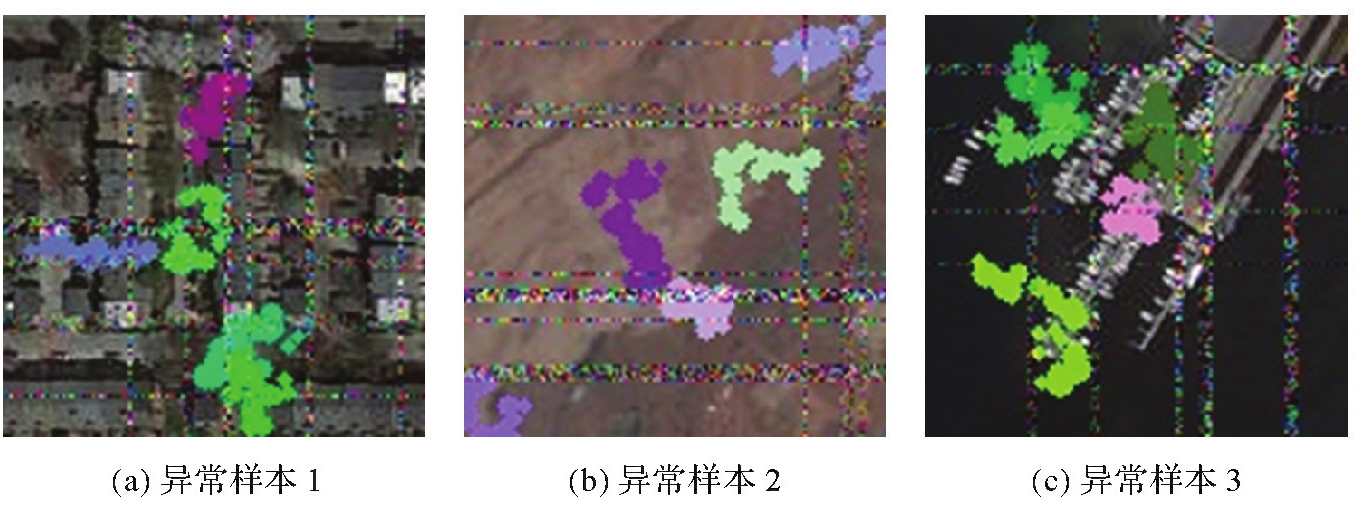
Fig. 9
Visualization of reconstruction of test samples"

Fig. 10
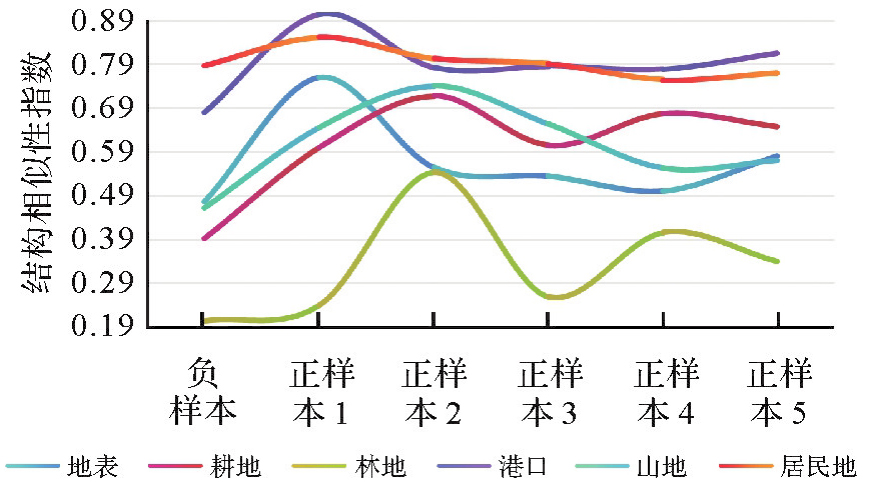
Structural similarity index of six land types"
| [1] | 李智勇, 匡纲要, 邹焕新, 等. 基于特征层融合的高光谱图像异常检测算法研究[J]. 遥感学报, 2003, 7(4): 304-308. |
| LI Zhiyong, KUANG Gangyao, ZOU Huanxin, et al. Research of anomaly detection approaches based on feature fusion in hyperspectral imagery[J]. National Remote Sensing Bulletin, 2003, 7(4): 304-308. | |
| [2] | 马丽, 田金文. 基于局部能量最大可分的高光谱图像异常检测算法[J]. 遥感学报, 2008, 12(3): 420-427. |
| MA Li, TIAN Jinwen. Anomaly detection algorithm for hyperspectral images based on local energy maximal division[J]. Journal of Remote Sensing, 2008, 12(3): 420-427. | |
| [3] | 林昱坤, 王楠, 张立福, 等. 独立成分分析的高光谱异常变化检测[J]. 遥感学报, 2019, 23(6): 1167-1176. |
| LIN Yukun, WANG Nan, ZHANG Lifu, et al. Hyperspectral anomaly change detection model based on independent component analysis[J]. Journal of Remote Sensing, 2019, 23(6): 1167-1176. | |
| [4] | MEHMOOD A, NASRABADI N M. Kernel Wavelet-Reed-Xiaoli: an anomaly detection for forward-looking infrared imagery[J]. Applied Optics, 2011, 50(17): 2744-2751. |
| [5] | ZHOU Jin, KWAN C, AYHAN B, et al. A novel cluster kernel RX algorithm for anomaly and change detection using hyperspectral images[J]. IEEE Transactions on Geoscience and Remote Sensing, 2016, 54(11): 6497-6504. |
| [6] | LI Jiayi, ZHANG Hongyan, ZHANG Liangpei, et al. Hyperspectral anomaly detection by the use of background joint sparse representation[J]. IEEE Journal of Selected Topics in Applied Earth Observations and Remote Sensing, 2015, 8(6): 2523-2533. |
| [7] | LIU Jinzhe, YUAN Zhiqiang, PAN Zhaoying, et al. Diffusion model with detail complement for super-resolution of remote sensing[J]. Remote Sensing, 2022, 14(19): 4834. |
| [8] | LIU Yidan, YUE Jun, XIA Shaobo, et al. Diffusion models meet remote sensing: principles, methods, and perspectives[J]. IEEE Transactions on Geoscience and Remote Sensing, 2024, 62: 4708322. |
| [9] | SUN Xu, YU Yinhui, CHENG Qing. Unified diffusion-based object detection in multi-modal and low-light remote sensing images[J]. Electronics Letters, 2024, 60(22): e70093. |
| [10] | 封子军, 张晓玲, 张靖波. 各向异性扩散与高斯差分模型的多聚焦图像融合方法[J]. 中国图象图形学报, 2011, 16(11): 2054-2059. |
| FENG Zijun, ZHANG Xiaoling, ZHANG Jingbo. Multifocus image fusion based on difference between anisotropic diffusion and Gaussian filter[J]. Journal of Image and Graphics, 2011, 16(11): 2054-2059. | |
| [11] |
李佳铃, 齐霁, 鲁伟鹏, 等. 面向城市功能区分类的光学遥感影像-OSM数据联合自监督学习方法[J]. 测绘学报, 2025, 54(1): 154-164. DOI: .
doi: 10.11947/j.AGCS.2025.20240067 |
|
LI Jialing, QI Ji, LU Weipeng, et al. Self-supervised learning based urban functional zone classification by integrating optical remote sensing image-OSM data[J]. Acta Geodaetica et Cartographica Sinica, 2025, 54(1): 154-164. DOI: .
doi: 10.11947/j.AGCS.2025.20240067 |
|
| [12] |
薛志祥, 余旭初, 刘景正, 等. 面向多源异质遥感影像地物分类的自监督预训练方法[J]. 测绘学报, 2024, 53(3): 512-525. DOI: .
doi: 10.11947/j.AGCS.2024.20220553 |
|
XUE Zhixiang, YU Xuchu, LIU Jingzheng, et al. A self-supervised pre-training scheme for multi-source heterogeneous remote sensing image land cover classification[J]. Acta Geodaetica et Cartographica Sinica, 2024, 53(3): 512-525. DOI: .
doi: 10.11947/j.AGCS.2024.20220553 |
|
| [13] | JIANG Yuling, LIU Shujun, WANG Huajun. Diffusion-based remote sensing image fusion for classification[J]. Applied Intelligence, 2025, 55: 247. |
| [14] | DIAO Wenxiu, HU Ling, ZHANG Kai, et al. Dual-conditionally guided diffusion models for fusion of unregistered multisource remote sensing images[J]. IEEE Transactions on Geoscience and Remote Sensing, 2025, 63: 5404117. |
| [15] | HIMEUR Y, ABURAED N, ELHARROUSS O, et al. Applications of knowledge distillation in remote sensing: a survey[J]. Information Fusion, 2025, 115: 102742. |
| [16] | WU Jie, FANG Leyuan, YUE Jun. TAKD: target-aware knowledge distillation for remote sensing scene classification[J]. IEEE Transactions on Circuits and Systems for Video Technology, 2024, 34(9): 8188-8200. |
| [17] | LEE J B, WOODYATT A S, BERMAN M. Enhancement of high spectral resolution remote-sensing data by a noise-adjusted principal components transform[J]. IEEE Transactions on Geoscience and Remote Sensing, 1990, 28(3): 295-304. |
| [18] | 邵振峰, 白云, 周熙然. 改进多尺度Retinex理论的低照度遥感影像增强方法[J]. 武汉大学学报(信息科学版), 2015, 40(1): 32-39. |
| SHAO Zhenfeng, BAI Yun, ZHOU Xiran. Improved multi-scale retinex image enhancement of under poor illumination[J]. Geomatics and Information Science of Wuhan University, 2015, 40(1): 32-39. | |
| [19] |
朱红, 宋伟东, 谭海, 等. 多尺度细节增强的遥感影像超分辨率重建[J]. 测绘学报, 2016, 45(9): 1081-1088. DOI: .
doi: 10.11947/j.AGCS.2016.20150451 |
|
ZHU Hong, SONG Weidong, TAN Hai, et al. Remote sensing images super resolution reconstruction based on multi-scale detail enhancement[J]. Acta Geodaetica et Cartographica Sinica, 2016, 45(9): 1081-1088. DOI: .
doi: 10.11947/j.AGCS.2016.20150451 |
|
| [20] | 蔡泽民, 赖剑煌. 一种基于超完备字典学习的图像去噪方法[J]. 电子学报, 2009, 37(2): 347-350. |
| CAI Zemin, LAI Jianhuang. An over-complete learned dictionary-based image de-noising method[J]. Acta Electronica Sinica, 2009, 37(2): 347-350. | |
| [21] | 戴维, 于盛林, 孙栓. 基于Contourlet变换自适应阈值的图像去噪算法[J]. 电子学报, 2007, 35(10): 1939-1943. |
| DAI Wei, YU Shenglin, SUN Shuan. Image de-noising algorithm using adaptive threshold based on contourlet transform[J]. Acta Electronica Sinica, 2007, 35(10): 1939-1943. | |
| [22] | RAMANI S, BLU T, UNSER M. Monte-Carlo sure: a black-box optimization of regularization parameters for general denoising algorithms[J]. IEEE Transactions on Image Processing, 2008, 17(9): 1540-1554. |
| [23] | WONG A, MISHRA A, ZHANG Wen, et al. Stochastic image denoising based on Markov-chain Monte Carlo sampling[J]. Signal Processing, 2011, 91(8): 2112-2120. |
| [24] | 赵泉华, 石雪, 王玉, 等. 可变类空间约束高斯混合模型遥感图像分割[J]. 通信学报, 2017, 38(2): 34-43. |
| ZHAO Quanhua, SHI Xue, WANG Yu, et al. Remote sensing image segmentation based on spatially constrained Gaussian mixture model with unknown class number[J]. Journal on Communications, 2017, 38(2): 34-43. | |
| [25] |
张津, 冯凡, 戴晨光, 等. 基于CNN-ViT混合特征优化的小样本高光谱图像分类[J]. 测绘学报, 2025, 54(12): 2233-2246. DOI: .
doi: 1011947/j.AGCS.2025.20250293 |
|
ZHANG Jin, FENG Fan, DAI Chenguang, et al. Small-sample classification of hyperspectral images based on mixed CNN-ViT feature optimization[J]. Acta Geodaetica et Cartographica Sinica, 2025, 54(12): 2233-2246. DOI: .
doi: 10.11947/j.AGCS.2025.20250293 |
|
| [26] | 武汉大学, 中国科学院, 慕尼黑工业大学, 等. Million-AID:一个用于遥感图像场景分类的大规模基准数据集[DB/OL]. [2025-12-28]. https://opendatalab.com/OpenDataLab/Million-AID. |
| Wuhan University, Chinese Academy of Sciences, Technical University of Munich, et al. Million-AID: a large-scale benchmark dataset for remote sensing image scene classification[DB/OL]. [2025-12-28]. https://opendatalab.com/OpenDataLab/Million-AID. |
| [1] | Kai YAN, Jianming XU, Qiao WANG. Earth surface anomaly detection based on lightweight large vision model features in remotely sensed imagery [J]. Acta Geodaetica et Cartographica Sinica, 2025, 54(9): 1664-1676. |
| [2] | Jin ZHANG, Fan FENG, Chenguang DAI, Zhenchao ZHANG, Ying YU, Bing LIU. Small-sample classification of hyperspectral images based on mixed CNN-ViT feature optimization [J]. Acta Geodaetica et Cartographica Sinica, 2025, 54(12): 2233-2246. |
| [3] | DU Qian, XIE Weiying. Adversarial autoencoder for hyperspectral anomaly detection [J]. Acta Geodaetica et Cartographica Sinica, 2023, 52(7): 1105-1114. |
| [4] | SONG Shangzhen, YANG Yixin, WANG Huifeng, WANG Xiaoyan, RONG Shenghui, ZHOU Huixin. Hyperspectral anomaly detection combining sparse constraint and feature extraction via stacked autoencoder [J]. Acta Geodaetica et Cartographica Sinica, 2023, 52(6): 932-943. |
| [5] | HUANG Yuancheng, XUE Yuanyuan, LI Pengfei. Subspace analysis isolation forest for hyperspectral anomaly detection [J]. Acta Geodaetica et Cartographica Sinica, 2021, 50(3): 416-425. |
| [6] | ZUO Xibing, LIU Bing, YU Xuchu, ZHANG Pengqiang, GAO Kuiliang, ZHU Enze. Graph convolutional network method for small sample classification of hyperspectral images [J]. Acta Geodaetica et Cartographica Sinica, 2021, 50(10): 1358-1369. |
| [7] | WU Yiwei. A cesium atomic clock frequency anomaly detection algorithm based on clock prediction and its performance analyses [J]. Acta Geodaetica et Cartographica Sinica, 2021, 50(1): 52-60. |
| [8] | LI Min, ZHU Guokang, ZHANG Xuewu, FAN Xinnan, LI Puhuang. An Anomaly Detector Based on Multi-aperture Mapping for Hyperspectral Data [J]. Acta Geodaetica et Cartographica Sinica, 2016, 45(10): 1222-1230. |
| [9] | . SVR Aided Adaptive Robust Filtering Algorithm for GPS/INS Integrated Navigation [J]. Acta Geodaetica et Cartographica Sinica, 2014, 43(6): 590-606. |
| Viewed | ||||||
|
Full text |
|
|||||
|
Abstract |
|
|||||
