

Acta Geodaetica et Cartographica Sinica ›› 2026, Vol. 55 ›› Issue (9): 1530-1541.doi: 10.11947/j.AGCS.2026.20260107
• Geodesy and Navigation • Previous Articles Next Articles
Zhiheng Liu( ), Weiping Liu(), Zhiwei Lü, Bo Jiao
Received:2026-03-25
Revised:2026-06-12
Online:2026-10-28
Published:2026-10-28
Contact:
Weiping Liu
E-mail:zhliu96@163.com;lwpchxy@sina.com
About author:Liu Zhiheng (1996—), male, PhD candidate, lecturer, majors in satellite navigation security and countermeasures. E-mail: zhliu96@163.com
Supported by:CLC Number:
Zhiheng Liu, Weiping Liu, Zhiwei Lü, Bo Jiao. GNSS distribute suppression jamming method based on directional antennas[J]. Acta Geodaetica et Cartographica Sinica, 2026, 55(9): 1530-1541.
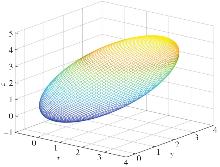
Fig. 1
Simplified model of directional dntenna"
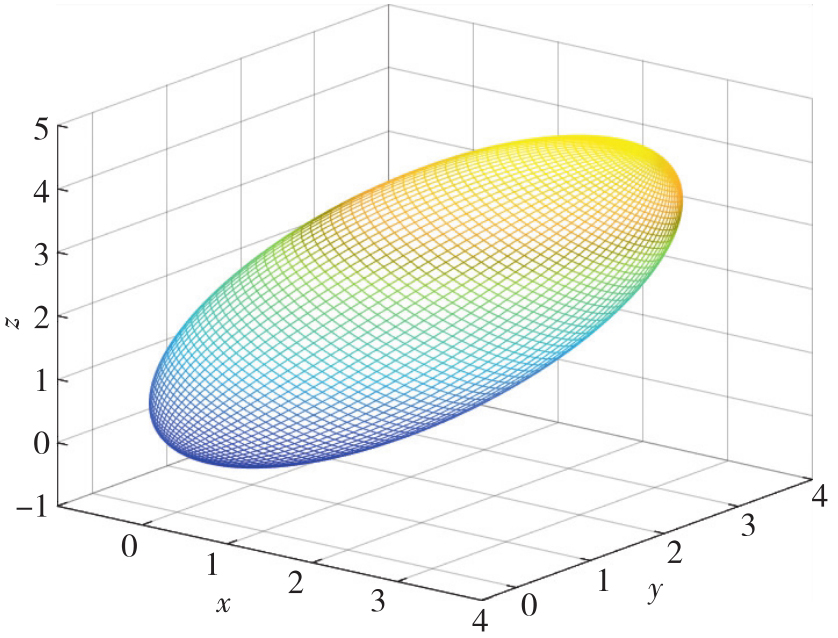
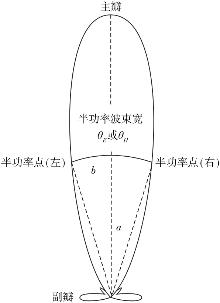
Fig. 2
Directional antenna pattern"
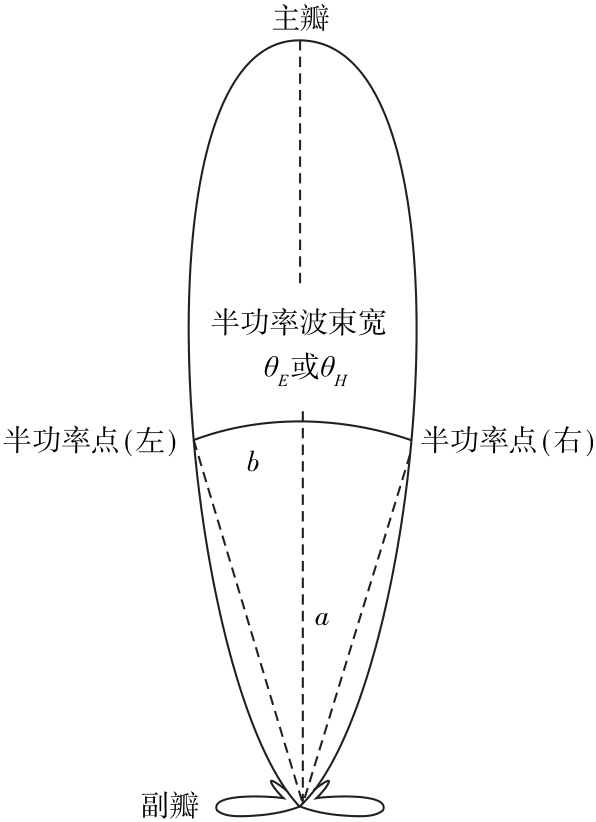
Tab. 1
Comparison of omnidirectional and directional antenna gain[18]"
| 天线类型 | 增益范围/dB | 典型应用场景 | |
|---|---|---|---|
| 全向天线 | 标准全向 | 2~5 | 车载干扰 |
| 中增益全向 | 6~9 | 中型区域覆盖 | |
| 特种全向 | 5~8 | 固定式干扰系统 | |
| 定向天线 | 八木天线 | 6~12 | 固定点定向干扰 |
| 平板/对数周期 | 8~16 | 基站式干扰 | |
| 螺旋定向 | 10~18 | 无人机反制 |
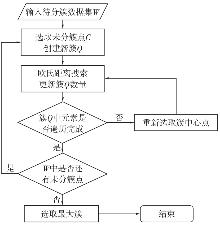
Fig. 3
Flowchart of Euclidean clustering algorithm"
Tab. 2
Simulation experiment of Euclidean clustering"
| 试验区域大小 | 待聚类点数 | 定向天线模型参数 | 欧氏聚类参数设置 | 分簇结果 | |||||
|---|---|---|---|---|---|---|---|---|---|
| a/m | b/m | c/m | 搜索半径R/m | 最小簇数量Nmin | 最大簇数量Nmax | 分簇个数 | 最大簇编号 | ||
| 10 km×10 km | 12 456 | 1500 | 1500 | 3000 | 100 | 1 | 10 000 | 3 | 1 |
| 10 km×10 km | 12 456 | 1500 | 1500 | 3000 | 100 | 1 | 8000 | 3 | 1 |
| 10 km×10 km | 12 456 | 1500 | 1500 | 3000 | 100 | 1 | 6000 | 5 | 1 |
| 10 km×10 km | 12 456 | 1500 | 1500 | 3000 | 100 | 1 | 4000 | 7 | 1 |
| 10 km×10 km | 12 456 | 1500 | 1500 | 3000 | 100 | 1 | 2000 | 6 | 2 |
| 10 km×10 km | 12 456 | 1500 | 1500 | 3000 | 100 | 1 | 1000 | 12 | 2 |
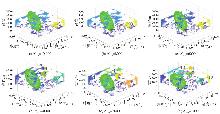
Fig. 4
Euclidean clustering results"

Fig. 5
Improved Euclidean clustering results"
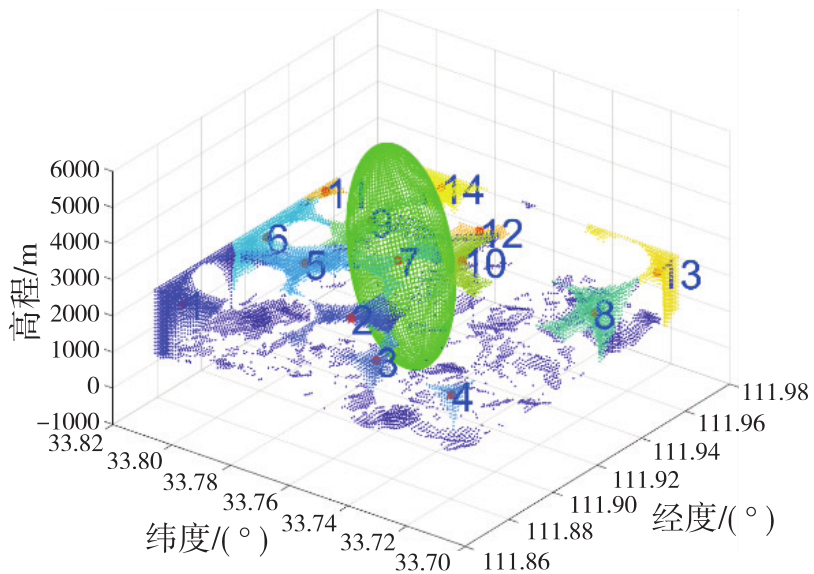
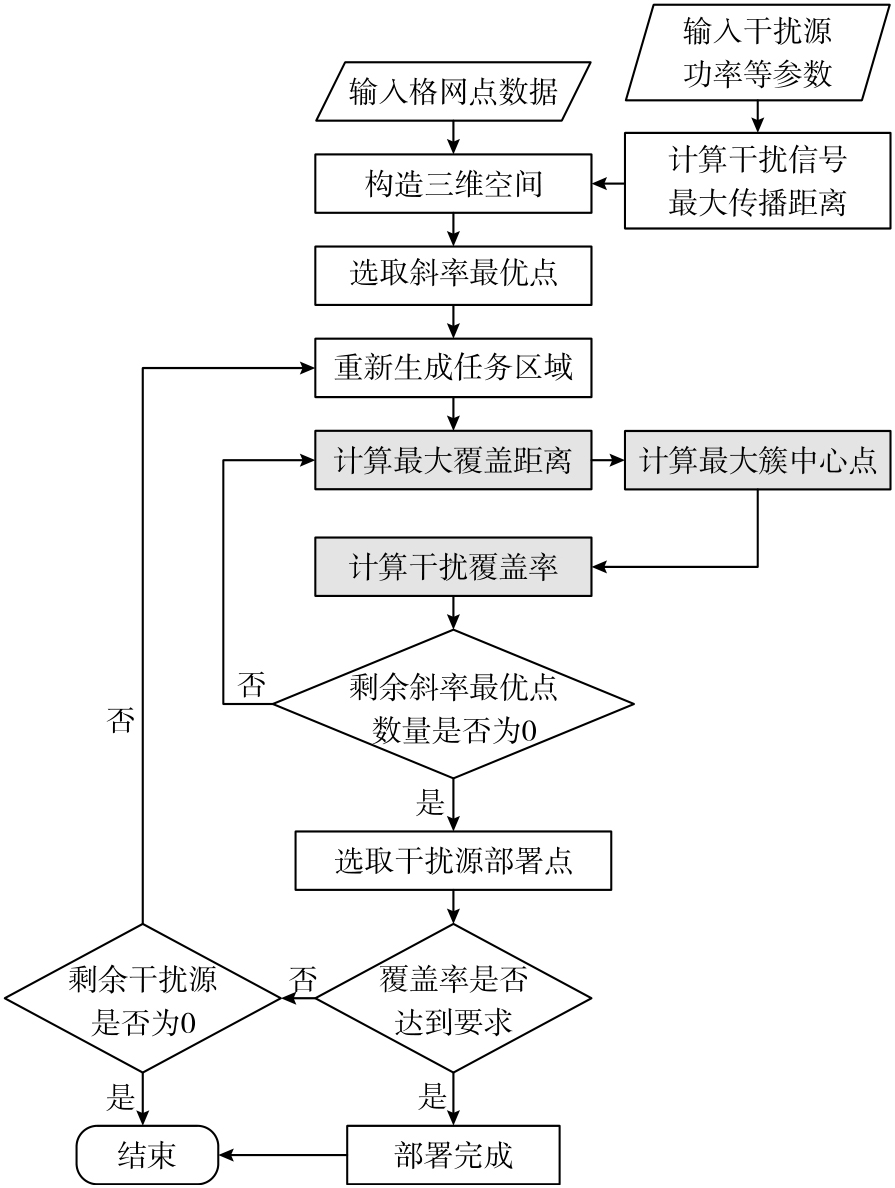
Fig. 6
Flowchart of jamming source deployment algorithm based on directional antenna"
Tab. 3
Simulation scenario configuration and experimental results"
| 场景编号 | 组别序号 | 发射功率/W | 干扰信号最大覆盖距离/m | 全向天线增益/dB | 定向天线增益/dB | 干扰源数量 | 干扰源数量减少百分比/(%) | |||
|---|---|---|---|---|---|---|---|---|---|---|
| 全向 | 定向 | 全/定向 | 定向vs全向 | 组合vs定向 | ||||||
| 1 | 1 | 0.01 | 90 | 2 | 6 | 26 | 17 | 12 | 34.62 | 29.41 |
| 8 | 15 | 12 | 42.31 | 20.00 | ||||||
| 2 | 0.03 | 156 | 2 | 6 | 21 | 12 | 8 | 42.86 | 33.33 | |
| 8 | 12 | 8 | 42.86 | 33.33 | ||||||
| 2 | 1 | 3 | 1560 | 5 | 12 | 32 | 19 | 11 | 40.63 | 42.11 |
| 18 | 11 | 8 | 65.63 | 27.27 | ||||||
| 2 | 5 | 2139 | 5 | 12 | 19 | 10 | 5 | 47.36 | 50.00 | |
| 18 | 7 | 5 | 63.16 | 28.57 | ||||||
Fig. 7
Scenario 1-1 jamming signal and jamming source deployment distribution"
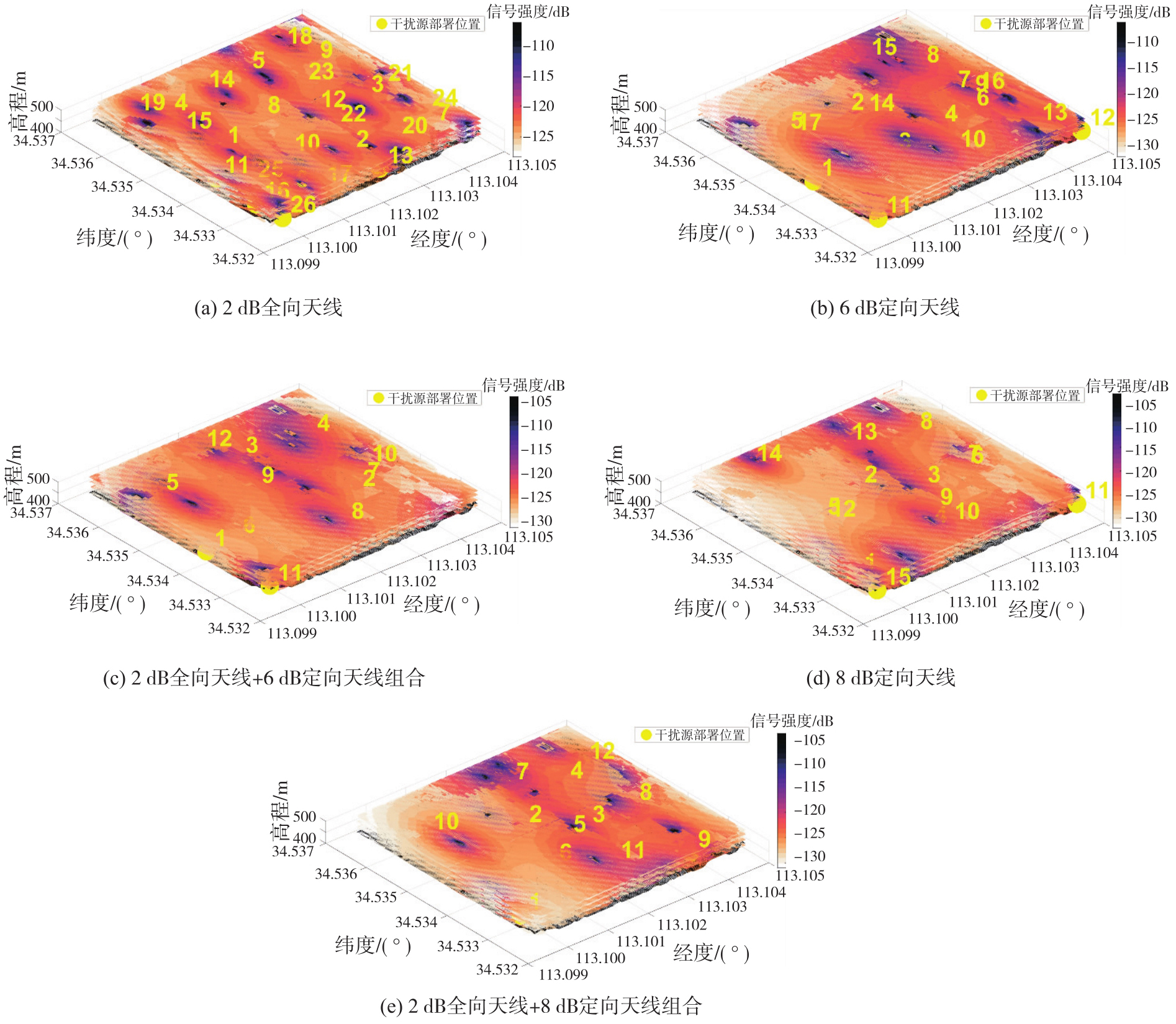
Fig. 8
Scenario 1-2 jamming signal and jamming source deployment distribution"
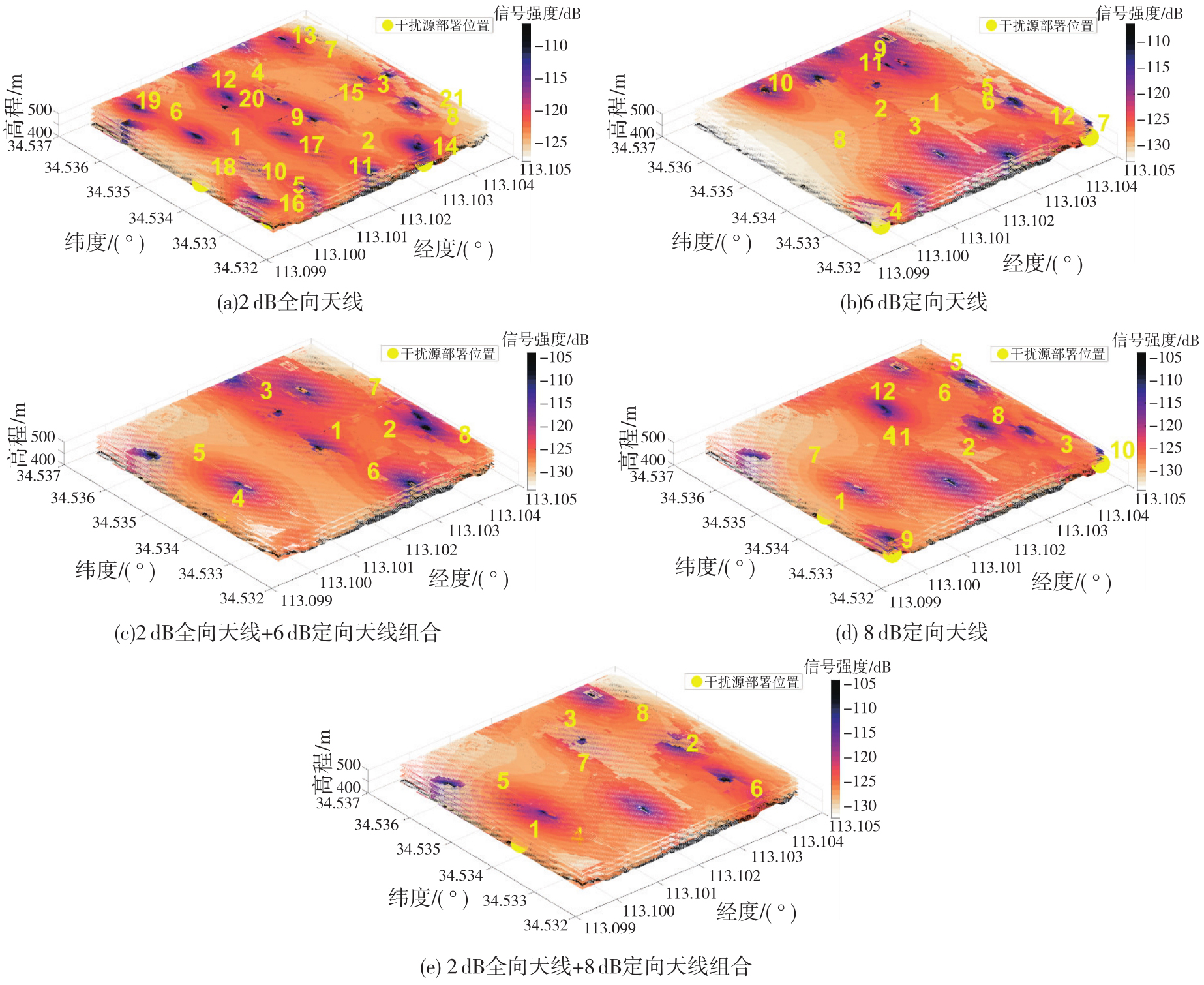
Fig. 9
Scenario 2-1 jamming signal and jamming source deployment distribution"
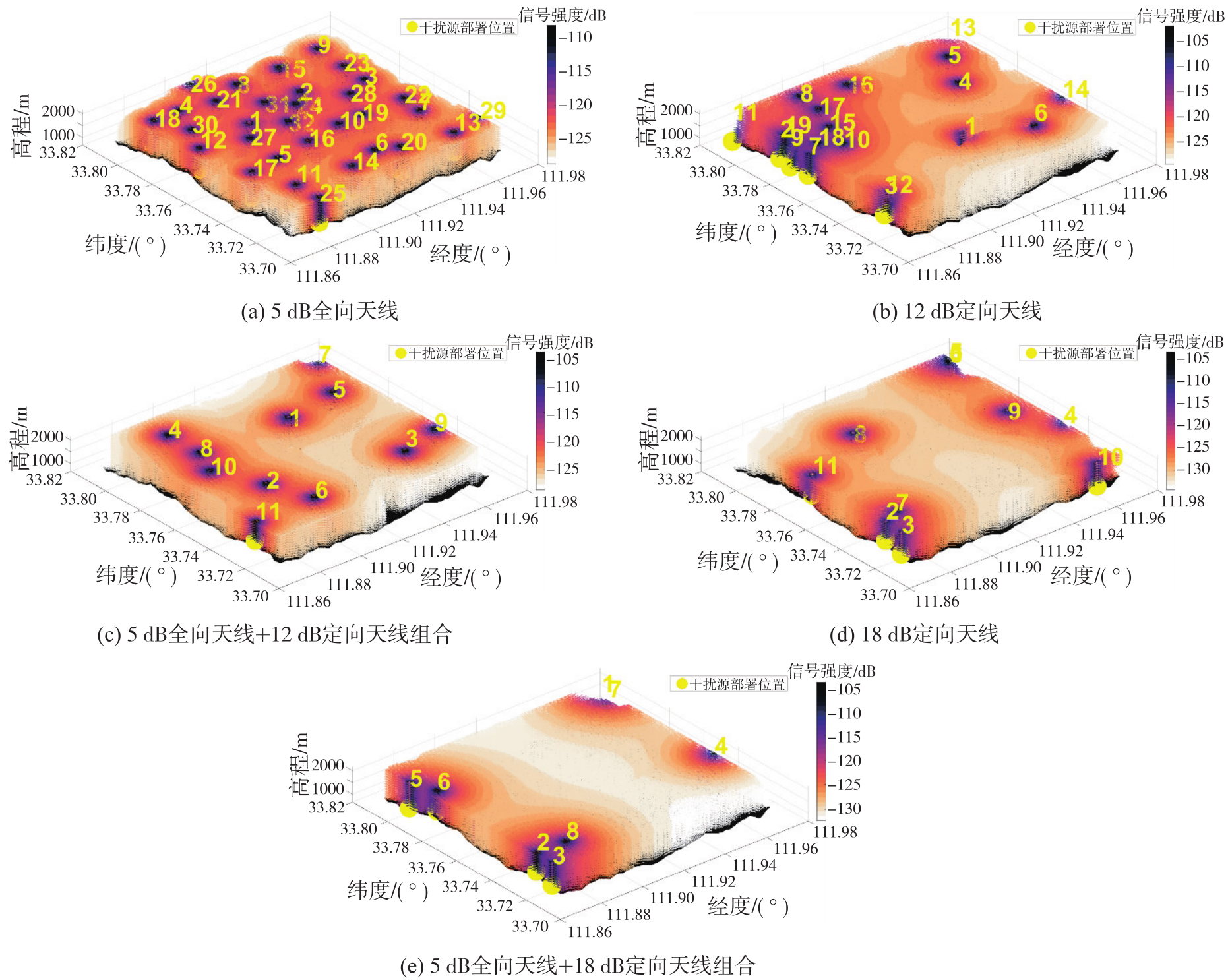
Fig. 10
Scenario 2-2 jamming signal and jamming source deployment distribution"

| [1] | Pyrgies J. The UAVs threat to airport security: risk analysis and mitigation[J]. Journal of Airline and Airport Management, 2019, 9(2): 63. |
| [2] | Spanghero M, Geib F, Panier R, et al. Uncovering GNSS interference with aerial mapping UAV[C]//Proceedings of 2024 IEEE Aerospace Conference. Big Sky: IEEE, 2024: 1-10. |
| [3] | Chen Peilin, Li Haobo, Ma Lejing. Distributed massive UAV jamming optimization algorithm with artificial bee colony[J]. IET Communications, 2023, 17(2): 197-206. |
| [4] | Ran Weizhi, Luo Rong, Zhang Funing, et al. Research on efficient multiagent reinforcement learning for multiple UAVs' distributed jamming strategy[J]. Electronics, 2023, 12(18): 3874. |
| [5] |
寇瑞雄. 城市立体空间导航卫星时空可见性分析[J]. 测绘学报, 2024, 53(11): 2231. DOI: .
doi: 10.11947/j.AGCS.2024.20230395 |
|
Kou Ruixiong. The spatio-temporal visibility analysis of navigation satellites in 3D urban space[J]. Acta Geodaetica et Cartographica Sinica, 2024, 53(11): 2231. DOI: .
doi: 10.11947/j.AGCS.2024.20230395 |
|
| [6] | 刘志衡, 刘伟平, 焦博. 基于局部最优点的GNSS分布式压制干扰源部署算法[J]. 兵工学报, 2024, 45(9): 3240-3252. |
| Liu Zhiheng, Liu Weiping, Jiao Bo. GNSS distributed interference source deployment algorithm based on locally optimal point[J]. Acta Armamentarii, 2024, 45(9): 3240-3252. | |
| [7] | 刘志衡, 刘伟平, 焦博. 基于斜率最优点的三维空间GNSS分布式压制干扰方法[J]. 兵工学报, 2026, 47(1): 250095. |
| Liu Zhiheng, Liu Weiping, Jiao Bo. 3D space GNSS distribute suppression jamming method based on slope optimal point[J]. Acta Armamentarii, 2026, 47(1): 250095. | |
| [8] | 徐悦, 张颖, 刘杨, 等. 一种分布式卫星导航干扰防护区域评估方法[J]. 微波学报, 2024, 40(S1): 394-397. |
| Xu Yue, Zhang Ying, Liu Yang, et al. An evaluation method of distributed satellite navigation interference protection area[J]. Journal of Microwaves, 2024, 40(S1): 394-397. | |
| [9] | Noghanian S. Textile omnidirectional antenna for wearable WiFi-7 applications using higher order modes[J]. Frontiers in Antennas and Propagation, 2024, 2: 1419391. |
| [10] | Xia Minghua, Aissa S. On the efficiency of far-field wireless power transfer[J]. IEEE Transactions on Signal Processing, 2015, 63(11): 2835-2847. |
| [11] | Huang Yingchun, Li Xiaoxiao, Li Hang. Design and simulation of the algorithm on the distribution and coverage of GPS jamming shells[C]//Proceedings of the 3rd International Conference on Intelligent Networks and Intelligent Systems. Shenyang: IEEE, 2010: 634-637. |
| [12] | George R, Mary T A J. Review on directional antenna for wireless sensor network applications[J]. IET Communications, 2020, 14(5): 715-722. |
| [13] | 马新生, 郭萌, 张正谦, 等. 应用于电子侦收的小型化高增益超宽带定向天线[J]. 天线学报, 2023, 12(3): 29-38. |
| Ma Xinsheng, Guo Meng, Zhang Zhengqian, et al. Miniaturized high-gain ultra-wide band (UWB) directional antenna for electronic reconnaissance applications[J]. Journal of Antennas, 2023, 12(3): 29-38. | |
| [14] | Taskhiri M M. Axis-symmetric ellipsoidal lens antenna design with independent E and H radiation pattern beamwidth[J]. Optics & Laser Technology, 2021, 140: 107037. |
| [15] | Pillai J, Prajapati J, Upadhayay M D. Wide half power beamwidth MIMO antenna for vehicular radar system[J]. International Journal of Applied Electromagnetics & Mechanics, 2025, 77(4): 276-290. |
| [16] | Yang Fan, Liu Yuhan. Research on alternative GNSS methods for UAV pseudolite networking[J]. Journal of Geodesy and Geoinformation Science, 2025, 8(1): 89-99. |
| [17] | Mitch R H, Dougherty R C, Psiaki M L, et al. Signal characteristics of civil GPS jammers[C]//Proceedings of the 24th International Technical Meeting of the Satellite Division of the Institute of Navigation. Portland: the Institute of Navigation, 2011: 1907-1919. |
| [18] | Reis S, Silva F, Albuquerque D, et al. General overview of antennas for unmanned aerial vehicles: a review[J]. Electronics, 2025, 14(16): 3205. |
| [19] | Sangenis E, Shkel A M. Fast-alignment of AR headset from local to geodetic coordinate frame for navigation and mixed reality applications[J]. IEEE Sensors Letters, 2025, 9(2): 6002404. |
| [20] | Hartigan J A, Wong M A. A K-means clustering algorithm[J]. Applied Statistics, 1979, 28(1): 100-108. |
| [21] | Sander J, Ester M, Kriegel H P, et al. Density-based clustering in spatial databases: the algorithm GDBSCAN and its applications[J]. Data Mining and Knowledge Discovery, 1998, 2(2): 169-194. |
| [22] | 谢一涵, 毕鹏飞, 王爱萍. 种群优化联合鲁棒距离度量的公平性K-means算法[J]. 电子测量与仪器学报, 2025, 39(06): 121-133. |
| Xie Yihan, Bi Pengfei, Wang Aiping. Population optimization combined with robust distance metric for fair K-means clustering algorithm[J]. Journal of Electronic Measurement and Instrumentation, 2025, 39(6): 121-133. | |
| [23] | Zhang Xingguo, Xu Li, Jia Weikuan. EGBDPM: efficient granular ball density peaks clustering for manifold data[J]. Neurocomputing, 2026, 682: 133427. |
| [24] | Wei Ya, Gan Shu, Yuan Xiping, et al. Analysis of topographic feature parameters of dinosaur valley ring tectonic geomorphology based on the advanced land observing satellite digital elevation model (ALOS DEM)[J]. Applied Sciences, 2023, 13(24): 13137. |
| [25] | Wang Xiaolei, He Xiufeng, Zhang Qin, et al. The preliminary discussion of the potential of GNSS-IR technology for terrain retrievals[J]. Journal of Geodesy and Geoinformation Science, 2021, 4(2): 79-88. |
| [26] | U. S. Department of Defense. Navstar GPS space segment/navigation user interfaces[R]. Washington, D. C.: Department of Defense, 2004. |
| [27] | 伍启燕. 复杂地形中的无线电波传播损耗特性研究[D]. 广汉: 中国民用航空飞行学院, 2023. |
| Wu Qiyan. Research on propagation attenuation characteristic of radio wave in complex terrain[D]. Guanghan: Civil Aviation Flight University of China, 2023. |
| [1] | CHEN Junping, ZHANG Yize, YU Chao, DING Junsheng. Processing algorithms and performance evaluation of BDS RDSS location reporting service [J]. Acta Geodaetica et Cartographica Sinica, 2022, 51(4): 511-521. |
| [2] | YAO Lianbi, QIN Changcai, ZHANG Shaohua, CHEN Qichao, RUAN Dongxu, NIE Shungen. Road marking extraction and semantic correlation based on vehicle-borne laser point cloud [J]. Acta Geodaetica et Cartographica Sinica, 2020, 49(4): 480-488. |
| [3] | CHEN Junping, WANG Ahao, ZHANG Yize, ZHOU Jianhua, WANG Binghao, WANG Jiexian. PPP algorithm using BDS new SBAS differential corrections [J]. Acta Geodaetica et Cartographica Sinica, 2019, 48(7): 822-830. |
| [4] | WEI Ziqing, WU Fumei, LIU Guangming. The BeiDou coordinate system [J]. Acta Geodaetica et Cartographica Sinica, 2019, 48(7): 805-809. |
| [5] | LI Xin, YUAN Yongqiang, ZHANG Keke, ZENG Qi, ZHANG Xiaohong, LI Xingxing. Assessment of BDS Ambiguity Resolution with GEO/IGSO/MEO Satellites [J]. Acta Geodaetica et Cartographica Sinica, 2018, 47(3): 324-331. |
| [6] | WANG Yuebing, GAN Weijun, CHEN Weitao, LIAN Weiping, YOU Xinzhao. The Analysis of Precise Point Positioning of BeiDou Navigation Satellite System Application in Crustal Motion Monitoring [J]. Acta Geodaetica et Cartographica Sinica, 2018, 47(1): 48-56. |
| [7] | ZENG Tian, SUI Lifen, JIA Xiaolin, JI Guofeng, ZHANG Qinghua. Results and Analysis of BDS Precise Orbit Determination with the Enhancement of Fengyun-3C [J]. Acta Geodaetica et Cartographica Sinica, 2017, 46(7): 824-833. |
| [8] | JIANG Weiping. Challenges and Opportunities of GNSS Reference Station Network [J]. Acta Geodaetica et Cartographica Sinica, 2017, 46(10): 1379-1388. |
| [9] | . Fusion positioning of COMPASS/GPS based on Spatio temporal system unification [J]. Acta Geodaetica et Cartographica Sinica, 2012, 41(5): 743-748. |
| [10] | . A New Strategy of Rapid Orbit Recovery for the Geostaionary Satellite [J]. Acta Geodaetica et Cartographica Sinica, 2011, 40(Sup.): 19-25. |
| [11] | . Study on the Minimum of GDOP in Satellite Navigation and Its Applications [J]. Acta Geodaetica et Cartographica Sinica, 2011, 40(Sup.): 85-88. |
| Viewed | ||||||
|
Full text |
|
|||||
|
Abstract |
|
|||||
