
Acta Geodaetica et Cartographica Sinica ›› 2026, Vol. 55 ›› Issue (10): 1878-1891.doi: 10.11947/j.AGCS.2026.20260170
• Cartography and Geographic Information • Previous Articles Next Articles
Yakun Xie1,2( ), Wenjing Bai1, Fenyang Cao1, Yangping Liu1, Jun Zhu1,2(), Qing Zhu1
Received:2026-05-08
Revised:2026-09-20
Online:2026-11-16
Published:2026-11-16
Contact:
Jun Zhu
E-mail:yakunxie@swjtu.edu.cn;zhujun@swjtu.edu.cn
About author:Xie Yakun (1991—), male, PhD, associate professor, majors in railway digital twin modeling. E-mail: yakunxie@swjtu.edu.cn
Supported by:CLC Number:
Yakun Xie, Wenjing Bai, Fenyang Cao, Yangping Liu, Jun Zhu, Qing Zhu. A multi-stage feature collaborative enhancement method for efficient defect detection in railway track components[J]. Acta Geodaetica et Cartographica Sinica, 2026, 55(10): 1878-1891.
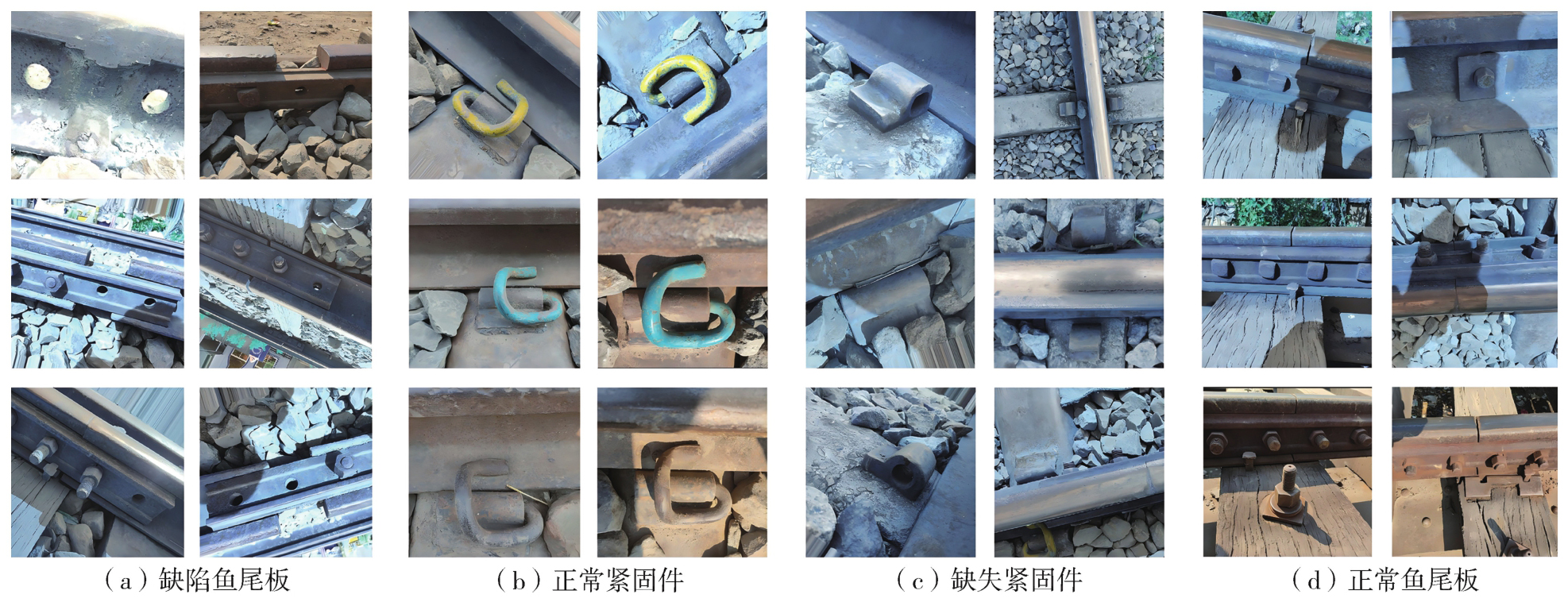
Fig. 1
Feature analysis of railway track components"
Tab. 1
Number of images and object instances per category"
| 类别ID | 类别名 | 图片数量 | 实例目标数量 |
|---|---|---|---|
| 0 | 缺陷鱼尾板 | 266 | 316 |
| 1 | 正常紧固件 | 705 | 966 |
| 2 | 缺失紧固件 | 431 | 545 |
| 3 | 正常鱼尾板 | 376 | 540 |
Tab. 2
Number of images and object instances in dataset splits"
| 数据集 | 图片数量 | 目标数量 | 类别0 | 类别1 | 类别2 | 类别3 |
|---|---|---|---|---|---|---|
| 训练集 | 916 | 1416 | 179 | 606 | 327 | 304 |
| 验证集 | 305 | 484 | 65 | 162 | 108 | 149 |
| 测试集 | 307 | 467 | 72 | 198 | 110 | 87 |
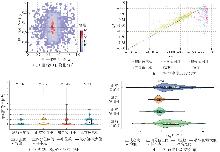
Fig. 2
Statistical analysis of target distribution in the dataset"
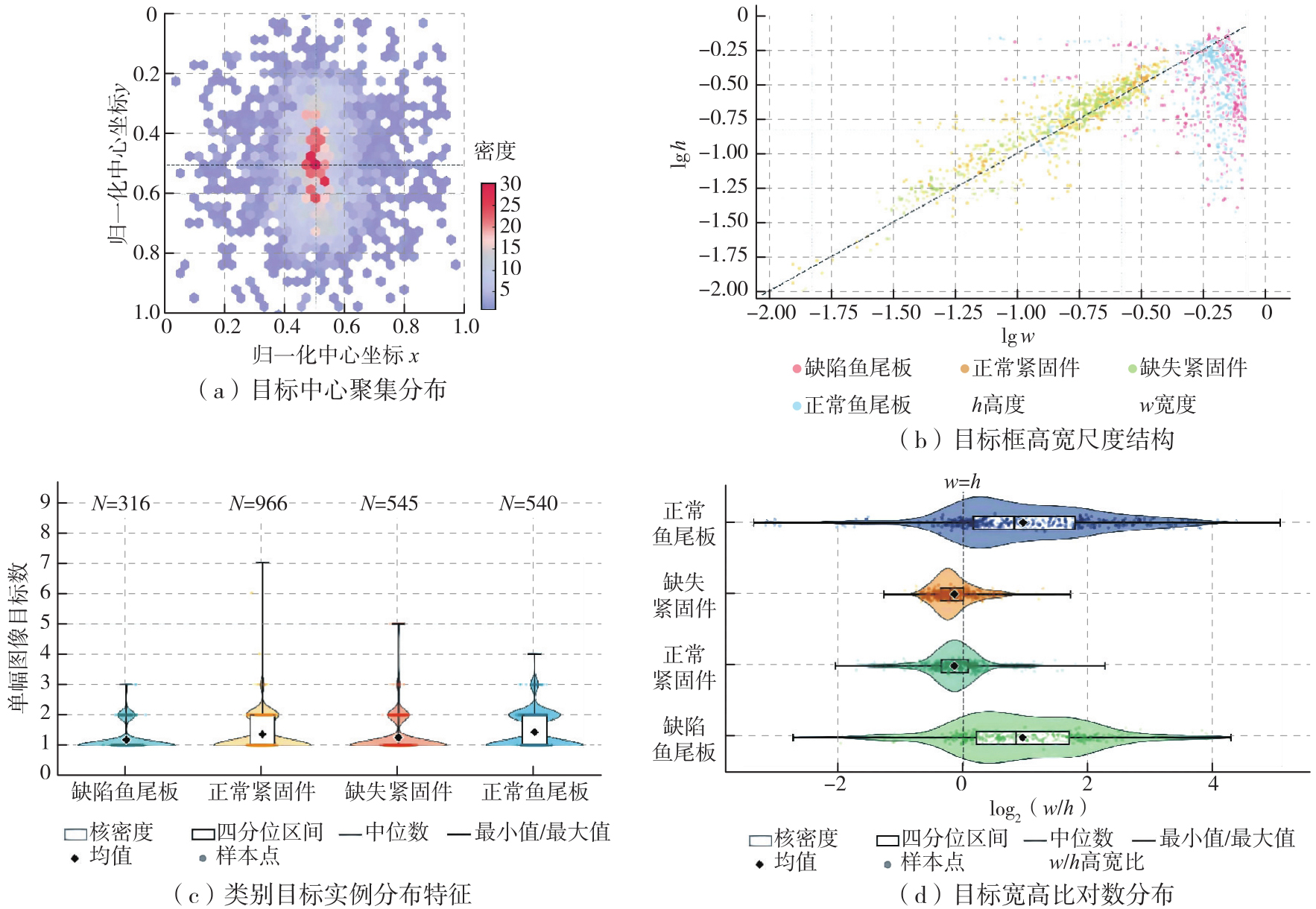
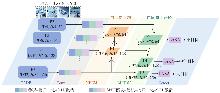
Fig. 3
Overall framework of multi-stage feature collaborative enhancement network"
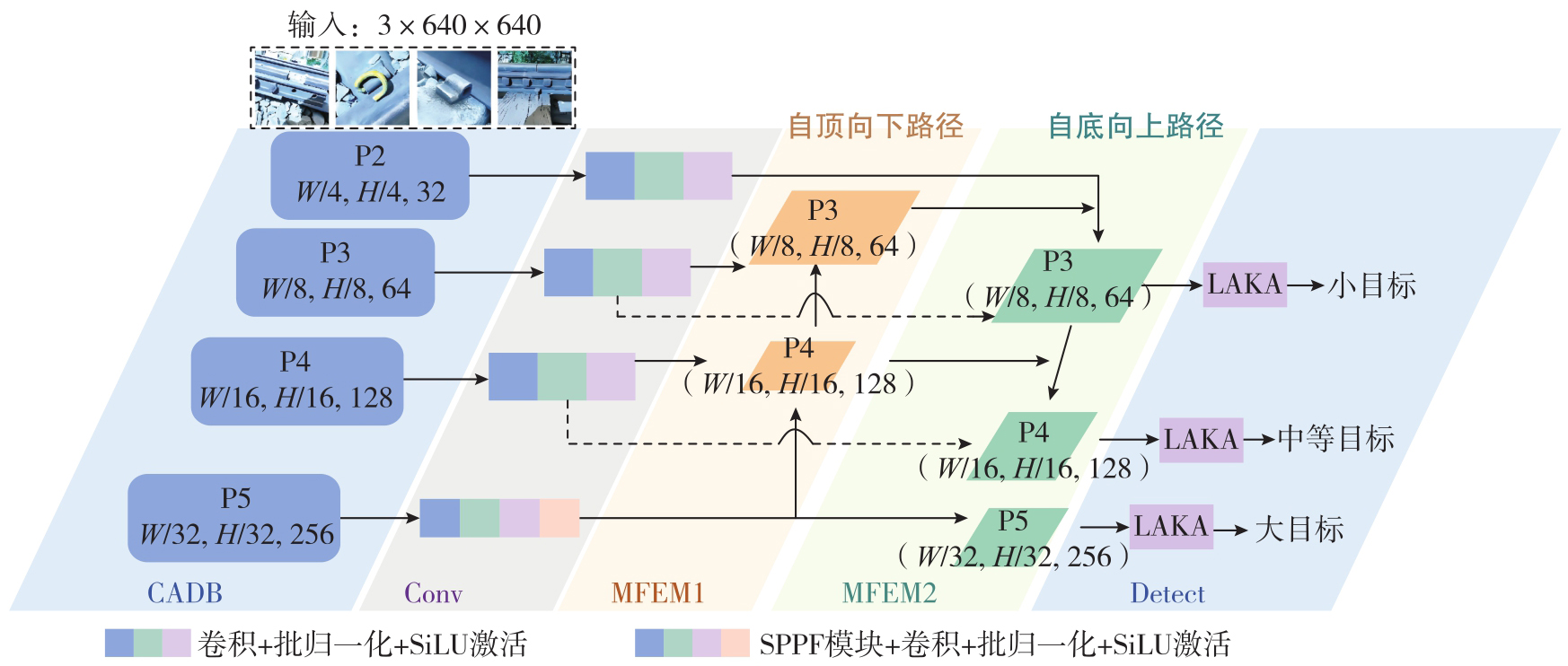
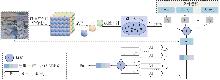
Fig. 4
Structure of content-adaptive downsampling block"

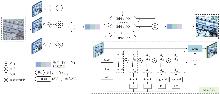
Fig. 5
Structure of multi-source feature equalization module"
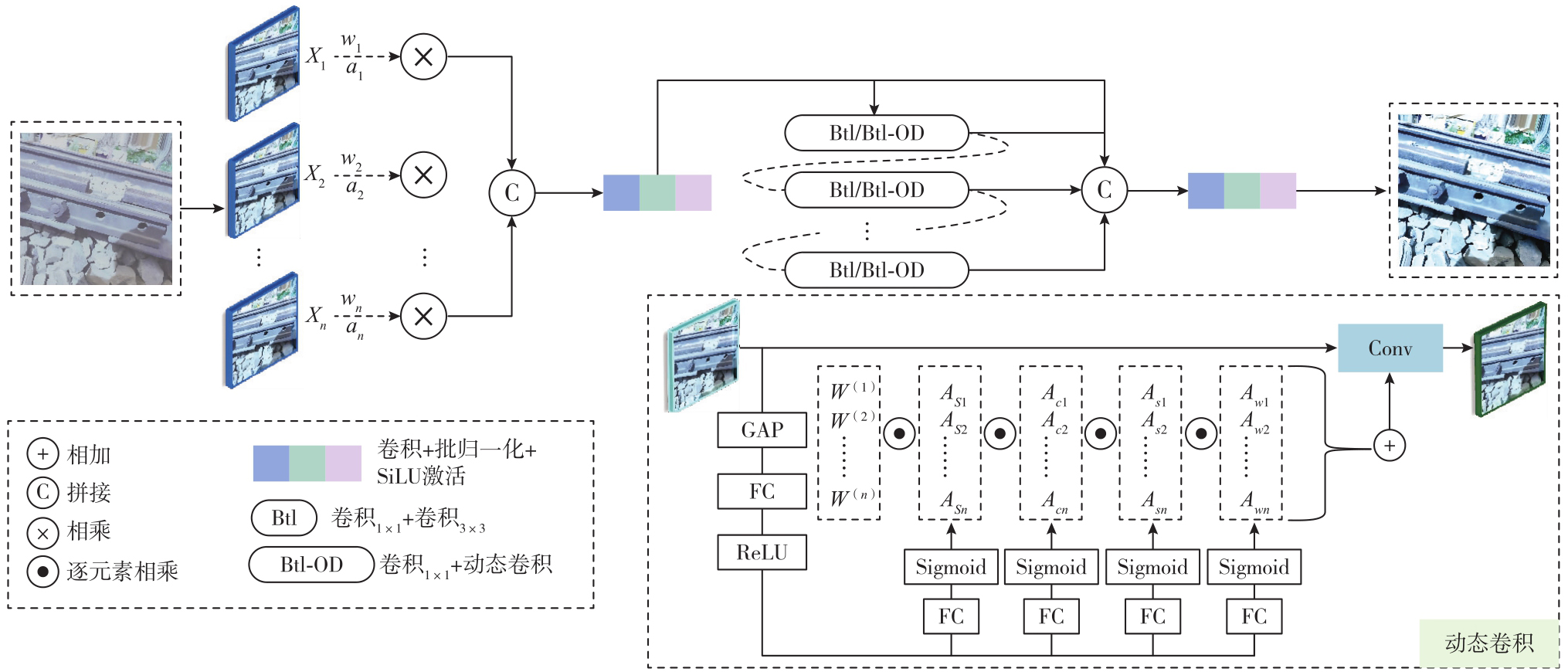
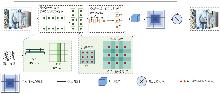
Fig. 6
Structure of large kernel adaptive attention"
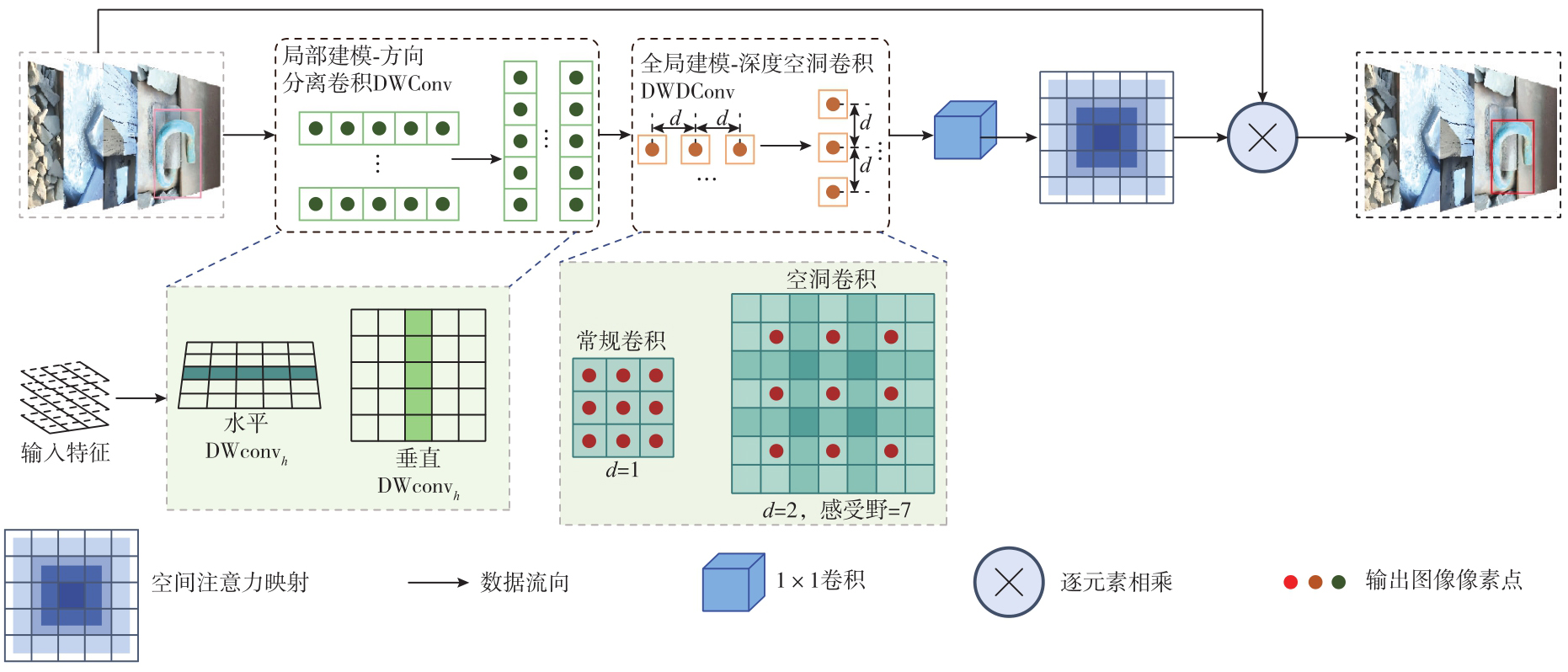
Tab. 3
Performance evaluation results"
| 方法 | P | R | mAP@0.5 | mAP@[0.5∶0.95] |
|---|---|---|---|---|
| YOLOv5 | 87.3 | 80.1 | 84.1 | 59.6 |
| YOLOv6 | 91.7 | 80.8 | 87.2 | 65.5 |
| YOLOv7 | 78.0 | 78.0 | 79.2 | 49.2 |
| YOLOv8 | 90.4 | 80.9 | 86.9 | 63.8 |
| YOLOv9 | 84.8 | 77.8 | 82.6 | 58.6 |
| YOLOv10 | 78.5 | 73.1 | 78.9 | 57.9 |
| YOLOv11 | 87.8 | 80.1 | 84.9 | 62.2 |
| YOLOv12 | 76.2 | 71.0 | 76.2 | 51.0 |
| YOLOv13 | 84.7 | 75.1 | 81.8 | 56.5 |
| RT-DETR | 75.1 | 76.5 | 78.4 | 61.5 |
| FFCA-YOLO | 63.1 | 56.8 | 63.6 | 34.6 |
| YoloOW | 72.5 | 65.3 | 68.5 | 39.7 |
| YOLO-World | 91.3 | 82.5 | 87.5 | 63.9 |
| CAF-YOLO | 80.5 | 79.0 | 82.0 | 53.6 |
| FBRT-YOLO | 81.8 | 75.9 | 81.1 | 52.3 |
| 本文方法 | 91.4 | 87.3 | 90.1 | 68.9 |
Tab. 4
Model efficiency and complexity assessment"
| 方法 | Params | FLOPs | 推理速度/(帧/s) |
|---|---|---|---|
| YOLOv5 | 2.5×10⁶ | 7.1×10⁹ | 149.3 |
| YOLOv6 | 4.2×10⁶ | 1.17×10¹⁰ | 169.5 |
| YOLOv7 | 3.65×10⁷ | 1.032×10¹¹ | 111.1 |
| YOLOv8 | 3.0×10⁶ | 8.1×10⁹ | 156.3 |
| YOLOv9 | 2.0×10⁶ | 7.6×10⁹ | 43.5 |
| YOLOv10 | 2.3×10⁶ | 6.5×10⁹ | 149.3 |
| YOLOv11 | 2.6×10⁶ | 6.3×10⁹ | 129.9 |
| YOLOv12 | 2.6×10⁶ | 6.3×10⁹ | 122.0 |
| YOLOv13 | 2.4×10⁶ | 6.2×10⁹ | 44.4 |
| RT-DETR | 3.2×10⁷ | 1.034×10¹¹ | 24.9 |
| FFCA-YOLO | 7.1×10⁶ | 5.12×10¹⁰ | 79.2 |
| YoloOW | 3.9×10⁵ | 8.79×10¹⁰ | 38.5 |
| YOLO-World | 3.5×10⁶ | 9.2×10⁹ | 76.3 |
| CAF-YOLO | 3.1×10⁶ | 7.0×10⁹ | 80.7 |
| FBRT-YOLO | 0.9×10⁶ | 6.7×10⁹ | 75.9 |
| 本文方法 | 4.6×10⁶ | 7.0×10⁹ | 101.0 |
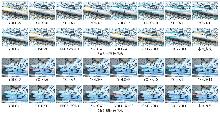
Fig. 7
Visualization of normal fishplate and defect fishplate detection"
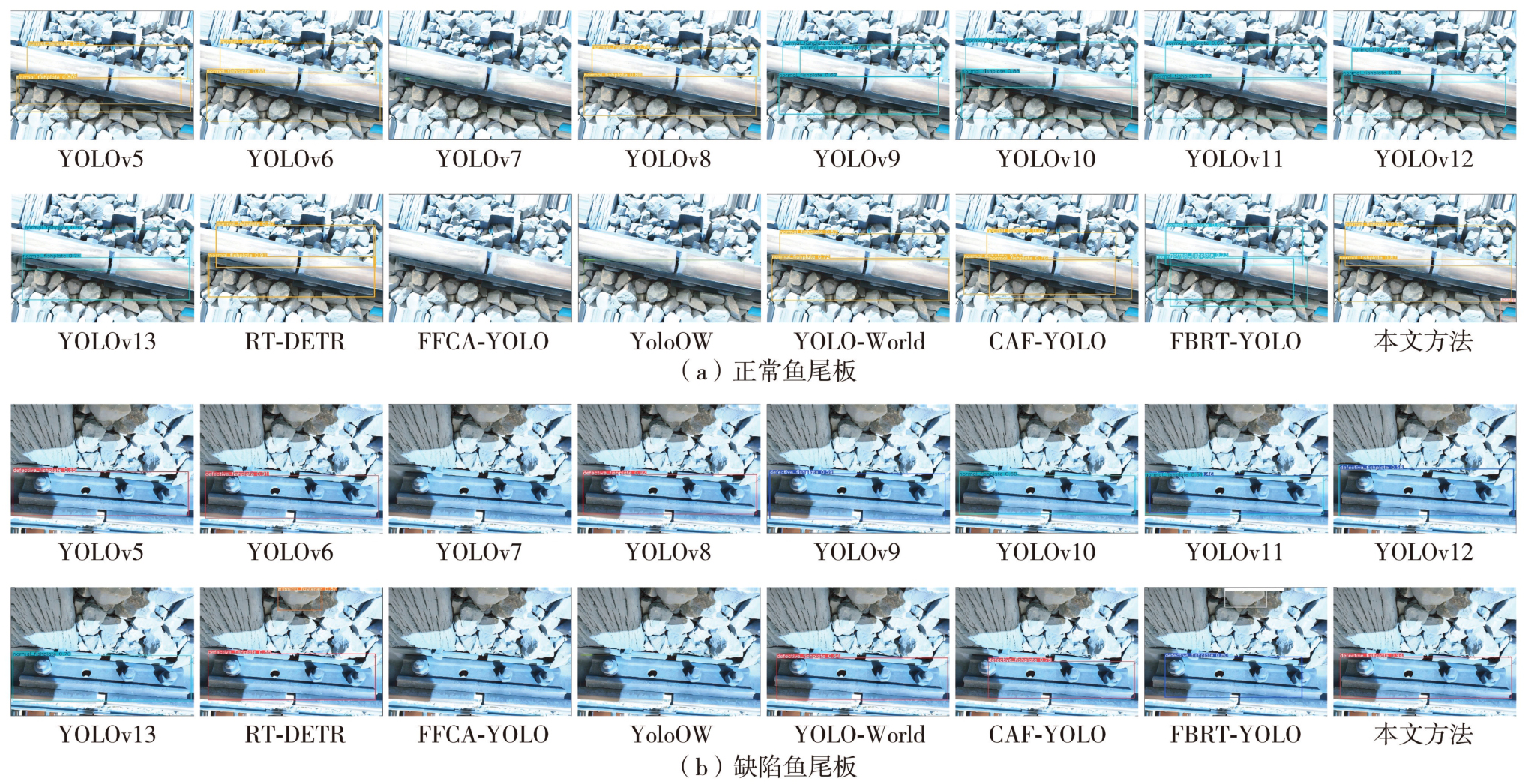
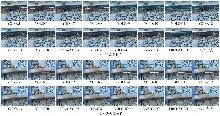
Fig. 8
Visualization of normal fastener and missing fastener detection"

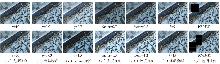
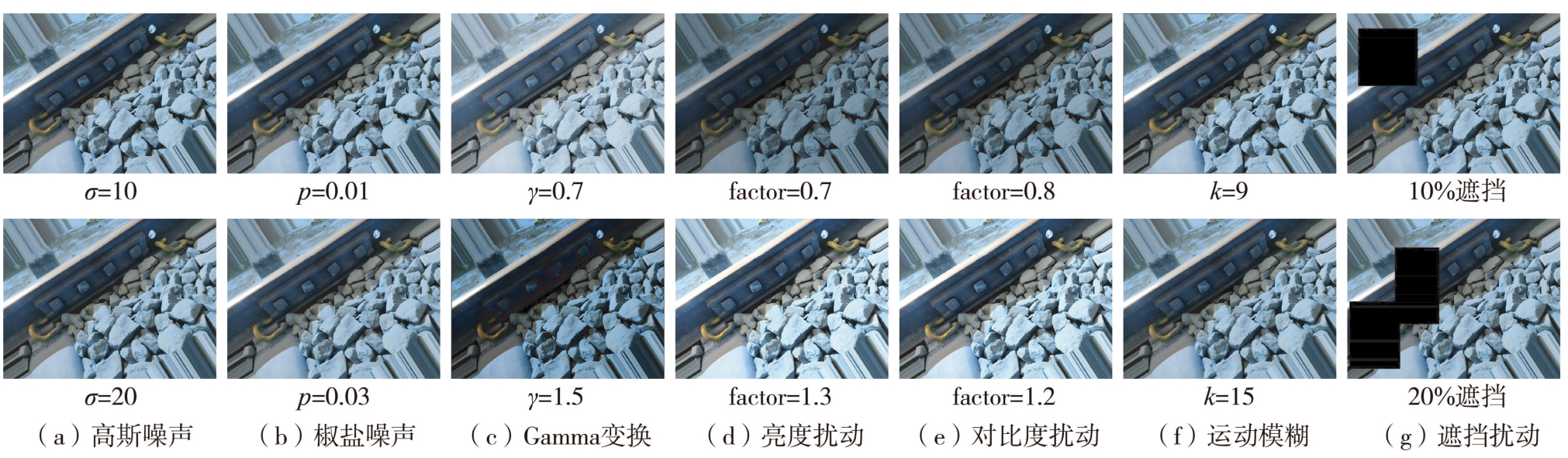
Fig. 9
Different perturbation simulations"
Tab. 5
Model robustness evaluation results"
| 干扰 | 阈值 | Precision | Recall | mAP@0.5 | mAP@[0.5∶0.95] |
|---|---|---|---|---|---|
| 高斯噪声 | σ=10 | 91.8 | 86.9 | 90.0 | 68.4 |
| σ=20 | 91.5 | 86.7 | 89.7 | 68.4 | |
| 椒盐噪声 | p=0.01 | 91.4 | 86.6 | 89.9 | 68.8 |
| p=0.03 | 91.3 | 86.5 | 89.4 | 68.5 | |
| Gamma变换 | γ=0.7 | 91.0 | 86.2 | 89.8 | 68.8 |
| γ=1.5 | 88.2 | 85.4 | 89.1 | 66.3 | |
| 亮度扰动 | factor=0.7 | 90.7 | 89.0 | 90.0 | 69.5 |
| factor=1.3 | 90.4 | 86.8 | 89.9 | 69.0 | |
| 对比度扰动 | factor=0.8 | 90.5 | 88.5 | 90.3 | 69.2 |
| factor=1.2 | 89.8 | 87.0 | 89.8 | 68.4 | |
| 运动模糊 | k=9 | 90.0 | 87.3 | 89.6 | 69.1 |
| k=15 | 89.8 | 84.1 | 88.9 | 68.7 | |
| 遮挡扰动 | 10%遮挡 | 80.8 | 60.6 | 65.1 | 40.9 |
| 20%遮挡 | 66.1 | 42.5 | 43.5 | 24.4 | |
| 本文方法(不添加扰动) | 91.4 | 87.3 | 90.1 | 68.9 | |
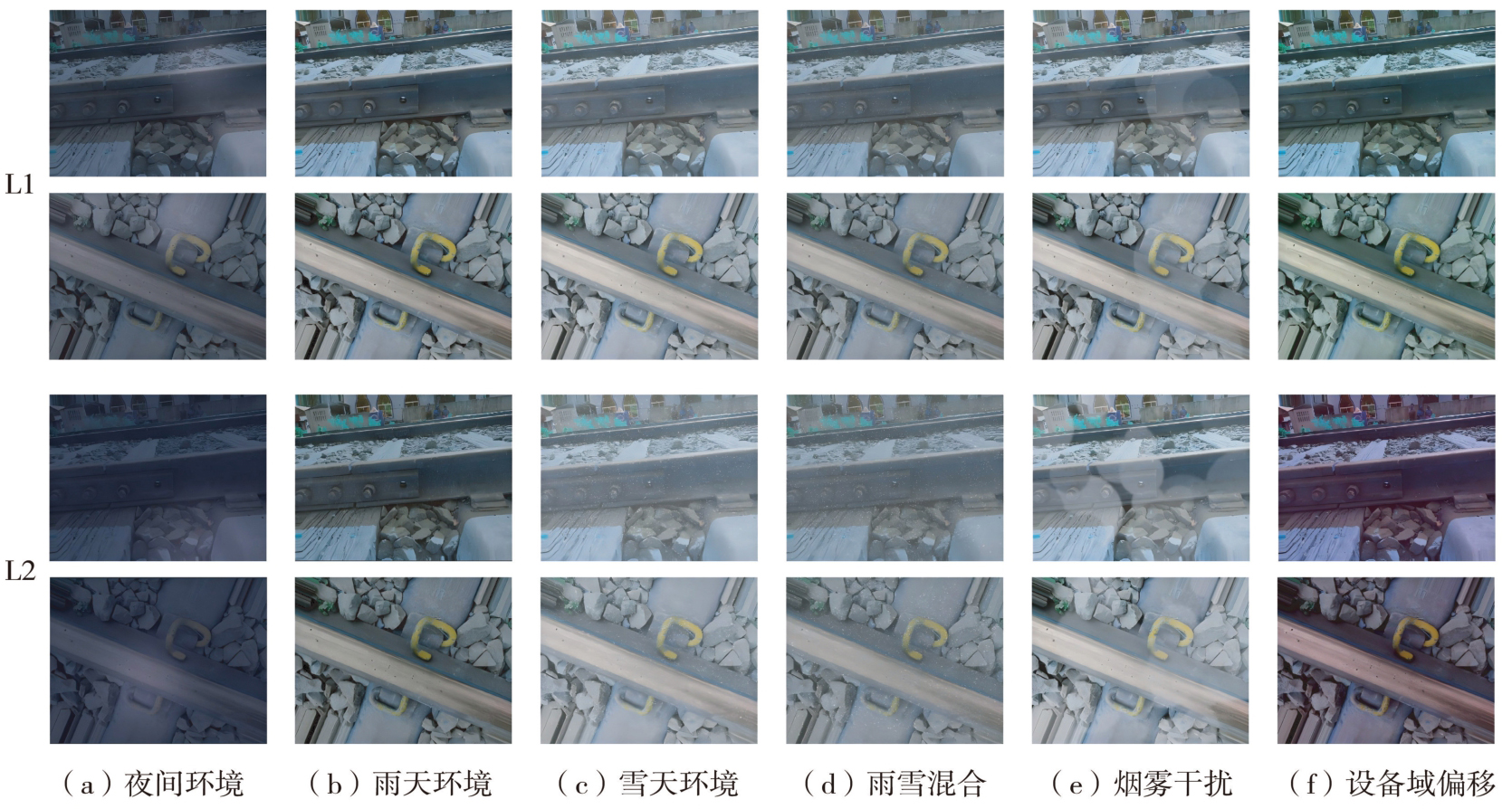
Fig. 10
Real-world oriented perturbations"
Tab. 6
Model robustness evaluation results under real railway scene perturbations"
| 类型 | 等级 | 主要参数 | Precision | Recall | mAP@0.5 | mAP@[0.5∶0.95] |
|---|---|---|---|---|---|---|
| 夜间 | L1 | 亮度0.45,噪声10,蓝色偏移10 | 76.6 | 64.9 | 69.1 | 49.6 |
| 环境 | L2 | 亮度0.28,噪声18,蓝色偏移18 | 63.8 | 33.9 | 39.7 | 24.1 |
| 雨天 | L1 | 雨密度0.08,雨丝长度20,亮度0.85 | 90.3 | 85.1 | 89.5 | 68.7 |
| 环境 | L2 | 雨密度0.14,雨丝长度30,亮度0.72 | 89.5 | 87.3 | 89.7 | 68.6 |
| 雪天 | L1 | 雪密度0.020,雾化强度0.15,亮度0.92 | 83.6 | 83.5 | 84.7 | 64.0 |
| 环境 | L2 | 雪密度0.045,雾化强度0.28,亮度0.85 | 66.7 | 45.9 | 61.2 | 39.6 |
| 雨雪 | L1 | 轻度雨丝、雪粒与雾化叠加 | 87.6 | 81.8 | 85.2 | 64.5 |
| 混合 | L2 | 强度雨丝、雪粒与雾化叠加 | 69.3 | 62.1 | 61.3 | 38.1 |
| 烟雾 | L1 | 烟雾强度0.28,烟雾团数量12 | 91.1 | 81.4 | 87.5 | 65.4 |
| 干扰 | L2 | 烟雾强度0.48,烟雾团数量22 | 78.9 | 68.7 | 72.5 | 50.8 |
| 设备域 | L1 | Gamma=1.20,JPEG质量60,缩放0.85 | 83.3 | 76.5 | 80.2 | 60.4 |
| 偏移 | L2 | Gamma=1.45,JPEG质量35,缩放0.65 | 70.6 | 65.1 | 66.6 | 47.1 |
| 本文方法(不添加扰动) | 91.4 | 87.3 | 90.1 | 68.9 | ||
Tab. 7
Model generalization evaluation results"
| 方法 | Precision | Recall | mAP@0.5 | mAP@[0.5∶0.95] |
|---|---|---|---|---|
| YOLOv5 | 32.3 | 22.3 | 16.1 | 7.8 |
| YOLOv6 | 38.3 | 27.1 | 22.6 | 11.3 |
| YOLOv7 | 48.8 | 30.0 | 20.0 | 7.4 |
| YOLOv8 | 35.5 | 18.0 | 14.6 | 7.3 |
| YOLOv9 | 33.7 | 25.4 | 17.7 | 9.3 |
| YOLOv10 | 27.1 | 11.7 | 9.1 | 4.4 |
| YOLOv11 | 24.9 | 19.2 | 11.2 | 5.0 |
| YOLOv12 | 12.5 | 12.9 | 5.7 | 2.2 |
| YOLOv13 | 17.6 | 10.5 | 6.3 | 3.0 |
| RT-DETR | 36.5 | 14.7 | 10.7 | 6.6 |
| FFCA-YOLO | 1.8 | 11.7 | 1.8 | 0.7 |
| YoloOW | 26.4 | 38.5 | 20.7 | 6.7 |
| YOLO-World | 38.7 | 21.2 | 20.0 | 10.1 |
| CAF-YOLO | 28.0 | 16.3 | 11.7 | 4.9 |
| FBRT-YOLO | 27.8 | 14.4 | 8.6 | 3.7 |
| 本文方法 | 48.5 | 38.8 | 35.0 | 18.2 |
Tab. 8
Mean and standard evaluation"
| 指标 | Precision | Recall | mAP@0.5 | mAP@[0.5∶0.95] | F1值 |
|---|---|---|---|---|---|
| 均值 | 89.9 | 87.4 | 89.4 | 68.3 | 88.6 |
| 标准差 | 1.0 | 0.4 | 0.5 | 0.4 | 0.4 |
Tab. 9
Ablation study evaluation results"
| MFEM | CADB | LAKA | Precision/(%) | Recall/(%) | mAP@0.5/(%) | [0.5∶0.95]/(%)mAP@ | Params | FLOPs | 推理速度/(帧/s) |
|---|---|---|---|---|---|---|---|---|---|
| — | — | — | 90.4 | 80.9 | 86.9 | 63.8 | 3.0×10⁶ | 8.1×10⁹ | 156.3 |
| √ | — | — | 89.8 | 86.6 | 88.8 | 67.3 | 3.4×10⁶ | 7.8×10⁹ | 122.0 |
| √ | √ | — | 88.6 | 87.4 | 89.4 | 66.7 | 4.6×10⁶ | 6.8×10⁹ | 99.5 |
| √ | √ | √ | 91.4 | 87.3 | 90.1 | 68.9 | 4.6×10⁶ | 7.0×10⁹ | 101.0 |
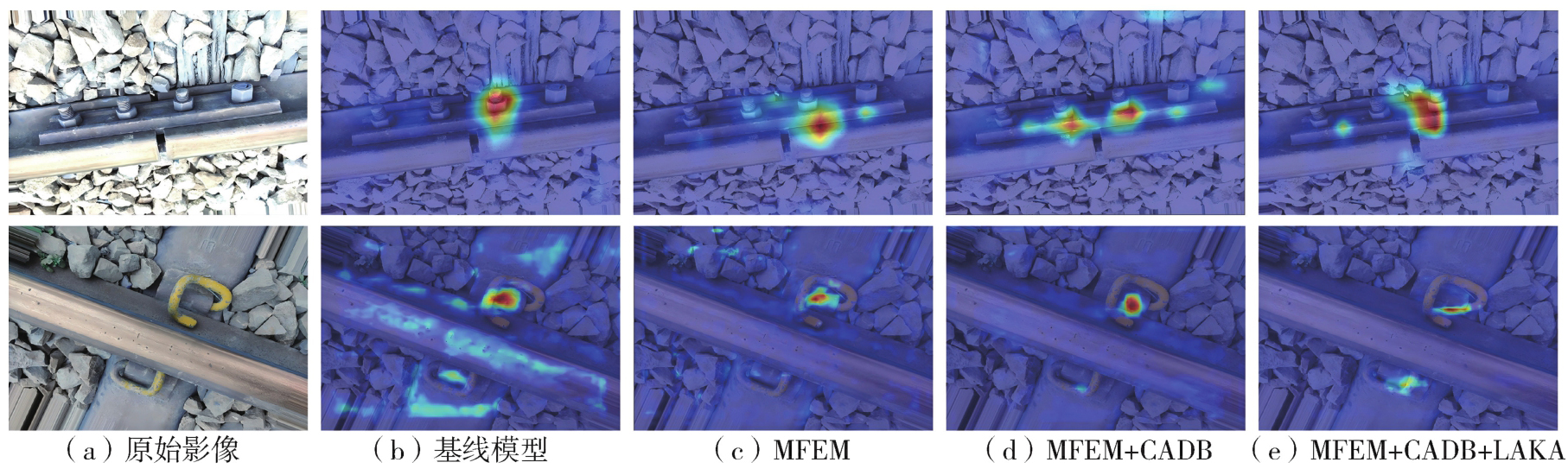
Fig. 11
Visualization of ablation study heatmaps"
| [1] |
朱庆, 张利国, 丁雨淋, 等. 从实景三维建模到数字孪生建模[J]. 测绘学报, 2022, 51(6): 1040-1049. DOI: .
doi: 10.11947/j.AGCS.2022.20210640 |
|
Zhu Qing, Zhang Liguo, Ding Yulin, et al. From real 3D modeling to digital twin modeling[J]. Acta Geodaetica et Cartographica Sinica, 2022, 51(6): 1040-1049. DOI: .
doi: 10.11947/j.AGCS.2022.20210640 |
|
| [2] | 朱庆, 赵元祯, 郭永欣, 等. 数字孪生铁路地理地质知识库分布式管理方法[J]. 西南交通大学学报, 2026, 61(1): 1-10. |
| Zhu Qing, Zhao Yuanzhen, Guo Yongxin, et al. Distributed management method for geographic and geological knowledge base for railway digital twin[J]. Journal of Southwest Jiaotong University, 2026, 61(1): 1-10. | |
| [3] | 王平, 陈嵘, 安博洋. 铁路轨道工程长寿命安全保障战略探讨[J]. 中国工程科学, 2017, 19(6): 66-71. |
| Wang Ping, Chen Rong, An Boyang. Discussion on long-life security strategies for railway track engineering[J]. Strategic Study of CAE, 2017, 19(6): 66-71. | |
| [4] | Cannon D F, Edel K O, Grassie S L, et al. Rail defects: an overview[J]. Fatigue & Fracture of Engineering Materials & Structures, 2003, 26(10): 865-886. |
| [5] | Kostrzewski M, Melnik R. Condition monitoring of rail transport systems: a bibliometric performance analysis and systematic literature review[J]. Sensors, 2021, 21(14): 4710. |
| [6] | 高艺平, 王浩, 李新宇, 等. 基于深度智能视觉的表面缺陷检测研究进展[J]. 工业工程, 2024, 27(2): 27-36, 66. |
| Gao Yiping, Wang Hao, Li Xinyu, et al. A review on surface defect detection based on deep intelligent vision[J]. Industrial Engineering Journal, 2024, 27(2): 27-36, 66. | |
| [7] | Gibert X, Patel V M, Chellappa R. Robust fastener detection for autonomous visual railway track inspection[C]//Proceedings of 2015 IEEE Winter Conference on Applications of Computer Vision. Waikoloa: IEEE, 2015: 694-701. |
| [8] | He Biao, Luo Jianqiao, Ou Yang, et al. Railway fastener defects detection under various illumination conditions using fuzzy C-means part model[J]. Transportation Research Record: Journal of the Transportation Research Board, 2021, 2675(4): 271-280. |
| [9] | Haroon M, Khan M J, Cheema H M, et al. An end-to-end approach to detect railway track defects based on supervised and self-supervised learning[J]. Results in Engineering, 2024, 24: 103326. |
| [10] | Wang T G, Yang F F, Tsui K L. Real-time detection of railway track component via one-stage deep learning networks[J]. Sensors, 2020, 20(15): 4325. |
| [11] | Brintha K, Jawhar S J. FOD-YOLO NET: fasteners fault and object detection in railway tracks using deep yolo network1[J]. Journal of Intelligent & Fuzzy Systems, 2024, 46(4): 8123-8137. |
| [12] | Bai Tangbo, Yang Jianwei, Xu Guiyang, et al. An optimized railway fastener detection method based on modified faster R-CNN[J]. Measurement, 2021, 182: 109742. |
| [13] | Tang Youzhi, Qian Yu. High-speed railway track components inspection framework based on YOLOv8 with high-performance model deployment[J]. High-speed Railway, 2024, 2(1): 42-50. |
| [14] |
谢亚坤, 赵耀纪, 涂佳星, 等. 融合边缘与全局特征的遥感影像显著性目标检测方法[J]. 测绘学报, 2025, 54(7): 1265-1279. DOI: .
doi: 10.11947/j.AGCS.2025.20240247 |
|
Xie Yakun, Zhao Yaoji, Tu Jiaxing, et al. Edge and global features integrated network for salient object detection in optical remote sensing images[J]. Acta Geodaetica et Cartographica Sinica, 2025, 54(7): 1265-1279. DOI: .
doi: 10.11947/j.AGCS.2025.20240247 |
|
| [15] | Zhao J Y, Yeung A W, Ali M, et al. CBAM-SwinT-BL: small rail surface defect detection method based on swin transformer with block level CBAM enhancement[J]. IEEE Access, 2024, 12: 181997-182009. |
| [16] | Sun Shizhong, Fu Gui, Li Jie, et al. Dual-stream landslide detection network integrating global and local information for remote sensing imagery[J]. Journal of Geodesy and Geoinformation Science, 2025, 8(4): 72-82. |
| [17] | Gui Gao, Wenya Linghu. LSD-DETR: a lightweight real-time detection transformer for SAR ship detection[J]. Journal of Geodesy and Geoinformation Science, 2025, 8(1): 47-70. |
| [18] | Chen Mei, Zhang Maolin, Peng Jun, et al. A multi-category defect detection model for rail fastener based on optimized YOLOv8n[J]. Machines, 2025, 13(6): 511. |
| [19] | Bai Tangbo, Wang Xiaolan, Wang Yufei, et al. YOLO-GEH: rail track fastener detection with gradient hierarchical edge enhancement and attention fusion[J]. The Journal of Supercomputing, 2025, 82(1): 9. |
| [20] | Cai Yijie, He Ming, Chen Bin. Efficient deep learning based rail fastener screw detection method for fastener screw maintenance robot under complex lighting conditions[J]. Scientific Reports, 2024, 14: 28957. |
| [21] | Lü Defang, Meng Jianjun, Meng Gaoyang, et al. Two-stage multi-label detection method for railway fasteners based on type-guided expert model[J]. Applied Sciences, 2025, 15(24): 13093. |
| [22] | Terven J, Córdova-Esparza D M, Romero-González J A. A comprehensive review of YOLO architectures in computer vision: from YOLOv1 to YOLOv8 and YOLO-NAS[J]. Machine Learning and Knowledge Extraction, 2023, 5(4): 1680-1716. |
| [23] | Li Chuyi, Li Lulu, Jiang Hongliang, et al. YOLOv6: a single-stage object detection framework for industrial applications[PP/OL]. arXiv (2022-09-07) [2025-10-13]. https://doi.org/10.48550/arXiv.2209.02976. |
| [24] | Wang C Y, Bochkovskiy A, Liao H M. YOLOv7: trainable bag-of-freebies sets new state-of-the-art for real-time object detectors[C]//Proceedings of 2023 IEEE/CVF Conference on Computer Vision and Pattern Recognition. Vancouver, BC: IEEE, 2023: 7464-7475. |
| [25] | Reis D, Kupec J, Hong J, et al. Real-time flying object detection with YOLOv8[PP/OL]. V2. arXiv (2024-05-22) [2025-10-13]. https://doi.org/10.48550/arXiv.2305.09972. |
| [26] | Wang C Y, Yeh I H, Mark Liao H Y. YOLOv9: learning what you want to Learn using programmable gradient information[C]//Proceedings of 2024 Computer Vision. Cham: Springer Nature Switzerland, 2025: 1-21. |
| [27] | Wang Ao, Chen Hui, Liu Lihao, et al. YOLOv10: real-time end-to-end object detection[J]. Advances in neural information processing systems, 2024, 37: 107984-108011. |
| [28] | Khanam R, Hussain M. YOLOv11: an overview of the key architectural enhancements[PP/OL]. arXiv (2024-10-23) [2025-10-13]. https://doi.org/10.48550/arXiv.2410.17725. |
| [29] | Tian Yunjie, Ye Qixiang, Doermann D. YOLOv12: attention-centric real-time object detectors[PP/OL]. arXiv (2025-02-18) [2025-10-13]. https://doi.org/10.48550/arXiv.2502.12524. |
| [30] | Lei Mengqi, Li Siqi, Wu Yihong, et al. YOLOv13: real-time object detection with hypergraph-enhanced adaptive visual perception[PP/OL]. V2. arXiv (2025-09-05) [2025-10-13]. https://doi.org/10.48550/arXiv.2506.17733. |
| [31] | Zhao Yian, Lv Wenyu, Xu Shangliang, et al. DETRs beat YOLOs on real-time object detection[C]//Proceedings of 2024 IEEE/CVF Conference on Computer Vision and Pattern Recognition. Seattle: IEEE, 2024: 16965-16974. |
| [32] | Zhang Yin, Ye Mu, Zhu Guiyi, et al. FFCA-YOLO for small object detection in remote sensing images[J]. IEEE Transactions on Geoscience and Remote Sensing, 2024, 62: 5611215. |
| [33] | Chen Zilin, Lu Shengnan. CAF-YOLO: a robust framework for multi-scale lesion detection in biomedical imagery[C]//Proceedings of 2025 IEEE International Conference on Acoustics, Speech and Signal Processing. Hyderabad: IEEE, 2025: 1-5. |
| [34] | Xiao Yao, Xu Tingfa, Xin Yu, et al. FBRT-YOLO: faster and better for real-time aerial image detection[C]//Proceedings of 2025 AAAI Conference on Artificial Intelligence. Washington, DC: AAAI Press, 2025, 39(8): 8673-8681. |
| [35] | Xu Jianhao, Fan Xiangtao, Jian Hongdeng, et al. YoloOW: a spatial scale adaptive real-time object detection neural network for open water search and rescue from UAV aerial imagery[J]. IEEE Transactions on Geoscience and Remote Sensing, 2024, 62: 5623115. |
| [36] | Cheng Tianheng, Song Lin, Ge Yixiao, et al. YOLO-world: real-time open-vocabulary object detection[C]//Proceedings of 2024 IEEE/CVF Conference on Computer Vision and Pattern Recognition. Seattle: IEEE, 2024: 16901-16911. |
| [1] | Shengjun Tang, Hanyu Li, Weixi Wang, Linfu Xie, Xiaoming Li, Renzhong Guo. A no-reference method for face-level defect detection and quality assessment of oblique photogrammetric 3D mesh models [J]. Acta Geodaetica et Cartographica Sinica, 2026, 55(8): 1382-1399. |
| Viewed | ||||||
|
Full text |
|
|||||
|
Abstract |
|
|||||
