

Acta Geodaetica et Cartographica Sinica ›› 2026, Vol. 55 ›› Issue (2): 301-314.doi: 10.11947/j.AGCS.2026.20250158
• Geodesy and Navigation • Previous Articles Next Articles
Yi LI1( ), Li WANG1(), Bao SHU1, Youjian XU1, Mengran LI1, Xiaojun LIU1, Xin PENG2
Received:2025-04-28
Revised:2026-01-15
Online:2026-03-13
Published:2026-03-13
Contact:
Li WANG
E-mail:yi.li@chd.edu.cn;wangli@chd.edu.cn
About author:LI Yi (1999—), male, PhD candidate, majors in GNSS/INS integrated navigation and integrity monitoring. E-mail: yi.li@chd.edu.cn
Supported by:CLC Number:
Yi LI, Li WANG, Bao SHU, Youjian XU, Mengran LI, Xiaojun LIU, Xin PENG. An optimization algorithm for RTK integrity monitoring based on solution separation for vehicle applications[J]. Acta Geodaetica et Cartographica Sinica, 2026, 55(2): 301-314.
Fig. 1
Vehicle trajectories and number of visible satellites (dataset Ⅰ)"
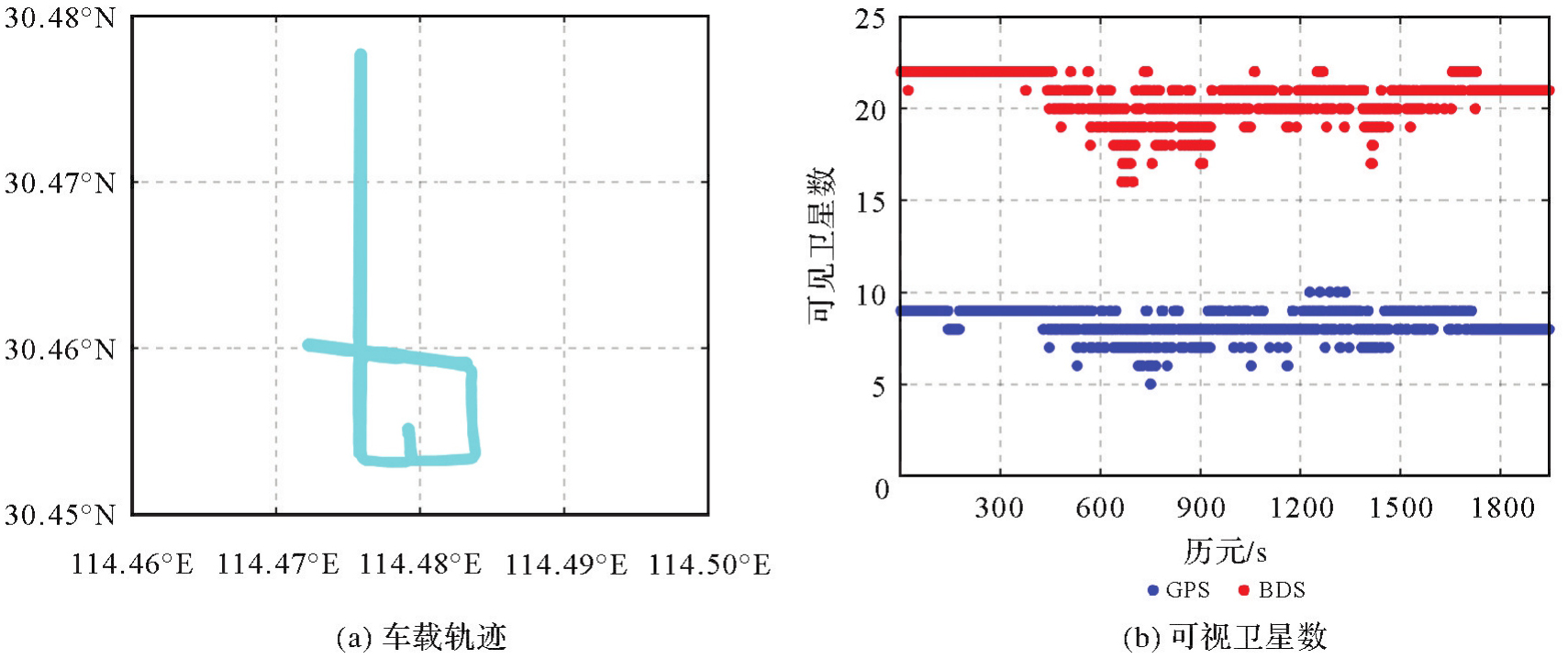
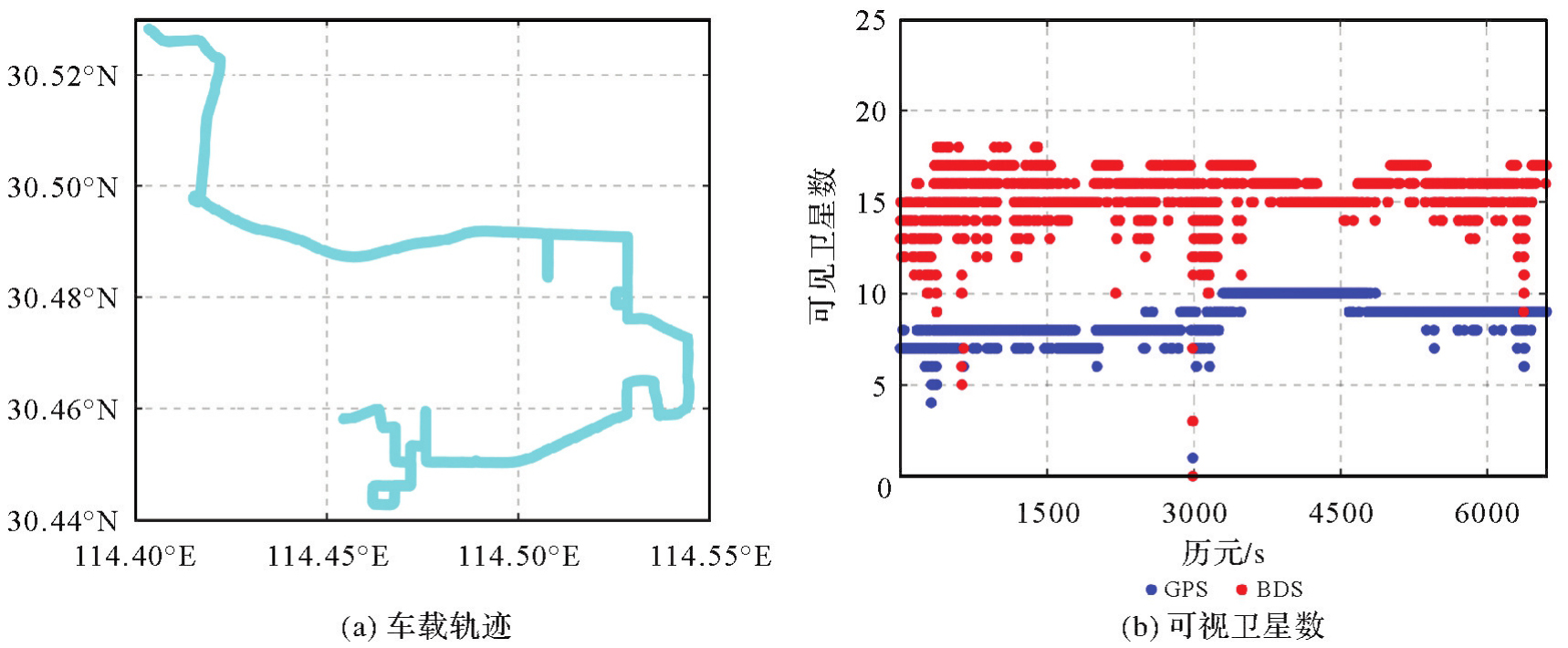
Fig. 2
Vehicle trajectories and number of visible satellites (dataset Ⅱ)"
Tab. 1
RTK solution strategy"
| 类型 | 内容 |
|---|---|
| 卫星系统 | GPS/BDS |
| 观测频点 | L1/B1 |
| 截止高度角/(°) | 10 |
| 定位解模式 | 动态解+前向滤波 |
| 模糊度固定模式 | 部分模糊度固定+单历元解算 |
| 模糊度固定阈值 | 固定成功率>0.999 |
| 先验故障概率[ | 10-5 |
| 完好性风险[ | 10-7 |
| 连续性风险/h | 10-3 |
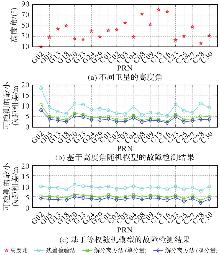
Fig. 3
Performances of different fault detection methods"
Tab. 2
Minimum detectable pseudorange gross error by different fault detection methods for each PRN"
| PRN | 残差检验法 | 解分离(单分量) | 解分离(双分量) | PRN | 残差检验法 | 解分离(单分量) | 解分离(双分量) |
|---|---|---|---|---|---|---|---|
| G02 | 18.4(9.9) | 10.5(5.3) | 8.0(4.1) | C04 | 9.5(10.0) | 5.4(5.8) | 4.3(4.6) |
| G05 | 9.1(9.4) | 4.8(5.0) | 3.7(3.8) | C08 | 5.6(8.8) | 3.0(4.8) | 2.3(3.7) |
| G13 | 7.3(9.2) | 4.0(4.9) | 3.1(3.7) | C09 | 6.8(9.6) | 3.9(5.5) | 3.2(4.4) |
| G18 | 6.3(8.5) | 3.3(4.4) | 2.5(3.4) | C13 | 6.3(9.3) | 3.6(5.3) | 2.9(4.2) |
| G20 | 11.0(10.7) | 6.4(6.2) | 5.2(5.0) | C16 | 5.2(8.5) | 2.6(4.5) | 2.0(3.4) |
| G23 | 10.6(10.0) | 5.9(5.6) | 4.7(4.4) | C23 | 10.7(9.9) | 6.0(5.7) | 4.8(4.6) |
| G24 | 8.3(9.7) | 4.4(5.3) | 3.4(4.1) | C25 | 7.7(8.5) | 3.6(4.0) | 2.4(2.8) |
| G29 | 8.6(9.2) | 4.4(4.7) | 3.2(3.5) | C27 | 6.7(9.3) | 3.8(5.3) | 3.0(4.2) |
| C01 | 7.9(9.9) | 4.7(5.8) | 3.8(4.7) | C28 | 11.1(7.8) | 5.2(3.3) | 3.6(2.1) |
| C02 | 6.5(8.7) | 3.3(4.6) | 2.5(3.5) | C30 | 9.1(9.9) | 4.7(5.2) | 3.6(3.9) |
| C03 | 6.1(9.0) | 3.4(5.0) | 2.6(4.0) | 均值 | 8.5(9.3) | 4.6(5.0) | 3.6(3.9) |
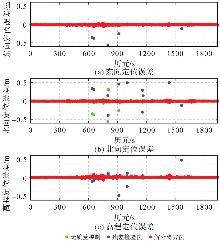
Fig. 4
RTK positioning errors of different fault detection methods (dataset Ⅰ)"
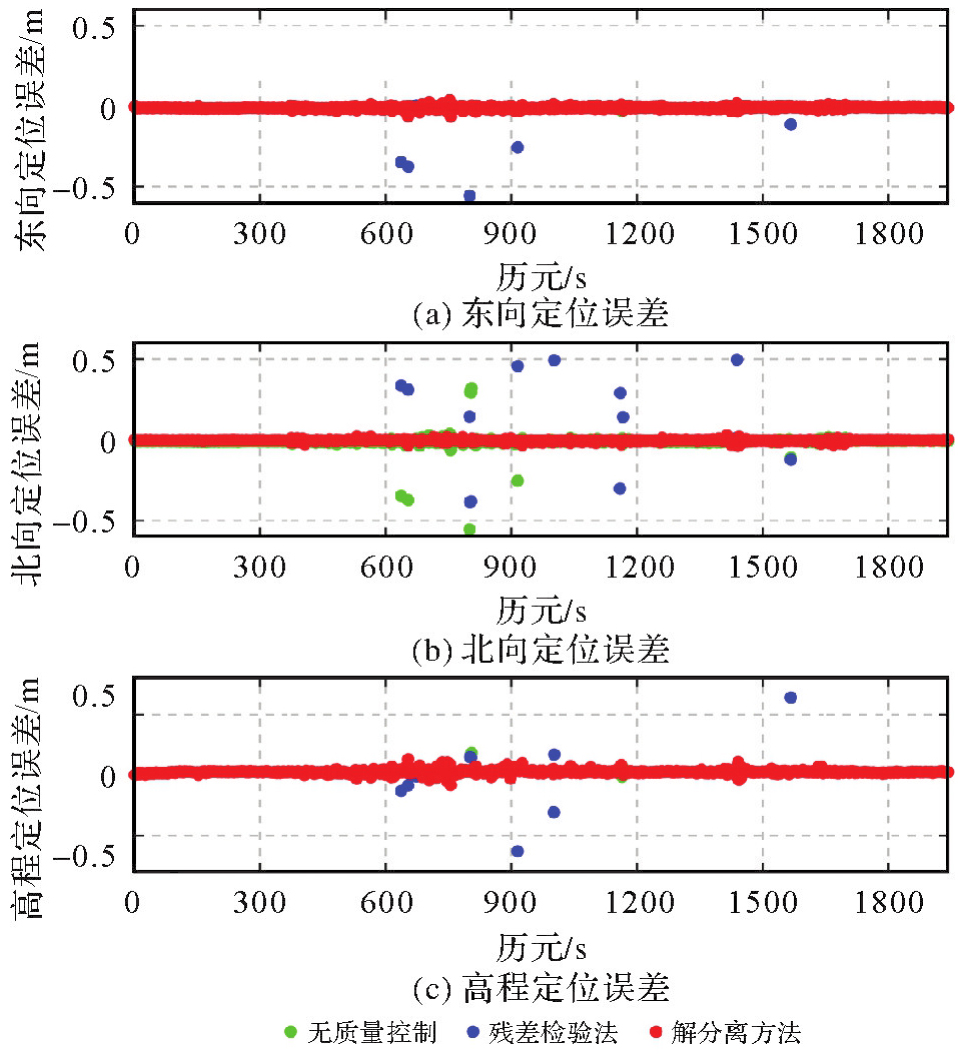
Tab. 3
RTK positioning errors and incorrect ambiguity fix for different fault detection methods (dataset Ⅰ)"
| 方案 | RMS/m | 模糊度错误固定历元数 | ||
|---|---|---|---|---|
| 东向 | 北向 | 高程 | ||
| 无质量控制 | 0.15 | 0.15 | 0.24 | 17 |
| 残差检验法 | 0.15 | 0.15 | 0.24 | 17 |
| 解分离方法 | 0.01 | 0.02 | 0.03 | 0 |
Fig. 5
PRNs with incorrect fixed ambiguity and its effect on the positioning error (dataset Ⅰ)"
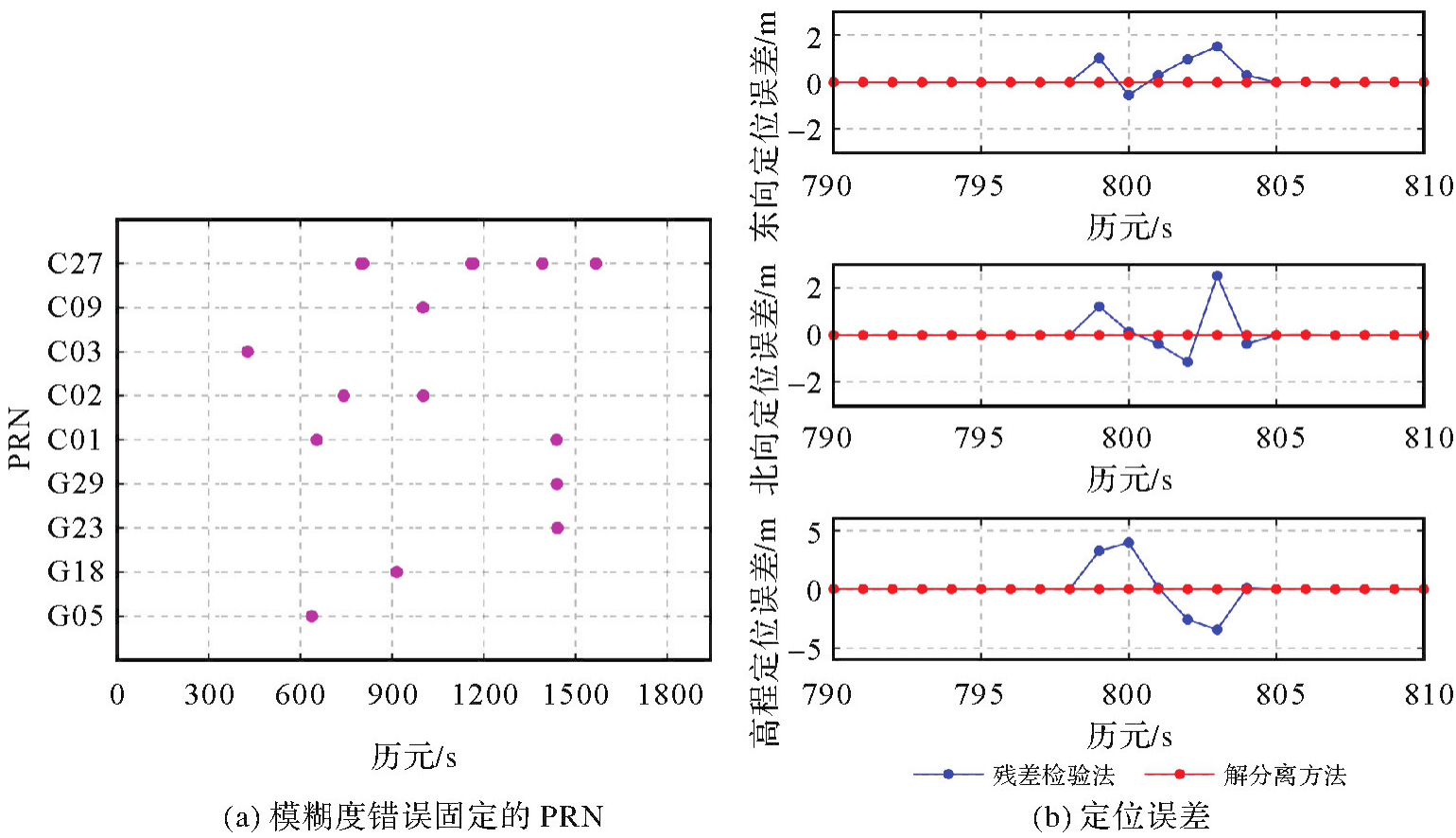
Fig. 6
RTK positioning errors with different fault detection methods (dataset Ⅱ)"
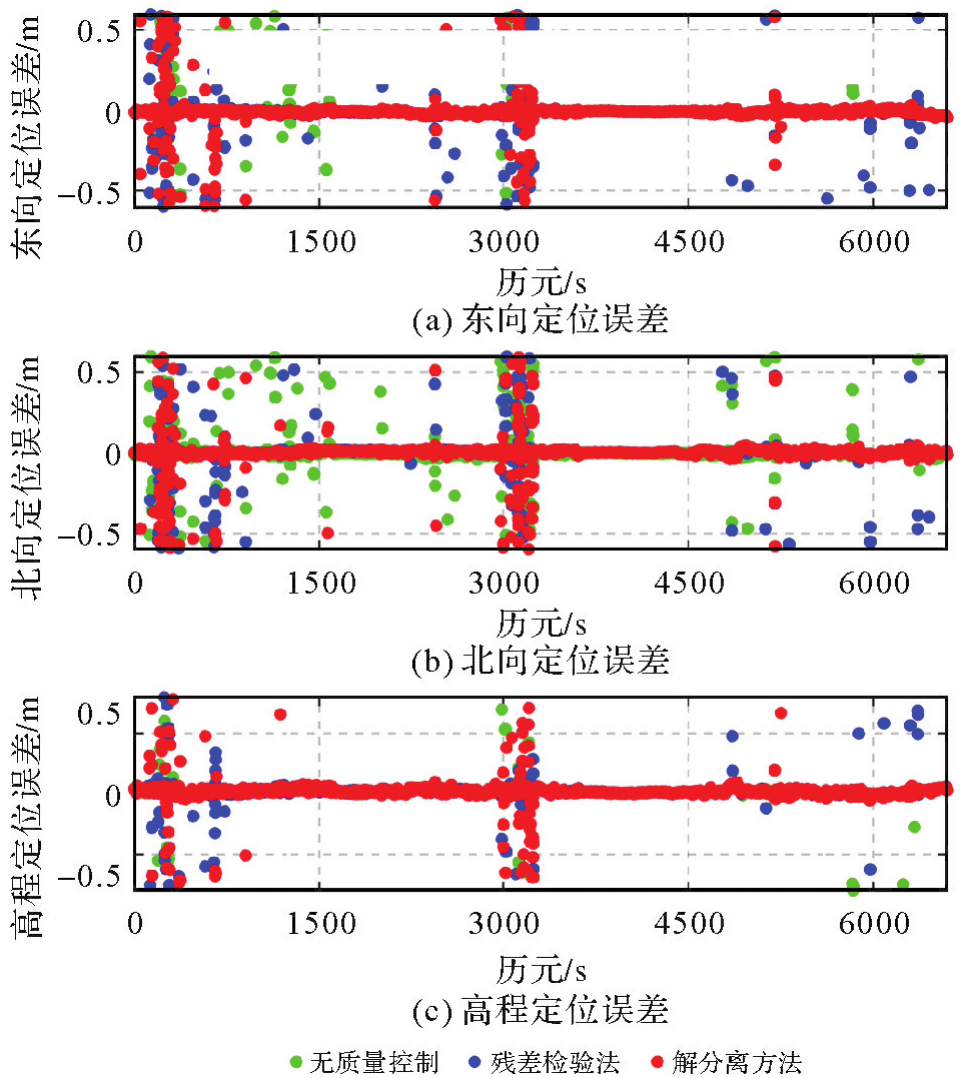
Tab. 4
RTK positioning errors and incorrect ambiguity fix for different fault detection methods (dataset Ⅱ)"
| 方案 | RMS/m | 模糊度错误固定历元数 | ||
|---|---|---|---|---|
| 东向 | 北向 | 高程 | ||
| 无质量控制 | 2.46 | 3.98 | 6.75 | 1708 |
| 残差检验法 | 0.24 | 0.26 | 0.79 | 111 |
| 解分离方法 | 0.22 | 0.23 | 0.52 | 90 |
Fig. 7
PRNs with incorrect fixed ambiguity and its effect on the positioning errors (dataset Ⅱ)"
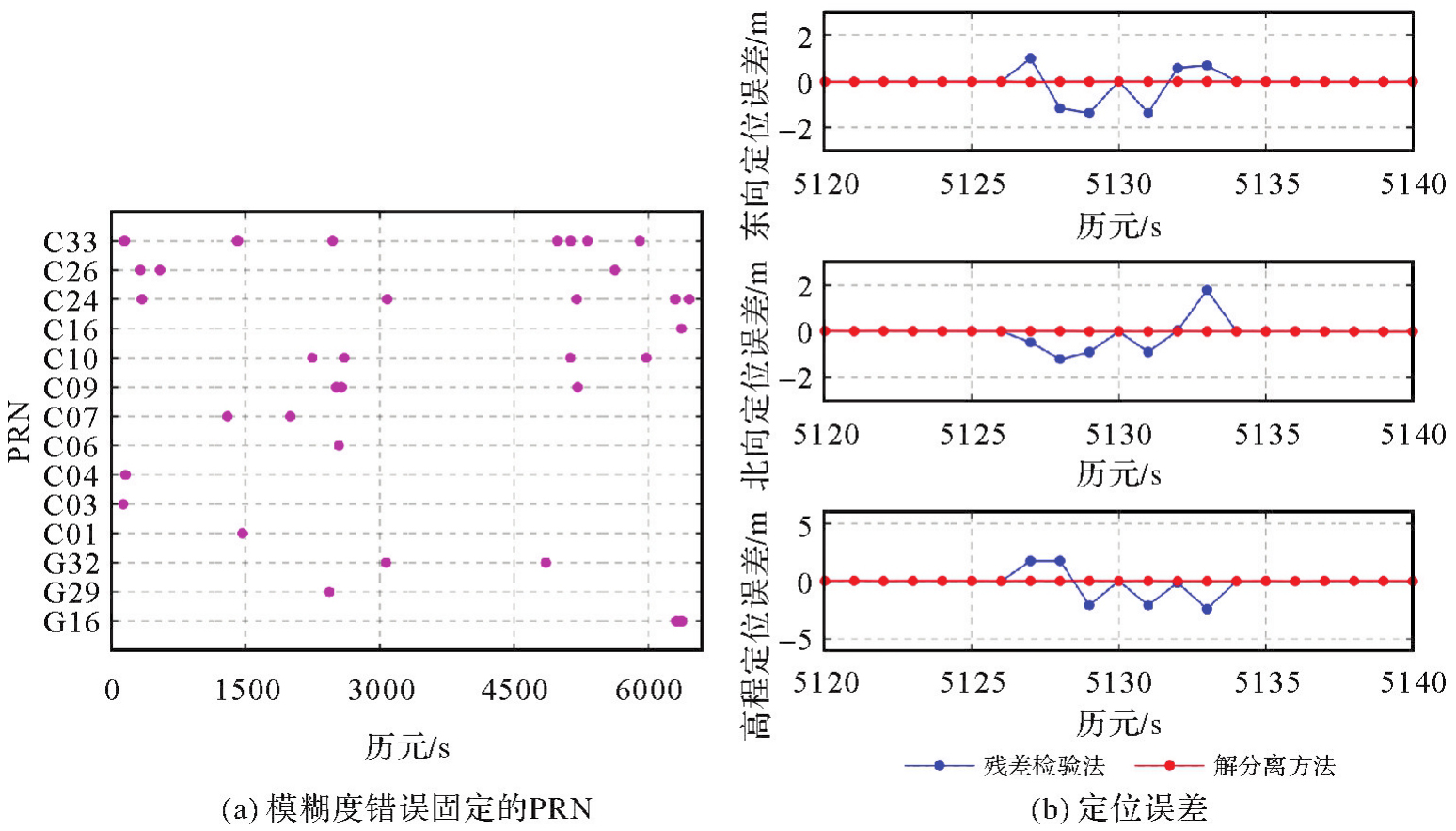
Fig. 8
QQ plots of double difference pseudorange and phase residuals for dataset Ⅰ and dataset Ⅱ"
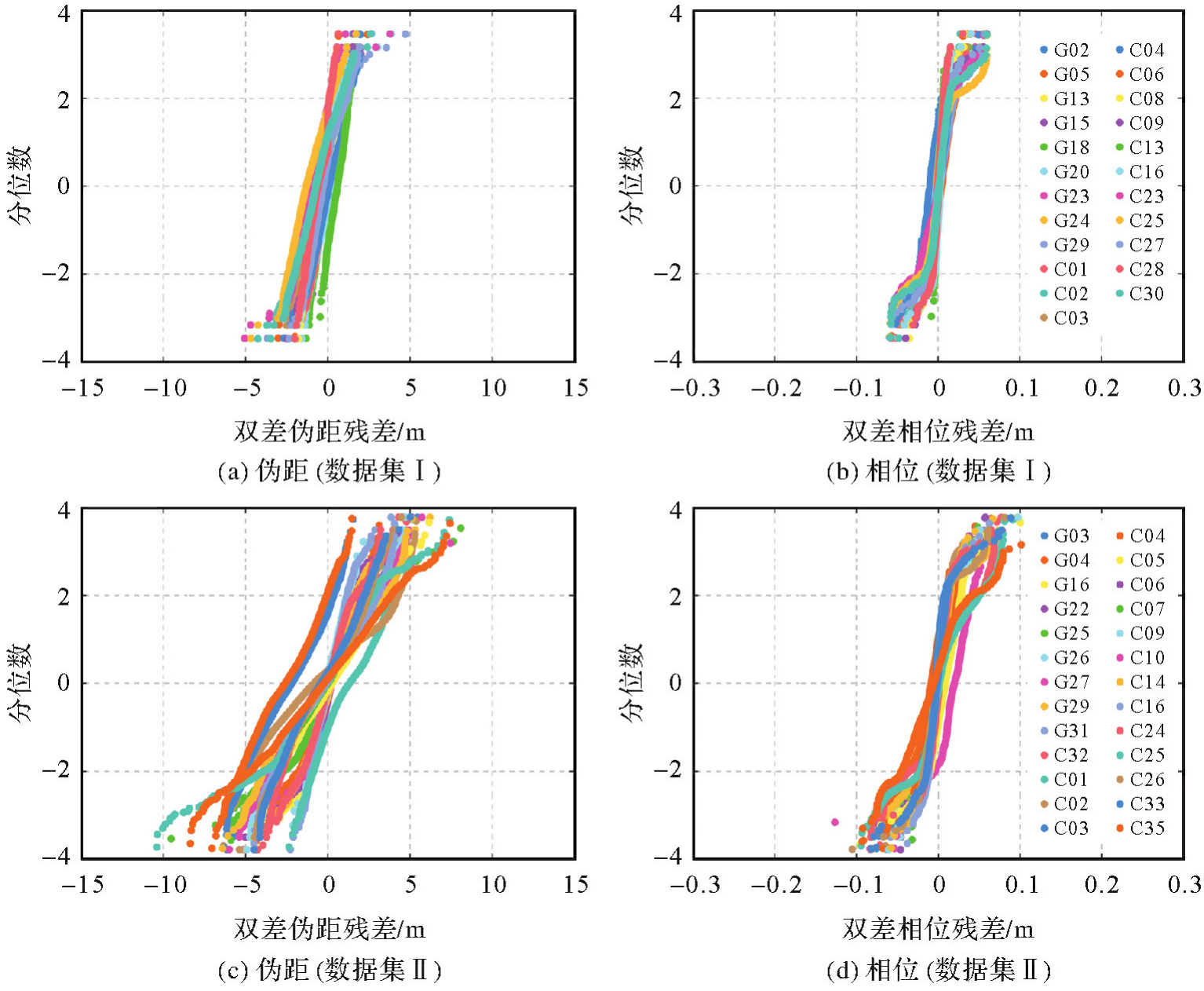
Fig. 9
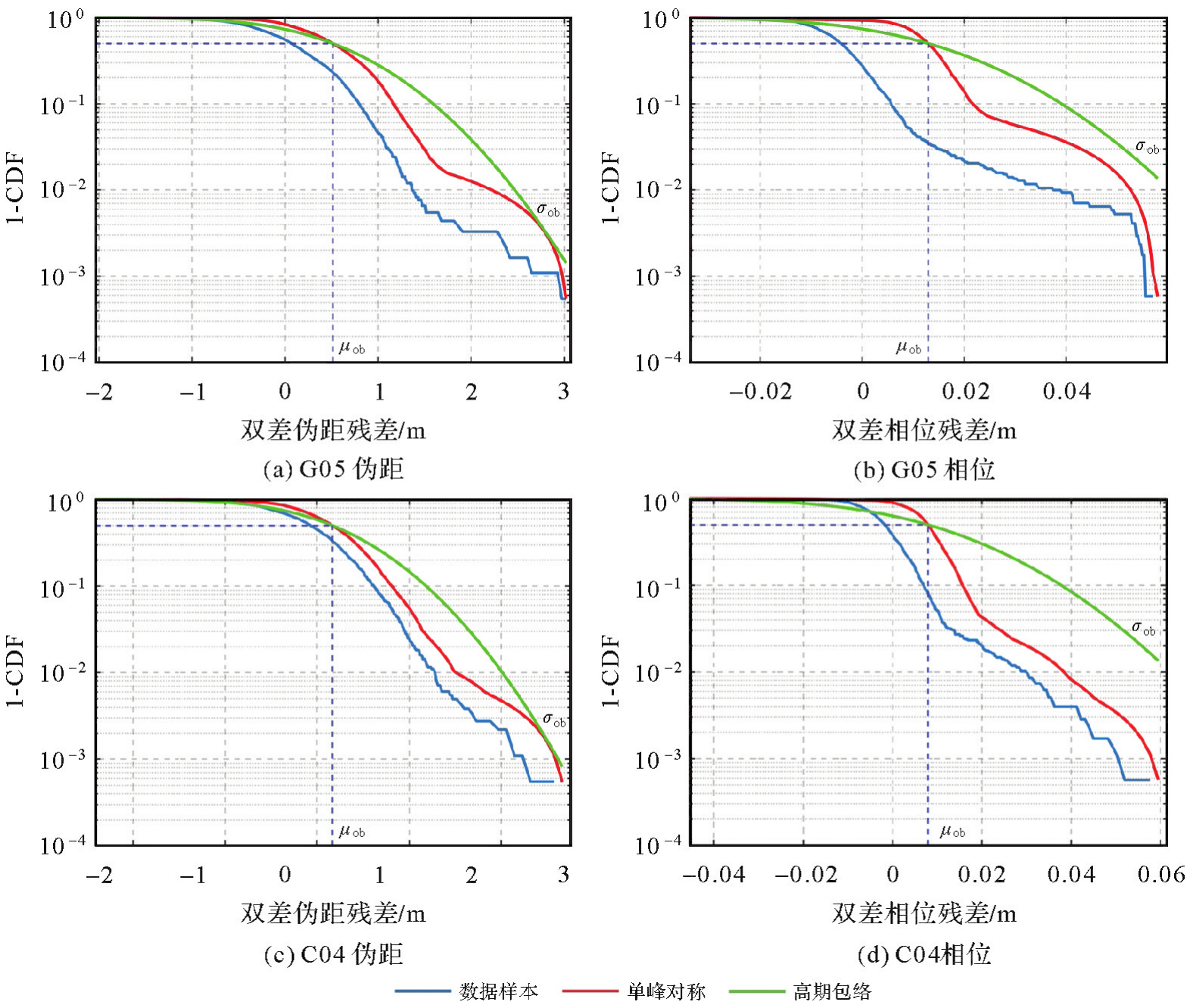
Overbounding effect of G05 and C04 observation residuals"
Tab. 5
Overbounding parameters of dataset Ⅰ"
| PRN | μob | σob | PRN | μob | σob |
|---|---|---|---|---|---|
| G02 | 0.882(0.014) | 0.621(0.017) | C04 | 0.169(0.008) | 0.793(0.023) |
| G05 | 0.514(0.013) | 0.840(0.024) | C06 | 0.735(0.018) | 0.451(0.018) |
| G13 | 0.190(0.006) | 0.628(0.025) | C08 | 0.423(0.008) | 0.594(0.017) |
| G15 | 0.472(0.004) | 0.662(0.005) | C09 | 0.628(0.012) | 0.591(0.021) |
| G18 | 0.155(0.009) | 0.463(0.021) | C13 | 0.661(0.004) | 0.698(0.008) |
| G20 | 1.019(0.013) | 0.904(0.020) | C16 | 0.636(0.016) | 0.526(0.018) |
| G23 | 0.598(0.009) | 1.011(0.021) | C23 | 1.858(0.015) | 1.021(0.025) |
| G24 | 0.573(0.011) | 0.622(0.020) | C25 | 1.459(0.015) | 1.012(0.022) |
| G29 | 0.807(0.006) | 1.241(0.025) | C27 | 0.355(0.014) | 0.772(0.025) |
| C01 | 0.163(0.008) | 0.562(0.021) | C28 | 0.575(0.017) | 0.443(0.027) |
| C02 | 1.255(0.009) | 0.837(0.018) | C30 | 0.957(0.026) | 1.033(0.022) |
| C03 | 0.832(0.013) | 0.816(0.020) |
Tab. 6
Overbounding parameters of dataset Ⅱ"
| PRN | μob | σob | PRN | μob | σob |
|---|---|---|---|---|---|
| G03 | 0.262(0.009) | 1.715(0.029) | C04 | 2.899(0.003) | 1.630(0.028) |
| G04 | 0.413(0.022) | 1.199(0.026) | C05 | 0.404(0.019) | 1.715(0.033) |
| G16 | 0.539(0.012) | 1.291(0.027) | C06 | 0.193(0.004) | 1.751(0.023) |
| G22 | 0.332(0.013) | 1.397(0.025) | C07 | 0.719(0.006) | 1.893(0.019) |
| G25 | 1.643(0.009) | 2.422(0.029) | C09 | 0.570(0.007) | 1.821(0.032) |
| G26 | 0.225(0.013) | 0.699(0.018) | C10 | 0.261(0.011) | 1.892(0.028) |
| G27 | 2.095(0.034) | 1.897(0.038) | C14 | 0.384(0.002) | 2.271(0.028) |
| G29 | 0.320(0.007) | 1.663(0.034) | C16 | 1.695(0.006) | 1.910(0.025) |
| G31 | 0.348(0.007) | 0.997(0.024) | C24 | 0.614(0.026) | 1.507(0.026) |
| G32 | 0.350(0.020) | 1.294(0.024) | C25 | 1.580(0.018) | 2.679(0.034) |
| C01 | 1.610(0.006) | 1.513(0.032) | C26 | 0.428(0.011) | 1.920(0.035) |
| C02 | 1.010(0.012) | 3.267(0.027) | C33 | 0.535(0.005) | 1.786(0.031) |
| C03 | 2.405(0.011) | 1.826(0.029) | C35 | 0.719(0.022) | 2.506(0.047) |
Fig. 10
Protection level and positioning error of RTK float and fixed solutions (dataset Ⅰ)"
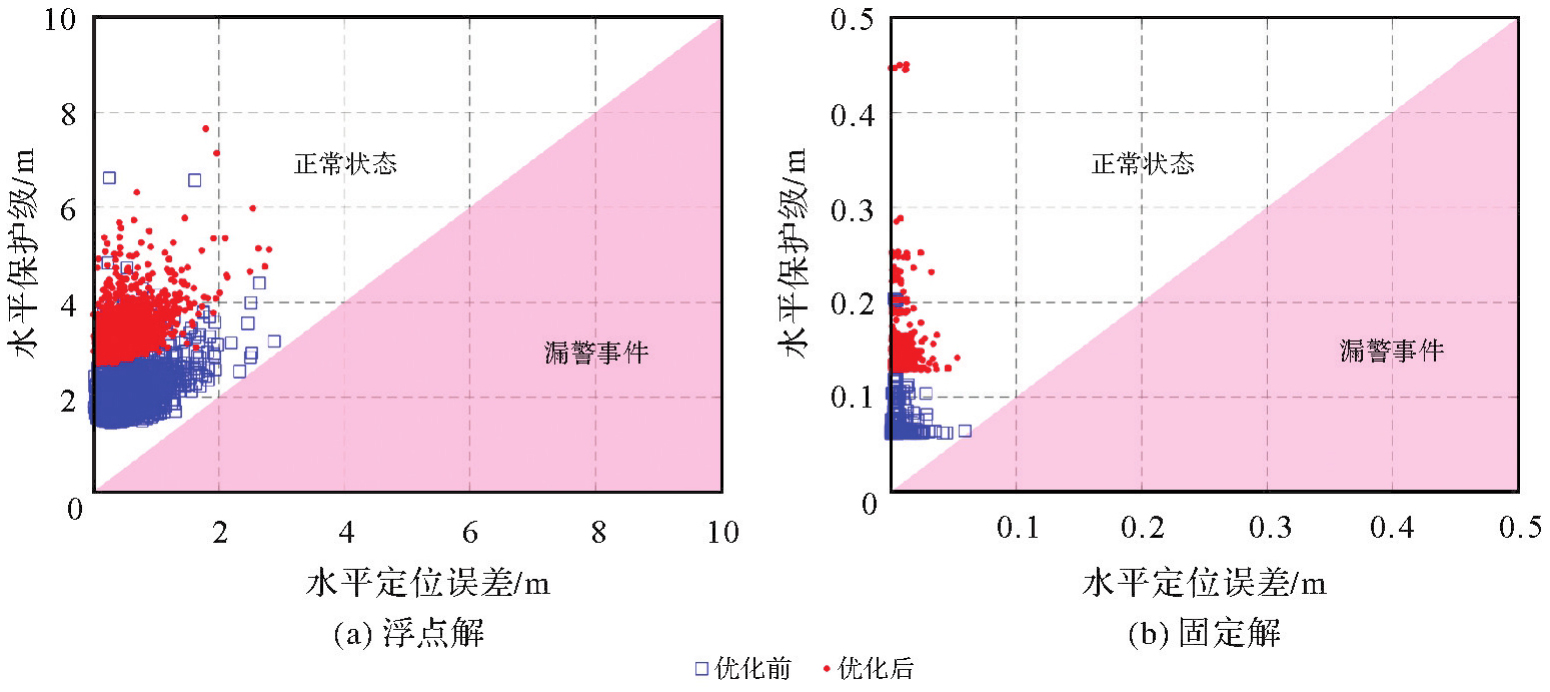
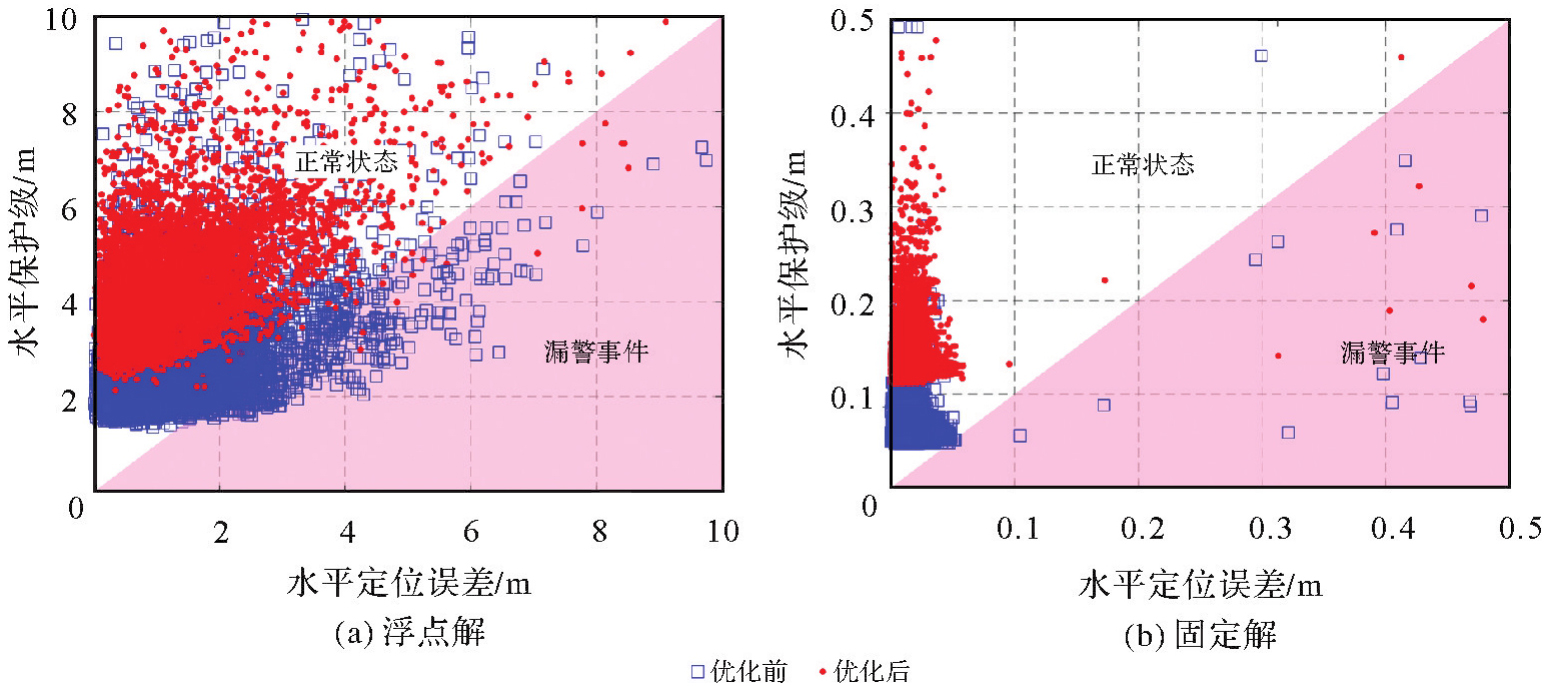
Fig. 11
Protection level and positioning error of RTK float and fixed solutions (dataset Ⅱ)"
Tab. 7
Protection levels for RTK float and fixed solution"
| 轨迹 | 方案 | 浮点解 | 固定解 | ||
|---|---|---|---|---|---|
| 保护级/m | 漏警率/(%) | 保护级/m | 漏警率/(%) | ||
| 数据集Ⅰ | 优化前 | 2.880 | 0.0 | 0.077 | 0.0 |
| 优化后 | 4.186 | 0.0 | 0.166 | 0.0 | |
| 数据集Ⅱ | 优化前 | 5.221 | 8.8 | 0.096 | 1.6 |
| 优化后 | 7.273 | 0.3 | 0.218 | 1.4 | |
| [1] | 李博峰, 苗维凯, 陈广鄂. 多频多模GNSS高精度定位关键技术与挑战[J]. 武汉大学学报(信息科学版), 2023, 48(11): 1769-1783. |
| LI Bofeng, MIAO Weikai, CHEN Guang'e. Key technologies and challenges of multi-frequency and multi-GNSS high-precision positioning[J]. Geomatics and Information Science of Wuhan University, 2023, 48(11): 1769-1783. | |
| [2] | 李子申, 王宁波, 李亮, 等. 北斗高精度高可信PPP-RTK服务基本框架[J]. 导航定位与授时, 2023, 10(2): 7-15. |
| LI Zishen, WANG Ningbo, LI Liang, et al. Basic framework of BDS-based high-precision and high-credibility PPP-RTK service[J]. Navigation Positioning and Timing, 2023, 10(2): 7-15. | |
| [3] | CHEN J, ZHANG S, CAO Y, et al. A robust fault detection algorithm for the GNSS/INS integrated navigation systems[J]. Journal of Geodesy and Geoinformation Science, 2020, 3(1): 12-24. |
| [4] | 苏先礼. GNSS完好性监测体系及辅助性能增强技术研究[D]. 上海: 上海交通大学, 2013. |
| SU Xianli. The research on GNSS integrity monitoring theory and assisted performance enhancement technique[D]. Shanghai: Shanghai Jiao Tong University, 2013. | |
| [5] | 张洁, 赵琳, 杨福鑫, 等. 面向大众导航应用的精密单点定位完好性监测方法[J]. 航空学报, 2023, 44(13): 196-206. |
| ZHANG Jie, ZHAO Lin, YANG Fuxin, et al. PPP integrity monitoring algorithm for general-purpose navigation applications[J]. Acta Aeronautica et Astronautica Sinica, 2023, 44(13): 196-206. | |
| [6] | FAN Z, ZHAO L. Autonomous integrity of multi-source information resilient fusion navigation system: state-of-the-art and open challenges[J]. IEEE Transactions on Instrumentation and Measurement, 2024, 73: 1-17. |
| [7] |
杨玲, 朱金成, 孙楠, 等. GNSS高级接收机自主完好性监测随机模型精化[J]. 测绘学报, 2024, 53(2): 286-295. DOI: .
doi: 10.11947/j.AGCS.2024.20210669 |
|
YANG Ling, ZHU Jincheng, SUN Nan, et al. Stochastic model refinement of GNSS advanced receiver autonomous integrity monitoring[J]. Acta Geodaetica et Cartographica Sinica, 2024, 53(2): 286-295. DOI: .
doi: 10.11947/j.AGCS.2024.20210669 |
|
| [8] | ZHANG Y, WANG L, FAN L, et al. MHSS ARAIM algorithm combined with gross error detection[J]. Journal of Geodesy and Geoinformation Science, 2020, 3(1): 36-44. |
| [9] |
田云青, 王利, 舒宝, 等. 北斗系统ARAIM可用性评估[J]. 测绘学报, 2021, 50(7): 879-890. DOI: .
doi: 10.11947/j.AGCS.2021.20200518 |
|
TIAN Yunqing, WANG Li, SHU Bao, et al. Evaluation of the availability of BDS ARAIM[J]. Acta Geodaetica et Cartographica Sinica, 2021, 50(7): 879-890. DOI: .
doi: 10.11947/j.AGCS.2021.20200518 |
|
| [10] | IMPARATO D, EL-MOWAFY A, RIZOS C, et al. Vulnerabilities in SBAS and RTK positioning in intelligent transport systems: an overview[C]//Proceedings of 2018 International Global Navigation Satellite System Association IGNSS Symposium. Sydney: University of New South Wales, 2018: 1-17. |
| [11] | DU Y, WANG J, RIZOS C, et al. Vulnerabilities and integrity of precise point positioning for intelligent transport systems: overview and analysis[J]. Satellite Navigation, 2021(2): 1-22. |
| [12] | 千寻位置. 自动驾驶解决方案[EB/OL]. [2025-08-19]. https://www.qxwz.com/solutions/autopilot. |
| Qianxun SI. Autonomous driving solutions[EB/OL]. [2025-08-19]. https://www.qxwz.com/solutions/autopilot. | |
| [13] | 六分科技. 智能驾驶解决方案[EB/OL]. [2025-08-19]. https://www.sixents.com/productSolution/solution/intelligentDriving#div5. |
| SIXENTS TECHNOLOGY. Intelligent driving solutions[EB/OL]. [2025-08-19]. https://www.sixents.com/productSolution/solution/intelligentDriving#div5. | |
| [14] | FENG S, OCHIENG W, MOORE T, et al. Carrier phase-based integrity monitoring for high-accuracy positioning[J]. GPS Solutions, 2009, 13(1): 13-22. |
| [15] | CHANG J, REN Q, ZHAN X, et al. Integrity monitoring performance analysis for future LEO constellation augmented GNSS RTK positioning[J]. Journal of Aeronautics, Astronautics and Aviation, 2021, 53(3): 339-352. |
| [16] | WANG S, ZHAI Y, ZHAN X. Implementation of solution separation-based Kalman filter integrity monitoring against all-source faults for multi-sensor integrated navigation[J]. GPS Solutions, 2023, 27(3): 103. |
| [17] | WANG K, EL-MOWAFY A. Effect of biases in integrity monitoring for RTK positioning[J]. Advances in Space Research, 2021, 67(12): 4025-4042. |
| [18] | GAO Y, JIANG Y, GAO Y, et al. Solution separation-based integrity monitoring for RTK positioning with faulty ambiguity detection and protection level[J]. GPS Solutions, 2023, 27(3): 140. |
| [19] | ZHU N, MARAIS J, BETAILLE D, et al. GNSS position integrity in urban environments: a review of literature[J]. IEEE Transactions on Intelligent Transportation Systems, 2018, 19(9): 2762-2778. |
| [20] | HASSAN T, EL-MOWAFY A, WANG K. A review of system integration and current integrity monitoring methods for positioning in intelligent transport systems[J]. IET Intelligent Transport Systems, 2021, 15(1): 43-60. |
| [21] | EL-MOWAFY A. On detection of observation faults in the observation and position domains for positioning of intelligent transport systems[J]. Journal of Geodesy, 2019, 93(10): 2109-2122. |
| [22] | TAKASU T, YASUDA A. Development of the low-cost RTK-GPS receiver with an open source program package RTKLIB[C]//Proceedings of 2009 International Symposium on GPS/GNSS. Jeju: ICC, 2009: 1-6. |
| [23] | LI L, WANG H, JIA C, et al. Integrity and continuity allocation for the RAIM with multiple constellations[J]. GPS Solutions, 2017, 21(4): 1503-1513. |
| [24] | BLANCH J, WALKER T, ENGE P, et al. Baseline advanced RAIM user algorithm and possible improvements[J]. IEEE Transactions on Aerospace and Electronic Systems, 2015, 51(1): 713-732. |
| [25] | JING H, GAO Y, SHAHBEIGI S, et al. Integrity monitoring of GNSS/INS based positioning systems for autonomous vehicles: state-of-the-art and open challenges[J]. IEEE Transactions on Intelligent Transportation Systems, 2022, 23(9): 14166-14187. |
| [26] | ZHANG W, WANG J, EL-MOWAFY A, et al. Integrity monitoring scheme for undifferenced and uncombined multi-frequency multi-constellation PPP-RTK[J]. GPS Solutions, 2023, 27(2): 68. |
| [27] |
符运日, 杨玲, 沈云中, 等. 对流层延迟模型的残差包络建模[J]. 测绘学报, 2023, 52(6): 895-903. DOI: .
doi: 10.11947/j.AGCS.2023.20220231 |
|
FU Yunri, YANG Ling, SHEN Yunzhong, et al. Residuals overbounding modeling of the tropospheric delay models[J]. Acta Geodaetica et Cartographica Sinica, 2023, 52(6): 895-903. DOI: .
doi: 10.11947/j.AGCS.2023.20220231 |
|
| [28] | DECLEENE B. Defining pseudorange integrity-overbounding[C]//Proceedings of the 13th International Technical Meeting of the Satellite Division of the Institute of Navigation. Alexandria: ION, 2000: 1916-1924. |
| [29] | RIFE J, PULLEN S, ENGE P, et al. Paired overbounding for nonideal LAAS and WAAS error distributions[J]. IEEE Transactions on Aerospace and Electronic Systems, 2006, 42(4): 1386-1395. |
| [30] | BLANCH J, WALTER T, ENGE P. Gaussian bounds of sample distributions for integrity analysis[J]. IEEE Transactions on Aerospace and Electronic Systems, 2018, 55(4): 1806-1815. |
| [31] | ZHU F. SmartPNT-POS: raw GNSS and INS measurements for research[EB/OL]. [2025-06-12]. https://www.kaggle.com/datasets/fengzhusgg/smartpnt-pos. |
| [32] | LI X X, HUANG J D, LI X, et al. GREAT: a scientific software platform for satellite geodesy and multi-source fusion navigation[J]. Advances in Space Research, 2024, 74(4): 1751-1769. |
| [33] | TANIL C, KHANAFSEH S, JOERGER M, et al. Optimal INS/GNSS coupling for autonomous car positioning integrity[C]//Proceedings of the 32nd International Technical Meeting of the Satellite Division of the Institute of Navigation. Manassas: ION, 2019: 3123-3140. |
| [1] | Deying YU, Houpu LI, Yi LIU, Shuguang WU, Deyan LI, Mingchao LI, Wenkui LI, Shaofeng BIAN. A DBSCAN-based RAIM algorithm for multiple gross error identification [J]. Acta Geodaetica et Cartographica Sinica, 2026, 55(1): 59-72. |
| [2] | Liang LI, Liuqi WANG, Ningbo WANG, Min LI, Zishen LI, Fengze DU, Shuai PANG, Zhibo NA. Vectorized integrity monitoring method for PPP-RTK correction products [J]. Acta Geodaetica et Cartographica Sinica, 2024, 53(9): 1777-1789. |
| [3] | YANG Ling, ZHU Jincheng, SUN Nan, YU Yangkang, SHEN Yunzhong, LI Bofeng. Stochastic model refinement of GNSS advanced receiver autonomous integrity monitoring [J]. Acta Geodaetica et Cartographica Sinica, 2024, 53(2): 286-295. |
| [4] | MA Yuexin, TANG Chengpan, HU Xiaogong, CHANG Zhiqiao, PU Junyu, XING Nan, CAO Yueling, WANG Ningbo. Optimization of GIVE algorithm for grid-based single shell ionospheric model over Chinese region based on residual statistics [J]. Acta Geodaetica et Cartographica Sinica, 2021, 50(3): 304-314. |
| Viewed | ||||||
|
Full text |
|
|||||
|
Abstract |
|
|||||
