

Acta Geodaetica et Cartographica Sinica ›› 2025, Vol. 54 ›› Issue (10): 1741-1756.doi: 10.11947/j.AGCS.2025.20250209
• Geodesy and Navigation • Previous Articles Next Articles
Xiong PAN1( ), Zixuan ZHAO1, Chang PING1, Lihong JIN2(), Lilong LIU3
Received:2025-05-19
Revised:2025-09-12
Online:2025-11-14
Published:2025-11-14
Contact:
Lihong JIN
E-mail:pxjlh@163.com;33384351@qq.com
About author:PAN Xiong (1973—), male, PhD, professor, majors in deep learning and satellite navigation positioning. E-mail: pxjlh@163.com
Supported by:CLC Number:
Xiong PAN, Zixuan ZHAO, Chang PING, Lihong JIN, Lilong LIU. Ionospheric TEC prediction incorporating semi-parametric and rule-learning[J]. Acta Geodaetica et Cartographica Sinica, 2025, 54(10): 1741-1756.

Fig. 1
Flowchart of ionospheric TEC prediction using a combined semi-parametric rule-learning model"

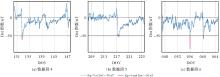
Fig. 2
Line chart of geomagnetic activity indices by day of year during geomagnetic storms"
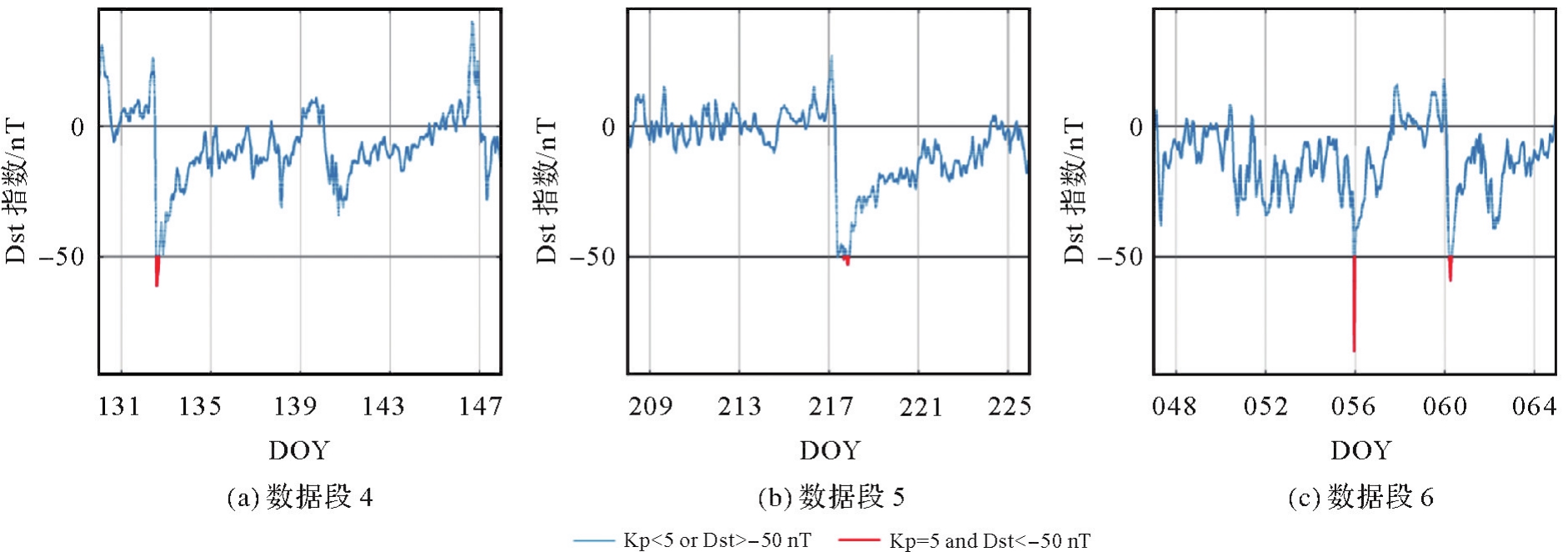

Fig. 3
DCT decomposition period of the residual of the spherical harmonic coefficients of different models"


Fig. 4
Tree diagram of characteristic periods for rule-learning framework"


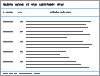
Fig. 5
The feature period of multi-day forecast after further pruning"

Tab. 1
RMSE and computational time for each data segment in ablation experiments"
| 试验 | 模型 | 各数据段的RMSE/TECU | 耗时/s | ||||||
|---|---|---|---|---|---|---|---|---|---|
| 1 | 2 | 3 | 4 | 5 | 6 | 均值 | |||
| 1 | Semi-SH | 1.554 6 | 1.181 1 | 1.022 8 | 1.911 1 | 2.140 9 | 1.775 2 | 1.597 6 | 9.62 |
| 2 | Semi-SH-RLv0 | 1.725 0 | 1.418 3 | 1.304 6 | 2.158 1 | 2.656 3 | 2.006 4 | 1.878 1 | 10.44 |
| 3 | Semi-SH-RLv0-SA | 2.344 4 | 1.290 2 | 1.192 5 | 2.210 9 | 2.595 5 | 2.313 3 | 1.991 1 | 12.72 |
| 4 | Semi-SH-RLv0-Prun | 1.467 8 | 1.264 0 | 1.231 7 | 2.072 5 | 1.936 2 | 1.679 3 | 1.608 6 | 11.79 |
| 5 | Semi-SH-RL(RLv0-SA-Prun | )1.444 1 | 1.059 7 | 0.962 1 | 1.719 6 | 1.912 7 | 1.501 9 | 1.433 3 | 11.07 |
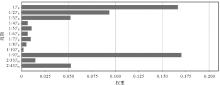
Fig. 6
Histogram of feature value weights of parameter components based on self-attention mechanism"

Tab. 2
Stability of accuracy for different data segments for single-day forecasting"
| 数据段 | 模型 | 残差绝对值(|Δ|)范围/(%) | 精度评定/TECU | ||||
|---|---|---|---|---|---|---|---|
| |Δ|<1TECU | |Δ|<3TECU | |Δ|<5TECU | E(|Δ|) | var(Δ) | RMSE | ||
| 1 | QP | 39.07 | 83.23 | 96.13 | 1.734 6 | 2.324 3 | 2.309 4 |
| C1PG | 48.30 | 89.67 | 98.49 | 1.389 7 | 1.513 7 | 1.856 1 | |
| LSTM | 48.16 | 92.90 | 98.86 | 1.294 4 | 1.224 5 | 1.702 9 | |
| Semi-SH | 56.32 | 94.39 | 98.87 | 1.136 5 | 1.125 2 | 1.554 6 | |
| Semi-SH-AR | 55.40 | 94.22 | 98.88 | 1.153 8 | 1.137 7 | 1.571 3 | |
| Semi-SH-LSTM | 59.01 | 94.48 | 98.88 | 1.093 2 | 1.148 3 | 1.530 9 | |
| Semi-SH-RL | 63.01 | 95.18 | 99.00 | 1.014 7 | 1.055 9 | 1.444 1 | |
| 2 | QP | 56.67 | 92.92 | 98.22 | 1.181 6 | 1.393 7 | 1.670 3 |
| C1PG | 61.11 | 95.14 | 99.29 | 1.052 8 | 0.945 5 | 1.433 2 | |
| LSTM | 57.77 | 96.15 | 99.44 | 1.058 9 | 0.882 5 | 1.415 6 | |
| Semi-SH | 68.83 | 97.64 | 99.62 | 0.847 9 | 0.676 1 | 1.181 1 | |
| Semi-SH-AR | 69.52 | 97.65 | 99.62 | 0.837 1 | 0.676 0 | 1.173 3 | |
| Semi-SH-LSTM | 67.68 | 97.76 | 99.67 | 0.870 3 | 0.658 4 | 1.189 9 | |
| Semi-SH-RL | 72.68 | 98.43 | 99.77 | 0.760 1 | 0.545 3 | 1.059 7 | |
| 3 | QP | 57.88 | 94.60 | 99.19 | 1.099 9 | 1.024 9 | 1.494 9 |
| C1PG | 74.87 | 96.70 | 99.68 | 0.801 2 | 0.718 1 | 1.166 2 | |
| LSTM | 64.67 | 98.54 | 99.96 | 0.876 2 | 0.491 1 | 1.122 0 | |
| Semi-SH | 72.66 | 98.63 | 99.97 | 0.765 9 | 0.459 5 | 1.022 8 | |
| Semi-SH-AR | 72.62 | 98.62 | 99.97 | 0.766 3 | 0.460 0 | 1.023 3 | |
| Semi-SH-LSTM | 75.09 | 98.99 | 99.98 | 0.727 3 | 0.398 8 | 0.963 2 | |
| Semi-SH-RL | 76.27 | 98.87 | 99.97 | 0.702 4 | 0.432 2 | 0.962 1 | |
| 4 | QP | 43.95 | 86.54 | 95.78 | 1.626 3 | 2.827 0 | 2.339 2 |
| C1PG | 55.00 | 92.64 | 98.26 | 1.235 8 | 1.454 6 | 1.726 8 | |
| LSTM | 40.10 | 87.52 | 97.22 | 1.621 1 | 2.294 6 | 2.218 7 | |
| Semi-SH | 47.60 | 91.21 | 98.22 | 1.373 8 | 1.764 9 | 1.911 1 | |
| Semi-SH-AR | 49.80 | 91.68 | 98.23 | 1.331 2 | 1.765 8 | 1.880 9 | |
| Semi-SH-LSTM | 47.41 | 91.66 | 98.24 | 1.357 6 | 1.611 1 | 1.858 6 | |
| Semi-SH-RL | 54.93 | 93.06 | 98.44 | 1.206 0 | 1.502 5 | 1.719 6 | |
| 5 | QP | 39.90 | 83.38 | 94.73 | 1.755 2 | 2.722 4 | 2.408 9 |
| C1PG | 41.01 | 82.85 | 95.80 | 1.732 9 | 2.287 8 | 2.300 1 | |
| LSTM | 40.10 | 83.34 | 95.16 | 1.736 2 | 2.604 3 | 2.370 4 | |
| Semi-SH | 46.15 | 86.62 | 96.37 | 1.534 6 | 2.228 2 | 2.140 9 | |
| Semi-SH-AR | 43.26 | 85.18 | 95.86 | 1.628 1 | 2.387 2 | 2.244 5 | |
| Semi-SH-LSTM | 37.54 | 87.04 | 97.36 | 1.629 7 | 1.784 4 | 2.107 2 | |
| Semi-SH-RL | 50.31 | 89.89 | 97.45 | 1.369 3 | 1.783 3 | 1.912 7 | |
| 6 | QP | 43.38 | 86.61 | 96.23 | 1.599 7 | 2.370 9 | 2.220 3 |
| C1PG | 48.53 | 85.58 | 97.39 | 1.513 3 | 1.906 8 | 2.048 6 | |
| LSTM | 42.17 | 89.22 | 97.38 | 1.514 1 | 1.780 1 | 2.018 0 | |
| Semi-SH | 51.92 | 91.60 | 98.31 | 1.287 3 | 1.494 2 | 1.775 2 | |
| Semi-SH-AR | 53.25 | 92.21 | 98.32 | 1.250 8 | 1.447 8 | 1.735 6 | |
| Semi-SH-LSTM | 49.68 | 92.42 | 98.18 | 1.293 7 | 1.412 9 | 1.756 9 | |
| Semi-SH-RL | 58.44 | 94.26 | 99.21 | 1.092 6 | 1.061 7 | 1.501 9 | |
| 均值 | QP | 46.81 | 87.88 | 96.71 | 1.499 6 | 2.110 5 | 2.073 8 |
| C1PG | 54.80 | 90.43 | 98.15 | 1.287 6 | 1.471 1 | 1.755 2 | |
| LSTM | 48.83 | 91.28 | 98.00 | 1.350 2 | 1.546 2 | 1.807 9 | |
| Semi-SH | 57.25 | 93.35 | 98.56 | 1.157 7 | 1.291 4 | 1.597 6 | |
| Semi-SH-AR | 57.31 | 93.26 | 98.48 | 1.161 2 | 1.312 4 | 1.604 8 | |
| Semi-SH-LSTM | 56.07 | 93.73 | 98.72 | 1.162 0 | 1.169 0 | 1.567 8 | |
| Semi-SH-RL | 62.61 | 94.95 | 98.97 | 1.024 2 | 1.063 5 | 1.433 3 | |
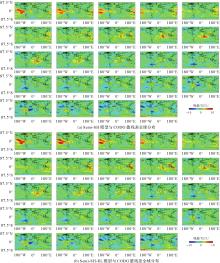
Fig. 7
Distribution of single-day forecast residuals for different models"

Tab. 3
Number of residuals in each interval for different models"
| 模型 | [0,0.5)TECU | [0.5,1.0)TECU | [1.0,1.5)TECU | [1.5,2.0)TECU | [2.0,2.5)TECU | [2.5,3.0)TECU | >3.0 TECU |
|---|---|---|---|---|---|---|---|
| QP | 25 | 189 | 350 | 321 | 212 | 119 | 80 |
| C1PG | 15 | 387 | 393 | 247 | 210 | 42 | 2 |
| LSTM | 19 | 360 | 530 | 281 | 84 | 17 | 5 |
| Semi-SH | 39 | 541 | 469 | 196 | 40 | 9 | 2 |
| Semi-SH-AR | 34 | 515 | 490 | 199 | 47 | 8 | 3 |
| Semi-SH-LSTM | 38 | 592 | 444 | 178 | 37 | 7 | 0 |
| Semi-SH-RL | 73 | 648 | 438 | 114 | 20 | 3 | 0 |

Fig. 8
Residuals in different latitudinal zones for various models"

Tab. 4
The relationship between the step length and the forecast accuracy of Semi-SH-RL model"
| 步长/h | 残差绝对值(|Δ|)范围/(%) | 精度评定/TECU | ||||
|---|---|---|---|---|---|---|
| |Δ|<1 TECU | |Δ|<3 TECU | |Δ|<5 TECU | E(|Δ|) | var(Δ) | RMSE | |
| 12 | 59.04 | 94.63 | 99.00 | 1.090 1 | 1.100 1 | 1.512 7 |
| 15 | 59.05 | 94.66 | 99.00 | 1.089 4 | 1.096 0 | 1.510 9 |
| 20 | 59.11 | 94.62 | 99.00 | 1.089 5 | 1.099 4 | 1.512 0 |
| 24 | 59.51 | 94.77 | 99.01 | 1.079 3 | 1.084 2 | 1.499 7 |
| 30 | 59.01 | 94.49 | 98.99 | 1.094 1 | 1.102 9 | 1.516 6 |
| 40 | 58.48 | 94.13 | 98.91 | 1.114 6 | 1.160 8 | 1.550 2 |
| 60 | 54.66 | 92.99 | 98.77 | 1.200 5 | 1.269 2 | 1.646 3 |
| 120 | 46.31 | 83.84 | 95.88 | 1.612 8 | 2.522 5 | 2.263 6 |
Tab. 5
Daily RMSE for multi-day forecasts of different models"
| 模型 | 第1天 | 第2天 | 第3天 | 第4天 | 第5天 | 均值 |
|---|---|---|---|---|---|---|
| QP | 2.309 4 | 2.183 1 | 2.020 5 | 1.883 7 | 2.077 6 | 2.095 7 |
| LSTM | 1.702 9 | 1.841 7 | 1.486 4 | 1.433 2 | 1.673 2 | 1.628 6 |
| Semi-SH | 1.554 6 | 1.767 6 | 1.470 4 | 1.427 1 | 1.641 4 | 1.572 5 |
| Semi-SH-AR | 1.571 3 | 1.763 8 | 1.455 2 | 1.411 1 | 1.635 5 | 1.568 2 |
| Semi-SH-LSTM | 1.530 9 | 1.601 9 | 1.344 4 | 1.338 4 | 1.606 6 | 1.485 7 |
| Semi-SH-RL | 1.445 4 | 1.576 7 | 1.407 8 | 1.402 6 | 1.649 5 | 1.497 0 |

Fig. 9
Boxplot of residual statistics for multi-day forecasts for models across latitude bands"

Tab. 6
Computational time for forecasts of different models"
| 模型 | 单天预报耗时 | 多天预报耗时 |
|---|---|---|
| QP | 296.32 | 1 533.10 |
| LSTM | 845.77 | 4 761.60 |
| Semi-SH | 9.62 | 52.11 |
| Semi-SH-AR | 9.66 | 53.35 |
| Semi-SH-LSTM | 994.25 | 5 534.66 |
| Semi-SH-RL | 11.07 | 56.17 |
| [1] | GHAFFARI-RAZIN S R, RASTBOOD A, HOOSHANGI N, et al. Regional application of generalized regression neural network in ionosphere spatio-temporal modeling and forecasting[J]. GPS Solutions, 2023, 27(1): 51. |
| [2] | LI Wang, ZHU Haoze, SHI Shuangshuang, et al. Modeling China's Sichuan-Yunnan's ionosphere based on multichannel WOA-CNN-LSTM algorithm[J]. IEEE Transactions on Geoscience and Remote Sensing, 2024, 62: 5705018. |
| [3] | 张小红, 任晓东, 吴风波, 等. 自回归移动平均模型的电离层总电子含量短期预报[J]. 测绘学报, 2014, 43(2): 118-124. |
| ZHANG Xiaohong, REN Xiaodong, WU Fengbo, et al. Short-term TEC prediction of ionosphere based on ARIMA model[J]. Acta Geodaetica et Cartographica Sinica, 2014, 43(2): 118-124. | |
| [4] | AGGARWAL M, JOSHI H P, IYER K N. Day-to-day variability of equatorial anomaly in GPS-TEC during low solar activity period[J]. Advances in Space Research, 2012, 49(12): 1709-1720. |
| [5] | ZHANG Xiao, ZHANG Baocheng, YUAN Yunbin, et al. A refined carrier-to-code levelling method for retrieving ionospheric measurements from dual-frequency GPS data[J]. Measurement Science and Technology, 2020, 31(3): 035010. |
| [6] | WANG Y, JAYACHANDRAN P T, MA Y Z, et al. Dependencies of GPS scintillation indices on the ionospheric plasma drift and rate of change of TEC around the dawn sector of the polar ionosphere[J]. Journal of Geophysical Research: space Physics, 2022, 127(11): e2022JA030870. |
| [7] | XU Fei, YUE Dongjie, ZHAI Changzhi, et al. Assessing the role of space weather indices in the prediction of total electron content at different latitudes during geomagnetic storms[J]. Astrophysics and Space Science, 2025, 370(3): 32. |
| [8] | DONG Yanfeng, GAO Chengfa, LONG Fengyang, et al. Enhanced neural network model for regional ionospheric modeling and evaluation under different solar-geomagnetic conditions[J]. Measurement Science and Technology, 2023, 34(3): 035801. |
| [9] | XU Lei, GAO Jingxiang, LI Zengke, et al. A new flexible model to calibrate single-layer height for ionospheric modeling using a neural network model[J]. GPS Solutions, 2023, 27(3): 106. |
| [10] | LIN Yang, FANG Hanxian, DUAN Die, et al. Multi-model assessment of PCA-informer hybrid model against empirical and deep learning methods in TEC forecasting[J]. Space Weather, 2025, 23(4): e2024SW004018. |
| [11] | LEI Dongxing, LIU Haijun, LE Huijun, et al. Ionospheric TEC prediction base on attentional BiGRU[J]. Atmosphere, 2022, 13(7): 1039. |
| [12] | LIU Haijun, WANG Haoran, YUAN Jing, et al. TEC prediction based on Att-CNN-BiLSTM[J]. IEEE Access, 2024, 12: 68471-68484. |
| [13] | XUE Kaiyu, SHI Chuang, WANG Cheng. RA-ConvLSTM: recurrent-architecture attentional ConvLSTM networks for prediction of global total electron content[J]. Space Weather, 2025, 23(2): e2024SW004173. |
| [14] | 蒋磊, 孙蕊, 刘正午, 等. 基于GA-BP的中欧GNSS电离层误差建模与精度分析[J]. 北京航空航天大学学报, 2023, 49(6): 1533-1542. |
| JIANG Lei, SUN Rui, LIU Zhengwu, et al. Modeling and accuracy analysis of GNSS ionospheric error in EU-China based on GA-BP[J]. Journal of Beijing University of Aeronautics and Astronautics, 2023, 49(6): 1533-1542. | |
| [15] | 刘立龙, 陈军, 黄良珂, 等. 基于Holt指数平滑模型的Klobuchar模型精化[J]. 武汉大学学报(信息科学版), 2018, 43(4): 599-604. |
| LIU Lilong, CHEN Jun, HUANG Liangke, et al. A sophisticated Klobuchar model based on the Holt exponential smoothing model[J]. Geomatics and Information Science of Wuhan University, 2018, 43(4): 599-604. | |
| [16] | 王喜江, 边少锋, 李子申, 等. 利用半参数核估计法预报全球电离层总电子含量[J]. 地球物理学报, 2020, 63(4): 1271-1281. |
| WANG Xijiang, BIAN Shaofeng, LI Zishen, et al. Prediction of global ionospheric TEC using the semiparametric kernel estimation method[J]. Chinese Journal of Geophysics, 2020, 63(4): 1271-1281. | |
| [17] | LI Shuhui, ZHOU Houxiang, XU Jiajia, et al. Modeling and analysis of ionosphere TEC over China and adjacent areas based on EOF method[J]. Advances in Space Research, 2019, 64(2): 400-414. |
| [18] | NATH S, CHETIA B, KALITA S. Ionospheric TEC prediction using hybrid method based on ensemble empirical mode decomposition (EEMD) and long short-term memory (LSTM) deep learning model over India[J]. Advances in Space Research, 2023, 71(5): 2307-2317. |
| [19] | DABBAKUTI J R K K, PEESAPATI R, PANDA S K, et al. Modeling and analysis of ionospheric TEC variability from GPS-TEC measurements using SSA model during 24th solar cycle[J]. Acta Astronautica, 2021, 178: 24-35. |
| [20] | KHANLI L M, MAHAN F, ISAZADEH A. Active rule learning using decision tree for resource management in grid computing[J]. Future Generation Computer Systems, 2011, 27(6): 703-710. |
| [21] | LIU Yonggang, LIU Junjun, ZHANG Yuanjian, et al. Rule learning based energy management strategy of fuel cell hybrid vehicles considering multi-objective optimization[J]. Energy, 2020, 207: 118212. |
| [22] | FARISON F, LIMA-CAMPÊLO V R, PARADIS M, et al. Farmers who implemented this, also implemented that: use of association-rule-learning to improve biosecurity on dairies[J]. Preventive Veterinary Medicine, 2025, 239: 106516. |
| [23] | 张道胜, 蒙祖强. 基于RL-Net改进的可解释规则学习方法[J]. 计算机工程与应用, 2025, 61(18): 157-165. |
| ZHANG Daosheng, MENG Zuqiang. An improved learning method of interpretable rules based on RL-Net[J]. Computer Engineering and Applications, 2025, 61(18): 157-165. | |
| [24] | PARK S, YOON H, KIM B, et al. FAGA: feedback-aided greedy algorithm for periodic messages in LTE V2V communications[J]. IEEE Transactions on Vehicular Technology, 2018, 67(11): 11062-11068. |
| [25] | 罗小敏, 曹光胤, 潘雄, 等. 联合半参数和长短期记忆神经网络的全球电离层TEC短期预报[J]. 地球物理学报, 2023, 66(5): 1807-1819. |
| LUO Xiaomin, CAO Guangyin, PAN Xiong, et al. Global ionospheric TEC short-term prediction by combing semiparametric and long-short term memory networks method[J]. Chinese Journal of Geophysics, 2023, 66(5): 1807-1819. | |
| [26] | 闵继源, 鲁统宇, 任婷婷, 等. 基于规则集成的可解释机器学习算法及应用[J]. 计算机科学与探索, 2024, 18(6): 1476-1490. |
| MIN Jiyuan, LU Tongyu, REN Tingting, et al. Interpretable machine learning algorithm based on rules ensemble and its application[J]. Journal of Frontiers of Computer Science and Technology, 2024, 18(6): 1476-1490. | |
| [27] | ESPOSITO F, MALERBA D, SEMERARO G, et al. A comparative analysis of methods for pruning decision trees[J]. IEEE Transactions on Pattern Analysis and Machine Intelligence, 1997, 19(5): 476-491. |
| [28] | KNUTH D E. The art of computer programming[M]. 3rd ed. Massachusetts: Addison-Wesley, 1997. |
| [1] | Qihao HUANG, Guowang JIN, Xin XIONG, Limei WANG, Jiahao LI. Lightweight SAR target detection based on channel pruning and know-ledge distillation [J]. Acta Geodaetica et Cartographica Sinica, 2024, 53(4): 712-723. |
| [2] | ZHANG Yichao, ZHENG Xiangtao, LU Xiaoqiang. Hyperspectral image classification method based on hierarchical transformer network [J]. Acta Geodaetica et Cartographica Sinica, 2023, 52(7): 1139-1147. |
| [3] | WANG Leyang, XIONG Luyun. A Method for Dealing with the Systematic Errors of Partial EIV Semi-parametric Model [J]. Acta Geodaetica et Cartographica Sinica, 2018, 47(1): 25-34. |
| Viewed | ||||||
|
Full text |
|
|||||
|
Abstract |
|
|||||
