

Acta Geodaetica et Cartographica Sinica ›› 2026, Vol. 55 ›› Issue (2): 249-260.doi: 10.11947/j.AGCS.2026.20250284
• Spatial Artificial Intelligence and Smart Cities • Previous Articles Next Articles
Junhao GUO1( ), Mingzhi WU1(), Peixiao WANG2,3, Hengcai ZHANG2,3
Received:2025-07-14
Revised:2025-10-22
Online:2026-03-13
Published:2026-03-13
Contact:
Mingzhi WU
E-mail:245520020@fzu.edu.cn;Mingzhi.wu17@student.xjtlu.edu.cn
About author:GUO Junhao (2002—), male, postgraduate, majors in geospatial big data mining. E-mail: 245520020@fzu.edu.cn
Supported by:CLC Number:
Junhao GUO, Mingzhi WU, Peixiao WANG, Hengcai ZHANG. A dual-threshold stay point detection method based on adaptive extended density peak clustering for sparse fixed-point trajectories[J]. Acta Geodaetica et Cartographica Sinica, 2026, 55(2): 249-260.
Fig. 1
Dual trajectories"
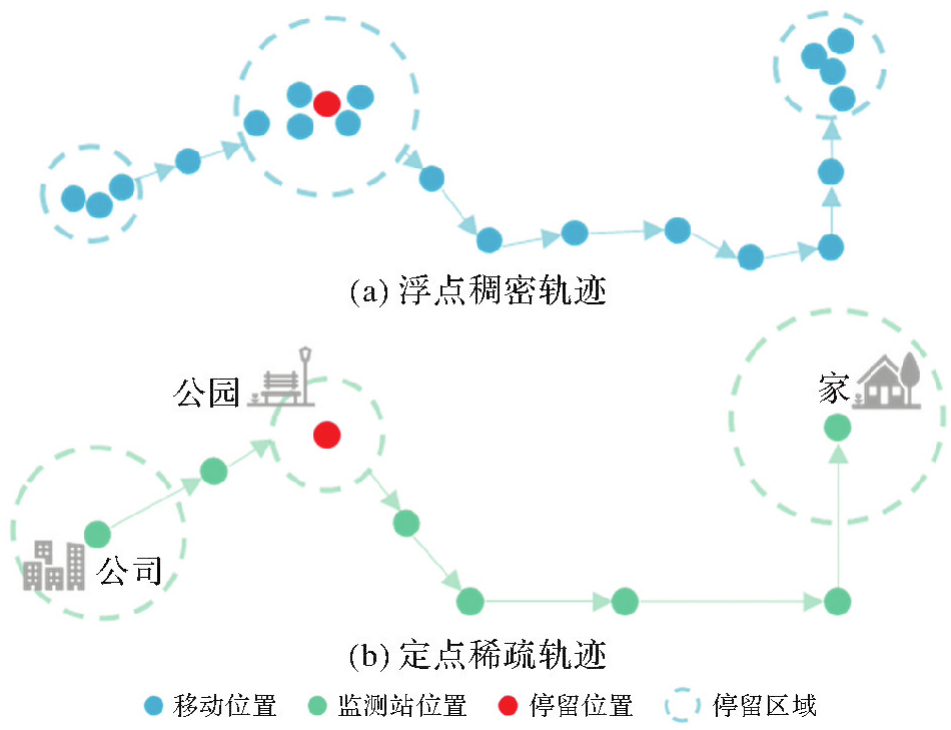
Fig. 2
Technical flowchart"
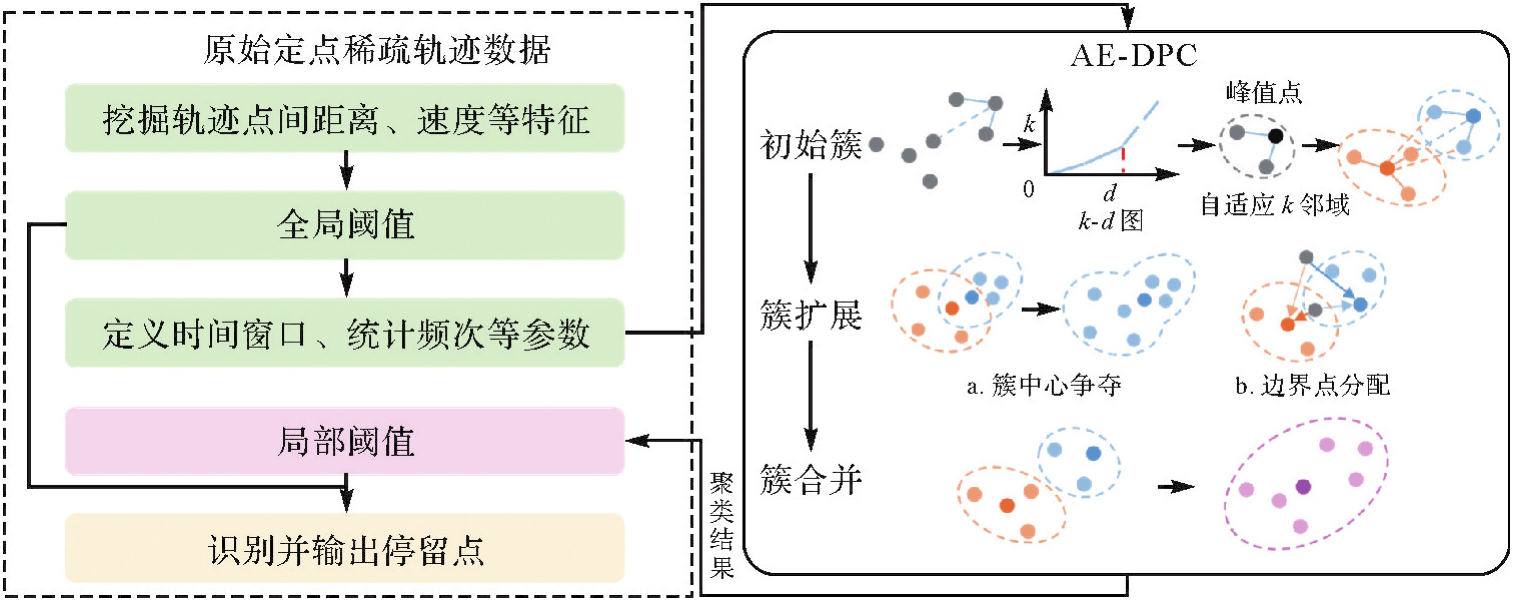
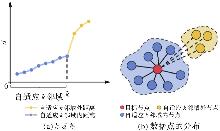
Fig. 3
k-d graph and adaptive k neighborhood"
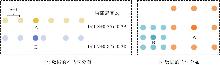
Fig. 4
Data distribution and local density"
Fig. 5
Overlap coverage of the initial cluster and density attenuation of peak point"
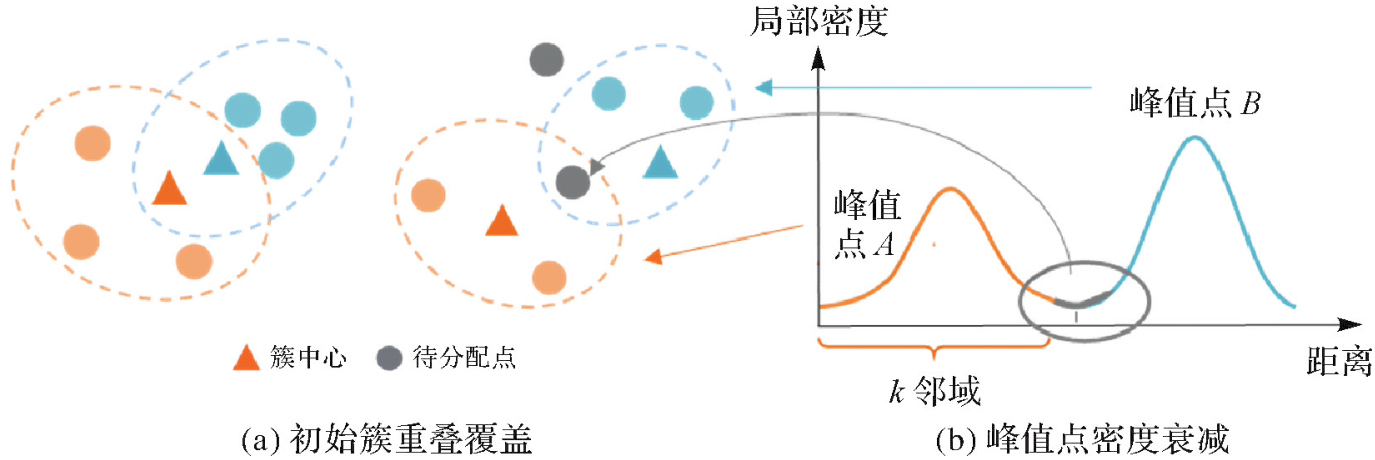
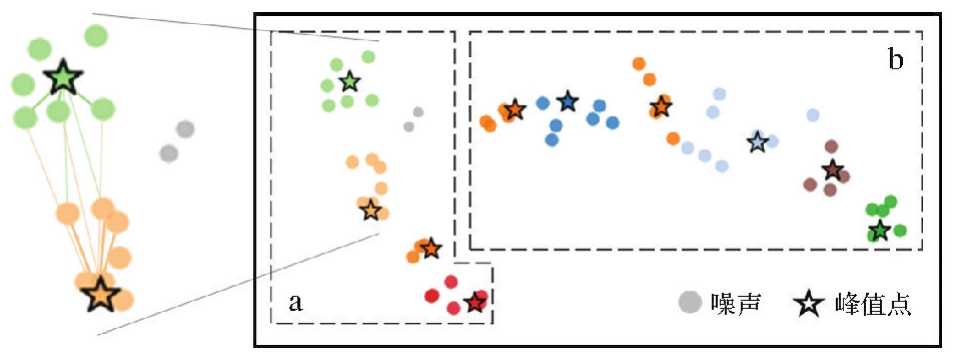
Fig. 6
Fine clustering affected by density attenuation of peak point"

Tab. 1
Synthetic dataset details"
| 数据集 | 样本数 | 特征数 | 簇数 |
|---|---|---|---|
| Spiral | 312 | 2 | 3 |
| Ring | 500 | 2 | 2 |
| Ls3 | 1741 | 2 | 6 |
| Compound | 399 | 2 | 6 |
| Jain | 373 | 2 | 2 |
| Jain2 | 500 | 2 | 4 |
Tab. 2
Clustering metrics of different algorithms across datasets"
| 数据集 | 算法 | ARI | AMI | Arg- |
|---|---|---|---|---|
| Spiral | DBSCAN | 1.000 | 1.000 | 0.05/3 |
| HDBSCAN | 1.000 | 1.000 | 17/2 | |
| SC | 1.000 | 1.000 | 3/5 | |
| OPTICS | 1.000 | 1.000 | 4/0.12 | |
| SNN-DPC | 1.000 | 1.000 | 4/3 | |
| 3W-PEDP | 1.000 | 1.000 | 3 | |
| AE-DPC | 1.000 | 1.000 | 10/31 | |
| Ring | DBSCAN | 1.000 | 1.000 | 0.16/3 |
| HDBSCAN | 1.000 | 1.000 | 2/3 | |
| SC | 1.000 | 1.000 | 2/8 | |
| OPTICS | 1.000 | 1.000 | 7/0.08 | |
| SNN-DPC | 1.000 | 1.000 | 3/2 | |
| 3W-PEDP | 0.670 | 0.718 | 4 | |
| AE-DPC | 1.000 | 1.000 | 10/50 | |
| Ls3 | DBSCAN | 1.000 | 1.000 | 0.05/11 |
| HDBSCAN | 1.000 | 1.000 | 9/1 | |
| SC | 1.000 | 1.000 | 6/25 | |
| OPTICS | 0.959 | 0.950 | 6/0.03 | |
| SNN-DPC | 0.719 | 0.807 | 70/6 | |
| 3W-PEDP | 0.494 | 0.688 | 6 | |
| AE-DPC | 1.000 | 1.000 | 41/174 | |
| Compound | DBSCAN | 0.949 | 0.908 | 0.05/3 |
| HDBSCAN | 0.909 | 0.896 | 2/3 | |
| SC | 0.804 | 0.853 | 4/13 | |
| OPTICS | 0.882 | 0.864 | 6/0.05 | |
| SNN-DPC | 0.875 | 0.854 | 3/10 | |
| 3W-PEDP | 0.820 | 0.821 | 6 | |
| AE-DPC | 0.969 | 0.933 | 9/21 | |
| Jain | DBSCAN | 0.976 | 0.865 | 0.08/2 |
| HDBSCAN | 0.976 | 0.934 | 20/2 | |
| SC | 1.000 | 1.000 | 2/9 | |
| OPTICS | 0.976 | 0.922 | 4/0.08 | |
| SNN-DPC | 0.811 | 0.832 | 2/3 | |
| 3W-PEDP | 0.444 | 0.601 | 3 | |
| AE-DPC | 1.000 | 1.000 | 16/37 | |
| Jain2 | DBSCAN | 0.725 | 0.814 | 0.06/5 |
| HDBSCAN | 0.871 | 0.838 | 5/4 | |
| SC | 0.705 | 0.688 | 4/47 | |
| OPTICS | 0.799 | 0.788 | 9/0.06 | |
| SNN-DPC | 0.927 | 0.921 | 7/4 | |
| 3W-PEDP | 0.826 | 0.838 | 5 | |
| AE-DPC | 0.930 | 0.913 | 13/49 |
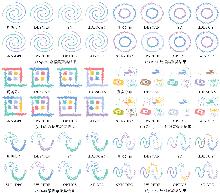
Fig. 7
Clustering results of different algorithms across datasets"
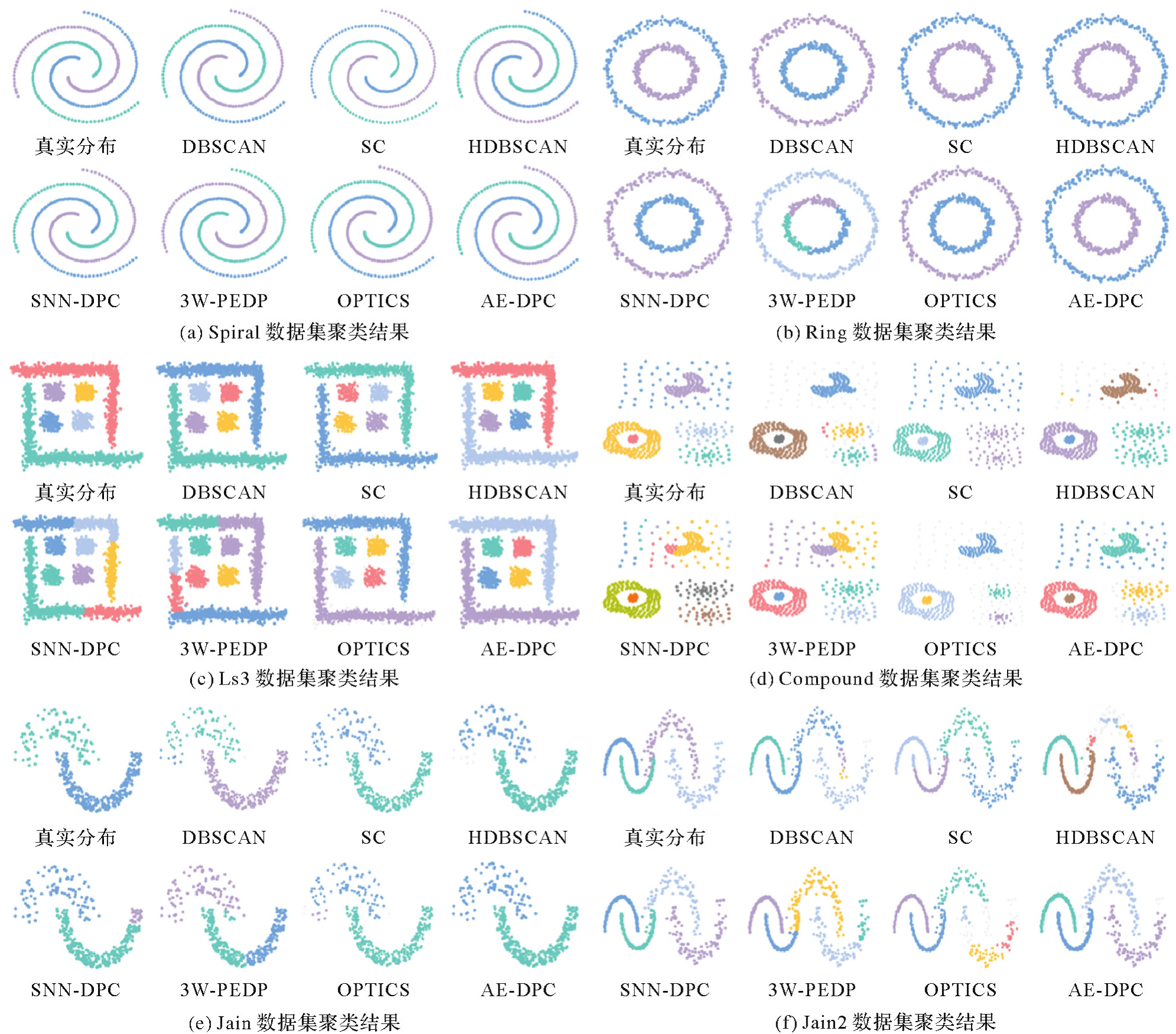
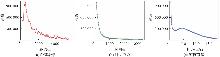
Fig. 8
Frequency of trajectory point features"
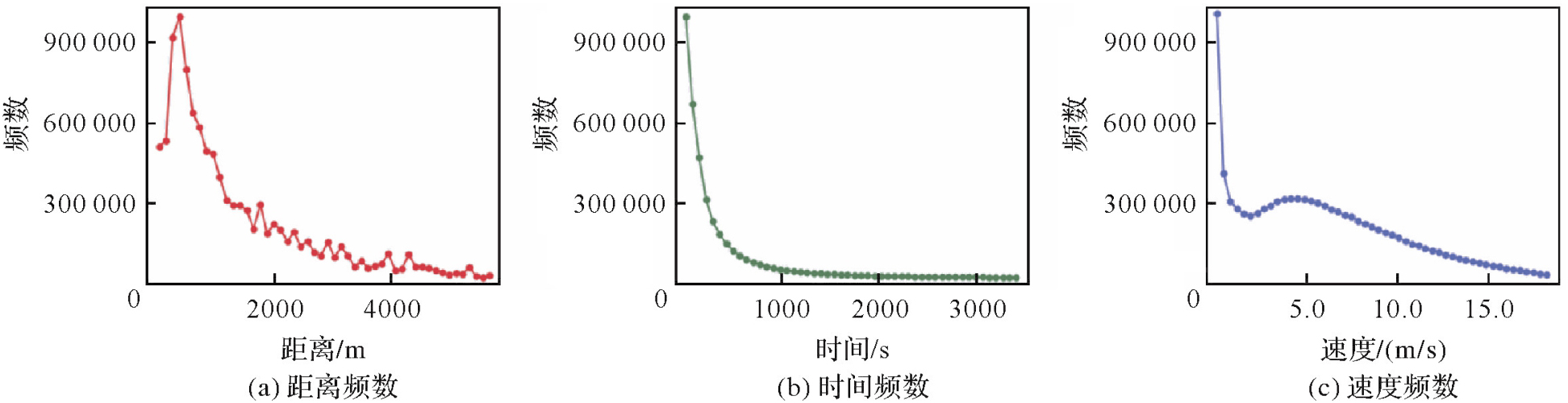
Fig. 9
Spatial distribution of cameras in main urban areas of Wuhan"
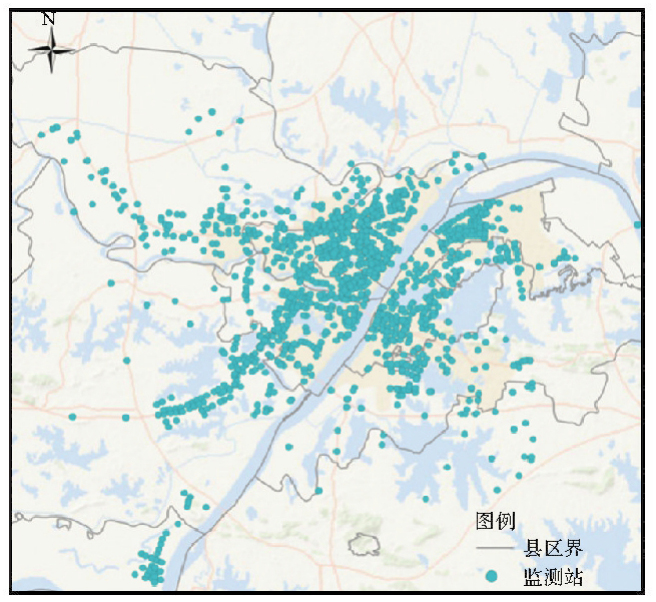
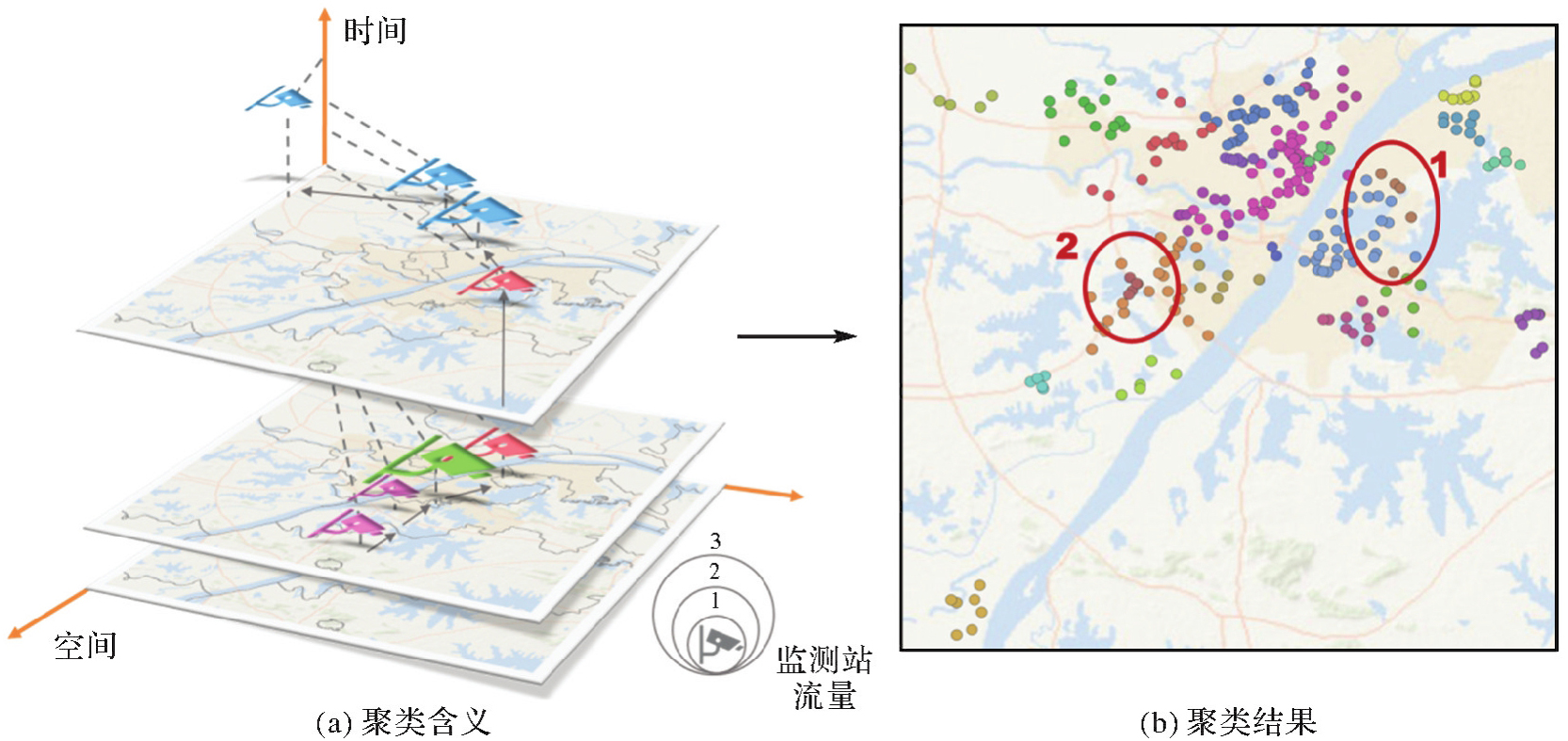
Fig. 10
Cluster analysis: concept and trajectory clustering results in Wuhan (Mar 1, 18: 00)"
Tab. 3
Trajectory samples and comparative of clustering methods"
| 车辆 | 记录时间 | 监测设备 | 距离/m | 时间/s | 速度/(m/s) | 簇 | 簇时间/s | 簇速度/(m/s) | 标签 | 结果 | 簇H | 簇D |
|---|---|---|---|---|---|---|---|---|---|---|---|---|
| 5f0** | 16:35:36 | 435** | 0 | 33 | 0 | 2059 | 600 | 5.44 | -1 | 0 | 225 | d3 |
| 5f0** | 17:26:10 | 484** | 3799 | 3034 | 1.25 | 4901 | 1833 | 5.21 | 2 | 2 | 825 | d3 |
| 5f0** | 18:57:16 | 471** | 1421 | 5466 | 0.26 | 1095 | 2731 | 5.91 | 2 | 2 | 828 | e3 |
| 5f0** | 18:58:17 | 459** | 8 | 61 | 0.13 | 1095 | 2731 | 5.91 | 0 | 0 | 828 | e3 |
| 5f0** | 19:24:10 | 494** | 11 438 | 1553 | 7.367 | 1095 | 2731 | 5.91 | 1 | 0 | - | f5 |
| 13f** | 15:37:31 | 441** | 0 | 0 | 0 | 1222 | 764 | 6.54 | -1 | 0 | 311 | d4 |
| 13f** | 15:37:36 | 441** | 0 | 5 | 0 | 1222 | 764 | 6.54 | 0 | 0 | 311 | d4 |
| 13f** | 15:53:31 | 455** | 1335 | 955 | 1.39 | 2104 | 700 | 6.38 | 2 | 2 | - | d4 |
| 13f** | 15:54:01 | 456** | 396 | 30 | 13.22 | 2104 | 700 | 6.38 | 0 | 0 | - | d4 |
| 13f** | 15:54:23 | 410** | 181 | 22 | 8.26 | 2104 | 700 | 6.38 | 0 | 0 | 368 | d4 |
| 13f** | 16:05:24 | 499** | 1831 | 661 | 2.77 | 2307 | 892 | 3.99 | 1 | 0 | 369 | d4 |
Tab. 4
Comparative of stay point detection methods"
| 识别方法 | 查准率 | 查全率 |
|---|---|---|
| 本文方法 | 0.89 | 0.83 |
| 基于HDBSCAN的局部阈值法 | 0.78 | 0.71 |
| 动态阈值法 | 0.81 | 0.82 |
Fig. 11
Figure of vehicle driving trajectory and stay point recognition"
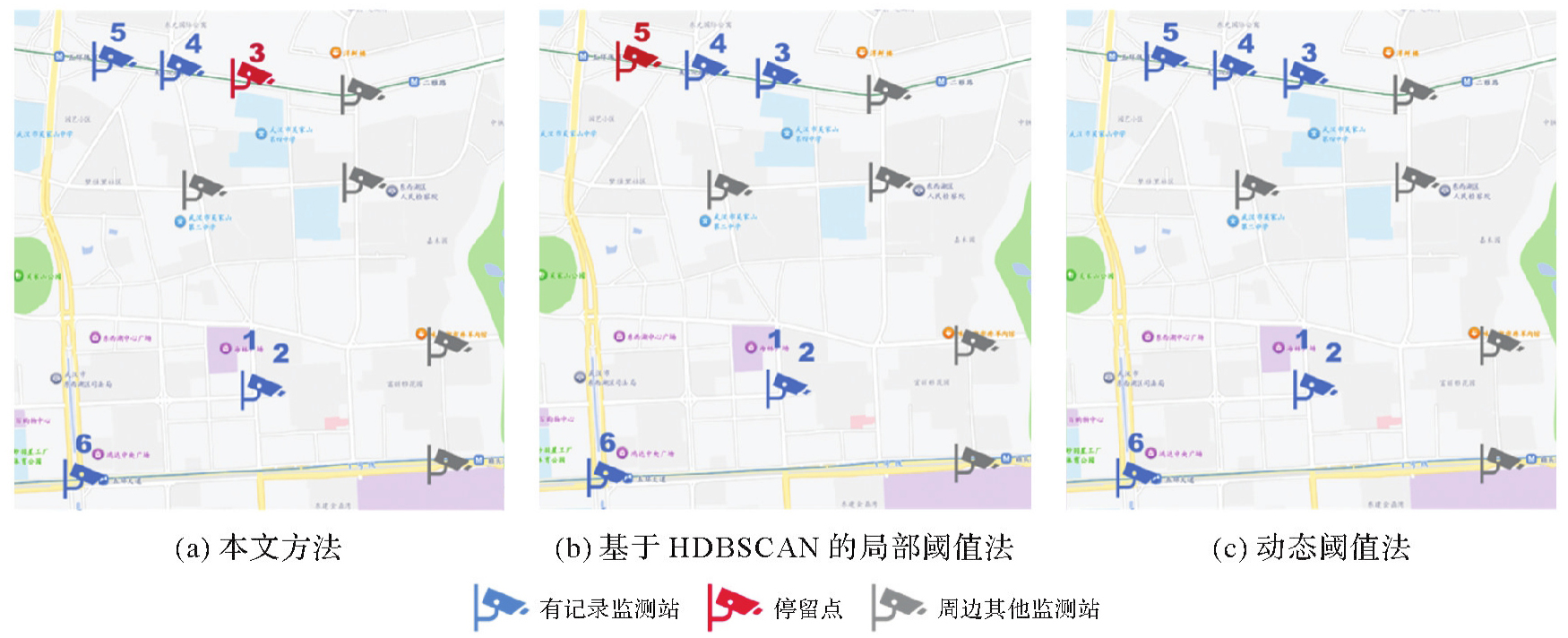
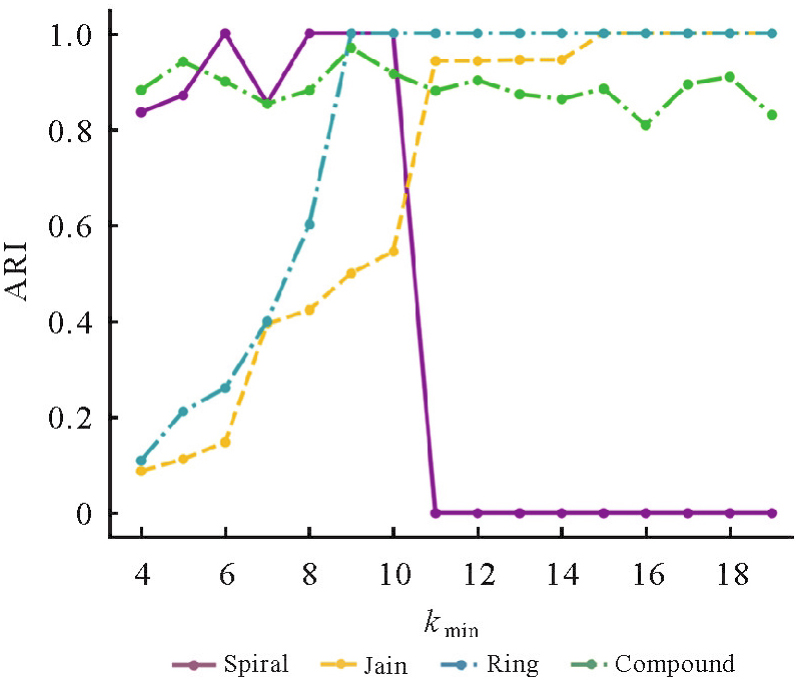
Fig. 12
Clustering performance with varying kmin"
| [1] | 李婷, 裴韬, 袁烨城, 等. 人类活动轨迹的分类、模式和应用研究综述[J]. 地理科学进展, 2014, 33(7): 938-948. |
| LI Ting, PEI Tao, YUAN Yecheng, et al. A review on the classification, patterns and applied research of human mobility trajectory[J]. Progress in Geography, 2014, 33(7): 938-948. | |
| [2] |
代维秀, 陈占龙, 谢鹏. 居民出行与轨迹行为交互模式挖掘与关联技术[J]. 测绘学报, 2021, 50(4): 532-543. DOI: .
doi: 10.11947/j.AGCS.2021.20200072 |
|
DAI Weixiu, CHEN Zhanlong, XIE Peng. Research on the interactive mode of residents' behavior based on trajectory data mining[J]. Acta Geodaetica et Cartographica Sinica, 2021, 50(4): 532-543. DOI: .
doi: 10.11947/j.AGCS.2021.20200072 |
|
| [3] | 王培晓, 张恒才, 张岩, 等. 地理空间智能预测研究进展与发展趋势[J]. 地球信息科学学报, 2025, 27(1): 60-82. |
| WANG Peixiao, ZHANG Hengcai, ZHANG Yan, et al. GeoAI-driven spatiotemporal prediction: progress and prospects[J]. Journal of Geo-information Science, 2025, 27(1): 60-82. | |
| [4] | HWANG S, VANDEMARK C, DHATT N, et al. Segmenting human trajectory data by movement states while addressing signal loss and signal noise[J]. International Journal of Geographical Information Science, 2018, 32(7): 1391-1412. |
| [5] | ZHANG Weiqi, XIE Zhenzhen, VERA VENKATA SAI A M, et al. A local differential privacy trajectory protection method based on temporal and spatial restrictions for staying detection[J]. Tsinghua Science and Technology, 2024, 29(2): 617-633. |
| [6] | 张宽, 赵卓峰, 郭炜强. 一种面向定点轨迹数据的行程识别方法[J]. 北京邮电大学学报, 2020, 43(4): 39-47. |
| ZHANG Kuan, ZHAO Zhuofeng, GUO Weiqiang. Travel recognition method for fixed-point trajectory data[J]. Journal of Beijing University of Posts and Telecommunications, 2020, 43(4): 39-47. | |
| [7] | YANG Yitao, JIA Bin, YAN Xiaoyong, et al. Identifying intracity freight trip ends from heavy truck GPS trajectories[J]. Transportation Research Part C: Emerging Technologies, 2022, 136: 103564. |
| [8] | ZHANG Bin, WANG Qiuxia, LI Jing, et al. Spatial-temporal grid clustering method based on frequent stay point recognition[J]. Neural Computing and Applications, 2022, 34(12): 9247-9255. |
| [9] | 陆剑锋, 郭茂祖, 张昱, 等. 基于时空约束密度聚类的停留点识别方法[J]. 智能系统学报, 2020, 15(1): 59-66. |
| LU Jianfeng, GUO Maozu, ZHANG Yu, et al. Stay point recognition method based on spatio-temporal constraint density clustering[J]. CAAI Transactions on Intelligent Systems, 2020, 15(1): 59-66. | |
| [10] | 姜晓红, 陈庆炜, 严亚丹, 等. 基于规则判别的末端配送停留点识别与出行链特征[J]. 交通运输系统工程与信息, 2024, 24(6): 232-241. |
| JIANG Xiaohong, CHEN Qingwei, YAN Yadan, et al. Rule-based discriminative identification and travel chain characterization of last-mile delivery stops[J]. Journal of Transportation Systems Engineering and Information Technology, 2024, 24(6): 232-241. | |
| [11] | QIAN Jiaxin, ZHOU You, HAN Xuming, et al. MDBSCAN: a multi-density DBSCAN based on relative density[J]. Neurocomputing, 2024, 576: 127329. |
| [12] | 吴笛, 杜云艳, 易嘉伟, 等. 基于密度的轨迹时空聚类分析[J]. 地球信息科学学报, 2015, 17(10): 1162-1171. |
| WU Di, DU Yunyan, YI Jiawei, et al. Density-based spatiotemporal clustering analysis of trajectories[J]. Journal of Geo-information Science, 2015, 17(10): 1162-1171. | |
| [13] | 周洋, 杨超. 基于时空聚类算法的轨迹停驻点识别研究[J]. 交通运输系统工程与信息, 2018, 18(4): 88-95. |
| ZHOU Yang, YANG Chao. Anchors identification in trajectory based on temporospatial clustering algorithm[J]. Journal of Transportation Systems Engineering and Information Technology, 2018, 18(4): 88-95. | |
| [14] |
王培晓, 张恒才, 王海波, 等. ST-CFSFDP:快速搜索密度峰值的时空聚类算法[J]. 测绘学报, 2019, 48(11): 1380-1390. DOI: .
doi: 10.11947/j.AGCS.2019.20180538 |
|
WANG Peixiao, ZHANG Hengcai, WANG Haibo, et al. Spatial-temporal clustering by fast search and find of density peaks[J]. Acta Geodaetica et Cartographica Sinica, 2019, 48(11): 1380-1390. DOI: .
doi: 10.11947/j.AGCS.2019.20180538 |
|
| [15] | GONG Lei, YAMAMOTO T, MORIKAWA T. Identification of activity stop locations in GPS trajectories by DBSCAN-TE method combined with support vector machines[J]. Transportation Research Procedia, 2018, 32: 146-154. |
| [16] | 徐晓, 丁世飞, 丁玲. 密度峰值聚类算法研究进展[J]. 软件学报, 2022, 33(5): 1800-1816. |
| XU Xiao, DING Shifei, DING Ling. Survey on density peaks clustering algorithm[J]. Journal of Software, 2022, 33(5): 1800-1816. | |
| [17] | 白璐, 赵鑫, 孔钰婷, 等. 谱聚类算法研究综述[J]. 计算机工程与应用, 2021, 57(14): 15-26. |
| BAI Lu, ZHAO Xin, KONG Yuting, et al. Survey of spectral clustering algorithms[J]. Computer Engineering and Applications, 2021, 57(14): 15-26. | |
| [18] | YU Fudan, AO Wenxuan, YAN Huan, et al. Spatio-temporal vehicle trajectory recovery on road network based on traffic camera video data[C]//Proceedings of the 28th ACM SIGKDD Conference on Knowledge Discovery and Data Mining. New York: ACM Press, 2022: 4413-4421. |
| [19] | TRAN L H, DANG T K, THOAI N. Hybrid stop discovery in trajectory records[C]//Proceedings of 2013 International Workshop on Database and Expert Systems Applications. Los Alamitos: IEEE, 2013: 9-14. |
| [20] | 吕莉, 陈威, 肖人彬, 等. 面向密度分布不均数据的加权逆近邻密度峰值聚类算法[J]. 智能系统学报, 2024, 19(1): 165-175. |
| LÜ Li, CHEN Wei, XIAO Renbin, et al. Density peak clustering algorithm based on weighted reverse nearest neighbor for uneven density datasets[J]. CAAI Transactions on Intelligent Systems, 2024, 19(1): 165-175. | |
| [21] | PENG Ju, TANG Jianbo, DENG Min, et al. A two-stage method for detecting trajectory clusters of different densities with peak trajectories identification[J]. International Journal of Geographical Information Science, 2025, 39(10): 2177-2210. |
| [22] | RODRIGUEZ A, LAIO A. Clustering by fast search and find of density peaks[J]. Science, 2014, 344(6191): 1492-1496. |
| [23] | ZANG Wenke, CHE Jing, MA Linlin, et al. Density peaks clustering based on density voting and neighborhood diffusion[J]. Information Sciences, 2024, 681: 121209. |
| [24] | 陈梅, 魏礼磊, 尤远毓秀, 等. 基于k近邻图的密度峰值聚类算法[J]. 控制与决策, 2025, 40(7): 2242-2250. |
| CHEN Mei, WEI Lilei, YOU Yuanyuxiu, et al. Density peaks clustering algorithm based on k-nearest neighbor graph[J]. Control and Decision, 2025, 40(7): 2242-2250. | |
| [25] | ZHAO Jia, WANG Gang, PAN J S, et al. Density peaks clustering algorithm based on fuzzy and weighted shared neighbor for uneven density datasets[J]. Pattern Recognition, 2023, 139: 109406. |
| [26] | MOULAVI D, JASKOWIAK P A, CAMPELLO R J G B, et al. Density-based clustering validation[C]//Proceedings of 2014 SIAM International Conference on Data Mining. Philadelphia: Society for Industrial and Applied Mathematics, 2014: 839-847. |
| [27] | LIU Rui, WANG Hong, YU Xiaomei. Shared-nearest-neighbor-based clustering by fast search and find of density peaks[J]. Information Sciences, 2018, 450: 200-226. |
| [28] | JU Hengrong, LU Yang, DING Weiping, et al. Three-way evidence theory-based density peak clustering with the principle of justifiable granularity[J]. Applied Soft Computing, 2024, 152: 111217. |
| [1] | SUN Genyun, LI Renren, ZHANG Aizhu, AN Na, FU Hang, PAN Zhaojie. Band selection algorithm for reverse nearest neighbor density peak clustering of hyperspectral images [J]. Acta Geodaetica et Cartographica Sinica, 2024, 53(1): 8-19. |
| [2] | TANG Xiaofang, ZHAN Zongqian, DING Jiujie, LIU Jiahui, XIONG Zirou. Superpixel spectral features-based automatic fuzzy clustering segmentation for UAV image [J]. Acta Geodaetica et Cartographica Sinica, 2022, 51(5): 677-690. |
| [3] | WEI Yuan, JIN Shaohua, LI Shujun, WANG Lei, BIAN Gang, WANG Mo. Automatic recognition and cleaning of outliers in multi-beam bathymetric data with clustering algorithm [J]. Acta Geodaetica et Cartographica Sinica, 2022, 51(11): 2294-2302. |
| [4] | SHAO Fan, WANG Xiaoya, HE Bing, ZHANG Jing. Effect analysis of the weighting scheme with modified FCM clustering algorithm on precision of SLR orbit determination [J]. Acta Geodaetica et Cartographica Sinica, 2019, 48(10): 1236-1243. |
| [5] | WANG Jianming, SHI Wenzhong, SHAO Pan. Change-detection Method for SAR Image Using Adaptive Distance and Fuzzy Topology Optimization-based Fuzzy Clustering [J]. Acta Geodaetica et Cartographica Sinica, 2018, 47(5): 611-619. |
| [6] | LIU Meng, WU Qunyong, QIU Duansheng, SUN Mei, ZHANG Qiang. Fast Search the Density Peaks and Clustering Method for Check-in Data [J]. Acta Geodaetica et Cartographica Sinica, 2017, 46(4): 516-525. |
| [7] | TIAN Yingguo, HAO Jinming, YU Heli, LIU Weiping, XIE Jiantao, ZHANG Kang. Improved Ionospheric Model Algorithm for LEO Satellite Single-frequency Precise Orbit Determination [J]. Acta Geodaetica et Cartographica Sinica, 2016, 45(7): 803-809. |
| Viewed | ||||||
|
Full text |
|
|||||
|
Abstract |
|
|||||
