

Acta Geodaetica et Cartographica Sinica ›› 2025, Vol. 54 ›› Issue (3): 397-409.doi: 10.11947/j.AGCS.2025.20230493
• Review • Next Articles
Gang LI1,2( ), Fang XIE3, Yifan WU3, Jun LU1,2, Shuren GUO1,2, Yingchun LIU3, Chengeng SU1,2, Xiaoheng YANG1,2
Received:2023-12-24
Online:2025-04-11
Published:2025-04-11
About author:LI Gang (1982—), male, PhD, associate researcher, majors in satellite navigation, satellite communication, intersatellite link, search and rescue, et al. E-mail: ligang8212@126.com
CLC Number:
Gang LI, Fang XIE, Yifan WU, Jun LU, Shuren GUO, Yingchun LIU, Chengeng SU, Xiaoheng YANG. Prospects for the development of deep space navigation technologies[J]. Acta Geodaetica et Cartographica Sinica, 2025, 54(3): 397-409.
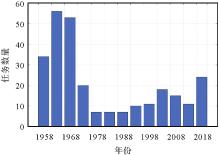
Fig. 1
Statistics of launched deep space missions (1958—2023, statistical analysis on a five-year cycle)[31-36]"

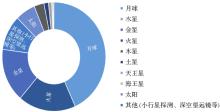
Fig. 2
Distribution graph of the number of deep space probes in the solar system by target"
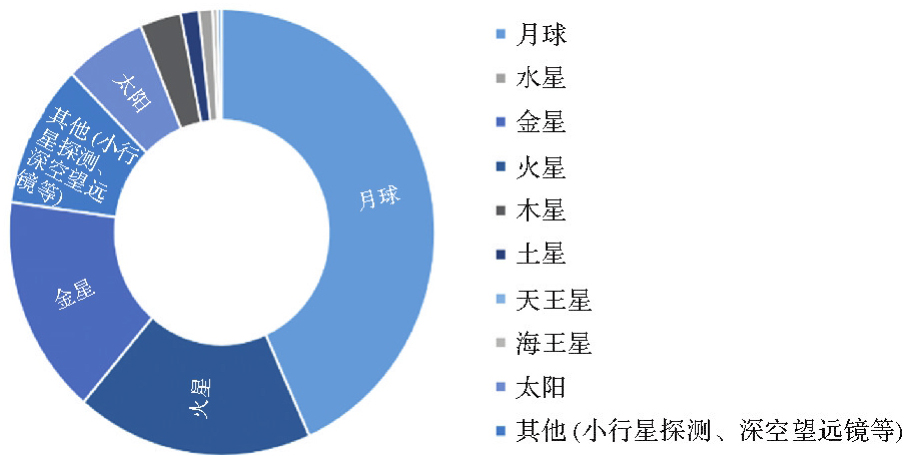
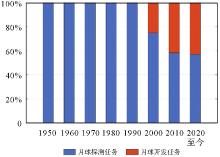
Fig. 3
The proportion of lunar missions for exploration and development"
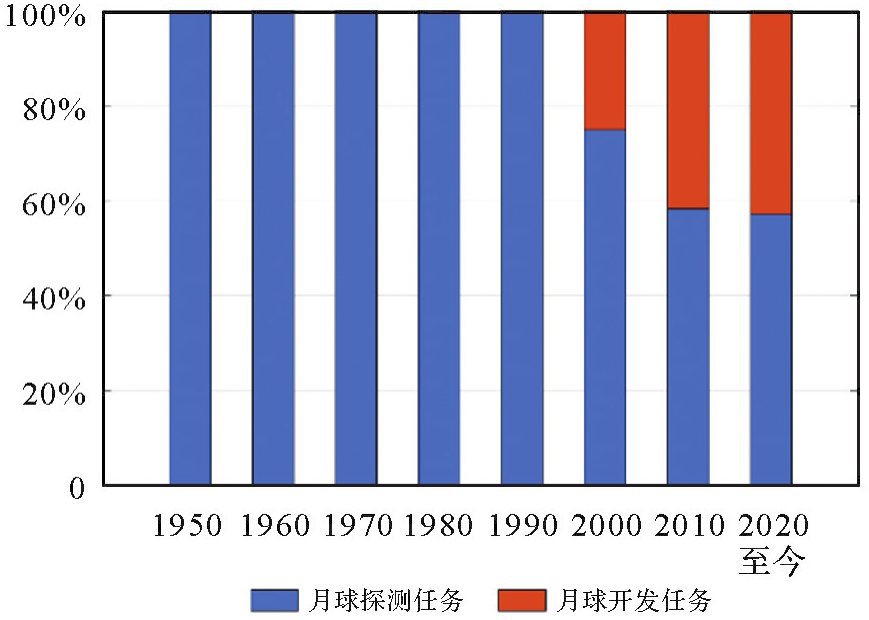
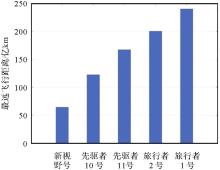
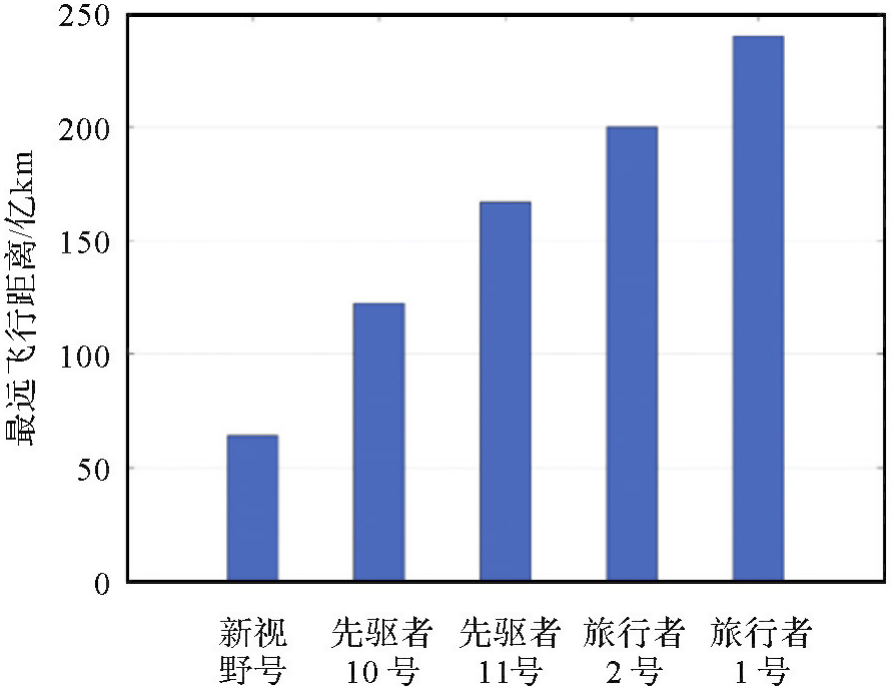
Fig. 4
Typical deep space exploration missions with the furthest distance[31-36]"
Tab. 1
Characteristics of deep space navigation technology means"
| 序号类别 | 技术手段 | 观测量 | 作用域 | 自主性 | 基准源 | 性能指标 | 优点 | 局限性 | |
|---|---|---|---|---|---|---|---|---|---|
| 1 | 在用类 | 深空网[ | 测距、测速和干涉测量 | 深空 | 被动 | 人造 | 定轨精度 1 km(地月转移轨道) 200 m(环月轨道) | 观测距离远 | 覆盖范围取决于地面深空站能力,系统容量有限 |
| 2 | 星光导航[ | 测角 | 深空 | 自主 | 自然天体 | 定轨精度10 km | 测角精度较低,独立导航能力较差 | ||
| 3 | 惯性导航[ | 测加速度 | 深空 | 自主 | — | 定位精度100 m(航天器着落阶段,与测距等手段联合使用) | 实现完全自主 | 需要外部不断校准 | |
| 4 | 可用类 | 导航信号[ | 单程测距 | 地月空间 | 半自主 | 人造 | 定位精度50 m、授时精度50μs | 用户数量不受限 | 覆盖范围受限,对接收机要求较高 |
| 5 | 星间链路[ | 双程测距 | 远至月球 | 半自主 | 人造 | 定轨精度120 m、授时精度20 ns | 测距精度高 | 单链路定轨需累积观测及初始轨道 | |
| 6 | 导航通信一体化卫星系统[ | 单程测距 | 月球等近星体空间及表面 | 半自主 | 人造 | 定位精度10 m、授时精度20 ns | 精度高,可覆盖星体外部空间及表面 | 建设成本较高,覆盖范围难以扩展至其他星体 | |
| 7 | 导航信标[ | 测距+信息增强 | 月球等星体表面 | 半自主 | 人造 | 定位精度50 m(星体表面局域范围) | 局域精度高,可按需扩展 | 局域导航,需已知信标精确坐标 | |
| 8 | 研究类 | 脉冲星导航[ | 单程测距 | 深空 | 自主 | 自然天体 | 定轨精度5 km授时精度100 ns | 实现完全自主 | 技术成熟度较低 |
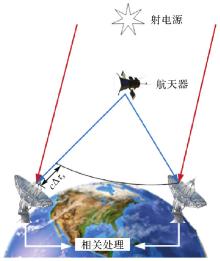
Fig. 5
Principle of DOR orbit determination technology using deep space stations[45]"

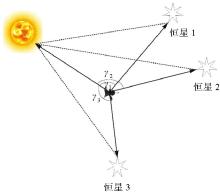
Fig. 6
Principle of starlight navigation technology[47]"
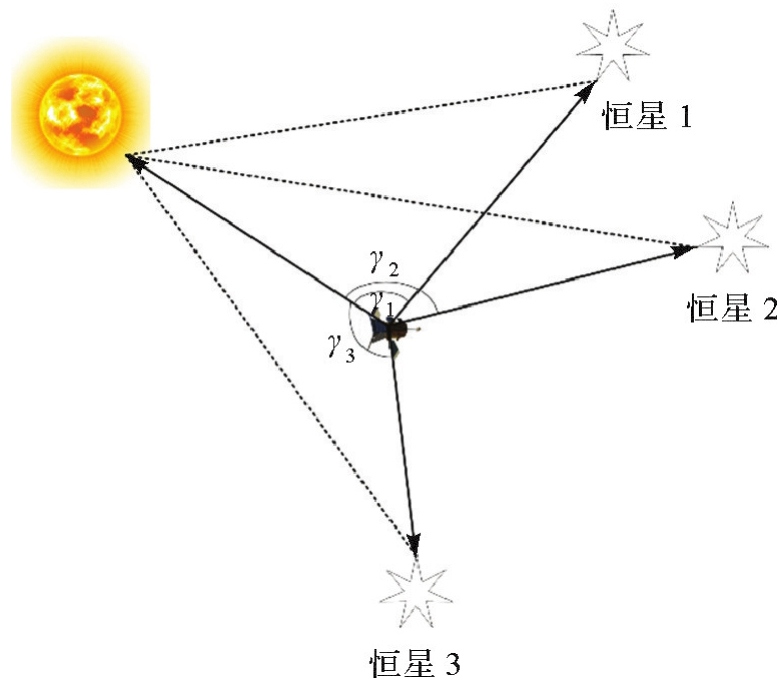
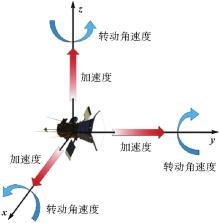
Fig. 7
Inertial navigation system block[48]"
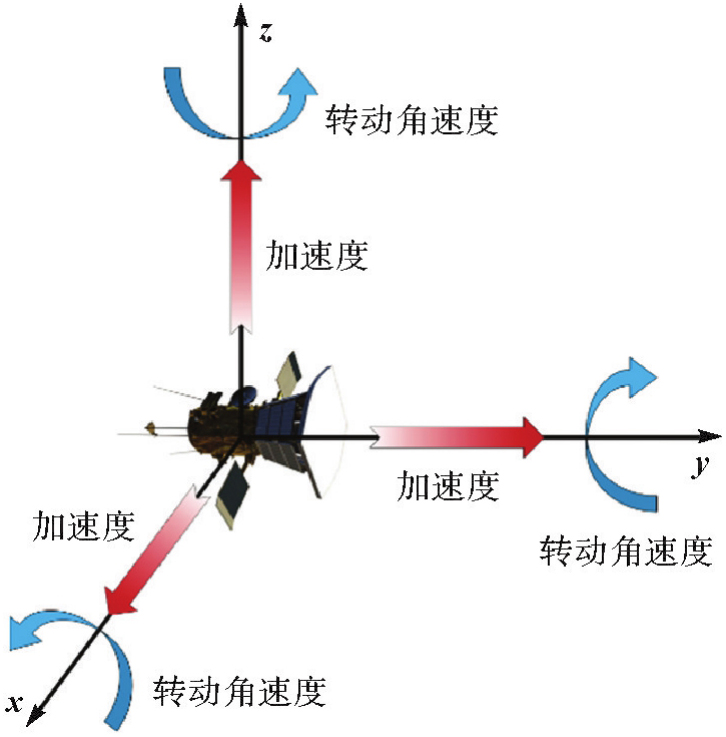
Fig. 8
Principle of GNSS signal leakage navigation technology[51]"
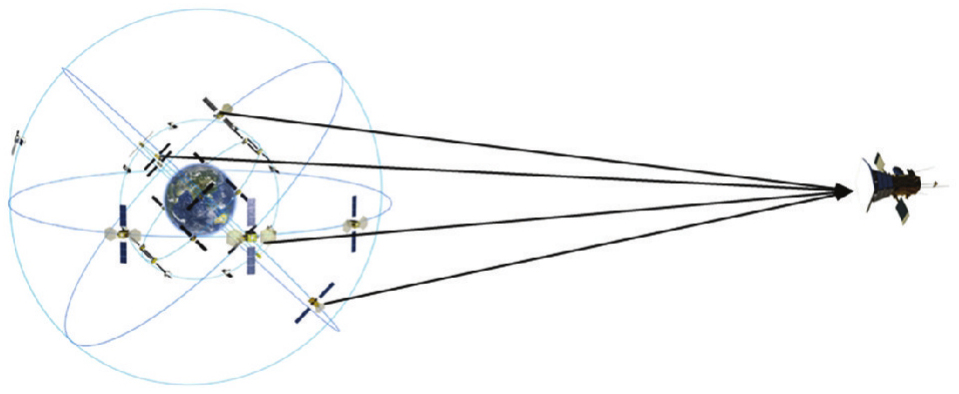
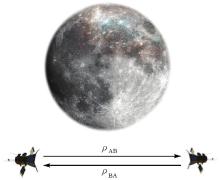
Fig. 9
Principle of interstellar link navigation[54]"
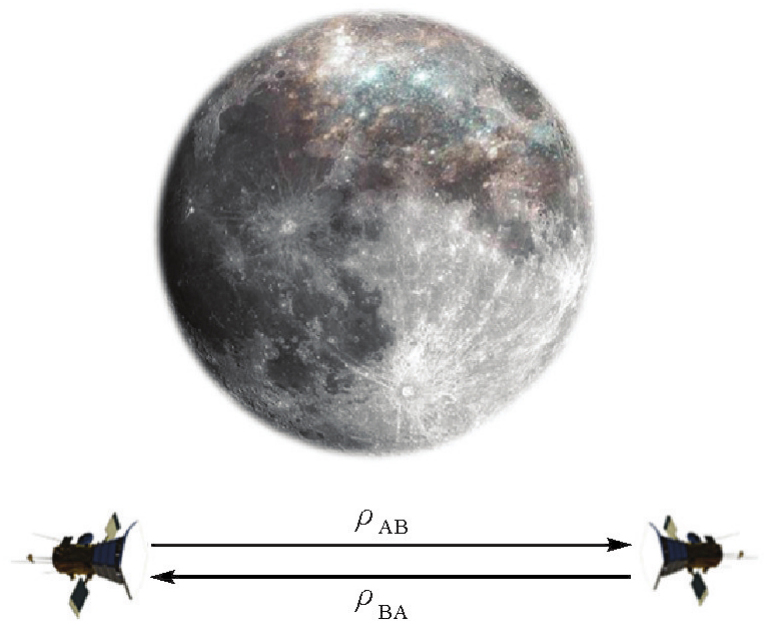
Fig. 10
A lunar space navigation system with 2 ELFOs[57]"
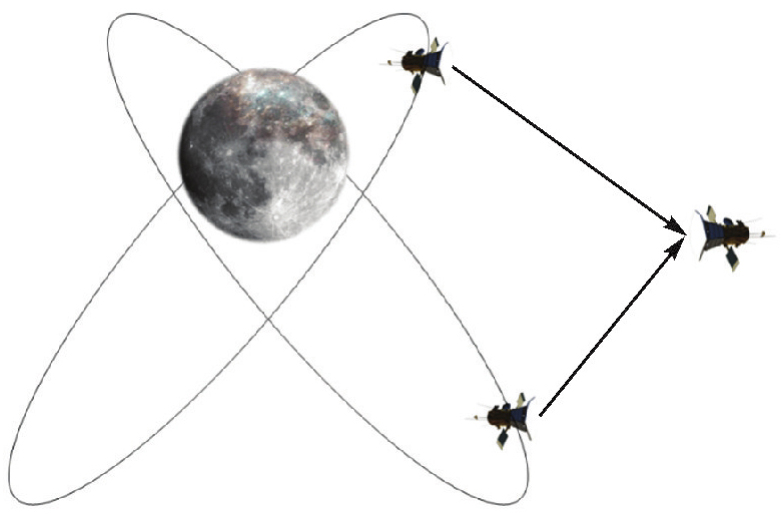
Fig. 11
Principle of lunar beacon navigation[61]"
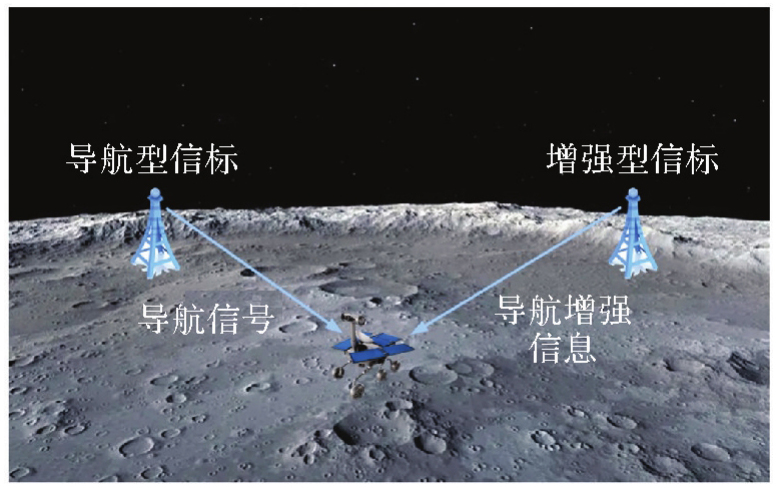
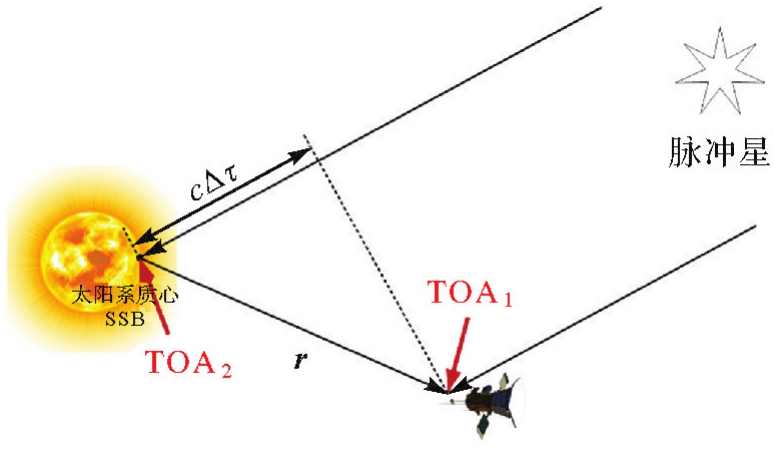
Fig. 12
Principle of pulsar navigation technology[62]"
| [1] | 叶培建, 于登云, 孙泽洲, 等. 中国月球探测器的成就与展望[J]. 深空探测学报, 2016, 3(4): 323-333. |
| YE Peijian, YU Dengyun, SUN Zezhou, et al. Achievements and prospect of Chinese lunar probes[J]. Journal of Deep Space Exploration, 2016, 3(4): 323-333. | |
| [2] | CRUSAN J, BLEACHER J, CARAM J, et al. NASA's gateway: an update on progress and plans for extending human presence to cislunar space[C]//Proceedings of 2019 IEEE Aerospace Conference. Big Sky: IEEE, 2019: 1-19. |
| [3] | BOLLIGER M J. Cislunar mission design: transfers linking near rectilinear halo orbits and the butterfly family[D]. West Lafayette: Purdue University, 2019. |
| [4] | CHEETHAM B. Cislunar autonomous positioning system technology operations and navigation experiment (CAPSTONE)[C]//Proceedings of 2021 ASCEND. Las Vegas: AIAA, 2021. |
| [5] | FLORES G, HARRIS D, MCCAULEY R, et al. Deep space habitation: establishing a sustainable human presence on the Moon and beyond[C]//Proceedings of 2021 IEEE Aerospace Conference. Big Sky: IEEE, 2021: 1-7. |
| [6] | FARLEY K A, WILLIFORD K H, STACK K M, et al. Mars 2020 mission overview[J]. Space Science Reviews, 2020, 216(8): 142. |
| [7] | EDWARDS C S, CHRISTENSEN P R, MEHALL G L, et al. The emirates Mars mission (EMM) emirates Mars infrared spectrometer (EMIRS) instrument[J]. Space Science Reviews, 2021, 217(7): 77. |
| [8] | LIM D S S, ABERCROMBY A F J, KOBS NAWOTNIAK S E, et al. The BASALT research program: designing and developing mission elements in support of human scientific exploration of Mars[J]. Astrobiology, 2019, 19(3): 245-259. |
| [9] | LIU Kai, HAO Xinjun, LI Yiren, et al. Mars orbiter magnetometer of China's first Mars mission Tianwen-1[J]. Earth and Planetary Physics, 2020, 4(4): 384-389. |
| [10] | 耿言, 周继时, 李莎, 等. 我国首次火星探测任务[J]. 深空探测学报, 2018, 5(5): 399-405. |
| GENG Yan, ZHOU Jishi, LI Sha, et al. A brief introduction of the first Mars exploration mission in China[J]. Journal of Deep Space Exploration, 2018, 5(5): 399-405. | |
| [11] | 于登云, 孙泽洲, 孟林智, 等. 火星探测发展历程与未来展望[J]. 深空探测学报, 2016, 3(2): 108-113. |
| YU Dengyun, SUN Zezhou, MENG Linzhi, et al. The development process and prospects for Mars exploration[J]. Journal of Deep Space Exploration, 2016, 3(2): 108-113. | |
| [12] | ZOU Yongliao, ZHU Yan, BAI Yunfei, et al. Scientific objectives and payloads of Tianwen-1, China's first Mars exploration mission[J]. Advances in Space Research, 2021, 67(2): 812-823. |
| [13] | SMITH M, CRAIG D, HERRMANN N, et al. The Artemis program: an overview of NASA's activities to return humans to the moon[C]//Proceedings of 2020 IEEE Aerospace Conference. Big Sky: IEEE, 2020: 1-10. |
| [14] | ISRAEL D J, MAULDIN K D, ROBERTS C J, et al. LunaNet: a flexible and extensible lunar exploration communications and navigation infrastructure[C]//Proceedings of 2020 IEEE Aerospace Conference. Big Sky: IEEE, 2020: 1-14. |
| [15] | GIORDANO P, GRENIER A, ZOCCARATO P, et al. Moonlight navigation service-how to land on peaks of eternal light[C]//Proceedings of the 72nd International Astronautical Congress. Dubai: United Arab Emirates, 2021: 25-29. |
| [16] | PALMER C. SpaceX starship lands on earth, but manned missions to Mars will require more[J]. Engineering, 2021, 7(10): 1345-1347. |
| [17] | FLETCHER L N, CAVALIÉ T, GRASSI D, et al. Jupiter science enabled by ESA's Jupiter icy moons explorer[J]. Space Science Reviews, 2023, 219(7): 53. |
| [18] | 万卫星, 魏勇, 郭正堂, 等. 从深空探测大国迈向行星科学强国[J]. 中国科学院院刊, 2019, 34(7): 748-755. |
| WAN Weixing, WEI Yong, GUO Zhengtang, et al. Toward a power of planetary science from a gaint of deep space exploration[J]. Bulletin of Chinese Academy of Sciences, 2019, 34(7): 748-755. | |
| [19] | JI Jianghui, WANG Su. China's future missions for deep space exploration and exoplanet space survey by 2030[J]. Chinese Journal of Space Science, 2020, 40(5): 729-731. |
| [20] | 吴伟仁, 于登云. 深空探测发展与未来关键技术[J]. 深空探测学报, 2014, 1(1): 5-17. |
| WU Weiren, YU Dengyun. Development of deep space exploration and its future key technologies[J]. Journal of Deep Space Exploration, 2014, 1(1): 5-17. | |
| [21] | 蒋栋荣, 洪晓瑜. 甚长基线干涉测量技术在深空导航中的应用[J]. 科学, 2008, 60(1): 10-14,4. |
| JIANG Dongrong, HONG Xiaoyu. VLBI for deep-space navigation[J]. Science, 2008, 60(1): 10-14,4. | |
| [22] | 李海涛, 周欢, 郝万宏, 等. 深空导航无线电干涉测量技术的发展历程和展望[J]. 飞行器测控学报, 2013, 32(6): 470-478. |
| LI Haitao, ZHOU Huan, HAO Wanhong, et al. Development of radio interferometry and its prospect in deep space navigation[J]. Journal of Spacecraft TT&C Technology, 2013, 32(6): 470-478. | |
| [23] | 韩来辉. 美国地基深空探测网现状及对我国发展的启示[J]. 现代雷达, 2020, 42(5): 1-8. |
| HAN Laihui. Status of ground-based deep space exploration network of USA and its revelation for China[J]. Modern Radar, 2020, 42(5): 1-8. | |
| [24] | 王大轶, 黄翔宇. 深空探测自主导航与控制技术综述[J]. 空间控制技术与应用, 2009, 35(3): 6-12,43. |
| WANG Dayi, HUANG Xiangyu. Survey of autonomous navigation and control for deep space exploration[J]. Aerospace Control and Application, 2009, 35(3): 6-12,43. | |
| [25] | 张伟, 许俊, 黄庆龙, 等. 深空天文自主导航技术发展综述[J]. 飞控与探测, 2020, 3(4): 8-16. |
| ZHANG Wei, XU Jun, HUANG Qinglong, et al. Survey of autonomous celestial navigation technology for deep space[J]. Flight Control & Detection, 2020, 3(4): 8-16. | |
| [26] | 强祺昌, 林宝军, 刘迎春, 等. 深空探测自主导航技术综述[J]. 导航与控制, 2023, 22(1): 19-32. |
| QIANG Qichang, LIN Baojun, LIU Yingchun, et al. Review of autonomous navigation technology for deep space exploration[J]. Navigation and Control, 2023, 22(1): 19-32. | |
| [27] | TURAN E, SPERETTA S, GILL E. Autonomous navigation for deep space small satellites: scientific and technological advances[J]. Acta Astronautica, 2022, 193: 56-74. |
| [28] | MUDGWAY D J. Uplink-downlink: a history of the NASA deep space network, 1957—1997[M]. Washington, D.C.: National Aeronautics and Space Administration, 2001. |
| [29] | ALESSI N, CAINI C, DE COLA T, et al. DTN performance in complex deep-space networks[C]//Proceedings of the 9th Advanced Satellite Multimedia Systems Conference and the 15th Signal Processing for Space Communications Workshop. Berlin: IEEE, 2018: 1-7. |
| [30] | MUKHERJEE J, RAMAMURTHY B. Communication technologies and architectures for space network and interplanetary internet[J]. IEEE Communications Surveys & Tutorials, 2013, 15(2): 881-897. |
| [31] | TURAN E, SPERETTA S, GILL E. Autonomous navigation for deep space small satellites: scientific and technological advances[J]. Acta Astronautica, 2022, 193: 56-74. |
| [32] | 张众, 武迪, 宝音贺西. 深空探测任务进展与展望[J]. 上海航天(中英文), 2024, 41(5): 52-68. |
| ZHANG Zhong, WU Di, BAO Yinhexi. Progress and prospects of deep space exploration missions[J]. Aerospace Shanghai (Chinese & English), 2024, 41(5): 52-68. | |
| [33] | 张扬眉. 2023年国外深空探测领域发展综述[J]. 国际太空, 2024(3): 11-15. |
| ZHANG Yangmei. A summary of the development of deep space exploration abroad in 2023[J]. Space International, 2024(3): 11-15. | |
| [34] | 葛平, 康焱, 张天馨, 等. 2023年深空探测进展与展望[J]. 中国航天, 2024(2): 7-15. |
| GE Ping, KANG Yan, ZHANG Tianxin, et al. Progress and prospects of global deep space exploration in 2023[J]. Aerospace China, 2024(2): 7-15. | |
| [35] | MITROFANOV I G, ZELENYI L M, TRET’ YAKOV V I, et al. Luna-25: the first polar mission to the moon[J]. Solar System Research, 2021, 55(6): 485-495. |
| [36] | KARANAM D P, BHATT M, AMITABH A, et al. Contextual characterization study of Chandrayaan-3 primary landing site[J]. Monthly Notices of the Royal Astronomical Society: Letters, 2023, 526(1): 116-123. |
| [37] | 彭德云, 谢剑锋, 赵凤才, 等. 月球采样返回飞控任务多目标协同规划设计[J]. 深空探测学报, 2022, 9(2): 191-201. |
| PENG Deyun, XIE Jianfeng, ZHAO Fengcai, et al. Collaborative planning design of multi-targets for lunar sampling return flight control task[J]. Journal of Deep Space Exploration (Chinese & English), 2022, 9(2): 191-201. | |
| [38] | ENTRENA UTRILLA C M. Establishing a framework for studying the emerging cislunar economy[J]. Acta Astronautica, 2017, 141: 209-218. |
| [39] | TOKLU Y C, AKPINAR P. Lunar soils, simulants and lunar construction materials: an overview[J]. Advances in Space Research, 2022, 70(3): 762-779. |
| [40] | 王平, 于晓强, 郭继峰. 月球大范围探测巡视器及GNC技术发展综述[J]. 宇航学报, 2022, 43(5): 548-562. |
| WANG Ping, YU Xiaoqiang, GUO Jifeng. A survey of lunar wide-range exploration rover and GNC technology[J]. Journal of Astronautics, 2022, 43(5): 548-562. | |
| [41] | 贾阳, 孙泽洲, 郑旸, 等. 星球车技术发展综述[J]. 深空探测学报, 2020, 7(5): 419-427. |
| JIA Yang, SUN Zezhou, ZHENG Yang, et al. Overview on development of planetary rover technology[J]. Journal of Deep Space Exploration (Chinese & English), 2020, 7(5): 419-427. | |
| [42] | 董光亮, 李海涛, 郝万宏, 等. 中国深空测控系统建设与技术发展[J]. 深空探测学报, 2018, 5(2): 99-114. |
| DONG Guangliang, LI Haitao, HAO Wanhong, et al. Development and future of China's deep space TT & C system[J]. Journal of Deep Space Exploration, 2018, 5(2): 99-114. | |
| [43] | 于登云, 马继楠. 中国深空探测进展与展望[J]. 前瞻科技, 2022, 1(1): 17-27. |
| YU Dengyun, MA Jinan. Progress and prospect of deep space exploration in China[J]. Science and Technology Foresight, 2022, 1(1): 17-27. | |
| [44] | 吴季. 深空探测的现状、展望与建议[J]. 科技导报, 2021, 39(3): 80-87. |
| WU Ji. Deep space exploration: status, expectation and suggestion[J]. Science & Technology Review, 2021, 39(3): 80-87. | |
| [45] | 吴伟仁, 李海涛, 李赞, 等. 中国深空测控网现状与展望[J]. 中国科学:信息科学, 2020, 50(1): 87-108. |
| WU Weiren, LI Haitao, LI Zan, et al. Status and prospect of China's deep space TT & C network[J]. Scientia Sinica (Informationis), 2020, 50(1): 87-108. | |
| [46] | 孔静, 张宇, 任天鹏, 等. 深空网干涉测量数据对嫦娥五号定轨能力分析[J]. 宇航学报, 2022, 43(2): 183-188. |
| KONG Jing, ZHANG Yu, REN Tianpeng, et al. Orbit determination ability of Chang' E-5 based on CDSN tracking data[J]. Journal of Astronautics, 2022, 43(2): 183-188. | |
| [47] | HOLT G N, D'SOUZA C N, SALEY D W. Orion optical navigation progress toward exploration mission 1[C]//Proceedings of 2018 Space Flight Mechanics Meeting. Kissimmee: AIAA, 2018. |
| [48] | 袁利, 李骥. 航天器惯性及其组合导航技术发展现状[J]. 导航与控制, 2020, 19(S1): 53-63. |
| YUAN Li, LI Ji. The development of inertial and integrated navigation technology for spacecraft[J]. Navigation and Control, 2020, 19(S1): 53-63. | |
| [49] | MENG Yansong, LEI Wenying, BIAN Lang, et al. One-way deep space navigation with radiometric and inertial data fusion[C]//Proceedings of the 20th International Conference on Information Fusion. Xi'an: IEEE, 2017: 1-5. |
| [50] | 叶培建, 邹乐洋, 王大轶, 等. 中国深空探测领域发展及展望[J]. 国际太空, 2018(10): 4-10. |
| YE Peijian, ZOU Leyang, WANG Dayi, et al. Development and prospect of Chinese deep space exploration[J]. Space International, 2018(10): 4-10. | |
| [51] | WINTERNITZ L B, BAMFORD W A, PRICE S R. New high-altitude GPS navigation results from the magnetospheric multiscale spacecraft and simulations at Lunar distances[C]//Proceedings of the 30th International Technical Meeting of the Satellite Division of the Institute of Navigation. Portland: Institute of Navigation, 2017: 1114-1126. |
| [52] | WINTERNITZ L B, BAMFORD W A, PRICE S R, et al. Global positioning system navigation above 76, 000 km for NASA'S magnetospheric multiscale mission[J]. Navigation, 2017, 64(2): 289-300. |
| [53] | FAN Min, HU Xiaogong, DONG Guangliang, et al. Orbit improvement for Chang' E-5T lunar returning probe with GNSS technique[J]. Advances in Space Research, 2015, 56(11): 2473-2482. |
| [54] | 孟轶男, 樊士伟, 李罡, 等. 利用GNSS星间链路对中高轨航天器测定轨的可行性研究[J]. 武汉大学学报(信息科学版), 2014, 39(4): 445-449. |
| MENG Yinan, FAN Shiwei, LI Gang, et al. Orbit determination of medium-high earth orbital satellite using GNSS crosslink ranging observations[J]. Geomatics and Information Science of Wuhan University, 2014, 39(4): 445-449. | |
| [55] | 黄勇, 杨鹏, 陈艳玲, 等. 地月空间探测器星间测距自主定轨[J]. 中国科学:物理学 力学 天文学, 2023, 53(2): 132-144. |
| HUANG Yong, YANG Peng, CHEN Yanling, et al. Orbit determination of a cislunar space probe using inter-satellite link data[J]. Scientia Sinica (Physica, Mechanica & Astronomica), 2023, 53(2): 132-144. | |
| [56] | ŠPRLÁK M, HAN S C, FEATHERSTONE W E. Integral inversion of GRAIL inter-satellite gravitational accelerations for regional recovery of the lunar gravitational field[J]. Advances in Space Research, 2020, 65(1): 630-649. |
| [57] | 杨长风. 进入全球服务新时代的北斗系统[J]. 卫星应用, 2022(4): 8-9. |
| YANG Changfeng. BeiDou system entering a new era of global service[J]. Satellite Application, 2022(4): 8-9. | |
| [58] | 杨元喜, 任夏, 贾小林, 等. 以北斗系统为核心的国家安全PNT体系发展趋势[J]. 中国科学:地球科学, 2023, 53(5): 917-927. |
| YANG Yuanxi, REN Xia, JIA Xiaolin, et al. Development trends of the national secure PNT system based on BDS[J]. Scientia Sinica (Terrae), 2023, 53(5): 917-927. | |
| [59] |
郭树人, 蔡洪亮, 孟轶男, 等. 北斗三号导航定位技术体制与服务性能[J]. 测绘学报, 2019, 48(7): 810-821. DOI:.
doi: 10.11947/j.AGCS.2019.20190091 |
|
GUO Shuren, CAI Hongliang, MENG Yinan, et al. BDS-3 RNSS technical characteristics and service performance[J]. Acta Geodaetica et Cartographica Sinica, 2019, 48(7): 810-821. DOI:.
doi: 10.11947/j.AGCS.2019.20190091 |
|
| [60] | MURATA M, KOGA M, NAKAJIMA Y, et al. Lunar navigation satellite system: mission, system overview, and demonstration[J]. IET Conference Proceedings, 2023, 29: 12-15. |
| [61] | FEINBERG E H, GABRIEL J, LACHANCE Z, et al. Lunar navigation beacons: technology development and mission applications[C]//Proceedings of 2022 ASCEND. Las Vegas: AIAA, 2022. |
| [62] | 李连升, 梅志武, 吕政欣, 等. X射线脉冲星导航探测技术发展综述[J]. 兵器装备工程学报, 2017, 38(5): 1-9. |
| LI Liansheng, MEI Zhiwu, LÜ Zhengxin, et al. Overview of the development of X-ray pulsar navigation detection technology[J]. Journal of Ordnance Equipment Engineering, 2017, 38(5): 1-9. | |
| [63] | WITZE A. NASA test proves pulsars can function as a celestial GPS[J]. Nature, 2018, 553(7688): 261-262. |
| [64] | ZHENG Shijie, ZHANG Shuangnan, LU Fangjun, et al. In-orbit demonstration of X-ray pulsar navigation with the insight-HXMT satellite[J]. The Astrophysical Journal Supplement Series, 2019, 244(1): 1-18. |
| [65] | SUN Haifeng, SU Jianyu, DENG Zhongwen, et al. Grouping bi-Chi-squared method for pulsar navigation experiment using observations of Rossi X-ray timing explorer[J]. Chinese Journal of Aeronautics, 2023, 36(1): 386-395. |
| [66] | 樊士伟, 孟轶男, 高为广, 等. 航天器测定轨技术发展综述[J]. 测绘科学技术学报, 2013, 30(6): 549-554. |
| FAN Shiwei, MENG Yinan, GAO Weiguang, et al. Summarizing on the development of spacecraft orbit determination technology[J]. Journal of Geomatics Science and Technology, 2013, 30(6): 549-554. | |
| [67] | YANG Yuanxi. Resilient PNT concept frame[J]. Journal of Geodesy and Geoinformation Science, 2019, 2(3): 1-7. |
| [68] | REN Xia, YANG Yuanxi. Development of comprehensive PNT and resilient PNT[J]. Journal of Geodesy and Geoinformation Science, 2023, 6(3): 1-8. |
| [69] | LI Xingxing, ZHANG Xiaohong, NIU Xiaoji, et al. Progress and achievements of multi-sensor fusion navigation in China during 2019—2023[J]. Journal of Geodesy and Geoinformation Science, 2023, 6(3): 102-114. |
| [70] | SCHIER J, RUSH J, VROTSOS P, et al. Space communication architecture supporting exploration and science: plans & studies for 2010—2030[C]//Proceedings of the 1st Space Exploration Conference: Continuing the Voyage of Discovery. Orlando: AIAA, 2005. |
| [71] | LI Gang, GUO Shuren, GONG Wenbin, et al. The communication and measurement architecture of BDS-3 global operations and services[J]. Discover Applied Sciences, 2024, 6(4): 180. |
| [72] | LI Gang, GUO Shuren, LÜ Jing, et al. Introduction to global short message communication service of BeiDou-3 navigation satellite system[J]. Advances in Space Research, 2021, 67(5): 1701-1708. |
| [73] | 王巍, 邢朝洋, 冯文帅. 自主导航技术发展现状与趋势[J]. 航空学报, 2021, 42(11): 525049. |
| WANG Wei, XING Chaoyang, FENG Wenshuai. State of the art and perspectives of autonomous navigation technology[J]. Acta Aeronautica et Astronautica Sinica, 2021, 42(11): 525049. | |
| [74] | 房建成, 宁晓琳, 马辛, 等. 深空探测器自主天文导航技术综述[J]. 飞控与探测, 2018, 1(1): 1-15. |
| FANG Jiancheng, NING Xiaolin, MA Xin, et al. A survey of autonomous astronomical navigation technology for deep space detectors[J]. Flight Control & Detection, 2018, 1(1): 1-15. | |
| [75] | CHRISTIAN J A. StarNAV: autonomous optical navigation of a spacecraft by the relativistic perturbation of starlight[J]. Sensors, 2019, 19(19): 4064-4124. |
| [76] | WANG Jian, HAN Houzeng, LIU Fei, et al. Performance analysis of GNSS/MIMU tight fusion positioning model with complex scene feature constraints[J]. Journal of Geodesy and Geoinformation Science, 2021, 4(2): 1-13. |
| [77] | ZHAO Dineng, WU Ziyin, ZHOU Jieqiong, et al. Parameter group optimization by combining CUBE with surface filtering and its application[J]. Journal of Geodesy and Geoinformation Science, 2020, 3(2): 81-92. |
| [78] | JIANG Chen, ZHANG Shubi, CAO Yizhi, et al. A robust fault detection algorithm for the GNSS/INS integrated navigation systems[J]. Journal of Geodesy and Geoinformation Science, 2020, 3(1): 12-24. |
| [79] | MA Xin, FANG Jiancheng, NING Xiaolin. An overview of the autonomous navigation for a gravity-assist interplanetary spacecraft[J]. Progress in Aerospace Sciences, 2013, 63: 56-66. |
| [80] | 李亮, 王广利, 郭丽, 等. 脉冲星导航的天体测量考虑[J]. 深空探测学报, 2018, 5(3): 235-240. |
| LI Liang, WANG Guangli, GUO Li, et al. Some discussion on X-ray pulsar navigation in astrometry[J]. Journal of Deep Space Exploration, 2018, 5(3): 235-240. |
| [1] | Chenming YE, Zhizhong KANG, Jinhao CAI, Bingzheng ZUO, Shuai SHAO, Yan LI. A morphology-guided real-scene 3D modeling method of lunar geo-entities [J]. Acta Geodaetica et Cartographica Sinica, 2026, 55(3): 525-535. |
| [2] | Xiaohua TONG, Rong HUANG, Jiarui CAO, Chen LIU, Rong WANG, Yusheng XU, Zhen YE, Yanmin JIN, Shijie LIU, Sicong LIU, Yongjiu FENG, Huan XIE. Intelligent methods for 3D terrain reconstruction of the Moon and near-Earth planets: a review of current advances and future perspectives [J]. Acta Geodaetica et Cartographica Sinica, 2025, 54(11): 1917-1933. |
| [3] | ZHANG Yu, CAO Jianfeng, KONG Jing, DUAN Jianfeng, LI Cuilan, SHEN Qianhui, SONG Chen, LIANG Meng. Positioning method of Tianwen-1 Mars landing site based on sparse SBI measurement [J]. Acta Geodaetica et Cartographica Sinica, 2024, 53(1): 91-100. |
| [4] | CAO Zilong, TONG Xiaohua, XU Xiong, YE Zhen, XIAO Changjiang. Research and ground-based validation on Mars rover localization based on multi-level images matching [J]. Acta Geodaetica et Cartographica Sinica, 2023, 52(4): 579-587. |
| [5] | TONG Xiaohua, LIU Shijie, XIE Huan, XU Xiong, YE Zhen, FENG Yongjiu, WANG Chao, LIU Sicong, JIN Yanmin, CHEN Peng, HONG Zhonghua, LUAN Kuifeng. From Earth mapping to extraterrestrial planet mapping [J]. Acta Geodaetica et Cartographica Sinica, 2022, 51(4): 488-500. |
| [6] | DI Kaichang, WANG Jia, XING Yan, LIU Zhaoqin, WAN Wenhui, PENG Man, WANG Yexin, LIU Bin, YU Tianyi, LI Lichun, LIU Chuankai. Progresses and prospects of environment perception and navigation for deep space exploration rovers [J]. Acta Geodaetica et Cartographica Sinica, 2021, 50(11): 1457-1468. |
| [7] | ZHAN Yinhu, ZHENG Yong, ZHANG Chao. Bias Estimations for Ill-posed Problem of Celestial Positioning Using the Sun and Precision Analysis [J]. Acta Geodaetica et Cartographica Sinica, 2016, 45(8): 911-918. |
| Viewed | ||||||
|
Full text |
|
|||||
|
Abstract |
|
|||||
