

Acta Geodaetica et Cartographica Sinica ›› 2025, Vol. 54 ›› Issue (5): 795-804.doi: 10.11947/j.AGCS.2025.20240108
• Geodesy and Navigation • Previous Articles Next Articles
Haopeng FAN1,2( ), Bojiao ZHANG2, Zhongmiao SUN3, Jinkai FENG2
Received:2024-03-19
Revised:2025-05-21
Online:2025-06-23
Published:2025-06-23
About author:FAN Haopeng (1989—), male, PhD, associate professor, majors in intelligent processing of spatio-temporal data and marine surveying. E-mail: 362158438@qq.com
Supported by:CLC Number:
Haopeng FAN, Bojiao ZHANG, Zhongmiao SUN, Jinkai FENG. Prediction method of regional tropospheric wet delay based on Conv-LSTM network[J]. Acta Geodaetica et Cartographica Sinica, 2025, 54(5): 795-804.
Fig. 1
ZWD in 7 consecutive epochs"
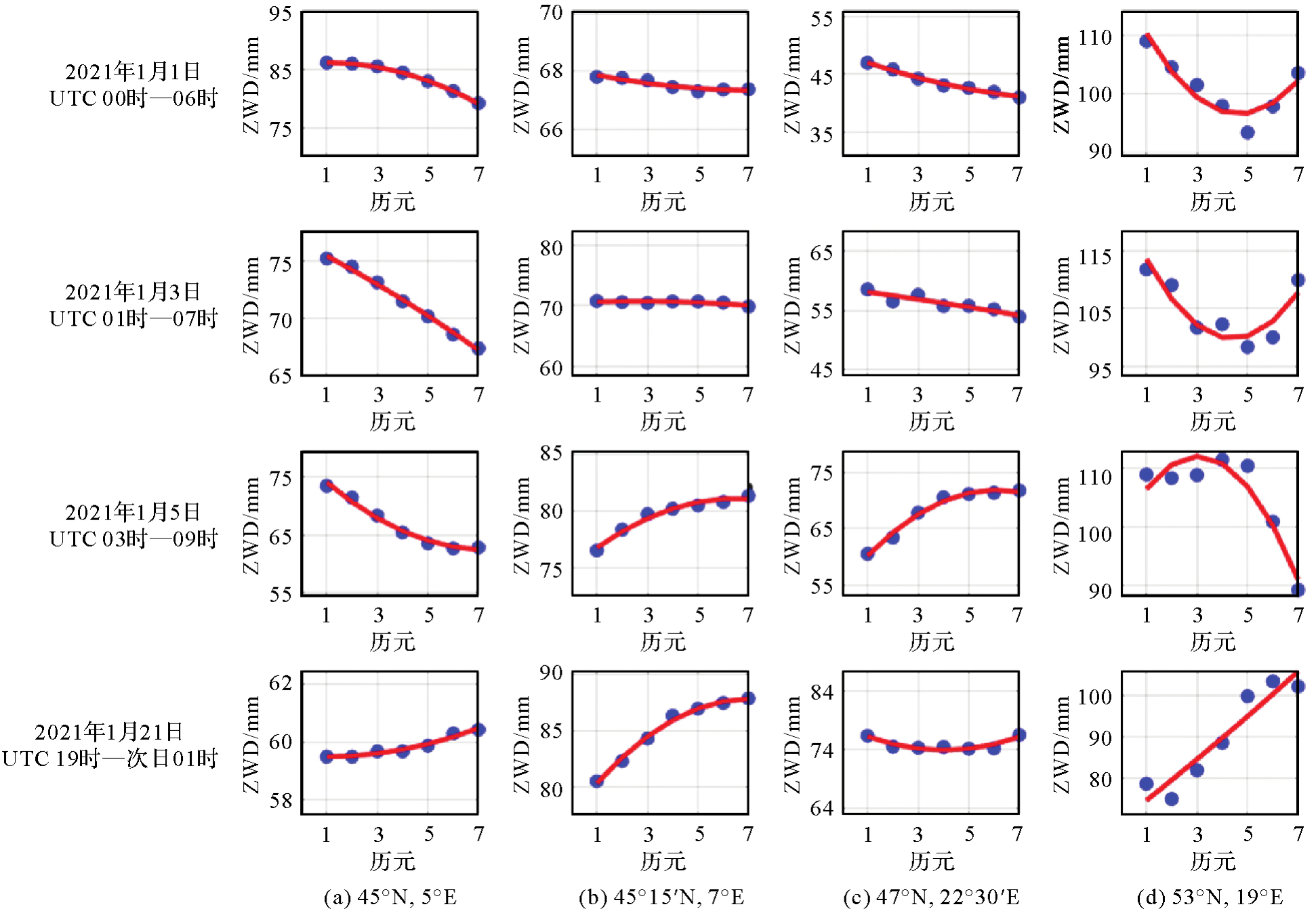
Fig. 2
Basic cell structure of ConvLSTM network[26]"
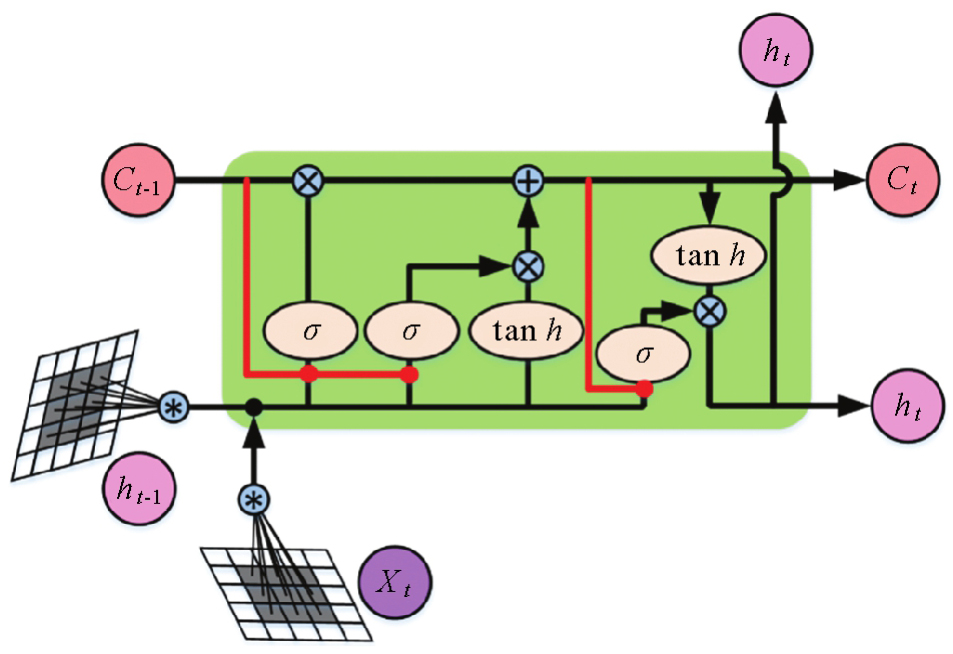
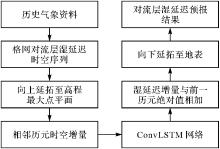
Fig. 3
ConvLSTM prediction process based on spatio-temporal increment"
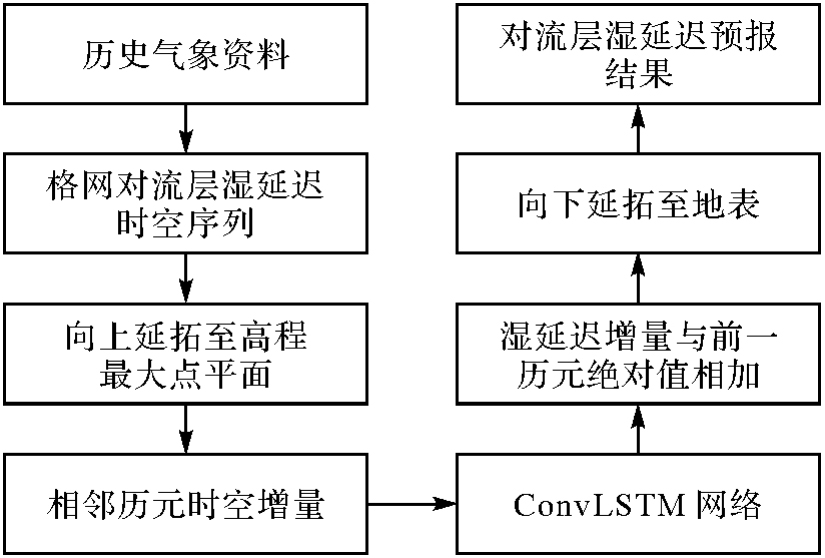
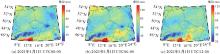
Fig. 4
ZWD in central Europe"

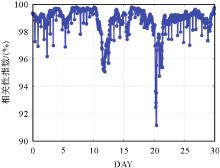
Fig. 5
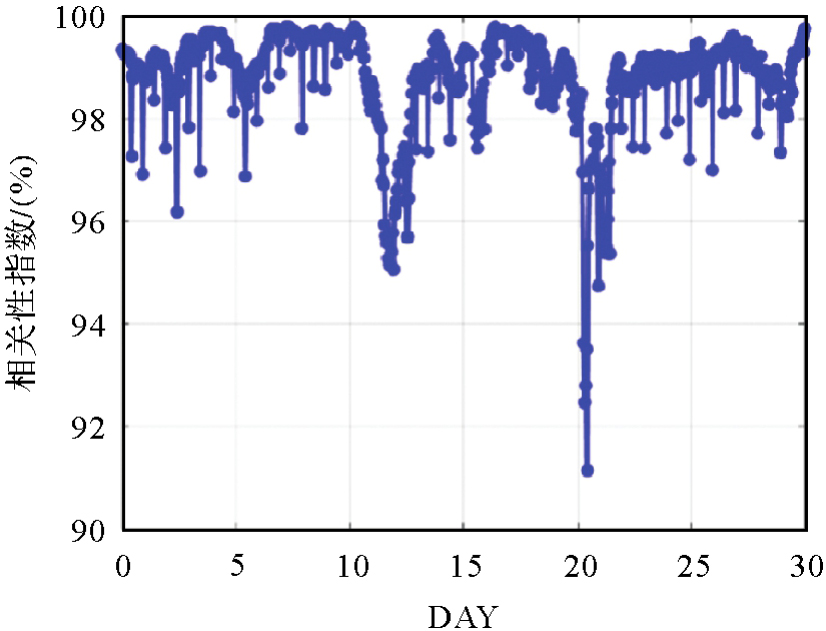
Correlation index of ZWD between adjacent epochs (1 hour resolution) in central Europe during January 1 to 30"
Tab. 1
Settings of ConvLSTM network"
| ConvLSTM参数 | 设置情况 | 备注 |
|---|---|---|
| 输入矩阵尺寸 | 41×81×7 | 前两维为ZWD格网尺寸,第三维为历史步长 |
| 输出矩阵尺寸 | 41×81×7 | 前两维为ZWD格网尺寸,第三维为预测步长 |
| 训练数据样本 | 前480个历元 | — |
| 测试数据样本 | 后240个历元 | — |
| 卷积核尺寸 | 3×3 | — |
| 激活函数 | ReLU | — |
| 优化器 | Adam | — |
| 损失函数 | MSE | — |
| 循环训练次数 | 50 | — |
| 时空增量策略 | 方法1:经典方法 | 方法1:无特殊设置 |
| 方法2:相邻历元作差 | 方法2:利用相邻历元差值作为ConvLSTM的输入信息 | |
| 方法3:延拓+相邻历元作差 | 方法3:将区域ZWD向上延拓至区域内最高点所在平面(根据试验区地形数据,最高点海拔为3114 m),作差后再输入ConvLSTM网络,对预测后的结果再向下延拓至地表 |
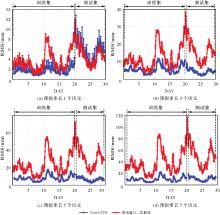
Fig. 6
RMS errors of sliding-window conic curve and ConvLSTM in experimental region"

Tab. 2
RMS errors calculated by sliding-window conic curve and ConvLSTM in experimental region"
| 方法 | 预报步长 | 最小值/mm | 最大值/mm | 平均值/mm | 标准差/mm |
|---|---|---|---|---|---|
| 滑动窗口二次曲线 | 1 | 1.4 | 12.0 | 4.7 | 2.1 |
| 3 | 5.1 | 38.1 | 15.6 | 6.8 | |
| 5 | 9.9 | 72.1 | 30.3 | 12.9 | |
| 7 | 17.0 | 116.6 | 49.0 | 20.5 | |
| 经典ConvLSTM | 1 | 0.8/2.1 | 4.4/12.8 | 1.8/5.5 | 0.7/1.9 |
| 3 | 2.4/1.8 | 11.9/9.2 | 5.6/4.2 | 2.3/1.4 | |
| 5 | 3.5/2.6 | 18.0/12.0 | 8.0/6.6 | 3.3/2.2 | |
| 7 | 4.5/4.9 | 22.7/18.9 | 10.1/10.7 | 4.0/3.4 |
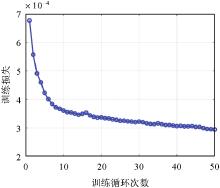
Fig. 7
Training loss curve of ConvLSTM"
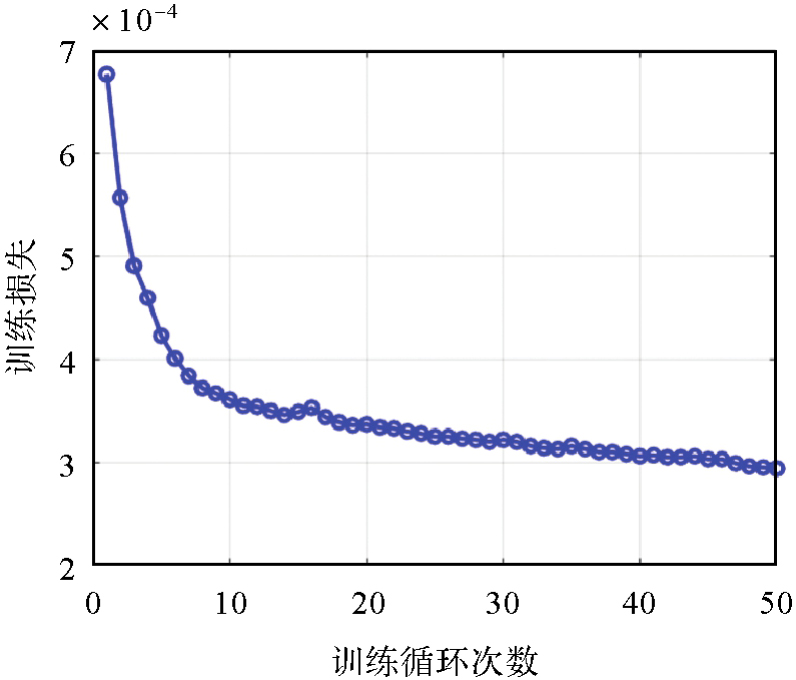
Fig. 8
Errors of the ConvLSTM method in predicting ZWD in experimental region"
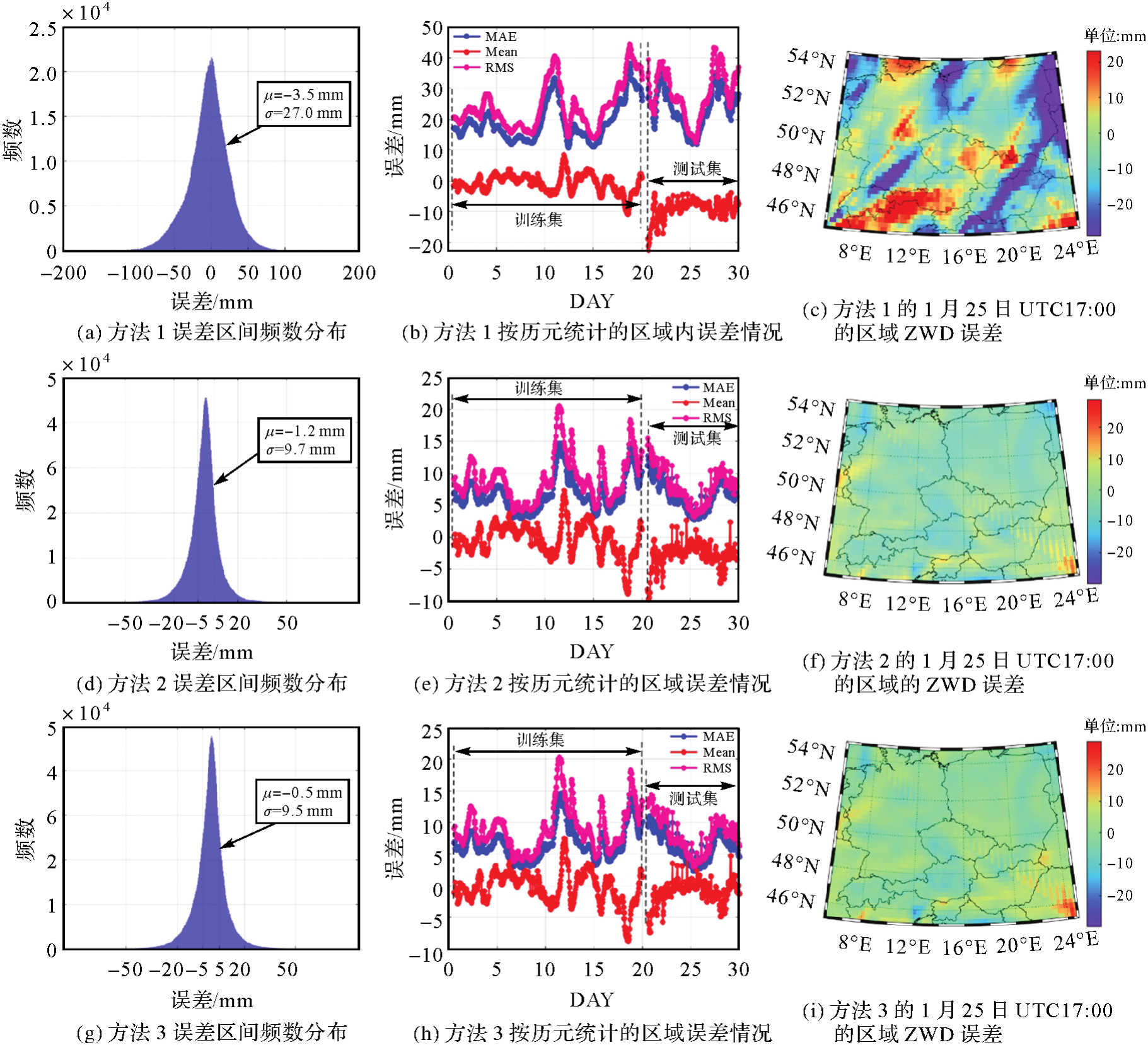
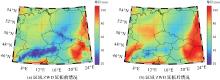
Fig. 9
Regional ZWD before and after continuation"

| [1] | BEVIS M, BUSINGER S, CHISWELL S, et al. GPS meteorology: mapping zenith wet delays onto precipitable water[J]. Journal of Applied Meteorology, 1994, 33(3): 379-386. |
| [2] | BOEHM J, WERI B, SCHUH H. Troposphere mapping functions for GPS and VLBI from ECMWF operational analysis data[J]. Journal of Geophysical Research: Solid Earth, 2006, 111(B2): 403-408. |
| [3] | 唐伟, 廖明生, 张丽, 等. 基于全球气象再分析资料的InSAR对流层延迟改正研究[J]. 地球物理学报, 2017, 60(2): 527-540. |
| TANG Wei, LIAO Mingsheng, ZHANG Li, et al. Study on InSAR tropospheric correction using global atmospheric reanalysis products[J]. Chinese Journal of Geophysics, 2017, 60(2): 527-540. | |
| [4] | DROŻDEWSKI M, SOŚNICA K. Tropospheric and range biases in satellite laser ranging[J]. Journal of Geodesy, 2021, 95(9): 100. |
| [5] | 周茂, 金涛勇, 姜卫平. 利用最优插值法改正宽刈幅高度计对流层湿延迟[J]. 武汉大学学报(信息科学版), 2023, 48(6): 911-918. |
| ZHOU Mao, JIN Taoyong, JIANG Weiping. Wet tropospheric correction of wide-swath altimeter by optimum interpolation method[J]. Geomatics and Information Science of Wuhan University, 2023, 48(6): 911-918. | |
| [6] | BOEHM J, SALSTEIN D, ALIZADEH M. Atmospheric effects in space geodesy[M]. Berlin: Springer-Verlag, 2013: 73-136. |
| [7] | FAN Haopeng, SUN Zhongmiao, ZHANG Liping, et al. A two-step estimation method of troposphere delay with consideration of mapping function errors[J]. Journal of Geodesy and Geoinformation Science, 2020, 3(1): 76-84. |
| [8] |
张小红, 胡家欢, 任晓东. PPP/PPP-RTK新进展与北斗/GNSS PPP定位性能比较[J]. 测绘学报, 2020, 49(9): 1084-1100. DOI: .
doi: 10.11947/j.AGCS.2020.20200328 |
|
ZHANG Xiaohong, HU Jiahuan, REN Xiaodong. New progress of PPP/PPP-RTK and positioning performance comparison of BDS/GNSS PPP[J]. Acta Geodaetica et Cartographica Sinica, 2020, 49(9): 1084-1100. DOI: .
doi: 10.11947/j.AGCS.2020.20200328 |
|
| [9] | 姚宜斌, 张良, 张琦, 等. 面向大高差RTK的对流层延迟改正模型及实时差分服务构建[J]. 武汉大学学报(信息科学版), 2023, 48(7): 1019-1028. |
| YAO Yibin, ZHANG Liang, ZHANG Qi, et al. Tropospheric delay model and real-time differencial service for large height difference RTK[J]. Geomatics and Information Science of Wuhan University, 2023, 48(7): 1019-1028. | |
| [10] | SCHÜLER T. The TropGrid2 standard tropospheric correction model[J]. GPS Solutions, 2014, 18(1): 123-131. |
| [11] | THAYER G D. A rapid and accurate ray tracing algorithm for a horizontally stratified atmosphere[J]. Radio Science, 1967, 2(2): 249-252. |
| [12] | LEANDRO R, SANTOS M, LANGLEY R. UNB neutral atmosphere models: development and performance[C]//Proceedingss of 2006 ION GNSS. Monterey: Institute of Navigation, 2006. |
| [13] | PENNA N, DODSON A, CHEN Wu. Assessment of EGNOS tropospheric correction model[J]. Journal of Navigation, 2001, 54(1): 37-55. |
| [14] | BÖHM J, MÖLLER G, SCHINDELEGGER M, et al. Development of an improved empirical model for slant delays in the troposphere (GPT2w)[J]. GPS Solutions, 2015, 19(3): 433-441. |
| [15] | LANDSKRON D, BÖHM J. VMF3/GPT3: refined discrete and empirical troposphere mapping functions[J]. Journal of Geodesy, 2018, 92(4): 349-360. |
| [16] | 李薇, 袁运斌, 欧吉坤, 等. 全球对流层天顶延迟模型IGGtrop的建立与分析[J]. 科学通报, 2012, 57(15): 1317-1325. |
| LI Wei, YUAN Yunbin, OU Jikun, et al. Establishment and analysis of global tropospheric zenith delay model IGGtrop[J]. Chinese Science Bulletin, 2012, 57(15): 1317-1325. | |
| [17] | 戴吾蛟, 陈招华, 梁铭. 高差对GPS大地高测量精度的影响[J]. 大地测量与地球动力学, 2009, 29(3): 80-83. |
| DAI Wujiao, CHEN Zhaohua, LIANG Ming. Effect of height difference on GPS vertical accuracy[J]. Journal of Geodesy and Geodynamics, 2009, 29(3): 80-83. | |
| [18] | 黄良珂, 陈华, 刘立龙, 等. 一种新的高精度全球对流层天顶延迟模型[J]. 地球物理学报, 2021, 64(3): 782-795. |
| HUANG Liangke, CHEN Hua, LIU Lilong, et al. A new high-precision global model for calculating zenith tropospheric delay[J]. Chinese Journal of Geophysics, 2021, 64(3): 782-795. | |
| [19] | 聂檄晨. 对流层天顶湿延迟模型及水汽反演应用研究[D]. 南京: 东南大学, 2020. |
| NIE Xichen. Study on tropospheric wet delay model and application of water vapor inversion[D]. Nanjing: Southeast University, 2020. | |
| [20] | HOPFIELD H S. Tropospheric effect on electromagnetically measured range: prediction from surface weather data[J]. Radio Science, 1971, 6(3): 357-367. |
| [21] | SAASTAMOINEN J. Contributions to the theory of atmospheric refraction[J]. Bulletin Géodésique, 1973, 6(3): 357-367. |
| [22] | DAVIS J L, HERRING T A, SHAPIRO I I, et al. Geodesy by radio interferometry: effects of atmospheric modeling errors on estimates of baseline length[J]. Radio Science, 1985, 20(6): 1593-1607. |
| [23] | XIA Pengfei, XIA Jingchao, YE Shirong, et al. A new method for estimating tropospheric zenith wet-component delay of GNSS signals from surface meteorology data[J]. Remote Sensing, 2020, 12(21): 3497. |
| [24] | YANG Fei, GUO Jiming, MENG Xiaolin, et al. Establishment and assessment of a zenith wet delay (ZWD) augmentation model[J]. GPS Solutions, 2021, 25: 148. |
| [25] | FAN Haopeng, LI Siran, SUN Zhongmiao, et al. Analysis of systematic biases in tropospheric hydrostatic delay models and construction of a correction model[J]. Geoscientific Model Development, 2023, 16(4): 1345-1358. |
| [26] | SHI Xingjian, CHEN Zhourong, WANG Hao, et al. Convolutional LSTM network: a machine learning approach for precipitation nowcasting[C]//Proceedings of the 28th International Conference on Neural Information Processing Systems. Cambridge: MIT Press, 2015: 802-810. |
| [27] | 黄启桥, 麦雄发, 李玲, 等. 基于ConvLSTM的广西短临降水预报[J]. 气象研究与应用, 2021, 42(4): 44-49. |
| HUANG Qiqiao, MAI Xiongfa, LI Ling, et al. Forecast of short-term precipitation in Guangxi based on ConvLSTM[J]. Journal of Meteorological Research and Application, 2021, 42(4): 44-49. | |
| [28] | LI Chen, FENG Yuan, SUN Tianying, et al. Long term Indian Ocean dipole (IOD) index prediction used deep learning by ConvLSTM[J]. Remote Sensing, 2022, 14(3): 523. |
| [29] | LUO Hanze, GONG Yingkui, CHEN Si, et al. Prediction of global ionospheric total electron content (TEC) based on SAM-ConvLSTM model[J]. Space Weather, 2023, 21(12): e2023SW003707. |
| [30] | 罗子聪. 基于深度学习的气象要素时空预测研究[D]. 南京: 南京信息工程大学, 2023. |
| LUO Zicong. Research on temporal and spatial prediction of meteorological elements based on deep learning[D]. Nanjing: Nanjing University of Information Science & Technology, 2023. | |
| [31] | XU Tianhe, LI Song, JIANG Nan. Zenith troposphere delay prediction based on BP neural network and least squares support vector machine[R]. [S.l.]: EGU General Assembly, 2020. |
| [32] | ZHENG Yuxin, LU Cuixian, WU Zhilu, et al. Machine learning-based model for real-time GNSS precipitable water vapor sensing[J]. Geophysical Research Letters, 2022, 49(3): e2021GL096408. |
| [33] | LI Song, XU Tianhe, XU Yan, et al. Forecasting GNSS zenith troposphere delay by improving GPT3 model with machine learning in Antarctica[J]. Atmosphere, 2022, 13(1): 78. |
| [34] | 许超钤. 实时高精度对流层关键参量建模及其应用研究[D]. 武汉: 武汉大学, 2017. |
| XU Chaoqian. Modeling and application of real-time high-accuracy troposphere key parameters[D]. Wuhan: Wuhan University, 2017. | |
| [35] | WANG Jungang, BALIDAKIS K, ZUS F, et al. Improving the vertical modeling of tropospheric delay[J]. Geophysical Research Letters, 2022, 49(5): e2021GL096732. |
| [36] | HOFMEISTER A. Determination of path delays in theatmosphere for geodetic VlBl by means of ray-tracing[D]. Vienna: Technische Universität Wien, 2016. |
| [37] | 范昊鹏. 新一代大地测量VLBI关键技术及应用研究[D]. 郑州: 信息工程大学, 2018. |
| FAN Haopeng. Research on key technologies and applications of the new-generation geodetic VLBI[D]. Zhengzhou: Information Engineering University, 2018. |
| [1] | LI Junyu, YAO Yibin, LIU Lilong, ZHANG Bao, HUANG Liangke, CAO Liying. A predicting ZWD model based on multi-source data and generalized regression neural network [J]. Acta Geodaetica et Cartographica Sinica, 2023, 52(9): 1492-1503. |
| [2] | DU Jiawei, WU Fang, ZHU Li, LIU Chengyi, WANG Andong. An ensemble learning simplification approach based on multiple machine-learning algorithms with the fusion using of raster and vector data and a use case of coastline simplification [J]. Acta Geodaetica et Cartographica Sinica, 2022, 51(3): 373-387. |
| [3] | WANG Chenhui, ZHAO Yijiu, GUO Wei, MENG Qingjia, LI Bin. Displacement prediction model of landslide based on ensemble empirical mode decomposition and support vector regression [J]. Acta Geodaetica et Cartographica Sinica, 2022, 51(10): 2196-2204. |
| [4] | XIAO Xiangwen, SHEN Xiaoyi, KE Changqing, ZHOU Xinghua. Comparison of machine learning algorithms based on Sentinel-1A data to detect icebergs [J]. Acta Geodaetica et Cartographica Sinica, 2020, 49(4): 509-521. |
| Viewed | ||||||
|
Full text |
|
|||||
|
Abstract |
|
|||||
