

Acta Geodaetica et Cartographica Sinica ›› 2025, Vol. 54 ›› Issue (9): 1608-1619.doi: 10.11947/j.AGCS.2025.20240323
• Geodesy and Navigation • Previous Articles Next Articles
Zhonghe LIU1( ), Zongchun LI1(), Hua HE1, Yinggang GUO2, Wenbin ZHAO3
Received:2024-08-12
Revised:2025-08-06
Online:2025-10-10
Published:2025-10-10
Contact:
Zongchun LI
E-mail:2936054806@qq.com;13838092876@139.com
About author:LIU Zhonghe (1995—), male, PhD, lecturer, majors in precision engineering surveying. E-mail: 2936054806@qq.com
Supported by:CLC Number:
Zhonghe LIU, Zongchun LI, Hua HE, Yinggang GUO, Wenbin ZHAO. A strategy for selecting quasi-stable points with a high breakdown point by integrating robust S-transform with K-means clustering[J]. Acta Geodaetica et Cartographica Sinica, 2025, 54(9): 1608-1619.
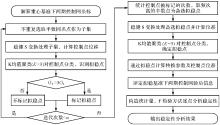
Fig. 1
Stability analysis process of control network"
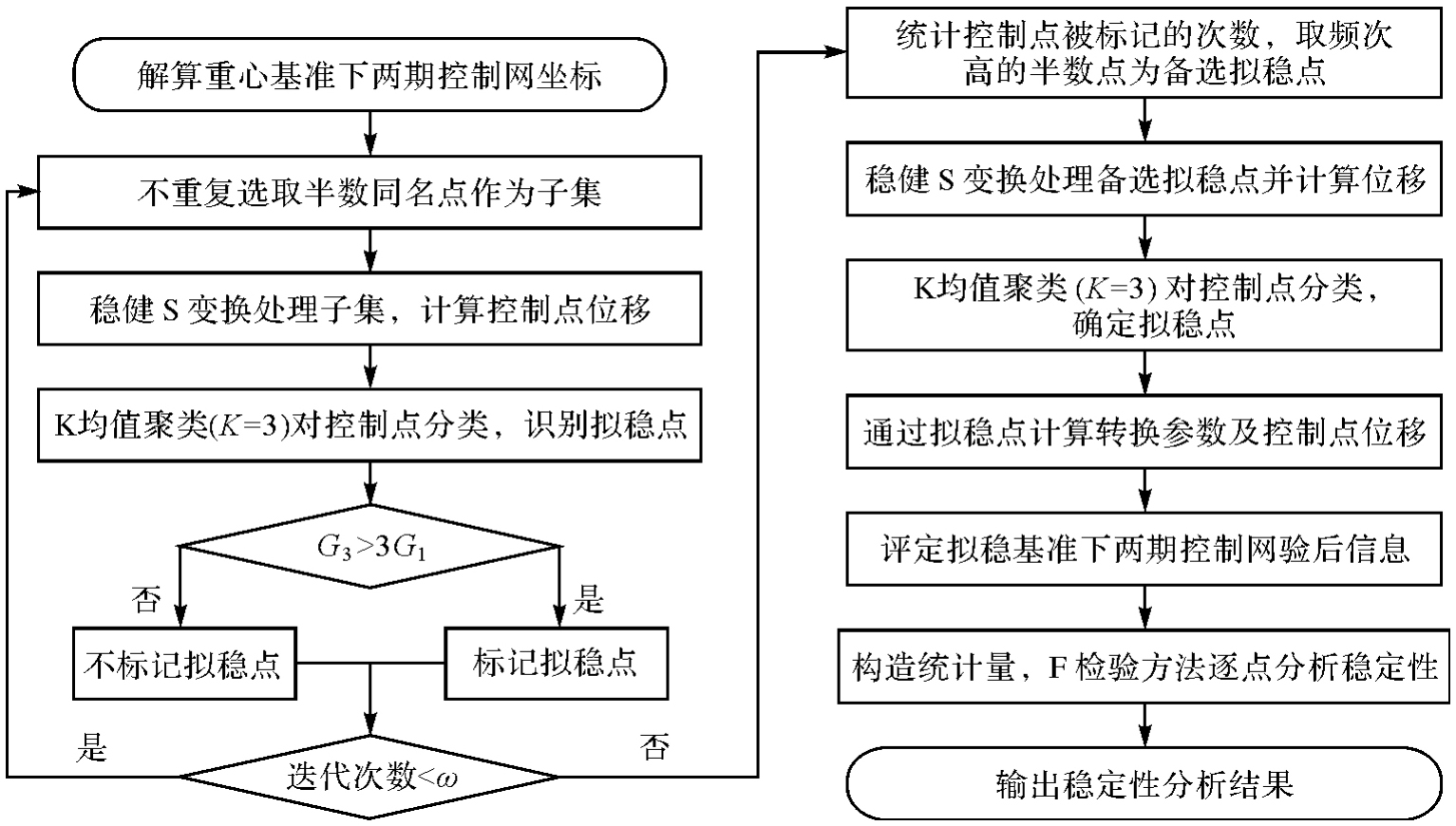
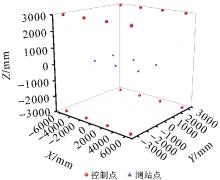
Fig. 2
Simulation experiment scenario"

Tab. 1
Coordinates of control points and survey stations"
| 点名/测站名 | X | Y | Z |
|---|---|---|---|
| Station1 | -4 000.000 | 1 000.000 | 0.000 |
| Station2 | 0.000 | 1 000.000 | 0.000 |
| Station3 | 4 000.000 | 1 000.000 | 0.000 |
| Station4 | -4 000.000 | -1 000.000 | 0.000 |
| Station5 | 0.000 | -1 000.000 | 0.000 |
| Station6 | 4 000.000 | -1 000.000 | 0.000 |
| A1 | -6 000.000 | 3 000.000 | 3 000.000 |
| A2 | -2 000.000 | 3 000.000 | 3 000.000 |
| A3 | 2 000.000 | 3 000.000 | 3 000.000 |
| A4 | 6 000.000 | 3 000.000 | 3 000.000 |
| A5 | -6 000.000 | -3 000.000 | 3 000.000 |
| A6 | -2 000.000 | -3 000.000 | 3 000.000 |
| A7 | 2 000.000 | -3 000.000 | 3 000.000 |
| A8 | 6 000.000 | -3 000.000 | 3 000.000 |
| A9 | -6 000.000 | 3 000.000 | -3 000.000 |
| A10 | -2 000.000 | 3 000.000 | -3 000.000 |
| A11 | 2 000.000 | 3 000.000 | -3 000.000 |
| A12 | 6 000.000 | 3 000.000 | -3 000.000 |
| A13 | -6 000.000 | -3 000.000 | -3 000.000 |
| A14 | -2 000.000 | -3 000.000 | -3 000.000 |
| A15 | 2 000.000 | -3 000.000 | -3 000.000 |
| A16 | 6 000.000 | -3 000.000 | -3 000.000 |
Tab. 2
Simulate the deformation of control points"
| 点名 | 方案② | 方案③ | 方案④ | 方案⑤ | 方案⑥ | ||||||||||
|---|---|---|---|---|---|---|---|---|---|---|---|---|---|---|---|
| X | Y | Z | X | Y | Z | X | Y | Z | X | Y | Z | X | Y | Z | |
| A1 | 0.000 | 0.000 | 0.000 | 0.000 | 0.000 | 0.300 | 0.100 | 0.000 | 0.000 | 0.000 | 0.000 | 0.300 | 0.000 | 0.000 | 0.000 |
| A2 | 0.000 | 0.000 | 0.000 | 0.100 | 0.000 | 0.000 | 0.100 | 0.000 | 0.000 | 0.000 | 0.000 | 0.300 | 0.000 | 0.000 | 0.000 |
| A3 | 0.500 | 0.000 | 0.000 | 0.000 | 0.000 | 0.000 | 0.000 | 0.000 | 0.000 | 0.000 | 0.000 | 0.000 | 0.000 | 0.000 | 0.300 |
| A4 | 0.000 | 0.000 | 0.000 | 0.000 | 0.000 | 0.000 | 0.100 | 0.000 | 0.000 | 0.000 | 0.000 | 0.300 | 0.000 | 0.000 | 0.000 |
| A5 | 0.000 | 0.000 | 0.000 | 0.000 | 0.000 | 0.200 | 0.000 | 0.000 | 0.000 | 0.000 | 0.000 | 0.000 | 0.000 | 0.000 | 0.300 |
| A6 | 0.000 | 0.000 | 0.000 | 0.000 | 0.000 | 0.000 | 0.100 | 0.000 | 0.000 | 0.000 | 0.000 | 0.300 | 0.000 | 0.000 | 0.000 |
| A7 | 0.000 | 0.100 | 0.000 | 0.000 | 0.100 | 0.000 | 0.000 | 0.000 | 0.300 | 0.000 | 0.000 | 0.300 | 0.000 | 0.000 | 0.000 |
| A8 | 0.000 | 0.000 | 0.000 | 0.400 | 0.000 | 0.000 | 0.000 | 0.000 | 0.000 | 0.000 | 0.000 | 0.000 | 0.000 | 0.000 | 0.300 |
| A9 | 0.000 | 0.000 | 0.000 | 0.000 | 0.000 | 0.000 | 0.000 | 0.000 | 0.300 | 0.000 | 0.000 | 0.300 | 0.000 | 0.000 | 0.000 |
| A10 | 0.000 | 0.000 | 0.000 | 0.300 | 0.000 | 0.000 | 0.000 | 0.000 | 0.300 | 0.000 | 0.000 | 0.300 | 0.000 | 0.000 | 0.000 |
| A11 | 0.000 | 0.000 | 0.500 | 0.000 | 0.000 | 0.000 | 0.000 | 0.000 | 0.300 | 0.000 | 0.000 | 0.300 | 0.000 | 0.000 | 0.000 |
| A12 | 0.000 | 0.000 | 0.000 | 0.000 | 0.000 | 0.000 | 0.000 | 0.000 | 0.000 | 0.000 | 0.000 | 0.000 | 0.000 | 0.000 | 0.300 |
| A13 | 0.000 | 0.000 | 0.000 | 0.000 | 0.000 | 0.000 | 0.000 | 0.000 | 0.000 | 0.000 | 0.000 | 0.000 | 0.000 | 0.000 | 0.300 |
| A14 | 0.000 | 0.000 | 0.000 | 0.000 | 0.500 | 0.000 | 0.000 | 0.000 | 0.300 | 0.000 | 0.000 | 0.300 | 0.000 | 0.000 | 0.000 |
| A15 | 0.000 | 0.000 | 0.000 | 0.100 | 0.000 | 0.000 | 0.100 | 0.000 | 0.000 | 0.000 | 0.000 | 0.300 | 0.000 | 0.000 | 0.000 |
| A16 | 0.100 | 0.000 | 0.000 | 0.000 | 0.000 | 0.000 | 0.000 | 0.000 | 0.000 | 0.000 | 0.000 | 0.000 | 0.000 | 0.000 | 0.300 |
Tab. 3
The proportion of stable points in the candidate quasi-stable points"
| 方案 | 方案① | 方案② | 方案③ | 方案④ | 方案⑤ | 方案⑥ |
|---|---|---|---|---|---|---|
| 比例 | 100 | 100 | 100 | 75 | 0 | 100 |
Tab. 4
Results of deformation point judgment using different methods"
| 方案 | TST模型 | IWST模型 | RANSAC_ST模型 | SMST模型 | 本文方法 | |||||
|---|---|---|---|---|---|---|---|---|---|---|
| τ1 | τ2 | τ1 | τ2 | τ1 | τ2 | τ1 | τ2 | τ1 | τ2 | |
| 方案① | 1.0 | 1.0 | 1.0 | 1.0 | 1.0 | 1.0 | 1.0 | 1.0 | 1.0 | 1.0 |
| 方案② | 0.3 | 1.0 | 1.0 | 1.0 | 1.0 | 1.0 | 1.0 | 1.0 | 1.0 | 1.0 |
| 方案③ | 0.8 | 1.0 | 1.0 | 1.0 | 1.0 | 1.0 | 0.7 | 1.0 | 1.0 | 1.0 |
| 方案④ | 0.6 | 1.0 | 0.9 | 1.0 | 0.8 | 1.0 | 0.7 | 0.9 | 1.0 | 1.0 |
| 方案⑤ | 0.6 | 1.0 | 0.0 | 0.0 | 0.0 | 0.0 | 0.0 | 0.0 | 0.0 | 0.0 |
| 方案⑥ | 0.6 | 1.0 | 1.0 | 1.0 | 1.0 | 1.0 | 1.0 | 1.0 | 1.0 | 1.0 |
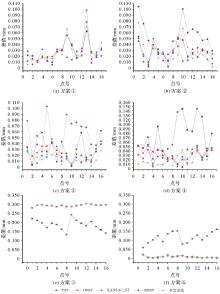
Fig. 3
The difference between the displacement of the control point and the design value"
Tab. 5
Root mean square values of difference between the displacement of the control point and the design value"
| 方案 | TST模型 | IWST模型 | RANSAC_ST模型 | SMST模型 | 本文方法 |
|---|---|---|---|---|---|
| 方案① | 0.008 | 0.008 | 0.008 | 0.008 | 0.008 |
| 方案② | 0.014 | 0.008 | 0.008 | 0.007 | 0.008 |
| 方案③ | 0.009 | 0.007 | 0.006 | 0.015 | 0.004 |
| 方案④ | 0.022 | 0.008 | 0.009 | 0.010 | 0.006 |
| 方案⑤ | 0.188 | 0.294 | 0.294 | 0.294 | 0.294 |
| 方案⑥ | 0.118 | 0.009 | 0.008 | 0.008 | 0.009 |
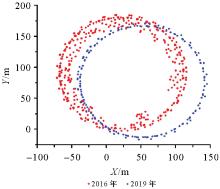
Fig. 4
Plane distribution of two epoch control network"
Tab. 6
Adjustment result statistics"
| 年份 | 测站数 | 控制点数 | 中误差/(″) | 自由度 |
|---|---|---|---|---|
| 2016 | 43 | 401 | 1.2 | 1341 |
| 2019 | 41 | 166 | 1.7 | 990 |
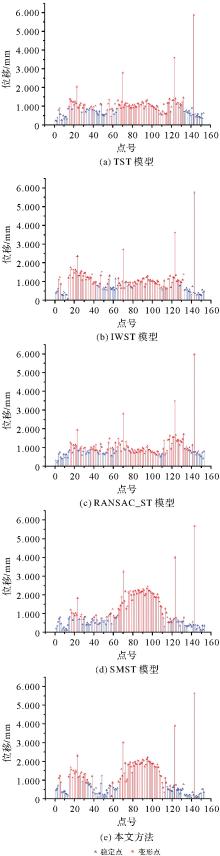
Fig. 5
Displacement of control points"

Tab. 7
Results of deformation analysis using different methods"
| 方法 | 拟稳点数 | 判别的稳定点数 | 判别的变形点数 | 最大变形量/mm | 变形点位移的均方根值/mm | 稳定点位移的均方根值/mm |
|---|---|---|---|---|---|---|
| TST模型 | 153 | 63 | 90 | 5.849 | 1.315 | 0.648 |
| IWST模型 | 149 | 51 | 102 | 5.760 | 1.321 | 0.573 |
| RANSAC_ST模型 | 109 | 55 | 98 | 5.972 | 1.292 | 0.678 |
| SMST模型 | 103 | 77 | 76 | 5.667 | 1.841 | 0.522 |
| 本文方法 | 90 | 75 | 78 | 5.607 | 1.735 | 0.464 |
Tab. 8
Results of deformation point judgment using different methods"
| 判断依据 | TST模型 | IWST模型 | RANSAC_ST模型 | SMST模型 | 本文方法 |
|---|---|---|---|---|---|
| τ1 | 0.7 | 0.7 | 0.6 | 0.8 | 1.0 |
| τ2 | 0.9 | 0.9 | 0.8 | 0.8 | 1.0 |
| [1] | 王穗辉. 变形数据处理、分析及预测方法若干问题研究[D]. 上海: 同济大学, 2007. |
| WANG Suihui. Research on several problems in deformation data processing, analysis and prediction[D]. Shanghai: Tongji University, 2007. | |
| [2] | 陶本藻. 自由网平差与变形分析[M]. 武汉: 武汉测绘科技大学出版社, 2001. |
| TAO Benzao. Free network adjustment and deformation analysis[M]. Wuhan: Wuhan University of Surveying and Mapping Press, 2001. | |
| [3] | CASPARY W F, HAEN W, BORUTTA H. Deformation analysis by statistical methods[J]. Technometrics, 1990, 32(1): 49-57. |
| [4] | VELSINK H. On the deformation analysis of point fields[J]. Journal of Geodesy, 2015, 89(11): 1071-1087. |
| [5] | AYDIN C. Effects of displaced reference points on deformation analysis[J]. Journal of Surveying Engineering, 2017, 143(3): 04017001. |
| [6] | MANWILLER P E. Three-dimensional network adjustment of laser tracker measurements for large-scale metrology applications[J]. Journal of Surveying Engineering, 2021, 147: 05020009. |
| [7] | 郭迎钢, 李宗春, 刘忠贺, 等. 加速器隧道控制网变形可监测性及稳定性分析[J]. 原子能科学技术, 2019, 53(9): 1634-1642. |
| GUO Yinggang, LI Zongchun, LIU Zhonghe, et al. Deformation detectability and stability analysis for tunnel control network of particle accelerator[J]. Atomic Energy Science and Technology, 2019, 53(9): 1634-1642. | |
| [8] | 姚宜斌, 黄承猛, 李程春, 等. 一种适用于大角度的三维坐标转换参数求解算法[J]. 武汉大学学报(信息科学版), 2012, 37(3): 253-256. |
| YAO Yibin, HUANG Chengmeng, LI Chengchun, et al. A new algorithm for solution of transformation parameters of big rotation angle's 3D coordinate[J]. Geomatics and Information Science of Wuhan University, 2012, 37(3): 253-256. | |
| [9] | 周江文, 黄幼才, 杨元喜, 等. 抗差最小二乘法[M]. 武汉: 华中理工大学出版社, 1997. |
| ZHOU Jiangwen, HUANG Youcai, YANG Yuanxi, et al. Robust least squares method[M]. Wuhan: Huazhong University of Science and Technology Press, 1997. | |
| [10] | YANG Y. Robust estimation of geodetic datum transformation[J]. Journal of Geodesy, 1999, 73(5): 268-274. |
| [11] | 欧吉坤. 粗差的拟准检定法(QUAD法)[J]. 测绘学报, 1999, 28(1): 15-20. |
| OU Jikun. Quasi accurate detection of gross errors (QUAD)[J]. Acta Geodaetica et Cartographica Sinica, 1999, 28(1): 15-20. | |
| [12] | ROUSSEEUW P J, HUBERT M. Robust statistics for outlier detection[J]. Wiley Interdisciplinary Reviews: Data Mining and Knowledge Discovery, 2011, 1(1): 73-79. |
| [13] | CHEN Y. Analysis of deformation surveys-a generalized method[D]. Fredericton: University of New Brunswick, 1983. |
| [14] | CHEN Y Q, CHRZANOWSKI A, SECORD J M. A strategy for the analysis of the stability of reference points in deformation surveys[J]. CISM Journal, 1990, 44(2): 141-149. |
| [15] | 周江文, 陶本藻, 庄昆元, 等. 拟稳平差论文集[M]. 北京: 测绘出版社, 1987. |
| ZHOU Jiangwen, TAO Benzao, ZHUANG Kunyuan, et al. Collection of papers on quasi stable adjustment[M]. Beijing: Surveying and Mapping Press, 1987. | |
| [16] | 周江文, 欧吉坤. 名次法及拟稳点的选定[J]. 测绘学报, 1987, 16(2): 88-94. |
| ZHOU Jiangwen, OU Jikun. The method of order andselection of quasi-stable points[J]. Acta Geodaetica et Cartographic Sinica, 1987, 16(2): 88-94. | |
| [17] | DUCHNOWSKI R. Median-based estimates and their application in controlling reference mark stability[J]. Journal of Surveying Engineering, 2010, 136(2): 47-52. |
| [18] | NOWEL K, KAMISKI W. Robust estimation of deformation from observation differences for free control networks[J]. Journal of Geodesy, 2014, 88(8): 749-764. |
| [19] | NOWEL K. Investigating efficacy of robust M-estimation of deformation from observation differences[J]. Survey Review, 2016, 48(346): 21-30. |
| [20] | AMIRI-SIMKOOEI A R, ALAEI-TABATABAEI S M, ZANGENEH-NEJAD F, et al. Stability analysis of deformation-monitoring network points using simultaneous observation adjustment of two epochs[J]. Journal of Surveying Engineering, 2017, 143: 04016020. |
| [21] | 刘忠贺, 李宗春, 郭迎钢, 等. 结合RANSAC算法与传统相似变换模型的稳定性分析[J]. 测绘工程, 2021, 30(5): 43-48, 57. |
| LIU Zhonghe, LI Zongchun, GUO Yinggang, et al. Stability analysis method of combining RANSAC algorithm and traditional similar transformation model[J]. Engineering of Surveying and Mapping, 2021, 30(5): 43-48, 57. | |
| [22] | WIŚNIEWSKI Z. Estimation of parameters in a split functional model of geodetic observations (Msplit estimation)[J]. Journal of Geodesy, 2009, 83(2): 105-120. |
| [23] | WIŚNIEWSKI Z. Msplit(q) estimation: estimation of parameters in a multi split functional model of geodetic observations[J]. Journal of Geodesy, 2010, 84(6): 355-372. |
| [24] | DUCHNOWSKI R, WIŚNIEWSKI Z. Estimation of the shift between parameters of functional models of geodetic observations by applying Msplit estimation[J]. Journal of Surveying Engineering, 2012, 138(1): 1-8. |
| [25] | ZIENKIEWICZ M H. Application of Msplit estimation to determine control points displacements in networks with unstable reference system[J]. Survey Review, 2015, 47(342): 174-180. |
| [26] | ZIENKIEWICZ M H. Deformation analysis of geodetic networks by applying Msplit estimation with conditions binding the competitive parameters[J]. Journal of Surveying Engineering, 2019, 145(2): 04019001. |
| [27] | NOWEL K. Squared Msplit (q) S-transformation of control network deformations[J]. Journal of Geodesy, 2019, 93(7): 1025-1044. |
| [28] |
郭迎钢, 李宗春, 何华, 等. 变形监测网稳定点选取的平方型Msplit相似变换法[J]. 测绘学报, 2020, 49(11): 1419-1429. DOI: .
doi: 10.11947/j.AGCS.2020.20200023 |
|
GUO Yinggang, LI Zongchun, HE Hua, et al. A squared Msplit similarity transformation method for stable points selection of deformation monitoring network[J]. Acta Geodaetica et Cartographica Sinica, 2020, 49(11): 1419-1429. DOI: .
doi: 10.11947/j.AGCS.2020.20200023 |
|
| [29] | 何选森, 何帆, 徐丽, 等. K-Means算法最优聚类数量的确定[J]. 电子科技大学学报, 2022, 51(6): 904-912. |
| HE Xuansen, HE Fan, XU Li, et al. Determination of the optimal number of clusters in K-means algorithm[J]. Journal of University of Electronic Science and Technology of China, 2022, 51(6): 904-912. | |
| [30] | 张文君, 顾行发, 陈良富, 等. 基于均值-标准差的K均值初始聚类中心选取算法[J]. 遥感学报, 2006, 10(5): 715-721. |
| ZHANG Wenjun, GU Xingfa, CHEN Liangfu, et al. An algorithm for initilizing of K-means clustering based on mean-standard deviation[J]. Journal of Remote Sensing, 2006, 10(5): 715-721. | |
| [31] | ROUSSEEUW P J. Least median of squares regression[J]. Journal of the American Statistical Association, 1984, 79(388): 871-880. |
| [32] | YANG Ling, SHEN Yunzhong, LI Bofeng. M-estimation using unbiased median variance estimate[J]. Journal of Geodesy, 2019, 93(6): 911-925. |
| [33] | ZHANG Xudong, CHEN Wenjun, ZHANG Xiaodong, et al. The deformation analysis of the 3D alignment control network based on the multiple congruence models[J]. Journal of Geodesy and Geoinformation Science, 2023, 6(2): 21-31. |
| [34] | ZHU Jianjun, WANG Leyang, HU Jun, et al. Recent advances in the geodesy data processing[J]. Journal of Geodesy and Geoinformation Science, 2023, 6(3): 33-45. |
| [35] | 杨玲, 沈云中, 楼立志. 基于中位参数初值的等价权抗差估计方法[J]. 测绘学报, 2011, 40(1): 28-32. |
| YANG Ling, SHEN Yunzhong, LOU Lizhi. Equivalent weight robust estimation method based on median parameter estimates[J]. Acta Geodaetica et Cartographica Sinica, 2011, 40(1): 28-32. |
| [1] | LING Qing, ZHANG Qin, ZHANG Jing, QU Wei, KONG Lingjie, ZHU Li, ZHANG Jinhui. Stability evaluation of Dangchuan loess landslide in Heifangtai based on integration of engineering geological data and GNSS high-precision monitoring information [J]. Acta Geodaetica et Cartographica Sinica, 2022, 51(10): 2226-2238. |
| [2] | WANG Huixian, JIN Huijia, WANG Jiaolong, JIANG Wanshou. Optimization Approach for Multi-scale Segmentation of Remotely Sensed Imagery under k-means Clustering Guidance [J]. Acta Geodaetica et Cartographica Sinica, 2015, 44(5): 526-532. |
| Viewed | ||||||
|
Full text |
|
|||||
|
Abstract |
|
|||||
