

Acta Geodaetica et Cartographica Sinica ›› 2025, Vol. 54 ›› Issue (9): 1572-1582.doi: 10.11947/j.AGCS.2025.20250181
• Geodesy and Navigation • Previous Articles Next Articles
Zhen LI1,2( ), Zhenghang HE1,3, Chuang SHI1,2,3
Received:2025-05-16
Revised:2025-07-29
Online:2025-10-10
Published:2025-10-10
About author:LI Zhen (1989—), male, PhD, assistant researcher, majors in spacecraft orbital dynamics, precise orbit determination, space debris, et al. E-mail: hpulizhen@163.com
Supported by:CLC Number:
Zhen LI, Zhenghang HE, Chuang SHI. A high-degree gravitational potential and gradient calculation method without singularities[J]. Acta Geodaetica et Cartographica Sinica, 2025, 54(9): 1572-1582.
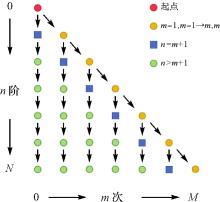
Fig. 1
The recursive relationship of different orders"
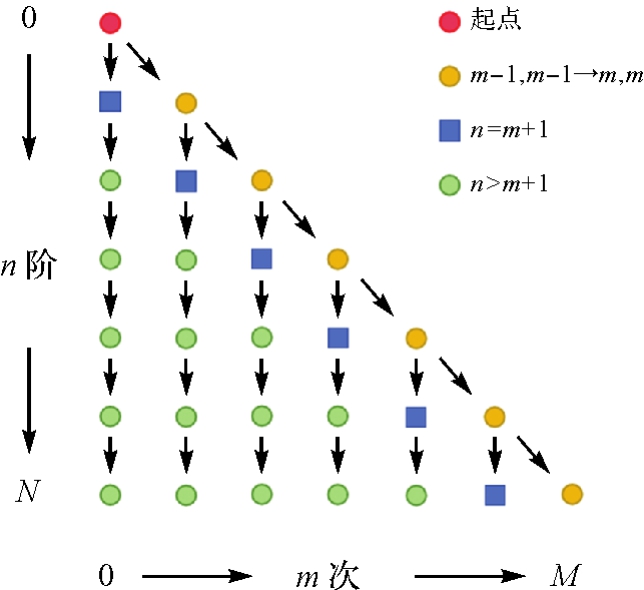
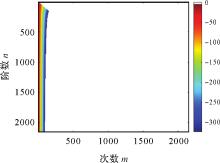
Fig. 2
Distribution of Snm magnitude under CM method"
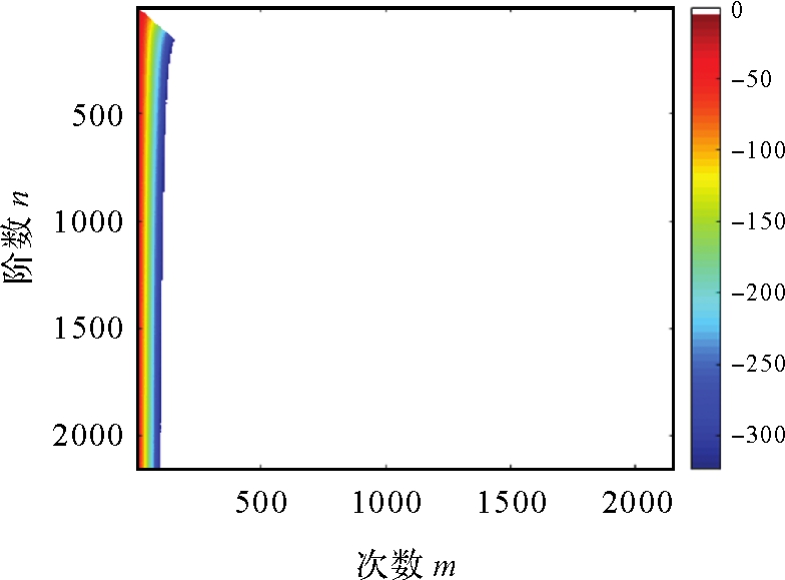
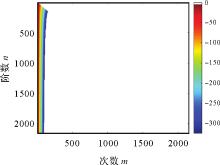
Fig. 3
Distribution of Cnm magnitude under CM method"

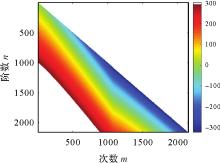
Fig. 4
Distribution of Snm magnitude under improved CM method"

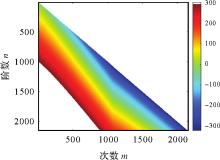
Fig. 5
Distribution of Cnm magnitude under improved CM method"

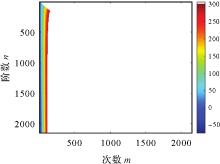
Fig. 6
Anm value of CM method overflow/underflow (under IEEE double precision, when φ=15°)"
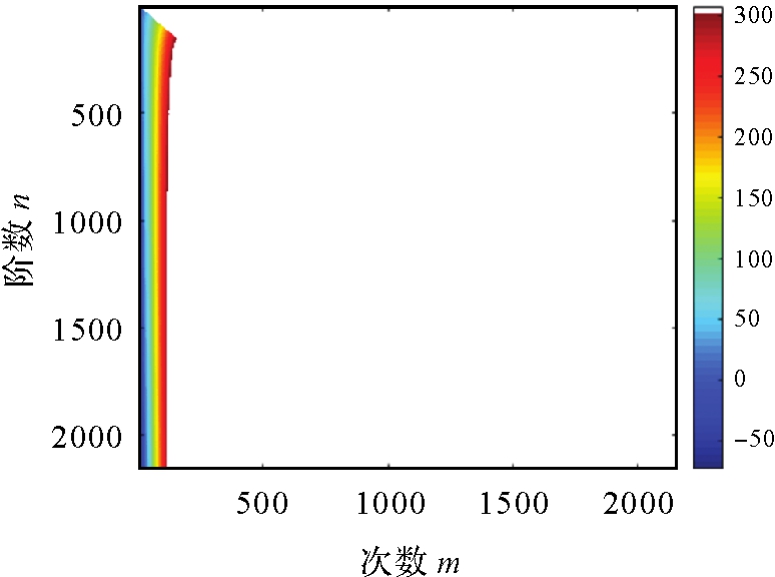
Fig. 7
Anm value of improved CM method overflow/underflow (under IEEE double precision, when φ=15°)"
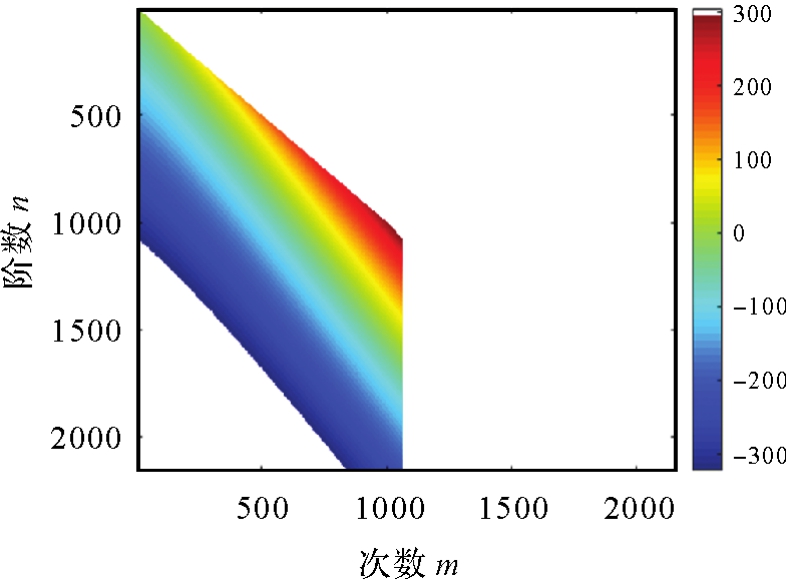
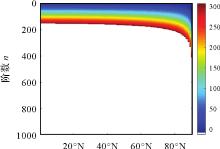
Fig. 8
The overflow of CM method at different latitudes under IEEE double precision condition"
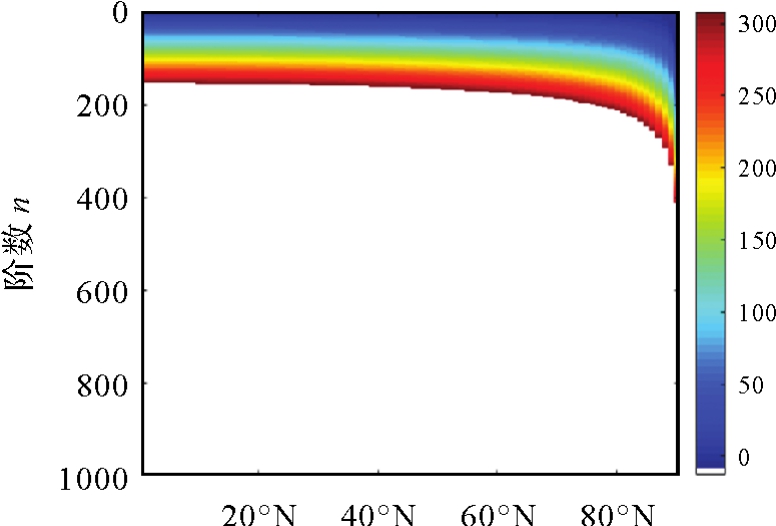
Fig. 9
The overflow of improved CM method at different latitudes under IEEE double precision condition"
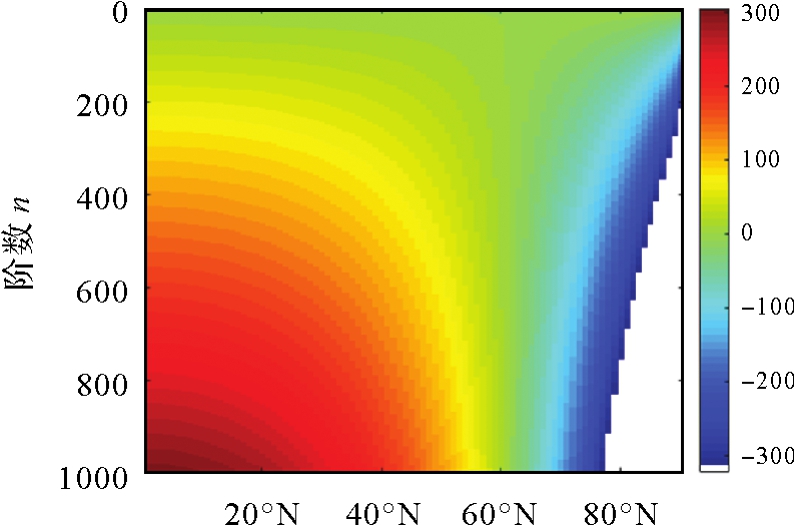
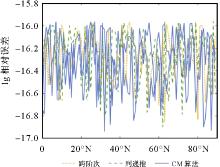
Fig. 10
Comparison of relative errors of gravitational potential with 800 order"

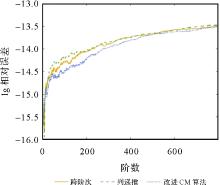
Fig. 11
The relative errors of gravitational potential of different degrees of sectorial harmonic terms"


Fig. 12
The relative errors of gravitational potential of different degrees with zonal harmonic terms"
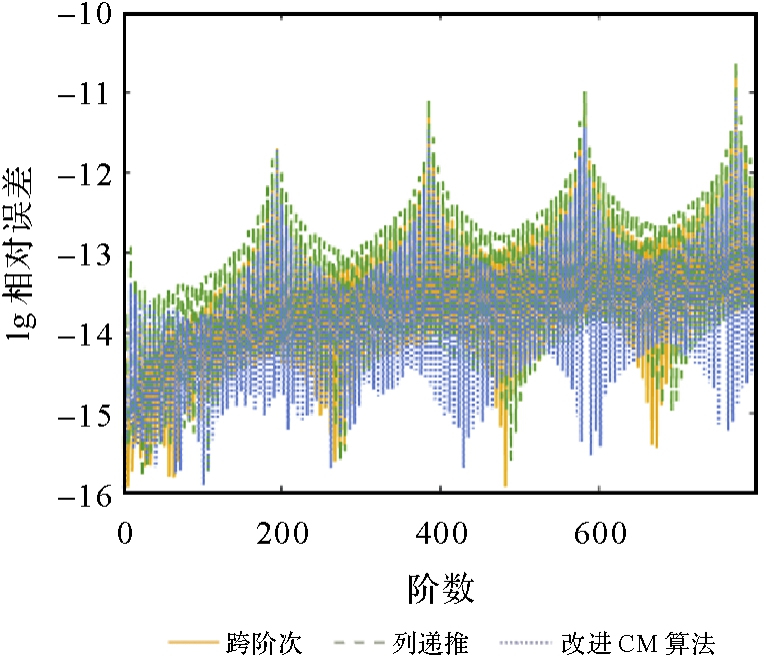
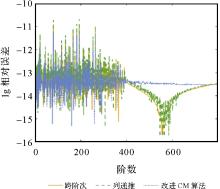
Fig. 13
The relative errors of gravitational potential for different orders of the 800th-degree tesseral harmonic terms"

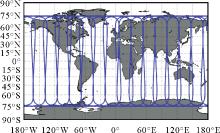
Fig. 14
Subsatellite ground tracks of GRACE-FO(C) satellites on 1 June 2025"

Tab. 1
Comparison of computation time for four recursive methods"
| 计算内容 | 格网数据U | 格网数据 | 轨道数据U | 轨道数据 |
|---|---|---|---|---|
| 改进CM算法 | 1.51 | 2.59 | 1.47 | 2.66 |
| 跨阶次递推法 | 1.76 | 2.88 | 1.82 | 2.83 |
| CM算法 | 2.42 | 3.71 | 2.44 | 3.65 |
| 标准列递推法 | 2.37 | 3.96 | 2.43 | 4.01 |
| [1] | 温生林. 超低轨道卫星动力学建模与控制方法研究[D]. 长沙: 国防科学技术大学, 2016. |
| WEN Shenglin. Research on dynamics modeling and control methods for ultra-low orbit satellites[D]. Changsha: National University of Defense Technology, 2016. | |
| [2] | 陈喆, 卞鸿巍, 林泓一, 等. 惯性导航重力扰动影响与补偿方法综析[J]. 导航定位学报, 2025, 13(2): 28-36. |
| CHEN Zhe, BIAN Hongwei, LIN Hongyi, et al. Comprehensive analysis of gravity disturbance impact and compensation methods in inertial navigation systems[J]. Journal of Navigation and Positioning, 2025, 13(2): 28-36. | |
| [3] | 朱宏堡, 田野, 严恭敏, 等. 基于重力模型阶次自适应的实时重力补偿系统研究[J]. 导航定位与授时, 2024, 11(4): 55-64. |
| ZHU Hongbao, TIAN Ye, YAN Gongmin, et al. Research on real-time gravity compensation system based on gravity model order adaptation[J]. Navigation Positioning and Timing, 2024, 11(4): 55-64. | |
| [4] | 宁津生, 王正涛. 地球重力场研究现状与进展[J]. 测绘地理信息, 2013, 38(1): 1-7. |
| NING Jinsheng, WANG Zhengtao. Progress and present status of research on Earth's gravitational field[J]. Journal of Geomatics, 2013, 38(1): 1-7. | |
| [5] | PAVLIS N K, HOLMES S A, KENYON S C, et al. The development and evaluation of the Earth gravitational model 2008 (EGM2008)[J]. Journal of Geophysical Research: Solid Earth, 2012, 117(B4): 1-38. |
| [6] | KOSTELECKÝ J, KLOKOĞNÍK J, BUCHA B, et al. Evaluation of gravity field model EIGEN-6C4 by means of various functions of gravity potential, and by GNSS/levelling[J]. Geoinformatics FCE CTU, 2015, 14(1): 7-28. |
| [7] | 夏哲仁, 石磐, 李迎春. 高分辨率区域重力场模型DQM2000[J]. 武汉大学学报(信息科学版), 2003, 28(S1): 124-128. |
| XIA Zheren, SHI Pan, LI Yingchun. A new series of high resolution Earth's gravity field models DQM2000[J]. Geomatics and Information Science of Wuhan University, 2003, 28(S1): 124-128. | |
| [8] | RHEE N, BANI-YAGHOUB M, LEIBSLE F M. Computing the associated Legendre polynomials through a matrix-eigen value algorithm[J]. Missouri Journal of Mathematical Sciences, 2022, 34(1): 30-39. |
| [9] | MÉTRIS G, XU Jin, WYTRZYSZCZAK I. Derivatives of the gravity potential with respect to rectangular coordinates[J]. Celestial Mechanics and Dynamical Astronomy, 1998, 71(2): 137-151. |
| [10] | PINES S. Uniform representation of the gravitational potential and its derivatives[J]. AIAA Journal, 1973, 11(11): 1508-1511. |
| [11] | CUNNINGHAM L E. On the computation of the spherical harmonic terms needed during the numerical integration of the orbital motion of an artificial satellite[J]. Celestial Mechanics, 1970, 2(2): 207-216. |
| [12] | LUNDBERG J B, SCHUTZ B E. Recursion formulas of Legendre functions for use with nonsingular geopotential models[J]. Journal of Guidance, Control, and Dynamics, 1988, 11(1): 31-38. |
| [13] | COLOMBO O L. Numerical methods for harmonic analysis on the sphere[R]. Ohio: The Ohio State University, 1981. |
| [14] | 张捍卫, 杨永勤, 张华, 等. 缔合勒让德函数的跨阶次递推公式[J]. 测绘科学, 2022, 47(9): 46-51. |
| ZHANG Hanwei, YANG Yongqin, ZHANG Hua, et al. Recurrence formulas between every other order and degree for associated Legendre functions[J]. Science of Surveying and Mapping, 2022, 47(9): 46-51. | |
| [15] | 吴星, 刘雁雨. 多种超高阶次缔合勒让德函数计算方法的比较[J]. 测绘科学技术学报, 2006, 23(3): 188-191. |
| WU Xing, LIU Yanyu. Comparison of computing methods of the ultra-high degree and order[J]. Journal of Geomatics Science and Technology, 2006, 23(3): 188-191. | |
| [16] | CLENSHAW C W. A note on the summation of Chebyshev series[J]. Mathematics of Computation, 1955, 9(51): 118-120. |
| [17] | HOLMES S A, FEATHERSTONE W E. A unified approach to the Clenshaw summation and the recursive computation of very high degree and order normalised associated Legendre functions[J]. Journal of Geodesy, 2002, 76(5): 279-299. |
| [18] | BALMINO G, BARRIOT J P, VALÈS N. Non-singular formulation of the gravity vector and gravity gradient tensor in spherical harmonics[J]. Manuscripta Geodaetica, 1990, 15(1): 11-16. |
| [19] | GILL E, MONTENBRUCK O. Satellite orbits: models, methods and applications[M]. Berlin: Springer, 2013. |
| [20] |
单建晨, 李姗姗, 范雕, 等. 超高阶全球地形球谐系数模型的构建方法与实现[J]. 测绘学报, 2023, 52(5): 748-759. DOI: .
doi: 10.11947/jAGCS.2023.20220003 |
|
SHAN Jianchen, LI Shanshan, FAN Diao, et al. Design and implementation of ultra-high-degree spherical harmonic model of Earth topography[J]. Acta Geodaetica et Cartographica Sinica, 2023, 52(5): 748-759. DOI: .
doi: 10.11947/jAGCS.2023.20220003 |
|
| [21] |
张捍卫, 杨永勤, 李晓玲, 等. 第二类勒让德函数的重规格化及其优化[J]. 测绘学报, 2024, 53(7): 1298-1307. DOI: .
doi: 10.11947/j.AGCS.2024.20230283 |
|
ZHANG Hanwei, YANG Yongqin, LI Xiaoling, et al. Renormalization and its optimization of the Legendre function of the second kind[J]. Acta Geodaetica et Cartographica Sinica, 2024, 53(7): 1298-1307. DOI: .
doi: 10.11947/j.AGCS.2024.20230283 |
|
| [22] | FUKUSHIMA T. Numerical computation of spherical harmonics of arbitrary degree and order by extending exponent of floating point numbers[J]. Journal of Geodesy, 2012, 86(4): 271-285. |
| [23] | BALMINO G, VALES N, BONVALOT S, et al. Spherical harmonic modelling to ultra-high degree of Bouguer and isostatic anomalies[J]. Journal of Geodesy, 2012, 86(7): 499-520. |
| [24] | SNEEUW N, BUN R. Global spherical harmonic computation by two-dimensional Fourier methods[J]. Journal of Geodesy, 1996, 70(4): 224-232. |
| [25] | JEKELI C, LEE J K, KWON J H. On the computation and approximation of ultra-high-degree spherical harmonic series[J]. Journal of Geodesy, 2007, 81(9): 603-615. |
| [26] | FANTINO E, CASOTTO S. Methods of harmonic synthesis for global geopotential models and their first-, second- and third-order gradients[J]. Journal of Geodesy, 2009, 83(7): 595-619. |
| [27] | NOVIKOVA E, DMITRENKO A. Problems and methods of calculating the Legendre functions of arbitrary degree and order[J]. Geodesy and Cartography, 2016, 65(2): 283-312. |
| [28] | BERNHARD HOFMANN-WELLENHOF H M. Physical geodesy[M]. Nashville: Freeman and Company, 1967. |
| [29] | GAL S. An accurate elementary mathematical library for the IEEE floating point standard[J]. ACM Transactions on Mathematical Software (TOMS), 1991, 17(1): 26-45. |
| [30] | LEI Weiwei, LI Kai. Evaluating applicability of four recursive algorithms for computation of the fully normalized associated Legendre functions[J]. Journal of Applied Geodesy, 2016, 10(4): 267-275. |
| [31] | WIECZOREK M A, MESCHEDE M. SHTools: tools for working with spherical harmonics[J]. Geochemistry, Geophysics, Geosystems, 2018, 19(8): 2574-2592. |
| [32] | BELIKOV M V. Spherical harmonic analysis and synthesis with the use of column-wise recurrence relations[J]. Manuscripta Geodaetica, 1991, 16(6): 384-410. |
| [33] | PAUL M K. Recurrence relations for integrals of associated Legendre functions[J]. Bulletin Géodésique, 1978, 52(3): 177-190. |
| [1] | . Scale factors in recursion of ultra-high degree and order Legendre functions and Horner’s scheme of summation [J]. Acta Geodaetica et Cartographica Sinica, 2011, 40(4): 0-441. |
| Viewed | ||||||
|
Full text |
|
|||||
|
Abstract |
|
|||||
