

Acta Geodaetica et Cartographica Sinica ›› 2026, Vol. 55 ›› Issue (2): 222-235.doi: 10.11947/j.AGCS.2026.20250385
• Spatial Artificial Intelligence and Smart Cities • Previous Articles Next Articles
Shaohua WANG1,2( ), Haojian LIANG1, Cheng SU1,2, Dachuan XU3, Liang ZHOU3, Kun QIN4
Received:2025-09-16
Revised:2026-01-16
Online:2026-03-13
Published:2026-03-13
About author:WANG Shaohua (1983—), male, PhD, researcher, majors in geospatial optimization and simulation, geospatial intelligence, spatio-temporal big data analysis, and key GIS technologies. E-mail: wangshaohua@aircas.ac.cn
Supported by:CLC Number:
Shaohua WANG, Haojian LIANG, Cheng SU, Dachuan XU, Liang ZHOU, Kun QIN. Advances and prospects in urban facility allocation optimization through coupling spatio-temporal big data and artificial intelligence[J]. Acta Geodaetica et Cartographica Sinica, 2026, 55(2): 222-235.
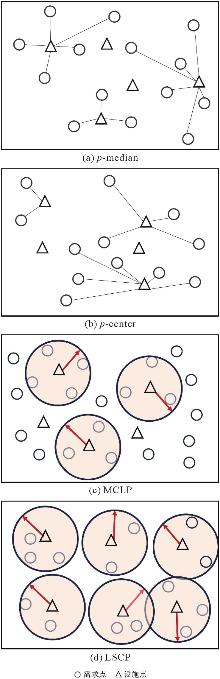
Fig. 1
Typical urban facility allocation optimization model"
Tab. 1
Adaptability of artificial intelligence technology"
| 技术类别 | 求解效率 | 可扩展性 | 泛化能力 | 可解释性 | 对数据质量依赖度 | 适用问题类型 |
|---|---|---|---|---|---|---|
| 精确算法 | 慢 | 差 | 弱 | 强 | 低 | 简单/中等规模的静态离散选址问题 |
| 近似算法 | 较快 | 中等 | 中等 | 中等 | 中等 | 可接受次优解的静态选址问题 |
| 启发式算法 | 快 | 强 | 弱 | 弱 | 中等 | 静态或简单的多目标、组合优化问题 |
| 深度强化学习 | 中等/快 | 强 | 中等/强 | 弱 | 高 | 动态、序列决策、复杂环境下的实时优化问题 |
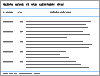
Fig. 2
AI model building framework for optimizing urban infrastructure configuration"
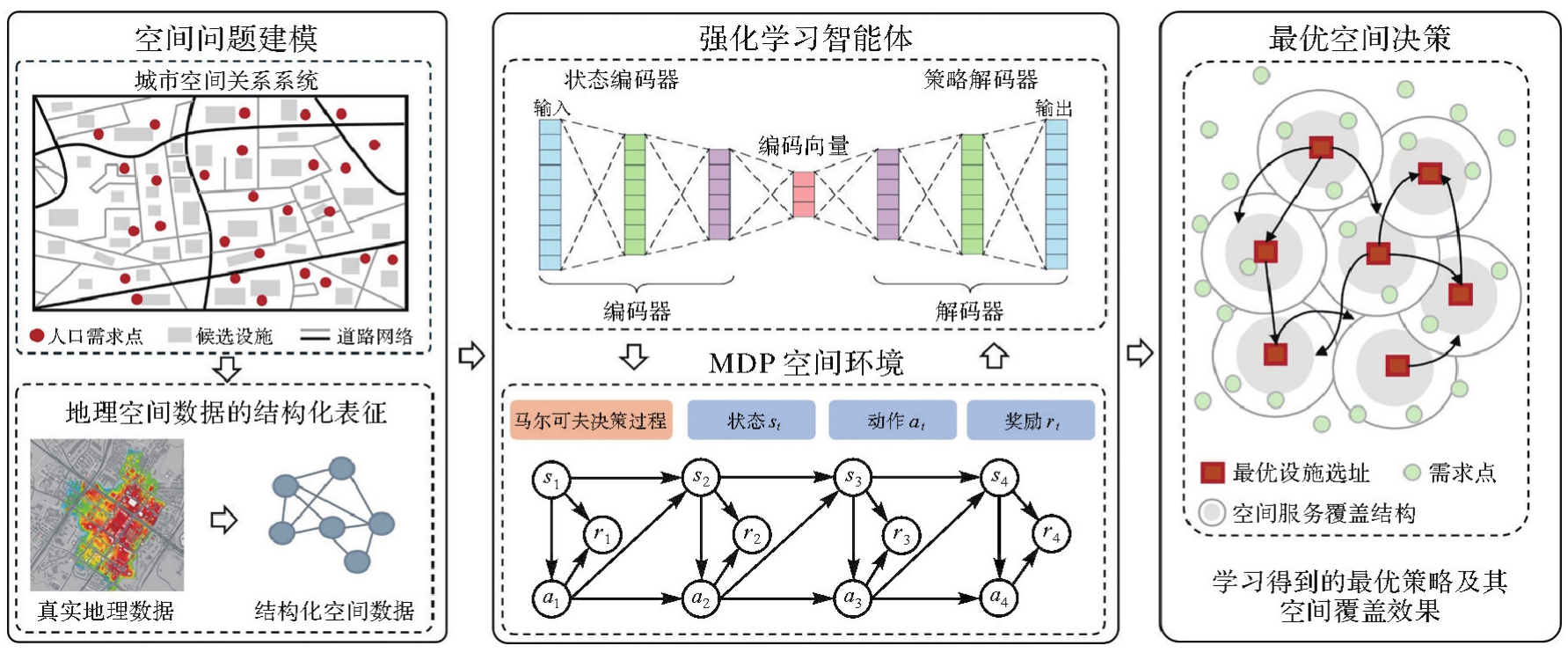

Fig. 3
Workflow of AI-based urban facility allocation optimization"

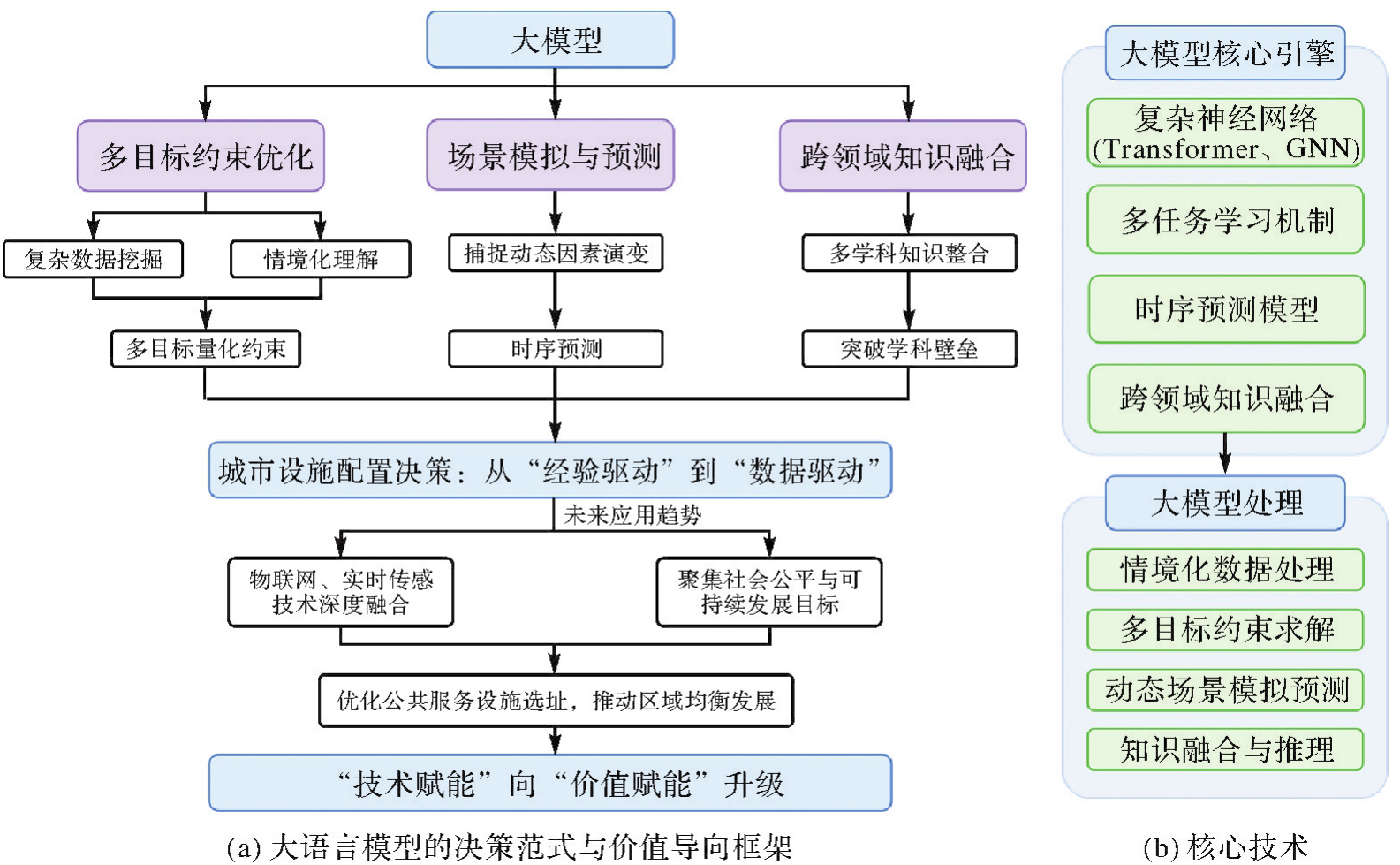
Fig. 4
Urban spatial optimization large language model"
| [1] | CAO Kai, ZHOU Chenghu, CHURCH R, et al. Revisiting spatial optimization in the era of geospatial big data and GeoAI[J]. International Journal of Applied Earth Observation and Geoinformation, 2024, 129: 103832. |
| [2] | WU Xiaohuan, DONG Weihua, WU Lun, et al. Research themes of geographical information science during 1991—2020: a retrospective bibliometric analysis[J]. International Journal of Geographical Information Science, 2023, 37(2): 243-275. |
| [3] | 黎夏, 刘小平, 李少英. 智能式GIS与空间优化[M]. 北京: 科学出版社, 2010. |
| LI Xia, LIU Xiaoping, LI Shaoying. Intelligent GIS and spatial optimization[M]. Beijing: Science Press, 2010. | |
| [4] | 周亮, 党雪薇, 周成虎, 等. 中国建设用地的坡谱演化规律与爬坡影响[J]. 地理学报, 2021, 76(7): 1747-1762. |
| ZHOU Liang, DANG Xuewei, ZHOU Chenghu, et al. Evolution characteristics of slope spectrum and slope-climbing effects of built-up land in China[J]. Acta Geographica Sinica, 2021, 76(7): 1747-1762. | |
| [5] | MURRAY A T. Contemporary optimization application through geographic information systems[J]. Omega, 2021, 99: 102176. |
| [6] | SANG Lingling, ZHANG Chao, YANG Jianyu, et al. Simulation of land use spatial pattern of towns and villages based on CA-Markov model[J]. Mathematical and Computer Modelling, 2011, 54(3/4): 938-943. |
| [7] | ZHANG Liping, ZHANG Shiwen, ZHOU Zhiming, et al. Spatial distribution prediction and benefits assessment of green manure in the Pinggu district, Beijing, based on the CLUE-S model[J]. Journal of Integrative Agriculture, 2016, 15(2): 465-474. |
| [8] | XIA Yutong, CHEN Huanfa, ZUO Chengchao, et al. The impact of traffic on equality of urban healthcare service accessibility: a case study in Wuhan, China[J]. Sustainable Cities and Society, 2022, 86: 104130. |
| [9] | CHURCH R L, MURRAY A T. Business site selection, location analysis, and GIS[M]. New York: John Wiley & Sons, Inc., 2009. |
| [10] | 刘瑜, 詹朝晖, 朱递, 等. 集成多源地理大数据感知城市空间分异格局[J]. 武汉大学学报(信息科学版), 2018, 43(3): 327-335. |
| LIU Yu, ZHAN Zhaohui, ZHU Di, et al. Incorporating multi-source big geo-data to sense spatial heterogeneity patterns in an urban space[J]. Geomatics and Information Science of Wuhan University, 2018, 43(3): 327-335. | |
| [11] | 吕永强, 于新伟, 杨朔, 等. 基于多源地理大数据的城市多中心识别方法[J]. 自然资源遥感, 2023, 35(2): 132-139. |
| LÜ Yongqiang, YU Xinwei, YANG Shuo, et al. Identification of the polycentric urban structure based on multi-source geographic big data[J]. Remote Sensing for Natural Resources, 2023, 35(2): 132-139. | |
| [12] | ZHANG Wengang, GU Xin, TANG Libin, et al. Application of machine learning, deep learning and optimization algorithms in geo-engineering and geoscience: comprehensive review and future challenge[J]. Gondwana Research, 2022, 109: 1-17. |
| [13] | KARPATNE A, EBERT-UPHOFF I, RAVELA S, et al. Machine learning for the geosciences: challenges and opportunities[J]. IEEE Transactions on Knowledge and Data Engineering, 2019, 31(8): 1544-1554. |
| [14] | 黄波, 吴波, 刘彪, 等. 空间智能:地理信息科学的新进展[J]. 遥感学报, 2008, 12(5): 766-771. |
| HUANG Bo, WU Bo, LIU Biao, et al. Spatial intelligence: advancement of geographic information science[J]. Journal of Remote Sensing, 2008, 12(5): 766-771. | |
| [15] |
张永生, 张振超, 童晓冲, 等. 地理空间智能研究进展和面临的若干挑战[J]. 测绘学报, 2021, 50(9): 1137-1146. DOI: .
doi: 10.11947/j.AGCS.2021.20200420 |
|
ZHANG Yongsheng, ZHANG Zhenchao, TONG Xiaochong, et al. Progress and challenges of geospatial artificial intelligence[J]. Acta Geodaetica et Cartographica Sinica, 2021, 50(9): 1137-1146. DOI: .
doi: 10.11947/j.AGCS.2021.20200420 |
|
| [16] | LIANG Haojian, WANG Shaohua, LI Huilai, et al. A trade-off algorithm for solving p-center problems with a graph convolutional network[J]. ISPRS International Journal of Geo-Information, 2022, 11(5): 270. |
| [17] | UM J, SON S W, LEE S L, et al. Scaling laws between population and facility densities[J]. Proceedings of the National Academy of Sciences, 2009, 106(34): 14236-14240. |
| [18] | ZHONG Yang, WANG Shaohua, LIANG Haojian, et al. ReCovNet: reinforcement learning with covering information for solving maximal coverage billboards location problem[J]. International Journal of Applied Earth Observation and Geoinformation, 2024, 128: 103710. |
| [19] | 梁浩健. 基于深度学习的地理空间优化问题算法研究[D]. 长春: 吉林大学, 2024. |
| LIANG Haojian. Research on algorithms for geospatial optimization problem based on deep learning[D]. Changchun: Jilin University, 2024. | |
| [20] | LÜ Guonian, BATTY M, STROBL J, et al. Reflections and speculations on the progress in geographic information systems (GIS): a geographic perspective[J]. International Journal of Geographical Information Science, 2019, 33(2): 346-367. |
| [21] | LIU Yu, LIU Xi, GAO Song, et al. Social sensing: a new approach to understanding our socioeconomic environments[J]. Annals of the Association of American Geographers, 2015, 105(3): 512-530. |
| [22] | 程昌秀, 沈石, 李强坤. 黄河流域人地系统研究的大数据支撑与方法探索[J]. 中国科学基金, 2021, 35(4): 529-536. |
| CHENG Changxiu, SHEN Shi, LI Qiangkun. Big data support and method exploration about natural and human systems research in the Yellow River Basin[J]. Bulletin of National Natural Science Foundation of China, 2021, 35(4): 529-536. | |
| [23] | 裴韬, 刘亚溪, 郭思慧, 等. 地理大数据挖掘的本质[J]. 地理学报, 2019, 74(3): 586-598. |
| PEI Tao, LIU Yaxi, GUO Sihui, et al. Principle of big geodata mining[J]. Acta Geographica Sinica, 2019, 74(3): 586-598. | |
| [24] | NYIMBILI P H, ERDEN T. GIS-based fuzzy multi-criteria approach for optimal site selection of fire stations in Istanbul, Turkey[J]. Socio-Economic Planning Sciences, 2020, 71: 100860. |
| [25] | 刘艳芳, 方飞国, 刘耀林, 等. 时空大数据在空间优化中的应用[J]. 测绘地理信息, 2019, 44(3): 7-20. |
| LIU Yanfang, FANG Feiguo, LIU Yaolin, et al. Application of spatio-temporal big data in spatial optimization[J]. Journal of Geomatics, 2019, 44(3): 7-20. | |
| [26] | TU Wei, LI Qingquan, FANG Zhixiang, et al. Optimizing the locations of electric taxi charging stations: a spatial-temporal demand coverage approach[J]. Transportation Research Part C: Emerging Technologies, 2016, 65: 172-189. |
| [27] | 王璞. 多源数据融合下城市设施的选址推荐和区域需求研究[D]. 苏州: 苏州大学, 2021. |
| WANG Pu. Research on location recommendation and regional demand of urban facilities based on multi-source data fusion[D]. Suzhou: Soochow University, 2021. | |
| [28] | QIN Kun, ZHOU Qing, WU Tao, et al. Hotspots detection from trajectory data based on spatiotemporal data field clustering[C]//Proceedings of 2017 ISPRS Geospatial Week. Wuhan: ISPRS, 2017: 1319-1325. |
| [29] | SUN Yeran, FAN Hongchao, BAKILLAH M, et al. Road-based travel recommendation using geo-tagged images[J]. Computers, Environment and Urban Systems, 2015, 53: 110-122. |
| [30] | SUN Yeran, MOSHFEGHI Y, LIU Zhang. Exploiting crowdsourced geographic information and GIS for assessment of air pollution exposure during active travel[J]. Journal of Transport & Health, 2017, 6: 93-104. |
| [31] | KONG Yunfeng. Variants of location-allocation problems for public service planning[M]//New thinking in GIScience. Singapore: Springer Nature Singapore, 2022: 309-318. |
| [32] | XU Yanyan, OLMOS L E, ABBAR S, et al. Deconstructing laws of accessibility and facility distribution in cities[J]. Science Advances, 2020, 6(37): eabb4112. |
| [33] | 张恒才, 陆锋, 陈洁. 网络空间移动对象模型的应用与发展[J]. 地球信息科学学报, 2013, 15(3): 328-337. |
| ZHANG Hengcai, LU Feng, CHEN Jie. Advance in moving object data modeling under geographic network environment[J]. Journal of Geo-information Science, 2013, 15(3): 328-337. | |
| [34] | LIU Kang, GAO Song, LU Feng. Identifying spatial interaction patterns of vehicle movements on urban road networks by topic modelling[J]. Computers, Environment and Urban Systems, 2019, 74: 50-61. |
| [35] | CHURCH R L, WANG Shaohua. Solving the p-median problem on regular and lattice networks[J]. Computers & Operations Research, 2020, 123: 105057. |
| [36] | TU Wei, YE Haoyu, MAI Ke, et al. Deep online recommendations for connected E-taxis by coupling trajectory mining and reinforcement learning[J]. International Journal of Geographical Information Science, 2024, 38(2): 216-242. |
| [37] | TU Wei, GAO Wei, LI Mingxiao, et al. Spatial cooperative simulation of land use-population-economy in the Greater Bay Area, China[J]. International Journal of Geographical Information Science, 2024, 38(2): 381-406. |
| [38] | LIU Kang, QIU Peiyuan, GAO Song, et al. Investigating urban metro stations as cognitive places in cities using points of interest[J]. Cities, 2020, 97: 102561. |
| [39] | 刘瑜, 张晶, 邬伦. 空间数据工程理论框架研究[J]. 地理与地理信息科学, 2003, 19(1): 12-15, 24. |
| LIU Yu, ZHANG Jing, WU Lun. Geo-spatial data engineering: a theoretical framework[J]. Geography and Geo-Information Science, 2003, 19(1): 12-15, 24. | |
| [40] | HAKIMI S L. Optimum locations of switching centers and the absolute centers and medians of a graph[J]. Operations research, 1964, 12(3): 450-459. |
| [41] | CAO Kai, ZHANG Wenting, WANG Tianwei. Spatio-temporal land use multi-objective optimization: a case study in Central China[J]. Transactions in GIS, 2019, 23(4): 726-744. |
| [42] | 宋正娜, 颜庭干, 刘婷, 等. 新重力P中值模型及其在城市综合医院区位决策中的实证检验——以无锡市为例[J]. 地理科学进展, 2016, 35(4): 420-430. |
| SONG Zhengna, YAN Tinggan, LIU Ting, et al. A new gravity P-median model and empirical test in urban comprehensive hospital location decision making: take Wuxi as an example[J]. Progress in Geography, 2016, 35(4): 420-430. | |
| [43] | ABUBAKAR Z, EJIMA O, MUSTAFA A, et al. P-center problem of fire stations in Sokoto Metropolis[J]. Asian Journal of Mathematics and Computer Research, 2017, 18(3): 143-151. |
| [44] | HUANG Meng, FANG Zhixiang, WEIBEL R, et al. Dynamic optimization models for displaying outdoor advertisement at the right time and place[J]. International Journal of Geographical Information Science, 2021, 35(6): 1179-1204. |
| [45] | SHARIFF S S R, MOIN N H, OMAR M. Location allocation modeling for healthcare facility planning in Malaysia[J]. Computers & Industrial Engineering, 2012, 62(4): 1000-1010. |
| [46] | HASHIM N I M, SHARIFF S S R, DENI S M. Allocation of relief centre for flood victims using location set covering problem (LSCP)[C]//Proceedings of 2021 International Conference on Mathematics, Statistics and Computing Technology. Bangkok: IOP Publishing Ltd., 2021. |
| [47] | WU Qiang, DU Zhili, ZHAO Yingwang, et al. Optimal location of water level sensors for monitoring mine water inrush based on the set covering model[J]. Scientific Reports, 2021, 11(1): 2621. |
| [48] | 钟耳顺. 深度地图——论地图学与神经科学的结合[J]. 武汉大学学报(信息科学版), 2022, 47(12): 1988-2002. |
| ZHONG Ershun. Deep mapping—a critical engagement of cartography with neuroscience[J]. Geomatics and Information Science of Wuhan University, 2022, 47(12): 1988-2002. | |
| [49] | VASILYEV I L, USHAKOV A V. Discrete facility location in machine learning[J]. Journal of Applied and Industrial Mathematics, 2021, 15(4): 686-710. |
| [50] | LIANG Haojian, WANG Shaohua, LI Huilai, et al. Sponet: solve spatial optimization problem using deep reinforcement learning for urban spatial decision analysis[J]. International Journal of Digital Earth, 2024, 17(1): 2299211. |
| [51] | WANG Shaohua, LIANG Haojian, ZHONG Yang, et al. DeepMCLP: solving the MCLP with deep reinforcement learning for urban facility location analytics[C/OL]//Proceedings of 2023 Spatial Data Science Symposium. Santa Barbara: Center for Spatial Studies, University of California, Santa Barbara, 2023 [2025-08-20]. http://dx.doi.org/10.25436/E2MK55. |
| [52] | ZHANG Di, MENG Huan, WANG Moyang, et al. A multi-objective optimization method for shelter site selection based on deep reinforcement learning[J]. Transactions in GIS, 2024, 28(8): 2722-2741. |
| [53] | QAYYUM A, USAMA M, QADIR J, et al. Securing connected & autonomous vehicles: challenges posed by adversarial machine learning and the way forward[J]. IEEE Communications Surveys & Tutorials, 2020, 22(2): 998-1026. |
| [54] | ZHENG Jiayi, WANG Shaohua, LI Shijie, et al. Towards conversational spatial optimization: an llm-driven decision support system for geospatial facility location problems[C]//Proceedings of the 14th International Workshop on Urban Computing. New York: ACM Press, 2025. |
| [55] | ZHANG Zeyu, DAI Quanyu, BO Xiaohe, et al. A survey on the memory mechanism of large language model based agents[J]. ACM Transactions on Information Systems, 2025, 43(6): 1-47. |
| [56] | 王湉, 范峻铭, 郑湃. 基于大语言模型的人机交互移动检测机器人导航方法[J]. 计算机集成制造系统, 2024, 30(5): 1587-1594. |
| WANG Tian, FAN Junming, ZHENG Pai. Large language model-based approach for human-mobile inspection robot interactive navigation[J]. Computer Integrated Manufacturing Systems, 2024, 30(5): 1587-1594. | |
| [57] | YANG Xi, CHEN Aokun, POURNEJATIAN N, et al. A large language model for electronic health records[J]. NPJ Digital Medicine, 2022, 5: 194. |
| [58] | MAI Gengchen, JANOWICZ K, HU Yingjie, et al. A review of location encoding for GeoAI: methods and applications[J]. International Journal of Geographical Information Science, 2022, 36(4): 639-673. |
| [59] | 张新长, 华淑贞, 齐霁, 等. 新型智慧城市建设与展望:基于AI的大数据、大模型与大算力[J]. 地球信息科学学报, 2024, 26(4): 779-789. |
| ZHANG Xinchang, HUA Shuzhen, QI Ji, et al. Progress and prospects of new smart city construction: AI-based big data, big models and big computing power[J]. Journal of Geo-information Science, 2024, 26(4): 779-789. | |
| [60] | 高松. 地理空间人工智能的近期研究总结与思考[J]. 武汉大学学报(信息科学版), 2020, 45(12): 1865-1874. |
| GAO Song. A review of recent researches and reflections on geospatial artificial intelligence[J]. Geomatics and Information Science of Wuhan University, 2020, 45(12): 1865-1874. |
| [1] | Peng LI, Jiahan ZHANG, Zhihan WANG, Houjie WANG, Zhenhong LI. A review of intertidal topography reconstruction methods: current status, challenges and trends [J]. Acta Geodaetica et Cartographica Sinica, 2026, 55(4): 571-587. |
| [2] | Jiayao WANG, Lin CHEN, Shiyuan CHENG, Lijun WANG, Siqi XIONG. Artificial intelligence empowering the digital-intelligent transformation of cartographic science [J]. Acta Geodaetica et Cartographica Sinica, 2026, 55(3): 381-389. |
| [3] | Yunbo RAN, Xue YANG, Wenhao ZHOU, Chengen WU, Baoding ZHOU, Luliang TANG, Qingquan LI. Pedestrian path planning driven by preference-enhanced adversarial deep reinforcement learning [J]. Acta Geodaetica et Cartographica Sinica, 2026, 55(2): 191-205. |
| [4] | Xiaohua TONG, Rong HUANG, Jiarui CAO, Chen LIU, Rong WANG, Yusheng XU, Zhen YE, Yanmin JIN, Shijie LIU, Sicong LIU, Yongjiu FENG, Huan XIE. Intelligent methods for 3D terrain reconstruction of the Moon and near-Earth planets: a review of current advances and future perspectives [J]. Acta Geodaetica et Cartographica Sinica, 2025, 54(11): 1917-1933. |
| [5] | Xiaogang NING, Hanchao ZHANG, Ruiqian ZHANG. Practical framework and methodology for high-performance intelligent invariant detection in remote sensing imagery [J]. Acta Geodaetica et Cartographica Sinica, 2024, 53(6): 1098-1112. |
| [6] | Qin YAN, Haiyan GU, Yi YANG, Haitao LI, Hengtong SHEN, Shiqi LIU. Research progress and trend of intelligent remote sensing large model [J]. Acta Geodaetica et Cartographica Sinica, 2024, 53(10): 1967-1980. |
| [7] | LI Shutao, WU Qiong, KANG Xudong. Hyperspectral remote sensing image intrinsic information decomposition: advances and challenges [J]. Acta Geodaetica et Cartographica Sinica, 2023, 52(7): 1059-1073. |
| [8] | WANG Peixiao, ZHANG Tong, NIE Shichao, YANG Jinxuan, WANG Tianjiao. A causal graph convolutional network considering missing values for spatio-temporal prediction [J]. Acta Geodaetica et Cartographica Sinica, 2023, 52(5): 818-830. |
| [9] | YANG Bisheng, CHEN Chi, DONG Zhen. 3D geospatial information extraction of urban objects for smart surveying and mapping [J]. Acta Geodaetica et Cartographica Sinica, 2022, 51(7): 1476-1484. |
| [10] | GONG Jianya, HUAN Linxi, ZHENG Xianwei. Deep learning interpretability analysis methods in image interpretation [J]. Acta Geodaetica et Cartographica Sinica, 2022, 51(6): 873-884. |
| [11] | WANG Jiayao, WU Fang, YAN Haowen. Cartography:its past, present and future [J]. Acta Geodaetica et Cartographica Sinica, 2022, 51(6): 829-842. |
| [12] | LIU Jingnan, LUO Yarong, GUO Chi, GAO Kefu. PNT intelligence and intelligent PNT [J]. Acta Geodaetica et Cartographica Sinica, 2022, 51(6): 811-828. |
| [13] | LIU Yu, GUO Hao, LI Haifeng, DONG Weihua, PEI Tao. A note on GeoAI from the perspective of geographical laws [J]. Acta Geodaetica et Cartographica Sinica, 2022, 51(6): 1062-1069. |
| [14] | WANG Quan, YOU Shucheng. Research and application outlook of land satellite remote sensing monitoring system [J]. Acta Geodaetica et Cartographica Sinica, 2022, 51(4): 534-543. |
| [15] | LI Deren, XU Xiaodi, SHAO Zhenfeng. On geospatial information science in the era of IoE [J]. Acta Geodaetica et Cartographica Sinica, 2022, 51(1): 1-8. |
| Viewed | ||||||
|
Full text |
|
|||||
|
Abstract |
|
|||||
