

Acta Geodaetica et Cartographica Sinica ›› 2026, Vol. 55 ›› Issue (7): 1183-1198.doi: 10.11947/j.AGCS.2026.20250454
• Frontiers in AI-Driven Geodesy and Satellite Gravity Inversion • Previous Articles
Zehua Guo1( ), Xinyu Xu1,2(), Yongqi Zhao1, Wenqi Lin1, Jiawei Ding1
Received:2025-10-27
Revised:2026-06-18
Published:2026-08-18
Contact:
Xinyu Xu
E-mail:zehuaguo@whu.edu.cn;xyxu@sgg.whu.edu.cn
About author:Guo Zehua (1992—), male, PhD candidate, majors in gravity satellite data processing. E-mail: zehuaguo@whu.edu.cn
Supported by:CLC Number:
Zehua Guo, Xinyu Xu, Yongqi Zhao, Wenqi Lin, Jiawei Ding. A correction method for GOCE satellite attitude quaternions considering moonlight disturbance and orbit-periodic noise[J]. Acta Geodaetica et Cartographica Sinica, 2026, 55(7): 1183-1198.
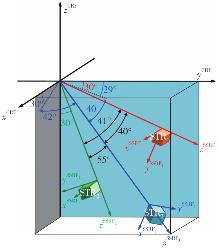
Fig. 1
Orientation of the star tracker reference frames (SSRF1, SSRF2, SSRF3) with respect to the common reference frame (CRF) of the GOCE satellite"
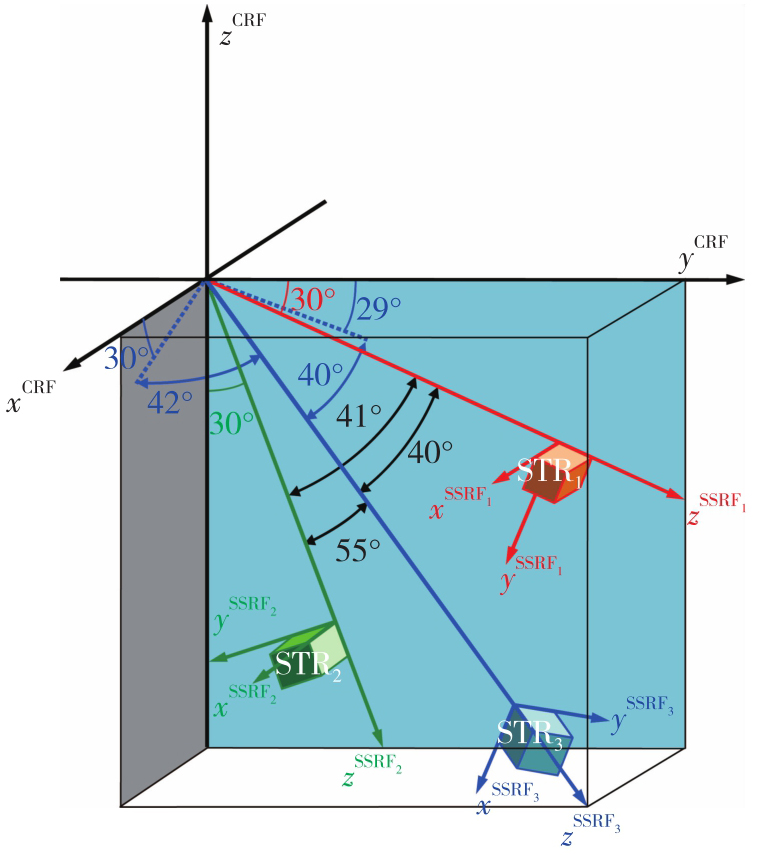
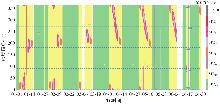
Fig. 2
Distribution of valid in-orbit combinations of STR1, STR2, and STR3 from January to June 2012"

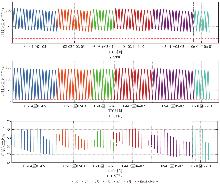
Fig. 3
Time series of angles between the satellite-Moon vector and STR boresights (STR2 has invalid periods)"
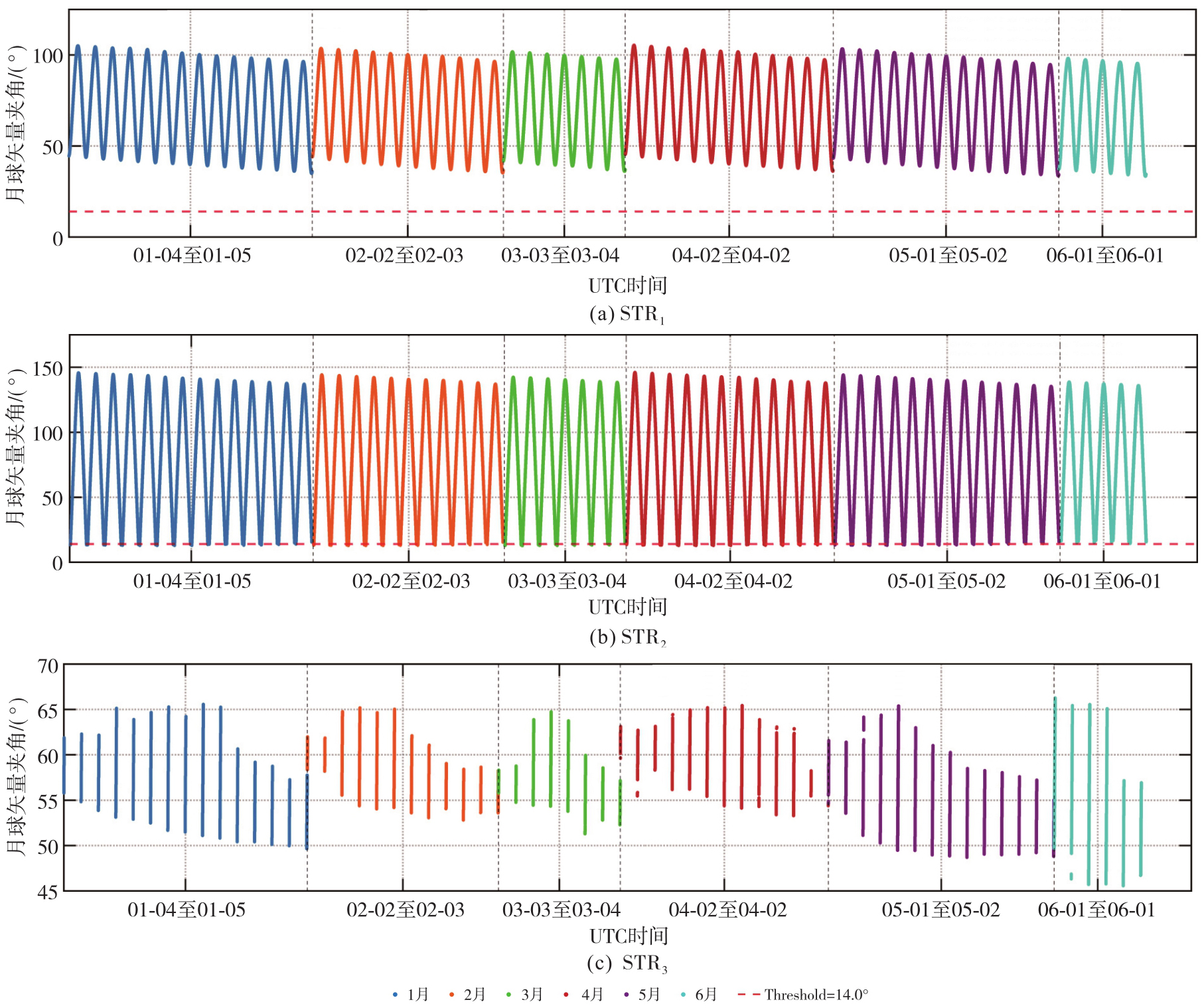
Fig. 4
Time series of angles between the satellite-Moon vector and STR boresights (STR1 has invalid periods)"

Tab. 1
Comparison of inter-STR parameter differences between the estimated parameters and ESA calibration parameters"
| 方法 | b2-b1/(″) | b3-b1/(″) | t2-t1/(″/℃) | t3-t1/(″/℃) |
|---|---|---|---|---|
| 本文方法 | [-5.910-18.100 4.230] | [-0.951-2.780 10.710] | [-0.476 0.704 0.117] | [-0.502 0.093 1.089] |
| ESA | [-5.839-18.341 4.487] | [-1.017-2.626 10.556] | [-0.479 0.712 0.090] | [-0.464 0.112 1.072] |
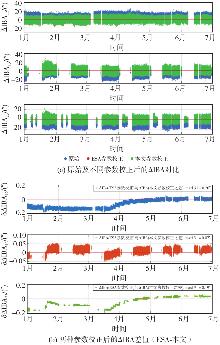
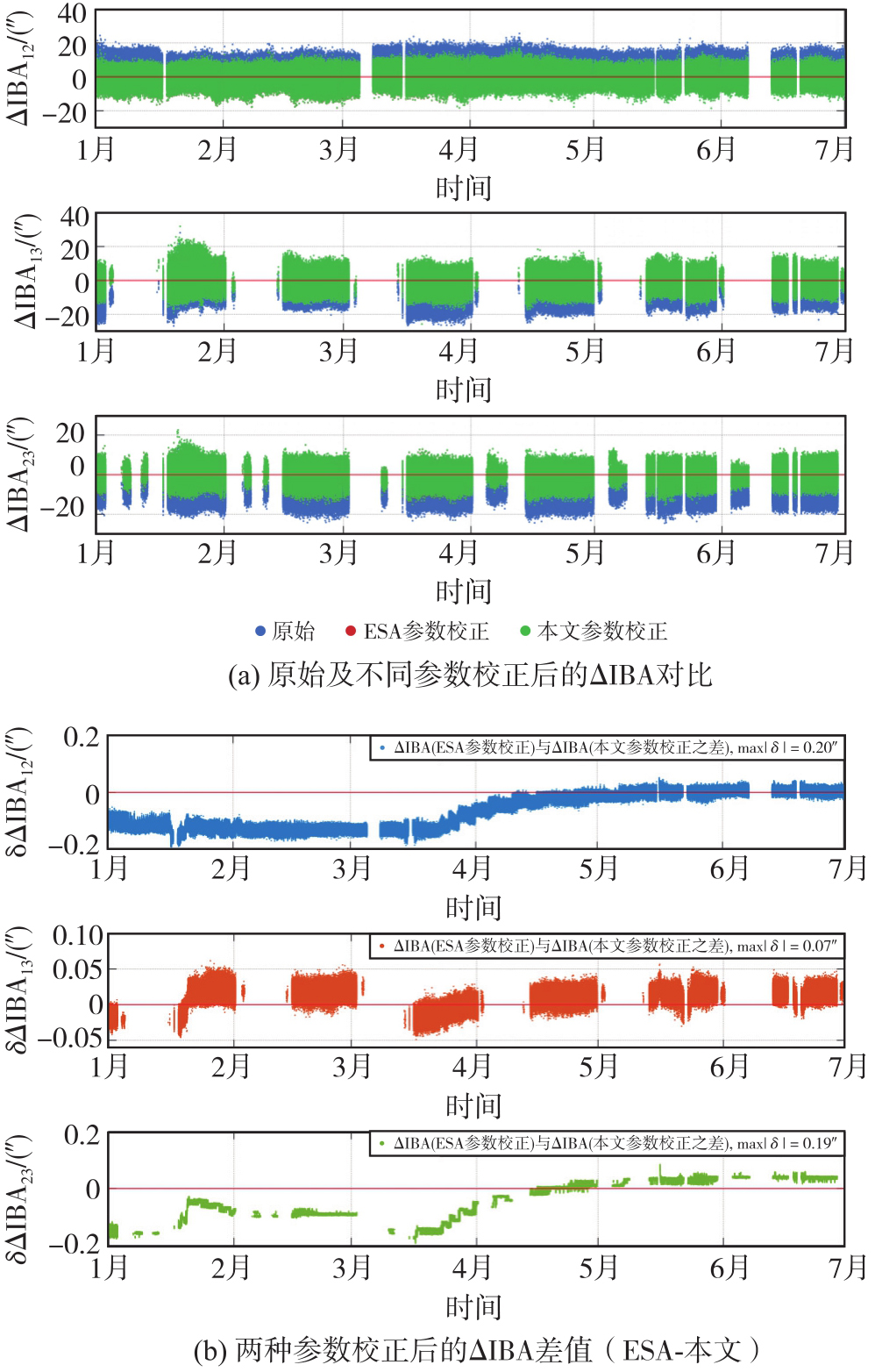
Fig. 5
Correction effects of inter-boresight angle residuals ΔIBA and the discrepancy between the two parameter-corrected results (January to June 2012)"
Tab. 2
Statistics of orbital-period mean values of ΔIBA13 and ΔIBA23 during moonlight-affected and unaffected intervals"
| 视轴夹角残差 | 是否受影响段 | 最大值 | 最小值 | 均值 | 标准差 |
|---|---|---|---|---|---|
| ΔIBA13 | 未受影响 | 1.66 | -1.58 | -0.31 | 0.39 |
| 受影响 | 9.73 | -6.40 | 0.51 | 2.86 | |
| ΔIBA23 | 未受影响 | 1.23 | -2.35 | -0.01 | 0.36 |
| 受影响 | 5.99 | -4.41 | -0.25 | 1.15 |
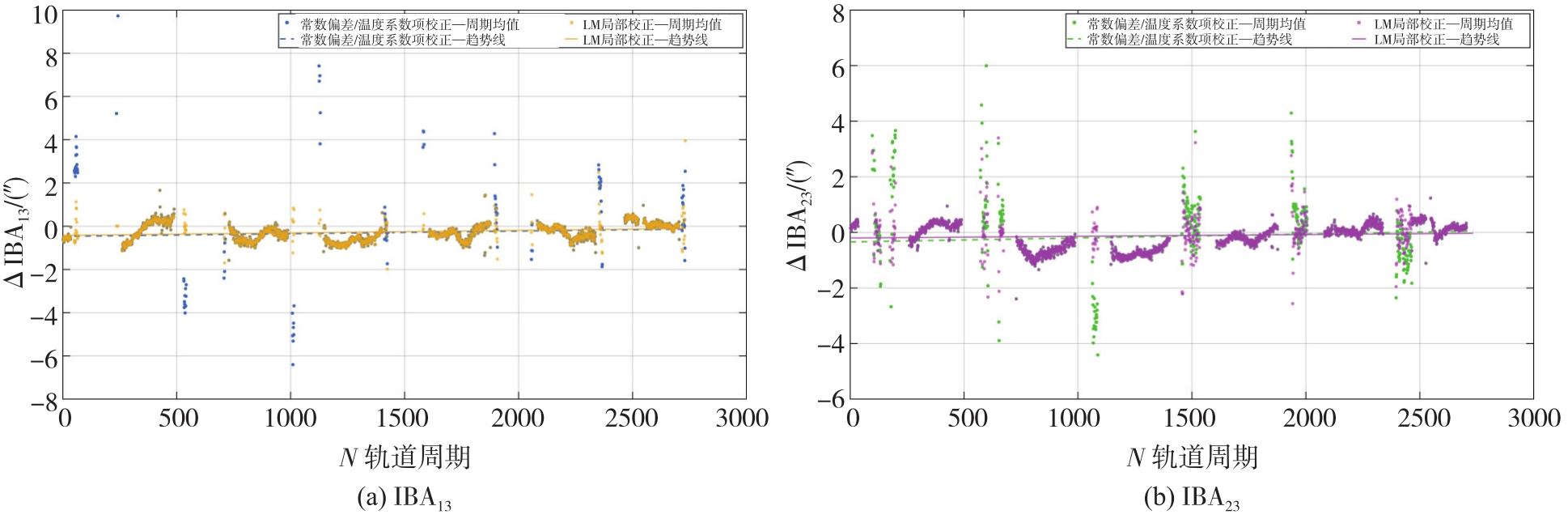
Fig. 6
Orbital-period mean series of ΔIBA13、ΔIBA23(T=5384 s)"
Tab. 3
Statistics of orbital-period mean values of ΔIBA12, ΔIBA13, ΔIBA23 under different processing methods"
| 方法 | 残差项 | 趋势斜率 | 均值/(″) | 标准差/(″) |
|---|---|---|---|---|
| 原始姿态 | ΔIBA12 | -0.002 732 | 7.299 | 0.50 |
| ΔIBA13 | 0.007 699 | -9.827 | 1.44 | |
| ΔIBA23 | -0.003 530 | -8.900 | 0.51 | |
| 常数偏差bi/温度系数ti校正 | ΔIBA12 | -0.000 453 | 0.286 | 0.23 |
| ΔIBA13 | 0.001 222 | -0.310 | 0.87 | |
| ΔIBA23 | 0.001 537 | -0.182 | 0.84 | |
| LM局部校正 | ΔIBA12 | -0.000 454 | 0.286 | 0.23 |
| ΔIBA13 | 0.001 179 | -0.311 | 0.44 | |
| ΔIBA23 | 0.001 101 | -0.185 | 0.63 |
Fig. 7
Comparison of ASD of ΔIBA13、ΔIBA23 after constant-bias/temperature correction, LM local correction, and periodic-term denoising"
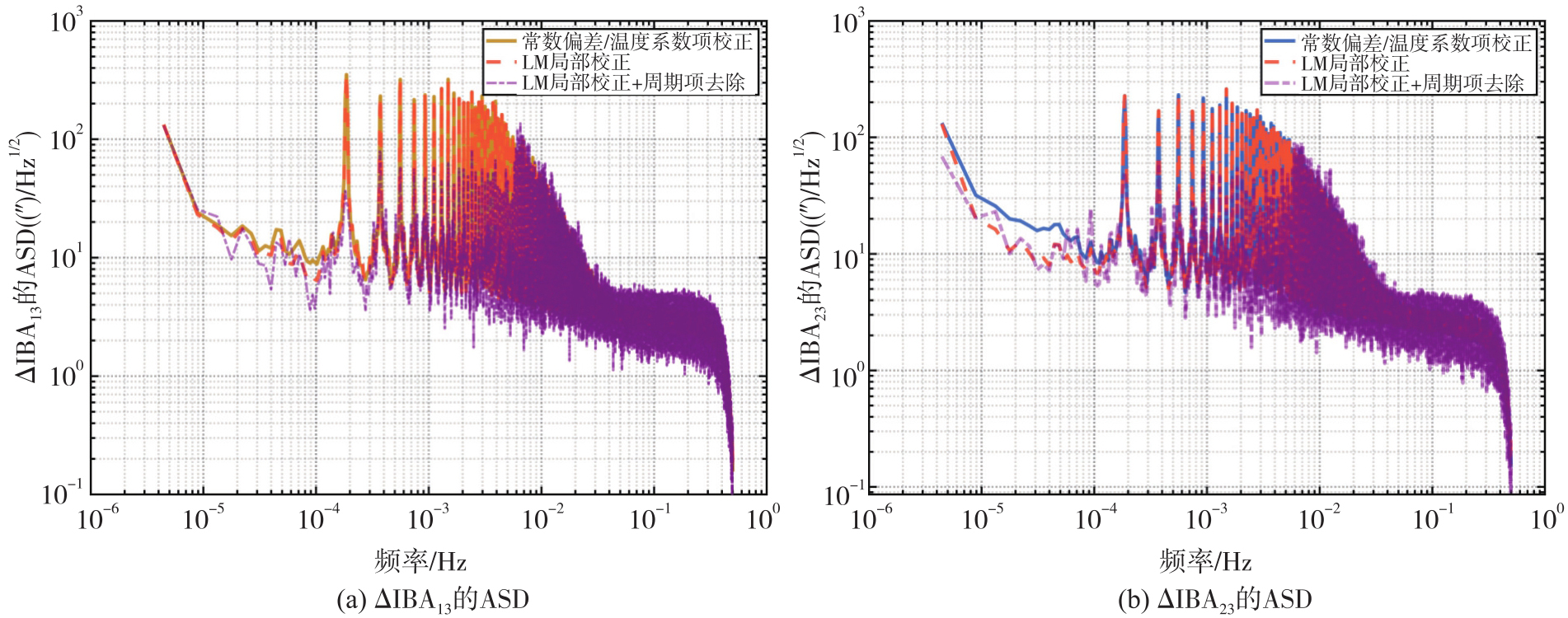
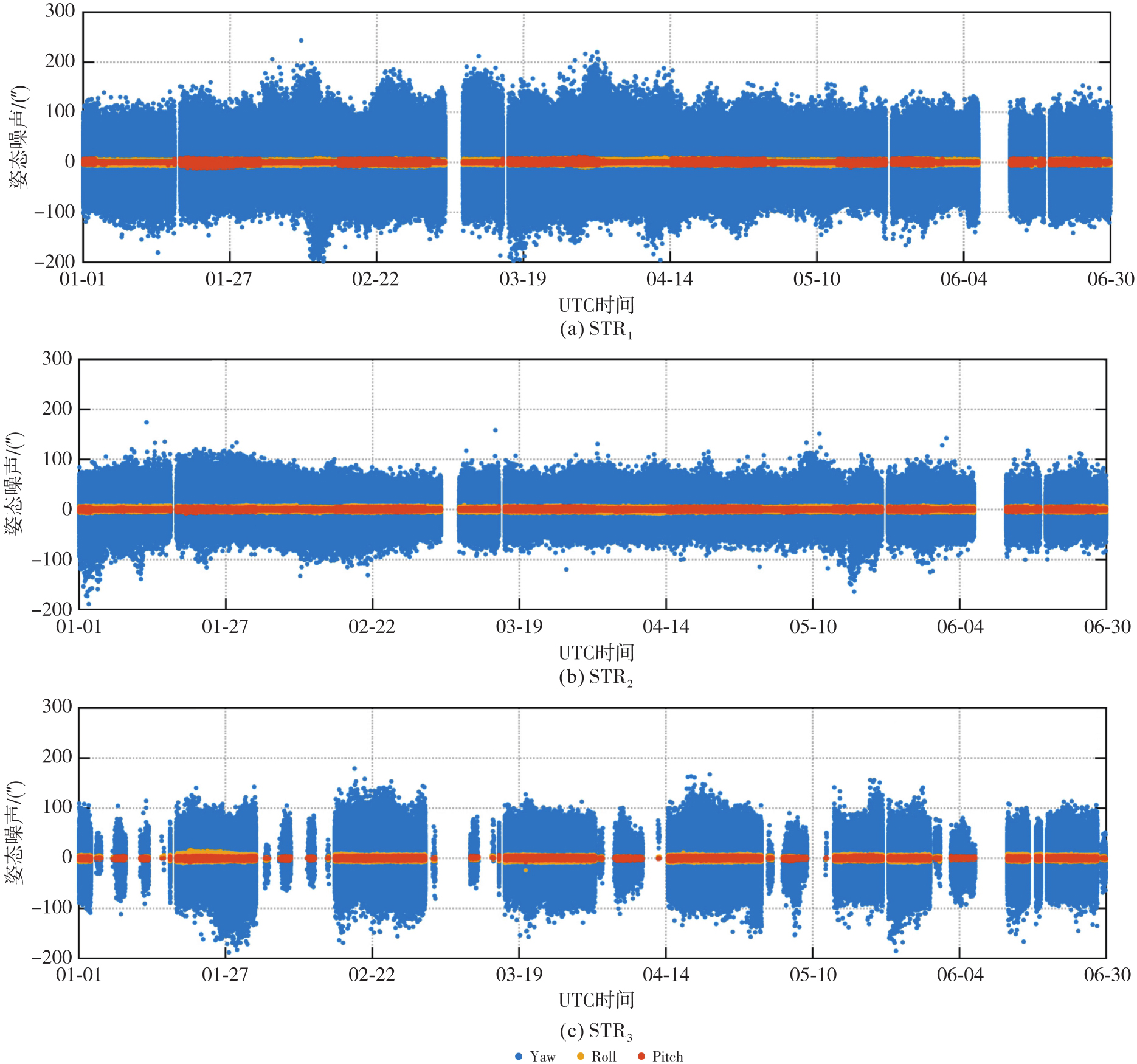
Fig. 8
Time series of attitude-noise Euler angles for STR1, STR2, and STR3 estimated by the LM method"
Tab. 4
Statistics of STR noise Euler angles obtained by the ESA and LM methods"
| 星敏感器 | 欧拉角 | 方法 | 最大值 | 最小值 | 均值 | 标准差 |
|---|---|---|---|---|---|---|
| STR1 | Roll | ESA | 11.170 | -11.979 | 0.045 | 1.759 |
| LM | 13.576 | -15.650 | 0.062 | 2.020 | ||
| Pitch | ESA | 27.205 | -9.204 | 0.101 | 1.514 | |
| LM | 6.696 | -5.746 | 0.032 | 0.890 | ||
| Yaw | ESA | 330.797 | -243.367 | -0.663 | 35.710 | |
| LM | 250.738 | -243.716 | -0.690 | 35.584 | ||
| STR2 | Roll | ESA | 10.107 | -11.196 | 0.008 | 1.637 |
| LM | 14.325 | -14.711 | -0.029 | 1.849 | ||
| Pitch | ESA | 7.006 | -7.329 | 0.078 | 1.102 | |
| LM | 6.460 | -7.148 | 0.022 | 0.911 | ||
| Yaw | ESA | 159.742 | -165.314 | 0.269 | 19.552 | |
| LM | 154.114 | -152.771 | 0.207 | 19.496 | ||
| STR3 | Roll | ESA | 11.599 | -24.020 | -0.251 | 2.146 |
| LM | 16.893 | -18.652 | -0.262 | 3.183 | ||
| Pitch | ESA | 6.601 | -9.425 | 0.116 | 1.269 | |
| LM | 5.291 | -5.927 | 0.032 | 0.959 | ||
| Yaw | ESA | 188.802 | -217.493 | 1.687 | 27.247 | |
| LM | 187.646 | -186.051 | 1.493 | 27.252 |
Tab. 5
Noise weighted sum of squares obtained by ESA and the proposed LM method"
| 方法 | STR1 | STR2 | STR3 |
|---|---|---|---|
| ESA | 2.388×10⁻³ | 1.019×10⁻³ | 1.174×10⁻³ |
| LM | 1.931×10⁻³ | 7.506×10⁻⁴ | 1.085×10⁻³ |
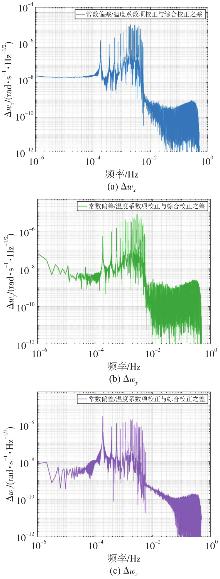
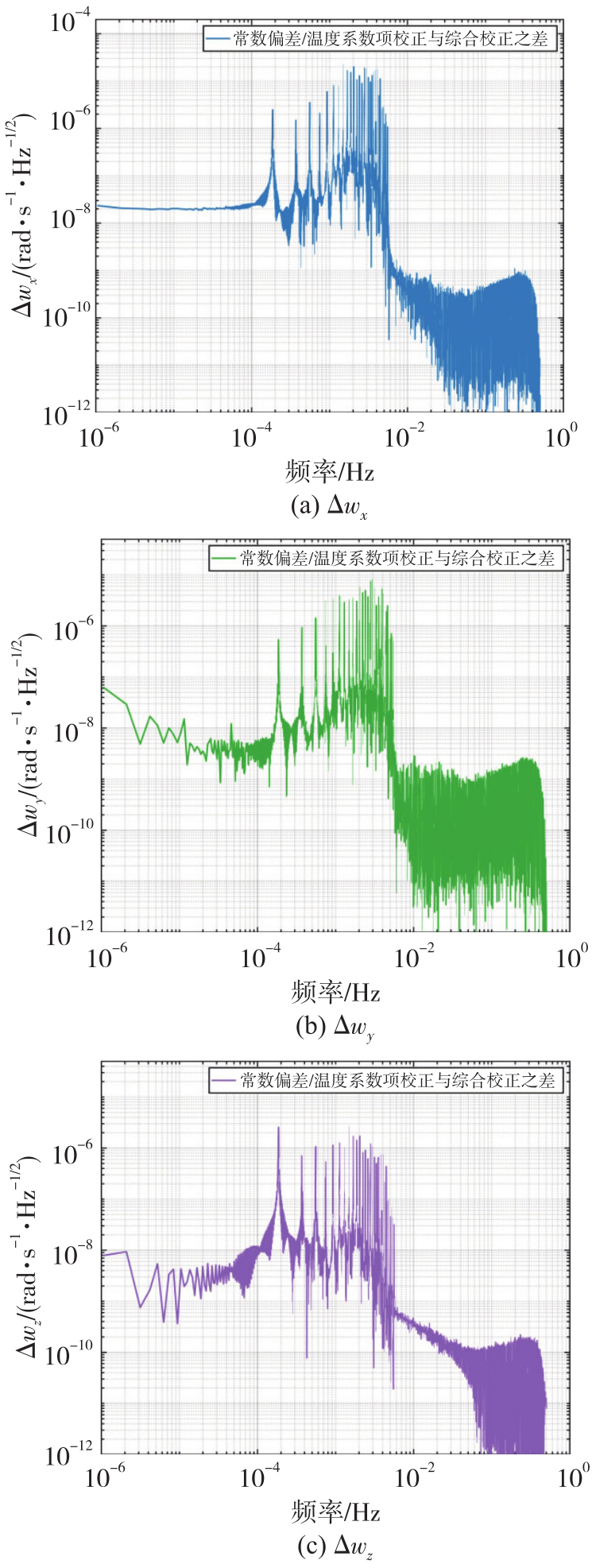
Fig. 9
ASD of angular velocity differences between constant-bias/temperature correction and comprehensive correction"
Tab. 6
Statistical difference of the main diagonal components of the gravity gradient calculated by ESA and LM methods"
| 分量 | 最大值 | 最小值 | 均值 | 标准差 |
|---|---|---|---|---|
| Vxx | 1.976 | -2.440 | 0.066 | 0.703 |
| Vyy | 0.478 | -0.632 | -0.111 | 0.182 |
| Vzz | 2.026 | -2.622 | 0.070 | 0.740 |
Tab. 7
Statistics of gravity gradient traces calculated by ESA and LM methods"
| 迹 | 最大值 | 最小值 | 均值 | 标准差 |
|---|---|---|---|---|
| Trace_ESA | -572 093.791 | -577 148.577 | -574 599.662 | 1 412.553 |
| Trace_LM | -572 096.100 | -577 149.188 | -574 599.637 | 1 412.434 |
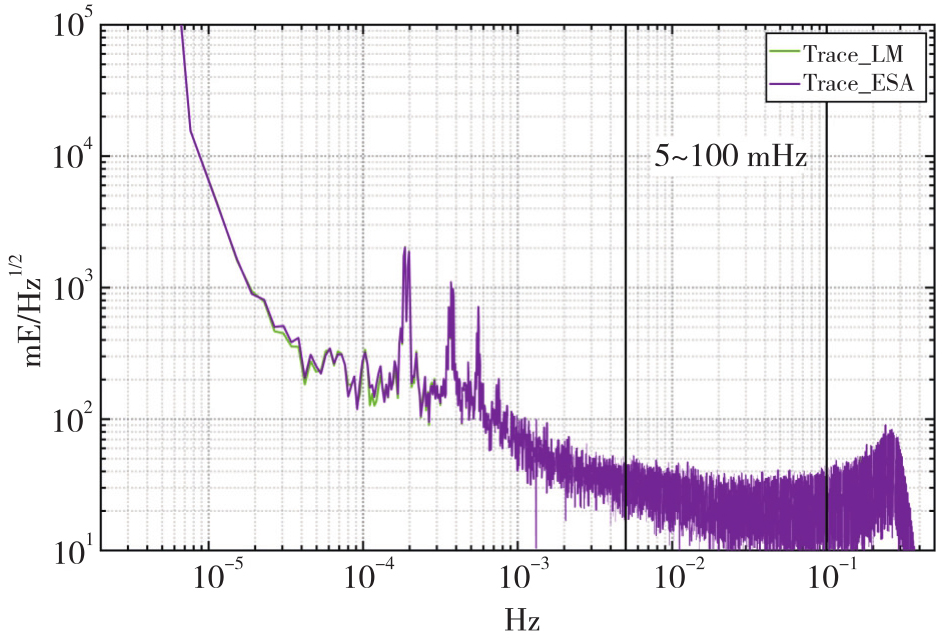
Fig. 10
ASD of the gravity gradient trace calculated by ESA and LM methods"
| [1] | Drinkwater M R, Floberghagen R, Haagmans R, et al. GOCE: ESA's first earth explorer core mission[J]. Space Science Reviews, 2003, 108(1): 419-432. |
| [2] | 徐新禹, 李建成, 邹贤才, 等. GOCE卫星重力探测任务[J]. 大地测量与地球动力学, 2006, 26(4): 49-55. |
| Xu Xinyu, Li Jiancheng, Zou Xiancai, et al. GOCE gravity explorer mission[J]. Journal of Geodesy and Geodynamics, 2006, 26(4): 49-55. | |
| [3] |
徐新禹, 赵永奇, 魏辉, 等. 利用先验重力场模型对GOCE卫星重力梯度观测值进行校准分析[J]. 测绘学报, 2015, 44(11): 1196-1201. DOI: .
doi: 10.11947/j.AGCS.2015.20140414 |
|
Xu Xinyu, Zhao Yongqi, Wei Hui, et al. Calibration and analysis of SGG observations of GOCE based on prior gravity models[J]. Acta Geodaetica et Cartographica Sinica, 2015, 44(11): 1196-1201. DOI: .
doi: 10.11947/j.AGCS.2015.20140414 |
|
| [4] | Siemes C. Improving GOCE cross-track gravity gradients[J]. Journal of Geodesy, 2018, 92(1): 33-45. |
| [5] | Rispens S, Bouman J. Calibrating the GOCE accelerations with star sensor data and a global gravity field model[J]. Journal of Geodesy, 2009, 83(8): 737-749. |
| [6] | Siemes C, Haagmans R, Kern M, et al. Monitoring GOCE gradiometer calibration parameters using accelerometer and star sensor data: methodology and first results[J]. Journal of Geodesy, 2012, 86(8): 629-645. |
| [7] | Visser P N A M. Exploring the possibilities for star-tracker assisted calibration of the six individual GOCE accelerometers[J]. Journal of Geodesy, 2008, 82(10): 591-600. |
| [8] | Siemes C, Rexer M, Schlicht A, et al. GOCE gradiometer data calibration[J]. Journal of Geodesy, 2019, 93(9): 1603-1630. |
| [9] | Frommknecht B, Lamarre D, Meloni M, et al. GOCE level 1b data processing[J]. Journal of Geodesy, 2011, 85(11): 759-775. |
| [10] | Romans L. Optimal combination of quaternions from multiple star cameras[R]. Los Angeles: Jet Propulsion Laboratory, 2003. |
| [11] | 郭泽华, 吴云龙, 肖云, 等. 联合星象仪四元数的卫星重力梯度测量角速度重建方法[J]. 武汉大学学报(信息科学版), 2021, 46(9): 1336-1344. |
| Guo Zehua, Wu Yunlong, Xiao Yun, et al. Reconstruction method of satellite gravity gradient measurement angular velocity by combining star tracker quaternion[J]. Geomatics and Information Science of Wuhan University, 2021, 46(9): 1336-1344. | |
| [12] | Bandikova T, Flury J. Improvement of the GRACE star camera data based on the revision of the combination method[J]. Advances in Space Research, 2014, 54(9): 1818-1827. |
| [13] | Siemes C, Rexer M, Haagmans R. GOCE star tracker attitude quaternion calibration and combination[J]. Advances in Space Research, 2019, 63(3): 1133-1146. |
| [14] | 陈逸峰, 朱广彬, 常晓涛, 等. 顾及姿态偏移的重力梯度卫星姿态确定方法[J]. 测绘科学, 2023, 48(4): 46-53. |
| Chen Yifeng, Zhu Guangbin, Chang Xiaotao, et al. A gravity gradient satellite attitude determination method by using attitude offset correction[J]. Science of Surveying and Mapping, 2023, 48(4): 46-53. | |
| [15] |
胡丹怡, 吴云龙, 肖云, 等. 顾及温度效应改正的多星敏感器角速度重建方法[J]. 测绘学报, 2024, 53(9): 1748-1760. DOI: .
doi: 10.11947/j.AGCS.2024.20240093 |
|
Hu Danyi, Wu Yunlong, Xiao Yun, et al. Multi-star tracker angular velocity reconstruction method considering temperature effect correction[J]. Acta Geodaetica et Cartographica Sinica, 2024, 53(9): 1748-1760. DOI: .
doi: 10.11947/j.AGCS.2024.20240093 |
|
| [16] | Wang Aoming, Gu Defeng, Huang Zhiyong, et al. GRACE-FO attitude determination: star camera installation matrix calibration and incremental quaternion integrator[J]. Acta Astronautica, 2024, 219: 774-784. |
| [17] | 梁磊, 闫易浩, 王长青, 等. 基于卡尔曼滤波重构GRACE-FO姿态数据[J]. 地球物理学报, 2022, 65(12): 4602-4615. |
| Liang Lei, Yan Yihao, Wang Changqing, et al. Results from GRACE-FO attitude determination based on Kalman filter[J]. Chinese Journal of Geophysics, 2022, 65(12): 4602-4615. | |
| [18] | Stummer C, Fecher T, Pail R. Alternative method for angular rate determination within the GOCE gradiometer processing[J]. Journal of Geodesy, 2011, 85(9): 585-596. |
| [19] | 赵永奇, 李建成, 徐新禹, 等. 利用GOCE和GRACE卫星观测数据确定静态重力场模型[J]. 地球物理学报, 2023, 66(6): 2322-2336. |
| Zhao Yongqi, Li Jiancheng, Xu Xinyu, et al. Determination of static gravity field model by using satellite data of GOCE and GRACE[J]. Chinese Journal of Geophysics, 2023, 66(6): 2322-2336. | |
| [20] | 邹贤才, 李建成. 单加速度计模式下的GOCE卫星重力场建模方法研究[J]. 地球物理学报, 2016, 59(4): 1260-1266. |
| Zou Xiancai, Li Jiancheng. Study on the Earth gravity modeling by GOCE in individual accelerometer mode[J]. Chinese Journal of Geophysics, 2016, 59(4): 1260-1266. | |
| [21] | Siemes C. GOCE gradiometer calibration and Level 1b data processing: ESA working paper EWP-2384[R]. Noordwijk: European Space Agency, 2011: 31-35. |
| [22] | Pail R. A parametric study on the impact of satellite attitude errors on GOCE gravity field recovery[J]. Journal of Geodesy, 2005, 79(4/5): 231-241. |
| [23] | Stummer C, Siemes C, Pail R, et al. Upgrade of the GOCE level 1b gradiometer processor[J]. Advances in Space Research, 2012, 49(4): 739-752. |
| [24] | 乔兴, 王宏力, 王永胜, 等. 基于GA-LM融合的星敏感器参数标定算法[J]. 激光与红外, 2014, 44(11): 1224-1229. |
| Qiao Xing, Wang Hongli, Wang Yongsheng, et al. Parameter calibration of star sensor based on GA-LM fusion algorithm[J]. Laser & Infrared, 2014, 44(11): 1224-1229. | |
| [25] | 赵健, 郭忠磊, 滕惠忠, 等. 基于LM方法的单位四元数光束法平差模型解算[J]. 海洋测绘, 2017, 37(5): 56-59. |
| Zhao Jian, Guo Zhonglei, Teng Huizhong, et al. A solution to unit quaternion bundle adjustment model based on LM method[J]. Hydrographic Surveying and Charting, 2017, 37(5): 56-59. | |
| [26] | 王文超, 王夏莉, 王斌, 等. LCR-G型相对重力仪周期项参数的确定方法[J]. 大地测量与地球动力学, 2022, 42(1): 100-103, 110. |
| Wang Wenchao, Wang Xiali, Wang Bin, et al. The method for periodic terms parameters of LCR-G gravity meters[J]. Journal of Geodesy and Geodynamics, 2022, 42(1): 100-103, 110. | |
| [27] | Marquardt D W. An algorithm for least-squares estimation of nonlinear parameters[J]. Journal of the Society for Industrial and Applied Mathematics, 1963, 11(2): 431-441. |
| [28] | Welch P. The use of fast Fouriert Transform for the estimation of power spectra: a method based on time averaging over short, modified periodograms[J]. IEEE Transactions on Audio and Electroacoustics, 1967, 15(2): 70-73. |
| [1] | WANG Ke, LIU Guolin, FU Zhengqing, WANG Luyao. A separable nonlinear least squares solution method based on Moore-Penrose generalized inverse and solid matrix [J]. Acta Geodaetica et Cartographica Sinica, 2022, 51(3): 340-350. |
| [2] | PAN Juanxia, ZOU Xiancai. Internal calibration method of GOCE gravity gradients [J]. Acta Geodaetica et Cartographica Sinica, 2022, 51(2): 192-200. |
| [3] | CHEN Jianhua, ZHANG Xingfu, SHEN Yunzhong, CHEN Qiujie, LI Weichao. The impact analysis of corrections to GOCE satellite gravity gradient observations by accounting for temporal gravity field variations [J]. Acta Geodaetica et Cartographica Sinica, 2021, 50(3): 324-332. |
| [4] | LIU Huanling, WEN Hanjiang, XU Xinyu, ZHAO Yongqi, CAI Jianqing. Torus approach in high degree gravity field model determination from GOCE satellite gradiometry observations [J]. Acta Geodaetica et Cartographica Sinica, 2020, 49(8): 965-973. |
| [5] | DENG Xingsheng, PENG Sichun, YOU Yangsheng. Weighted total least square adjustment EIO model and its algorithms [J]. Acta Geodaetica et Cartographica Sinica, 2019, 48(7): 926-930. |
| [6] | WANG Leyang, YU Hang, ZOU Chuanyi, LU Tieding. EIV models and algorithms of weighted total least squares problem*: discuss with “Weighted total least square adjustment EIO model and its algorithms” [J]. Acta Geodaetica et Cartographica Sinica, 2019, 48(7): 931-937. |
| [7] | MENG Lingkui, MAO Xudong, WEI Zushuai, ZHANG Wen. Probabilistic water body mapping of GF-3 images based on prior probability estimation [J]. Acta Geodaetica et Cartographica Sinica, 2019, 48(4): 439-447. |
| [8] | QU Qingliang, CHANG Xiaotao, YU Shengwen, ZHU Guangbin. Calibration for GOCE gradiometer data based on the prior gravity models [J]. Acta Geodaetica et Cartographica Sinica, 2019, 48(2): 176-184. |
| [9] | ZOU Xiancai. Calibration of the Satellite Gravity Gradients for GOCE and Analysis on Its Drag Free Control System [J]. Acta Geodaetica et Cartographica Sinica, 2018, 47(3): 291-297. |
| [10] | HE Lin, LI Jiancheng, CHU Yonghai. Evaluation of the Geopotential Value for the Local Vertical Datum of China Using GRACE/GOCE GGMs and GPS/Leveling Data [J]. Acta Geodaetica et Cartographica Sinica, 2017, 46(7): 815-823. |
| [11] | DAI Gaoxing, XIE Xianming. A Fresh Phase Unwrapping Method Based on Modified Embedded Cubature Kalman Filter [J]. Acta Geodaetica et Cartographica Sinica, 2017, 46(12): 1998-2005. |
| [12] | MENG Xiangchao, WAN Xiaoyun, YU Jinhai, ZHU Yongchao, FENG Wei. Optimization Method for Computing Radial Gravity Gradient Using Gravity Gradient Observations [J]. Acta Geodaetica et Cartographica Sinica, 2016, 45(7): 775-781. |
| [13] | PAN Xiong, LUO Jing, WANG Yao. Real Order and Logarithmic Moment Estimation Method of P-norm Distribution [J]. Acta Geodaetica et Cartographica Sinica, 2016, 45(3): 302-309. |
| [14] | LIU Huanling, WEN Hanjiang, XU Xinyu, ZHU Guangbin. Torus Approach in Gravity Field Determination from Simulated GOCE Observations [J]. Acta Geodaetica et Cartographica Sinica, 2015, 44(9): 965-972. |
| [15] | ZHOU Hao, LUO Zhicai, ZHONG Bo, LU Biao. MPI Parallel Algorithm in Satellite Gravity Field Model Inversion on the Basis of Least Square Method [J]. Acta Geodaetica et Cartographica Sinica, 2015, 44(8): 833-839. |
| Viewed | ||||||
|
Full text |
|
|||||
|
Abstract |
|
|||||
