

Acta Geodaetica et Cartographica Sinica ›› 2025, Vol. 54 ›› Issue (2): 248-261.doi: 10.11947/j.AGCS.2025.20240239
• Geodesy and Navigation • Previous Articles Next Articles
Haichao WANG1( ), Changqing WANG2, Dinghao GUO1, Zitong ZHU2,3, Wei FENG1,4, Min ZHONG1,4()
Received:2024-06-14
Online:2025-03-11
Published:2025-03-11
Contact:
Min ZHONG
E-mail:wanghch35@mail2.sysu.edu.cn;zhongm63@mail.sysu.edu.cn
About author:WANG Haichao (2001—), male, postgraduate, majors in the detection of geomagnetic storm events using low-earth orbit satellites. E-mail: wanghch35@mail2.sysu.edu.cn
Supported by:CLC Number:
Haichao WANG, Changqing WANG, Dinghao GUO, Zitong ZHU, Wei FENG, Min ZHONG. Detection of atmospheric density in the thermosphere and satellite orbital decay variations triggered by different intensities of geomagnetic storms using the GRACE-FO satellite[J]. Acta Geodaetica et Cartographica Sinica, 2025, 54(2): 248-261.
Tab. 1
Geomagnetic storm classification standards and selections of geomagnetic storm events"
| 最小Dst值范围/nt | 磁暴等级 | 对应时间 |
|---|---|---|
| -50~-30 | 弱磁暴 | 2019年4月8日—4月13日(Dstmin=-34 nt) |
| -100~-50 | 中磁暴 | 2022年4月12日—4月17日(Dstmin=-81 nt) |
| -200~-100 | 强磁暴 | 2023年3月21日—3月26日(Dstmin=-163 nt) |
| -350~-200 | 烈磁暴 | 2023年4月21日—4月26日(Dstmin=-212 nt) |
| <-350 | 巨磁暴 | 无 |
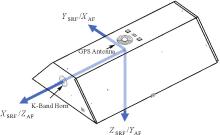
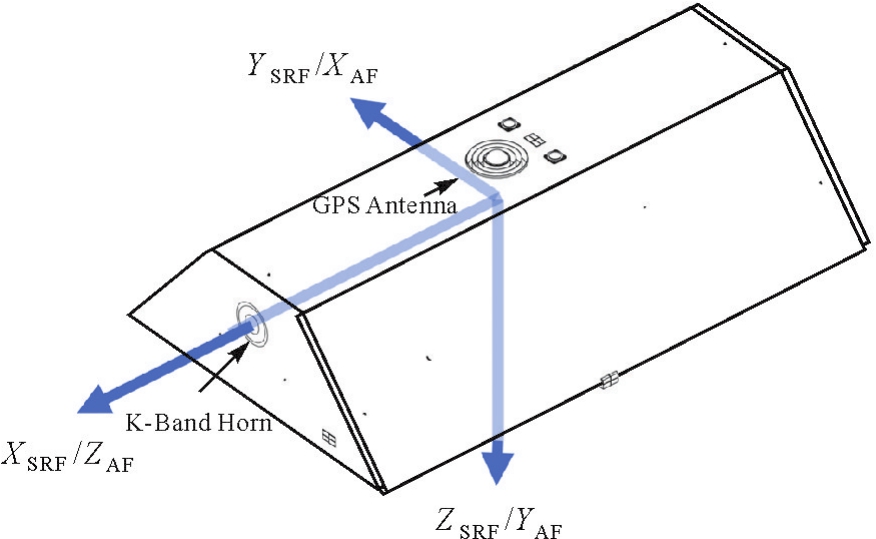
Fig. 1
The accelerometer frame (AF) and the science reference frame (SRF) within the GRACE-FO satellite[31]"
Tab. 2
Non-gravitational force modeling information"
| 非保守力 | 建模所需数据 | 数据源或模型 |
|---|---|---|
| 卫星质量 | 初值(601.214 kg) | |
| 卫星位置 | GNV文件 | |
| 卫星姿态 | SCA文件 | |
| 大气阻力 | 大气阻尼系数 | Sentman稀薄空气动力学方程[ |
| 能量调节系数[ | ||
| 大气密度 | NRLMSIS 2.0经验模型[ | |
| 卫星与大气分子之间的相对速度 | HWM14模型[ | |
| 卫星表面信息 | Macro模型[ | |
| 太阳、月球位置 | JPLDE405星历 | |
| 卫星质量 | 初值(601.214 kg) | |
| 太阳光压 | 卫星位置 | GNV文件 |
| 卫星姿态 | SCA文件 | |
| 阴影因子 | SOLAARS-CF模型[ | |
| 卫星表面信息 | Macro模型 | |
| 太阳位置 | JPLDE405星历 | |
| 地球反射率及发射率 | CERES模型[ | |
| 地球反照压 | 卫星质量 | 初值(601.214 kg) |
| 卫星位置 | GNV文件 | |
| 卫星姿态 | SCA文件 | |
| 卫星表面信息 | Macro模型 |
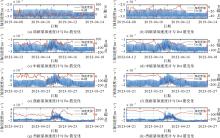
Fig. 2
The variations in GRACE-FO C satellite's X-axis accelerometer data, Bz index and Dst index during the geomagnetic storm event"

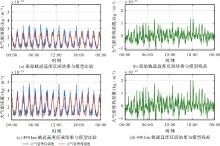
Fig. 3
Comparison of atmospheric density inversion values with models at the original orbital altitude of the GRACE-FO satellite and after orbital altitude normalization on January 1, 2022"

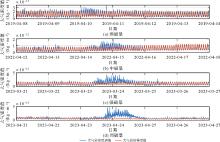
Fig. 4
Comparison between the atmospheric density inversion and model values during geomagnetic storm events"

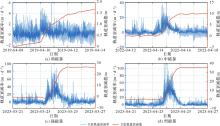
Fig. 5
The decay rate and decay values of the GRACE-FO satellite orbit triggered by geomagnetic storm events"

Tab. 3
Statistics of accelerometer, atmospheric density, and satellite orbit decay rate variations during geomagnetic storm events"
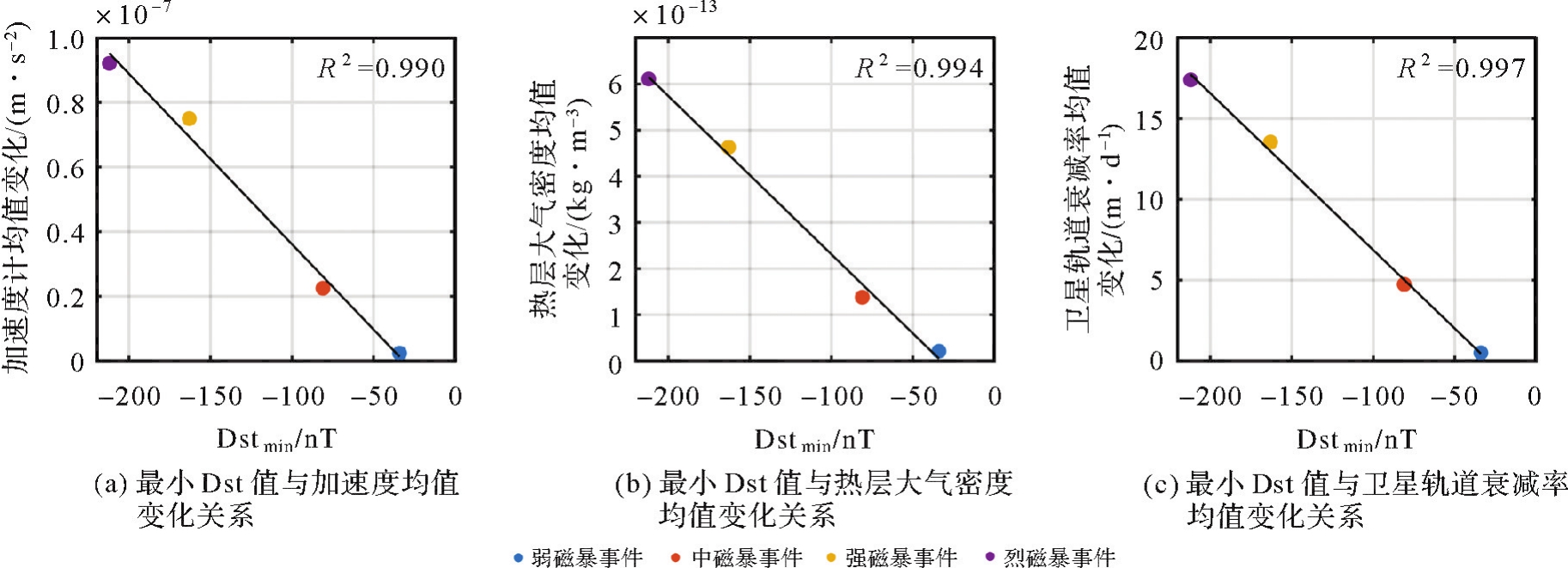
| 磁暴等级 | 最小Dst值/nt | 加速度计均值变化/(m·s-2) | 大气密度均值变化/(kg·m-3) | 卫星轨道衰减率均值变化/(m·d-1) |
|---|---|---|---|---|
| 弱磁暴 | -34 | 2.38×10⁻⁹ | 2.10×10⁻¹⁴ | 0.50 |
| 中磁暴 | -81 | 2.25×10⁻⁸ | 1.38×10⁻¹³ | 4.74 |
| 强磁暴 | -163 | 7.50×10⁻⁸ | 4.63×10⁻¹³ | 13.55 |
| 烈磁暴 | -212 | 9.21×10⁻⁸ | 6.11×10⁻¹³ | 17.40 |
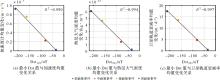
Fig. 6
The relationship between the mean changes in accelerometer data, thermospheric density, and satellite orbit decay rate with the minimum Dst value"
Tab. 4
Eigenvalues, contribution statistics and their error ranges of the first three orders of EOF modes during the April 2023 geomagnetic storm event"
| 空间模态 | 特征值 | 方差贡献率 | 累计方差贡献率 | 误差上限 | 误差下限 |
|---|---|---|---|---|---|
| 1 | 1.26×10⁻²¹ | 0.934 4 | 0.934 4 | 1.49×10⁻²¹ | 1.04×10⁻²¹ |
| 2 | 5.51×10⁻²³ | 0.040 8 | 0.975 2 | 6.49×10⁻²³ | 4.54×10⁻²³ |
| 3 | 1.10×10⁻²³ | 0.008 2 | 0.983 3 | 1.30×10⁻²³ | 9.08×10⁻²⁴ |
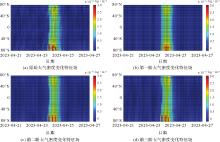
Fig. 7
Comparison of the original atmospheric density field and the first three orders of EOF eigenfields during the April 2023 geomagnetic storm event"

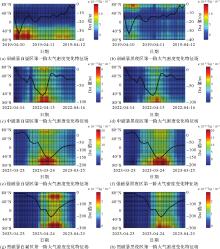
Fig. 8
Comparison of the first-order EOF eigenfields of atmospheric density variations in the daytime and nighttime zones during geomagnetic storms events"

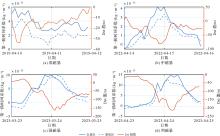
Fig. 9
First-order EOF time coefficients in the daytime and nighttime zones and the Dst index during geomagnetic storm events"

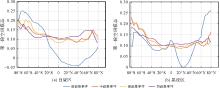
Fig. 10
First-order EOF spatial mode in the daytime and nighttime zones during geomagnetic storm events"

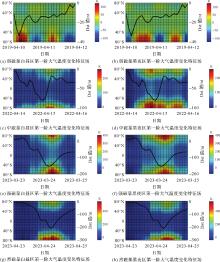
Fig. 11
Comparison of first-order EOF eigenfields of atmospheric density variations in the daytime and nighttime zones during geomagnetic storm events"

| [1] | LAKHINA G S, TSURUTANI B T. Geomagnetic storms: historical perspective to modern view[J]. Geoscience Letters, 2016, 3(1): 5. |
| [2] | FULLER-ROWELL T J, CODRESCU M V, MOFFETT R J, et al. Response of the thermosphere and ionosphere to geomagnetic storms[J]. Journal of Geophysical Research: Space Physics, 1994, 99(A3): 3893-3914. |
| [3] | LU G, RICHMOND A D, LÜHR H, et al. High-latitude energy input and its impact on the thermosphere[J]. Journal of Geophysical Research: Space Physics, 2016, 121(7): 7108-7124. |
| [4] | KALAFATOGLU E C, KAYMAZ Z, FRISSELL N A, et al. Investigating upper atmospheric joule heating using cross-combination of data for two moderate substorm cases[J]. Space Weather, 2018, 16(8): 987-1012. |
| [5] | OLIVEIRA D M, ZESTA E, SCHUCK P W, et al. Thermosphere global time response to geomagnetic storms caused by coronal mass ejections[J]. Journal of Geophysical Research: Space Physics, 2017, 122(10): 1076-1082. |
| [6] | EMMERT J T. Thermospheric mass density: a review[J]. Advances in Space Research, 2015, 56(5): 773-824. |
| [7] | SHAHZAD R, SHAH M, TARIQ M A, et al. Ionospheric-thermospheric responses to geomagnetic storms from multi-instrument space weather data[J]. Remote Sensing, 2023, 15(10): 2687. |
| [8] | LI Wenbo, LIU Libo, CHEN Yiding, et al. Multi-instruments observation of ionospheric-thermospheric dynamic coupling over Mohe (53.5°N, 122.3°E) during the April 2023 geomagnetic storm[J]. Journal of Geophysical Research: Space Physics, 2023, 128(12): e2023JA032141. |
| [9] | HEDIN A E, HINTON B B, SCHMITT G A. Role of gas-surface interactions in the reduction of Ogo 6 neutral particle mass spectrometer data[J]. Journal of Geophysical Research, 1973, 78(22): 4651-4668. |
| [10] | MEIER R R, PICONE J M. Retrieval of absolute thermospheric concentrations from the far UV dayglow: an application of discrete inverse theory[J]. Journal of Geophysical Research: Space Physics, 1994, 99(A4): 6307-6320. |
| [11] | KING-HELE D. Satellite orbits in an atmosphere: theory and applications[M]. Blackie: Springer, 1987. |
| [12] | PICONE J M, EMMERT J T, LEAN J L. Thermospheric densities derived from spacecraft orbits: accurate processing of two-line element sets[J]. Journal of Geophysical Research (Space Physics), 2005, 110(A3): A03301. |
| [13] | CALABIA A, JIN Shuanggen. Thermospheric density estimation and responses to the March 2013 geomagnetic storm from GRACE GPS-determined precise orbits[J]. Journal of Atmospheric and Solar-Terrestrial Physics, 2017, 154: 167-179. |
| [14] | SANG J, SMITH C, ZHANG K. Towards accurate atmospheric mass density determination using precise positional information of space objects[J]. Advances in Space Research, 2012, 49(6): 1088-1096. |
| [15] | LI Ruoxi, LEI Jiuhou, WANG Xijing, et al. Thermospheric mass density derived from CHAMP satellite precise orbit determination data based on energy balance method[J]. Science China Earth Sciences, 2017, 60(8): 1495-1506. |
| [16] | REIGBER C, LÜHR H, SCHWINTZER P. CHAMP mission status[J]. Advances in Space Research, 2002, 30(2): 129-134. |
| [17] | DRINKWATER M R, FLOBERGHAGEN R, HAAGMANS R, et al. GOCE: ESA's first earth explorer core mission[J]. Space Science Reviews, 2003, 108(1): 419-432. |
| [18] | TAPLEY B D, BETTADPUR S, WATKINS M, et al. The gravity recovery and climate experiment: mission overview and early results[J]. Geophysical research letters, 2004, 31(9): L09607. |
| [19] | KORNFELD R P, ARNOLD B W, GROSS M A, et al. GRACE-FO: the gravity recovery and climate experiment follow-on mission[J]. Journal of Spacecraft and Rockets, 2019, 56(3): 931-951. |
| [20] | SUTTON E K. Effects of solar disturbances on the thermosphere densities and winds from champ and grace satellite accelerometer data[D]. Boulder: University of Colorado at Boulder, 2008. |
| [21] | KRAUSS S, FICHTINGER B, LAMMER H, et al. Solar flares as proxy for the young Sun: satellite observed thermosphere response to an X17.2 flare of earth's upper atmosphere[J]. Annales Geophysicae, 2012, 30(8): 1129-1141. |
| [22] | 雷久侯, 李若曦, 任德馨, 等. 热层大气密度反演与建模研究进展[J]. 地球与行星物理论评, 2023, 54(4): 434-454. |
| LEI Jiuhou, LI Ruoxi, REN Dexin, et al. Recent progress on the retrieval and modeling of thermosphere mass density[J]. Reviews of Geophysics and Planetary Physics, 2023, 54(4): 434-454. | |
| [23] | RIDLEY A J, ZHANG D, XIAO Z. Analyzing the hemispheric asymmetry in the thermospheric density response to geomagnetic storms[J]. Journal of Geophysical Research (Space Physics), 2012, 117(A8): A08317. |
| [24] | WANG Bowen, MENG Xiangguang, SUN Yueqiang, et al. Impact of solar activity on thermospheric mass density response: observations from GRACE-FO[J]. Advances in Space Research, 2024, 73(9): 4546-4560. |
| [25] | 刘舒莳, 龚建村, 刘四清, 等. 基于经验正交分析法的暴时热层大气密度时空分布规律[J]. 地球物理学报, 2013, 56(10): 3236-3245. |
| LIU Shushi, GONG Jiancun, LIU Siqing, et al. Thermospheric density during geomagnetic storm based on EOF analysis[J]. Chinese Journal of Geophysics, 2013, 56(10): 3236-3245. | |
| [26] | 葛丽君. 基于低轨卫星加速度计的大气密度反演研究[D]. 成都: 电子科技大学, 2019. |
| GE Lijun. Inversion of atmospheric density based on accelerometers of LEO satellites[D]. Chengdu: University of Electronic Science and Technology of China, 2019. | |
| [27] | KRAUSS S, TEMMER M, VENNERSTROM S. Multiple satellite analysis of the earth's thermosphere and interplanetary magnetic field variations due to ICME/CIR events during 2003—2015[J]. Journal of Geophysical Research (Space Physics), 2018, 123(10): 8884-8894. |
| [28] | OLIVEIRA D M, ZESTA E. Satellite orbital drag during magnetic storms[J]. Space Weather, 2019, 17(11): 1510-1533. |
| [29] | KRAUSS S, BEHZADPOUR S, TEMMER M, et al. Exploring thermospheric variations triggered by severe geomagnetic storm on 26 August 2018 using GRACE follow-on data[J]. Journal of Geophysical Research (Space Physics), 2020, 125(5): e27731. |
| [30] | LOEWE C A, PRÖLSS G W. Classification and mean behavior of magnetic storms[J]. Journal of Geophysical Research: Space Physics, 1997, 102(A7): 14209-14213. |
| [31] | WEN H Y, KRUIZINGA G, PAIK M, et al. Gravity recovery and climate experiment follow-on (GRACE-FO) level-1 data product user handbook[EB/OL]. [2024-02-11]. https://archive.podace.earthdata.nasa.gov/podaacops_cumulus_docs/gracefo/open/docs/GRACE_FO_Handbook.pdf. |
| [32] | WÖSKE F, KATO T, RIEVERS B, et al. GRACE accelerometer calibration by high precision non-gravitational force modeling[J]. Advances in Space Research, 2019, 63(3): 1318-1335. |
| [33] | SENTMAN L H. Free molecule flow theory and its application to the determination of aerodynamic forces[M]. [S.l.]: Lockheed Missiles & Space Company, 1961. |
| [34] | MOE K, MOE M M. Gas-surface interactions and satellite drag coefficients[J]. Planetary and Space Science, 2005, 53(8): 793-801. |
| [35] | EMMERT J T, DROB D P, PICONE J M, et al. NRLMSIS 2.0: a whole atmosphere empirical model of temperature and neutral species densities[J]. Earth and Space Science, 2021, 8(3): e01321. |
| [36] | DROB D P, EMMERT J T, MERIWETHER J W, et al. Anupdate to the horizontal wind model (HWM): the quiet time thermosphere[J]. Earth and Space Science, 2015, 2(7): 301-319. |
| [37] | ROBERTSON R V. Highly physical solar radiation pressure modeling during penumbra transitions[D]. Virginia: Virginia Polytechnic Institute and State University, 2015. |
| [38] | WIELICKI B A, BARKSTROM B R, HARRISON E F, et al. Clouds and the earth's radiant energy system (CERES): an earth observing system experiment[J]. Bulletin of the American Meteorological Society, 1996, 77(5): 853-868. |
| [39] | KLINGER B, MAYER-GÜRR T. The role of accelerometer data calibration within GRACE gravity field recovery: results from ITSG-Grace2016[J]. Advances in Space Research, 2016, 58(9): 1597-1609. |
| [40] | BRUINSMA S, FORBES J M, NEREM R S, et al. Thermosphere density response to the 20—21 November 2003 solar and geomagnetic storm from CHAMP and GRACE accelerometer data[J]. Journal of Geophysical Research (Space Physics), 2006, 111(A6): A06303. |
| [41] | CHEN Guangming, XU Jiyao, WANG Wenbin, et al. A comparison of the effects of CIR- and CME-induced geomagnetic activity on thermospheric densities and spacecraft orbits: case studies[J]. Journal of Geophysical Research: Space Physics, 2012, 117(A8): 2012JA017782. |
| [42] | NORTH G R, BELL T L, CAHALAN R F, et al. Sampling errors in the estimation of empirical orthogonal functions[J]. Monthly Weather Review, 1982, 110(7): 699-706. |
| [43] | YUAN Liangliang, JIN Shuanggen, CALABIA A. Distinct thermospheric mass density variations following the September 2017 geomagnetic storm from GRACE and Swarm[J]. Journal of Atmospheric and Solar-Terrestrial Physics, 2019, 184: 30-36. |
| [44] | 张晓芳, 刘立波, 刘松涛, 等. 磁暴期间热层大气密度变化[J]. 地球物理学报, 2015, 58(9): 3023-3037. |
| ZHANG Xiaofang, LIU Libo, LIU Songtao, et al. A statistical study on the response of thermospheric total mass density to geomagnetic storms[J]. Chinese Journal of Geophysics, 2015, 58(9): 3023-3037. | |
| [45] | ZHU Qingyu, LU Gang, LEI Jiuhou, et al. Interhemispheric asymmetry of the thermospheric neutral density response to the 7—9 September 2017 geomagnetic storms[J]. Geophysical Research Letters, 2023, 50(11): e2023GL103208. |
| [46] | LIU Bowei, LIU Jing, LIU Xuanqing, et al. Dynamics of thermospheric traveling atmospheric disturbance during a geomagnetic storm[J]. Journal of Geophysical Research (Space Physics), 2023, 128(8): e2023JA031448. |
| [1] | CHEN Guanxu, GAO Kefu, ZHAO Jianhu, LIU Jingnan, LIU Yanxiong, LIU Yang, LI Menghao. The method of sound speed errors correction in GNSS-acoustic location service [J]. Acta Geodaetica et Cartographica Sinica, 2023, 52(4): 536-549. |
| Viewed | ||||||
|
Full text |
|
|||||
|
Abstract |
|
|||||
