

Acta Geodaetica et Cartographica Sinica ›› 2025, Vol. 54 ›› Issue (2): 286-296.doi: 10.11947/j.AGCS.2025.20240065
• Marine Survey • Previous Articles Next Articles
Jixing ZHU1( ), Shuqiang XUE1,2(), Baojin LI1,3, Zhen XIAO1,4, Kaiming WANG1
Received:2024-02-12
Online:2025-03-11
Published:2025-03-11
Contact:
Shuqiang XUE
E-mail:2211286162@qq.com;xuesq@casm.ac.cn
About author:ZHU Jixing (2001—), male, postgraduate, majors in marine geodesy. E-mail: 2211286162@qq.com
Supported by:CLC Number:
Jixing ZHU, Shuqiang XUE, Baojin LI, Zhen XIAO, Kaiming WANG. GNSS-acoustic inversion of double-exponential temperature profile[J]. Acta Geodaetica et Cartographica Sinica, 2025, 54(2): 286-296.
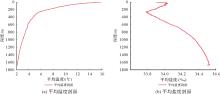
Fig. 1
Average temperature and salinity profile of MYGI station"
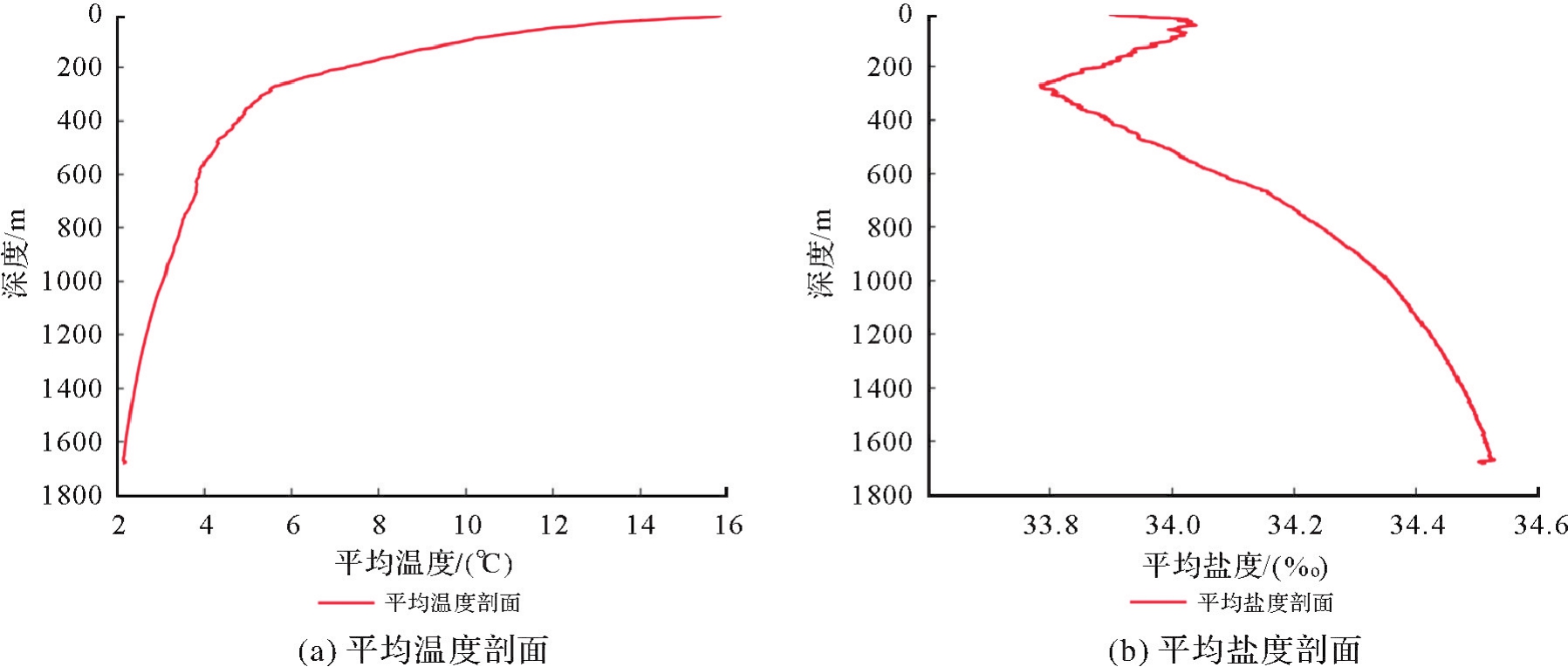
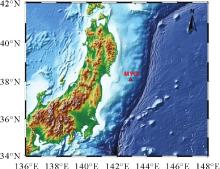
Fig. 2
MYGI stations location"

Tab. 1
Statistics of temperature and temperature slope information at 1 727.8 m at MYGI station"
| 参数 | 温度/(℃) | 温度斜率 |
|---|---|---|
| 平均值 | 2.15 | -8.09×10⁻⁴ |
| 标准差 | 0.087 4 | 1.924 9×10⁻⁴ |
Tab. 2
Temperature information of the depth of transducer"
| MYGI站复测日期 | 平均值/(℃) | 标准差/(℃) |
|---|---|---|
| 2011-03-28 | 3.87 | 1.69 |
| 2011-04-11 | 8.35 | 1.16 |
| 2011-04-29 | 11.66 | 1.06 |
| 2011-08-29 | 24.70 | 0.22 |
| 2011-11-18 | 17.60 | 0.75 |
| 2012-01-12 | 8.60 | 0.45 |
| 2012-04-22 | 12.69 | 0.53 |
| 2012-09-03 | 25.30 | 1.20 |
| 2012-11-14 | 19.28 | 0.21 |
| 2012-12-12 | 15.90 | 0.36 |
| 2013-01-29 | 8.53 | 1.46 |
| 2013-06-30 | 17.55 | 0.90 |
| 2013-09-05 | 22.16 | 0.76 |
| 2013-11-08 | 17.73 | 0.80 |
| 2014-01-15 | 11.22 | 1.14 |
| 2014-08-07 | 24.37 | 0.31 |
| 2015-01-15 | 8.55 | 0.75 |
| 2015-04-22 | 14.56 | 0.86 |
| 2015-08-12 | 24.85 | 0.13 |
| 2015-10-18 | 19.40 | 0.86 |
| 2016-03-09 | 11.90 | 0.21 |
| 2016-06-05 | 19.42 | 0.27 |
| 2016-07-23 | 24.67 | 0.34 |
| 2016-10-17 | 20.07 | 0.41 |
| 2017-03-10 | 6.28 | 1.70 |
| 2017-04-22 | 11.06 | 0.65 |
| 2017-08-19 | 23.44 | 0.31 |
| 2018-01-11 | 11.21 | 2.11 |
| 2018-02-07 | 11.44 | 1.22 |
| 2018-08-21 | 24.69 | 0.70 |
| 2019-03-10 | 16.48 | 1.85 |
| 2019-06-01 | 12.47 | 1.64 |
| 2019-10-20 | 18.32 | 0.38 |
| 2020-02-05 | 11.11 | 1.15 |
| 2020-06-15 | 15.47 | 0.90 |
Tab. 3
Single-exponential model parameters and constraint information"
| 单指数模型参数 | 约束值 | 约束标准差 |
|---|---|---|
| 中间过渡量Tm/(℃) | 2 | 100 |
| 温度差ΔT/(℃) | 10 | 100 |
| 温跃层深度u0/m | 300 | 20 |
| 换能器深度温度 | * | ** |
| 1 727.8 m处温度/(℃) | 2.15 | 0.01 |
| 1 727.8 m处斜率 | -8.09×10⁻⁴ | 0.000 01 |
Tab. 4
Double-exponential model parameters and constraint information"
| 双指数模型参数 | 约束值 | 约束标准差 |
|---|---|---|
| h1 | 4.093 7 | 100 |
| h2 | -0.000 4 | 100 |
| h3 | 13.649 8 | 100 |
| h4 | -0.004 0 | 100 |
| 换能器深度温度 | * | ** |
| 1 727.8 m处温度/(℃) | 2.15 | 0.01 |
| 1 727.8 m处斜率 | -8.09×10⁻⁴ | 0.000 01 |
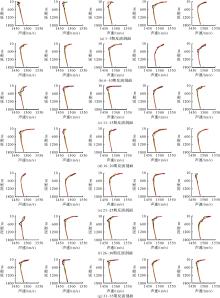
Fig. 3
Comparison of the inversion results of two models"

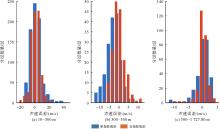
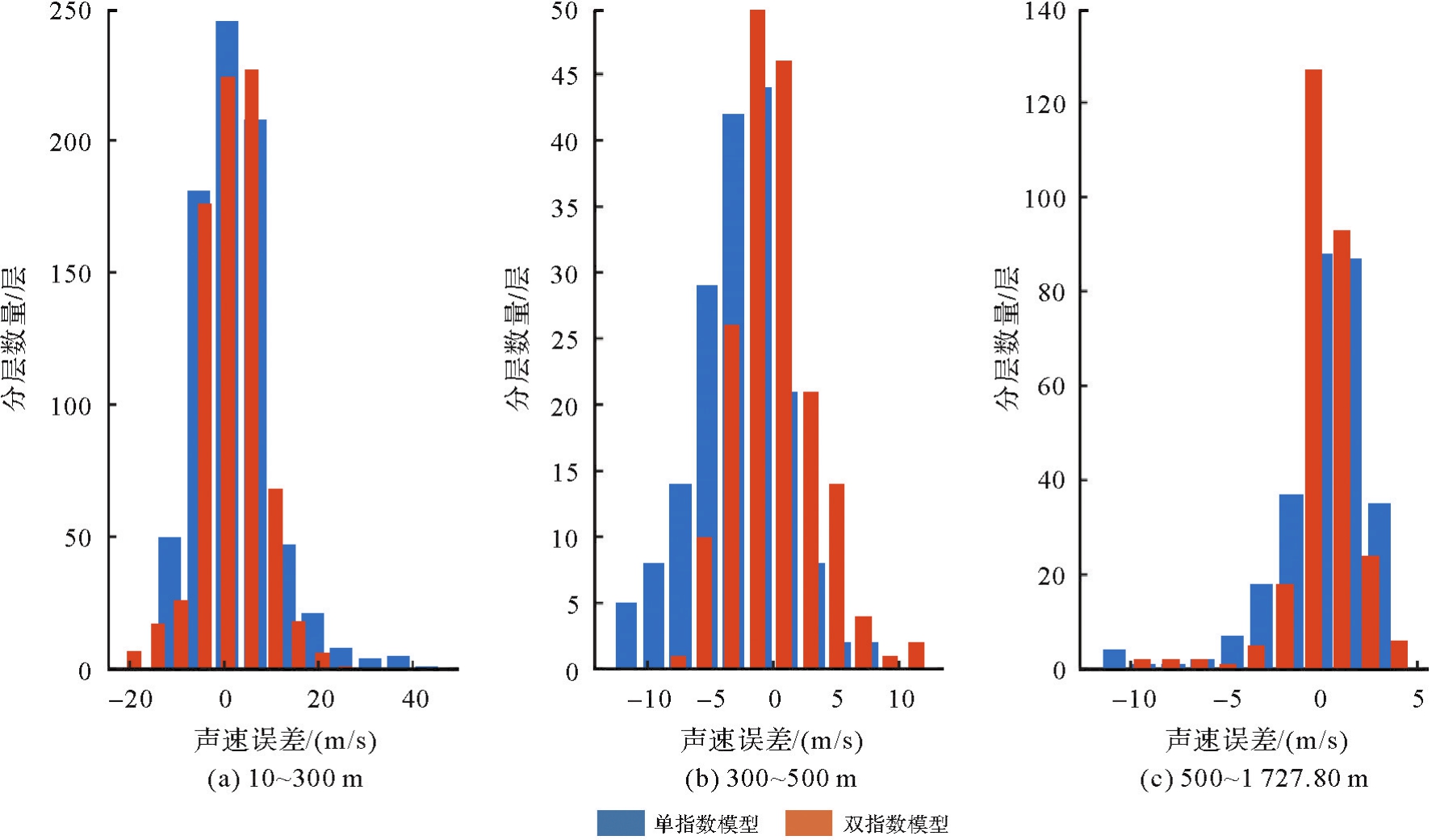
Fig. 4
Segmented statistics of the inversion SSP accuracy"
Tab. 5
Mean bias, STD and RMSE of the inversion SSP"
| 深度分层/m | 单指数模型 | 双指数模型 | ||||
|---|---|---|---|---|---|---|
| 偏差均值/(m/s) | STD/(m/s) | RMSE/(m/s) | 偏差均值/(m/s) | STD/(m/s) | RMSE/(m/s) | |
| 10~300 | 2.03 | 7.94 | 8.19 | 1.76 | 6.36 | 6.59 |
| 300~500 | -2.76 | 3.75 | 4.65 | 0.07 | 3.18 | 3.18 |
| 500~1 727.8 | -4.4×10⁻³ | 2.39 | 2.39 | 0.08 | 1.83 | 1.83 |
| 10~1 727.8 | 1.11 | 6.83 | 6.92 | 1.21 | 5.40 | 5.54 |
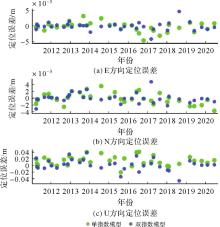
Fig. 5
Positioning error statistics of different models"
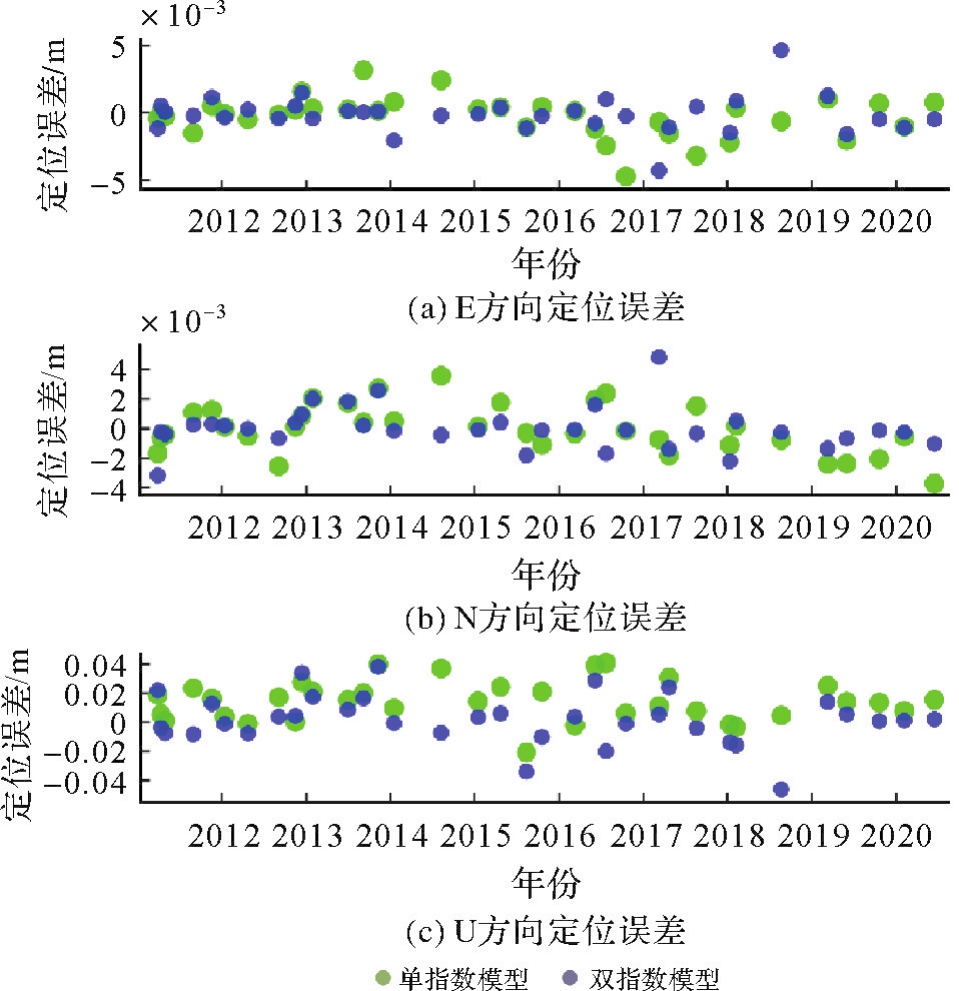
Tab. 6
Comparison of positioning accuracy of different models"
| 指标 | 单指数模型 | 双指数模型 | ||||
|---|---|---|---|---|---|---|
| E | N | U | E | N | U | |
| 偏差均值 | -0.000 3 | -1.2×10⁻⁵ | 0.015 | -0.000 1 | -2.6×10⁻⁶ | 0.002 |
| 标准差 | 0.002 | 0.002 | 0.014 | 0.001 | 0.001 | 0.017 |
| [1] | 杨元喜, 刘焱雄, 孙大军, 等. 海底大地基准网建设及其关键技术[J]. 中国科学:地球科学, 2020, 50(7): 936-945. |
| YANG Yuanxi, LIU Yanxiong, SUN Dajun, et al. Seafloor geodetic network establishment and key technologies[J]. Scientia Sinica (Terrae), 2020, 50(7): 936-945. | |
| [2] |
杨元喜, 徐天河, 薛树强. 我国海洋大地测量基准与海洋导航技术研究进展与展望[J]. 测绘学报, 2017, 46(1): 1-8.DOI:.
doi: 10.11947/j.AGCS.2017.20160519 |
|
YANG Yuanxi, XU Tianhe, XUE Shuqiang. Progresses and prospects in developing marine geodetic datum and marine navigation of China[J]. Acta Geodaetica et Cartographica Sinica, 2017, 46(1): 1-8. DOI:.
doi: 10.11947/j.AGCS.2017.20160519 |
|
| [3] | 薛树强, 杨元喜, 肖圳, 等. 全球导航卫星系统-声呐组合观测模型分类体系[J]. 哈尔滨工程大学学报, 2023, 44(11): 1857-1868. |
| XUE Shuqiang, YANG Yuanxi, XIAO Zhen, et al. Global navigation satellite system-acoustic combined observation model classification system[J]. Journal of Harbin Engineering University, 2023, 44(11): 1857-1868. | |
| [4] |
陈冠旭, 高柯夫, 赵建虎, 等. GNSS-声学位置服务中声速误差修正方法[J]. 测绘学报, 2023, 52(4): 536-549. DOI:.
doi: 10.11947/j.AGCS.2023.20220097 |
|
CHEN Guanxu, GAO Kefu, ZHAO Jianhu, et al. The method of sound speed errors correction in GNSS-acoustic location service[J]. Acta Geodaetica et Cartographica Sinica, 2023, 52(4): 536-549. DOI:.
doi: 10.11947/j.AGCS.2023.20220097 |
|
| [5] | 张盛秋, 杨元喜, 徐天河. 基于GNSS-A的海洋声速变化估计及其对定位的影响[J]. 地球物理学报, 2023, 66(3): 961-972. |
| ZHANG Shengqiu, YANG Yuanxi, XU Tianhe. Estimation of ocean sound velocity variation based on GNSS-A and its influence on positioning[J]. Chinese Journal of Geophysics, 2023, 66(3): 961-972. | |
| [6] | 孙大军, 郑翠娥, 张居成, 等. 水声定位导航技术的发展与展望[J]. 中国科学院院刊, 2019, 34(3): 331-338. |
| SUN Dajun, ZHENG Cuie, ZHANG Jucheng, et al. Development and prospect for underwater acoustic positioning and navigation technology[J]. Bulletin of Chinese Academy of Sciences, 2019, 34(3): 331-338. | |
| [7] | 齐珂, 曲国庆, 苏晓庆, 等. 水下声纳定位浮标阵列解析优化[J]. 武汉大学学报(信息科学版), 2019, 44(9): 1312-1319. |
| QI Ke, QU Guoqing, SU Xiaoqing, et al. Analytical optimization on GNSS/sonar buoy array deployment for underwater positioning[J]. Geomatics and Information Science of Wuhan University, 2019, 44(9): 1312-1319. | |
| [8] |
王薪普, 薛树强, 曲国庆, 等. 水下定位声线扰动分析与分段指数权函数设计[J]. 测绘学报, 2021, 50(7): 982-989.DOI:.
doi: 10.11947/j.AGCS.2021.20200424 |
|
WANG Xinpu, XUE Shuqiang, QU Guoqing, et al. Disturbance analysis of underwater positioning acoustic ray and design of piecewise exponential weight function[J]. Acta Geodaetica et Cartographica Sinica, 2021, 50(7): 982-989. DOI:.
doi: 10.11947/j.AGCS.2021.20200424 |
|
| [9] | 王凯明, 薛树强, 李景森. 有效声速泰勒级数逼近的适用条件[J]. 海洋测绘, 2023, 43(5): 31-34. |
| WANG Kaiming, XUE Shuqiang, LI Jingsen. Applicable conditions of Taylor series approximation formulae of effective sound velocity[J]. Hydrographic Surveying and Charting, 2023, 43(5): 31-34. | |
| [10] |
辛明真, 阳凡林, 薛树强, 等. 顾及波束入射角的常梯度声线跟踪水下定位算法[J]. 测绘学报, 2020, 49(12): 1535-1542.DOI:.
doi: 10.11947/j.AGCS.2020.20190518 |
|
XIN Mingzhen, YANG Fanlin, XUE Shuqiang, et al. A constant gradient sound ray tracing underwater positioning algorithm considering incident beam angle[J]. Acta Geodaetica et Cartographica Sinica, 2020, 49(12): 1535-1542.DOI:.
doi: 10.11947/j.AGCS.2020.20190518 |
|
| [11] |
闫凤池, 王振杰, 赵爽, 等. 顾及双程声径的常梯度声线跟踪水下定位算法[J]. 测绘学报, 2022, 51(1): 31-40.DOI:.
doi: 10.11947/j.AGCS.2022.20210234 |
|
YAN Fengchi, WANG Zhenjie, ZHAO Shuang, et al. A layered constant gradient acoustic ray tracing underwater positioning algorithm considering round-trip acoustic path[J]. Acta Geodaetica et Cartographica Sinica, 2022, 51(1): 31-40. DOI:.
doi: 10.11947/j.AGCS.2022.20210234 |
|
| [12] | 李伟嘉, 王振杰, 孙振, 等. 基于深度约束的超短基线声速改正方法[J]. 导航定位学报, 2022, 10(5): 40-45. |
| LI Weijia, WANG Zhenjie, SUN Zhen, et al. An USBL sound velocity correction method based on depth constraint[J]. Journal of Navigation and Positioning, 2022, 10(5): 40-45. | |
| [13] |
赵爽, 王振杰, 刘慧敏. 顾及声线入射角的水下定位随机模型[J]. 测绘学报, 2018, 47(9): 1280-1289.DOI:.
doi: 10.11947/j.AGCS.2018.20170026 |
|
ZHAO Shuang, WANG Zhenjie, LIU Huimin. Investigation on underwater positioning stochastic model based on sound ray incidence angle[J]. Acta Geodaetica et Cartographica Sinica, 2018, 47(9): 1280-1289. DOI:.
doi: 10.11947/j.AGCS.2018.20170026 |
|
| [14] | 李景森, 薛树强, 徐莹, 等. 声速剖面测量误差对水下定位的影响[J]. 哈尔滨工程大学学报, 2023, 44(11): 2062-2070. |
| LI Jingsen, XUE Shuqiang, XU Ying, et al. Effects of sound speed profile measurement error on underwater positioning[J]. Journal of Harbin Engineering University, 2023, 44(11): 2062-2070. | |
| [15] | 薛树强, 杨诚, 赵爽, 等. 海底大地控制网无人观测系统研究进展[J/OL]. 导航定位学报. [2025-01-06]. http://dhdwxb.chinajournal.net.cn/WKC/WebPublication/paperDigest.aspx?paperID=4d65ba60-5961-4f8f-b596-4cb9350a02e3. |
| XUE Shuqiang, YANG Cheng, ZHAO Shuang, et al. Review of unmanned observation systems for seafloor geodetic network[J/OL]. Journal of Navigation and Positioning. [2025-01-06]. http://dhdwxb.chinajournal.net.cn/WKC/WebPublication/paperDigest.aspx?paperID=4d65ba60-5961-4f8f-b596-4cb9350a02e3. | |
| [16] | 胡军. 基于RBF神经网络的声速剖面反演及软件实现[D]. 湘潭: 湘潭大学, 2018. |
| HU Jun. Inversion of sound velocity profile based on RBF neural network and its software implementation[D]. Xiangtan: Xiangtan University, 2018. | |
| [17] |
赵建虎, 梁文彪. 海底控制网测量和解算中的几个关键问题[J]. 测绘学报, 2019, 48(9): 1197-1203.DOI:.
doi: 10.11947/j.AGCS.2019.20190157 |
|
ZHAO Jianhu, LIANG Wenbiao. Some key points of submarine control network measurement and calculation[J]. Acta Geodaetica et Cartographica Sinica, 2019, 48(9): 1197-1203. DOI:.
doi: 10.11947/j.AGCS.2019.20190157 |
|
| [18] | 王凯明, 薛树强, 韩保民, 等. 海洋内波对海底精密定位的影响[J]. 哈尔滨工程大学学报, 2023, 44(11): 2054-2061. |
| WANG Kaiming, XUE Shuqiang, HAN Baomin, et al. Effect of ocean internal waves on high-precision seafloor geodetic positioning[J]. Journal of Harbin Engineering University, 2023, 44(11): 2054-2061. | |
| [19] | HAN Fuxing, SUN Jianguo, WANG Kun. The influence of sea water velocity variation on seismic traveltimes, ray paths, and amplitude[J]. Applied Geophysics, 2012, 9(3): 319-325. |
| [20] | 黄威, 高凡, 王君婷, 等. 水下声速场构建方法综述[J]. 哈尔滨工程大学学报, 2023, 44(11): 2005-2017. |
| HUANG Wei, GAO Fan, WANG Junting, et al. A review on the construction of underwater sound speed fields[J]. Journal of Harbin Engineering University, 2023, 44(11): 2005-2017. | |
| [21] | 李林洋, 徐天河, 王君婷, 等. 联合匹配场和神经网络的声速时间场构建方法[J]. 哈尔滨工程大学学报, 2023, 44(11): 2044-2053. |
| LI Linyang, XU Tianhe, WANG Junting, et al. A method for constructing a sound velocity time field by combining a matched field and neural network[J]. Journal of Harbin Engineering University, 2023, 44(11): 2044-2053. | |
| [22] | 肖圳, 薛树强, 韩保民, 等. 参考声速剖面误差对主动式声呐定位影响仿真分析[J]. 地球物理学报, 2023, 66(12): 4889-4899. |
| XIAO Zhen, XUE Shuqiang, HAN Baomin, et al. Simulation analysis on reference sound velocity profile error influence on active acoustic positioning[J]. Chinese Journal of Geophysics, 2023, 66(12): 4889-4899. | |
| [23] |
赵爽, 王振杰, 聂志喜, 等. 顾及声速结构时域变化的海底基准站高精度定位方法[J]. 测绘学报, 2023, 52(1): 41-50.DOI:.
doi: 10.11947/j.AGCS.2023.20210326 |
|
ZHAO Shuang, WANG Zhenjie, NIE Zhixi, et al. Precise positioning method for seafloor geodetic stations based on the temporal variation of sound speed structure[J]. Acta Geodaetica et Cartographica Sinica, 2023, 52(1): 41-50.DOI:.
doi: 10.11947/j.AGCS.2023.20210326 |
|
| [24] | MUNK W H. Sound channel in an exponentially stratified ocean, with application to SOFAR[J]. The Journal of the Acoustical Society of America, 1974, 55(2): 220-226. |
| [25] | DAVIS T M, COUNTRYMAN K A, CARRON M J. Tailored acoustic products utilizing the NAVOCEANO GDEM (a generalized digital environmental model)[C]//Proceedings of the 36th Naval Symposium on Underwater Acoustics. San Diego: Naval Ocean Systems Center, 1986. |
| [26] | TEAGUE W J, CARRON M J, HOGAN P J. A comparison between the generalized digital environmental model and levitus climatologies[J]. Journal of Geophysical Research: Oceans, 1990, 95(C5): 7167-7183. |
| [27] | 张旭, 张永刚, 张健雪, 等. 一种新的声速剖面结构参数化方法[J]. 海洋学报, 2011, 33(5): 54-60. |
| ZHANG Xu, ZHANG Yonggang, ZHANG Jianxue, et al. A new model for calculating sound speed profile structure[J]. Acta Oceanologica Sinica, 2011, 33(5): 54-60. | |
| [28] | CHEN H H. Travel-time approximation of acoustic ranging in GPS/acoustic seafloor geodesy[J]. Ocean Engineering, 2014, 84: 133-144. |
| [29] | XUE Shuqiang, LI Baojin, XIAO Zhen, et al. Centimeter-level-precision seafloor geodetic positioning model with self-structured empirical sound speed profile[J]. Satellite Navigation, 2023, 4(1): 30. |
| [30] | DEL GROSSO V A. New equation for the speed of sound in natural waters (with comparisons to other equations)[J]. The Journal of the Acoustical Society of America, 1974, 56(4): 1084-1091. |
| [31] | 吴碧, 陈长安, 林龙. 声速经验公式的适用范围分析[J]. 声学技术, 2014, 33(6): 504-507. |
| WU Bi, CHEN Chang'an, LIN Long. Analysis of applicable scope of empirical equation for sound velocity[J]. Technical Acoustics, 2014, 33(6): 504-507. | |
| [32] | LEROY C C, PARTHIOT F. Depth-pressure relationships in the oceans and seas[J]. The Journal of the Acoustical Society of America, 1998, 103(3): 1346-1352. |
| [33] | YOKOTA Y, ISHIKAWA T, WATANABE S I. Seafloor crustal deformation data along the subduction zones around Japan obtained by GNSS-A observations[J]. Scientific Data, 2018, 5: 180182. |
| [34] | 李景森, 薛树强, 肖圳, 等. GNSS/声呐组合观测臂长改正不确定度评估[J/OL]. 武汉大学学报(信息科学版). [2025-01-06]. http://ch.whu.edu.cn/cn/article/doi/10.13203/j.whugis20220673. |
| LI Jingsen, XUE Shuqiang, XIAO Zhen, et al. Uncertainty evaluation on the arm length correction of GNSS-A observation[J/OL]. Geomatics and Information Science of Wuhan Universiny.[2025-01-06]. http://ch.whu.edu.cn/cn/article/doi/10.13203/j.whugis20220673. |
| [1] | KUANG Yingcai, Lü Zhiping, LI Linyang, WANG Fangchao, XU Guochang. Dynamic nolinear Gauss-Helmert model and its robust total Kalman filter algorithm for GNSS-acoustic underwater positioning [J]. Acta Geodaetica et Cartographica Sinica, 2023, 52(4): 559-570. |
| [2] | CHEN Guanxu, GAO Kefu, ZHAO Jianhu, LIU Jingnan, LIU Yanxiong, LIU Yang, LI Menghao. The method of sound speed errors correction in GNSS-acoustic location service [J]. Acta Geodaetica et Cartographica Sinica, 2023, 52(4): 536-549. |
| [3] | ZHAO Shuang, WANG Zhenjie, NIE Zhixi, HE Kaifei, LIU Huimin, SUN Zhen. Precise positioning method for seafloor geodetic stations based on the temporal variation of sound speed structure [J]. Acta Geodaetica et Cartographica Sinica, 2023, 52(1): 41-50. |
| Viewed | ||||||
|
Full text |
|
|||||
|
Abstract |
|
|||||
