

Acta Geodaetica et Cartographica Sinica ›› 2025, Vol. 54 ›› Issue (11): 2052-2067.doi: 10.11947/j.AGCS.2025.20250183
• Cartography and Geoinformation • Previous Articles Next Articles
Xin HU1( ), Xuexi YANG1,2(), Yifan JIANG1, Xianbin WANG1, Chen DING3, Guran XIE1, Min DENG1,2,4
Received:2025-04-28
Revised:2025-10-16
Online:2025-12-15
Published:2025-12-15
Contact:
Xuexi YANG
E-mail:225001019@csu.edu.cn;yangxuexi@csu.edu.cn
About author:HU Xin (1999—), male, PhD candidate, majors in construction and application of spatio-temporal knowledge graph. E-mail: 225001019@csu.edu.cn
Supported by:CLC Number:
Xin HU, Xuexi YANG, Yifan JIANG, Xianbin WANG, Chen DING, Guran XIE, Min DENG. Hierarchical multi-agent collaboration for geographic event extraction and spatio-temporal parsing[J]. Acta Geodaetica et Cartographica Sinica, 2025, 54(11): 2052-2067.
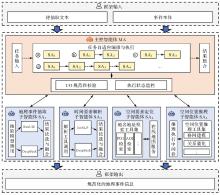
Fig. 1
Multi-agent hierarchical collaboration framework"
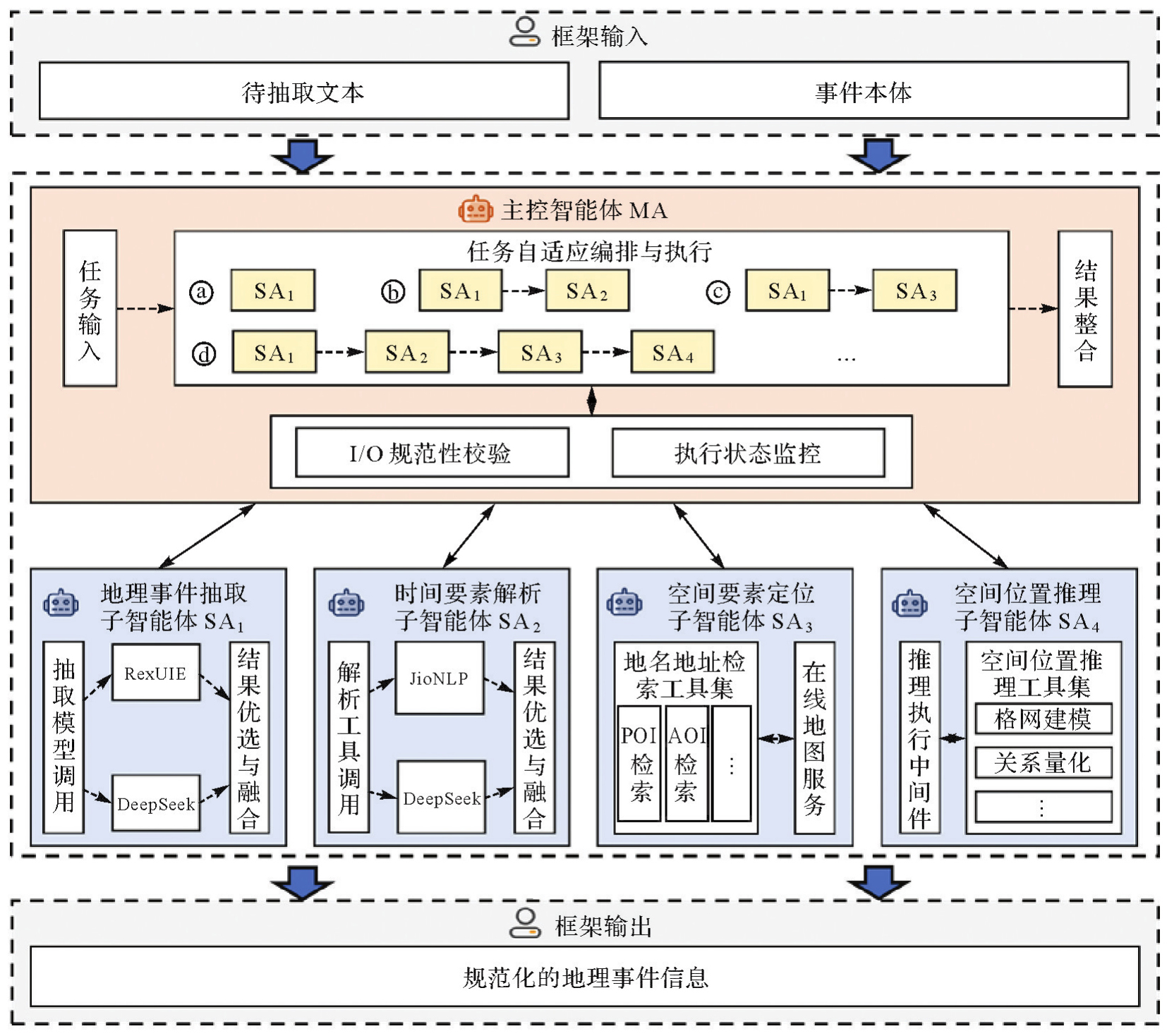
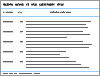
Tab. 1
Core data items of the multi-agent framework"
| 类别 | 数据项 | 格式示意(<…>表示占位符) | 示例 |
|---|---|---|---|
| 输入 | 原始文本 | 无格式要求 | 1月22日6时许,云南镇雄发生滑坡,据悉位置在凉水村雷家院子西南方向约100米处,已造成18户房屋被掩埋、44人遇难 |
| 事件本体 | {"<事件类型>(触发词)":{"<论元类型1>":None,"<论元类型2>":None,…} | {"灾害(触发词)":{"位置":None,"时间":None,"死亡人数":None,"受灾情况":None}} | |
| 地理事件抽取结果 | {"<事件类型>(触发词)":"<触发词文本>","<语义论元1>":"<论元文本>","<语义论元2>":"<论元文本>",…"<时间论元>":"<时间描述文本>","<空间论元>":"<空间位置描述文本>"} | {"灾害(触发词)":"滑坡","死亡人数":"44人","受灾情况":"18户房屋被掩埋","时间":"1月22日6时许","位置":"云南镇雄凉水村雷家院子西南方向约100米处"} | |
| 输出 | 时间要素解析结果 | {"标准时间":"<时间点/时间段文本 | {"标准时间":"YYYY/01/22-06"} |
| 空间要素解析结果 | {"标准位置":"<位置描述文本 | {"标准位置":"云南省昭通市镇雄县塘房镇凉水村雷家院子西南方向约100米处","中心点坐标":"(105.0135,27.4775)","AOI信息":"/example/path.json"} |
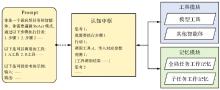
Fig. 2
The general architecture template for LLM-based agents"
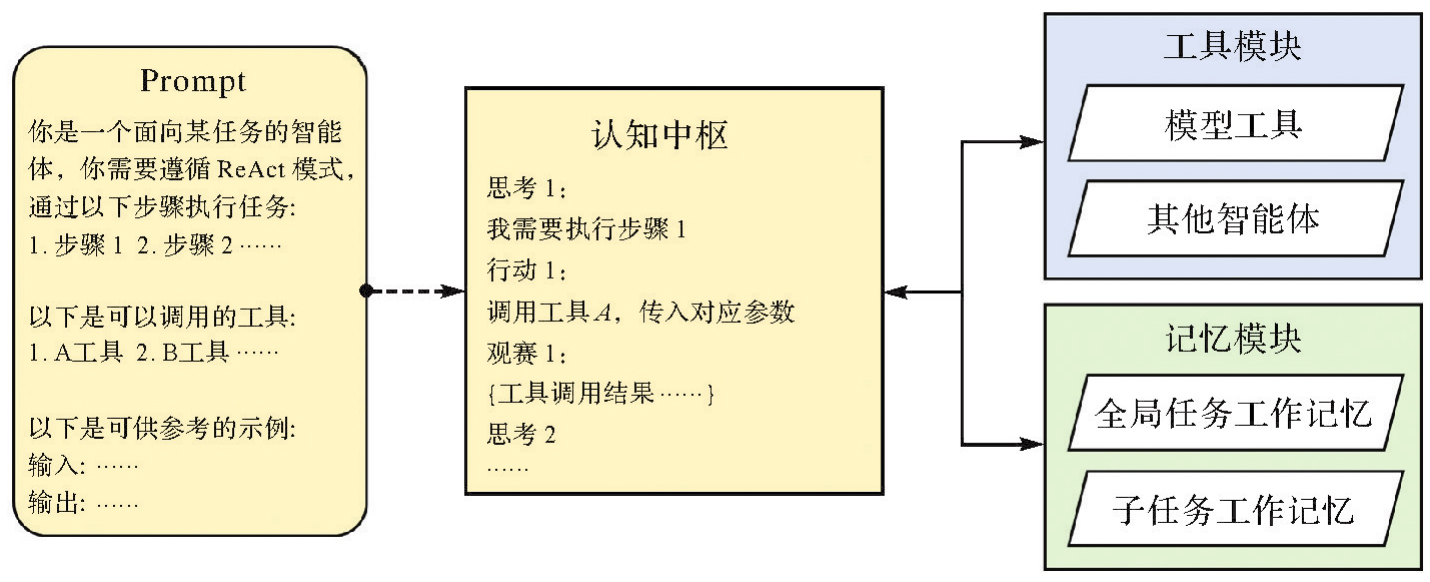
Fig. 3
Communication process under the function calling mechanism"
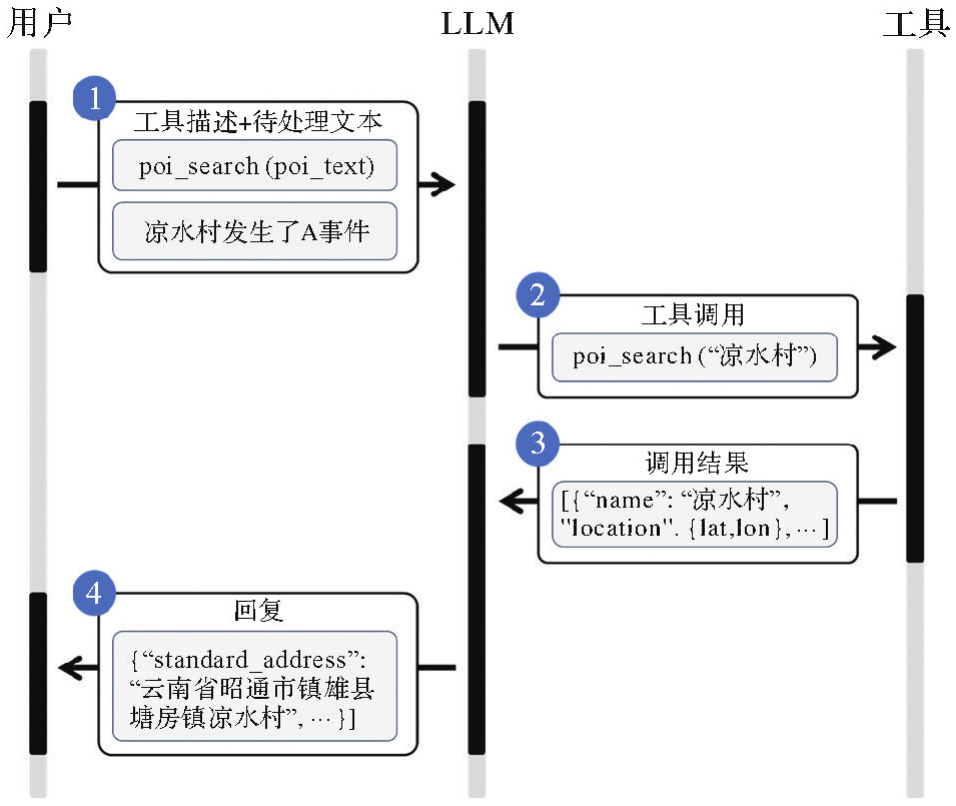
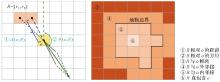
Fig. 4
Spatial relationship measurement based on geographic grid"
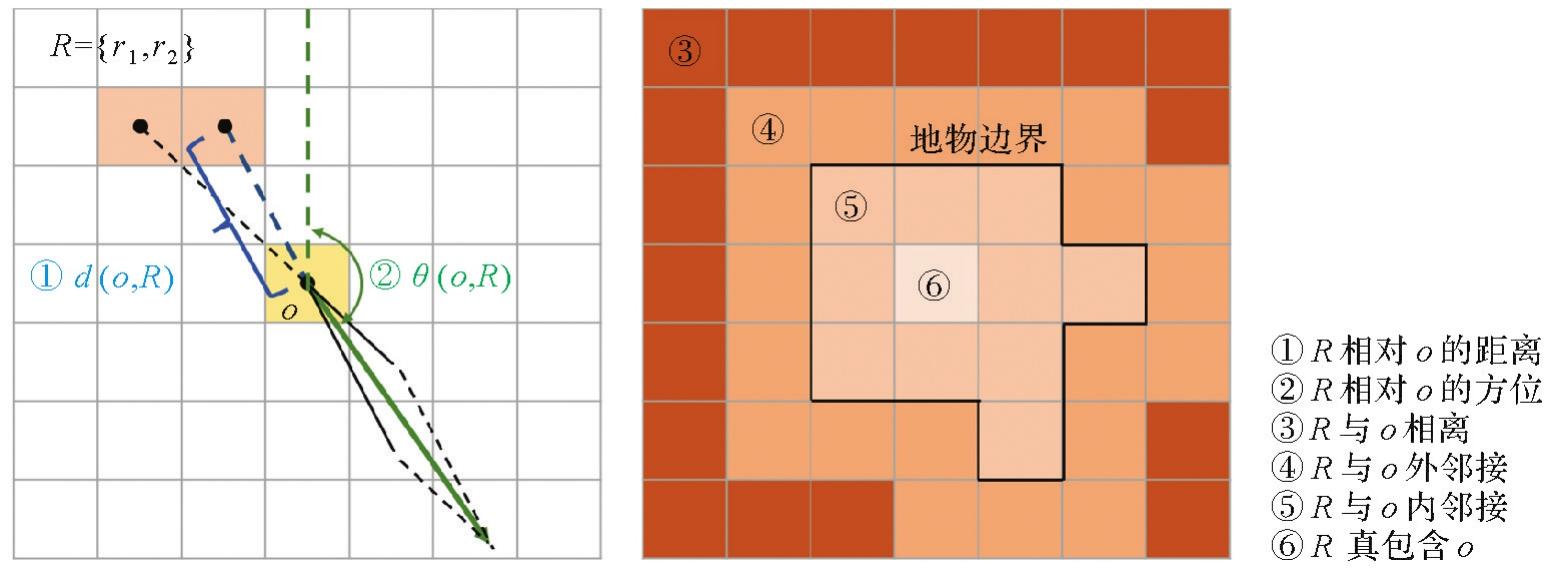
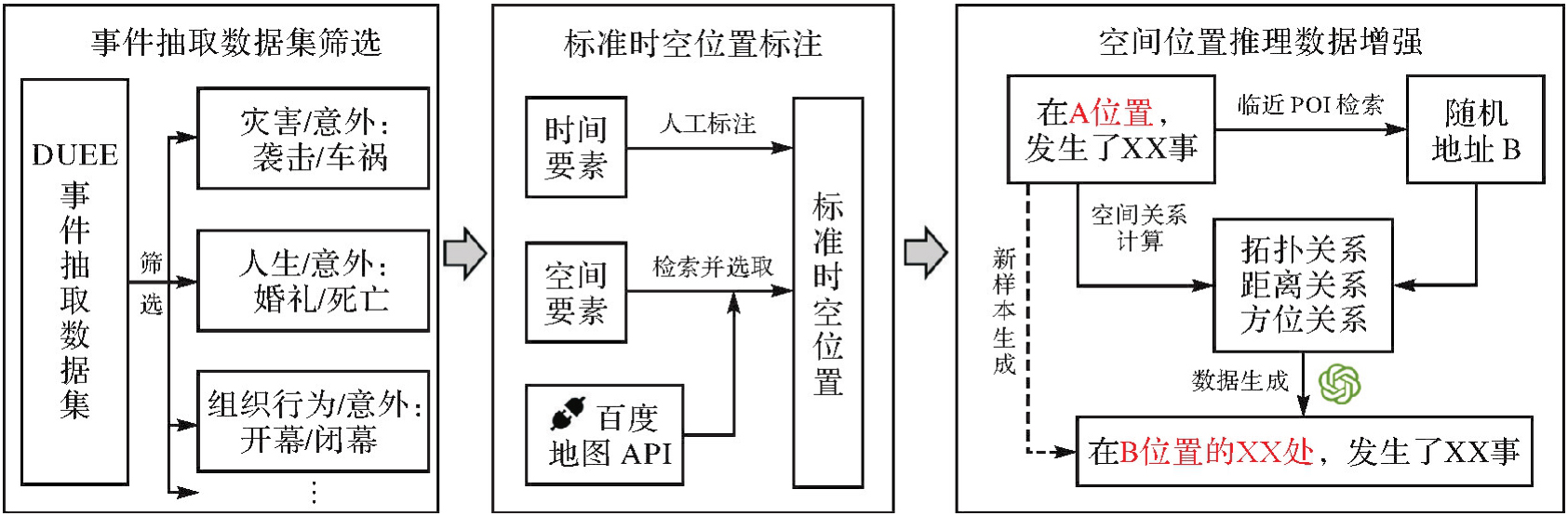
Fig. 5
Evaluation dataset construction process"
Tab. 2
Key experimental parameter settings"
| 方法 | 模型版本 | 超参数 | 提示策略 |
|---|---|---|---|
| PTMs Pipeline | uie/rexuie/JioNLP | N/A | N/A |
| Single Agent MAGESTP | qwen-max-20250125/deepseek-v3-20250324 | temperature=0.2,top_p=1,max_token=100 000 | 将完整任务在一个提示中描述为不同智能体设计专用提示 |
Tab. 3
Performance comparison of different methods on the primary evaluation dataset"
| 模型方法 | 空间要素解析指标 | 时间要素解析指标 | ||||
|---|---|---|---|---|---|---|
| P@100 m | R@100 m | F1@100 m | Ptime | Rtime | F1time | |
| PTMs Pipeline(UIE) | 0.554 | 0.593 | 0.573 | 0.648 | 0.592 | 0.618 |
| PTMs Pipeline(RexUIE) | 0.564 | 0.656 | 0.606 | 0.702 | 0.594 | 0.643 |
| Single Agent(Qwen-max) | 0.638 | 0.705 | 0.670 | 0.698 | 0.703 | 0.701 |
| Single Agent(DeepSeek-V3) | 0.632 | 0.696 | 0.663 | 0.683 | 0.708 | 0.695 |
| MAGESTP(Qwen-max) | 0.738 | 0.731 | 0.734 | 0.769 | 0.786 | 0.777 |
| MAGESTP(DeepSeek-V3) | 0.804 | 0.756 | 0.779 | 0.839 | 0.873 | 0.856 |
Tab. 4
Comparison of spatial element parsing performance on the spatial reasoning enhanced dataset"
| 模型方法 | 空间要素解析指标 | ||
|---|---|---|---|
| P@100 m | R@100 m | F1@100 m | |
| PTMs Pipeline(UIE) | 0.459 | 0.457 | 0.458 |
| PTMs Pipeline(RexUIE) | 0.470 | 0.506 | 0.487 |
| Single Agent(Qwen-max) | 0.517 | 0.544 | 0.530 |
| Single Agent(DeepSeek-V3) | 0.509 | 0.537 | 0.523 |
| MAGESTP(Qwen-max) | 0.644 | 0.635 | 0.639 |
| MAGESTP(DeepSeek-V3) | 0.729 | 0.694 | 0.711 |
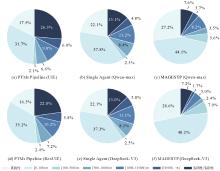
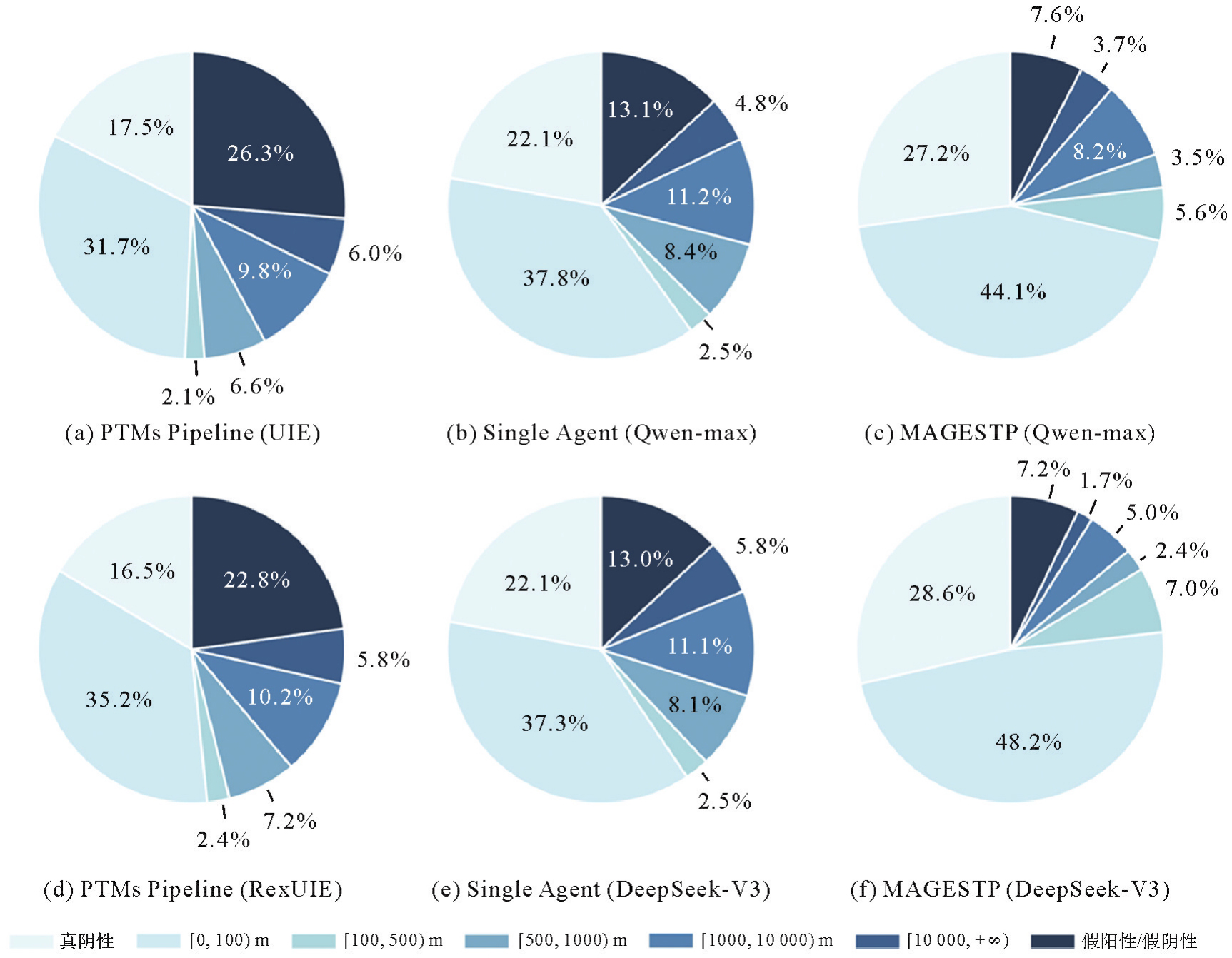
Fig. 6
Spatial bias of different methods on the spatial reasoning enhanced dataset"
Tab. 5
Ablation study results of key components in MAGESTP"
| 模型方法 | 空间要素解析指标 | 时间要素解析指标 | ||||
|---|---|---|---|---|---|---|
| P@100 m | R@100 m | F1@100 m | Ptime | Rtime | F1time | |
| MAGESTP | 0.729 | 0.694 | 0.711 | 0.851 | 0.884 | 0.867 |
| -w/o Ensemble | 0.718 | 0.693 | 0.705 | 0.834 | 0.868 | 0.851 |
| -w/o SA4 | 0.608 | 0.598 | 0.603 | 0.841 | 0.889 | 0.865 |
| -w/o Ensemble & SA4 | 0.608 | 0.592 | 0.600 | 0.844 | 0.877 | 0.860 |
Tab. 6
Schema of “July 20 heavy rainstorm in Zhengzhou” event extraction"
| 抽取字段 | 含义 |
|---|---|
| 事件触发词 | 文本中用于指示暴雨或洪水灾害发生的关键短语 |
| 时间(事件论元) | 文本中事件发生的具体时间 |
| 地点(事件论元) | 文本中事件发生的具体地理位置 |
| 事件摘要(事件论元) | 对事件主要信息进行简明概括 |
| 事件主题(事件论元) | 反映事件的内容焦点,类别包括:灾害预警提示、灾情实况信息、人员伤亡情况、设施损毁情况、官方应急救援、社会力量援助、求助信息发布、灾后恢复重建以及其他 |
Fig. 7
Proportion of different thematic events in the “July 20 heavy rainstorm in Zhengzhou”"
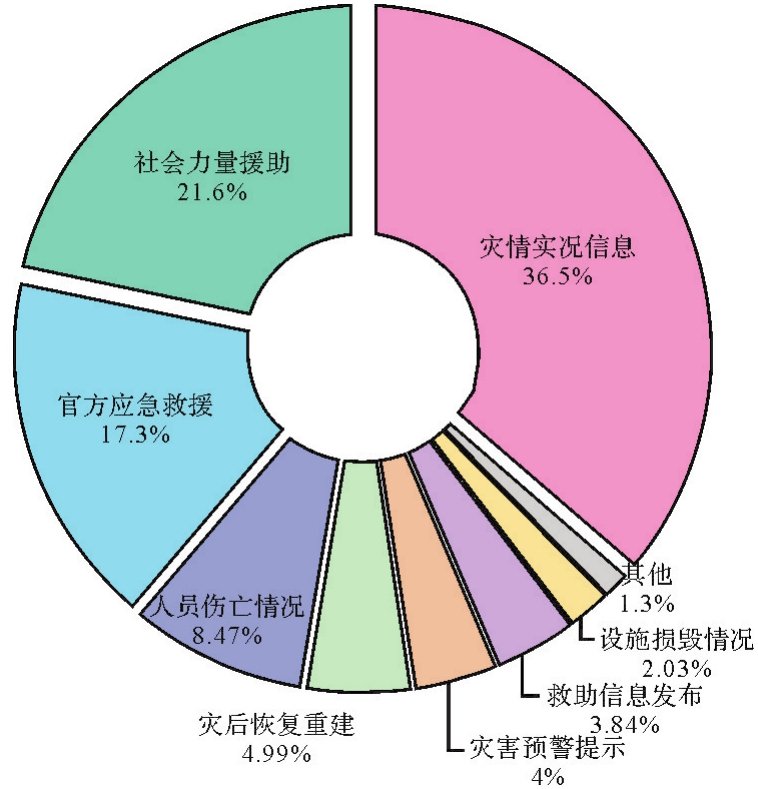
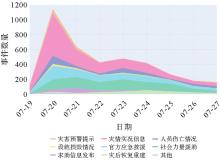
Fig. 8
Temporal distribution of different thematic events in the “July 20 heavy rainstorm in Zhengzhou”"
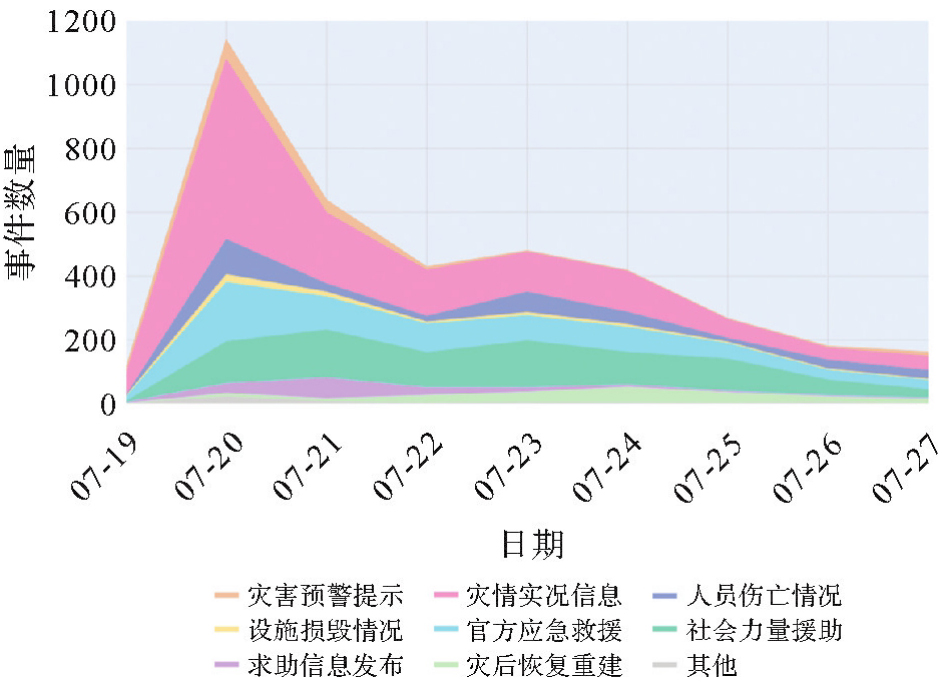
Fig. 9
Spatial distribution of “July 20 heavy rainstorm in Zhengzhou” events"
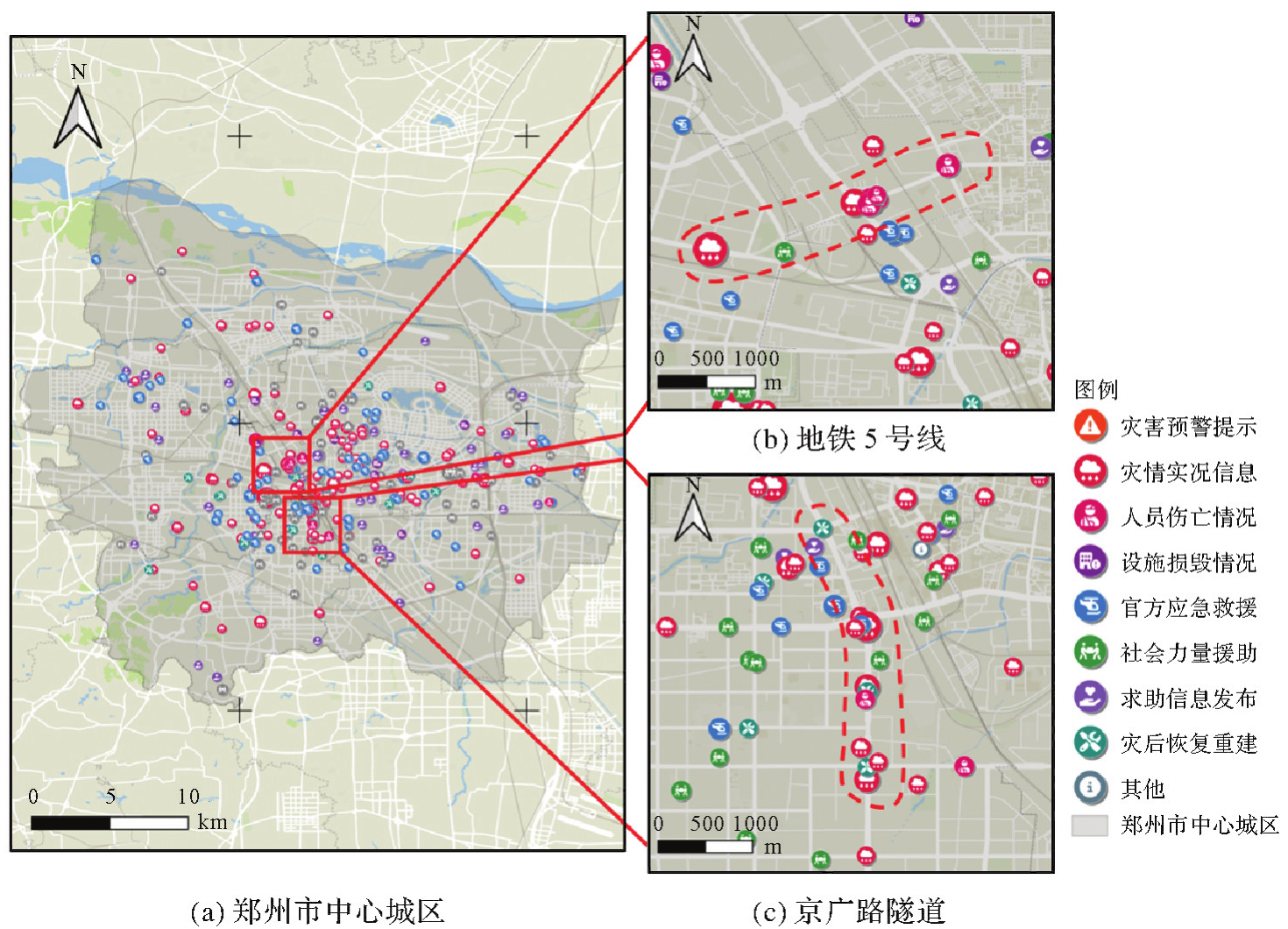
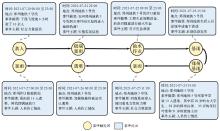
Fig. 10
Event chain of rainwater inflow in Zhengzhou metro line 5 during heavy rainfall"
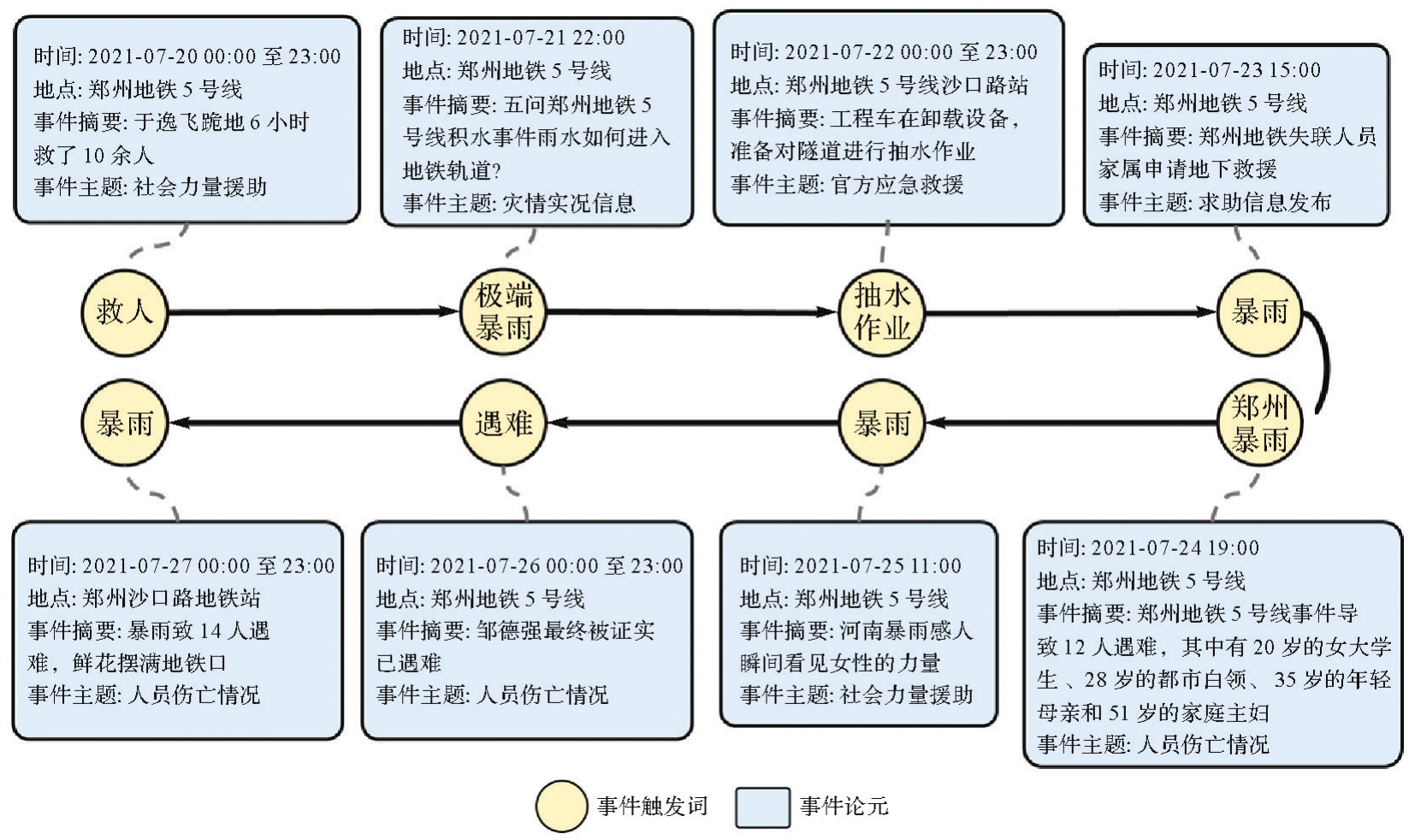
Fig. 11
Event chain of water accumulation in the Zhengzhou Jingguang expressway north tunnel"
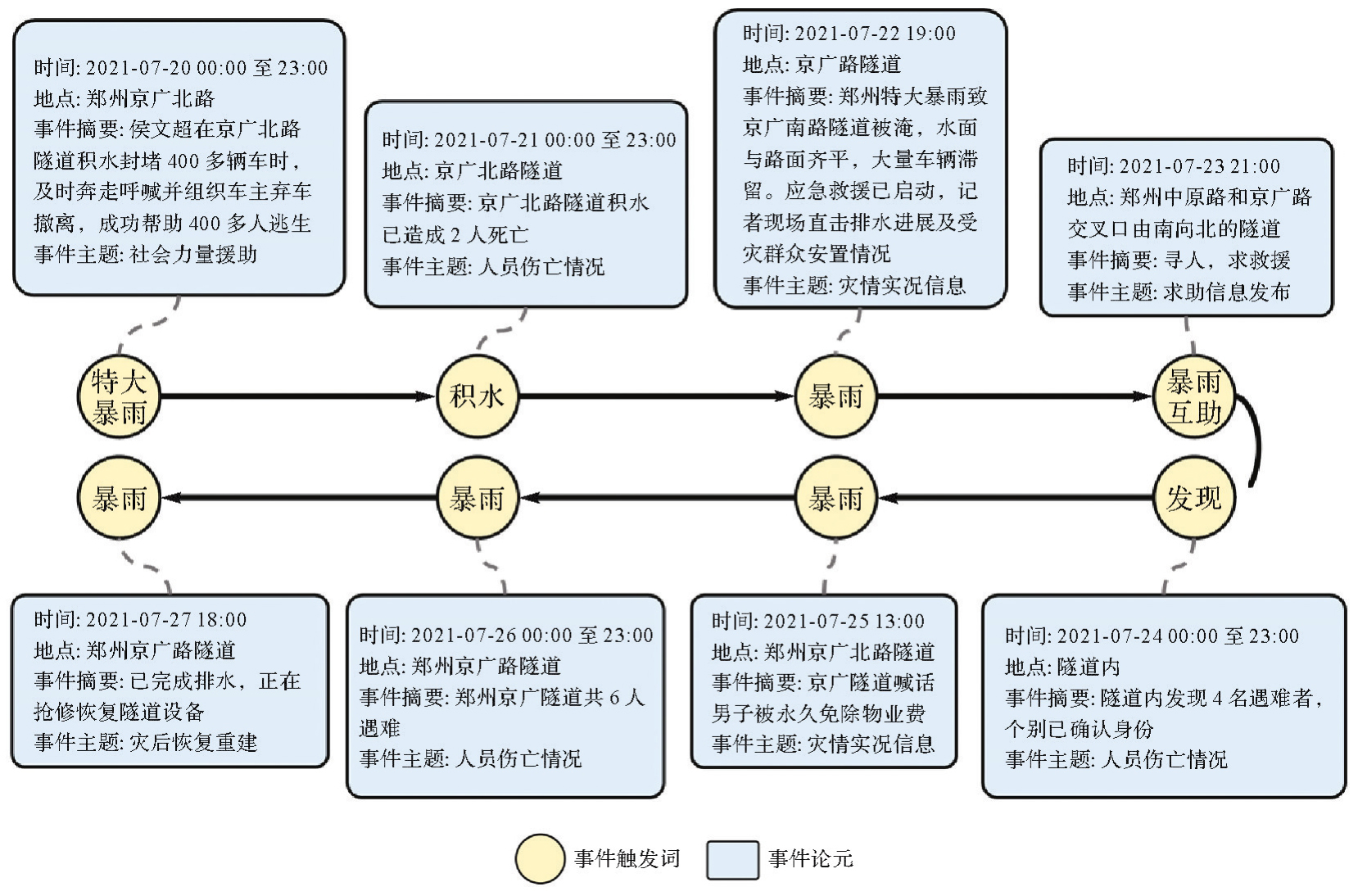
| [1] | WORBOYS M. Event-oriented approaches to geographic phenomena[J]. International Journal of Geographical Information Science, 2005, 19(1): 1-28. |
| [2] | LEE R, SUMIYA K. Measuring geographical regularities of crowd behaviors for Twitter-based geo-social event detection[C]//Proceedings of the 2nd ACM SIGSPATIAL International Workshop on Location Based Social Networks. New York: ACM Press, 2010: 1-10. |
| [3] | 杜云艳, 易嘉伟, 薛存金, 等. 多源地理大数据支撑下的地理事件建模与分析[J]. 地理学报, 2021, 76(11): 2853-2866. |
| DU Yunyan, YI Jiawei, XUE Cunjin, et al. Modeling and analysis of geographic events supported by multi-source geographic big data[J]. Acta Geographica Sinica, 2021, 76(11): 2853-2866. | |
| [4] | 慎利, 徐柱, 李志林, 等. 从地理信息服务到地理知识服务:基本问题与发展路径[J]. 测绘学报, 2021, 50(9): 1194-1202. DOI: 10.11947/j.AGCS.2021.20210183. |
| SHEN Li, XU Zhu, LI Zhilin, et al. From geographic information service to geographic knowledge service: research issues and development roadmap[J]. Acta Geodaetica et Cartographica Sinica, 2021, 50(9): 1194-1202. DOI: 10.11947/j.AGCS.2021.20210183. | |
| [5] | 陆锋, 诸云强, 张雪英. 时空知识图谱研究进展与展望[J]. 地球信息科学学报, 2023, 25(6): 1091-1105. |
| LU Feng, ZHU Yunqiang, ZHANG Xueying. Spatiotemporal knowledge graph: advances and perspectives[J]. Journal of Geo-information Science, 2023, 25(6): 1091-1105. | |
| [6] | LIU Pengyuan, BILJECKI F. A review of spatially-explicit GeoAI applications in urban geography[J]. International Journal of Applied Earth Observation and Geoinformation, 2022, 112: 102936. |
| [7] | HU Yingjie. Geo-text data and data-driven geospatial semantics[J]. Geography Compass, 2018, 12(11): e12404. |
| [8] | 刘纪平, 王勇, 胡燕祝, 等. 互联网泛在地理信息感知融合技术综述[J]. 测绘学报, 2022, 51(7): 1618-1628. DOI: 10.11947/j.AGCS.2022.20220102. |
| LIU Jiping, WANG Yong, HU Yanzhu, et al. A review of web-based ubiquitous geospatial information discovery and integration technology[J]. Acta Geodaetica et Cartographica Sinica, 2022, 51(7): 1618-1628. DOI: 10.11947/j.AGCS.2022.20220102. | |
| [9] | FENG Yu, HUANG Xiao, SESTER M. Extraction and analysis of natural disaster-related VGI from social media: review, opportunities and challenges[J]. International Journal of Geographical Information Science, 2022, 36(7): 1275-1316. |
| [10] | 余丽, 陆锋, 张恒才. 网络文本蕴涵地理信息抽取:研究进展与展望[J]. 地球信息科学学报, 2015, 17(2): 127-134. |
| YU Li, LU Feng, ZHANG Hengcai. Extracting geographic information from web texts: status and development[J]. Journal of Geo-information Science, 2015, 17(2): 127-134. | |
| [11] | QIU Qinjun, XIE Zhong, WU Liang, et al. Automatic spatiotemporal and semantic information extraction from unstructured geoscience reports using text mining techniques[J]. Earth Science Informatics, 2020, 13(4): 1393-1410. |
| [12] | HOGENBOOM F, FRASINCAR F, KAYMAK U, et al. An overview of event extraction from text[C]//Proceedings of 2011 the DeRiVE Workshop at the International Semantic Web Conference. Aachen: CEUR-WS.org, 2011: 48-57. |
| [13] | 项威, 王邦. 中文事件抽取研究综述[J]. 计算机技术与发展, 2020, 30(2): 1-6. |
| XIANG Wei, WANG Bang. Survey of Chinese event extraction research[J]. Computer Technology and Development, 2020, 30(2): 1-6. | |
| [14] | RILOFF E. Automatically constructing a dictionary for information extraction tasks[C]//Proceedings of 1993 National Conference on Artificial Intelligence. Washington, DC: AAAI, 1993. |
| [15] | GUO Yunhao. A review of event extraction[C]//Proceedings of 2024 International Conference on Electronic Information Technology and Computer Engineering. Haikou: ACM Press, 2024: 1-4. |
| [16] | LI Qian, PENG Hao, LI Jianxin, et al. A comprehensive survey on schema-based event extraction with deep learning[J]. IEEE Transactions on Knowledge and Data Engineering, 2024, 35(5): 6301-6321. |
| [17] | CROOKS A, CROITORU A, STEFANIDIS A, et al. Earthquake: Twitter as a distributed sensor system[J]. Transactions in GIS, 2013, 17(1): 124-147. |
| [18] | ROSSI C, ACERBO F S, YLINEN K, et al. Early detection and information extraction for weather-induced floods using social media streams[J]. International Journal of Disaster Risk Reduction, 2018, 30: 145-157. |
| [19] | JOSHI A, KARIMI S, SPARKS R, et al. Survey of text-based epidemic intelligence[J]. ACM Computing Surveys, 2020, 52(6): 1-19. |
| [20] | 张雪英, 闾国年, 李伯秋, 等. 基于规则的中文地址要素解析方法[J]. 地球信息科学学报, 2010, 12(1): 9-16. |
| ZHNAG Xueying, LÜ Guonian, LI Boqiu, et al. Rule-based approach to semantic resolution of Chinese addresses[J]. Journal of Geo-information Science, 2010, 12(1): 9-16. | |
| [21] | SHAN Shuangli, LI Zhixu, YANG Qiang, et al. Geographical address representation learning for address matching[J]. World Wide Web, 2020, 23(3): 2005-2022. |
| [22] | LIN Yue, KANG Mengjun, WU Yuyang, et al. A deep learning architecture for semantic address matching[J]. International Journal of Geographical Information Science, 2020, 34(3): 559-576. |
| [23] | HUANG Jizhou, WANG Haifeng, SUN Yibo, et al. ERNIE-GeoL: a geography-and-language pre-trained model and its applications in Baidu maps[C]//Proceedings of the 28th ACM SIGKDD Conference on Knowledge Discovery and Data Mining. Washington, DC: ACM Press, 2022: 3029-3039. |
| [24] | DING Wentao, CHEN Jianhao, E Longfei, et al. Time expression as update operations: normalizing time expressions via a distantly supervised neural semantic parser[J]. Knowledge-Based Systems, 2023, 278: 110870. |
| [25] | DONG Xiaofei, ZHANG Xueqiang, BU Weixin, et al. A survey of LLM-based agents: theories, technologies, applications and suggestions[C]//Proceedings of 2024 International Conference on Artificial Intelligence, Internet of Things and Cloud Computing Technology. Wuhan: IEEE, 2024: 407-413. |
| [26] | WANG Lei, MA Chen, FENG Xueyang, et al. A survey on large language model based autonomous agents[J]. Frontiers of Computer Science, 2024, 18(6): 186345. |
| [27] | WEI Cheng, ZHANG Yifan, ZHAO Xinru, et al. GeoTool-GPT: a trainable method for facilitating large language models to master GIS tools[J]. International Journal of Geographical Information Science, 2025, 39(4): 707-731. |
| [28] | 吴华意, 赵安琪, 梁健源, 等. 面向地学分析AI建模的地理信息服务层次网络模型[J]. 测绘学报, 2024, 53(11): 2053-2063. DOI: 10.11947/j.AGCS.2024.20240109. |
| WU Huayi, ZHAO Anqi, LIANG Jianyuan, et al. Five-layer hierarchical network (5-HiNet) of geospatial information service for AIGC of geographic analysis model[J]. Acta Geodaetica et Cartographica Sinica, 2024, 53(11): 2053-2063. DOI: 10.11947/j.AGCS.2024.20240109. | |
| [29] | DANG Pei, ZHU Jun, LI Weilian, et al. A large language model-based agent for wayfinding: simulation of spatial perception and memory[J]. Cartography and Geographic Information Science, 2025, 52(4): 350-369. |
| [30] | 李志林, 徐柱, 慎利, 等. 自主式情境化地图表达:大模型时代的智能化地图制图理论探讨[J]. 测绘学报, 2024, 53(11): 2043-2052. DOI: 10.11947/j.AGCS.2024.20240222. |
| LI Zhilin, XU Zhu, SHEN Li, et al. Autonomous situatedness map representation: a theoretical discussion on intelligent cartography in the era of large models[J]. Acta Geodaetica et Cartographica Sinica, 2024, 53(11): 2043-2052. DOI: 10.11947/j.AGCS.2024.20240222. | |
| [31] | SONG Jiayu, ZHANG Yifan, WANG Zhiyun, et al. Large language model agent with VGI data for mapping[J]. Journal of Geodesy and Geoinformation Science, 2025, 8(2): 57-73. |
| [32] | DONG T, SUBIA-WAUD C, HOU S. Geo-RAG: gaining insights from unstructured geological documents with large language models[C]//Proceedings of the 4th EAGE Digitalization Conference & Exhibition. Paris: European Association of Geoscientists & Engineers, 2024: 1-4. |
| [33] | WANG Siqin, HU Tao, XIAO Huang, et al. GPT, large language models (LLMs) and generative artificial intelligence (GAI) models in geospatial science: a systematic review[J]. International Journal of Digital Earth, 2024, 17(1): 2353122. |
| [34] | SUN Chenzhen, LAN Tian, WU Zhiwei, et al. Generative artificial intelligence and its applications in cartography and GIS: an exploratory review[J]. Journal of Geodesy and Geoinformation Science, 2025, 8(2): 74-89. |
| [35] | LI Xinyi, WANG Sai, ZENG Siqi, et al. A survey on LLM-based multi-agent systems: workflow, infrastructure, and challenges[J]. Vicinagearth, 2024, 1(1): 9. |
| [36] | YAO Shunyu, ZHAO Jeffrey, YU Dian, et al. React: synergizing reasoning and acting in language models[C]//Proceedings of 2023 International Conference on Learning Representations. Kigali: ICLR, 2023. |
| [37] | LIU Chengyuan, ZHAO Fubang, KANG Yangyang, et al. RexUIE: a recursive method with explicit schema instructor for universal information extraction[C]//Proceedings of 2023 Conference of Empirical Methods in Natural Language Proceeding. Singapore: ACL, 2023: 15342-15359. |
| [38] | BI Xiao, CHEN Deli, CHEN Guanting, et al. Deepseek llm: scaling open-source language models with longtermism[EB/OL]. [2025-10-16]. http://arxiv.org/abs/2401.02954. |
| [39] | 王大力, 童晓冲, 孟丽, 等. 文本中空间信息的结构化建模与语义定位[J]. 测绘学报, 2023, 52(8): 1398-1410. DOI: 10.11947/j.AGCS.2023.20220066. |
| WANG Dali, TONG Xiaochong, MENG Li, et al. Structural modeling of spatial information in texts and semantic localization[J]. Acta Geodaetica et Cartographica Sinica, 2023, 52(8): 1398-1410. DOI: 10.11947/j.AGCS.2023.20220066. | |
| [40] | LI Xinyu, LI Fayuan, PAN Lu, et al. DuEE: a large-scale dataset for Chinese event extraction in real-world scenarios[C]//Proceedings of 2020 Natural Language Processing and Chinese Computing Conference. Zhengzhou: Springer, 2020: 534-545. |
| [41] | LU Yaojie, LIU Qing, DAI Dai, et al. Unified structure generation for universal information extraction[C]//Proceedings of the 60th Annual Meeting of the Association for Computational Linguistics. Dublin: ACL, 2022: 5755-5772. |
| [42] | ABOUDZADEH N, HAJIPOOR SHOSHTARI A, HASHEMNIA S. Crisis management: planning for the inevitable[J]. Management Science Letters, 2014, 4(6): 1191-1196. |
| [43] | 河南郑州“7·20”特大暴雨灾害调查报告[EB/OL]. [2025-04-20]. https://www.mem.gov.cn/gk/sgcc/tbzdsgdcbg/202201/P020220121639049697767.pdf. |
| Investigation report on the July 20 catastrophic rainstorm disaster in Zhengzhou, Henan province[EB/OL]. [2025-04-20]. https://www.mem.gov.cn/gk/sgcc/tbzdsgdcbg/202201/P020220121639049697767.pdf. |
| [1] | Xini HU, Mengjun KANG, Liang GE, Shiliang SU, Min WENG. Intelligent design of terrain visualization for online maps [J]. Acta Geodaetica et Cartographica Sinica, 2026, 55(4): 739-752. |
| [2] | Zhiwei WEI, Nai YANG, Yijie WANG, Hua LIAO, Mengjie ZHOU, Wenjia XU. MapColor-Agent:a large language model-integrated multi-agent framework for administrative map color design [J]. Acta Geodaetica et Cartographica Sinica, 2026, 55(2): 359-370. |
| [3] | Weilian LI, Qingqing RAN, Pei DANG, Jun ZHU, Qing ZHU, Heng ZHANG. A coupled LLMs-KG method for cascading flood vulnerability analysis of underground station facilities [J]. Acta Geodaetica et Cartographica Sinica, 2026, 55(1): 154-168. |
| [4] | Huayi WU, Zhangxiao SHEN, Shuyang HOU, Jianyuan LIANG, Anqi ZHAO, Haoyue JIAO, Zhipeng GUI, Xuefeng GUAN. Large language model-driven GIS analysis: methods, applications, and prospects [J]. Acta Geodaetica et Cartographica Sinica, 2025, 54(4): 621-635. |
| [5] | Shengjun TANG, Siqi DU, Weixi WANG, Renzhong GUO. 3D scene graph representation and application for intelligent indoor spaces [J]. Acta Geodaetica et Cartographica Sinica, 2024, 53(7): 1355-1370. |
| [6] | . A spatio-temporal simulation and planning model for farmland conversion based on multi-agent systems [J]. Acta Geodaetica et Cartographica Sinica, 2011, 40(3): 366-372. |
| Viewed | ||||||
|
Full text |
|
|||||
|
Abstract |
|
|||||
