

Acta Geodaetica et Cartographica Sinica ›› 2026, Vol. 55 ›› Issue (1): 46-58.doi: 10.11947/j.AGCS.2026.20250100
• Geodesy and Navigation • Previous Articles Next Articles
Wenyuan ZHANG1,2( ), Jinsong PENG1(), Nadu WEI3, Yu GAO1, Shubi ZHANG1,2
Received:2025-03-07
Revised:2025-09-15
Online:2026-02-13
Published:2026-02-13
Contact:
Jinsong PENG
E-mail:zhangwy@cumt.edu.cn;pjs@cumt.edu.cn
About author:ZHANG Wenyuan (1996—), male, PhD, associate professor, majors in GNSS atmospheric monitoring and climate change applications, GNSS data processing, and ERP forecasting. E-mail: zhangwy@cumt.edu.cn
Supported by:CLC Number:
Wenyuan ZHANG, Jinsong PENG, Nadu WEI, Yu GAO, Shubi ZHANG. A short-term prediction method for Earth's polar motion using cascaded LSTM networks based on SSA denoising[J]. Acta Geodaetica et Cartographica Sinica, 2026, 55(1): 46-58.
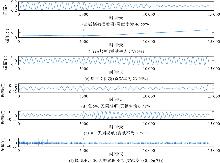
Fig. 1
SSA decomposition sequence in X direction of polar motion"

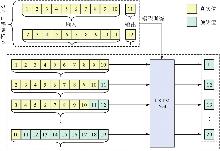
Fig. 2
Flowchart of recursive LSTM neural network model prediction"
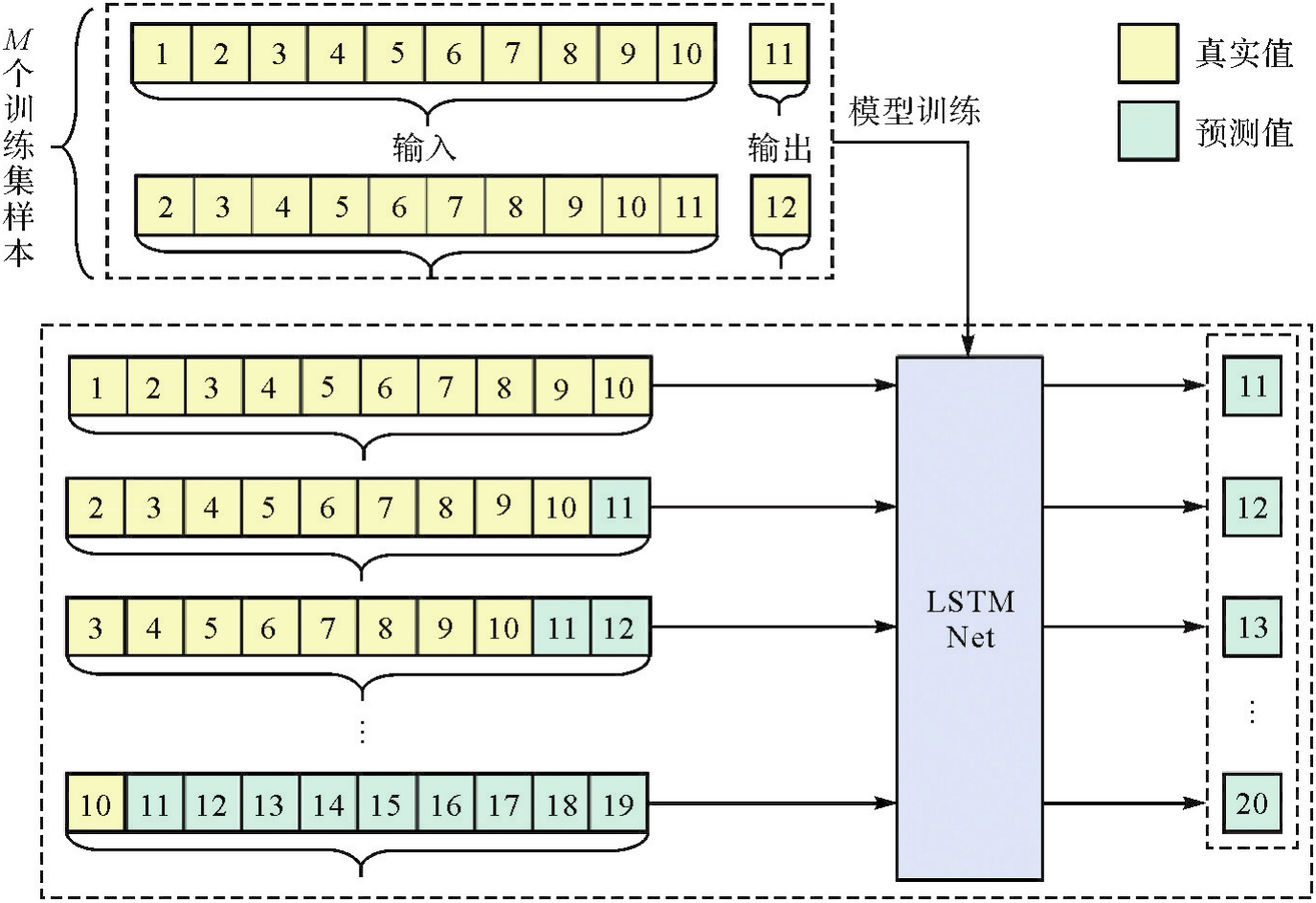
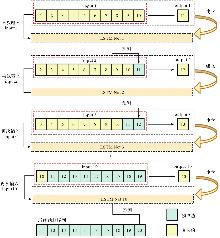
Fig. 3
Flowchart of cascaded LSTM neural network model prediction"
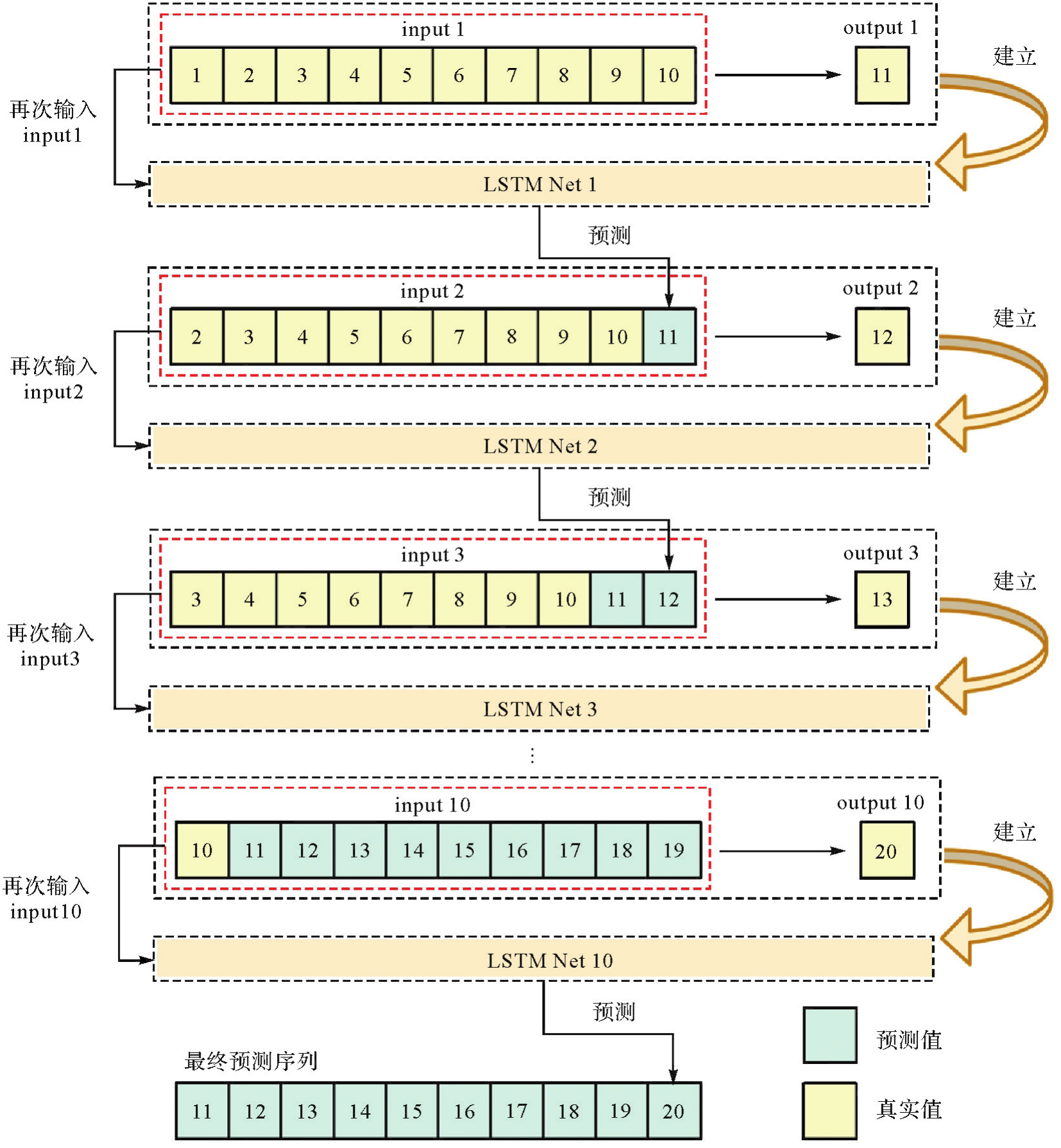
Fig. 4
3D trajectory of Earth's polar motion from 1962 to 2024"
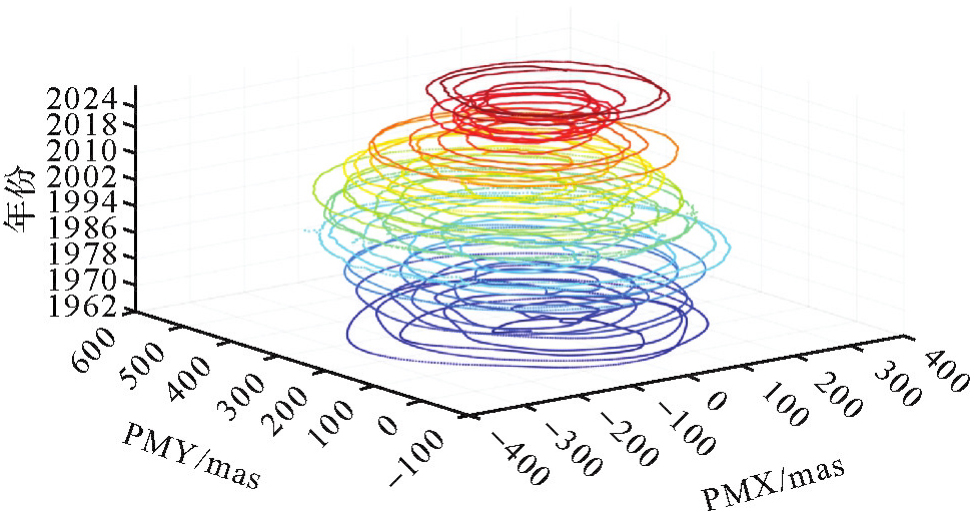

Fig. 5
MAE comparison of prediction results for four schemes over the next 10 days"
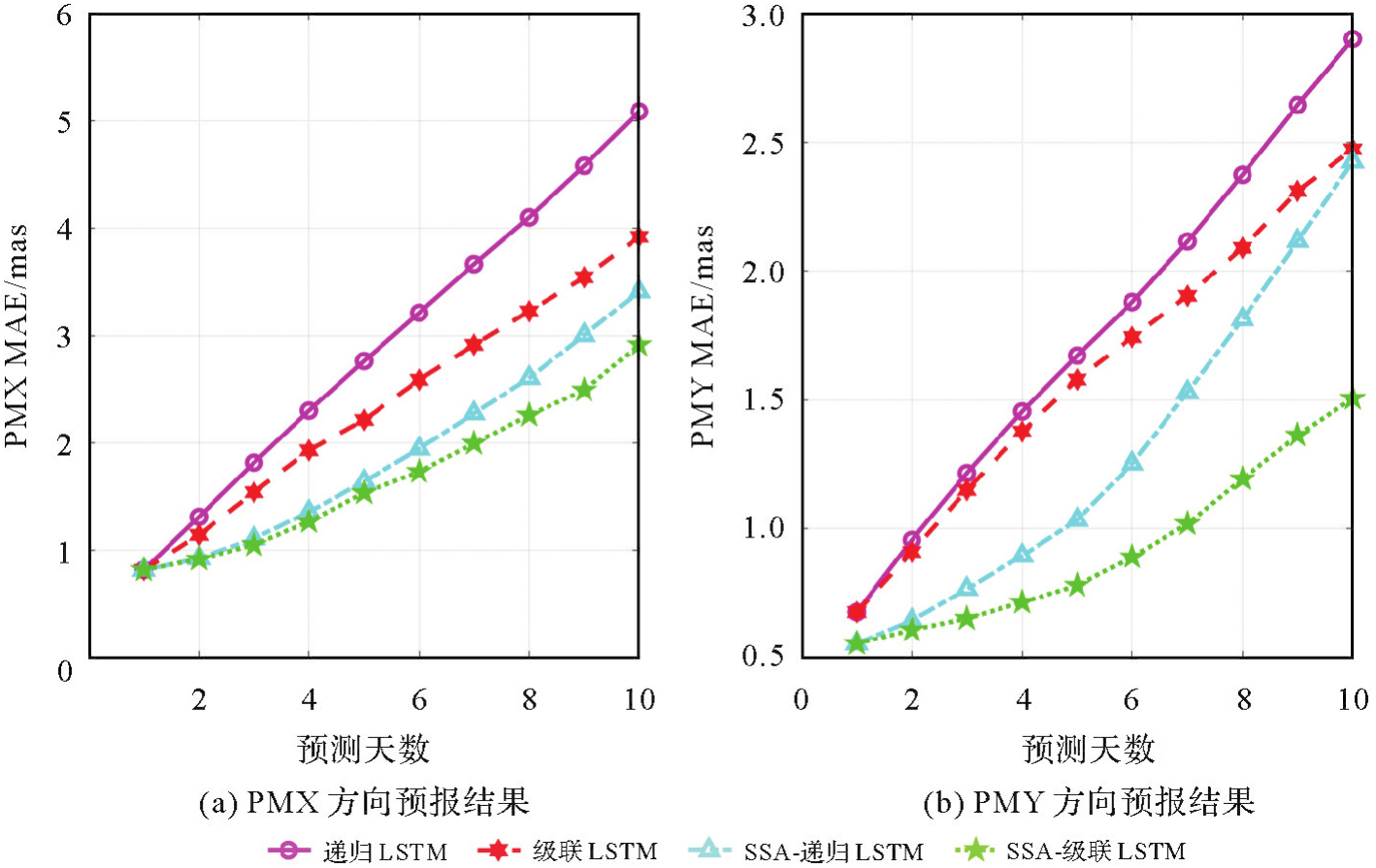
Fig. 6
AE comparison of prediction results for four schemes in the X direction of PM"
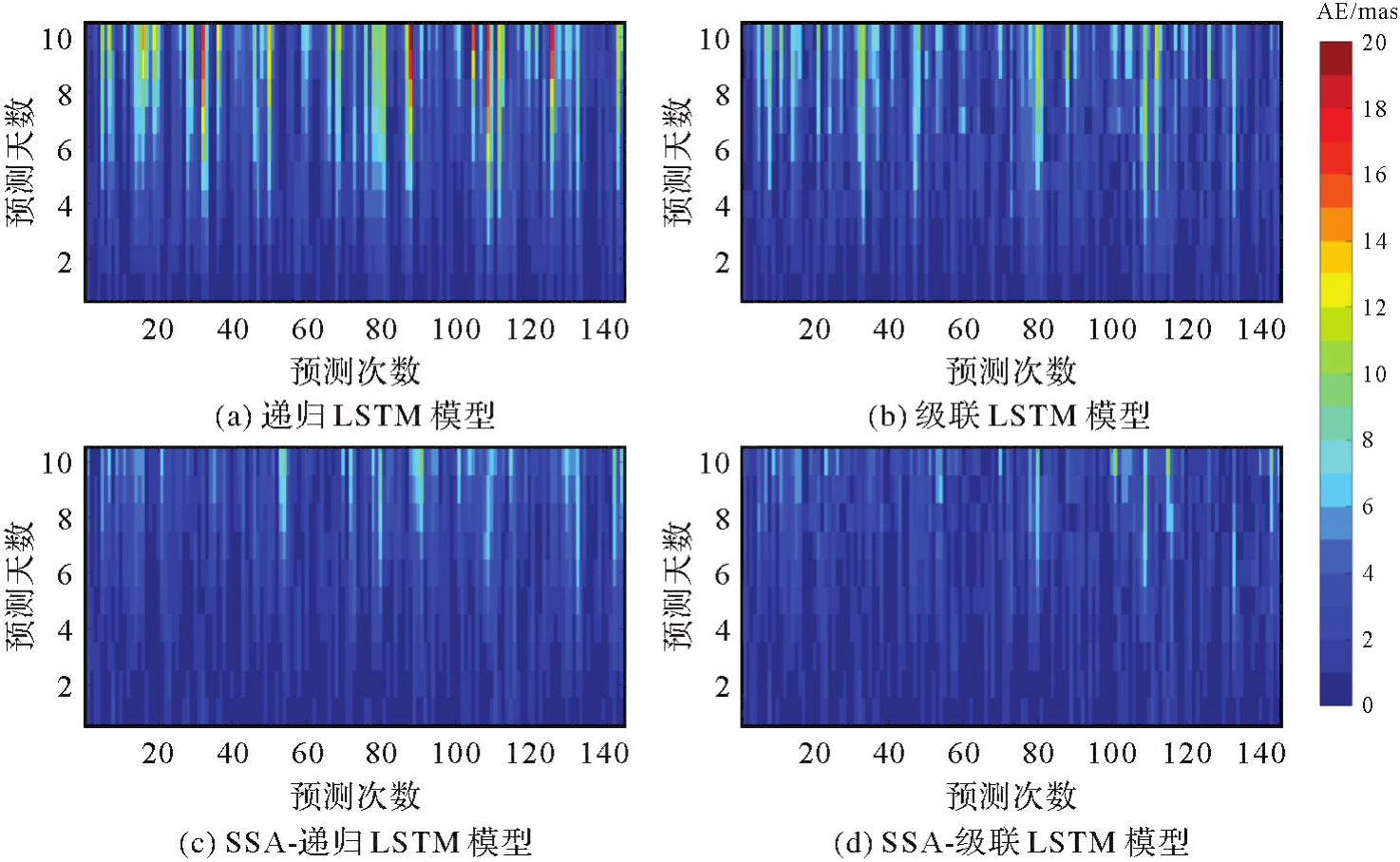
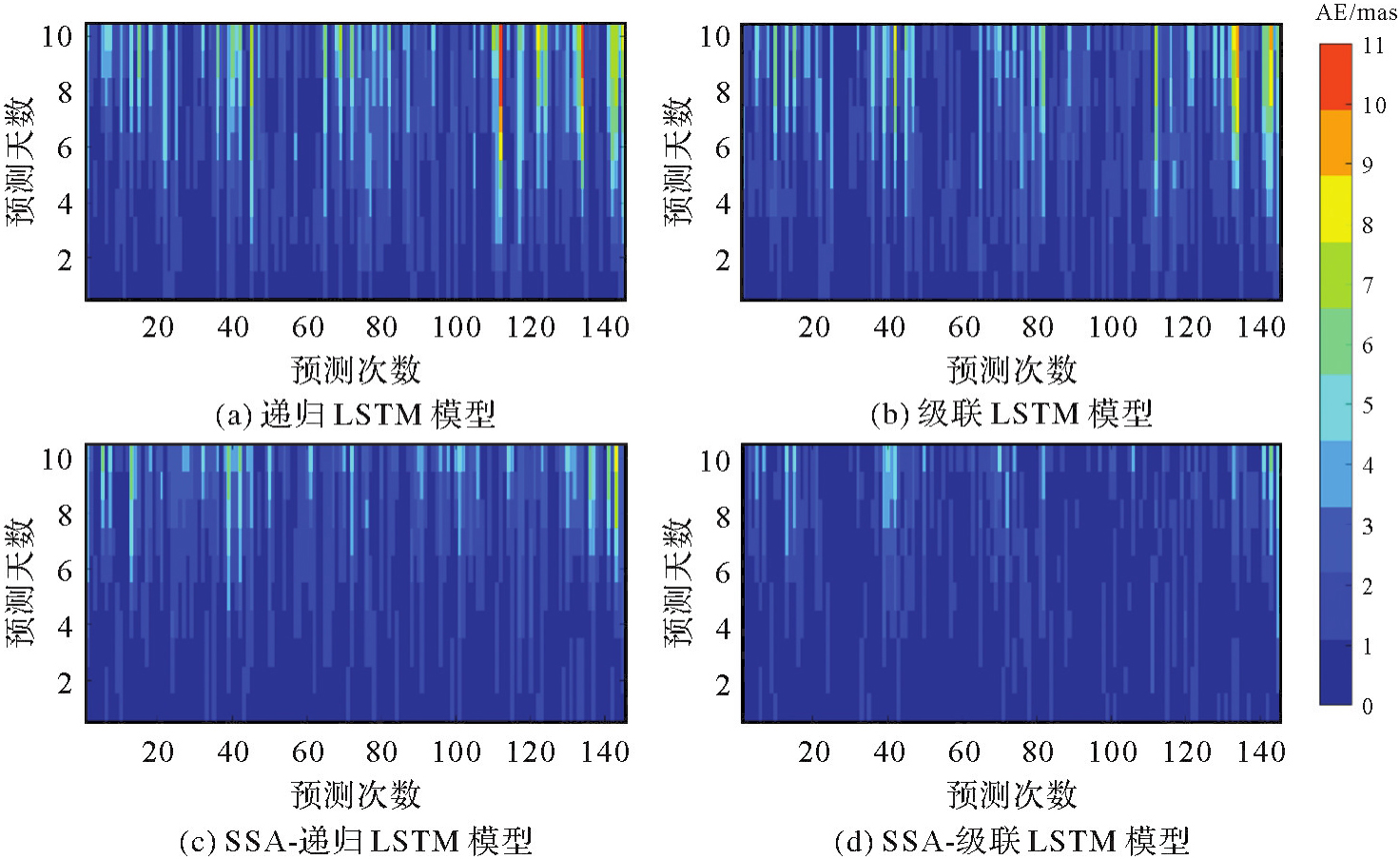
Fig. 7
AE comparison of prediction results for four schemes in the Y direction of PM"

Tab. 1
MAE of forecast results for four schemes in the X direction"
| 预报天数 | 方案1/mas | 方案2/mas | MAE降低率1/(%) | 方案3/mas | 方案4/mas | MAE降低率2/(%) | MAE降低率3/(%) | MAE降低率4/(%) |
|---|---|---|---|---|---|---|---|---|
| 1 | 0.816 | 0.816 | 0 | 0.816 | 0.816 | 0 | 0 | 0 |
| 2 | 1.310 | 1.142 | 12.8 | 0.923 | 0.915 | 30.2 | 19.9 | 0.9 |
| 3 | 1.816 | 1.540 | 15.2 | 1.109 | 1.051 | 42.1 | 31.8 | 5.2 |
| 4 | 2.300 | 1.930 | 16.1 | 1.356 | 1.266 | 45.0 | 34.4 | 6.6 |
| 5 | 2.762 | 2.213 | 19.9 | 1.640 | 1.534 | 44.5 | 30.7 | 6.5 |
| 6 | 3.212 | 2.587 | 19.5 | 1.945 | 1.732 | 46.1 | 33.0 | 11.0 |
| 7 | 3.665 | 2.914 | 20.5 | 2.274 | 1.995 | 45.6 | 31.5 | 12.3 |
| 8 | 4.101 | 3.226 | 21.3 | 2.604 | 2.258 | 44.9 | 30.0 | 13.3 |
| 9 | 4.581 | 3.542 | 22.7 | 3.004 | 2.491 | 45.6 | 29.7 | 17.1 |
| 10 | 5.088 | 3.919 | 23.0 | 3.411 | 2.914 | 42.7 | 25.6 | 14.6 |
| 均值 | 2.965 | 2.383 | 19.6 | 1.908 | 1.697 | 42.8 | 28.8 | 11.1 |
Tab. 2
MAE of forecast results for four schemes in the Y direction"
| 预报天数 | 方案1/mas | 方案2/mas | MAE降低率1/(%) | 方案3/mas | 方案4/mas | MAE降低率2/(%) | MAE降低率3/(%) | MAE降低率4/(%) |
|---|---|---|---|---|---|---|---|---|
| 1 | 0.676 | 0.676 | 0 | 0.554 | 0.554 | 18.0 | 18.0 | 0 |
| 2 | 0.956 | 0.910 | 4.8 | 0.643 | 0.607 | 36.5 | 33.3 | 5.6 |
| 3 | 1.216 | 1.150 | 5.4 | 0.766 | 0.651 | 46.5 | 43.4 | 15.0 |
| 4 | 1.455 | 1.377 | 5.4 | 0.895 | 0.714 | 50.9 | 48.1 | 20.2 |
| 5 | 1.672 | 1.579 | 5.6 | 1.034 | 0.780 | 53.3 | 50.6 | 24.6 |
| 6 | 1.880 | 1.744 | 7.2 | 1.253 | 0.890 | 52.7 | 49.0 | 29.0 |
| 7 | 2.115 | 1.904 | 10.0 | 1.530 | 1.019 | 51.8 | 46.5 | 33.4 |
| 8 | 2.374 | 2.090 | 12.0 | 1.813 | 1.193 | 49.7 | 42.9 | 34.2 |
| 9 | 2.645 | 2.311 | 12.6 | 2.117 | 1.363 | 48.5 | 41.0 | 35.6 |
| 10 | 2.901 | 2.473 | 14.8 | 2.425 | 1.506 | 48.1 | 39.1 | 37.9 |
| 均值 | 1.789 | 1.621 | 9.4 | 1.303 | 0.928 | 48.1 | 42.8 | 28.8 |
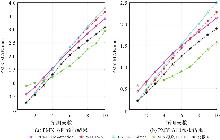
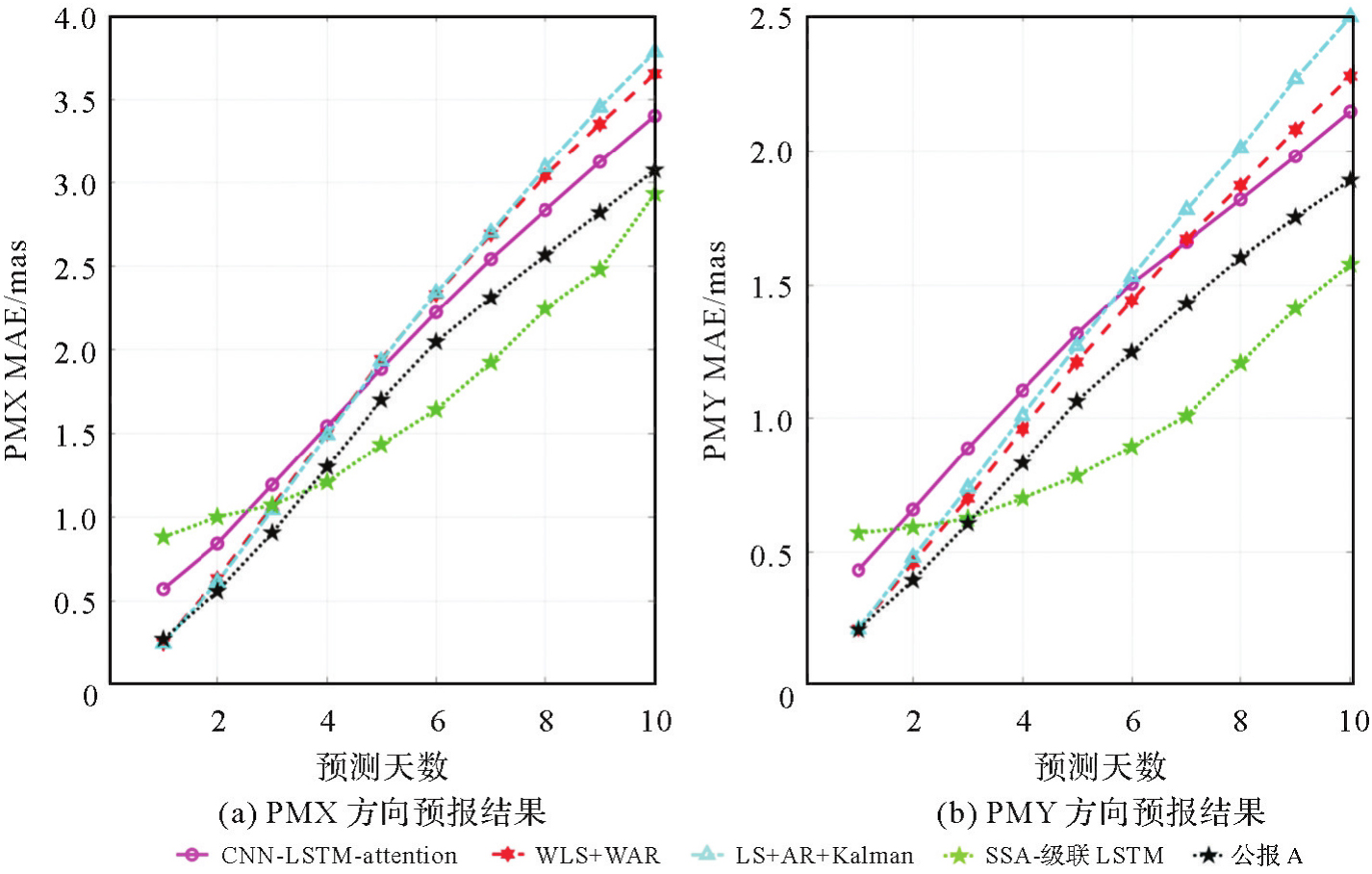
Fig. 8
Comparison of MAE of prediction results using different polar motion forecasting methods"
Tab. 3
Root mean square of satellite orbits corresponding to different polar motion products"
| DOY | 公报A/mm | LSTM递归/mm | LSTM级联/mm | SSA-递归LSTM/mm | SSA-级联LSTM/mm |
|---|---|---|---|---|---|
| 223 | 33.3 | 60.1 | 54.1 | 101.5 | 96.4 |
| 224 | 65.5 | 102.0 | 104.9 | 92.0 | 72.8 |
| 225 | 99.7 | 140.4 | 136.4 | 94.7 | 46.1 |
| 226 | 134.8 | 162.5 | 146.3 | 103.0 | 33.1 |
| 227 | 173.3 | 180.4 | 165.9 | 110.8 | 20.9 |
| 228 | 217.8 | 201.2 | 257.6 | 116.8 | 54.7 |
| 229 | 248.0 | 221.9 | 292.7 | 141.6 | 82.3 |
| 230 | 252.1 | 235.0 | 237.2 | 196.3 | 82.8 |
| 均值 | 153.1 | 162.9 | 174.4 | 119.6 | 61.1 |
| [1] |
加松, 徐天河, 杨红雷. LS+AR极移预报模型的两种修正算法[J]. 测绘学报, 2018, 47(S1): 71-77. DOI: .
doi: 10.11947/j.AGCS.2018.20180296 |
|
JIA Song, XU Tianhe, YANG Honglei. Two improved algorithms for LS+AR prediction model of the polar motion[J]. Acta Geodaetica et Cartographica Sinica, 2018, 47(S1): 71-77. DOI: .
doi: 10.11947/j.AGCS.2018.20180296 |
|
| [2] |
吴飞. 几种改进的地球自转参数预报方法[J]. 测绘学报, 2023, 52(7): 1229. DOI: .
doi: 10.11947/j.AGCS.2023.20210716 |
|
WU Fei. Several improved methods for prediction of earth rotation parameters[J]. Acta Geodaetica et Cartographica Sinica, 2023, 52(7): 1229. DOI: .
doi: 10.11947/j.AGCS.2023.20210716 |
|
| [3] | 魏娜, 周雨欣, 许雪晴, 等. 顾及有效角动量与IGS超快解数据的极移预报方法[J]. 地球物理学报, 2024, 67(4): 1356-1367. |
| WEI Na, ZHOU Yuxin, XU Xueqing, et al. A hybrid polar motion prediction method combining effective angular momentum and IGS ultra rapid data[J]. Chinese Journal of Geophysics, 2024, 67(4): 1356-1367. | |
| [4] | WAN Lihua, WEI Erhu, JIN Shuanggen. Earth rotation parameter estimation from GNSS and its impact on aircraft orbit determination[C]//Proceedings of 2014 China Satellite Navigation Conference. Berlin: Springer, 2014: 105-114. |
| [5] | WANG Qianxin, HU Chao, XU Tianhe, et al. Impacts of Earth rotation parameters on GNSS ultra-rapid orbit prediction: derivation and real-time correction[J]. Advances in Space Research, 2017, 60(12): 2855-2870. |
| [6] | KOSEK W, KALARUS M, NIEDZIELSKI T, et al. Forecasting of the Earth orientation parameters: comparison of different algorithms[C]//Proceedings of 2007 Journées Systèmes de Référence Spatio-temporels. Paris: Observatoire de Paris, 2007: 155-158. |
| [7] | KALARUS M, SCHUH H, KOSEK W, et al. Achievements of the Earth orientation parameters prediction comparison campaign[J]. Journal of Geodesy, 2010, 84(10): 587-596. |
| [8] | 严凤, 姚宜斌. 地球自转参数短期预报方法及其实现[J]. 大地测量与地球动力学, 2012, 32(4): 71-75. |
| YAN Feng, YAO Yibin. Short-term prediction methods and realization of earth rotation parameters[J]. Journal of Geodesy and Geodynamics, 2012, 32(4): 71-75. | |
| [9] | XU X Q, ZHOU Y H, LIAO X H. Short-term earth orientation parameters predictions by combination of the least-squares, AR model and Kalman filter[J]. Journal of Geodynamics, 2012, 62: 83-86. |
| [10] | 王志文, 王潜心, 何义磊, 等. 一种考虑PMX与PMY之间相关性的极移预报新方法[J]. 大地测量与地球动力学, 2017, 37(11): 1178-1182. |
| WANG Zhiwen, WANG Qianxin, HE Yilei, et al. A new method to predict pole shift based on the correlation between PMX and PMY[J]. Journal of Geodesy and Geodynamics, 2017, 37(11): 1178-1182. | |
| [11] | YE Fei, YUAN Yunbin. A modified stochastic model for LS+AR hybrid method and its application in polar motion short-term prediction[J]. Geodesy and Geodynamics, 2024, 15(1): 100-105. |
| [12] | 赵丹宁, 高蕊, 雷雨. 利用小波分解改进极移预报模型[J]. 武汉大学学报(信息科学版), 2019, 44(12): 1797-1801. |
| ZHAO Danning, GAO Rui, LEI Yu. Improvement of the polar motion prediction model using wavelet decomposition[J]. Geomatics and Information Science of Wuhan University, 2019, 44(12): 1797-1801. | |
| [13] | 王小辉, 王琪洁, 刘建. 经验模式分解在极移超短期预报中的应用[J]. 天文学报, 2012, 53(6): 519-526. |
| WANG Xiaohui, WANG Qijie, LIU Jian. Application of empirical mode decomposition in the ultra short-term prediction of polar motion[J]. Acta Astronomica Sinica, 2012, 53(6): 519-526. | |
| [14] | KONG Qiaoli, HAN Jingwei, JIN Xin, et al. Polar motion prediction using the combination of SSA and ARMA[J]. Geodesy and Geo-dynamics, 2023, 14(4): 368-376. |
| [15] | GUESSOUM S, BELDA S, MODIRI S, et al. Joint short-term prediction of polar motion and length of day with multi-task deep learning methods[J]. Earth, Planets and Space, 2025, 77(1): 25. |
| [16] | MODIRI S, BELDA S, HEINKELMANN R, et al. Polar motion prediction using the combination of SSA and Copula-based analysis[J]. Earth, Planets and Space, 2018, 70(1): 115. |
| [17] | 赵丹宁, 雷雨, 乔海花. 利用奇异谱分析提高极移中长期预报精度[J]. 天文学报, 2024, 65(3): 30-41. |
| ZHAO Danning, LEI Yu, QIAO Haihua. Improvement in the medium-and long-term prediction accuracy of polar motion using singular spectrum analysis[J]. Acta Astronomica Sinica, 2024, 65(3): 30-41. | |
| [18] | 赵丹宁, 雷雨. 基于极限学习机的极移中长期预报[J]. 天文研究与技术, 2020, 17(2): 178-184. |
| ZHAO Danning, LEI Yu. Medium-and long-term prediction of polar motion using extreme learning machine[J]. Astronomical Research & Technology, 2020, 17(2): 178-184. | |
| [19] | 王宗建. 基于BP神经网络的地球自转参数短期预测[D]. 西安: 长安大学, 2015. |
| WANG Zongjian. The short-term prediction of Earth rotation parameters based on BP neural network[D]. Xi'an: Changan University, 2015. | |
| [20] | 王帅民, 赵亿奇, 王振华, 等. 不同组合模型的地球自转参数预报对比[J]. 大地测量与地球动力学, 2024, 44(4): 377-381. |
| WANG Shuaimin, ZHAO Yiqi, WANG Zhenhua, et al. Comparison of Earth rotation parameters prediction based on different combination models[J]. Journal of Geodesy and Geodynamics, 2024, 44(4): 377-381. | |
| [21] | WANG Guocheng, LIU Lintao, TU Yi, et al. Application of the radial basis function neural network to the short term prediction of the Earth's polar motion[J]. Studia Geophysica et Geodaetica, 2018, 62(2): 243-254. |
| [22] | GOU Junyang, KIANI SHAHVANDI M, HOHENSINN R, et al. Ultra-short-term prediction of LOD using LSTM neural networks[J]. Journal of Geodesy, 2023, 97(5): 52. |
| [23] | GOU Junyang, RÖSCH C, SHEHAJ E, et al. Modeling the differences between ultra-rapid and final orbit products of GPS satellites using machine-learning approaches[J]. Remote Sensing, 2023, 15(23): 5585. |
| [24] | WANG Chenxiang, ZHANG Pengfei. Improving the accuracy of polar motion prediction using a hybrid least squares and long short-term memory model[J]. Earth, Planets and Space, 2023, 75(1): 153. |
| [25] | YU Kehao, YANG Kai, SHEN Tonghui, et al. Estimation of earth rotation parameters and prediction of polar motion using hybrid CNN-LSTM model[J]. Remote Sensing, 2023, 15(2): 427. |
| [26] | WANG Xuqiao, DU Lan, ZHANG Zhongkai, et al. Leveraging the empirical wavelet transform in combination with convolutional LSTM neural networks to enhance the accuracy of polar motion prediction[J]. Research in Astronomy and Astrophysics, 2024, 24(9): 095019. |
| [27] | WANG Leyang, QUE Haibo, WU Fei. The CNN-LSTM-attention model for short term prediction of the polar motion[J]. Measurement Science and Technology, 2025, 36(1): 016323. |
| [28] | AKYILMAZ O, KUTTERER H, SHUM C K, et al. Fuzzy-wavelet based prediction of Earth rotation parameters[J]. Applied Soft Computing, 2011, 11(1): 837-841. |
| [29] | 雷雨. 地球自转参数高精度预报方法研究[D]. 西安: 中国科学院研究生院(国家授时中心), 2016. |
| LEI Yu. Study on methods for high accuracy prediction of Earth rotation parameters[D]. Xi'an: National Time Service Center, Chinese Academy of Sciences, 2016. | |
| [30] | 魏晓蓓. 地球自转参数极移的预报方法研究[D]. 青岛: 山东科技大学, 2017. |
| WEI Xiaobei. Researches on the prediction methods of polar motion of the Earth rotation parameters[D]. Qingdao: Shandong University of Science and Technology, 2017. | |
| [31] | 王辰晨, 徐工, 苏晓庆, 等. 融合FBPBPF和NTFT的极移弱周期分量提取及其激发原因分析[J]. 地球物理学进展, 2025, 40(3): 905-912. |
| WANG Chenchen, XU Gong, SU Xiaoqing, et al. FBPBPF and NTFT are used to extract the weak periodic component of polar motion and analyze its excitation reasons[J]. Progress in Geophysics, 2025, 40(3): 905-912. | |
| [32] | TAN Zhirong, YE Fei, HUA Liangchun. Polar motion ultra-short-term prediction of least-squares+multivariate autoregressive hybrid method by using the Kalman filter[J]. Sensors, 2024, 24(19): 6260. |
| [1] | Xiong PAN, Longjie ZHANG, Qingsong AI, Lihong JIN, Mao CAI. Improved ABC algorithm for optimizing BP neural network in short-term clock bias prediction and application [J]. Acta Geodaetica et Cartographica Sinica, 2025, 54(8): 1404-1415. |
| [2] | SUN Genyun, FU Hang, ZHANG Aizhu, REN Jinchang. Singular spectrum analysis method for hyperspectral imagery feature extraction: a review and evaluation [J]. Acta Geodaetica et Cartographica Sinica, 2023, 52(7): 1148-1163. |
| [3] | YAO Yibin, ZHAI Changzhi, KONG Jian, LIU Lei. The Pre-earthquake Ionosphere Anomaly of the 2015 Nepal Earthquake [J]. Acta Geodaetica et Cartographica Sinica, 2016, 45(4): 385-395. |
| Viewed | ||||||
|
Full text |
|
|||||
|
Abstract |
|
|||||
