

Acta Geodaetica et Cartographica Sinica ›› 2026, Vol. 55 ›› Issue (5): 881-893.doi: 10.11947/j.AGCS.2026.20250230
• Photogrammetry and Remote Sensing • Previous Articles Next Articles
Yuzhun LIN1( ), Shuxiang WANG1, Jie RUI1, Fei JIN1(), Jianfang JIANG1, Xibing ZUO2, Xiao LIU1, Yujie ZOU1
Received:2025-06-05
Revised:2026-04-26
Online:2026-06-23
Published:2026-06-23
Contact:
Fei JIN
E-mail:lyz120218@163.com;jf371@sina.com
About author:LIN Yuzhun (1993—), male, phD, associate professor, majors in intelligent processing of remote sensing data. E-mail: lyz120218@163.com
Supported by:CLC Number:
Yuzhun LIN, Shuxiang WANG, Jie RUI, Fei JIN, Jianfang JIANG, Xibing ZUO, Xiao LIU, Yujie ZOU. Road extraction method for heterogeneous data using sparse labels[J]. Acta Geodaetica et Cartographica Sinica, 2026, 55(5): 881-893.
Fig. 1
Overall workflow of the proposed method"
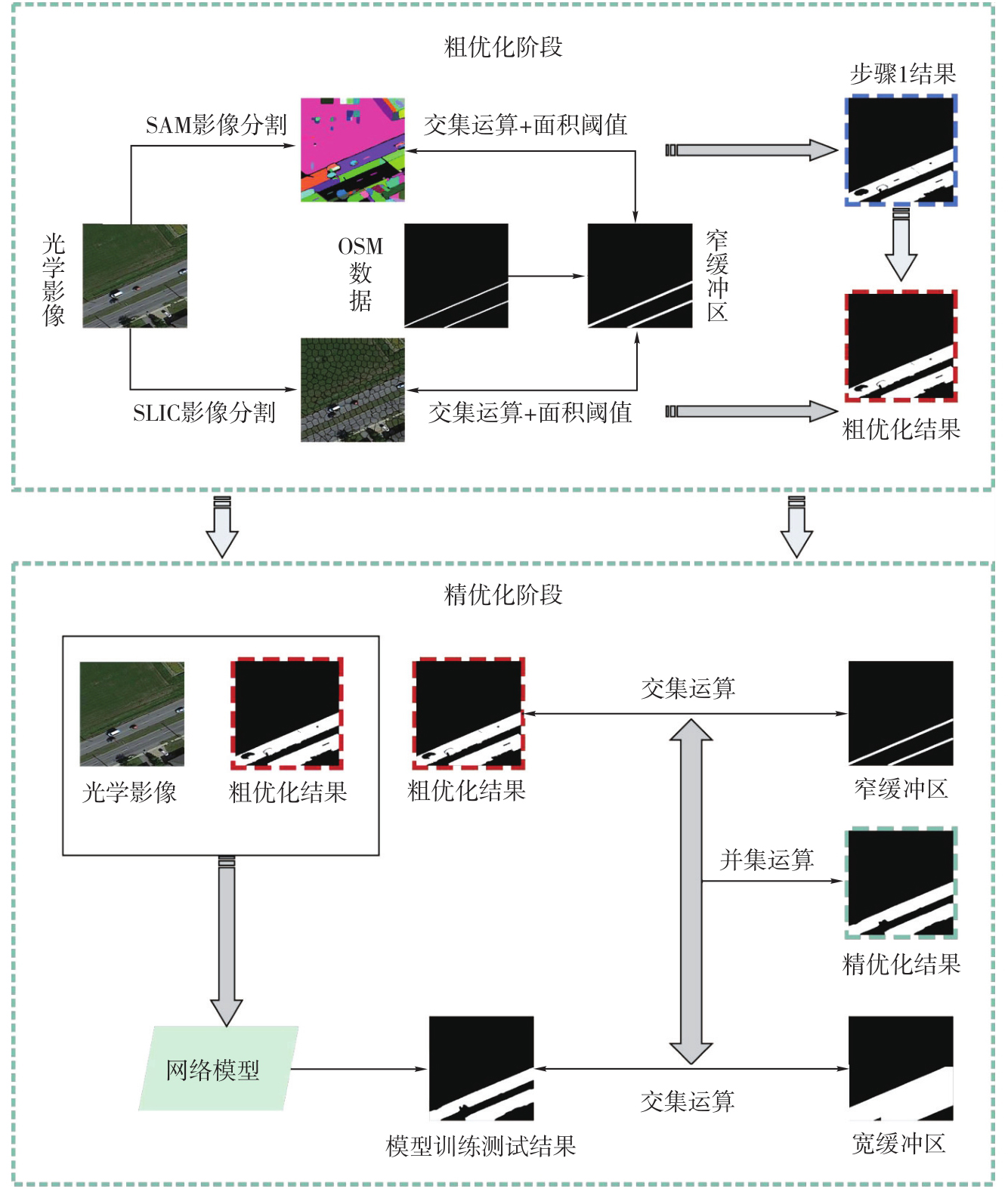
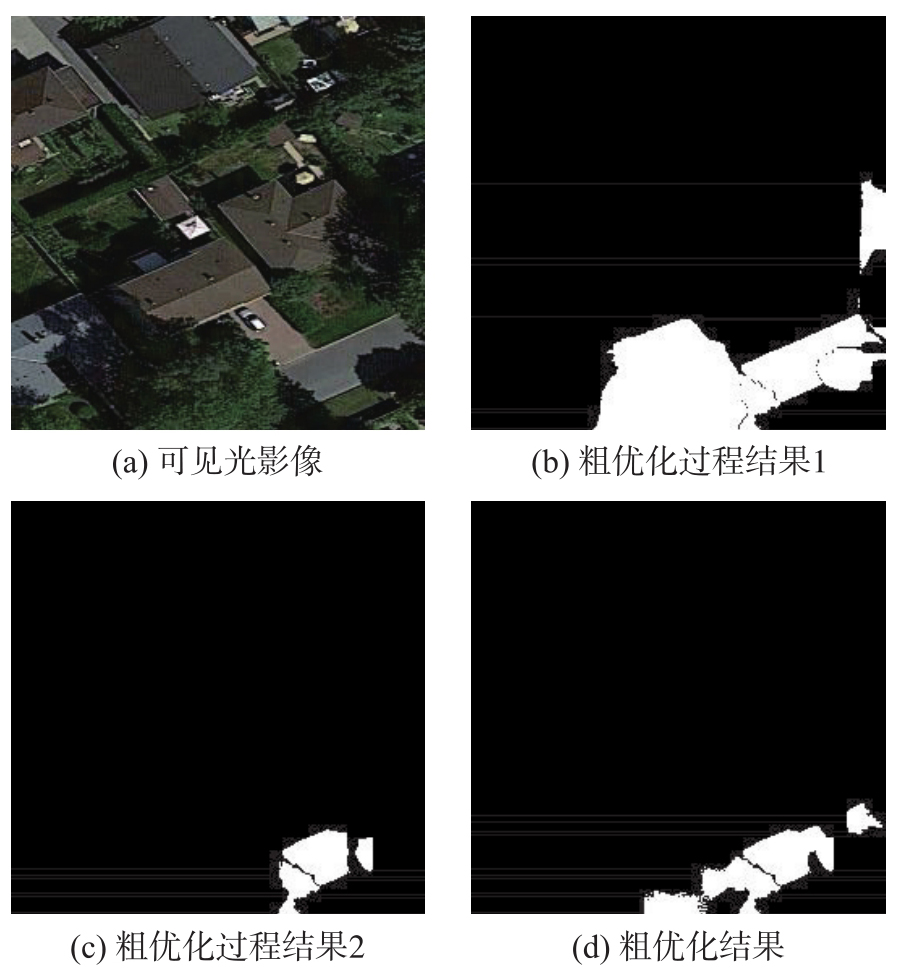
Fig. 2
Example of the rough label optimization process"
Tab. 1
Accuracy comparison of road extraction network models and label optimization methods on the RoadNet dataset"
| 网络模型 | 标签优化方法 | P↑ | R↑ | F1值↑ | IoU↑ | Com↑ | Eor↓ |
|---|---|---|---|---|---|---|---|
| UNet | ScRoadExtract | 77.96 | 91.55 | 84.22 | 72.74 | 85.37 | 8.24 |
| WeaklyOSM | 81.13 | 89.92 | 85.30 | 74.37 | 84.91 | 5.61 | |
| 本文方法 | 86.57 | 90.10 | 88.30 | 79.05 | 82.99 | 4.57 | |
| D-LinkNet | ScRoadExtract | 78.85 | 92.75 | 85.24 | 74.28 | 86.87 | 7.73 |
| WeaklyOSM | 81.32 | 90.66 | 85.74 | 75.04 | 85.66 | 5.99 | |
| 本文方法 | 96.31 | 80.74 | 87.84 | 78.32 | 81.28 | 1.94 | |
| MANet | ScRoadExtract | 80.98 | 92.09 | 86.18 | 75.72 | 86.14 | 6.16 |
| WeaklyOSM | 82.44 | 90.52 | 86.29 | 75.89 | 85.16 | 4.36 | |
| 本文方法 | 97.46 | 80.08 | 87.91 | 78.43 | 81.31 | 1.13 | |
| UNetFormer | ScRoadExtract | 80.13 | 92.59 | 85.91 | 75.30 | 87.08 | 6.15 |
| WeaklyOSM | 82.02 | 91.02 | 86.28 | 75.88 | 85.59 | 4.31 | |
| 本文方法 | 96.88 | 81.67 | 88.62 | 79.57 | 81.15 | 2.40 |
Tab. 2
Accuracy comparison of road extraction network models and label optimization methods on the Oklahoma dataset"
| 网络模型 | 标签优化方法 | P↑ | R↑ | F1值↑ | IoU↑ | Com↑ | Eor↓ |
|---|---|---|---|---|---|---|---|
| UNet | ScRoadExtract | 25.59 | 72.96 | 37.89 | 23.37 | 70.40 | 42.42 |
| WeaklyOSM | 24.67 | 66.98 | 36.06 | 22.00 | 65.60 | 46.51 | |
| 本文方法 | 64.72 | 58.83 | 61.64 | 44.55 | 54.57 | 29.03 | |
| D-LinkNet | ScRoadExtract | 26.66 | 80.12 | 40.00 | 25.00 | 77.62 | 40.32 |
| WeaklyOSM | 24.08 | 73.88 | 36.32 | 22.19 | 72.13 | 42.51 | |
| 本文方法 | 62.76 | 61.23 | 61.98 | 44.91 | 54.32 | 19.68 | |
| MANet | ScRoadExtract | 28.21 | 89.15 | 42.86 | 27.27 | 83.38 | 37.22 |
| WeaklyOSM | 24.25 | 90.92 | 38.29 | 23.68 | 85.86 | 42.89 | |
| 本文方法 | 59.65 | 72.26 | 65.35 | 48.53 | 65.38 | 21.47 | |
| UNetFormer | ScRoadExtract | 28.09 | 83.94 | 42.09 | 26.65 | 78.90 | 35.98 |
| WeaklyOSM | 25.81 | 84.98 | 39.59 | 24.68 | 79.55 | 38.72 | |
| 本文方法 | 60.73 | 69.70 | 64.90 | 48.04 | 62.36 | 23.32 |
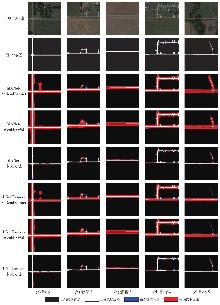
Fig. 3
Examples of road extraction results using different network models and label optimization methods (Oklahoma dataset)"
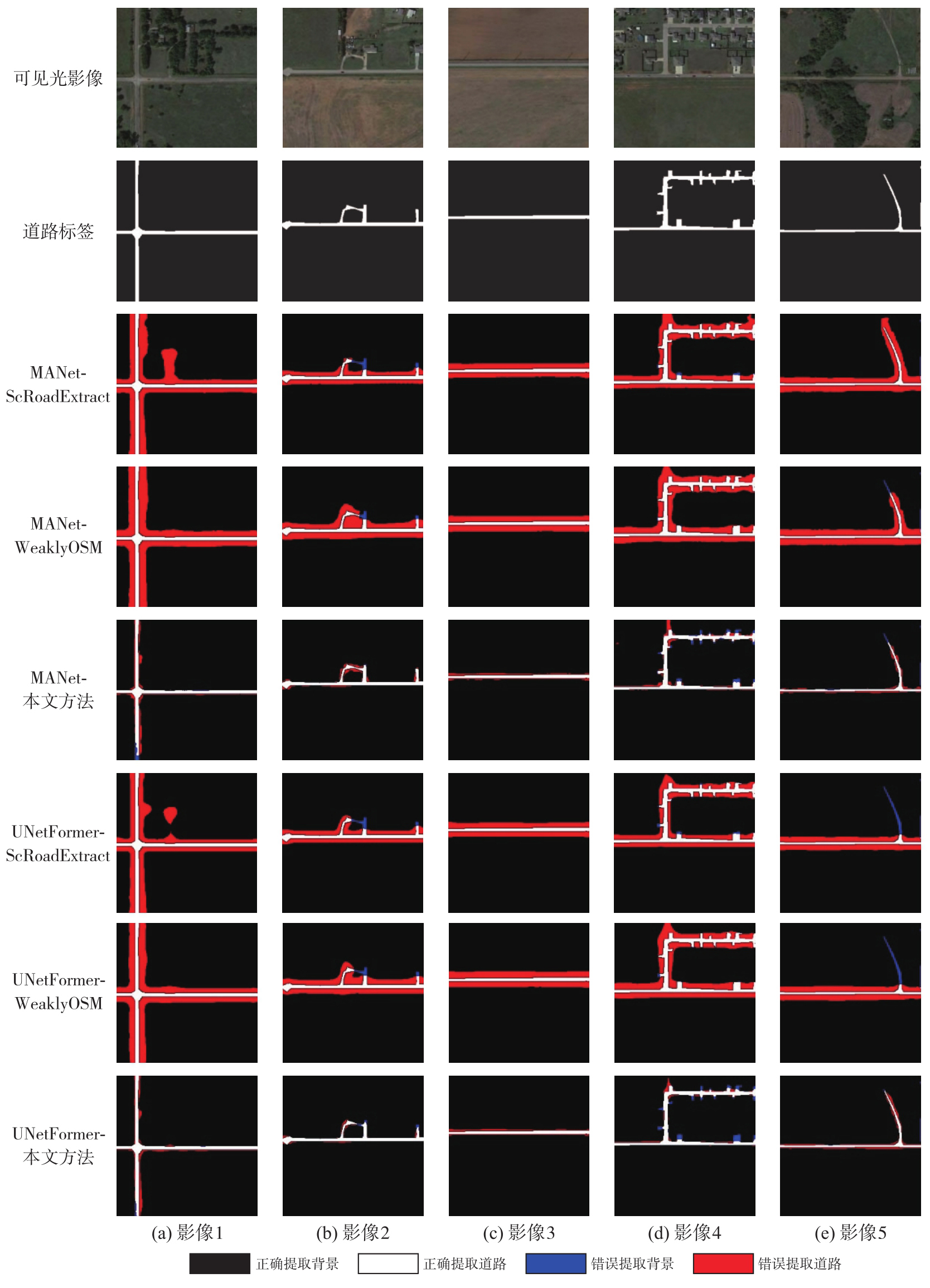
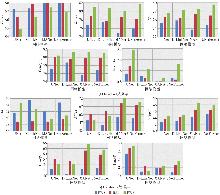
Fig. 4
Test accuracy of ablation experiment"

Fig. 5
Comparison of road extraction accuracy between the multi-scale buffer method and the proposed method"
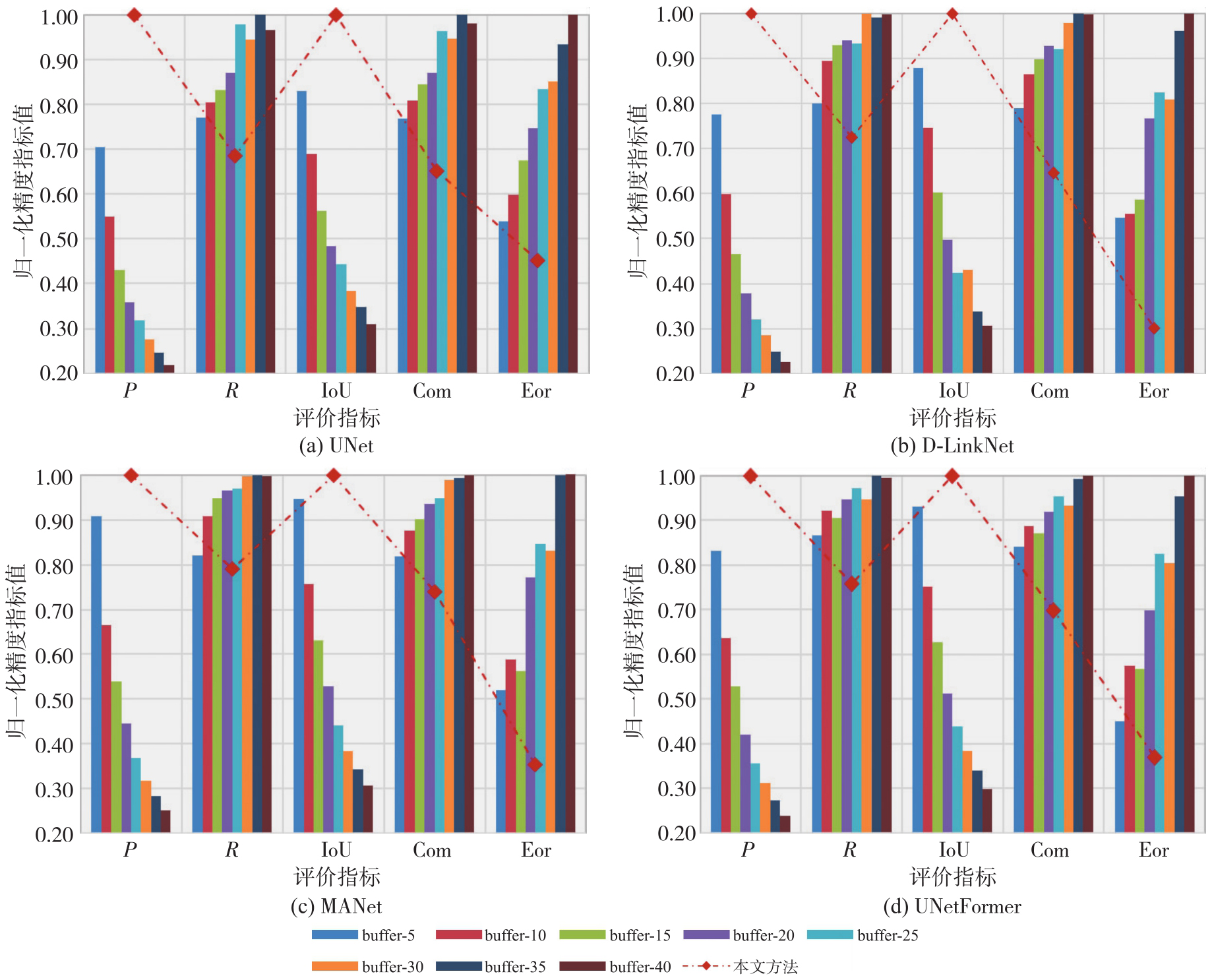
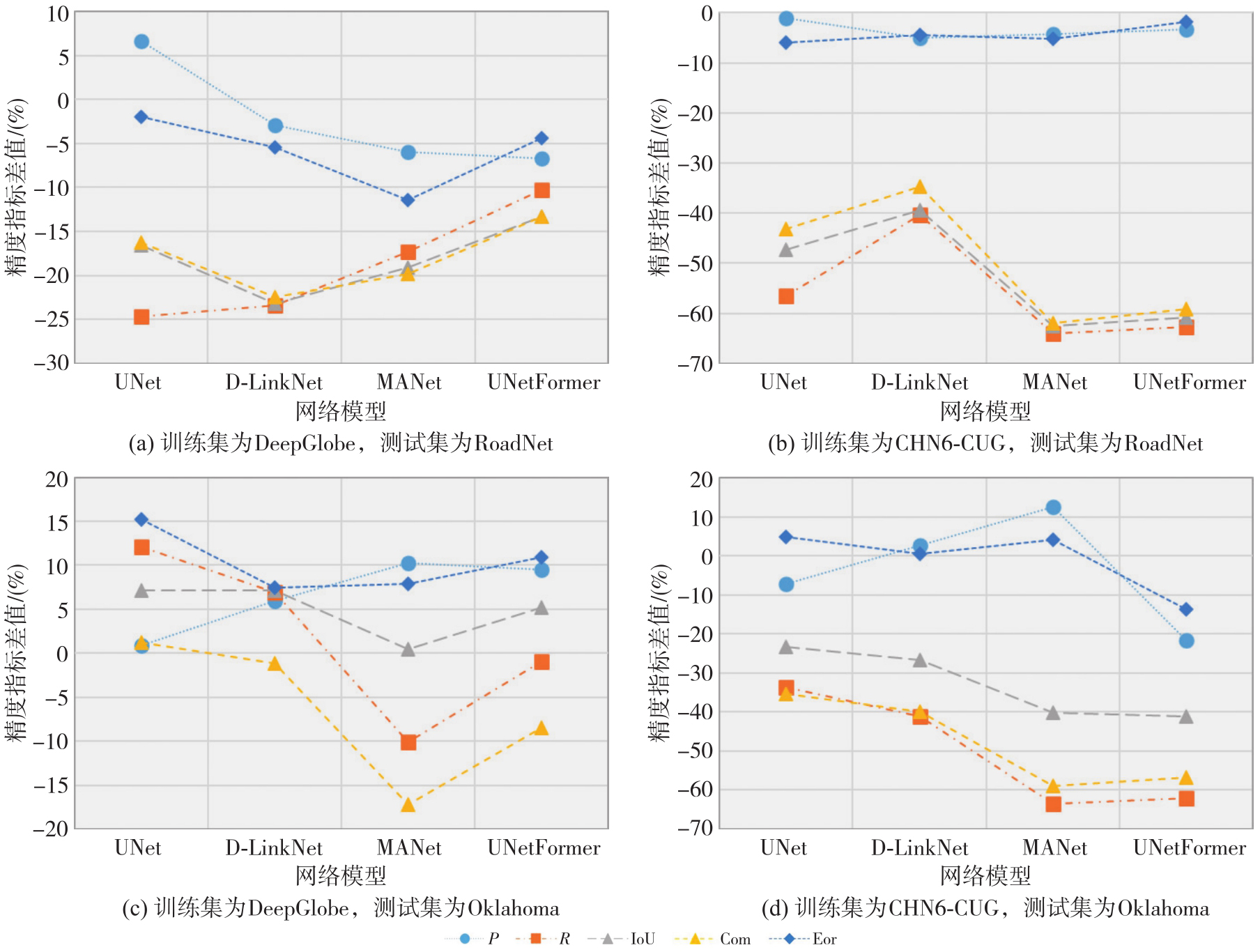
Fig. 6
Accuracy of cross-domain label road extraction"
| [1] | ACHANTA R, SHAJI A, SMITH K, et al. SLIC superpixels compared to state-of-the-art superpixel methods[J]. IEEE Transactions on Pattern Analysis and Machine Intelligence, 2012, 34(11): 2274-2282. |
| [2] | LENINISHA S, VANI K. Water flow based geometric active deformable model for road network[J]. ISPRS Journal of Photogrammetry and Remote Sensing, 2015, 102: 140-147. |
| [3] | RONNEBERGER O, FISCHER P, BROX T. U-Net: convolutional networks for biomedical image segmentation[C]//Proceedings of 2015 Medical Image Computing and Computer-Assisted Intervention. Berlin: Springer, 2015: 234-241. |
| [4] | BADRINARAYANAN V, KENDALL A, CIPOLLA R. SegNet: a deep convolutional encoder-decoder architecture for image segmentation[J]. IEEE Transactions on Pattern Analysis and Machine Intelligence, 2017, 39(12): 2481-2495. |
| [5] | CHENG Mingming, GUO Menghao, HOU Qibin, et al. SegNeXt: rethinking convolutional attention design for semantic segmentation[C]//Proceedings of 2022 Advances in Neural Information Processing Systems. New Orleans: Neural Information Processing Systems Foundation, Inc., 2022: 1140-1156. |
| [6] | ZHOU Lichen, ZHANG Chuang, WU Ming. D-LinkNet: LinkNet with pretrained encoder and dilated convolution for high resolution satellite imagery road extraction[C]//Proceedings of 2018 IEEE/CVF Conference on Computer Vision and Pattern Recognition Workshops. Salt Lake City: IEEE, 2018: 192-1924. |
| [7] | CHEN Xin, YU Anzhu, SUN Qun, et al. Updating road maps at city scale with remote sensed images and existing vector maps[J]. IEEE Transactions on Geoscience and Remote Sensing, 2024, 62: 5616521. |
| [8] | SUN Tao, DI Zonglin, CHE Pengyu, et al. Leveraging crowdsourced GPS data for road extraction from aerial imagery[C]//Proceedings of 2019 IEEE/CVF Conference on Computer Vision and Pattern Recognition. Long Beach: IEEE, 2020: 7501-7510. |
| [9] | BATRA A, SINGH S, PANG Guan, et al. Improved road connectivity by joint learning of orientation and segmentation[C]//Proceedings of 2019 IEEE/CVF Conference on Computer Vision and Pattern Recognition. Long Beach: IEEE, 2020: 10377-10385. |
| [10] | LI Xingang, WANG Yuebin, ZHANG Liqiang, et al. Topology-enhanced urban road extraction via a geographic feature-enhanced network[J]. IEEE Transactions on Geoscience and Remote Sensing, 2020, 58(12): 8819-8830. |
| [11] | XU Hongzhang, HE Hongjie, ZHANG Ying, et al. A comparative study of loss functions for road segmentation in remotely sensed road datasets[J]. International Journal of Applied Earth Observation and Geoinformation, 2023, 116: 103159. |
| [12] | LIU Yunyu, YUAN Jinpeng. ERSNet: lightweight attention-guided network for remote sensing scene image classification[J]. Journal of Geodesy and Geoinformation Science, 2025, 8(1): 30-46. |
| [13] | CHEN Zhaozheng, SUN Qianru. Extracting class activation maps from non-discriminative features as well[C]//Proceedings of 2023 IEEE/CVF Conference on Computer Vision and Pattern Recognition. Vancouver: IEEE, 2023: 3135-3144. |
| [14] | OH Y, KIM B, HAM B. Background-aware pooling and noise-aware loss for weakly-supervised semantic segmentation[C]//Proceedings of 2021 IEEE/CVF Conference on Computer Vision and Pattern Recognition. Nashville: IEEE, 2021: 6909-6918. |
| [15] | XU Jingshan, ZHOU Chuanwei, CUI Zhen, et al. Scribble-supervised semantic segmentation inference[C]//Proceedings of 2021 IEEE/CVF International Conference on Computer Vision. Montreal: IEEE, 2022: 15334-15343. |
| [16] | XU Lian, OUYANG Wanli, BENNAMOUN M, et al. Multi-class Token Transformer for weakly supervised semantic segmentation[C]//Proceedings of 2022 IEEE/CVF Conference on Computer Vision and Pattern Recognition. New Orleans: IEEE, 2022: 4300-4309. |
| [17] | CHEN Tao, YAO Yazhou, ZHANG Lei, et al. Saliency guided inter-and intra-class relation constraints for weakly supervised semantic segmentation[EB/OL]. [2025-06-01]. https://arxiv.org/abs/2206.09554. |
| [18] | ZHANG Fei, GU Chaochen, ZHANG Chenyue, et al. Complementary patch for weakly supervised semantic segmentation[C]//Proceedings of 2021 IEEE/CVF International Conference on Computer Vision. Montreal: IEEE, 2022: 7222-7231. |
| [19] | DAI Jifeng, HE Kaiming, SUN Jian. BoxSup: exploiting bounding boxes to supervise convolutional networks for semantic segmentation[C]//Proceedings of 2015 IEEE International Conference on Computer Vision. Santiago: IEEE, 2016: 1635-1643. |
| [20] | KULHARIA V, CHANDRA S, AGRAWAL A, et al. Box2Seg: attention weighted loss and discriminative feature learning for weakly supervised segmentation[C]//Proceedings of 2020 European Conference on Computer Vision. Berlin: Springer_Verlag, 2020: 290-308. |
| [21] | LIN Di, DAI Jifeng, JIA Jiaya, et al. ScribbleSup: scribble-supervised convolutional networks for semantic segmentation[C]//Proceedings of 2016 IEEE Conference on Computer Vision and Pattern Recognition. Las Vegas: IEEE, 2016: 3159-3167. |
| [22] | LIANG Zhiyuan, WANG Tiancai, ZHANG Xiangyu, et al. Tree energy loss: towards sparsely annotated semantic segmentation[C]//Proceedings of 2022 IEEE/CVF Conference on Computer Vision and Pattern Recognition. New Orleans: IEEE, 2022: 16886-16895. |
| [23] | KIRILLOV A, MINTUN E, RAVI N, et al. Segment anything[C]//Proceedings of 2023 IEEE/CVF International Conference on Computer Vision. Paris: IEEE, 2024: 3992-4003. |
| [24] | DING Lei, ZHU Kun, PENG Daifeng, et al. Adapting segment anything model for change detection in VHR remote sensing images[J]. IEEE Transactions on Geoscience and Remote Sensing, 2024, 62: 5611711. |
| [25] | LIU Yahui, YAO Jian, LU Xiaohu, et al. RoadNet: learning to comprehensively analyze road networks in complex urban scenes from high-resolution remotely sensed images[J]. IEEE Transactions on Geoscience and Remote Sensing, 2019, 57(4): 2043-2056. |
| [26] | MURPHY K P. Machine learning: a probabilistic perspective[M]. Cambridge: MIT Press, 2012. |
| [27] | MILLETARI F, NAVAB N, AHMADI S A. V-Net: fully convolutional neural networks for volumetric medical image segmentation[C]//Proceedings of 2016 International Conference on 3D Vision. Stanford: IEEE, 2016: 565-571. |
| [28] | LIN Yuzhun, JIN Fei, WANG Dandi, et al. Dual-task network for road extraction from high-resolution remote sensing images[J]. IEEE Journal of Selected Topics in Applied Earth Observations and Remote Sensing, 2023, 16: 66-78. |
| [29] | KINGMA D, BA J. Adam: a method for stochastic optimization[C]//Proceedings of 2015 International Conference on Learning Representations. San Diego: ICLR, 2015. |
| [30] | WEI Yao, JI Shunping. Scribble-based weakly supervised deep learning for road surface extraction from remote sensing images[J]. IEEE Transactions on Geoscience and Remote Sensing, 2022, 60: 5602312. |
| [31] | WU Songbing, DU Chun, CHEN Hao, et al. Road extraction from very high resolution images using weakly labeled OpenStreetMap centerline[J]. ISPRS International Journal of Geo-Information, 2019, 8(11): 478. |
| [32] | LI Rui, ZHENG Shunyi, ZHANG Ce, et al. Multiattention network for semantic segmentation of fine-resolution remote sensing images[J]. IEEE Transactions on Geoscience and Remote Sensing, 2022, 60: 5607713. |
| [33] | WANG Libo, LI Rui, ZHANG Ce, et al. UNetFormer: a UNet-like transformer for efficient semantic segmentation of remote sensing urban scene imagery[J]. ISPRS Journal of Photogrammetry and Remote Sensing, 2022, 190: 196-214. |
| [34] | DEMIR I, KOPERSKI K, LINDENBAUM D, et al. DeepGlobe 2018: a challenge to parse the Earth through satellite images[C]//Proceedings of 2018 IEEE/CVF Conference on Computer Vision and Pattern Recognition Workshops. Salt Lake City: IEEE, 2018: 172-181. |
| [35] | ZHU Qiqi, ZHANG Yanan, WANG Lizeng, et al. A global context-aware and batch-independent network for road extraction from VHR satellite imagery[J]. ISPRS Journal of Photogrammetry and Remote Sensing, 2021, 175: 353-365. |
| [1] | Yongyang XU, Jian WANG, Liang WU, Zhong XIE. Research on road extraction considering road boundaries and connectivity [J]. Acta Geodaetica et Cartographica Sinica, 2025, 54(7): 1254-1264. |
| [2] | Yungang CAO, Peng YANG, Jiangbo GONG, Gao ZHU, Xingyu SHEN. A road extraction method integrating spatial-relation enhancement and heterogeneous feature fusion [J]. Acta Geodaetica et Cartographica Sinica, 2025, 54(12): 2219-2232. |
| [3] | Xin XIONG, Guowang JIN, Ruibing CUI, Shuo LI, He YANG. Fast matching method of optical and SAR images using rank self-similarity features [J]. Acta Geodaetica et Cartographica Sinica, 2025, 54(10): 1852-1862. |
| [4] | Yanjun WANG, Xuchao TANG, Cheng WANG, Hengfan CAI. Urban and rural road surface extraction network based on road topological correlation features [J]. Acta Geodaetica et Cartographica Sinica, 2025, 54(1): 75-89. |
| [5] | Genyun SUN, Chao SUN, Aizhu ZHANG. Road extraction networks fusing multiscale and edge features [J]. Acta Geodaetica et Cartographica Sinica, 2024, 53(12): 2233-2243. |
| [6] | FAN Zhongli, ZHANG Li, WANG Qingdong, LIU Siting, YE Yuanxin. A fast matching method of SAR and optical images using angular weighted orientated gradients [J]. Acta Geodaetica et Cartographica Sinica, 2021, 50(10): 1390-1403. |
| [7] | LI Cailin, WANG Zhiyong, YU Lulu, GUO Baoyun. Geometric registration of close-range optical image and terrestrial laser point cloud constrained by nearest surface [J]. Acta Geodaetica et Cartographica Sinica, 2020, 49(8): 1014-1022. |
| [8] | LU Chuanwei, SUN Qun, CHEN Bing, WEN Bowei, ZHAO Yunpeng, XU Li. Road learning extraction method based on vehicle trajectory data [J]. Acta Geodaetica et Cartographica Sinica, 2020, 49(6): 692-702. |
| [9] | WANG Shuyang, MU Xiaodong, HE Hao, YANG Dongfang, MA Chenhui. Feature-representation-transfer based road extraction method for cross-domain aerial images [J]. Acta Geodaetica et Cartographica Sinica, 2020, 49(5): 611-621. |
| [10] | LI Dongchen, XIANG Wenhao, DANG Qiannan, WU Yan. SAR and optical images registration using uniform distribution and structure description-based ASIFT [J]. Acta Geodaetica et Cartographica Sinica, 2020, 49(12): 1583-1590. |
| [11] | HE Lijia, FENG Guangcai, FENG Zhixiong, GAO Hua. Coseismic displacements of 2016 MW7.8 Kaikoura, New Zealand earthquake, using Sentinel-2 optical images [J]. Acta Geodaetica et Cartographica Sinica, 2019, 48(3): 339-351. |
| [12] | HE Hao, WANG Shicheng, YANG Dongfang, WANG Shuyang, LIU Xing. An road extraction method for remote sensing image based on Encoder-Decoder network [J]. Acta Geodaetica et Cartographica Sinica, 2019, 48(3): 330-338. |
| [13] | LIAN Renbao, WANG Weixing, LI Juan. Road Extraction from High-resolution Remote Sensing Images Based on Adaptive Circular Template and Saliency Map [J]. Acta Geodaetica et Cartographica Sinica, 2018, 47(7): 950-958. |
| [14] | Yun ZHANG. Smart Photogrammetric and Remote Sensing Image Processing for Optical Very High Resolution Images-Examples from the CRC-AGIP Lab at UNB [J]. Acta Geodaetica et Cartographica Sinica, 2018, 47(6): 722-729. |
| [15] | YANG Bo, WANG Mi, PI Yingdong. Block-adjustment without GCPs for Large-scale Regions only Based on the Virtual Control Points [J]. Acta Geodaetica et Cartographica Sinica, 2017, 46(7): 874-881. |
| Viewed | ||||||
|
Full text |
|
|||||
|
Abstract |
|
|||||
