

Acta Geodaetica et Cartographica Sinica ›› 2026, Vol. 55 ›› Issue (6): 1018-1030.doi: 10.11947/j.AGCS.2026.20260051
• Geodesy and Navigation • Previous Articles
Xuexi LIU1,2( ), Guanghan LIU1, Chao YANG3, Nanshan ZHENG1(), Fudong GUO1, Kefei ZHANG1, Shimao DOU1
Received:2026-02-02
Revised:2026-05-20
Published:2026-07-28
Contact:
Nanshan ZHENG
E-mail:xuexiliu@cumt.edu.cn;znshcumt@cumt.edu.cn
About author:LIU Xuexi (1992—), male, PhD, associate professor, majors in GNSS precise data processing and space geodesy. E-mail: xuexiliu@cumt.edu.cn
Supported by:CLC Number:
Xuexi LIU, Guanghan LIU, Chao YANG, Nanshan ZHENG, Fudong GUO, Kefei ZHANG, Shimao DOU. Phase Wind-up and precise point positioning considering GNSS satellite attitude[J]. Acta Geodaetica et Cartographica Sinica, 2026, 55(6): 1018-1030.
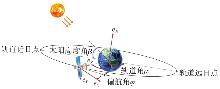
Fig. 1
Geometric illustration of satellite attitude"
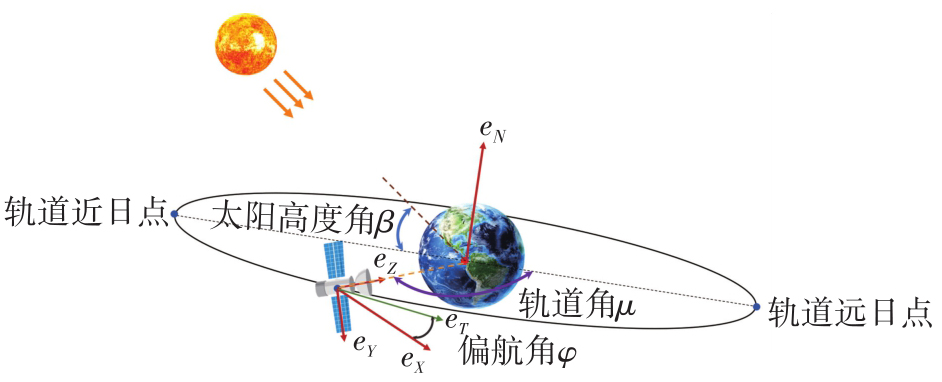
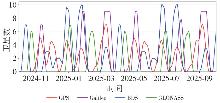
Fig. 2
Temporal variation characteristics of the number of GNSS satellites under low solar elevation angles"
Tab. 1
GNSS satellites under low solar elevation angles during the selected experimental periods"
| 系统 | 低太阳高度角卫星数量 |
|---|---|
| GPS | 8 |
| BDS | 10 |
| Galileo | 9 |
| GLONASS | 6 |
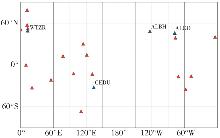
Fig. 3
Global distribution of the experimental stations"
Tab. 2
PPP processing strategy"
| 项目 | 设置 |
|---|---|
| 观测值 | GPS:L1/L2; Galileo:E1/E5a; BDS:B1I/B3I; GLONASS:G1/G2 |
| 采样间隔 | 30 s |
| 精密轨道/钟差 | 与姿态产品一致的同源分析中心精密产品 |
| ERP | IERS发布的地球自转参数产品 |
| PCO/PCV | igs20_2290.atx |
| 相位缠绕 | 模型改正 |
| 对流层延迟 | Saastamoinen模型 |
| 对流层投影函数 | GMF(global mapping function) |
| 湿延迟估计策略 | 随机游走参数模型 |
| 电离层延迟 | 非差非组合估计 |
| 接收机钟差 | 白噪声参数 |
| 系统间偏差ISB | 随机游走参数 |
| 截止高度角 | 7° |
| 观测定权 | 高度角定权 |
| 固体潮/海洋潮/极潮 | 模型改正 |
| 模糊度 | 动态浮点解 |
| 参数估计 | Kalman滤波 |
| 周跳探测 | MW和GF组合 |
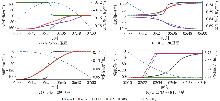
Fig. 4
Yaw angle time series of representative satellites from four GNSS constellations during low-β angle windows"
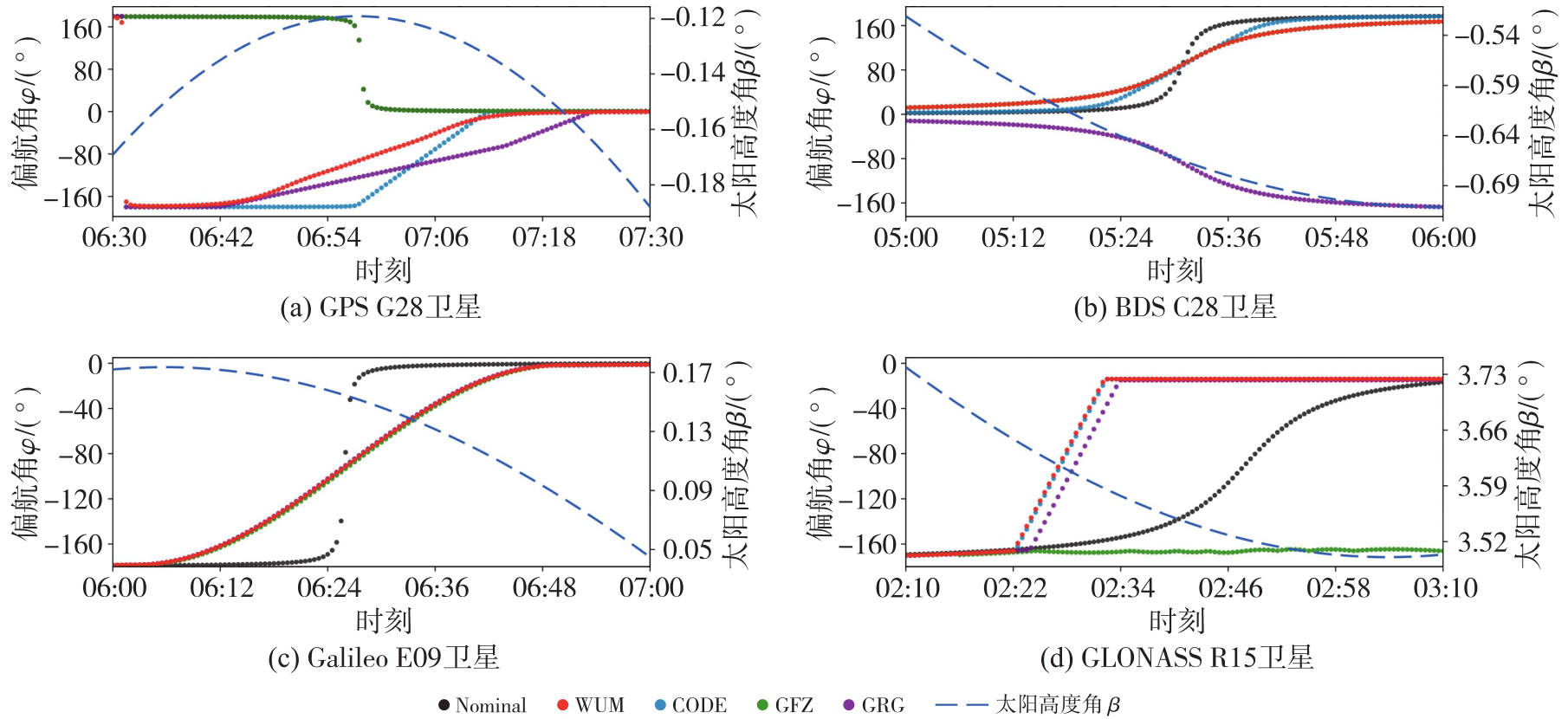
Fig. 5
Temporal variations of satellite antenna phase-center offset under different attitude models"

Fig. 6
Temporal variations of the phase wind-up correction under different attitude models"
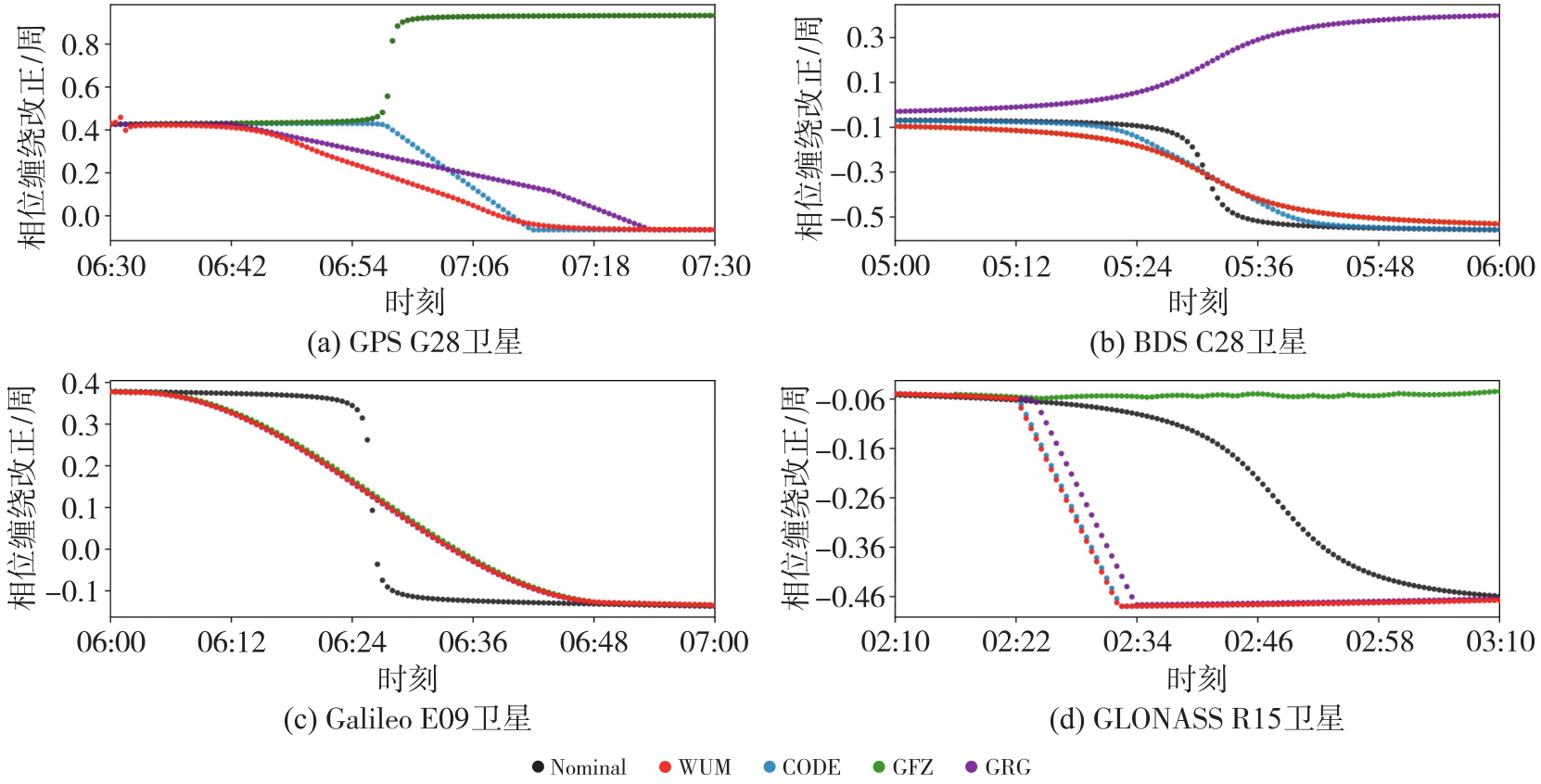
Fig. 7
Comparison of multi-constellation PPP positioning errors time series during eclipse periods: the first experiment"
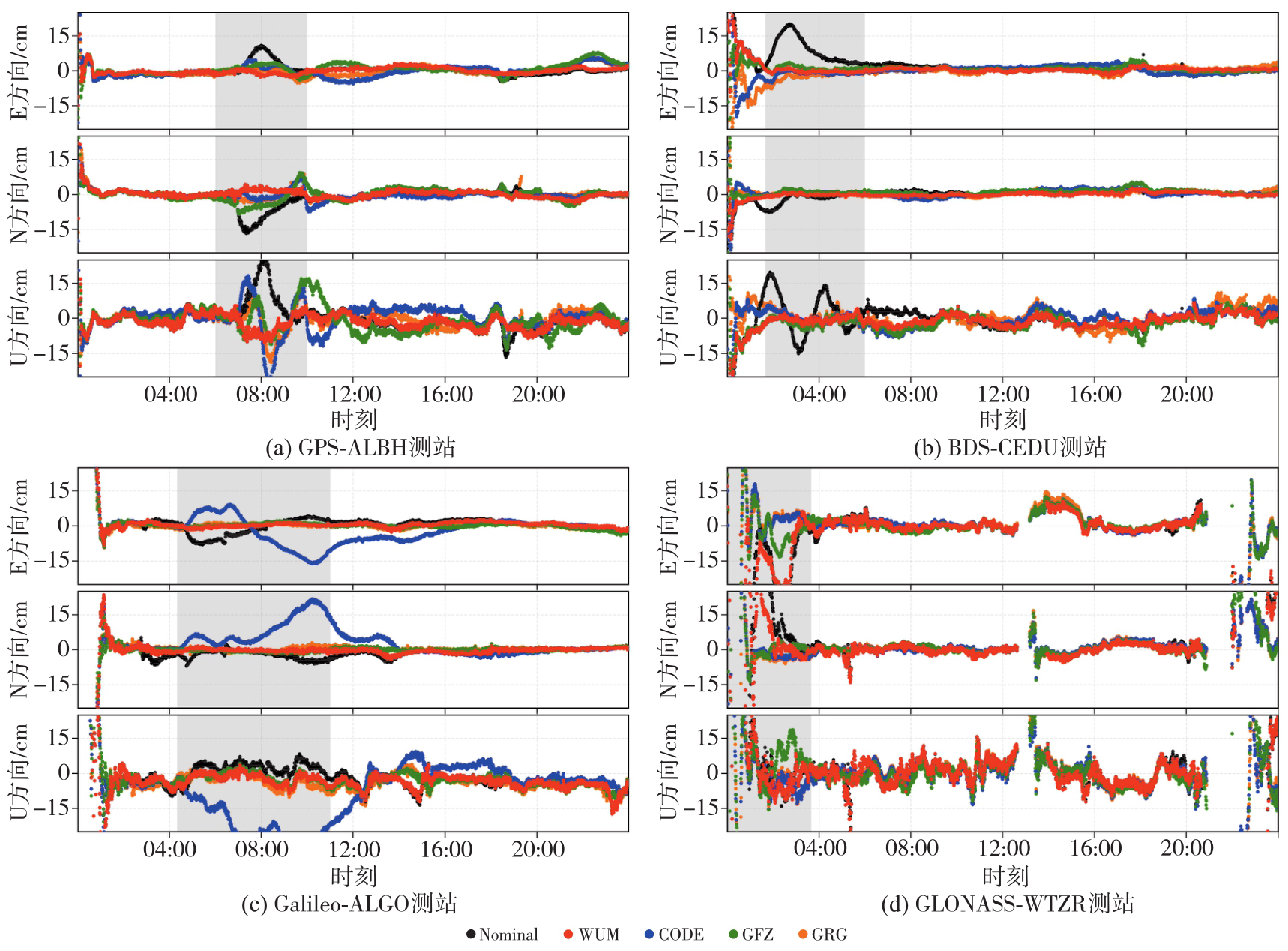
Fig. 8
Comparison of multi-constellation PPP positioning errors time series during eclipse periods: the second experiment (representive day)"

Fig. 9
Comparison of multi-constellation PPP positioning errors under different satellite attitude models during eclipse periods: the third experiment"

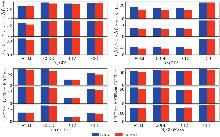
Fig. 10
Impact of attitude products from different analysis centers on the E、N、U RMS of PPP"
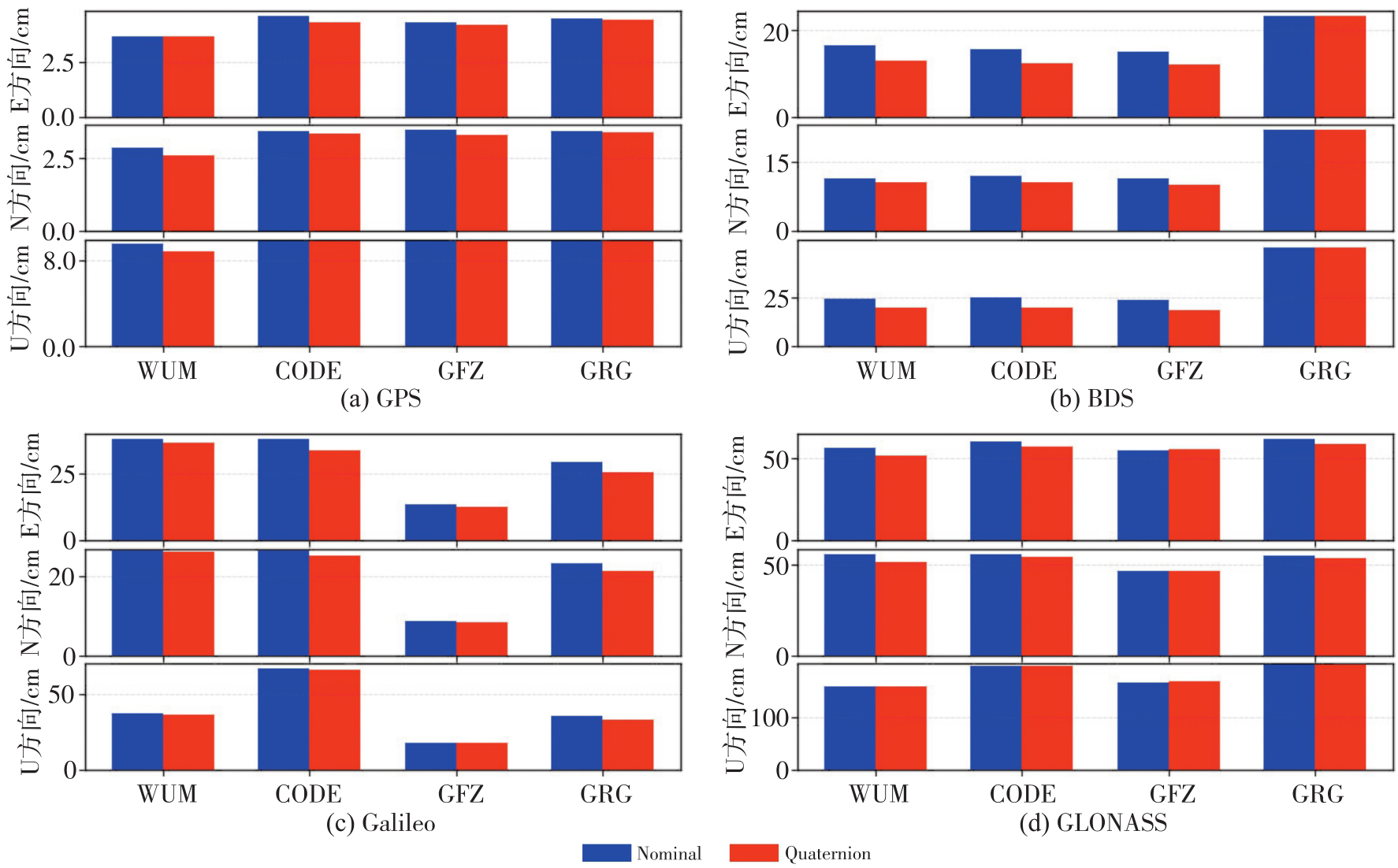
Tab. 3
PPP RMS improvement of quaternion-based attitude relative to the nominal attitude model"
| 系统 | 分析中心 | 提升/(%) | ||
|---|---|---|---|---|
| E方向 | N方向 | U方向 | ||
| GPS | WUM | 0.27 | 7.96 | 6.98 |
| CODE | 6.74 | 3.52 | 1.85 | |
| GFZ | 2.71 | 4.44 | 1.26 | |
| GRG | 2.11 | 1.91 | 0.01 | |
| BDS | WUM | 20.44 | 9.24 | 19.49 |
| CODE | 21.87 | 12.43 | 22.05 | |
| GFZ | 19.10 | 14.07 | 21.36 | |
| GRG | -0.09 | -0.07 | 0.29 | |
| Galileo | WUM | 3.43 | 1.54 | 2.24 |
| CODE | 10.80 | 7.94 | 1.68 | |
| GFZ | 6.62 | 3.57 | 0.92 | |
| GRG | 13.39 | 8.68 | 7.08 | |
| GLONASS | WUM | 7.78 | 7.66 | 0.65 |
| CODE | 4.99 | 1.70 | 0.09 | |
| GFZ | -0.89 | 0.19 | -0.82 | |
| GRG | 5.28 | 2.16 | 0.21 | |
| [1] | MONTENBRUCK O, STEIGENBERGER P, PRANGE L, et al. The multi-GNSS experiment (MGEX) of the International GNSS Service (IGS)-achievements, prospects and challenges[J]. Advances in Space Research, 2017, 59(7): 1671-1697. |
| [2] | PRANGE L, ORLIAC E, DACH R, et al. CODE's five-system orbit and clock solution-the challenges of multi-GNSS data analysis[J]. Journal of Geodesy, 2017, 91(4): 345-360. |
| [3] | UHLEMANN M, GENDT G, RAMATSCHI M, et al. GFZ global multi-GNSS network and data processing results[C]//Proceedings of 2015 International Association of Geodesy Symposia. Cham: Springer, 2015: 673-679. |
| [4] |
范曹明, 王胜利, 欧吉坤. GPS/BDS卫星姿态异常对PPP相位缠绕的影响及其改正模型[J]. 测绘学报, 2016, 45(10): 1165-1170. DOI: .
doi: 10.11947/j.AGCS.2016.20160126 |
|
FAN Caoming, WANG Shengli, OU Jikun. Effects of abnormal satellite attitudes of GPS and BDS on PPP phase wind-up and its correction model[J]. Acta Geodaetica et Cartographica Sinica, 2016, 45(10): 1165-1170. DOI: .
doi: 10.11947/j.AGCS.2016.20160126 |
|
| [5] | MONTENBRUCK O, SCHMID R, MERCIER F, et al. GNSS satellite geometry and attitude models[J]. Advances in Space Research, 2015, 56(6): 1015-1029. |
| [6] | CHENGPAN T, XIAOGONG H, SHANSHI Z, et al. Initial results of centralized autonomous orbit determination of the new-generation BDS satellites with inter-satellite link measurements[J]. Journal of Geodesy, 2018, 92(10): 1155-1169. |
| [7] | KUANG D, RIM H J, SCHUTZ B E, et al. Modeling GPS satellite attitude variation for precise orbit determination[J]. Journal of Geodesy, 1996, 70(9): 572-580. |
| [8] | 王晨, 郭靖, 赵齐乐. 偏航姿态对GPS和GLONASS精密轨道和钟差的影响[J]. 武汉大学学报(信息科学版), 2017, 42(5): 624-629. |
| WANG Chen, GUO Jing, ZHAO Qile. Impact of yaw attitude on precise orbits and clock offsets of GPS and GLONASS[J]. Geomatics and Information Science of Wuhan University, 2017, 42(5): 624-629. | |
| [9] | CHEN Q, YANG H, CHEN Z, et al. Solar radiation pressure modeling and application of BDS satellites[J]. Journal of Geodesy and Geoinformation Science, 2020, 3(2): 45. |
| [10] | 耿涛, 赵普, 谢新, 等. GPS/BDS-3卫星姿态产品评估及对精密数据处理的影响[J]. 武汉大学学报(信息科学版), 2026, 51(5): 914-924. |
| GENG Tao, ZHAO Pu, XIE Xin, et al. Evaluation of GPS/BDS-3 satellite attitude products and their impacts on precise data processing[J]. Geomatics and Information Science of Wuhan University, 2026. 51(5): 914-924. | |
| [11] | 郭靖. 姿态、光压和函数模型对导航卫星精密定轨影响的研究[D]. 武汉: 武汉大学, 2014. |
| GUO Jing. The impacts of attitude, solar radiation and function model on precise orbit determination for GNSS satellites[D]. Wuhan: Wuhan University, 2014. | |
| [12] | LOYER S, BANVILLE S, FÉLIX P, et al. Disseminating GNSS attitude for improved clock correction consistency[C]//Proceedings of 2017 IGS Workshop. Paris: [s.n.], 2017. |
| [13] | CAO Xinyun, ZHANG Shoujian, KUANG Kaifa, et al. The impact of eclipsing GNSS satellites on the precise point positioning[J]. Remote Sensing, 2018, 10(1): 94. |
| [14] | LI Xingxing, YUAN Yongqiang, ZHU Yiting, et al. Improving BDS-3 precise orbit determination for medium earth orbit satellites[J]. GPS Solutions, 2020, 24: 53. |
| [15] | YANG Nannan, XU Aigong, XU Zongqiu, et al. Effect of WHU/GFZ/CODE satellite attitude quaternion products on the GNSS kinematic PPP during the eclipse season[J]. Advances in Space Research, 2025, 75(1): 1-15. |
| [16] | LOYER S, BANVILLE S, GENG J, et al. Exchanging satellite attitude quaternions for improved GNSS data processing consistency[J]. Advances in Space Research, 2021, 68(6): 2441-2452. |
| [17] | 毛姝尹, 魏娜, 温强, 等. 顾及卫星姿态的多系统精密钟差产品综合[J]. 全球定位系统, 2022, 47(2): 13-20. |
| MAO Shuyin, WEI Na, WEN Qiang, et al. Multi-GNSS precise clock products combination considering satellite attitude[J]. Global Positioning System, 2022, 47(2): 13-20. | |
| [18] |
刘天骏, 陈渠森, 姜卫平, 等. 地影期间卫星姿态四元数产品对北斗精密单点定位的影响分析[J]. 测绘学报, 2023, 52(4): 550-558. DOI: .
doi: 10.11947/j.AGCS.2023.20220245 |
|
LIU Tianjun, CHEN Qusen, JIANG Weiping, et al. Impact of satellite attitude quaternion products on BDS precise point positioning during eclipse periods[J]. Acta Geodaetica et Cartographica Sinica, 2023, 52(4): 550-558. DOI: .
doi: 10.11947/j.AGCS.2023.20220245 |
|
| [19] | 孙爽, 刘长建, 王敏, 等. 四元数卫星姿态产品对BDS PPP的影响[J]. 大地测量与地球动力学, 2023, 43(3): 259-263. |
| SUN Shuang, LIU Changjian, WANG Min, et al. Impact of quaternion-based satellite attitude products on BDS PPP[J]. Geodesy and Geodynamics, 2023, 43(3): 259-263. | |
| [20] | 田福娟, 聂琳娟, 周晓慧. 不同分析中心BDS-3姿态四元数产品比较及其在PPP中的应用[J]. 武汉大学学报(信息科学版), 2024, 49(10): 1891-1899. |
| TIAN Fujuan, NIE Linjuan, ZHOU Xiaohui. Comparison of BDS-3 attitude quaternion products from different analysis centers and their application in PPP[J]. Geomatics and Information Science of Wuhan University, 2024, 49(10): 1891-1899. | |
| [21] | 王晟哲, 刘腾, 潭冰峰, 等. 姿态四元数产品对BDS PPP的影响研究[J]. 导航定位学报, 2024, 12(3): 16-28. |
| WANG Shengzhe, LIU Teng, TAN Bingfeng, et al. Impact of attitude quaternion products on BDS PPP[J]. Journal of Navigation and Positioning, 2024, 12(3): 16-28. | |
| [22] | 王晨. 北斗导航卫星光压模型构建与精化研究[D]. 武汉: 武汉大学, 2019. |
| WANG Chen. Research on construction and refinement of solar radiation pressure models for BeiDou navigation satellites[D]. Wuhan: Wuhan University, 2019. | |
| [23] | XIA Fengyu, YE Shirong, CHEN Dezhong, et al. Observation of BDS-2 IGSO/MEOs yaw-attitude behavior during eclipse seasons[J]. GPS Solutions, 2019, 23: 71. |
| [24] | LIU Tianjun, CHEN Hua, JIANG Weiping, et al. Assessing the exchanging satellite attitude quaternions from CNES/CLS and their application in the deep eclipse season[J]. GPS Solutions, 2022, 26: 11. |
| [25] | BAR-SEVER Y E. A new model for GPS yaw attitude[J]. Journal of Geodesy, 1996, 70: 714-723. |
| [26] | 戴小蕾. 基于平方根信息滤波的GNSS导航卫星实时精密定轨理论与方法[D]. 武汉: 武汉大学, 2016. |
| DAI Xiaolei. Theory and methods of real-time precise orbit determination for GNSS navigation satellites based on square-root information filtering[D]. Wuhan: Wuhan University, 2016. | |
| [27] | LIU T, CHEN H, CHEN Q, et al. Characteristics of phase bias from CNES and its application in multi-frequency and multi-GNSS precise point positioning with ambiguity resolution[J]. GPS Solutions, 2021, 25: 58. |
| [28] | WU J T, WU S C, HAJJ G A, et al. Effects of antenna orientation on GPS carrier phase[J]. Astrodynamics 1993, 18: 91-98. |
| [29] |
叶世榕, 夏凤雨, 赵乐文, 等. 偏航姿态对北斗精密单点定位的影响分析[J]. 测绘学报, 2017, 46(8): 7. DOI: .
doi: 10.11947/j.AGCS.2017.20170094 |
|
YE Shirong, XIA Fengyu, ZHAO Lewen, et al. Impact of yaw attitude on BeiDou precise point positioning[J]. Acta Geodaetica et Cartographica Sinica, 2017, 46(8): 7. DOI: .
doi: 10.11947/j.AGCS.2017.20170094 |
| [1] | Lei LIANG, Changqing WANG, Lingyong HUANG, Zhiyong HUANG, Yaoyao YU, Min ZHONG, Yihao YAN, Qinglu MU. GRACE-FO attitude data determination with consideration of star camera alignment matrix calibration [J]. Acta Geodaetica et Cartographica Sinica, 2026, 55(2): 287-300. |
| [2] | Shoujian ZHANG, Xinyun CAO, Yulong GE, Fei SHEN. Yaw attitude modeling of GLONASS-K and GLONASS-M+ satellites and its impact on satellite clock estimation and precise point positioning [J]. Acta Geodaetica et Cartographica Sinica, 2025, 54(12): 2142-2152. |
| [3] | Danyi HU, Yunlong WU, Yun XIAO, Yue QIU, Xiaohui WU, Yulong ZHONG. Multi-star tracker angular velocity reconstruction method considering temperature effect correction [J]. Acta Geodaetica et Cartographica Sinica, 2024, 53(9): 1748-1760. |
| [4] | LEI Zhen, ZHANG Fan, XIANG Hanyu, YANG Chong, HUANG Xianfeng. Multiple view complete 3D model reconstruction of manually turned object [J]. Acta Geodaetica et Cartographica Sinica, 2023, 52(8): 1305-1316. |
| [5] | LIU Tianjun, CHEN Qusen, JIANG Weiping, CHEN Hua, XIA Fengyu, FAN Caoming. Effect of satellite attitude quaternions on BeiDou precise point positioning during the eclipse season [J]. Acta Geodaetica et Cartographica Sinica, 2023, 52(4): 550-558. |
| [6] | YUAN Yunbin, LIU Shuai, TAN Bingfeng. Modeling and effects analysis of GNSS precise point positioning ambiguity resolution based on the decoupled clock method [J]. Acta Geodaetica et Cartographica Sinica, 2022, 51(8): 1669-1679. |
| [7] | LIU Genyou, GAO Ming, YIN Xiangfei, XIAO Gongwei, LÜ Dong, WANG Shengliang, WANG Run. High-precision cloud platform timing based on GNSS precise point positioning [J]. Acta Geodaetica et Cartographica Sinica, 2022, 51(8): 1736-1743. |
| [8] | ZHOU Feng, YANG Yuze, WANG Lei, XU Tianhe. GNSS carrier phase integer equivariant estimator and its application in improving PPP performance [J]. Acta Geodaetica et Cartographica Sinica, 2022, 51(8): 1779-1786. |
| [9] | JIN Shuanggen, WANG Qisheng, SHI Qiqi. Parameters estimation and applications from single- to five-frequency multi-GNSS precise point positioning [J]. Acta Geodaetica et Cartographica Sinica, 2022, 51(7): 1239-1248. |
| [10] | YANG Kaichun, LV Zhiping, LI Linyang, KUANG Yingcai, XU Wei, ZHENG Xi. Sliding window single-frequency real time precise point positioning algorithm with epoch constraints [J]. Acta Geodaetica et Cartographica Sinica, 2022, 51(5): 648-657. |
| [11] | ZHAO Leyang, YAN Li. Advanced quaternion unscented Kalman filter based on SLAM of mobile robot pose estimation [J]. Acta Geodaetica et Cartographica Sinica, 2022, 51(2): 212-223. |
| [12] | FANG Yanan, ZHU Jun, LI Jie, WANG Chong, WANG Jiasong, ZHANG Shaoyu. Precise orbit determination method for BeiDou mixed constellations with layered constraints [J]. Acta Geodaetica et Cartographica Sinica, 2021, 50(4): 466-474. |
| [13] | ZHANG Bingbing, NIU Jiqiang, WANG Zhengtao, XU Feng, TIAN Kunjun. Centimeter precise orbit determination for the Swarm satellites via undifferenced kinematic method [J]. Acta Geodaetica et Cartographica Sinica, 2021, 50(1): 27-36. |
| [14] | ZHOU Feng, XU Tianhe. Modeling and assessment of GPS/BDS/Galileo triple-frequency precise point positioning [J]. Acta Geodaetica et Cartographica Sinica, 2021, 50(1): 61-70. |
| [15] | ZHANG Xiaohong, HU Jiahuan, REN Xiaodong. New progress of PPP/PPP-RTK and positioning performance comparison of BDS/GNSS PPP [J]. Acta Geodaetica et Cartographica Sinica, 2020, 49(9): 1084-1100. |
| Viewed | ||||||
|
Full text |
|
|||||
|
Abstract |
|
|||||
