


测绘学报 ›› 2025, Vol. 54 ›› Issue (2): 334-344.doi: 10.11947/j.AGCS.2025.20230329
涂伟1,2,3( ), 池向沅1,2,3, 赵天鸿1,4(), 杨剑5, 朱世平6, 陈德莉6
收稿日期:2023-08-10
出版日期:2025-03-11
发布日期:2025-03-11
通讯作者:
赵天鸿
E-mail:tuwei@szu.edu.cn;zhaotianhong@sztu.edu.cn
作者简介:涂伟(1984—),男,博士,教授,研究方向为城市时空大数据分析方法及应用。 E-mail:tuwei@szu.edu.cn
基金资助:
Wei TU1,2,3(), Xiangyuan CHI1,2,3, Tianhong ZHAO1,4(), Jian YANG5, Shiping ZHU6, Deli CHEN6
Received:2023-08-10
Online:2025-03-11
Published:2025-03-11
Contact:
Tianhong ZHAO
E-mail:tuwei@szu.edu.cn;zhaotianhong@sztu.edu.cn
About author:TU Wei (1984—), male, PhD, professor, majors in urban spatio-temporal big data analysis methods and applications. E-mail: tuwei@szu.edu.cn
Supported by:摘要:
城市排水管网的流量是其运行效率和安全的关键指标,准确的流量预测对排水管网运行风险预警、优化其运行效率及规划布局至关重要。水流量不仅受到其自身动力学特性的影响,还与管网的空间结构紧密相关,但传统水流量预测方法较少关注水流在管道之间复杂多维的空间依赖关系。针对这一问题,本文提出了一种基于多视图的时空图网络模型,该模型综合考虑了排水管网的空间邻近性和节点间的属性相似性。分别构建最近邻拓扑视图与流量相似性属性视图,使用时空图卷积网络挖掘流量特征的内在时空依赖,利用注意力机制对多个视图的时空依赖特征进行融合以获得流量预测值。利用某市排水管网历史水流监测数据进行试验,结果表明本文提出的多视图时空图神经网络模型取得了较好的预测性能,多视图对比试验验证了不同视图在模型中起到的贡献。
中图分类号:
涂伟, 池向沅, 赵天鸿, 杨剑, 朱世平, 陈德莉. 城市排水管网流量预测多视图时空图神经网络模型[J]. 测绘学报, 2025, 54(2): 334-344.
Wei TU, Xiangyuan CHI, Tianhong ZHAO, Jian YANG, Shiping ZHU, Deli CHEN. Multi-view spatio-temporal graph convolutional networks model for urban drainage networks flow prediction[J]. Acta Geodaetica et Cartographica Sinica, 2025, 54(2): 334-344.
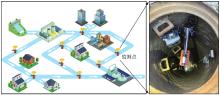
图1
城市排水管网系统"
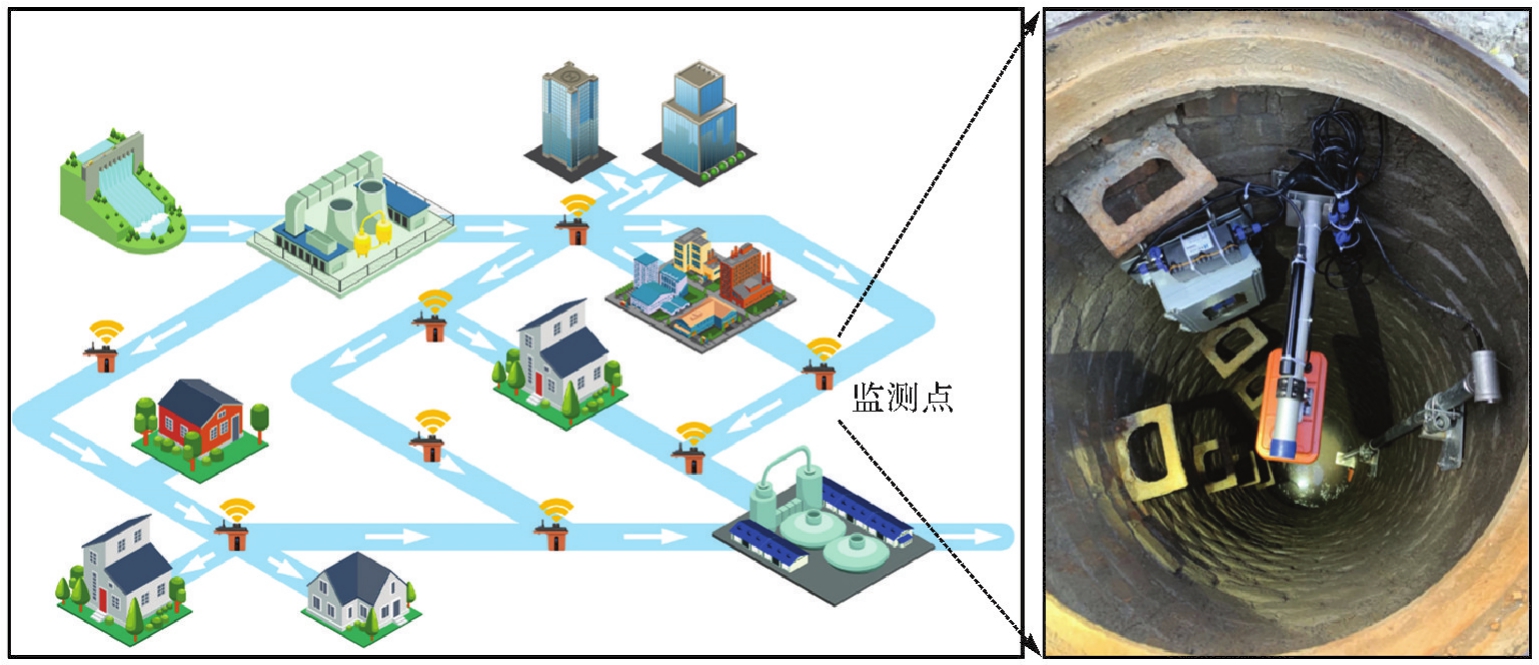
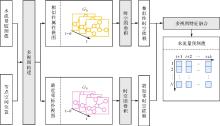
图2
MVSTGCN模型框架注:h为时间步长。"
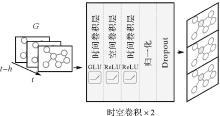
图3
时空图卷积模块结构"
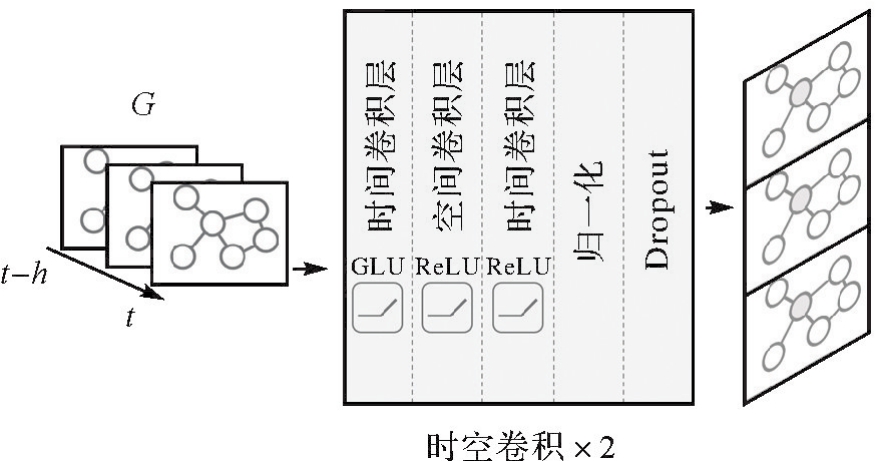
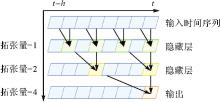
图4
拓张因果卷积结构用于捕获时间依赖"
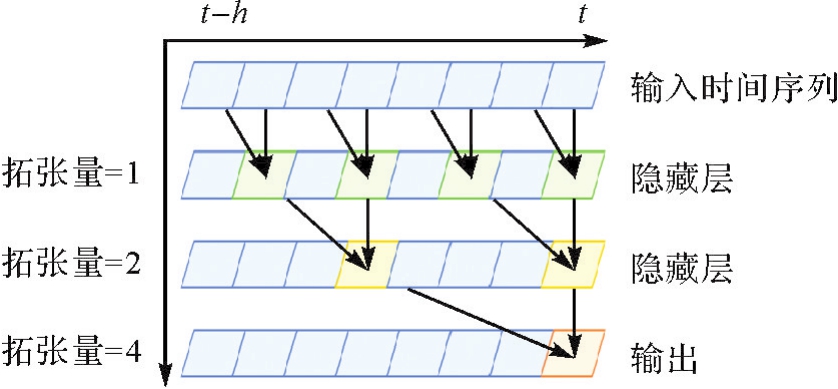
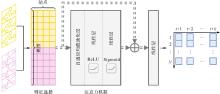
图5
多视图特征融合模块"
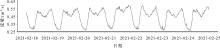
图6
第30号站点在一周时间内的流量监测值"
表1
测试集流量预测值精度"
| 未来时间跨度/min | MAPE | RMSE/(m3/s) |
|---|---|---|
| 15 | 0.097 | 0.075 |
| 30 | 0.102 | 0.078 |
| 45 | 0.106 | 0.080 |
| 60 | 0.111 | 0.083 |
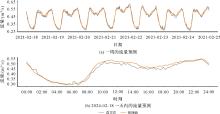
图7
第30号站点在一周及其第一天内的流量预测结果"

表2
各模型预测精度结果对比"
| 模型 | MAPE | RMSE/(m3/s) | ||||||
|---|---|---|---|---|---|---|---|---|
| 15 min | 30 min | 45 min | 60 min | 15 min | 30 min | 45 min | 60 min | |
| ARIMA | 0.176 | 0.238 | 0.258 | 0.276 | 0.107 | 0.141 | 0.153 | 0.165 |
| RFR | 0.146 | 0.161 | 0.175 | 0.190 | 0.090 | 0.095 | 0.101 | 0.110 |
| LSTM | 0.155 | 0.152 | 0.155 | 0.149 | 0.106 | 0.108 | 0.109 | 0.112 |
| AutoEncoder | 0.142 | 0.138 | 0.146 | 0.152 | 0.105 | 0.104 | 0.103 | 0.106 |
| GWNet | 0.099 | 0.118 | 0.128 | 0.139 | 0.075 | 0.080 | 0.084 | 0.089 |
| AGCRN | 0.095 | 0.104 | 0.118 | 0.118 | 0.081 | 0.085 | 0.087 | 0.090 |
| MVSTGCN | 0.097 | 0.102 | 0.106 | 0.111 | 0.075 | 0.078 | 0.080 | 0.083 |
表3
MVSTGCN中不同视图组合的流量预测精度结果对比"
| 模型 | MAPE | RMSE/(m3/s) | ||||||
|---|---|---|---|---|---|---|---|---|
| 15 min | 30 min | 45 min | 60 min | 15 min | 30 min | 45 min | 60 min | |
| MVSTGCN | 0.097 | 0.102 | 0.106 | 0.111 | 0.075 | 0.078 | 0.080 | 0.083 |
| MVSTGCN-P | 0.104 | 0.105 | 0.111 | 0.118 | 0.082 | 0.082 | 0.084 | 0.089 |
| MVSTGCN-S | 0.104 | 0.104 | 0.108 | 0.117 | 0.080 | 0.081 | 0.082 | 0.087 |
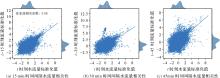
图8
水流在不同时间间隔的依赖性"
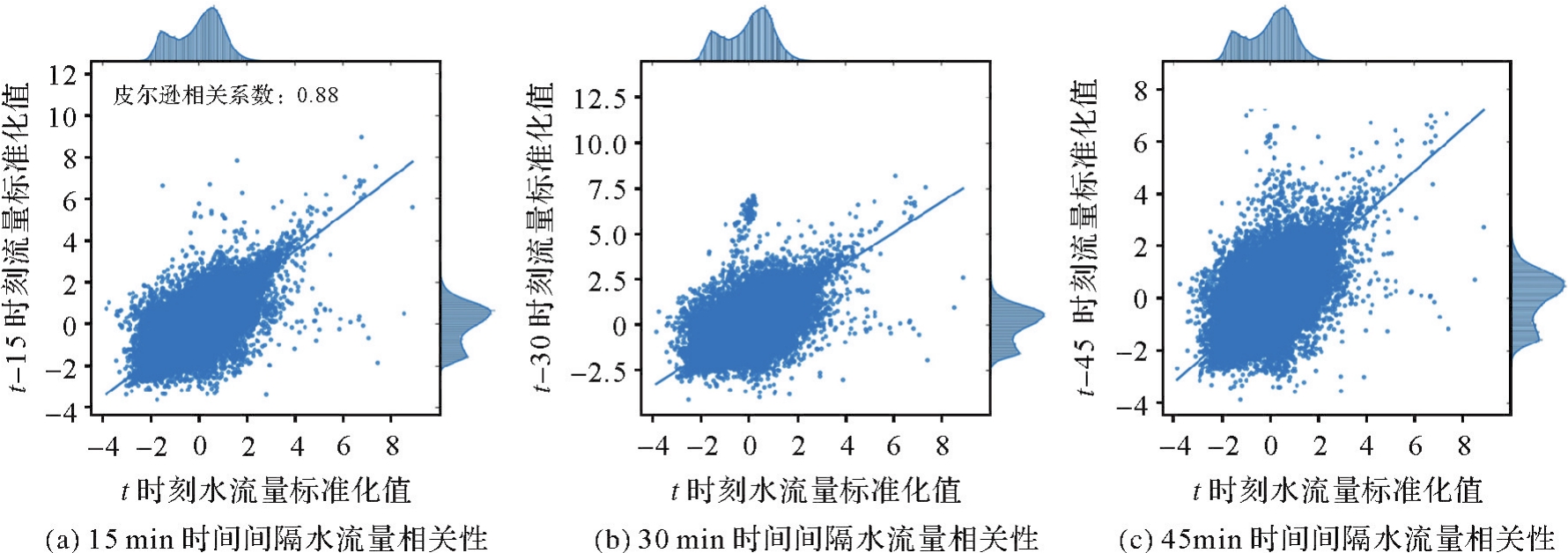
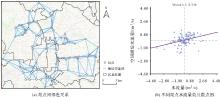
图9
水流量在不同观测站点之间的依赖性"

| [1] | HUANG Dong, LIU Xiuhong, JIANG Songzhu, et al. Current state and future perspectives of sewer networks in urban China[J]. Frontiers of Environmental Science & Engineering, 2018, 12(3): 2. |
| [2] |
李清泉, 张德津, 汪驰升, 等. 动态精密工程测量技术及应用[J]. 测绘学报, 2021, 50(9): 1147-1158. DOI:.
doi: 10.11947/j.AGCS.2021.20210172 |
|
LI Qingquan, ZHANG Dejin, WANG Chisheng, et al. Technology and applications of dynamic and precise engineering surveying[J]. Acta Geodaetica et Cartographica Sinica, 2021, 50(9): 1147-1158. DOI:.
doi: 10.11947/j.AGCS.2021.20210172 |
|
| [3] | KHODASHENAS S R, TAJBAKHSH M. Management of urban drainage system using integrated MIKE SWMM and GIS[J]. Journal of Water Resource and Hydraulic Engineering, 2016, 5(1): 36-45. |
| [4] | VAN DER VOORT M, DOUGHERTY M, WATSON S. Combining Kohonen maps with ARIMA time series models to forecast traffic flow[J]. Transportation Research Part C: Emerging Technologies, 1996, 4(5): 307-318. |
| [5] | WANG Hao, SONG Lixiang. Water level prediction of rainwater pipe network using an SVM-based machine learning method[J]. International Journal of Pattern Recognition and Artificial Intelligence, 2020, 34(2): 2051002. |
| [6] | KARIMI H S, NATARAJAN B, RAMSEY C L, et al. Comparison of learning-based wastewater flow prediction methodologies for smart sewer management[J]. Journal of Hydrology, 2019, 577: 123977. |
| [7] | ZHANG Duo, LINDHOLM G, RATNAWEERA H. Use long short-term memory to enhance Internet of Things for combined sewer overflow monitoring[J]. Journal of Hydrology, 2018, 556: 409-418. |
| [8] | 夏巍, 汪石, 梁祥莹. 基于改进GRU的城市供水管网流量预测研究[J]. 安徽建筑大学学报, 2023, 31(2): 51-54. |
| XIA Wei, WANG Shi, LIANG Xiangying. Research on flow forecasting methods for urban water supply network based on improved GRU[J]. Journal of Anhui Jianzhu University, 2023, 31(2): 51-54. | |
| [9] | 李双宇, 张明凯, 刘艳臣, 等. 基于LSTM模型的排水系统流量预测研究[J]. 中国给水排水, 2022, 38(5): 59-64. |
| LI Shuangyu, ZHANG Mingkai, LIU Yanchen, et al. Flow prediction of drainage system based on long short time memory model[J]. China Water & Wastewater, 2022, 38(5): 59-64. | |
| [10] | NGUYEN L V, TORNYEVIADZI H M, BUI D T, et al. Predicting discharges in sewer pipes using an integrated long short-term memory and entropy A-TOPSIS modeling framework[J]. Water, 2022, 14(3): 300. |
| [11] | SHENG Zheng, CAI Zhikai. GAT-GRU based model for water network flow prediction[C]//Proceedings of the 9th International Conference on Water Resource and Environment. Singapore: Springer, 2024: 151-162. |
| [12] | REN Yibin, CHEN Huanfa, HAN Yong, et al. A hybrid integrated deep learning model for the prediction of citywide spatio-temporal flow volumes[J]. International Journal of Geographical Information Science, 2020, 34(4): 802-823. |
| [13] |
于洋洋, 贺康杰, 武芳, 等. 面状居民地形状分类的图卷积神经网络方法[J]. 测绘学报, 2022, 51(11): 2390-2402. DOI:.
doi: 10.11947/j.AGCS.2022.20210134 |
|
YU Yangyang, HE Kangjie, WU Fang, et al. Graph convolution neural network method for shape classification of areal settlements[J]. Acta Geodaetica et Cartographica Sinica, 2022, 51(11): 2390-2402. DOI:.
doi: 10.11947/j.AGCS.2022.20210134 |
|
| [14] |
李静, 刘海砚, 郭文月, 等. 基于深度学习的人群活动流量时空预测模型[J]. 测绘学报, 2021, 50(4): 522-531. DOI:.
doi: 10.11947/j.AGCS.2021.20200230 |
|
LI Jing, LIU Haiyan, GUO Wenyue, et al. A spatio-temporal network for human activity prediction based on deep learning[J]. Acta Geodaetica et Cartographica Sinica, 2021, 50(4): 522-531. DOI:.
doi: 10.11947/j.AGCS.2021.20200230 |
|
| [15] | 井佩光, 田雨豆, 汪少初, 等. 基于动态扩散图卷积的交通流量预测算法[J]. 吉林大学学报(工学版), 2024, 54(6): 1582-1592. |
| JING Peiguang, TIAN Yudou, WANG Shaochu, et al. Traffic flow prediction algorithm based on dynamic diffusion graph convolution[J]. Journal of Jilin University (Engineering and Technology Edition), 2024, 54(6): 1582-1592. | |
| [16] | LIAO Ziyi, LIU Minghui, DU Bowen, et al. A temporal and spatial prediction method for urban pipeline network based on deep learning[J]. Physica A: Statistical Mechanics and Its Applications, 2022, 608: 128299. |
| [17] | YU Bing, YIN Haoteng, ZHU Zhanxing. Spatio-temporal graph convolutional networks: a deep learning framework for traffic forecasting[EB/OL]. [2023-05-04]. https://arxiv.org/abs/1709.04875v4. |
| [18] | WU Shaofei. Spatiotemporal dynamic forecasting and analysis of regional traffic flow in urban road networks using deep learning convolutional neural network[J]. IEEE Transactions on Intelligent Transportation Systems, 2022, 23(2): 1607-1615. |
| [19] | LIU Zhichen, LIU Zhiyuan, FU Xiao. Dynamic origin-destination flow prediction using spatial-temporal graph convolution network with mobile phone data[J]. IEEE Intelligent Transportation Systems Magazine, 2022, 14(5): 147-161. |
| [20] | RAWAT W, WANG Zenghui. Deep convolutional neural networks for image classification: a comprehensive review[J]. Neural Computation, 2017, 29(9): 2352-2449. |
| [21] | DAUPHIN Y N, FAN A, AULI M, et al. Language modeling with gated convolutional networks[C]//Proceedings of the 34th International Conference on Machine Learning. Sydney: JMLR, 2017: 933-941. |
| [22] | KIPF T N, WELLING M. Semi-supervised classification with graph convolutional networks[EB/OL]. [2023-05-04]. https://arxiv.org/abs/1609.02907v4. |
| [23] | VASWANI A, SHAZEER N, PARMAR N, et al. Attention is all you need[C]//Proceedings of the 31st International Conference on Neural Information Processing Systems. Red Hook: Curran Associates Inc., 2017: 1-11. |
| [24] | GUO Shengnan, LIN Youfang, FENG Ning, et al. Attention based spatial-temporal graph convolutional networks for traffic flow forecasting[C]//Proceedings of 2019 AAAI Conference on Artificial Intelligence. Honolulu: AAAI Press, 2019: 922-929. |
| [25] | NGUYEN N, QUANZ B. Temporal latent auto-encoder: a method for probabilistic multivariate time series forecasting[EB/OL]. [2023-05-04]. https://ojs.aaai.org/index.php/AAAI/article/download/17101/16908. |
| [26] | WU Zonghan, PAN Shirui, LONG Guodong, et al. Graph wavenet for deep spatial-temporal graph modeling[C]//Proceedings of the 28th International Joint Conference on Artificial Intelligence. Macao: ACM Press, 2019: 1907-1913. |
| [27] | BAI Lei, YAO Lina, LI Can, et al. Adaptive graph convolutional recurrent network for traffic forecasting[C]//Proceedings of the 34th International Conference on Neural Information Processing Systems. Vancouver: ACM Press, 2020: 17804-17815. |
| [28] | WUNSCH A, LIESCH T, BRODA S. Forecasting groundwater levels using nonlinear autoregressive networks with exogenous input (NARX)[J]. Journal of Hydrology, 2018, 567: 743-758. |
| [1] | 吴明光, 成梓铭. 顾及使用场景的绿色地图颜色生成方法研究[J]. 测绘学报, 2026, 55(3): 390-403. |
| [2] | 杨敏, 马宏然, 孔博, 刘鹏程, 艾廷华. 基于预训练模型的矢量海岸线形态模式判别方法[J]. 测绘学报, 2026, 55(3): 404-414. |
| [3] | 禹文豪, 曾子怡, 张一帆, 钱海忠. 融合欧氏空间邻近与拓扑邻接信息预训练模型的路网网格模式[J]. 测绘学报, 2026, 55(3): 415-424. |
| [4] | 禄小敏, 张志义, 闫浩文, 何毅, 苏小宁. 融合深度图信息最大化和多层感知机的建筑物群组模式识别方法[J]. 测绘学报, 2026, 55(3): 425-438. |
| [5] | 成晓强, 赵家威, 刘鹏程. 基于距离-相似性隐喻的空间交互可视化[J]. 测绘学报, 2026, 55(3): 536-547. |
| [6] | 王泽矫, 向隆刚, 王猛, 王兴娟, 刘清. 融合层级特征与多样化注意力的道路面与中心线协同提取网络[J]. 测绘学报, 2026, 55(3): 548-563. |
| [7] | 徐智邦. 实体城市的多层次边界识别、模式分析与扩张模拟[J]. 测绘学报, 2026, 55(3): 566-566. |
| [8] | 冉耘博, 杨雪, 周文豪, 吴承恩, 周宝定, 唐炉亮, 李清泉. 多维偏好增强型对抗深度强化学习驱动的行人路径规划[J]. 测绘学报, 2026, 55(2): 191-205. |
| [9] | 王立增, 程诗奋, 杨一涛, 王培晓, 陆锋. 局部-全局联合感知的时空自适应交通集成预测方法[J]. 测绘学报, 2026, 55(2): 206-221. |
| [10] | 王少华, 梁浩健, 苏澄, 徐大川, 周亮, 秦昆. 耦合时空大数据和人工智能的城市设施配置优化研究进展与展望[J]. 测绘学报, 2026, 55(2): 222-235. |
| [11] | 付晓, 朱司蕊, 厉旭东, 闾国年. 面向长距离通勤场景的城市垂直起降场布局优化方法[J]. 测绘学报, 2026, 55(2): 236-248. |
| [12] | 郭军豪, 吴明治, 王培晓, 张恒才. 一种面向定点稀疏轨迹的密度聚类停留点识别方法[J]. 测绘学报, 2026, 55(2): 249-260. |
| [13] | 李冠男. 道路实景三维模型自动构建方法[J]. 测绘学报, 2026, 55(2): 378-378. |
| [14] | 刘鹏程, 成晓强, 肖天元, 杨敏, 艾廷华. 一种面向地图综合建筑多边形化简的Transformer模型[J]. 测绘学报, 2026, 55(1): 124-137. |
| [15] | 贺彪, 林浩嘉, 郭仁忠, 蒯希, 马丁, 张琛. 基于视觉感知的三维空间相似关系量化计算[J]. 测绘学报, 2026, 55(1): 138-153. |
| 阅读次数 | ||||||
|
全文 |
|
|||||
|
摘要 |
|
|||||
