

Acta Geodaetica et Cartographica Sinica ›› 2025, Vol. 54 ›› Issue (10): 1826-1840.doi: 10.11947/j.AGCS.2025.20250139
• Geodesy and Navigation • Previous Articles Next Articles
Xin HUANG1,2( ), Jian YE1(), Chengbing LIU1, Qiuyu ZENG1, Wanxin GUO1,3, Zhikai GUO1
Received:2025-03-31
Revised:2025-06-19
Online:2025-11-14
Published:2025-11-14
Contact:
Jian YE
E-mail:xinhuang@my.swjtu.edu.cn;yejian518@swjtu.edu.cn
About author:HUANG Xin (2001—), male, master, majors in landslide susceptibility modeling and analysis. E-mail: xinhuang@my.swjtu.edu.cn
Supported by:CLC Number:
Xin HUANG, Jian YE, Chengbing LIU, Qiuyu ZENG, Wanxin GUO, Zhikai GUO. A Stacking-SHAP ensemble method for landslide susceptibility prediction with high accuracy and interpretability[J]. Acta Geodaetica et Cartographica Sinica, 2025, 54(10): 1826-1840.
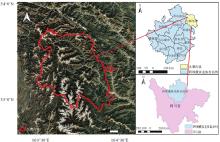
Fig. 1
Study area"

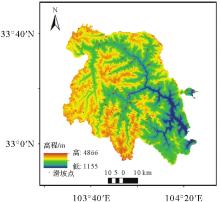
Fig. 2
Overview of landslide points in the study area"

Tab. 1
Landslide conditioning factors and data sources"
| 条件因子 | 来源 | 数据采集时间 | 条件因子 | 来源 | 数据采集时间 |
|---|---|---|---|---|---|
| 高程 | 30 m GDEMV3 | 2000—2013年 | 地形湿度指数 | 30 m GDEMV3 | 2000—2013年 |
| 坡度 | 30 m GDEMV3 | 2000—2013年 | 水流功率指数 | 30 m GDEMV3 | 2000—2013年 |
| 坡向 | 30 m GDEMV3 | 2000—2013年 | NDVI | 2020年 | |
| 地形曲率 | 30 m GDEMV3 | 2000—2013年 | 多年平均降水量 | 2011—2020年 | |
| 平面曲率 | 30 m GDEMV3 | 2000—2013年 | 土地覆盖类型 | 2020年 | |
| 剖面曲率 | 30 m GDEMV3 | 2000—2013年 | 地层岩性 | 全国地质资料馆 | 2002年 |
| 地表粗糙度 | 30 m GDEMV3 | 2000—2013年 | 地貌类型 | 全国地质资料馆 | 2009年 |
| 地表切割深度 | 30 m GDEMV3 | 2000—2013年 | 道路距离 | Open Street Map | 2023年 |
| 地形起伏度 | 30 m GDEMV3 | 2000—2013年 | 河流距离 | MapOpen Street | 2023年 |
| 高程变异系数 | 30 m GDEMV3 | 2000—2013年 | 断层距离 | 国家地震科学数据中心 | 2002年 |
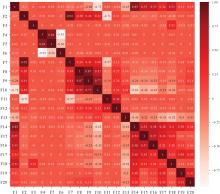
Fig. 3
Pearson correlation coefficient"

Tab. 2
Multi-collinearity analysis of landslide condition factors VIF value"
| 滑坡条件因子 | VIF | 滑坡条件因子 | VIF |
|---|---|---|---|
| 坡向 | 1.179 | NDVI | 1.737 |
| 平面曲率 | 1.470 | 多年平均降水量 | 3.810 |
| 剖面曲率 | 1.472 | 土地覆盖类型 | 1.822 |
| 地面粗糙度 | 2.320 | 地层岩性 | 1.593 |
| 地表切割度 | 1.919 | 地貌类型 | 1.335 |
| 高程变异系数 | 3.421 | 道路距离 | 1.996 |
| 地形湿度指数 | 2.962 | 河流距离 | 1.782 |
| 水流功率指数 | 2.144 | 断层距离 | 1.708 |
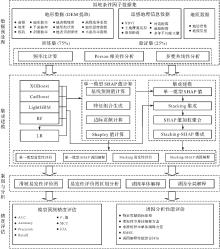
Fig. 4
Research methods and technical routes"

Tab. 3
Working mechanism and advantages of individual classifiers"
| 模型名称 | 模型原理 | 滑坡易发性预测优势 |
|---|---|---|
| XGBoost | 基于梯度提升决策树算法,通过目标函数优化模型性能,控制过拟合 | 具有较高的预测精度和泛化能力,可处理复杂非线性关系,在处理复杂地形和多变量数据上具有优势 |
| CatBoost | 基于梯度提升决策树框架,使用遗忘树处理类别特征,有效解决梯度和预测偏差问题 | 高效处理分类变量,提高模型精度,适合类别特征较多的滑坡数据集 |
| LightGBM | 基于梯度提升决策树算法,采用直方图分割方法加速训练 | 具有执行速度快、资源占用少的优势,适用于大规模滑坡数据的预测和分析 |
| RF | 基于决策树的集成模型,通过随机抽样生成多个训练子集,构建多棵树并结合输出结果 | 具有较高的预测精度,能够有效抵抗数据异常值和噪声,适合复杂环境下的滑坡预测 |
| LR | 广义线性模型,通过逻辑变换预测事件发生的概率 | 适用于滑坡易发性评价的二分类问题,能够快速评估滑坡影响因子对滑坡发生的影响 |
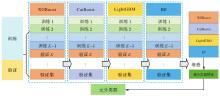
Fig. 5
Modeling process of base stacking model"

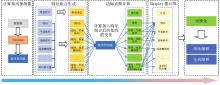
Fig. 6
Computational process of SHAP algorithm"

Tab. 4
Calculation results of model evaluation metrics"
| 模型 | Accuracy | AUC | Precision | Recall | F1值 | MCC | IOA |
|---|---|---|---|---|---|---|---|
| Stacking | 0.896 | 0.920 | 0.901 | 0.890 | 0.895 | 0.791 | 0.895 |
| XGBoost | 0.893 | 0.893 | 0.896 | 0.891 | 0.894 | 0.787 | 0.893 |
| CatBoost | 0.894 | 0.894 | 0.897 | 0.891 | 0.894 | 0.788 | 0.894 |
| LightGBM | 0.879 | 0.879 | 0.891 | 0.866 | 0.878 | 0.759 | 0.879 |
| RF | 0.859 | 0.859 | 0.871 | 0.843 | 0.857 | 0.718 | 0.859 |
| LR | 0.711 | 0.794 | 0.718 | 0.697 | 0.708 | 0.422 | 0.711 |
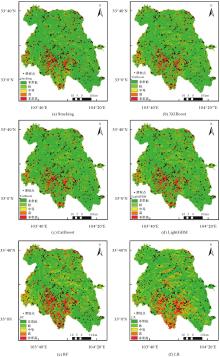
Fig. 7
Landslide susceptibility assessment in Jiuzhaigou"


Fig. 8
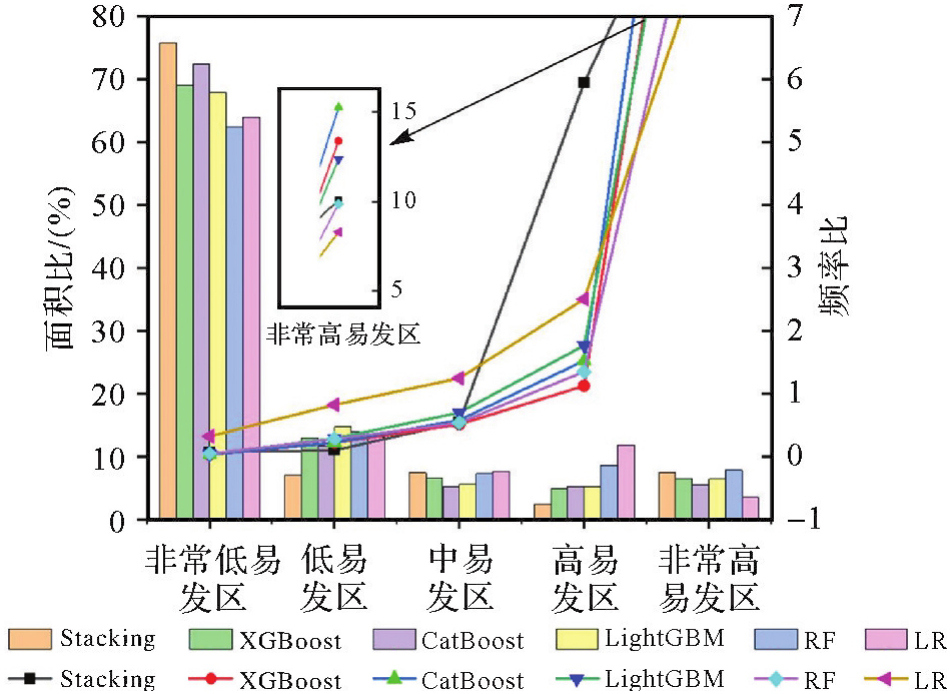
Statistics of frequency ratios for landslide susceptibility zones"
Tab. 5
Interpretation metric values derived from SHAP algorithm"
| 指标 | Stacking-SHAP | XGBoost-SHAP | CatBoost-SHAP | LightGBM-SHAP | RF-SHAP | LR-SHAP |
|---|---|---|---|---|---|---|
| 特征贡献值标准差 | 0.020 | 0.335 | 0.348 | 0.020 | 0.022 | 0.233 |
| 滑坡样本解释方差 | 0.023 | 1.416 | 1.254 | 0.023 | 0.006 | 0.152 |
| 非滑坡样本解释方差 | 0.014 | 0.850 | 0.850 | 0.014 | 0.014 | 0.034 |
| RMSE | 0.323 | 0.326 | 0.325 | 0.347 | 0.375 | 0.537 |
| 诱因解释性能综合评分 | 0.997 | 0.257 | 0.276 | 0.969 | 0.938 | 0.556 |
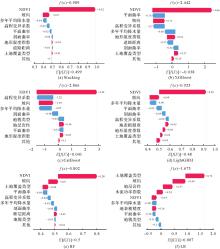
Fig. 9
Waterfall plot for the individual explanation of a landslide sample"

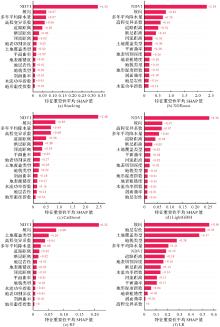
Fig. 10
Global feature importance of landslide susceptibility model"


Fig. 11
Partial dependence of selected features in landslide susceptibility model"

| [1] | FROUDE M J, PETLEY D N. Global fatal landslide occurrence from 2004 to 2016[J]. Natural Hazards and Earth System Sciences, 2018, 18(8): 2161-2181. |
| [2] | ZHANG Shuai, LI Can, PENG Jingyu, et al. Fatal landslides in China from 1940 to 2020: occurrences and vulnerabilities[J]. Landslides, 2023, 20(6): 1243-1264. |
| [3] | GUZZETTI F, REICHENBACH P, CARDINALI M, et al. Probabilistic landslide hazard assessment at the basin scale[J]. Geomorphology, 2005, 72(1/2/3/4): 272-299. |
| [4] |
许强, 朱星, 李为乐, 等. “天-空-地”协同滑坡监测技术进展[J]. 测绘学报, 2022, 51(7): 1416-1436. DOI: .
doi: 10.11947/j.AGCS.2022.20220320 |
|
XU Qiang, ZHU Xing, LI Weile, et al. Technical progress of space-air-ground collaborative monitoring of landslide[J]. Acta Geodaetica et Cartographica Sinica, 2022, 51(7): 1416-1436. DOI: .
doi: 10.11947/j.AGCS.2022.20220320 |
|
| [5] | MARJANOVIĆ M, KOVAČEVIĆ M, BAJAT B, et al. Landslide susceptibility assessment using SVM machine learning algorithm[J]. Engineering Geology, 2011, 123(3): 225-234. |
| [6] |
刘纪平, 梁恩婕, 徐胜华, 等. 顾及样本优化选择的多核支持向量机滑坡灾害易发性分析评价[J]. 测绘学报, 2022, 51(10): 2034-2045. DOI: .
doi: 10.11947/j.AGCS.2022.20220326 |
|
LIU Jiping, LIANG Enjie, XU Shenghua, et al. Multi-kernel support vector machine considering sample optimization selection for analysis and evaluation of landslide disaster susceptibility[J]. Acta Geodaetica et Cartographica Sinica, 2022, 51(10): 2034-2045. DOI: .
doi: 10.11947/j.AGCS.2022.20220326 |
|
| [7] | 王世宝, 庄建琦, 樊宏宇, 等. 基于频率比与集成学习的滑坡易发性评价:以金沙江上游巴塘—德格河段为例[J]. 工程地质学报, 2022, 30(3): 817-828. |
| WANG Shibao, ZHUANG Jianqi, FAN Hongyu, et al. Evaluation of landslide susceptibility based on frequency ratio and ensemble learning: taking the Batang-Dege section in the upstream of Jinsha river as an example[J]. Journal of Engineering Geology, 2022, 30(3): 817-828. | |
| [8] | ZHOU Xinzhi, WEN Haijia, ZHANG Yalan, et al. Landslide susceptibility mapping using hybrid random forest with GeoDetector and RFE for factor optimization[J]. Geoscience Frontiers, 2021, 12(5): 101211. |
| [9] | GORSEVSKI P V, BROWN M K, PANTER K, et al. Landslide detection and susceptibility mapping using LiDAR and an artificial neural network approach: a case study in the Cuyahoga Valley National Park, Ohio[J]. Landslides, 2016, 13(3): 467-484. |
| [10] | TIEN BUI D, TUAN T A, KLEMPE H, et al. Spatial prediction models for shallow landslide hazards: a comparative assessment of the efficacy of support vector machines, artificial neural networks, kernel logistic regression, and logistic model tree[J]. Landslides, 2016, 13(2): 361-378. |
| [11] | LOMBARDO L, CAMA M, CONOSCENTI C, et al. Binary logistic regression versus stochastic gradient boosted decision trees in assessing landslide susceptibility for multiple-occurring landslide events: application to the 2009 storm event in Messina (Sicily, southern Italy)[J]. Natural Hazards, 2015, 79(3): 1621-1648. |
| [12] | MERGHADI A, YUNUS A P, DOU Jie, et al. Machine learning methods for landslide susceptibility studies: a comparative overview of algorithm performance[J]. Earth-Science Reviews, 2020, 207: 103225. |
| [13] | AL-NAJJAR H A H, PRADHAN B. Spatial landslide susceptibility assessment using machine learning techniques assisted by additional data created with generative adversarial networks[J]. Geoscience Frontiers, 2021, 12(2): 625-637. |
| [14] | FANG Zhice, WANG Yi, PENG Ling, et al. A comparative study of heterogeneous ensemble-learning techniques for landslide susceptibility mapping[J]. International Journal of Geographical Information Science, 2021, 35(2): 321-347. |
| [15] | WANG Tianlong, ZHANG Keying, LIU Zhenghua, et al. Prediction and explanation of debris flow velocity based on multi-strategy fusion Stacking ensemble learning model[J]. Journal of Hydrology, 2024, 638: 131347. |
| [16] | HUANG Faming, CHEN Jiawu, LIU Weiping, et al. Regional rainfall-induced landslide hazard warning based on landslide susceptibility mapping and a critical rainfall threshold[J]. Geomorphology, 2022, 408: 108236. |
| [17] | LOCHE M, ALVIOLI M, MARCHESINI I, et al. Landslide susceptibility maps of Italy: lesson learnt from dealing with multiple landslide types and the uneven spatial distribution of the national inventory[J]. Earth-Science Reviews, 2022, 232: 104125. |
| [18] | CHA Y, SHIN J, GO B, et al. An interpretable machine learning method for supporting ecosystem management: application to species distribution models of freshwater macroinvertebrates[J]. Journal of Environmental Management, 2021, 291: 112719. |
| [19] | WEI Jing, WANG Zhihui, LI Zhanqing, et al. Global aerosol retrieval over land from Landsat imagery integrating Transformer and Google Earth Engine[J]. Remote Sensing of Environment, 2024, 315: 114404. |
| [20] | 董佳奇, 胡冬梅, 闫雨龙, 等. 基于可解释性机器学习的城市O3驱动因素挖掘[J]. 环境科学, 2023, 44(7): 3660-3668. |
| DONG Jiaqi, HU Dongmei, YAN Yulong, et al. Revealing driving factors of urban O3 based on explainable machine learning[J]. Environmental Science, 2023, 44(7): 3660-3668. | |
| [21] | YANG Changlan, GUAN Xuefeng, XU Qingyang, et al. How can SHAP (shapley additive explanations) interpretations improve deep learning based urban cellular automata model?[J]. Computers, Environment and Urban Systems, 2024, 111: 102133. |
| [22] | CHU Wenhao, ZHANG Chunxiao, LI Heng, et al. SHAP-powered insights into spatiotemporal effects: unlocking explainable Bayesian-neural-network urban flood forecasting[J]. International Journal of Applied Earth Observation and Geoinformation, 2024, 131: 103972. |
| [23] | FENG Zezheng, JIANG Yifan, WANG Hongjun, et al. TrafPS: a shapley-based visual analytics approach to interpret traffic[J]. Computational Visual Media, 2024, 10(6): 1101-1119. |
| [24] | KANG Y, KIM M, KANG E, et al. Improved retrievals of aerosol optical depth and fine mode fraction from GOCI geostationary satellite data using machine learning over East Asia[J]. ISPRS Journal of Photogrammetry and Remote Sensing, 2022, 183: 253-268. |
| [25] | 罗路广, 裴向军, 崔圣华, 等. 九寨沟地震滑坡易发性评价因子组合选取研究[J]. 岩石力学与工程学报, 2021, 40(11): 2306-2319. |
| LUO Luguang, PEI Xiangjun, CUI Shenghua, et al. Combined selection of susceptibility assessment factors for Jiuzhaigou earthquake-induced landslides[J]. Chinese Journal of Rock Mechanics and Engineering, 2021, 40(11): 2306-2319. | |
| [26] | 张钟远, 邓明国, 徐世光, 等. 镇康县滑坡易发性评价模型对比研究[J]. 岩石力学与工程学报, 2022, 41(1): 157-171. |
| ZHANG Zhongyuan, DENG Mingguo, XU Shiguang, et al. Comparison of landslide susceptibility assessment models in Zhenkang County, Yunnan Province, China[J]. Chinese Journal of Rock Mechanics and Engineering, 2022, 41(1): 157-171. | |
| [27] | LUNDBERG S M, LEE S I. A unified approach to interpreting model predictions[C]//Proceedings of the 31st Conference on Neural Information Processing Systems. Long Beach: [s.n.], 2017. |
| [28] | HUANG Faming, MAO Daxiong, JIANG Shuihua, et al. Uncertainties in landslide susceptibility prediction modeling: a review on the incompleteness of landslide inventory and its influence rules[J]. Geoscience Frontiers, 2024, 15(6): 101886. |
| [29] | OTHMAN A A, GLOAGUEN R, ANDREANI L, et al. Improving landslide susceptibility mapping using morphometric features in the Mawat area, Kurdistan Region, NE Iraq: comparison of different statistical models[J]. Geomorphology, 2018, 319: 147-160. |
| [1] | Yating LIU, Chuanfa CHEN, Qingxin HE, Kunyu LI. Landslide susceptibility evaluation considering positive and negative sample optimization [J]. Acta Geodaetica et Cartographica Sinica, 2025, 54(2): 308-320. |
| [2] | Jichao LÜ, Rui ZHANG, Xu HE, Ruikai HONG, Age SHAMA, Guoxiang LIU. Multi-branch network assessment and dynamic change analysis of wide-area landslide susceptibility [J]. Acta Geodaetica et Cartographica Sinica, 2025, 54(1): 104-122. |
| [3] | Yan SHI, Da WANG, Min DENG, Xuexi YANG. Spatio-temporal anomaly detection: connotation transformation and implementation path from data-driven to knowledge-driven modeling [J]. Acta Geodaetica et Cartographica Sinica, 2024, 53(8): 1493-1504. |
| [4] | Yating LIU, Chuanfa CHEN. Landslide susceptibility evaluation method considering spatial heterogeneity and feature selection [J]. Acta Geodaetica et Cartographica Sinica, 2024, 53(7): 1417-1428. |
| Viewed | ||||||
|
Full text |
|
|||||
|
Abstract |
|
|||||
