

Acta Geodaetica et Cartographica Sinica ›› 2026, Vol. 55 ›› Issue (10): 1722-1731.doi: 10.11947/j.AGCS.2026.20260193
• Geodesy and Navigation • Previous Articles Next Articles
Jing Kong( ), Lue Chen, Qianqian Han, Shaoran Liu, Mei Wang, Guolin Hu()
Received:2026-05-29
Revised:2026-09-21
Online:2026-11-16
Published:2026-11-16
Contact:
Guolin Hu
E-mail:13581877617@163.com;masterhgl@sina.com
About author:Kong Jing (1982—), female, master, senior engineer, majors in precise orbit determination and scientific applications of spacecraft. E-mail: 13581877617@163.com
Supported by:CLC Number:
Jing Kong, Lue Chen, Qianqian Han, Shaoran Liu, Mei Wang, Guolin Hu. Radio occultation detection of the Martian ionosphere by Tianwen-1[J]. Acta Geodaetica et Cartographica Sinica, 2026, 55(10): 1722-1731.
Tab. 1
Radio occultation observations by Tianwen-1"
| 序号 | 掩星时间 | 测站 | 类型 | 火面星下点 | SZA/(°) | 黄经/(°) |
|---|---|---|---|---|---|---|
| 1 | 2022-03-22 11:43:40 | KS | 出掩 | (32.71°E,55.13°S) | 84.12 | 194.72 |
| 2 | 2022-03-25 10:37:01 | JMS | 出掩 | (64.67°E,62.82°S) | 89.22 | 196.47 |
| 3 | 2023-05-25 16:43:33 | KS | 入掩 | (82.59°W,31.19°S) | 71.45 | 68.74 |
| 4 | 2023-05-25 17:29:55 | KS | 出掩 | (59.97°W,57.11°N) | 66.53 | 68.75 |
| 5 | 2023-05-27 18:20:15 | KS | 入掩 | (85.75°W,27.19°S) | 69.64 | 69.63 |
| 6 | 2023-05-27 19:02:51 | KS | 出掩 | (65.31°W,54.49°N) | 63.68 | 69.65 |
| 7 | 2023-12-22 19:56:12 | JMS | 入掩 | (41.34°W,65.09°N) | 84.62 | 168.37 |
| 8 | 2023-12-22 21:24:29 | JMS | 出掩 | (55.94°W,62.96°S) | 90.24 | 168.40 |
| 9 | 2023-12-29 14:49:12 | KS | 入掩 | (114.74°E,87.06°N) | 85.81 | 172.08 |
| 10 | 2024-01-03 15:16:23 | KS | 入掩 | (41.96°W,77.59°N) | 87.47 | 174.85 |
| 11 | 2024-01-03 16:51:24 | KS | 出掩 | (23.20°W,86.06°S) | 94.74 | 174.59 |
| 12 | 2024-01-12 12:01:12 | KS | 入掩 | (97.48°E,48.79°N) | 92.32 | 170.80 |
| 13 | 2024-01-12 13:18:37 | KS | 出掩 | (94.68°E,64.41°S) | 98.49 | 179.83 |
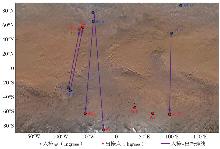
Fig. 1
Locations and associated solar zenith angles of radio occultation events"

Tab. 2
Parameters related to orbit determination"
| 参数名称 | 参数值 |
|---|---|
| 定轨数据 | 双向测距、双向测速 |
| 定轨弧段 | 约3天 |
| 火星重力场 | JGMRO120 |
| 太阳辐射压模型 | 固定面质比,Cr初值为1.2 |
| 行星历表 | JPL DE436 |
| 动量轮卸载模型 | 匀加速度模型(RTN坐标系) |
| 相对论影响 | 考虑 |
| 解算参数 | 位置速度动量轮卸载 |
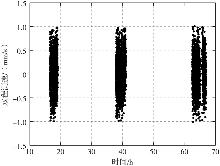
Fig. 2
Orbit determination residuals"
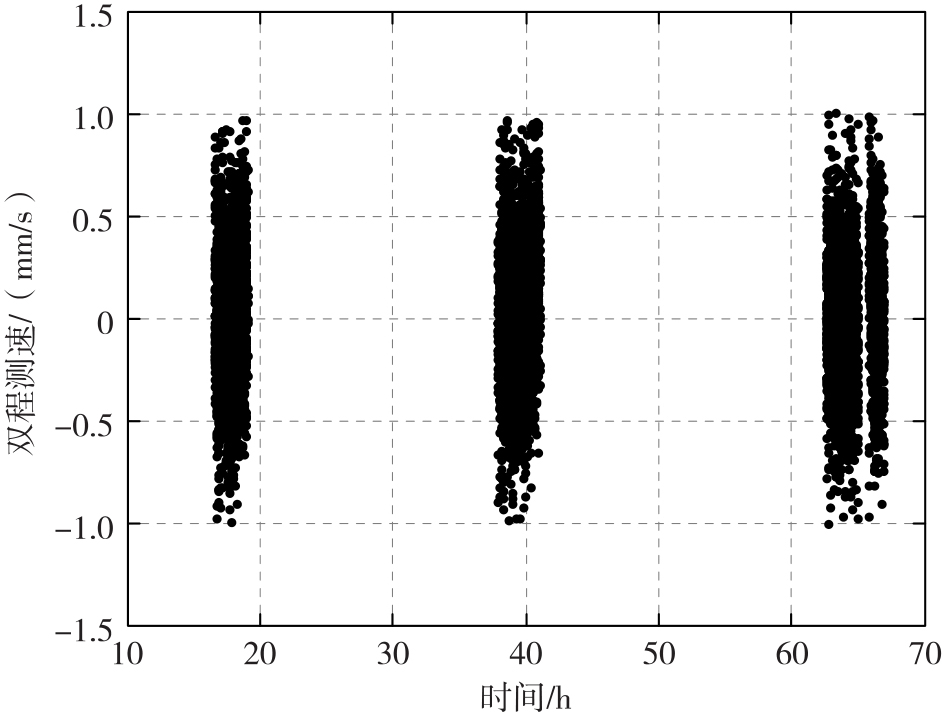
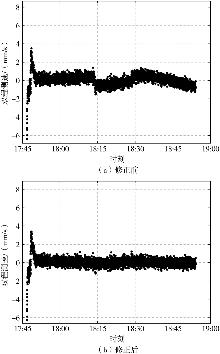
Fig. 3
Velocity residuals corrected for momentum wheel unloading"
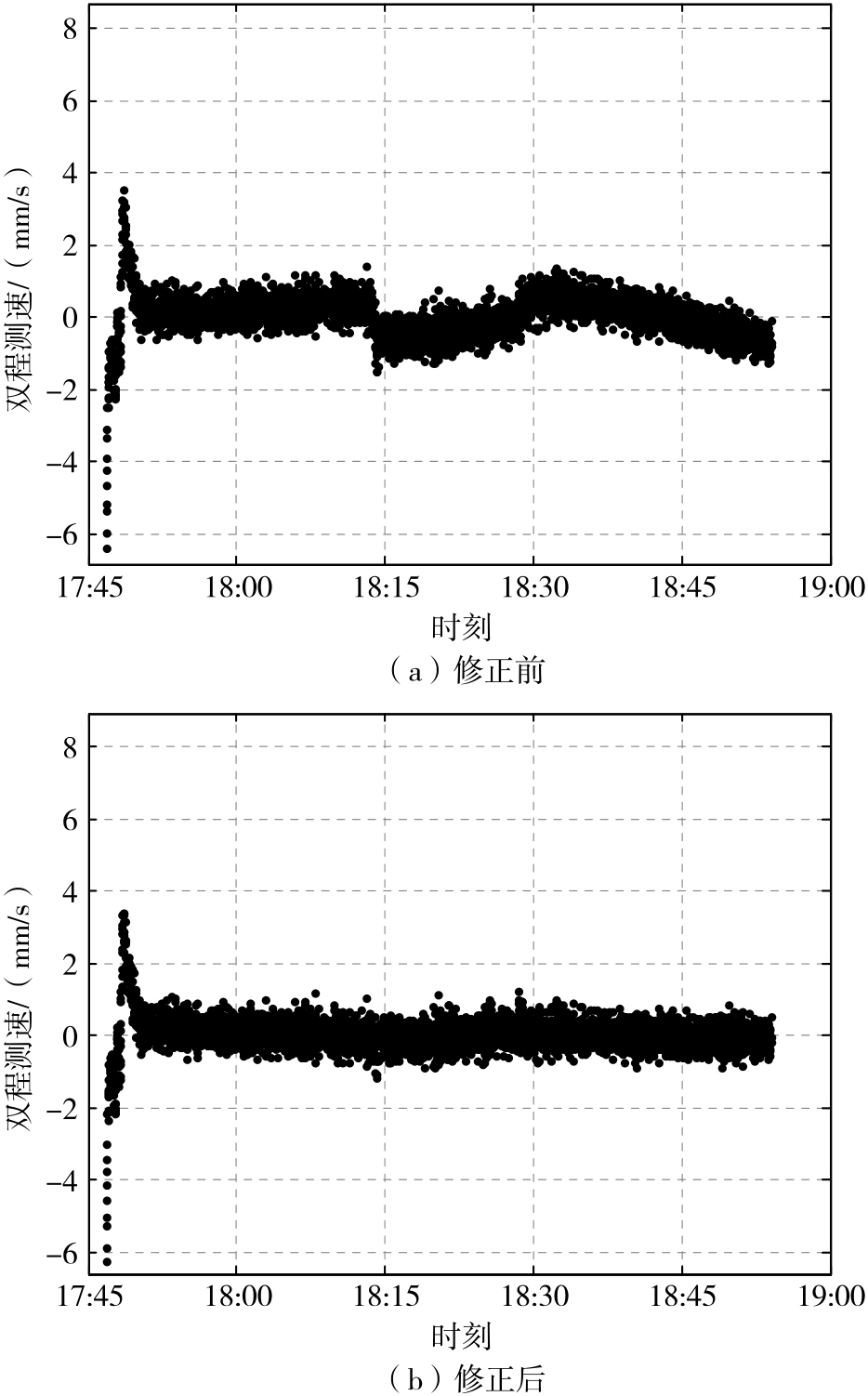
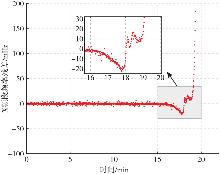
Fig. 4
Frequency residuals of radio occultation"
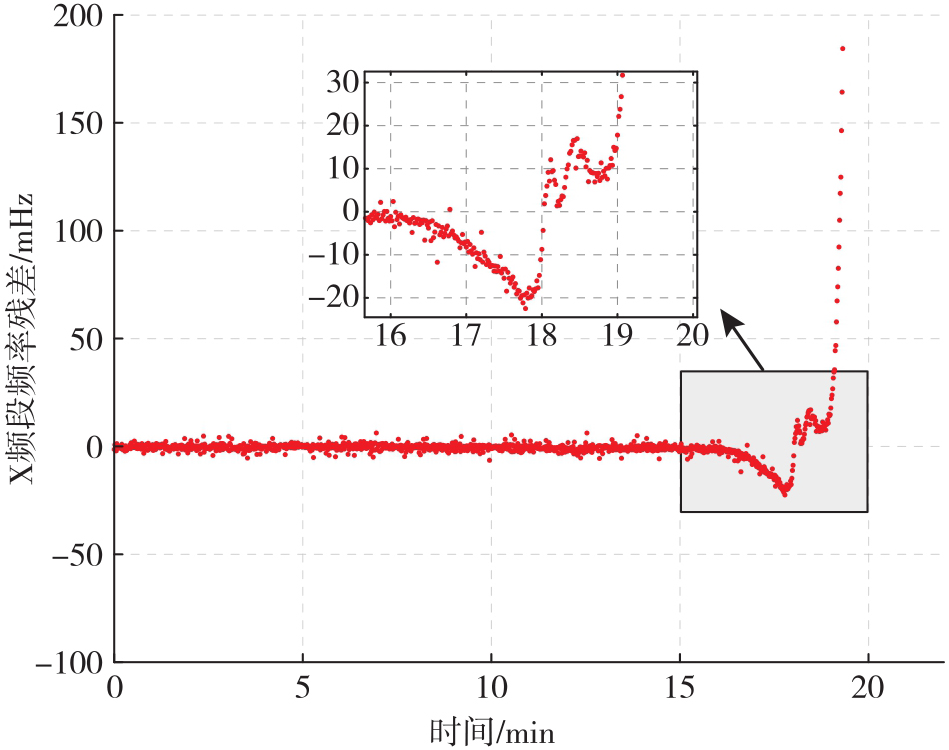
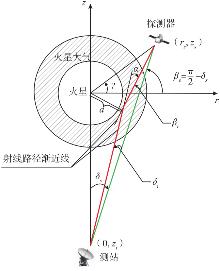
Fig. 5
Ray path geometry for Earth-Mars radio occultation[24]"
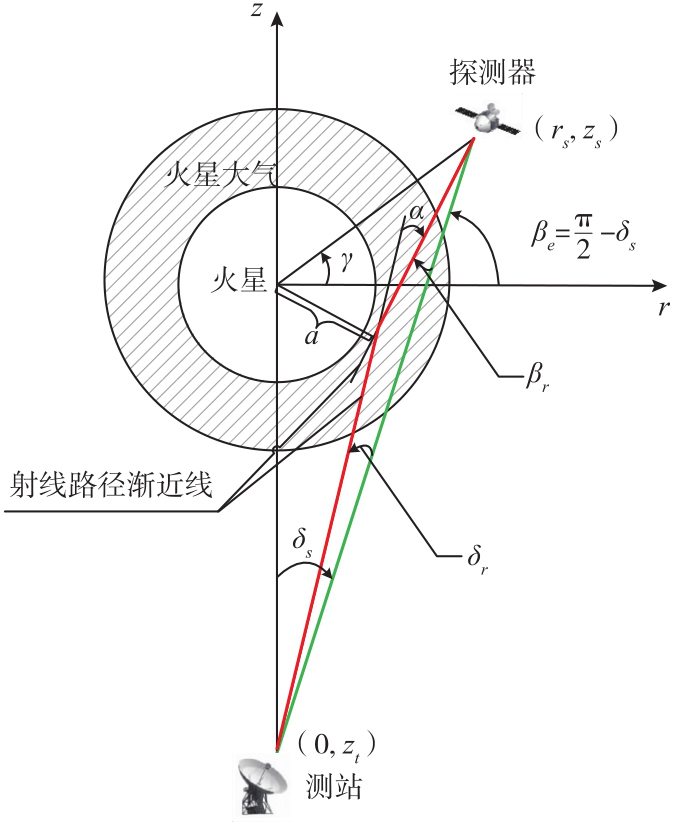
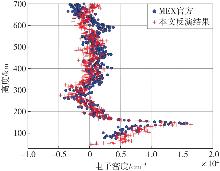
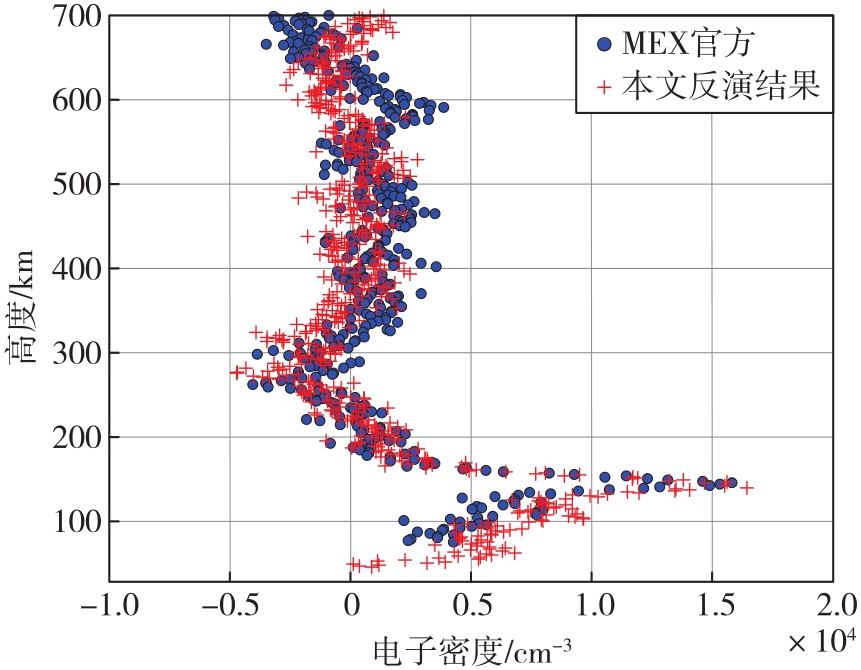
Fig. 6
Comparison between the results in this paper and the MEX inversion results"
Tab. 3
Comparison of the two inversion results"
| 事件 | 时间 | 峰值高度 | 电子密度 | ||||
|---|---|---|---|---|---|---|---|
| 本文结果/km | MEX数据/km | 不确定度/(%) | 本文结果103/cm3 | MEX数据103/cm3 | 不确定度/(%) | ||
| 1 | 2004-06-28 | 128 | 123 | 4.06 | 103 | 99 | 4.04 |
| 2 | 2004-12-27 | 142 | 147 | 3.40 | 163 | 160 | 1.87 |
| 3 | 2004-12-28 | 143 | 145 | 1.38 | 160 | 158 | 1.26 |
| 4 | 2005-08-22 | 139 | 146 | 4.79 | 78 | 82 | 4.88 |
| 5 | 2005-09-25 | 154 | 153 | 0.65 | 69 | 66 | 4.54 |
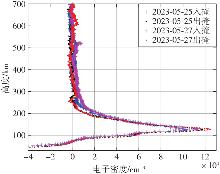
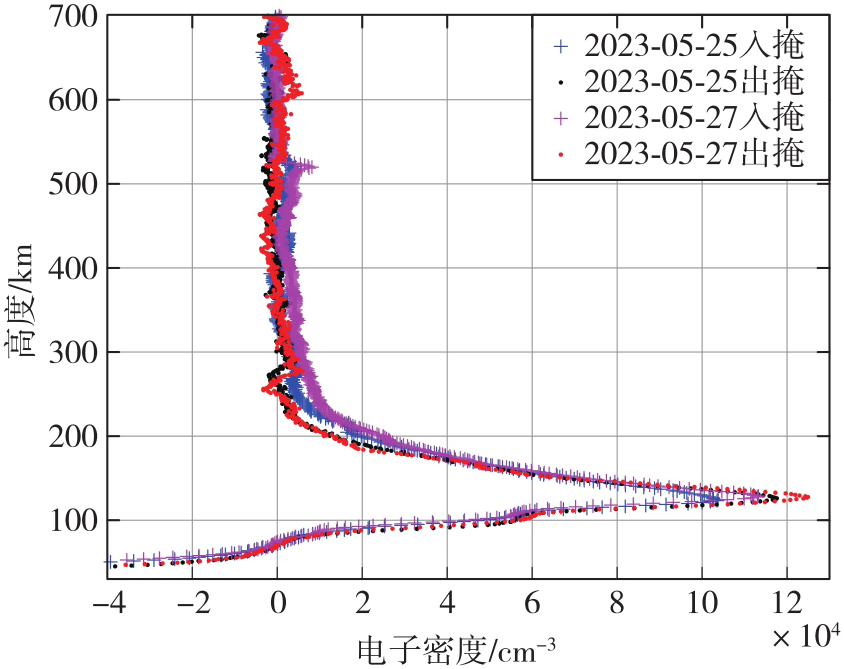
Fig. 7
Retrieved electron density profiles in May 2023"
Tab. 4
Comparison between the retrieved results and model results"
| 日期 | SZA/(°) | 峰值高度/km | 峰值电子密度/(103/cm3) | 密度误差/(%) | ||
|---|---|---|---|---|---|---|
| 反演值 | 模型值 | 反演值 | 模型值(N0=1.85×10⁵/cm3) | |||
| 2023-05-25 16:43:33 | 71.45 | 124 | 131.45 | 103 | 104.3 | 1.25 |
| 2023-05-25 17:29:55 | 66.53 | 126 | 129.20 | 118 | 116.7 | 1.11 |
| 2023-05-27 18:20:15 | 69.64 | 123 | 130.55 | 113 | 109.1 | 3.57 |
| 2023-05-27 19:02:51 | 63.68 | 127 | 128.13 | 125 | 123.1 | 1.54 |
Fig. 8
Retrieved electron density profiles in 22 December 2023"

| [1] | 张素君, 王明远, 简念川, 等. 基于无线电掩星观测的火星电离层观测研究进展[J]. 中国科学:物理学力学天文学, 2013, 43(8): 903-916. |
| Zhang Sujun, Wang Mingyuan, Jian Nianchuan, et al. A review on the study of Martian ionosphere based on radio occultation observations[J]. Scientia Sinica Physica, Mechanica & Astronomica, 2013, 43(8): 903-916. | |
| [2] | Chen Lue, Li Haitao, Fan Fei, et al. Method and application of high-precision open-loop velocity measurement of Tianwen-1 probe[J]. Space: Science & Technology, 2024, 4: 105. |
| [3] | Kliore A, Cain D L, Levy G S, et al. Occultation experiment: results of the first direct measurement of Mars's atmosphere and ionosphere[J]. Science, 1965, 149(3689): 1243-1248. |
| [4] | Kliore A, Fjeldbo G, Seidel B L, et al. Mariners 6 and 7: radio occultation measurements of the atmosphere of Mars[J]. Science, 1969, 166(3911): 1393-1397. |
| [5] | Kliore A J, Cain D L, Fjeldbo G, et al. The atmosphere of Mars from Mariner 9 radio occultation measurements[J]. Icarus, 1972, 17(2): 484-516. |
| [6] | Lindal G F, Hotz H B, Sweetnam D N, et al. Viking radio occultation measurements of the atmosphere and topography of Mars: data acquired during 1 Martian year of tracking[J]. Journal of Geophysical Research: Solid Earth, 1979, 84(B14): 8443-8456. |
| [7] | Tyler G L, Balmino G, Hinson D P, et al. Radio science observations with Mars global surveyor: orbit insertion through one Mars year in mapping orbit[J]. Journal of Geophysical Research: Planets, 2001, 106(E10): 23327-23348. |
| [8] | Hinson D P, Simpson R A, Twicken J D, et al. Initial results from radio occultation measurements with Mars global surveyor[J]. Journal of Geophysical Research: Planets, 1999, 104(E11): 26997-27012. |
| [9] | 肖洛, 肖存英, 胡雄, 等. 火星无线电掩星探测进展[J]. 地球与行星物理论评(中英文), 2024, 55(2): 164-174. |
| Xiao Luo, Xiao Cunying, Hu Xiong, et al. Progress of radio occultation exploration of Mars[J]. Reviews of Geophysics and Planetary Physics, 2024, 55(2): 164-174. | |
| [10] | Pätzold M, Häusler B, Tyler G L, et al. Mars Express 10 years at Mars: observations by the Mars Express radio science experiment (MaRS)[J]. Planetary and Space Science, 2016, 127: 44-90. |
| [11] | 马茂莉, 郑为民, 夏博, 等. 基于VLBI站接收的火星探测器信号研究行星际闪烁[J]. 中国科学(技术科学), 2017, 47(4): 448-454. |
| Ma Maoli, Zheng Weimin, Xia Bo, et al. Interplanetary scintillation observation and analysis using Martian spacecraft downlink signal from VLBI station[J]. Scientia Sinica Technologica, 2017, 47(4): 448-454. | |
| [12] | Withers P, Vogt M, Mayyasi M, et al. Comparison of model predictions for the composition of the ionosphere of Mars to MAVEN NGIMS data[J]. Geophysical Research Letters, 2015, 42(21): 8966-8976. |
| [13] | Mendillo M, Narvaez C, Vogt M F, et al. Sources of ionospheric variability at Mars[J]. Journal of Geophysical Research: Space Physics, 2017, 122(9): 9670-9684. |
| [14] | 张素君, 平劲松, 洪振杰, 等. 星-地无线电掩星技术探测火星大气和电离层[J]. 物理, 2009, 38(10): 722-728. |
| Zhang Sujun, Ping Jinsong, Hong Zhenjie, et al. Detection of the Martian atmosphere and ionosphere using spacecraft-earth radio occultation[J]. Physics, 2009, 38(10): 722-728. | |
| [15] |
满海钧, 曹建峰, 鞠冰, 等. “天问一号”探测器轨道确定及精度评估[J]. 测绘学报, 2024, 53(7): 1288-1297. DOI: .
doi: 10.11947/j.AGCS.2024.20230126 |
|
Man Haijun, Cao Jianfeng, Ju Bing, et al. Orbit determination and accuracy evaluation of Tianwen-1 probe[J]. Acta Geodaetica et Cartographica Sinica, 2024, 53(7): 1288-1297. DOI: .
doi: 10.11947/j.AGCS.2024.20230126 |
|
| [16] | Hu Xiong, Wu Xiaocheng, Song Shuli, et al. First observations of Mars atmosphere and ionosphere with Tianwen-1 radio-occultation technique on 5 August 2021[J]. Remote Sensing, 2022, 14(11): 2718. |
| [17] |
孔静, 张宇, 段建锋, 等. 利用单向多普勒确定“天问一号”轨道[J]. 测绘学报, 2023, 52(4): 588-595. DOI: .
doi: 10.11947/j.AGCS.2023.20220085 |
|
Kong Jing, Zhang Yu, Duan Jianfeng, et al. Orbit determination of Tianwen-1 with one-way Doppler[J]. Acta Geodaetica et Cartographica Sinica, 2023, 52(4): 588-595. DOI: .
doi: 10.11947/j.AGCS.2023.20220085 |
|
| [18] | Liu Min, Chen Lue, Jian Nianchuan, et al. Preliminary estimations of Mars atmospheric and ionospheric profiles from Tianwen-1 radio occultation one-way, two-way, and three-way observations[J]. Remote Sensing, 2023, 15(23): 5506. |
| [19] | 孔静, 汪赛进, 胡国林, 等. 强太阳活动对“天问一号”测控影响[J]. 科学通报, 2025, 70(28): 4969-4977. |
| Kong Jing, Wang Saijin, Hu Guolin, et al. Impact of intense solar activity on the tracking, telemetry, and command (TT&C) of Tianwen-1[J]. Chinese Science Bulletin, 2025, 70(28): 4969-4977. | |
| [20] | Li Zishen, Wang Ningbo, Liu Ang, et al. Progress of geodesy related ionosphere from Chinese scientists in the period of 2019—2023[J]. Journal of Geodesy and Geoinformation Science, 2023, 6(3): 115-123. |
| [21] | Yang Peng, Huang Yong, Li Peijia, et al. Orbit determination of China's first Mars probe Tianwen-1 during interplanetary cruise[J]. Advances in Space Research, 2022, 69(2): 1060-1071. |
| [22] | 孔静, 张宇, 陈明, 等. 动量轮卸载对“天问一号”环火轨道影响分析[J]. 深空探测学报(中英文), 2024, 11(4): 414-420. |
| Kong Jing, Zhang Yu, Chen Ming, et al. The effect of wheel off-loading on the orbit of Tianwen-1[J]. Journal of Deep Space Exploration, 2024, 11(4): 414-420. | |
| [23] | 张素君, 史弦, 平劲松. 基于MGS探测器掩星观测的火星电离层数据初步分析[J]. 天文学进展, 2009, 27(3): 280-290. |
| Zhang Sujun, Shi Xian, Ping Jinsong. Preliminary analysis of Martian ionospheric observation data based on MGS radio occultation experiment[J]. Progress in Astronomy, 2009, 27(3): 280-290. | |
| [24] | Fjeldbo G, Kliore A J, Eshleman V R. The neutral atmosphere of Venus as studied with the mariner V radio occultation experiments[J]. The Astronomical Journal, 1971, 76: 123. |
| [25] | Paetzold M, Tellmann S, Andert T. Mars: Mars Express radio science experiment[M]. Noordwijk: ESA Communication Production Office, 2019: 217-230. |
| [26] | Hantsch M H, Bauer S J. Solar control of the Mars ionosphere[J]. Planetary and Space Science, 1990, 38(4): 539-542. |
| [27] | He Qingbao, Wang Zhichao, Liu Qinghui, et al. CME-related large decreases in the differential phase delay of Tianwen-1 DOR signals[J]. The Astrophysical Journal Letters, 2022, 940(2): L45. |
| [28] | Fu Shuai, Ding Zheyi, Zhang Yongjie, et al. First report of a solar energetic particle event observed by China's Tianwen-1 mission in transit to Mars[J]. The Astrophysical Journal Letters, 2022, 934(1): L15. |
| [1] | Haijun MAN, Jianfeng CAO, Bing JU, Xie LI, Jing KONG, Shanhong LIU. Orbit determination and accuracy evaluation of Tianwen-1 probe [J]. Acta Geodaetica et Cartographica Sinica, 2024, 53(7): 1288-1297. |
| [2] | KONG Jing, ZHANG Yu, DUAN Jianfeng, CHEN Lue, WANG Hong, FAN Min. Orbit determination of Tianwen-1 with one-way Doppler [J]. Acta Geodaetica et Cartographica Sinica, 2023, 52(4): 588-595. |
| [3] | Zhang Jian-Jun. Analysis and Research of Radio occultation Air Detection System’s Interference Suppression Based on GNSS [J]. Acta Geodaetica et Cartographica Sinica, 2009, 38(5): 0-414. |
| Viewed | ||||||
|
Full text |
|
|||||
|
Abstract |
|
|||||
