

Acta Geodaetica et Cartographica Sinica ›› 2026, Vol. 55 ›› Issue (10): 1711-1721.doi: 10.11947/j.AGCS.2026.20260317
• Geodesy and Navigation • Next Articles
Ying Chen1( ), Weiguang Gao1, Yuchen Ma2(), Jun Lu1, Xiaohui Ba2
Received:2026-08-10
Revised:2026-10-12
Online:2026-11-16
Published:2026-11-16
Contact:
Yuchen Ma
E-mail:cheny@beidou.gov.cn;26110729@bjtu.edu.cn
About author:Chen Ying (1978—), female, master, associate researcher, majors in BeiDou satellite navigation system overall design, and navigation-communication integration. E-mail: cheny@beidou.gov.cn
Supported by:CLC Number:
Ying Chen, Weiguang Gao, Yuchen Ma, Jun Lu, Xiaohui Ba. Simulation analysis of frequency availability for cislunar PNT systems[J]. Acta Geodaetica et Cartographica Sinica, 2026, 55(10): 1711-1721.
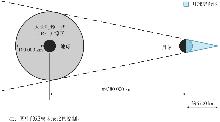
Fig. 1
Schematic of the lunar shielded zone"
Tab. 1
Frequency-dependent parameters and constants for SZM protection threshold calculation in Document 7B/193-E[14]"
| 频率f | 参考天空亮度温度Tf0/K | 参考频率f0/MHz | 谱指数β | 接收机噪声温度TR/K |
|---|---|---|---|---|
| 500 MHz<f≤1 GHz | 15.8 | 408 | -2.75 | 20 |
| 1 GHz<f≤12 GHz | 15.8 | 408 | -2.75 | 10 |
| 12 GHz<f≤20 GHz | 15.8 | 408 | -2.75 | 15 |
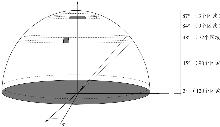
Fig. 2
Example of sky division into approximately 9 square-degree cells[17]"
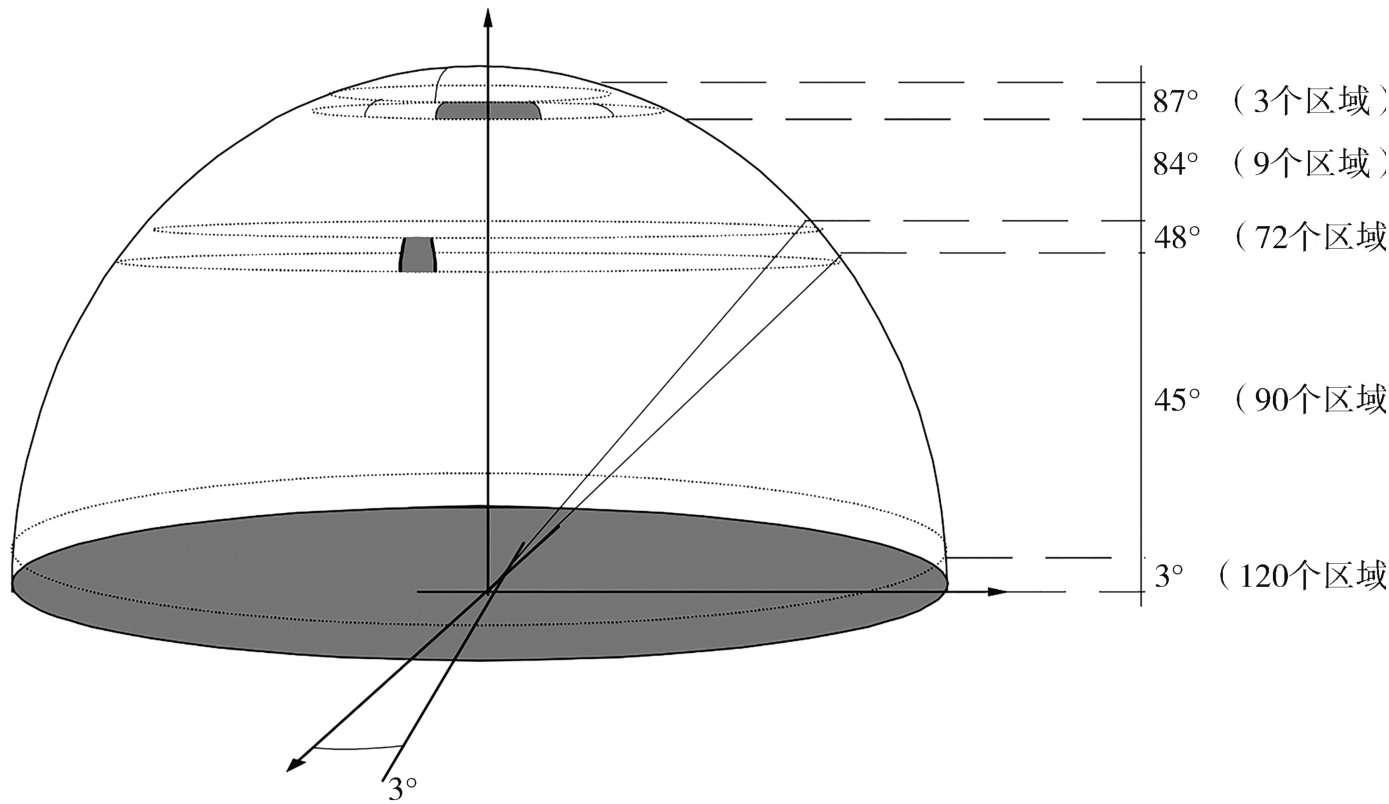
Fig. 3
Halo trajectory of NRHO in the Earth-Moon system"
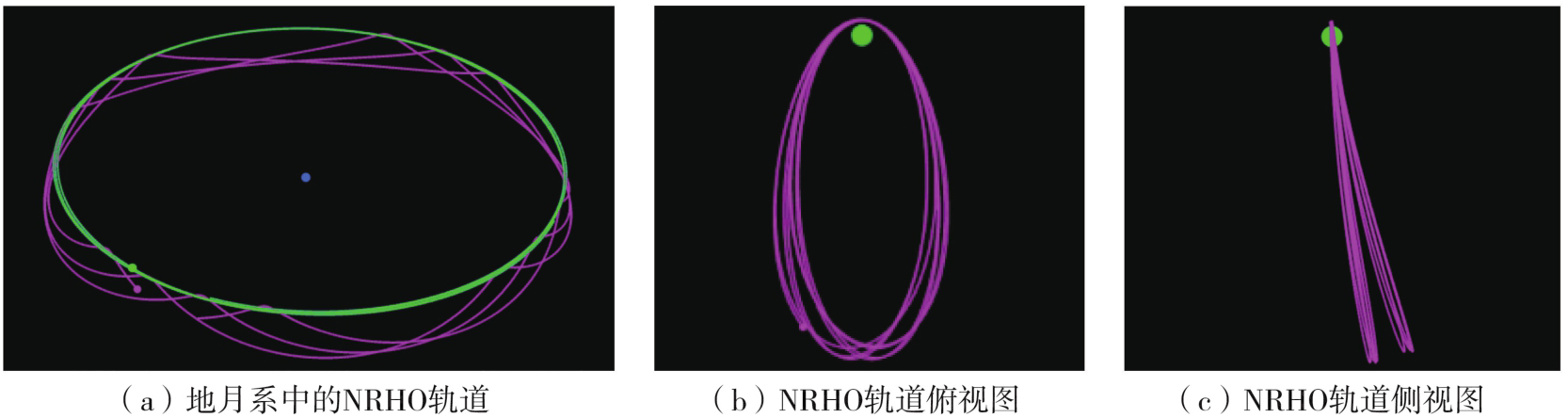
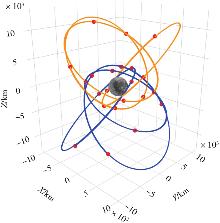
Fig. 4
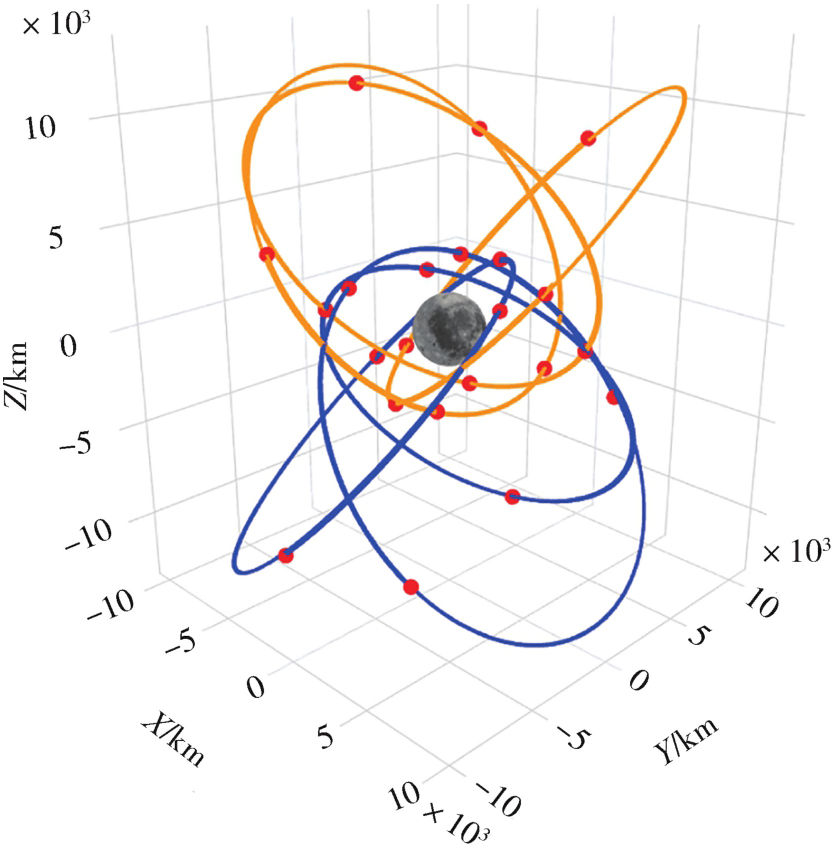
Schematic of ELFO orbits (S-ELFO (blue), NS-ELFO (yellow))[20]"
Tab. 2
Orbital parameters of the ELFO satellites in the 2NRHO+4ELFO constellation[18]"
| ELFO卫星数量 | 轨道面数量 | 近月点高度/km | 轨道倾角/(°) | 升交点赤经/(°) | 真近点角/(°) |
|---|---|---|---|---|---|
| 4 | 4 | 1 106.25 | 57.03 | 0 | 134.90 |
| 90 | 352.76 | ||||
| 180 | 185.51 | ||||
| 270 | 166.03 |
Tab. 3
Orbital parameters of the eight ELFO satellites in the constellation[19]"
| ELFO卫星数量 | 轨道面数量 | 半长轴a/km | 轨道倾角i/(°) | 升交点赤经Ω/(°) | 初始平近点角M0/(°) |
|---|---|---|---|---|---|
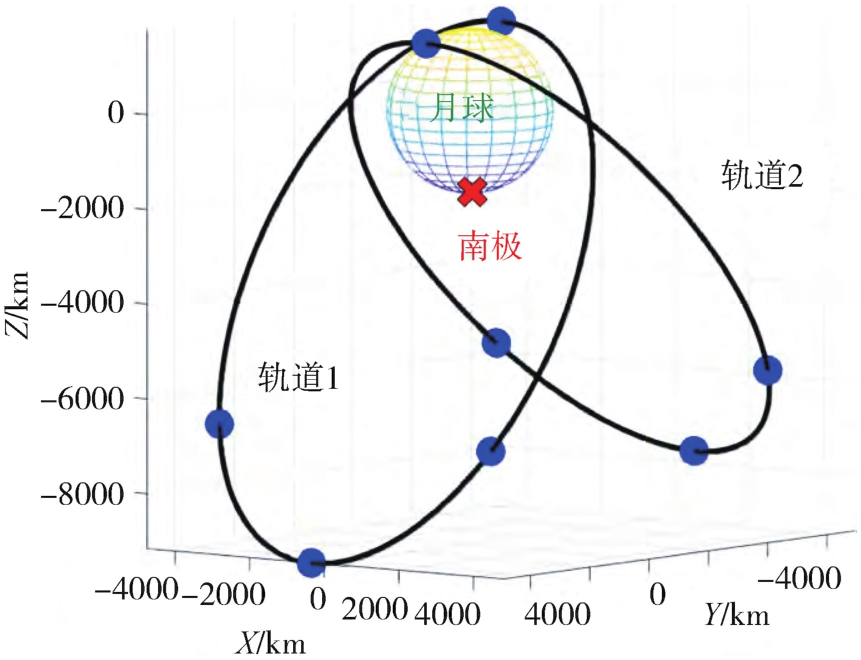
| 8 | 2 | 6 211.40 | 55 | 0 | 0 |
| 6 214.13 | 0 | 90 | |||
| 6 215.52 | 0 | 180 | |||
| 6 215.73 | 0 | 270 | |||
| 6 215.35 | 180 | 0 | |||
| 6 213.94 | 180 | 90 | |||
| 6 215.39 | 180 | 180 | |||
| 6 215.49 | 180 | 270 |
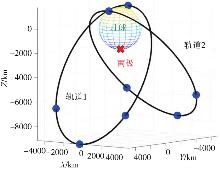
Fig. 5
Configuration of the two-orbital-plane ELFO constellation[19]"
Tab. 4
AFS signal parameters defined in the LNIS specification"
| 参数 | 数值 |
|---|---|
| 载波频率/MHz | 2 492.028 |
| 接收参考带宽/MHz | 15.944 |
| 信号设计 | 数据+导频分路 |
| 数据支路AFS-I | BPSK(1) |
| 导频支路AFS-Q | BPSK(5) |
| 月面接收功率/dBW | -160~-147 |
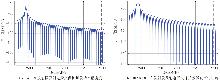
Fig. 6
Power spectral density of unfiltered signals in transmit and radio astronomy bands"
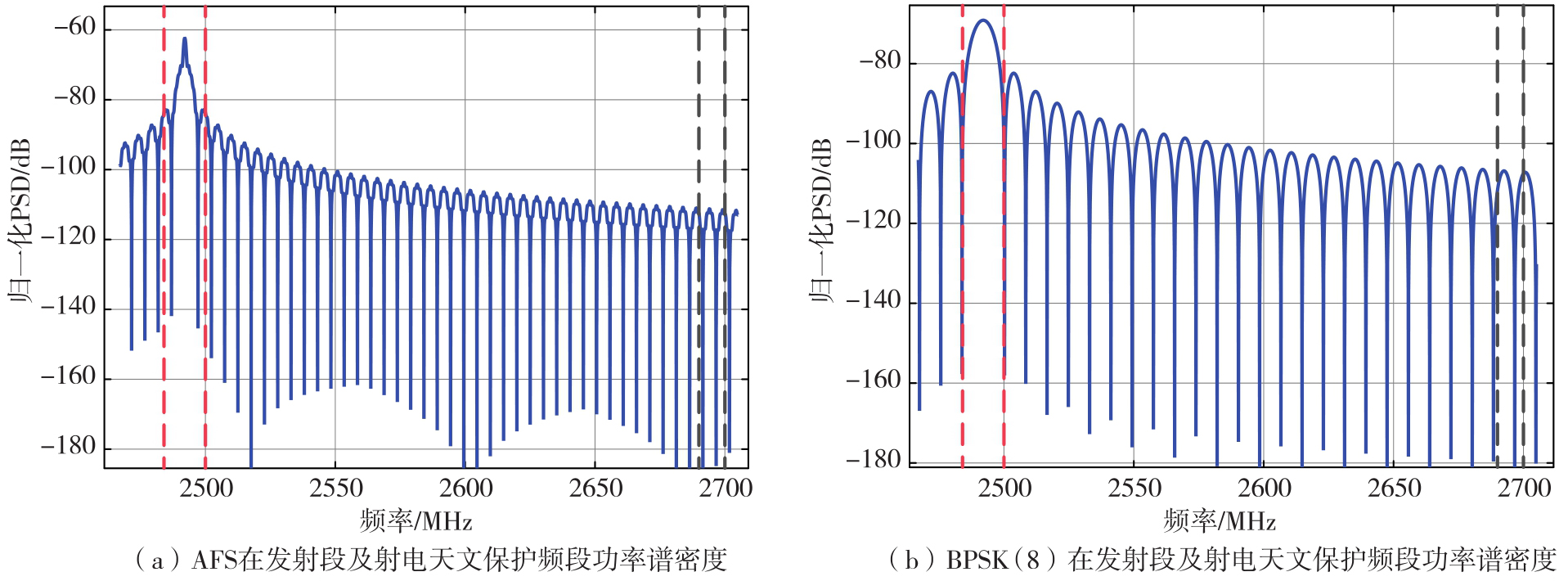
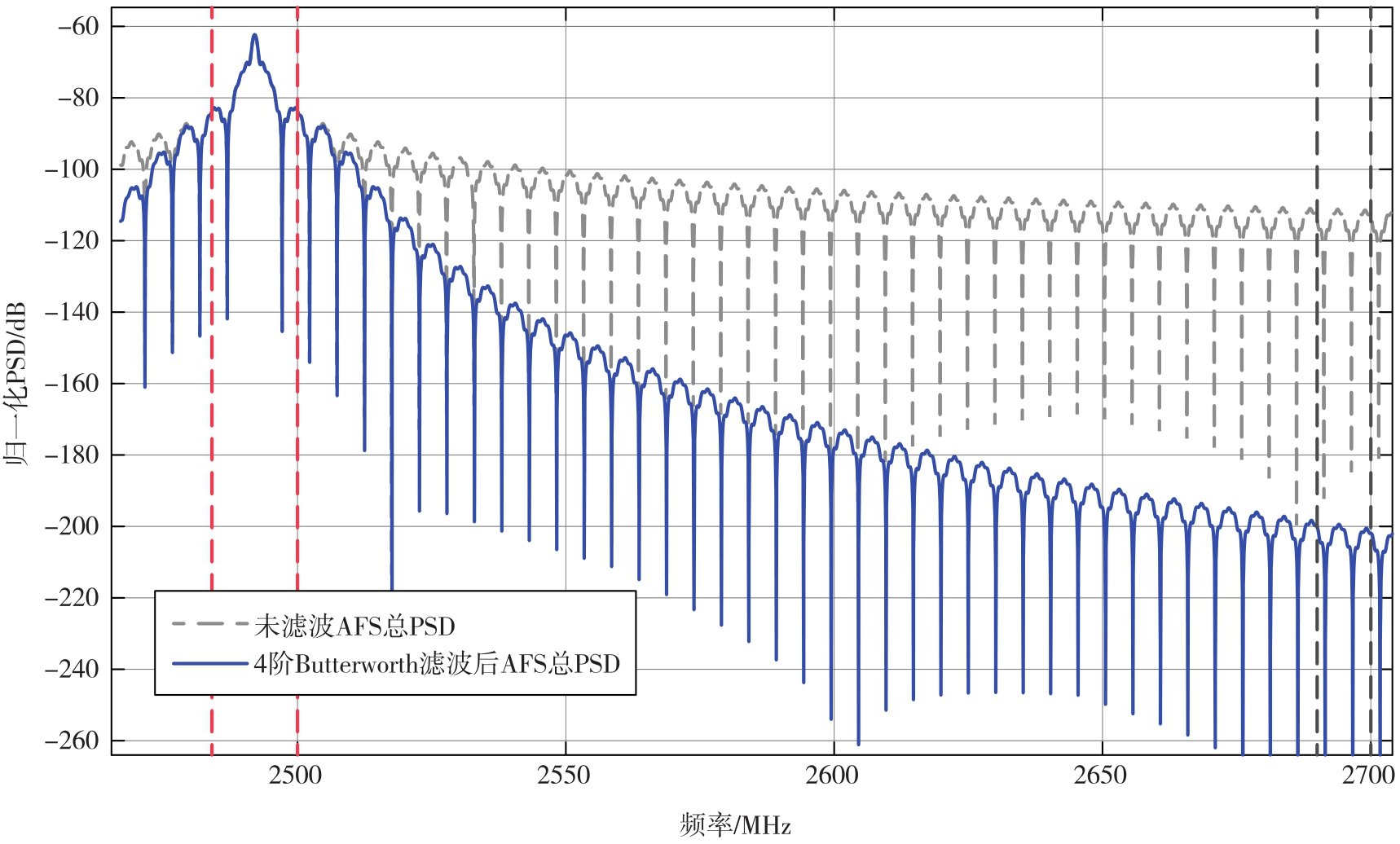
Fig. 7
AFS power spectra before and after 4th-order Butterworth filtering"
Tab. 5
Comparison of EPFD statistics before and after filtering"
| 滤波情况 | 平均值 | |
|---|---|---|
| 2NRHO+4ELFO | 8ELFO | |
| AFS信号未滤波EPFD | -171.63 | -171.23 |
| AFS信号滤波后EPFD | -260.08 | -259.68 |
| BPSK(8)信号未滤波EPFD | -167.04 | -166.65 |
| BPSK(8)信号滤波后EPFD | -255.26 | -254.86 |
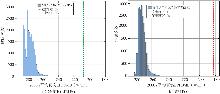
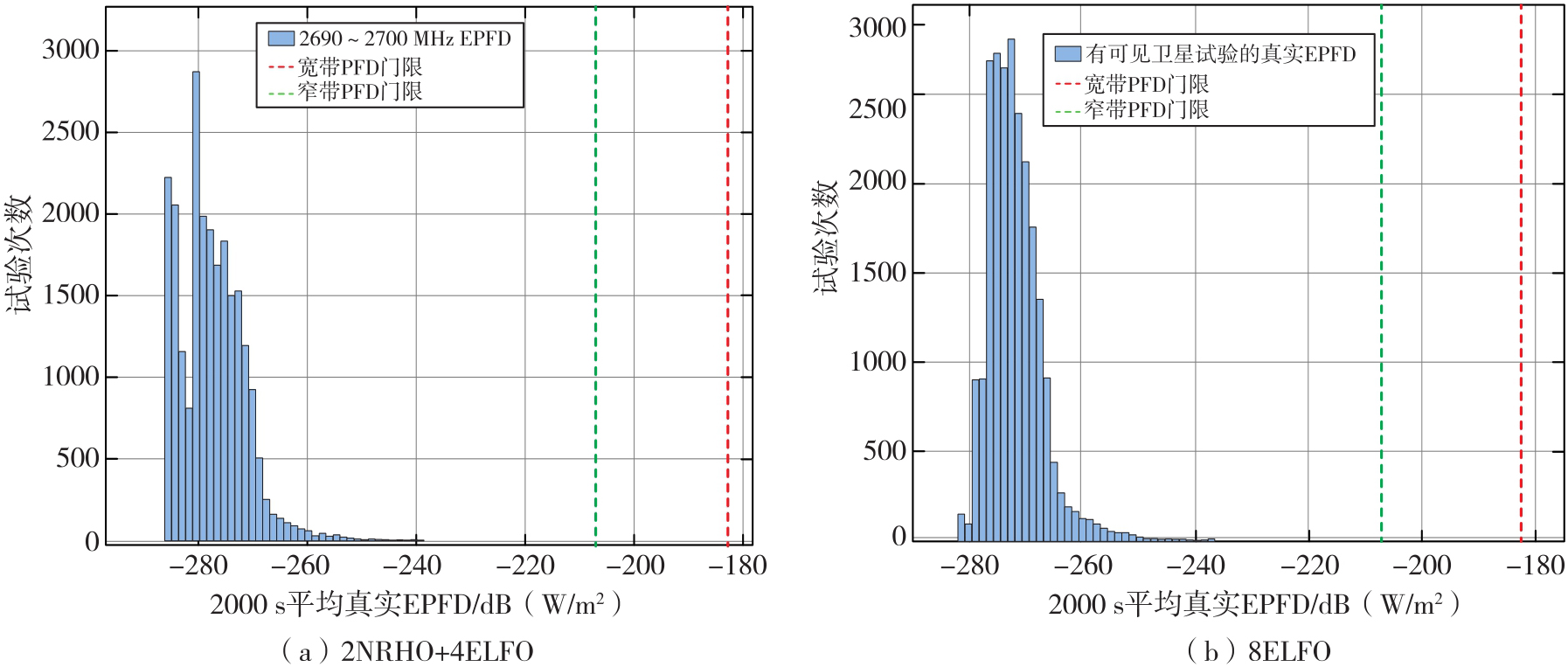
Fig. 8
Statistical distributions of the mean EPFD of the filtered AFS signal for two constellation configurations"
| [1] | NASA. Artemis[EB/OL]. [2026-07-20]. https://www.nasa.gov/humans-in-space/artemis/. |
| [2] | NASA. The Artemis Plan: NASA's lunar exploration program overview[R]. Washington, DC: NASA, 2020. |
| [3] | 中国空间探索研讨会. 国家航天局发布八大行动声明[EB/OL]. [2026-07-20]. https://www.cnsa.gov.cn/n6758823/n6758838/c6841646/content.html. China Space Exploration Symposium. |
| China National Space Administration releases a statement on eight major initiatives[EB/OL]. [2026-07-20]. https://www.cnsa.gov.cn/n6758823/n6758838/c6841646/content.html. | |
| [4] | European Space Agency. Moonlight: enabling connectivity and navigation services on the lunar surface and to Earth[EB/OL]. [2026-07-20]. https://www.esa.int/Applications/Connectivity_and_Secure_Communications/Moonlight. |
| [5] | ESA. Moonlight-ESA CSC: connectivity & secure communications[EB/OL]. [2026-07-20]. https://www.esa.int/Applications/Connectivity_and_Secure_Communications/Moonlight. |
| [6] | Space Frequency Coordination Group. REC 43-1: protection of in-situ lunar region positioning, navigation, and timing (PNT) services in the 2483.5-2500 MHz frequency band from unwanted emissions from lunar surface communication systems: REC 43-1[R]. Geneva: Space Frequency Coordination Group (SFCG), 2025. |
| [7] | LNIS V005. LunaNet interoperability specification, version 5[S]. |
| [8] | LSIS V1.0. LunaNet signal-in-space recommended standard-augmented forward signal (LSIS-AFS), Volume A, Version 1[S]. |
| [9] | International Telecommunication Union. Radio Regulations, Edition of 2024[M]. Geneva: ITU, 2024. |
| [10] | ITU-R RA.479-5. Recommendation ITU-R RA.479-5: protection of frequencies for radioastronomical measurements in the shielded zone of the Moon[S]. |
| [11] | Burns J O, MacDowall R, Bale S, et al. Low radio frequency observations from the Moon enabled by NASA landed payload missions[J]. The Planetary Science Journal, 2021, 2(2): 44. |
| [12] | Davis D C, Bhatt S, Howell K C, et al. Orbit maintenance and navigation of human spacecraft at cislunar near rectilinear halo orbits[C]//Proceedings of the AAS/AIAA Space Flight Mechanics Meeting. San Antonio: American Astronautical Society, 2017: 17-269. |
| [13] | ITU-R RA.769-2. Recommendation ITU-R RA.769-2: protection criteria used for radio astronomical measurements[S]. |
| [14] | ITU-R WP 7D. Liaison statement to Working Party 7B: threshold levels of interference to radio astronomy in the shielded zone of the Moon: Document 7B/193-E[R]. Geneva: International Telecommunication Union Radiocommunication Bureau (ITU-R), Working Party 7D, 2025. |
| [15] | International Telecommunication Union. Resolution 813 (WRC-23): agenda for the 2027 World Radiocommunication Conference[EB/OL]. [2026-07-20]. https://www.itu.int/pub/R-RES-R.813. |
| [16] | 国际电信联盟无线电通信局. 射电天文手册[M]. 3版. 日内瓦: 国际电信联盟, 2013: 42-53. |
| International Telecommunication Union Radiocommunication Bureau. Handbook of radio astronomy[M]. 3rd ed. Geneva: International Telecommunication Union, 2013: 42-53. | |
| [17] | ITU-R M.1583-1. Interference calculations between non-geostationary mobile-satellite service or radionavigation-satellite service systems and radio astronomy telescope sites[S]. |
| [18] | 高为广, 李罡, 王申, 等. 月球南极导航星座构型设计[J]. 中国空间科学技术(中英文), 2025, 45(5): 91-100. |
| Gao Weiguang, Li Gang, Wang Shen, et al. Research on the navigation constellation of the lunar south pole[J]. Chinese Space Science and Technology, 2025, 45(5): 91-100. | |
| [19] | Kang M, Jeong H, Park J, et al. Design of navigation satellite constellation for Lunar south pole PNT[J]. Journal of Positioning, Navigation, and Timing, 2025, 14(2): 131-138. |
| [20] | Iiyama K, Gao G. Trade-off analysis for lunar augmented navigation service (LANS) constellation design[PP/OL]. V2.arXiv (2025-11-21) [2026-07-20]. https://doi.org/10.48550/arXiv.2510.16030. |
| [21] | Julien O, Issler J L. Mitigating the impact of GNSS signals in the radio astronomy band 1610.6-1613.8 MHz[C]//Proceedings of the 21st International Technical Meeting of the Satellite Division of the Institute of Navigation. Savannah: Institute of Navigation, 2008: 921-932. |
| [1] | Jing Kong, Lue Chen, Qianqian Han, Shaoran Liu, Mei Wang, Guolin Hu. Radio occultation detection of the Martian ionosphere by Tianwen-1 [J]. Acta Geodaetica et Cartographica Sinica, 2026, 55(10): 1722-1731. |
| [2] | Leyang Wang, Kailing Yan, Fei Wu, Haibo Que. Short-term prediction of polar motion using an LS-BiGRU-Attention model based on radial basis function interpolation [J]. Acta Geodaetica et Cartographica Sinica, 2026, 55(10): 1732-1743. |
| [3] | Qingzhi Zhao, Ruirui Xue, Yongjie Ma, Yibin Yao, Qinda Han, Haojie Li. A GNSS rapid water vapor tomography method with background field constraints [J]. Acta Geodaetica et Cartographica Sinica, 2026, 55(10): 1744-1755. |
| [4] | Linghao Zhou, Chuang Shi, Hong Liang, Yunchang Cao, Lei Fan, Peng Zhang, Kezuan Wang, Danni Huang, Chunqing Shang, Xiefei Zhi, Chaoxia Yuan, Wei Han. Accuracy analysis of atmospheric water vapor monitoring using dense 5G-A base stations equipped with standalone BDS receivers [J]. Acta Geodaetica et Cartographica Sinica, 2026, 55(10): 1768-1779. |
| [5] | Jian Li, Hongdong Fan, Xiaoxiong Gao, Jun Wang. A circular variance iterative interferometric phase filtering algorithm with frequency-domain quantization error compensation [J]. Acta Geodaetica et Cartographica Sinica, 2026, 55(10): 1780-1796. |
| [6] | Shunshuang Xu, Jinwei Bu. Global coastal wave period estimation of spaceborne full polarization GNSS-R [J]. Acta Geodaetica et Cartographica Sinica, 2026, 55(10): 1797-1813. |
| [7] | Zhenqi Zheng. Scene backbone map: lightweight adaptive positioning enhancement in non-exposed environments [J]. Acta Geodaetica et Cartographica Sinica, 2026, 55(10): 1892-1892. |
| [8] | Xiaowei Zou. Study on water vapor variability and its effect on ice-atmosphere energy and mass exchange in polar regions [J]. Acta Geodaetica et Cartographica Sinica, 2026, 55(10): 1893-1893. |
| [9] | Haijun Yuan. Key technologies of GNSS fast and precise positioning under complex conditions [J]. Acta Geodaetica et Cartographica Sinica, 2026, 55(10): 1894-1894. |
| [10] | Ce Jing. Research on high precision deformation monitoring based on GNSS and accelerometer fusion in complex environment [J]. Acta Geodaetica et Cartographica Sinica, 2026, 55(10): 1896-1896. |
| [11] | Zhiheng Liu, Weiping Liu, Zhiwei Lü, Bo Jiao. GNSS distribute suppression jamming method based on directional antennas [J]. Acta Geodaetica et Cartographica Sinica, 2026, 55(9): 1530-1541. |
| [12] | Yanyan Li, Ao Wang, Rui Tu. Great earthquake magnitude estimation using HR-GNSS with epicentral-distance geometric auxiliary information and attention mechanisms [J]. Acta Geodaetica et Cartographica Sinica, 2026, 55(9): 1542-1554. |
| [13] | Youneng Su, Zhiyong Lin, Yi Liu, Fubing Zhang, Xinming Zhu, Pengfei Pan. Building semantics-driven UAV geographic-matching localization in GNSS-denied urban environments [J]. Acta Geodaetica et Cartographica Sinica, 2026, 55(9): 1666-1678. |
| [14] | Mengyuan Li. Research on GNSS observation data quality intelligent assessment technology [J]. Acta Geodaetica et Cartographica Sinica, 2026, 55(9): 1707-1707. |
| [15] | Youcun Wang. Modeling refinement of precise orbit determination for low Earth satellites based on GNSS [J]. Acta Geodaetica et Cartographica Sinica, 2026, 55(9): 1708-1708. |
| Viewed | ||||||
|
Full text |
|
|||||
|
Abstract |
|
|||||
