

Acta Geodaetica et Cartographica Sinica ›› 2025, Vol. 54 ›› Issue (3): 461-472.doi: 10.11947/j.AGCS.2025.20240379
• Geodesy and Navigation • Previous Articles Next Articles
Bo ZHU( ), Houpu LI(), Libo ZHU, Shaofeng BIAN, Cheng CHEN
Received:2024-09-13
Online:2025-04-11
Published:2025-04-11
Contact:
Houpu LI
E-mail:2317152520@qq.com;lihoupu1985@126.com
About author:ZHU Bo (2001—), male, PhD candidate, majors in geomagnetic field modeling. E-mail: 2317152520@qq.com
Supported by:CLC Number:
Bo ZHU, Houpu LI, Libo ZHU, Shaofeng BIAN, Cheng CHEN. A regional geomagnetic field model for China based on Swarm satellite data and 3D Legendre polynomials[J]. Acta Geodaetica et Cartographica Sinica, 2025, 54(3): 461-472.
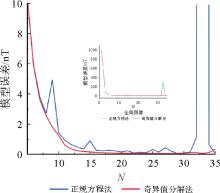
Fig. 1
Solution methods comparison"
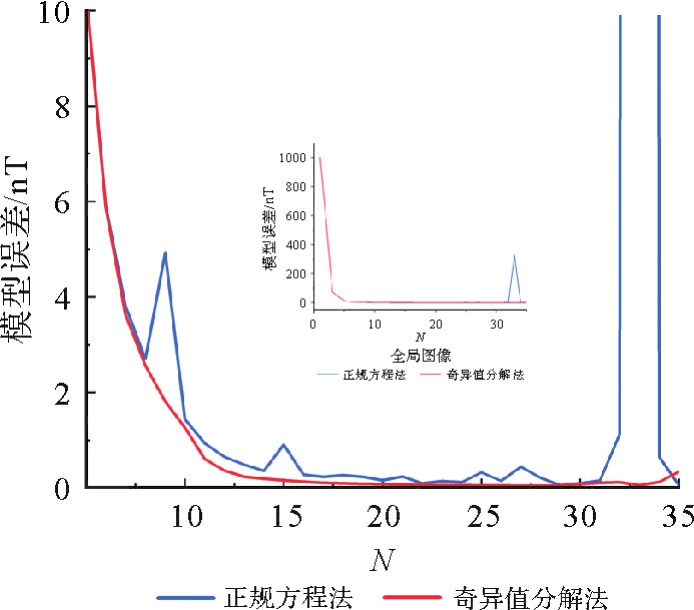
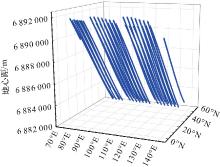
Fig. 2
Distribution of modelling data"
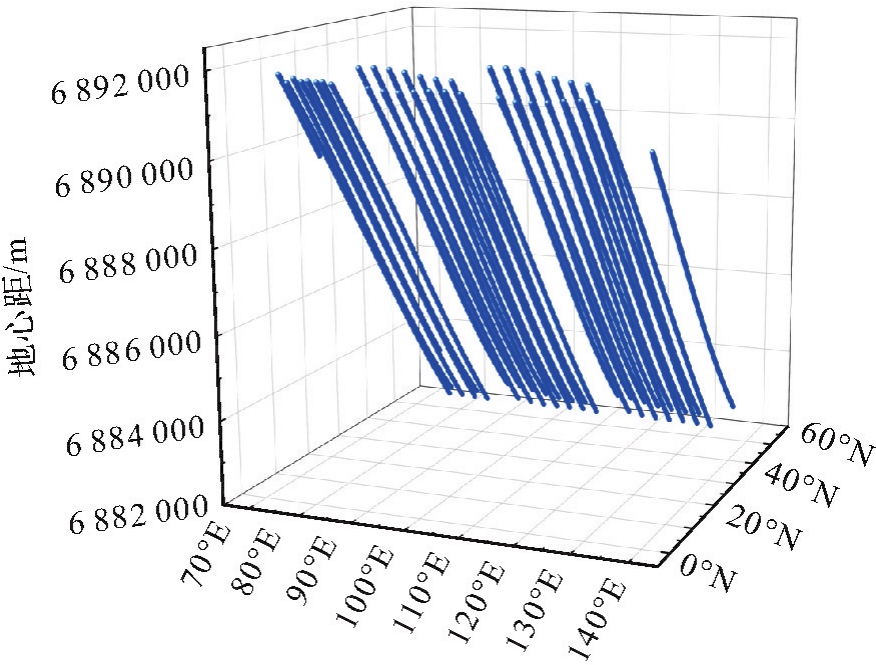
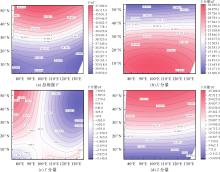
Fig. 3
Contour of Swarm satellite data"

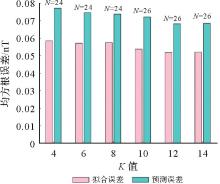
Fig. 4
Experimental results for K values"
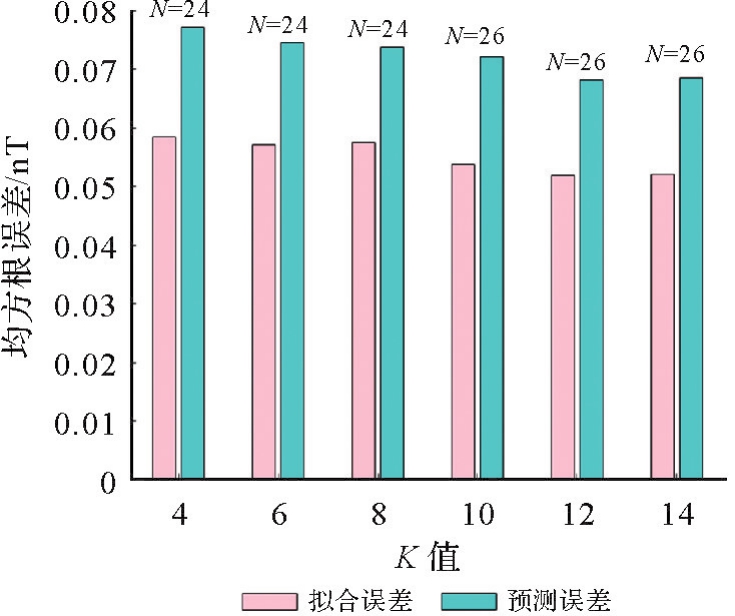
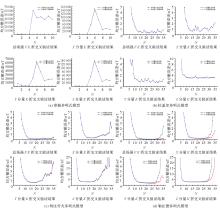
Fig. 5
K-fold cross-validation results for each polynomial model"
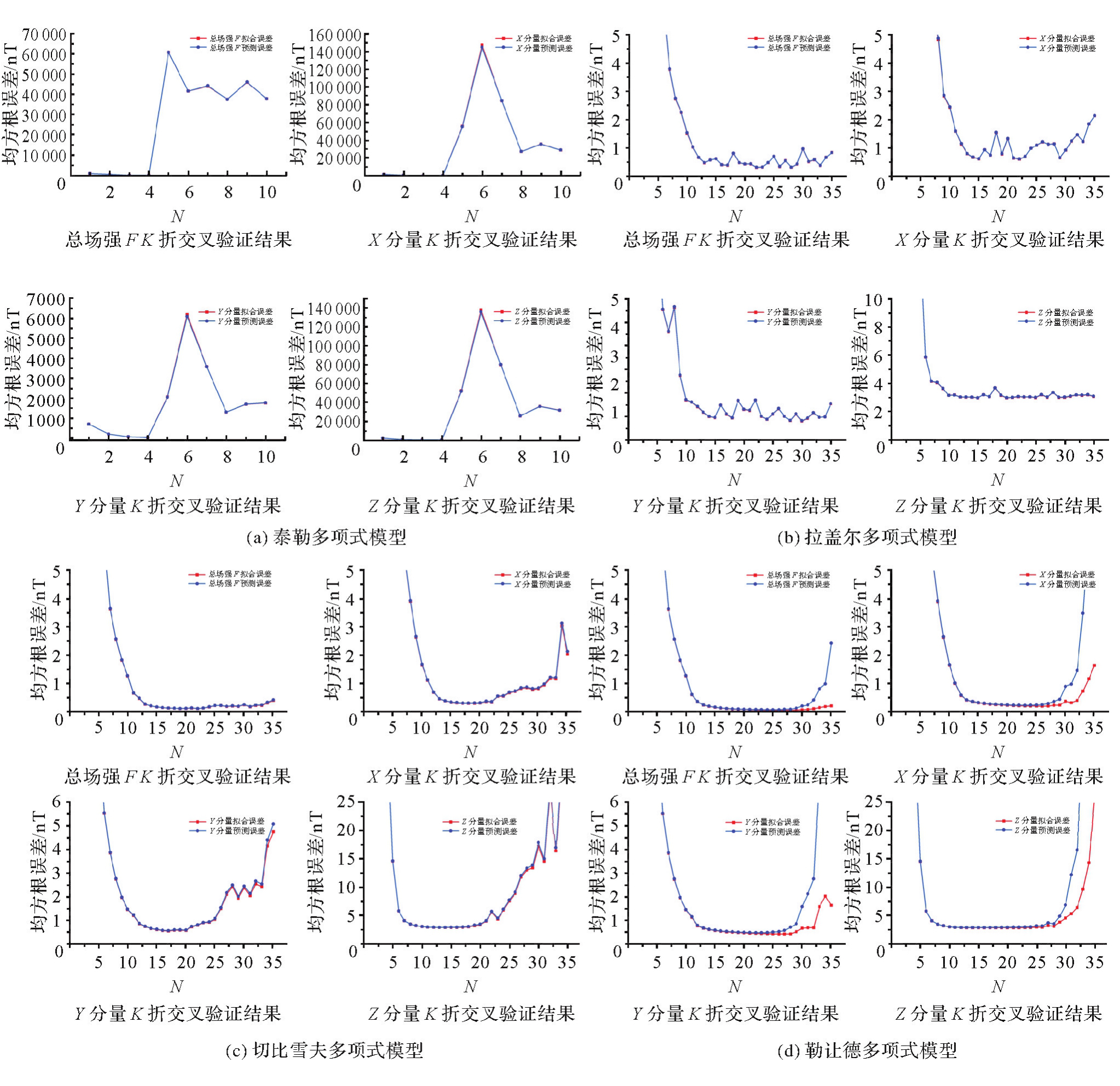
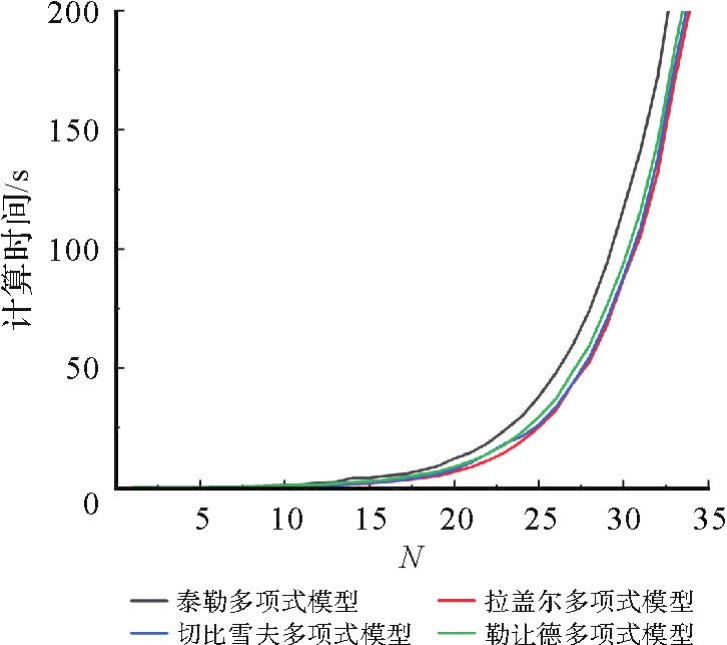
Fig. 6
The computation time for each polynomial model"
Tab. 1
Cut-off degree and error of each polynomial model"
| 多项式模型 | 地磁分量 | 最佳截止阶数 | 平均拟合误差/nT | 平均预测误差/nT |
|---|---|---|---|---|
| 泰勒 | 总强度F | 4 | 41.515 | 41.597 |
| X分量 | 4 | 23.980 | 24.010 | |
| Y分量 | 4 | 30.560 | 30.609 | |
| Z分量 | 4 | 41.346 | 41.407 | |
| 拉盖尔 | 总强度F | 17 | 0.379 | 0.384 |
| X分量 | 15 | 0.603 | 0.611 | |
| Y分量 | 15 | 0.942 | 0.954 | |
| Z分量 | 15 | 2.978 | 2.989 | |
| 切比雪夫 | 总强度F | 22 | 0.112 | 0.117 |
| X分量 | 18 | 0.304 | 0.313 | |
| Y分量 | 17 | 0.561 | 0.575 | |
| Z分量 | 13 | 2.946 | 2.963 | |
| 勒让德 | 总强度F | 26 | 0.052 | 0.073 |
| X分量 | 23 | 0.209 | 0.233 | |
| Y分量 | 23 | 0.451 | 0.489 | |
| Z分量 | 15 | 2.929 | 2.961 |
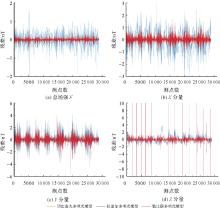
Fig. 7
Model residuals for each magnetic component"

Tab. 2
Fitting errors for geomagnetic component of each polynomial model"
| 模型 | 总场强F | X分量 | Y分量 | Z分量 |
|---|---|---|---|---|
| 泰勒多项式模型 | 41.525 | 23.989 | 30.562 | 41.392 |
| 拉盖尔多项式模型 | 0.321 | 0.743 | 0.868 | 3.023 |
| 切比雪夫多项式模型 | 0.111 | 0.289 | 0.555 | 2.946 |
| 勒让德多项式模型 | 0.055 | 0.207 | 0.452 | 2.934 |
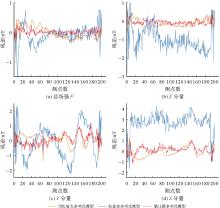
Fig. 8
Model boundary residuals for each magnetic component"

Tab. 3
Boundary fitting errors for geomagnetic components of each polynomial model"
| 多项式模型 | 总场强F | X分量 | Y分量 | Z分量 |
|---|---|---|---|---|
| 泰勒 | 113.885 | 50.643 | 41.073 | 97.788 |
| 拉盖尔 | 0.331 | 1.208 | 1.143 | 2.857 |
| 切比雪夫 | 0.213 | 0.228 | 0.386 | 0.480 |
| 勒让德 | 0.074 | 0.131 | 0.360 | 0.377 |
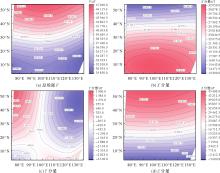
Fig. 9
Contour for geomagnetic components of 3D Legendre polynomial model"

Tab. 4
Fitting errors for the regional geomagnetic field models and WMM2020 model"
| 模型 | 总场强F | X分量 | Y分量 | Z分量 |
|---|---|---|---|---|
| 文献[ | 20.28 | 22.38 | 14.52 | 32.06 |
| 文献[ | 54.1 | 19.1 | 48.8 | 67.9 |
| 本文泰勒多项式模型 | 41.525 | 23.989 | 30.562 | 41.392 |
| 本文勒让德多项式模型 | 0.055 | 0.207 | 0.452 | 2.934 |
| WMM2020 | 46.581 | 161.924 | 45.932 | 133.256 |
| [1] | ALKEN P, THÉBAULT E, BEGGAN C D, et al. International geomagnetic reference field: the thirteenth generation[J]. Earth, Planets and Space, 2021, 73(1): 49. |
| [2] | CHULLIAT A, BROWN W, ALKEN P, et al. The US/UK world magnetic model for 2020—2025: technical report[R]. Boulder: National Centers for Environmental Information, NOAA, 2020. |
| [3] | 魏毅博. IGRF13和WMM2020模型与实测航磁地磁场数据的差异分析研究[D]. 西安: 长安大学, 2023. |
| WEI Yibo. Analysis of the difference between the IGRF13 and WMM2020 models and the measured aeromagnetic geomagnetic field data[D]. Xi'an: Chang'an University, 2023. | |
| [4] | 岳颖, 黄静, 李丛. IGRF和WMM模型与地磁台站观测数据对比分析[J]. 测绘标准化, 2018, 34(1): 31-32. |
| YUE Ying, HUANG Jing, LI Cong. Comparative analysis of errors from IGRF and WMM model with observations from geomagnetic station[J]. Standardization of Surveying and Mapping, 2018, 34(1): 31-32. | |
| [5] | 赵俊, 田源, 张亚军. 全球综合地磁场模型精度评估及统计特征分析[J]. 测绘与空间地理信息, 2024, 47(1): 20-23,28. |
| ZHAO Jun, TIAN Yuan, ZHANG Yajun. Accuracy assessment and statistical characteristics analysis of global synthetic geomagnetic field model[J]. Geomatics & Spatial Information Technology, 2024, 47(1): 20-23,28. | |
| [6] | LEE S M, JUNG J, MYUNG H. Geomagnetic field-based localization with bicubic interpolation for mobile robots[J]. International Journal of Control, Automation and Systems, 2015, 13(4): 967-977. |
| [7] | RIGLER E J, FIORI R A D, PULKKINEN A A, et al. Interpolating geomagnetic observations[M]. Washington, D.C.: American Geophysical Union (AGU), 2019: 15-41. |
| [8] | LIU Q, XU J, XIAO X, et al. Research on geomagnetic indoor positioning based on different spatial interpolation methods[J]. International Journal of Frontiers in Engineering Technology, 2022, 4(7): 52-59. |
| [9] | TORTA J M. Modelling by spherical cap harmonic analysis: a literature review[J]. Surveys in Geophysics, 2020, 41(2): 201-247. |
| [10] | FENG Yan, JIANG Yong, JIANG Yi, et al. Spherical cap harmonic analysis of regional magnetic anomalies based on CHAMP satellite data[J]. Applied Geophysics, 2016, 13(3): 561-569. |
| [11] | 张攀, 杜劲松, 李厚朴. 中国及邻区高分辨率三维岩石圈磁场修正球冠谐模型(CUG_CLMFM3Dv1)[J]. 地球物理学报, 2024, 67(5): 1866-1880. |
| ZHANG Pan, DU Jinsong, LI Houpu. CUG_CLMFM3Dv1: a high-resolution revised spherical cap harmonic model of three-dimensional lithospheric magnetic field over China and surroundings[J]. Chinese Journal of Geophysics, 2024, 67(5): 1866-1880. | |
| [12] | 李明明, 黄显林, 卢鸿谦, 等. 基于矩谐分析的高精度局部地磁场建模研究[J]. 宇航学报, 2010, 31(7): 1730-1736. |
| LI Mingming, HUANG Xianlin, LU Hongqian, et al. Modeling of high accuracy local geomagnetic field base on rectangular harmonic analysis[J]. Journal of Astronautics, 2010, 31(7): 1730-1736. | |
| [13] | 赵建虎, 刘辉, 王胜平. 局域海洋地磁场矩谐分析建模方法研究[J]. 大地测量与地球动力学, 2009, 29(2): 82-87. |
| ZHAO Jianhu, LIU Hui, WANG Shengping. Study on model building in RHA of local ocean geomagnetic field[J]. Journal of Geodesy and Geodynamics, 2009, 29(2): 82-87. | |
| [14] | 区家明, 杜爱民, 徐文耀, 等. 小尺度地磁场勒让德多项式建模方法[J]. 地球物理学报, 2012, 55(8): 2669-2675. |
| OU Jiaming, DU Aimin, XU Wenyao, et al. The Legendre polynomials modeling method of small-scale geomagnetic fields[J]. Chinese Journal of Geophysics, 2012, 55(8): 2669-2675. | |
| [15] | 赵建虎, 王胜平, 刘辉, 等. 海洋局域地磁正常场勒让德多项式模型的建立[J]. 地球物理学进展, 2008, 23(6): 1802-1808. |
| ZHAO Jianhu, WANG Shengping, LIU Hui, et al. Construction of normal geomagnetic filed model with Legendre polynomial model in local marine area[J]. Progress in Geophysics, 2008, 23(6): 1802-1808. | |
| [16] | 种洋, 柴洪洲. 基于三维Taylor多项式建立局域海洋地磁场模型[J]. 大地测量与地球动力学, 2016, 36(10): 854-858. |
| CHONG Yang, CHAI Hongzhou. Regional marine geomagnetic field model reconstruction based on three-dimensional Taylor polynomial[J]. Journal of Geodesy and Geodynamics, 2016, 36(10): 854-858. | |
| [17] | 张素琴, 付长华, 赵旭东. 基于三维Taylor模型的福建及邻近地区地磁模型研究[J]. 地球物理学报, 2016, 59(6): 1948-1956. |
| ZHANG Suqin, FU Changhua, ZHAO Xudong. Study of regional geomagnetic model of Fujian and adjacent areas based on 3D Taylor polynomial model[J]. Chinese Journal of Geophysics, 2016, 59(6): 1948-1956. | |
| [18] | 蒋勇, 姜乙, 冯彦, 等. 基于CHAMP卫星与三维Taylor多项式模型的区域地磁建模研究[J]. 地球物理学报, 2015, 58(9): 3121-3132. |
| JIANG Yong, JIANG Yi, FENG Yan, et al. Regional geomagnetic modelling based on the magnetic data of CHAMP satellite and 3D Taylor polynomial[J]. Chinese Journal of Geophysics, 2015, 58(9): 3121-3132. | |
| [19] | 柳士俊, 周小刚, 孙涵, 等. 用于区域地磁场模型计算的三维Taylor多项式方法[J]. 地球物理学进展, 2011, 26(4): 1165-1174. |
| LIU Shijun, ZHOU Xiaogang, SUN Han, et al. The three dimension Taylor polynomial method for the calculation of regional geomagnetic field model[J]. Progress in Geophysics, 2011, 26(4): 1165-1174. | |
| [20] | FENG Y, SUN H, JIANG Y. Data fitting and modeling of regional geomagnetic field[J]. Applied Geophysics, 2015, 12(3): 303-316. |
| [21] | TERAO T, OZAKI K, OGITA T. LU-Cholesky QR algorithms for thin QR decomposition[J]. Parallel Computing, 2020, 92: 102571. |
| [22] | KRISHNAMOORTHY A, MENON D. Matrix inversion using Cholesky decomposition[C]//Proceedings of 2013 Signal Processing: Algorithms, Architectures, Arrangements, and Applications. Poznan: IEEE, 2013: 70-72. |
| [23] | MA L, DICKSON K, MCALLISTER J, et al. QR decomposition-based matrix inversion for high performance embedded MIMO receivers[J]. IEEE Transactions on Signal Processing, 2011, 59(4): 1858-1867. |
| [24] | ALLEN G I, GROSENICK L, TAYLOR J. A generalized least-square matrix decomposition[J]. Journal of the American Statistical Association, 2014, 109(505): 145-159. |
| [25] | VATANKHAH S, LIU S, RENAUT R A, et al. Improving the use of the randomized singular value decomposition for the inversion of gravity and magnetic data[J]. Geophysics, 2020, 85(5): G93-G107. |
| [26] | SOLOVYEV SA, TORDEUX S. Large SVD computations for analysis of inverse problems in geophysics[C]//Proceedings of the 11th World Congress on Computational Mechanics. Barcelona: CIMNE, 2014: 2861-2869. |
| [27] | YANAI H, TAKEUCHI K, TAKANE Y. Singular value decomposition (SVD)[M]//Projection matrices, generalized inverse matrices, and singular value decomposition. New York: Springer, 2011: 125-149. |
| [28] | 郭文彬. 奇异值分解及其在广义逆理论中的应用[D]. 上海: 华东师范大学, 2004. |
| GUO Wenbin. Singular value decomposition and its application in the theory of generalized inverses[D]. Shanghai: East China Normal University, 2004. | |
| [29] | 聂琳娟, 许智铭. 利用SWARM星群磁测数据反演地球主磁场模型WHU-MM01[J]. 测绘地理信息, 2020, 45(5): 16-19. |
| NIE Linjuan, XU Zhiming. The inversion of the earth's main magnetic field model WHU-MM01 with SWARM satellite magnetic data[J]. Journal of Geomatics, 2020, 45(5): 16-19. | |
| [30] | 刘长青. 基于Swarm卫星和地面地磁台站数据的区域地磁场建模研究[D]. 郑州: 信息工程大学, 2023. |
| LIU Changqing. Research on regional geomagnetic field modeling based on Swarm satellite and ground geomagnetic station data[D]. Zhengzhou: Information Engineering University, 2023. | |
| [31] | 刘爽. 基于Swarm卫星数据的卫星高度区域地磁场模拟研究[D]. 南京: 南京信息工程大学, 2022. |
| LIU Shuang. Modelling of the regional geomagnetic field at satellite altitudes based on Swarm satellite data[D]. Nanjing: Nanjing University of Information Science and Technology, 2022. | |
| [32] | JUNG K, BAE D H, UM M J, et al. Evaluation of nitrate load estimations using neural networks and canonical correlation analysis with K-fold cross-validation[J]. Sustainability, 2020, 12(1): 400. |
| [33] | NTI I K, BOATENG O N, ANING J. Performance of machine learning algorithms with different K values in K-fold cross-validation[J]. International Journal of Information Technology and Computer Science (IJITCS), 2021, 13(6): 61-71. |
| [34] | MARCOT B G, HANEA A M. What is an optimal value of K in K-fold cross-validation in discrete Bayesian network analysis?[J]. Computational Statistics, 2021, 36(3): 2009-2031. |
| [1] | Wei QU, Rongtang XU, Jiuyuan LI, Xingyou TANG, Peinan CHEN. Singular value decomposition normalization prediction method for non-steady landslide displacement [J]. Acta Geodaetica et Cartographica Sinica, 2025, 54(9): 1647-1663. |
| [2] | Chuanguang ZHU, Jixian ZHANG, Sichun LONG, Ronghua YANG, Wenhao WU, Liya ZHANG. Phase estimation of distributed scatterer based on singular value decomposition [J]. Acta Geodaetica et Cartographica Sinica, 2024, 53(7): 1308-1320. |
| [3] | ZHANG Bingbing, NIU Jiqiang, WANG Zhengtao, XU Feng, TIAN Kunjun. Centimeter precise orbit determination for the Swarm satellites via undifferenced kinematic method [J]. Acta Geodaetica et Cartographica Sinica, 2021, 50(1): 27-36. |
| [4] | DONG Yang, FAN Dazhao, JI Song, LEI Rong. The Purification Method of Matching Points Based on Principal Component Analysis [J]. Acta Geodaetica et Cartographica Sinica, 2017, 46(2): 228-236. |
| [5] | TIAN Yingguo, HAO Jinming, YU Heli, LIU Weiping, XIE Jiantao, ZHANG Kang. Improved Ionospheric Model Algorithm for LEO Satellite Single-frequency Precise Orbit Determination [J]. Acta Geodaetica et Cartographica Sinica, 2016, 45(7): 803-809. |
| [6] | TIAN Yingguo, HAO Jinming. Swarm Satellite Antenna Phase Center Correction and Its Influence on the Precision Orbit Determination [J]. Acta Geodaetica et Cartographica Sinica, 2016, 45(12): 1406-1412. |
| [7] | ZHANG Bingbing, NIE Linjuan, WU Tangting, FENG Jiandi, QIU Yaodong. Centimeter Precise Orbit Determination for SWARM Satellite via Reduced-dynamic Method [J]. Acta Geodaetica et Cartographica Sinica, 2016, 45(11): 1278-1284. |
| Viewed | ||||||
|
Full text |
|
|||||
|
Abstract |
|
|||||
