

Acta Geodaetica et Cartographica Sinica ›› 2025, Vol. 54 ›› Issue (3): 448-460.doi: 10.11947/j.AGCS.2025.20240251
• Geodesy and Navigation • Previous Articles Next Articles
Luguang LAI1( ), Dongqing ZHAO1(), Linyang LI1,2, Wenzhe FAN1, Xiongqing LI1, Pengfei LI1
Received:2024-07-05
Online:2025-04-11
Published:2025-04-11
Contact:
Dongqing ZHAO
E-mail:llg16690994518@163.com;dongqing.zhao@hotmail.com
About author:LAI Luguang (1999—), male, PhD candidate, majors in multi-sensor fusion SLAM. E-mail: llg16690994518@163.com
Supported by:CLC Number:
Luguang LAI, Dongqing ZHAO, Linyang LI, Wenzhe FAN, Xiongqing LI, Pengfei LI. A thermal-inertial odometry with point and line fusion for the weak textured dark scenes[J]. Acta Geodaetica et Cartographica Sinica, 2025, 54(3): 448-460.

Fig. 1
Architecture of point and line fusion combined infrared-inertial odometry method"


Fig. 2
Point feature tracking filtering process"


Fig. 3
Plücker coordinates for line features"


Fig. 4
Factor graph model of point and line fusion"


Fig. 5
Reprojection error of point and line features"

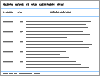
Tab. 1
Description of different data in M2DGR"
| 数据集 | Hall02 | Room_dark04 | Street02 | Street03 | Street06 | Street08 |
|---|---|---|---|---|---|---|
| 光照条件 | 室内黑暗 | 室内黑暗 | 白天 | 夜晚 | 夜晚 | 夜晚 |
| 轨迹长度/m | 83.0 | 59.8 | 330.2 | 423.9 | 347.6 | 340.6 |

Fig. 6
Trajectory comparison of Street03 and Street08"


Fig. 7
ATE for aligning trajectories using similar transformations in M2DGR"

Tab. 2
RMSE of ATE in the M2DGR dataset"
| RMSE | Hall02 | Room_dark04 | Street02 | Street03 | Street06 | Street08 |
|---|---|---|---|---|---|---|
| VINS-Fusion1 | 2.70 | 0.84 | — | 8.61 | 13.28 | 17.92 |
| PL-VINS1 | — | 0.82 | — | 5.64 | — | 12.44 |
| TIO1 | 2.25 | 0.75 | 2.63 | 2.71 | 3.49 | 5.83 |
| VINS-Fusion2 | 3.35 | 1.44 | — | 9.46 | 55.74 | 22.57 |
| PL-VINS2 | — | 1.31 | — | 5.84 | — | 21.00 |
| TIO2 | 2.97 | 1.02 | 8.91 | 2.86 | 32.79 | 11.10 |
Tab. 3
Sensor models and parameters information"
| 设备 | 设备型号 | 参数信息 |
|---|---|---|
| 红外相机 | Gaode PLUG 617 | 分辨率:640×512 水平视场角:92.0° 垂直视场角:70.6° 帧率:25 Hz |
| IMU | I300BA50 | 陀螺仪零偏:3°/h 加速度计零偏:100 m Gal 角度随机游走:0.15°/  h h速度随机游走:0.02 m/s/  h h采样频率:200 Hz |

Fig. 8
Experimental platform"


Fig. 9
Underground parking garage experimental environment"


Fig. 10
Line feature detection and matching before and after LSD improvement"


Fig. 11
Point and line feature extraction"


Fig. 12
Point and line feature reconstruction effect of Parking04"


Fig. 13
Trajectory comparison of Parking04 and Parking05"

Tab. 4
RMSE of ATE in underground garage data"
| 数据集 | 轨迹长度 | VINS-Fusion1 | PL-VINS1 | TIO1 | VINS-Fusion2 | PL-VINS2 | TIO2 |
|---|---|---|---|---|---|---|---|
| Parking01 | 330.08 | 4.89 | 4.79 | 4.36 | 13.36 | 12.83 | 9.68 |
| Parking02 | 229.99 | — | — | 8.00 | — | — | 11.98 |
| Parking03 | 141.93 | 5.67 | 5.33 | 3.72 | 6.38 | 8.00 | 4.95 |
| Parking04 | 115.69 | 4.32 | 3.13 | 2.64 | 6.20 | 5.34 | 3.74 |
| Parking05 | 166.30 | 2.57 | 2.35 | 2.01 | 5.19 | 4.12 | 3.56 |

Fig. 14
VINS-Fusion point feature tracking in Parking02"

| [1] |
张继贤, 刘飞. 视觉SLAM环境感知技术现状与智能化测绘应用展望[J]. 测绘学报, 2023, 52(10): 1617-1630. DOI:.
doi: 10.11947/j.AGCS.2023.20220240 |
|
ZHANG Jixian, LIU Fei. Review of visual SLAM environment perception technology and intelligent surveying and mapping application[J]. Acta Geodaetica et Cartographica Sinica, 2023, 52(10): 1617-1630. DOI:.
doi: 10.11947/j.AGCS.2023.20220240 |
|
| [2] | LI Xingxing, ZHANG Xiaohong, NIU Xiaoji, et al. Progress and achievements of multi-sensor fusion navigation in China during 2019—2023[J]. Journal of Geodesy and Geoinformation Science, 2023, 6(3): 102-114. |
| [3] | CADENA C, CARLONE L, CARRILLO H, et al. Past, present, and future of simultaneous localization and mapping: toward the robust-perception age[J]. IEEE Transactions on Robotics, 2016, 32(6): 1309-1332. |
| [4] |
杨元喜. 综合PNT体系及其关键技术[J]. 测绘学报, 2016, 45(5): 505-510. DOI:.
doi: 10.11947/j.AGCS.2016.20160127 |
|
YANG Yuanxi. Concepts of comprehensive PNT and related key technologies[J]. Acta Geodaetica et Cartographica Sinica, 2016, 45(5): 505-510. DOI:.
doi: 10.11947/j.AGCS.2016.20160127 |
|
| [5] | WU Yuzhen, WANG Lingxue, ZHANG Lian, et al. Catadioptric omnidirectional thermal odometry in dynamic environment[J]. ISPRS Journal of Photogrammetry and Remote Sensing, 2024, 216: 45-65. |
| [6] | YANG Yuanxi. Resilient PNT concept frame[J]. Journal of Geodesy and Geoinformation Science, 2019, 2(3): 1-7. |
| [7] | DI Kaichang, WAN Wenhui, ZHAO Hongying, et al. Progress and applications of visual SLAM[J]. Journal of Geodesy and Geoinformation Science, 2019, 2(2): 38-49. |
| [8] | KONG Da, ZHANG Yu, DAI Weichen. Direct near-infrared-depth visual SLAM with active lighting[J]. IEEE Robotics and Automation Letters, 2021, 6(4): 7057-7064. |
| [9] |
王铉彬, 李星星, 廖健驰, 等. 基于图优化的紧耦合双目视觉/惯性/激光雷达SLAM方法[J]. 测绘学报, 2022, 51(8): 1744-1756. DOI:.
doi: 10.11947/j.AGCS.2022.20210503 |
|
WANG Xuanbin, LI Xingxing, LIAO Jianchi, et al. Tightly-coupled stereo visual-inertial-LiDAR SLAM based on graph optimization[J]. Acta Geodaetica et Cartographica Sinica, 2022, 51(8): 1744-1756. DOI:.
doi: 10.11947/j.AGCS.2022.20210503 |
|
| [10] | 蔡毅, 王岭雪. 红外成像技术中的9个问题[J]. 红外技术, 2013, 35(11): 671-682. |
| CAI Yi, WANG Lingxue. Nine issues associated with infrared imaging technology[J]. Infrared Technology, 2013, 35(11): 671-682. | |
| [11] | EBADI K, BERNREITER L, BIGGIE H, et al. Present and future of SLAM in extreme environments: the DARPA SubT challenge[J]. IEEE Transactions on Robotics, 2023, 40: 936-959. |
| [12] | VAN MANEN B R, SLUITER V, MERSHA A Y. FirebotSLAM: thermal SLAM to increase situational awareness in smoke-filled environments[J]. Sensors, 2023, 23(17): 7611. |
| [13] | VIDAS S, SRIDHARAN S. Hand-held monocular SLAM in thermal-infrared[C]//Proceedings of 2012 International Conference on Control Automation Robotics & Vision. Guangzhou: IEEE, 2012: 859-864. |
| [14] | PAPACHRISTOS C, MASCARICH F, ALEXIS K. Thermal-inertial localization for autonomous navigation of aerial robots through obscurants[C]//Proceedings of 2018 International Conference on Unmanned Aircraft Systems. Dallas: IEEE, 2018: 394-399. |
| [15] | KHATTAK S, PAPACHRISTOS C, ALEXIS K. Key frame-based direct thermal-inertial odometry[EB/OL]. [2024-06-05]. https://arxiv.org/abs/1903.00798v1. |
| [16] | CHEN Wenqiang, WANG Yu, CHEN Haoyao, et al. EIL-SLAM: depth-enhanced edge-based infrared-LiDAR SLAM[J]. Journal of Field Robotics, 2022, 39(2): 117-130. |
| [17] | SHIN Y S, KIM A. Sparse depth enhanced direct thermal-infrared SLAM beyond the visible spectrum[J]. IEEE Robotics and Automation Letters, 2019, 4(3): 2918-2925. |
| [18] | 赖路广, 赵冬青, 李林阳, 等. 长波红外成像技术及其在SLAM中的应用[J]. 测绘科学, 2024, 49(3): 77-86. |
| LAI Luguang, ZHAO Dongqing, LI Linyang, et al. Long wave infrared imaging technology and its application in SLAM[J]. Science of Surveying and Mapping, 2024, 49(3): 77-86. | |
| [19] | SAPUTRA M R U, DE GUSMAO P P B, LU C X, et al. DeepTIO: a deep thermal-inertial odometry with visual hallucination[J]. IEEE Robotics and Automation Letters, 2020, 5(2): 1672-1679. |
| [20] | ZHAO Shibo, WANG Peng, ZHANG Hengrui, et al. TP-TIO: a robust thermal-inertial odometry with deep ThermalPoint[C]//Proceedings of 2020 IEEE/RSJ International Conference on Intelligent Robots and Systems. Las Vegas: IEEE, 2020: 4505-4512. |
| [21] | JIANG Jiajun, CHEN Xingxin, DAI Weichen, et al. Thermal-inertial SLAM for the environments with challenging illumination[J]. IEEE Robotics and Automation Letters, 2022, 7(4): 8767-8774. |
| [22] | WANG Yu, CHEN Haoyao, LIU Yufeng, et al. Edge-based monocular thermal-inertial odometry in visually degraded environments[J]. IEEE Robotics and Automation Letters, 2023, 8(4): 2078-2085. |
| [23] | HE Ziqi, LI Gang. A visual-inertial navigation coupled localization method based on adaptive point-line feature extraction[J]. IEEE Sensors Journal, 2023, 23(20): 25096-25104. |
| [24] | LIU Xin, WEN Shuhuan, ZHANG Hong. A real-time stereo visual-inertial SLAM system based on point-and-line features[J]. IEEE Transactions on Vehicular Technology, 2023, 72(5): 5747-5758. |
| [25] | ZHAO Weiqiang, SUN Hang, ZHANG Xinyu, et al. Visual SLAM combining lines and structural regularities: towards robust localization[J]. IEEE Transactions on Intelligent Vehicles, 2024, 9(6): 5047-5064. |
| [26] | SHEN Shaojie, MICHAEL N, KUMAR V. Tightly-coupled monocular visual-inertial fusion for autonomous flight of rotorcraft MAVs[C]//Proceedings of 2015 IEEE International Conference on Robotics and Automation. Seattle: IEEE, 2015: 5303-5310. |
| [27] | QIN Tong, LI Peiliang, SHEN Shaojie. VINS-Mono: a robust and versatile monocular visual-inertial state estimator[J]. IEEE Transactions on Robotics, 2018, 34(4): 1004-1020. |
| [28] | ZHANG Lilian, KOCH R. An efficient and robust line segment matching approach based on LBD descriptor and pairwise geometric consistency[J]. Journal of Visual Communication and Image Representation, 2013, 24(7): 794-805. |
| [29] | GIOI R G, JAKUBOWICZ J, MOREL J M, et al. LSD: a fast line segment detector with a false detection control[J]. IEEE Transactions on Pattern Analysis and Machine Intelligence, 2010, 32(4): 722-732. |
| [30] | QIN Tong, CAO Shaozu, PAN Jie, et al. A general optimization-based framework for global pose estimation with multiple sensors[EB/OL]. [2024-01-11]. http://arxiv.org/abs/1901.03642v1. |
| [31] | BARTOLI A, STURM P. Structure-from-motion using lines: representation, triangulation, and bundle adjustment[J]. Computer Vision and Image Understanding, 2005, 100(3): 416-441. |
| [32] | FU Qiang, WANG Jialong, YU Hongshan, et al. PL-VINS: real-time monocular visual-inertial SLAM with point and line features[EB/OL]. [2024-04-16]. https://arxiv.org/abs/2009.07462v1. |
| [33] | LEE J, PARK S Y. PLF-VINS: real-time monocular visual-inertial SLAM with point-line fusion and parallel-line fusion[J]. IEEE Robotics and Automation Letters, 6(4): 7033-7040. |
| [34] | HE Yijia, ZHAO Ji, GUO Yue, et al. PL-VIO: tightly-coupled monocular visual-inertial odometry using point and line features[J]. Sensors, 2018, 18(4): 1159. |
| [35] | HUBER P J. Robust estimation of a location parameter[J]. The Annals of Mathematical Statistics, 1964, 35(1): 73-101. |
| [36] | SIBLEY G, MATTHIES L, SUKHATME G. Sliding window filter with application to planetary landing[J]. Journal of Field Robotics, 2010, 27(5): 587-608. |
| [37] | FORSTER C, CARLONE L, DELLAERT F, et al. On-manifold preintegration for real-time visual-inertial odometry[J]. IEEE Transactions on Robotics, 2017, 33(1): 1-21. |
| [38] | WEI Hongyu, ZHANG Tao, ZHANG Liang, et al. Multifeatures association bundle adjustment constraints for visual-oriented localization[J]. IEEE Sensors Journal, 2023, 23(22): 27909-27920. |
| [39] | YIN Jie, LI Ang, LI Tao, et al. M2DGR: a multi-sensor and multi-scenario SLAM dataset for ground robots[J]. IEEE Robotics and Automation Letters, 2022, 7(2): 2266-2273. |
| [40] | ZHOU Yuxuan, LI Xingxing, LI Shengyu, et al. Ground-VIO: monocular visual-inertial odometry with online calibration of camera-ground geometric parameters[J]. IEEE Transactions on Intelligent Transportation Systems, 2024, 25(10): 14328-14343. |
| [41] | ZHANG Zhengyou. A flexible new technique for camera calibration[J]. IEEE Transactions on Pattern Analysis and Machine Intelligence, 2000, 22(11): 1330-1334. |
| [42] | FURGALE P, REHDER J, SIEGWART R. Unified temporal and spatial calibration for multi-sensor systems[C]//Proceeding of 2013 IEEE/RSJ International Conference on Intelligent Robots & Systems. Tokyo: IEEE, 2013: 1280-1286. |
| [43] | SHAN Tixiao, ENGLOT B, MEYERS D, et al. LIO-SAM: tightly-coupled LiDAR inertial odometry via smoothing and mapping[C]//Proceedings of 2020 IEEE/RSJ International Conference on Intelligent Robots and Systems. Las Vegas: IEEE, 2020: 5135-5142. |
| [44] | LIM H, KIM Y, JUNG K, et al. Avoiding degeneracy for monocular visual SLAM with point and line features[C]//Proceedings of 2021 IEEE International Conference on Robotics and Automation. Xi'an: IEEE, 2021: 11675-11681. |
| [1] | Weitong WU, Chi CHEN, Bisheng YANG, Xiufeng HE. Robust multi-sensor fusion-based odometry method of LiDAR, millimeter-wave radar and IMU in degraded scenes [J]. Acta Geodaetica et Cartographica Sinica, 2025, 54(9): 1677-1686. |
| [2] | Kefan SHAO, Zengke LI, Meng SUN, Zhenbin LIU, Qi WU. A geomagnetic SLAM method enhanced by multi-source data fusion based on smartphones [J]. Acta Geodaetica et Cartographica Sinica, 2025, 54(10): 1812-1825. |
| [3] | Chi GUO, Yang LIU, Yarong LUO, Jingnan LIU, Quan ZHANG. Research progress in the application of image semantic information in visual SLAM [J]. Acta Geodaetica et Cartographica Sinica, 2024, 53(6): 1057-1076. |
| [4] | ZHANG Jixian, LIU Fei. Review of visual SLAM environment perception technology and intelligent surveying and mapping application [J]. Acta Geodaetica et Cartographica Sinica, 2023, 52(10): 1617-1630. |
| [5] | WANG Xuanbin, LI Xingxing, LIAO Jianchi, FENG Shaoquan, LI Shengyu, ZHOU Yuxuan. Tightly-coupled stereo visual-inertial-LiDAR SLAM based on graph optimization [J]. Acta Geodaetica et Cartographica Sinica, 2022, 51(8): 1744-1756. |
| [6] | DENG Chen, LI Hongwei, ZHANG Bin, XU Zhibin, XIAO Zhiyuan. Research on key frame image processing of semantic SLAM based on deep learning [J]. Acta Geodaetica et Cartographica Sinica, 2021, 50(11): 1605-1616. |
| [7] | XU Zhibin, LI Hongwei, ZHANG Bin, XIAO Zhiyuan, DENG Chen. Localization method of mobile robot based on binocular vision and inertial navigation [J]. Acta Geodaetica et Cartographica Sinica, 2021, 50(11): 1512-1521. |
| [8] | LI Shuaixin, LI Jiuren, TIAN Bin, CHEN Long, WANG Li, LI Guangyun. A laser SLAM method for unmanned vehicles in point cloud degenerated tunnel environments [J]. Acta Geodaetica et Cartographica Sinica, 2021, 50(11): 1487-1499. |
| [9] | SHAO Xiaohang, WU Hangbin, LIU Chun, CHEN Chen, CAI Tianchi, CHENG Fanjin. Visual odometry optimizing bounded with semantic elements association in dynamic scenes [J]. Acta Geodaetica et Cartographica Sinica, 2021, 50(11): 1478-1486. |
| [10] | WANG Chenjie, LUO Bin, LI Chengyuan, WANG Wei, YIN Lu, ZHAO Qing. The collaborative mapping and navigation based on visual SLAM in UAV platform [J]. Acta Geodaetica et Cartographica Sinica, 2020, 49(6): 767-776. |
| [11] | JI Shunping, QIN Zijie. Panoramic SLAM for multi-camera rig [J]. Acta Geodaetica et Cartographica Sinica, 2019, 48(10): 1254-1265. |
| [12] | DI Kaichang, WAN Wenhui, ZHAO Hongying, LIU Zhaoqin, WANG Runzhi, ZHANG Feizhou. Progress and Applications of Visual SLAM [J]. Acta Geodaetica et Cartographica Sinica, 2018, 47(6): 770-779. |
| Viewed | ||||||
|
Full text |
|
|||||
|
Abstract |
|
|||||
