

Acta Geodaetica et Cartographica Sinica ›› 2025, Vol. 54 ›› Issue (7): 1305-1317.doi: 10.11947/j.AGCS.2025.20240448
• Cartography and Geoinformation • Previous Articles Next Articles
Min DENG( ), Chong PENG, Kaiqi CHEN()
Received:2024-11-01
Revised:2025-06-18
Online:2025-08-18
Published:2025-08-18
Contact:
Kaiqi CHEN
E-mail:dengmin@csu.edu.cn;chenkaiqi@csu.edu.cn
About author:DENG Min (1974—), male, PhD, professor, majors in spatio-temporal big data mining and intelligent services. E-mail: dengmin@csu.edu.cn
Supported by:CLC Number:
Min DENG, Chong PENG, Kaiqi CHEN. A predictability measurement methodology for spatial panel data considering geo-spatial effects[J]. Acta Geodaetica et Cartographica Sinica, 2025, 54(7): 1305-1317.

Fig. 1
Spatial panel data"
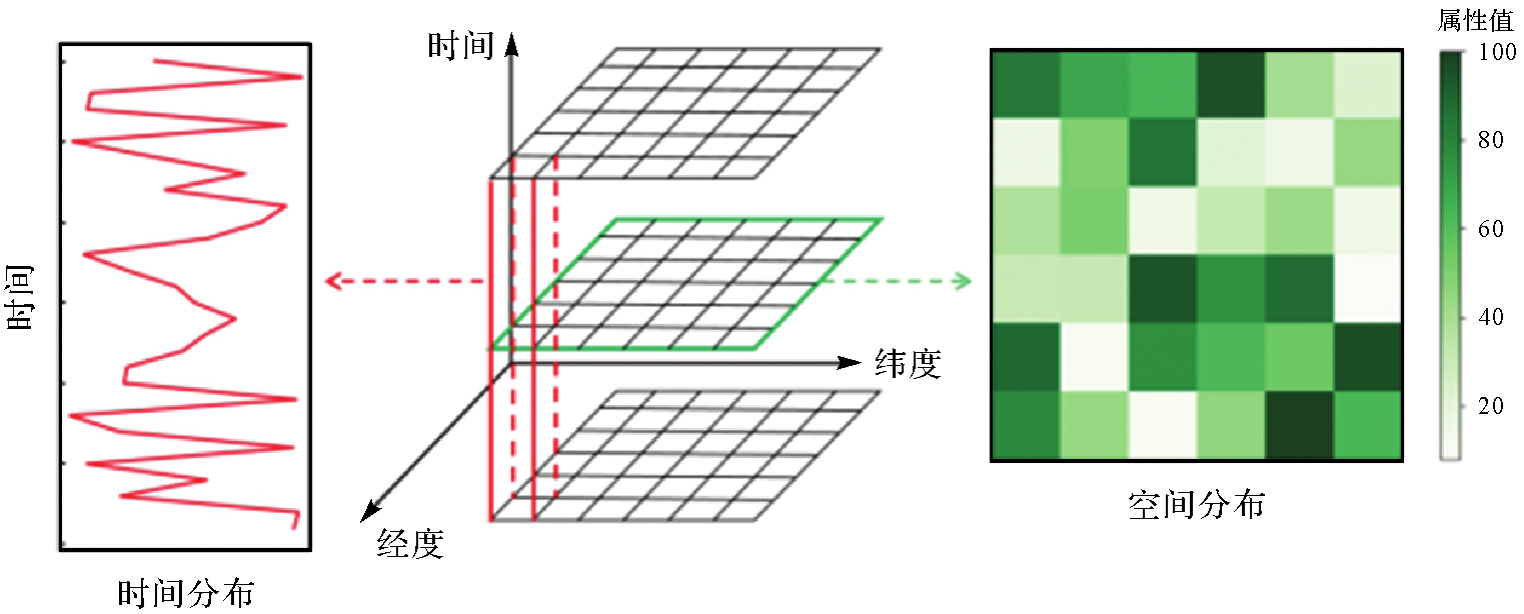
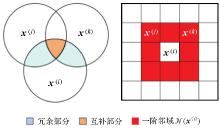
Fig. 2
Information relationship of spatial neighborhood unit data"

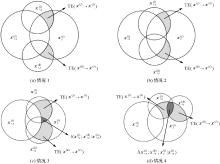
Fig. 3
Different information relationships between neighboring unit data (x(j) and x(k)) and central unit data (x(i))"

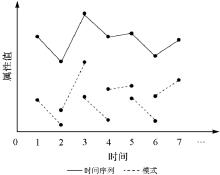
Fig. 4
Pattern division (m=2)"
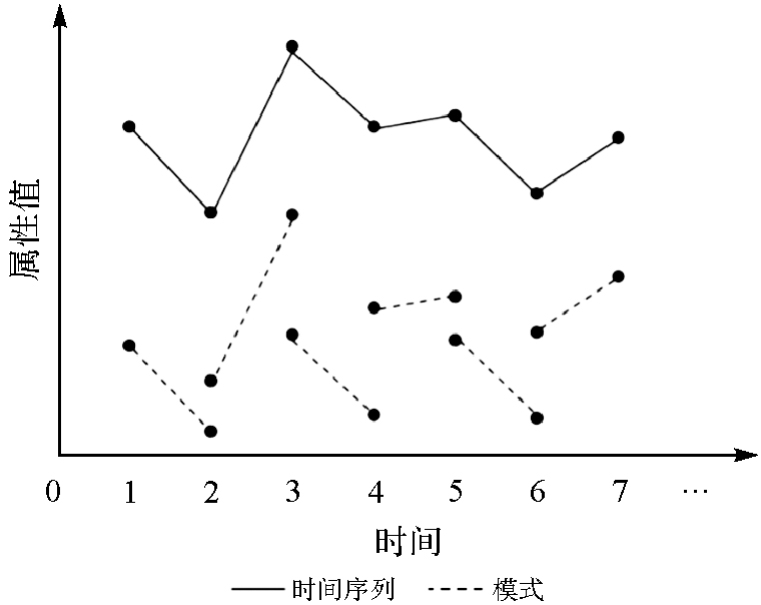
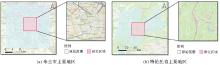
Fig. 5
Study area"

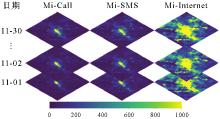
Fig. 6
Partial visualization of spatial panel data Mi-Call, Mi-SMS and Mi-Internet"


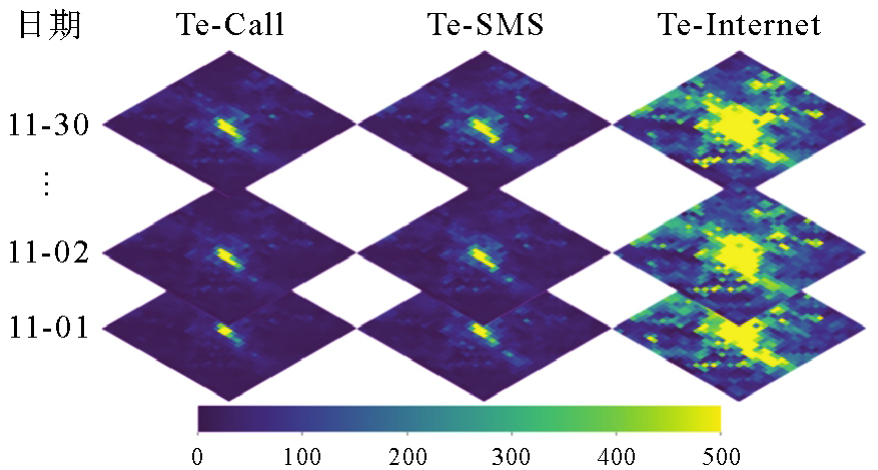
Fig. 7
Partial visualization of spatial panel data Te-Call, Te-SMS and Te-Internet"
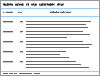
Tab. 1
Neighborhood transfer entropy calculation results"
| 研究区域 | 空间面板数据 | 邻域转移熵 | 具有显著增益的邻域单元数占比(一阶邻域)/(%) | ||||
|---|---|---|---|---|---|---|---|
| 平均值 | 最大值 | 0个单元 | 1~3个单元 | 4~6个单元 | 7~8个单元 | ||
| 米兰 | Mi-Call | 0.078 | 0.421 | 0.19 | 34.62 | 61.94 | 3.25 |
| Mi-SMS | 0.056 | 0.238 | 0.68 | 52.25 | 45.94 | 1.13 | |
| Mi-Internet | 0.060 | 0.290 | 0.25 | 46.56 | 50.94 | 2.25 | |
| 特伦托 | Te-Call | 0.076 | 0.303 | 0.22 | 51.00 | 47.78 | 1.00 |
| Te-SMS | 0.054 | 0.193 | 0.78 | 67.78 | 31.22 | 0.22 | |
| Te-Internet | 0.044 | 0.206 | 1.33 | 71.11 | 26.67 | 0.89 | |
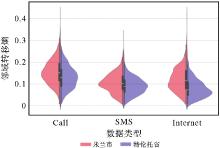
Fig. 8
Distribution of neighborhood transfer entropy values between two study areas"
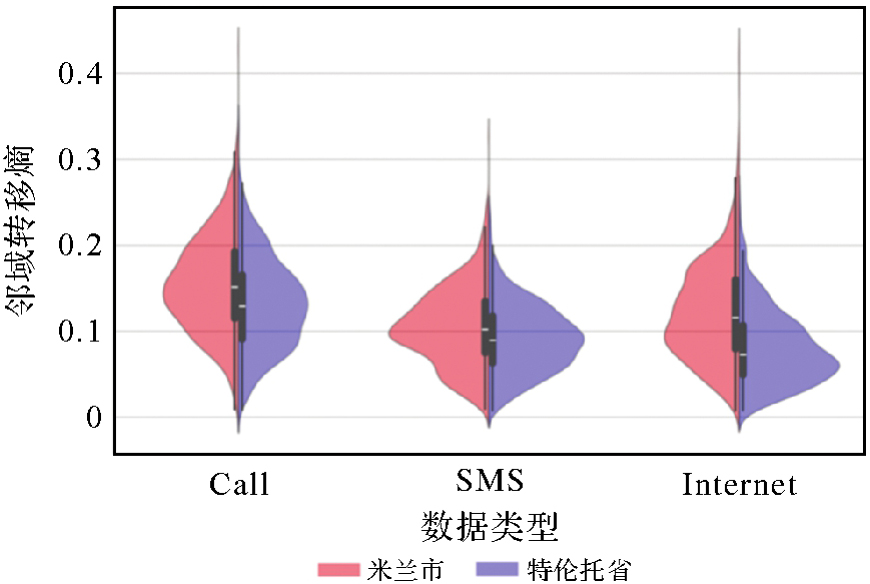
Tab. 2
Comparative analysis between changes in prediction accuracy and changes in neighborhood transfer entropy"
| 顾及邻域单元个数 | Mi-Call | Mi-SMS | Mi-Internet | Te-Call | Te-SMS | Te-Internet |
|---|---|---|---|---|---|---|
| 0 | 23.09 | 29.81 | 155.99 | 5.24 | 8.56 | 26.86 |
| 1 | 21.45(0.046) | 28.98(0.034) | 151.38(0.039) | 4.94(0.063) | 8.28(0.05) | 26.4(0.038) |
| 2 | 18.92(0.106) | 27.35(0.069) | 149.88(0.077) | 4.84(0.100) | 8.12(0.075) | 26.15(0.060) |
| 3 | 18.13(0.132) | 25.81(0.099) | 145.92(0.106) | 4.57(0.123) | 7.15(0.091) | 24.55(0.087) |
| 4 | 16.69(0.154) | 24.91(0.120) | 137.55(0.132) | 4.05(0.134) | 6.92(0.110) | 23.51(0.100) |
| 5 | 14.69(0.179) | 22.68(0.135) | 136.16(0.16) | 3.62(0.169) | 5.69(0.130) | 17.97(0.131) |
| 6 | 14.57(0.198) | 22.67(0.155) | 130.03(0.177) | 2.22(0.184) | 4.83(0.156) | 14.96(0.151) |
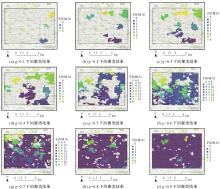
Fig. 9
Clustering results of Mi-Internet data based on cross spatial entropy"

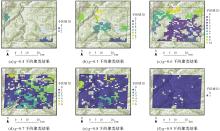
Fig. 10
Clustering results of Te-Internet data based on cross spatial entropy"

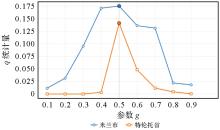
Fig. 11
Relationship between parameter g and statistics q of two study areas"

Tab. 3
Prediction accuracy validation results for Mi-Internet dataset"
| 参与训练的子区域ID | 参与测试的子区域ID | 预测精度(MAE) | 参与训练的子区域ID | 参与测试的子区域ID | 预测精度(MAE) |
|---|---|---|---|---|---|
| 5 | 5 | 96.99 | 10 | 50.34 | |
| 2 | 321.30 | 2 | 352.85 | ||
| 6 | 299.28 | 10 | 6 | 484.02 | |
| 8 | 346.80 | 8 | 305.05 | ||
| 13 | 174.68 | 13 | 168.96 |
Tab. 4
Prediction accuracy validation results for Te-Internet dataset"
| 参与训练的子区域ID | 参与测试的子区域ID | 预测精度(MAE) | 参与训练的子区域ID | 参与测试的子区域ID | 预测精度(MAE) |
|---|---|---|---|---|---|
| 4 | 4 | 11.67 | 5 | 9.22 | |
| 2 | 127.33 | 2 | 154.97 | ||
| 3 | 46.98 | 3 | 52.32 | ||
| 5 | 12.18 | 5 | 4 | 21.15 | |
| 6 | 106.35 | 6 | 117.24 | ||
| 7 | 28.66 | 7 | 31.67 |
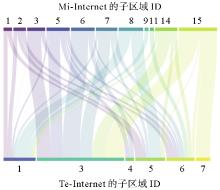
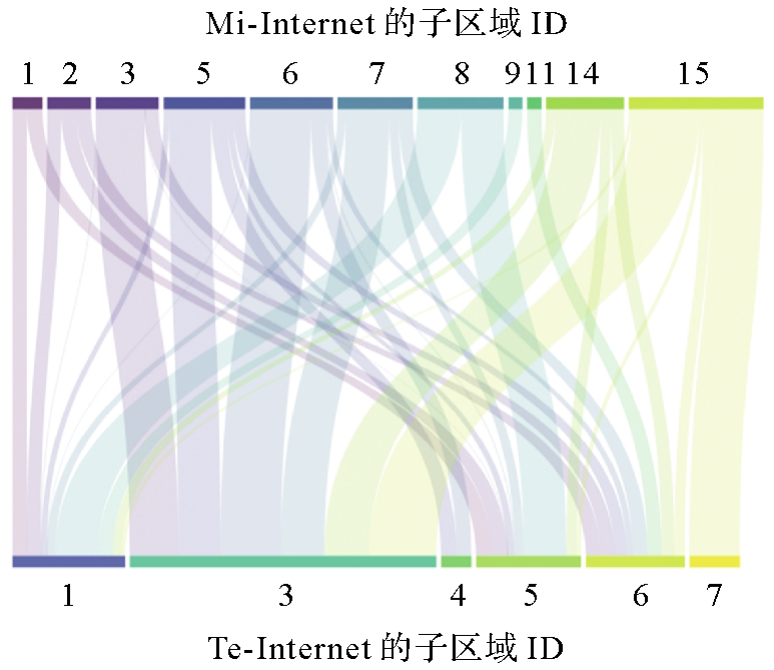
Fig. 12
Cross regional entropy calculations across cities"
Tab. 5
Generalization performance test results using subregion 2 of the Mi-Internet dataset as the source region"
| 源区域 | 目标区域 | 交叉区域熵 | 预测精度(MAE) |
|---|---|---|---|
| Mi-Internet的子区域2 | Te-Internet的子区域1 | 0.385 | 6.79 |
| Te-Internet的子区域5 | 0.400 | 11.77 | |
| Te-Internet的子区域4 | 0.408 | 17.60 | |
| Te-Internet的子区域7 | 0.489 | 28.78 | |
| Te-Internet的子区域3 | 0.574 | 47.61 |
Tab. 6
Generalization performance test results using subregion 5 of the Mi-Internet dataset as the source region"
| 源区域 | 目标区域 | 交叉区域熵 | 预测精度(MAE) |
|---|---|---|---|
| Mi-Internet的子区域5 | Te-Internet的子区域1 | 0.325 | 6.28 |
| Te-Internet的子区域5 | 0.331 | 11.30 | |
| Te-Internet的子区域4 | 0.398 | 17.61 | |
| Te-Internet的子区域7 | 0.515 | 30.37 | |
| Te-Internet的子区域3 | 0.602 | 46.54 |
Tab. 7
Generalization performance test results using subregion 2 of the Te-Internet dataset as the source region"
| 源区域 | 目标区域 | 交叉区域熵 | 预测精度(MAE) |
|---|---|---|---|
| Te-Internet的子区域2 | Mi-Internet的子区域12 | 0.442 | 15.71 |
| Mi-Internet的子区域11 | 0.449 | 69.50 | |
| Mi-Internet的子区域4 | 0.450 | 128.77 | |
| Mi-Internet的子区域13 | 0.453 | 169.16 | |
| Mi-Internet的子区域8 | 0.462 | 326.74 | |
| Mi-Internet的子区域6 | 0.519 | 525.57 |
Tab. 8
Generalization performance test results using subregion 5 of the Te-Internet dataset as the source region"
| 源区域 | 目标区域 | 交叉区域熵 | 预测精度(MAE) |
|---|---|---|---|
| Te-Internet的子区域5 | Mi-Internet的子区域3 | 0.281 | 88.04 |
| Mi-Internet的子区域9 | 0.402 | 147.81 | |
| Mi-Internet的子区域4 | 0.426 | 152.05 | |
| Mi-Internet的子区域16 | 0.482 | 159.23 | |
| Mi-Internet的子区域13 | 0.521 | 218.63 | |
| Mi-Internet的子区域3 | 0.606 | 421.04 |

Fig. 13
Cross regional entropy-MAE regression equation"

| [1] | 李龙飞, 虞吉海. 空间面板数据模型:基于空间计量的文献综述[J]. 经济管理学刊, 2024(1): 83-114. |
| LI Longfei, YU Jihai. Spatial panel data models: a survey[J]. Quarterly Journal of Economics and Management, 2024(1): 83-114. | |
| [2] | TAN Xiaoyong, DENG Min, CHEN Kaiqi, et al. A spatial hierarchical learning module based cellular automata model for simulating urban expansion: case studies of three Chinese urban areas[J]. GIScience & Remote Sensing, 2024, 61(1): 2290352. |
| [3] |
刘慧敏, 张陈为, 谌恺祺, 等. 基于深度学习的城市PM2.5浓度时空分布预测及不确定性评估[J]. 测绘学报, 2024, 53(4): 750-760. DOI: .
doi: 10.11947/j.AGCS.2024.20230071 |
|
LIU Huimin, ZHANG Chenwei, CHEN Kaiqi, et al. Deep learning-based spatio-temporal prediction and uncertainty assessment of urban PM2.5 distribution[J]. Acta Geodaetica et Cartographica Sinica, 2024, 53(4): 750-760. DOI: .
doi: 10.11947/j.AGCS.2024.20230071 |
|
| [4] | CHEN Kaiqi, LIU Enbo, DENG Min, et al. DKNN: deep Kriging neural network for interpretable geospatial interpolation[J]. International Journal of Geographical Information Science, 2024, 38(8): 1486-1530. |
| [5] | DENG Min, CHEN Kaiqi, LEI Kaiyuan, et al. MVCV-Traffic: multiview road traffic state estimation via cross-view learning[J]. International Journal of Geographical Information Science, 2023, 37(10): 2205-2237. |
| [6] | XIE Yiqun, JIA Xiaowei, BAO Han, et al. Spatial-Net: a self-adaptive and model-agnostic deep learning framework for spatially heterogeneous datasets[C]//Proceedings of the 29th International Conference on Advances in Geographic Information Systems. Beijing: ACM Press, 2021: 313-323. |
| [7] | LI Xia, LIU Yilun, LIU Xiaoping, et al. Knowledge transfer and adaptation for land-use simulation with a logistic cellular automaton[J]. International Journal of Geographical Information Science, 2013, 27(10): 1829-1848. |
| [8] | XU Lei, CHEN Nengcheng, CHEN Zeqiang, et al. Spatiotemporal forecasting in earth system science: methods, uncertainties, predictability and future directions[J]. Earth-Science Reviews, 2021, 222: 103828. |
| [9] | RICHMAN J S, MOORMAN J R. Physiological time-series analysis using approximate entropy and sample entropy[J]. American Journal of Physiology Heart and Circulatory Physiology, 2000, 278(6): H2039-H2049. |
| [10] | KOSKO B. Fuzzy entropy and conditioning[J]. Information Sciences, 1986, 40(2): 165-174. |
| [11] | ZHOU Xuan, ZHAO Zhifeng, LI Rongpeng, et al. The predictability of cellular networks traffic[C]//Proceedings of 2012 International Symposium on Communications and Information Technologies. Gold Coast: IEEE, 2012: 973-978. |
| [12] | SONG Chaoming, QU Zehui, BLUMM N, et al. Limits of predictability in human mobility[J]. Science, 2010, 327(5968): 1018-1021. |
| [13] | DIVILOV S, ECKERT H, HICKS D, et al. Disordered enthalpy-entropy descriptor for high-entropy ceramics discovery[J]. Nature, 2024, 625(7993): 66-73. |
| [14] | WU Jingyou. An information fractal dimensional relative entropy[J]. AIP Advances, 2024, 14(2): 025249. |
| [15] | YE Xiaojiang, TANG Yanjie, MA Dongkui. Correlation entropy of free semigroup actions[J]. Journal of Statistical Physics, 2024, 191(10): 122. |
| [16] | LI Zhenpeng, YAN Zhihua, YANG Jian, et al. The structure entropy of social networks[J]. Journal of Systems Science and Complexity, 2024, 37(3): 1147-1162. |
| [17] | TAYLOR K E, STOUFFER R J, MEEHL G A. An overview of CMIP5 and the experiment design[J]. Bulletin of the American Meteorological Society, 2012, 93(4): 485-498. |
| [18] | KIRTMAN B P, MIN D, INFANTI J M, et al. The North American multimodel ensemble: phase-1 seasonal-to-interannual prediction; phase-2 toward developing intraseasonal prediction[J]. Bulletin of the American Meteorological Society, 2014, 95(4): 585-601. |
| [19] | VITART F, ARDILOUZE C, BONET A, et al. The subseasonal to seasonal (S2S) prediction project database[J]. Bulletin of the American Meteorological Society, 2017, 98(1): 163-173. |
| [20] | CHEN Kaiqi, CHU Guowei, LEI Kaiyuan, et al. A multiview representation learning framework for large-scale urban road networks[J]. Applied Sciences, 2022, 12(13): 6301. |
| [21] | 刘瑜, 汪珂丽, 邢潇月, 等. 地理分析中的空间效应[J]. 地理学报, 2023, 78(3): 517-531. |
| LIU Yu, WANG Keli, XING Xiaoyue, et al. On spatial effects in geographical analysis[J]. Acta Geographica Sinica, 2023, 78(3): 517-531. | |
| [22] | DIOGO V, BÜRGI M, DEBONNE N, et al. Geographic similarity analysis for land system science: opportunities and tools to facilitate knowledge integration and transfer[J]. Journal of Land Use Science, 2023, 18(1): 227-248. |
| [23] | CHEN Kaiqi, DENG Min, SHI Yan. A temporal directed graph convolution network for traffic forecasting using taxi trajectory data[J]. ISPRS International Journal of Geo-Information, 2021, 10(9): 624. |
| [24] | 刘恩博, 谌恺祺, 石岩, 等. 数据不确定性下的犯罪事件热点探测方法[J]. 武汉大学学报(信息科学版), 2024, 49(12): 2342-2354. |
| LIU Enbo, CHEN Kaiqi, SHI Yan, et al. A hot spot detection method of criminal events under data uncertainty[J]. Geomatics and Information Science of Wuhan University, 2024, 49(12): 2342-2354. | |
| [25] | ZHUANG Fuzhen, QI Zhiyuan, DUAN Keyu, et al. A comprehensive survey on transfer learning[J]. Proceedings of the IEEE, 2021, 109(1): 43-76. |
| [26] | TOBLER W R. A computer movie simulating urban growth in the Detroit region[J]. Economic Geography, 1970, 46: 234-240. |
| [27] | SCHREIBER T. Measuring information transfer[J]. Physical Review Letters, 2000, 85(2): 461-464. |
| [28] | VICENTE R, WIBRAL M, LINDNER M, et al. Transfer entropy: a model-free measure of effective connectivity for the neurosciences[J]. Journal of Computational Neuroscience, 2011, 30(1): 45-67. |
| [29] | MAO Xuegeng, SHANG Pengjian. Transfer entropy between multivariate time series[J]. Communications in Nonlinear Science and Numerical Simulation, 2017, 47: 338-347. |
| [30] | LEE J, NEMATI S, SILVA I, et al. Transfer entropy estimation and directional coupling change detection in biomedical time series[J]. BioMedical Engineering OnLine, 2012, 11(1): 19. |
| [31] | WANG Jinfeng, ZHANG Tonglin, FU Bojie. A measure of spatial stratified heterogeneity[J]. Ecological Indicators, 2016, 67: 250-256. |
| [32] | 朱阿兴, 闾国年, 周成虎, 等. 地理相似性:地理学的第三定律?[J]. 地球信息科学学报, 2020, 22(4): 673-679. |
| ZHU Axing, LÜ Guonian, ZHOU Chenghu, et al. Geographic similarity: third law of geography?[J]. Journal of Geo-information Science, 2020, 22(4): 673-679. | |
| [33] | KINGMA D P, BA J. Adam: a method for stochastic optimization[EB/OL]. [2024-10-10]. https://arxiv.org/abs/1412.6980. |
| [34] | 王劲峰, 徐成东. 地理探测器:原理与展望[J]. 地理学报, 2017, 72(1): 116-134. |
| WANG Jinfeng, XU Chengdong. Geodetector: principle and prospective[J]. Acta Geographica Sinica, 2017, 72(1): 116-134. | |
| [35] | WANG Jinfeng, HAINING R, ZHANG Tonglin, et al. Statistical modeling of spatially stratified heterogeneous data[J]. Annals of the American Association of Geographers, 2024, 114(3): 499-519. |
| [1] | Qingyun YAN, Zixuan GUO, Yuanjin PAN, Yan JIA, Shuanggen JIN. Quantitative driving factors and zoning patterns of GNSS-R land surface reflectivity spatial heterogeneity [J]. Acta Geodaetica et Cartographica Sinica, 2026, 55(2): 315-327. |
| [2] | Qiqian SUN, Shuaidong JIA, Zhicheng LIANG, Xianpeng LIU, Haoshi SONG. A method for constructing digital depth model of strait passage considering crowdsourced bathymetric data characteristics [J]. Acta Geodaetica et Cartographica Sinica, 2026, 55(1): 90-100. |
| [3] | Jun YANG, Hengjing XIE, Hongchao FAN, Haowen YAN. Multi-scale entropy neural architecture search for object detection in remote sensing images [J]. Acta Geodaetica et Cartographica Sinica, 2024, 53(7): 1384-1400. |
| [4] | Yating LIU, Chuanfa CHEN. Landslide susceptibility evaluation method considering spatial heterogeneity and feature selection [J]. Acta Geodaetica et Cartographica Sinica, 2024, 53(7): 1417-1428. |
| [5] | Jinqi ZHAO, Yuxuan LI, Zirong LIU, Qing AN, Shiyu SONG, Yufen NIU. Flood change detection method using optimized similarity measurement function with temporal-spatial-polarized SAR information [J]. Acta Geodaetica et Cartographica Sinica, 2024, 53(12): 2375-2390. |
| [6] | PI Xinyu, ZENG Yongnian, WANG Pancheng. Spatially enhanced spatio-temporal fusion model for heterogeneity regions [J]. Acta Geodaetica et Cartographica Sinica, 2023, 52(10): 1714-1723. |
| [7] | CHENG Jiehai, HUANG Zhongyi, WANG Jianru, HE Shi. The automatic determination method of the optimal segmentation result of high-spatial resolution remote sensing image [J]. Acta Geodaetica et Cartographica Sinica, 2022, 51(5): 658-667. |
| [8] | ZHANG Hong, WU Zhiwei, WANG Jicheng, GAO Peichao. Unsupervised band selection for hyperspectral image classification using the Wasserstein metric-based configuration entropy [J]. Acta Geodaetica et Cartographica Sinica, 2021, 50(3): 405-415. |
| [9] | WANG Xu, CHAI Hongzhou, WANG Chang, CHONG Yang. A wavelet neural network for optimal wavelet function to predict GPS satellite clock bias [J]. Acta Geodaetica et Cartographica Sinica, 2020, 49(8): 983-992. |
| [10] | SHANG Daiyu, DING Yulin, ZHU Qing, WU Linbao. A multi-resolution texture-based visualization method for geographic vector fields by means of spatial variation features [J]. Acta Geodaetica et Cartographica Sinica, 2020, 49(5): 656-666. |
| [11] | XIAO Jia, TIAN Qin, HE Zongyi. Relative exponential entropy model on classification evaluation of geographic information data [J]. Acta Geodaetica et Cartographica Sinica, 2020, 49(11): 1497-1505. |
| [12] | QIN Yikun, WANG Zegen, FAN Dongming. The joint inversion of regional water reserve changes in the Qinghai-Tibet Plateau based on GRACE RL06 and TRMM data [J]. Acta Geodaetica et Cartographica Sinica, 2020, 49(10): 1285-1294. |
| [13] | SHI Chunlin, ZHANG Chao, CHEN Changyuan, DU Lan, YE Kai, HAN Zhong. One-dimensional Maximum Entropy Image Segmentation Algorithm Based on the Small Field of View of Measuring Robot Star Map [J]. Acta Geodaetica et Cartographica Sinica, 2018, 47(4): 446-454. |
| [14] | YUE Chunyu, XING Kun, BAO Yunfei, ZHOU Nan, HE Hongyan. A Matching Method of Space-borne Laser Altimeter Big Footprint Waveform and Terrain Based on Cross Cumulative Residual Entropy [J]. Acta Geodaetica et Cartographica Sinica, 2017, 46(3): 346-352. |
| [15] | CHENG Xiaoqiang, YANG Min, GUI Zhipeng, AI Tinghua, WU Huayi. An Algorithm Creating Thumbnail for Web Map Services Based on Information Entropy and Trans-scale Similarity [J]. Acta Geodaetica et Cartographica Sinica, 2017, 46(11): 1891-1898. |
| Viewed | ||||||
|
Full text |
|
|||||
|
Abstract |
|
|||||
