

Acta Geodaetica et Cartographica Sinica ›› 2026, Vol. 55 ›› Issue (10): 1797-1813.doi: 10.11947/j.AGCS.2026.20260157
• Marine Surveying and Mapping • Previous Articles Next Articles
Shunshuang Xu1( ), Jinwei Bu1,2()
Received:2026-04-27
Revised:2026-09-17
Online:2026-11-16
Published:2026-11-16
Contact:
Jinwei Bu
E-mail:202410109130@stu.kust.edu.cn;b_jinwei@kust.edu.cn
About author:Xu Shunshuang (2006—), female, majors in GNSS reflectometry remote sensing. E-mail: 202410109130@stu.kust.edu.cn
Supported by:CLC Number:
Shunshuang Xu, Jinwei Bu. Global coastal wave period estimation of spaceborne full polarization GNSS-R[J]. Acta Geodaetica et Cartographica Sinica, 2026, 55(10): 1797-1813.
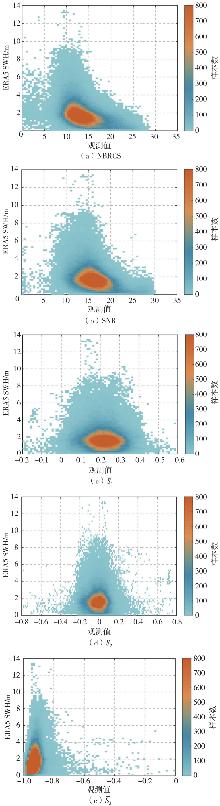
Fig. 1
Sensitivity analysis of SMAP-R observations and ERA5 SWH"
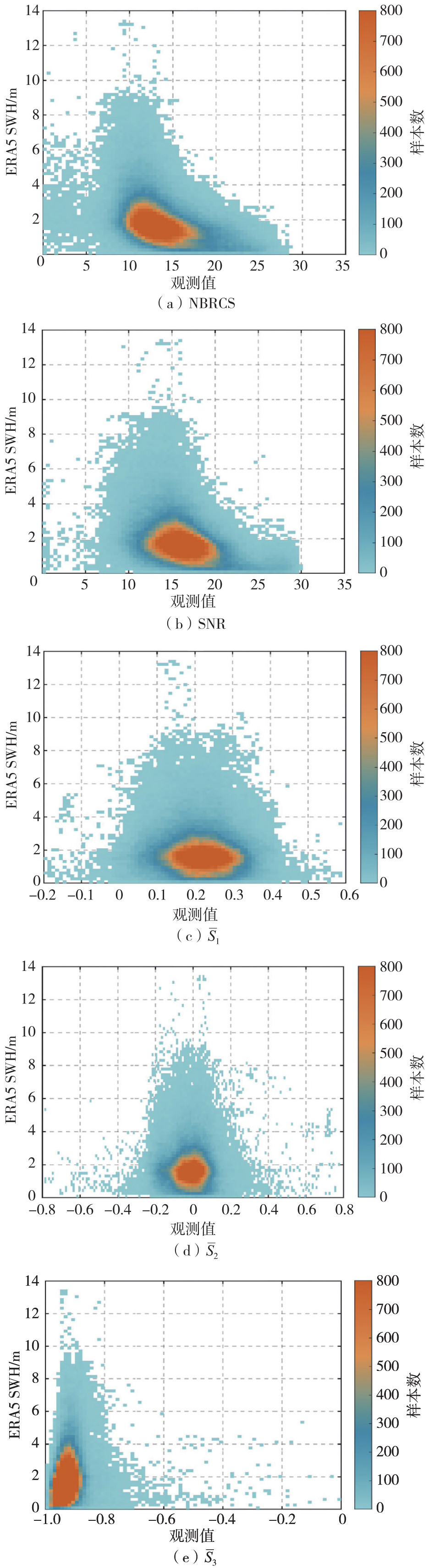
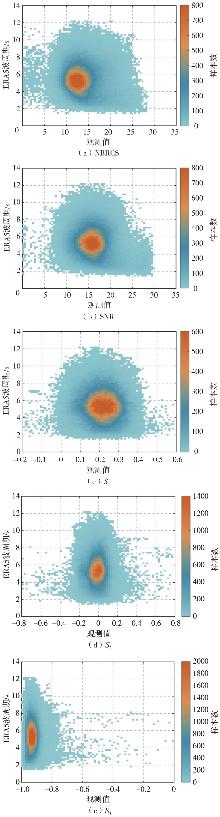
Fig. 2
Sensitivity analysis of SMAP-R observations and ERA5 spectral peak period"
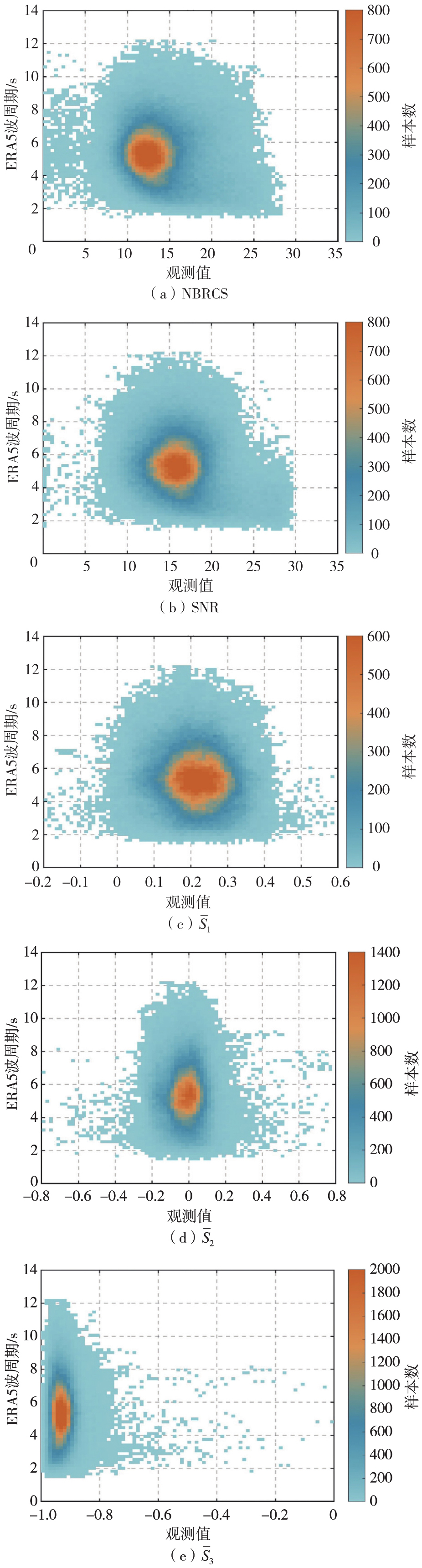
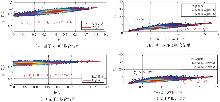
Fig. 3
Power function fitting results based on NBRCS and"

Tab. 1
Results of ablation test"
| Case | 输入参数 | RMSE/s | Bias/s | CC | IR/(%) |
|---|---|---|---|---|---|
| 1 | NBRCS | 3.103 | 0.015 | 0.12 | - |
| 2 |  | 3.112 | 0.014 | 0.10 | - |
| 3 |  | 3.119 | 0.014 | 0.07 | - |
| 4 |  | 3.123 | 0.014 | 0.05 | - |
| 5 |  | 3.062 | 0.013 | 0.21 | - |
| 6 | SWH+NBRCS | 2.627 | 0.026 | 0.54 | - |
| 7 |  | 2.706 | 0.019 | 0.50 | - |
| 8 |  | 2.712 | 0.017 | 0.50 | - |
| 9 |  | 2.650 | 0.017 | 0.53 | - |
| 10 |  | 2.559 | 0.020 | 0.57 | - |
| 11 | 基础输入+SWH+NBRCS | 1.879 | 0.016 | 0.80 | - |
| 12 |  | 1.852 | 0.016 | 0.81 | - |
| 13 |  | 1.845 | 0.016 | 0.81 | - |
| 14 |  | 1.867 | 0.017 | 0.80 | - |
| 15 |  | 1.823 | 0.017 | 0.81 | - |
| 16 |  | 1.855 | 0.021 | 0.81 | - |
| 17 |  | 1.832 | 0.018 | 0.81 | - |
| 18 |  | 1.820 | 0.019 | 0.81 | - |
| 19 | 基础输入+NBRCS | 1.914 | 0.011 | 0.79 | - |
| 20 |  | 1.880 | 0.009 | 0.80 | 1.78 |
| 21 |  | 1.868 | 0.005 | 0.80 | 2.40 |
| 22 |  | 1.903 | 0.010 | 0.79 | 0.57 |
| 23 |  | 1.853 | 0.007 | 0.81 | 3.19 |
| 24 |  | 1.882 | 0.012 | 0.80 | 1.67 |
| 25 |  | 1.854 | 0.006 | 0.81 | 3.13 |
| 26 |  | 1.845 | 0.007 | 0.81 | 3.61 |
Tab. 2
Statistical characteristics of SMAP-R variables"
| 变量 | 平均值 | 标准差 | 偏度 | 峰值 | 变异系数 | 熵 |
|---|---|---|---|---|---|---|
| NBRCS | 11.641 | 5.041 | -0.067 | 2.982 | 0.433 | 6.637 |
 | 0.299 | 0.133 | 0.335 | 3.503 | 0.444 | 6.733 |
 | 0.053 | 0.151 | 0.446 | 4.801 | 2.839 | 6.885 |
 | -0.852 | 0.106 | 4.508 | 50.945 | 0.124 | 6.675 |
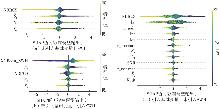
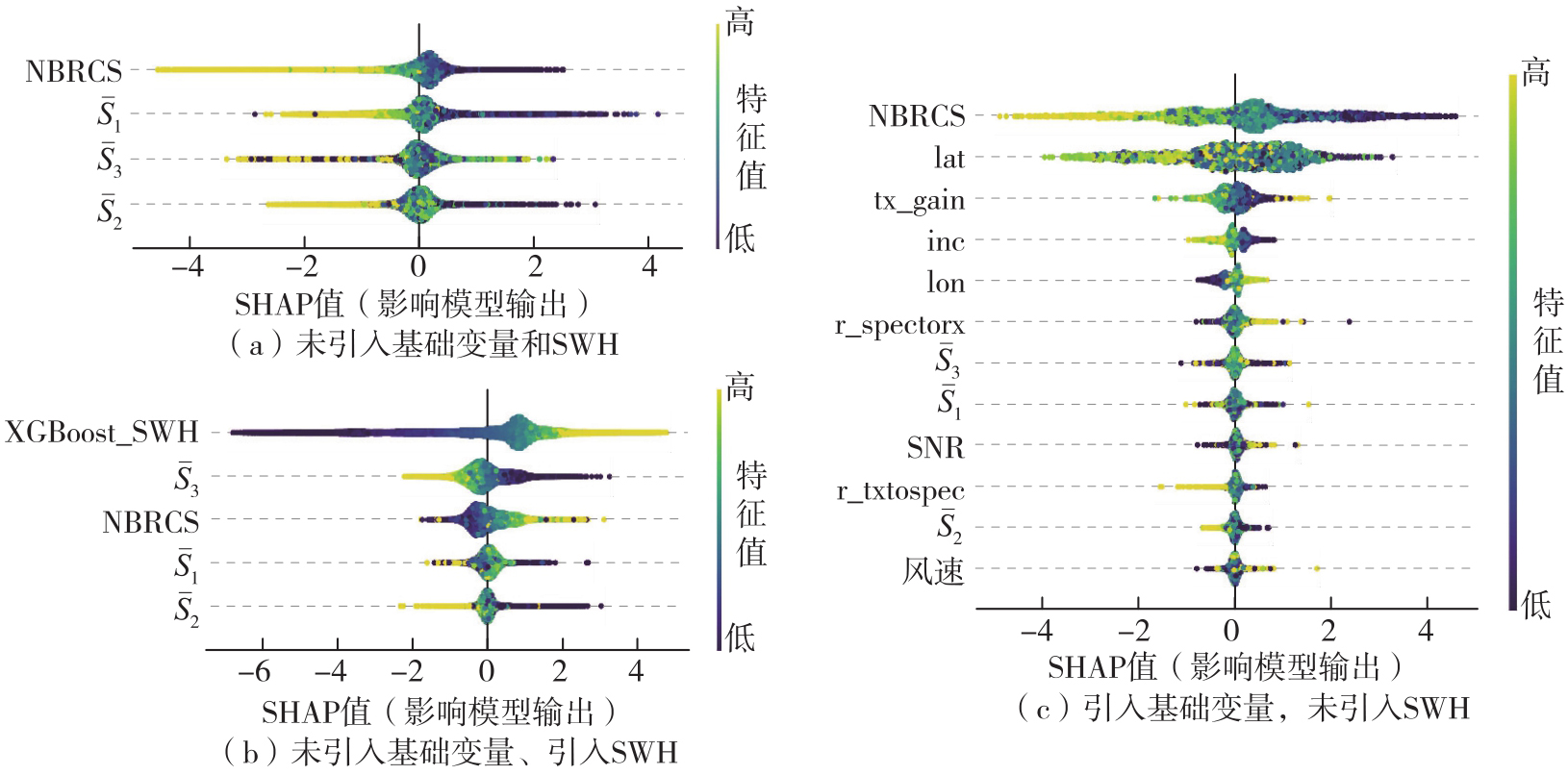
Fig. 4
SHAP analysis based on a single observation value"
Tab. 3
Statistical analysis of the impact of SWH from different sources on the retrieval results of the model"
| 模型 | SMAP-R估计的SWH | 没有SWH输入 | WW3 SWH(异源) | ||||||
|---|---|---|---|---|---|---|---|---|---|
| RMSE/s | CC | Bias/s | RMSE/s | CC | Bias/s | RMSE/s | CC | Bias/s | |
| Bagging | 1.910 | 0.79 | 0.018 | 1.790 | 0.82 | 0.009 | 1.585 | 0.86 | 0.003 |
| DT | 2.128 | 0.74 | 0.020 | 2.000 | 0.77 | 0.009 | 1.876 | 0.79 | 0.005 |
| XGBoost | 1.820 | 0.81 | 0.019 | 1.845 | 0.81 | 0.007 | 1.607 | 0.85 | -0.001 |
| RF | 1.911 | 0.79 | 0.017 | 1.790 | 0.82 | 0.009 | 1.585 | 0.86 | 0.002 |
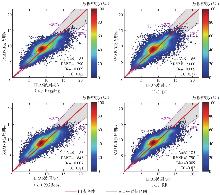
Fig. 5
Scatter density plot of estimated values based on fused data and ERA5 spectral peak period"

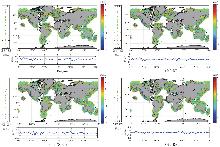
Fig. 6
Deviation between estimated values based on fused data and ERA5 spectral peak period"

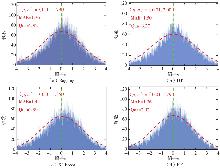
Fig. 7
Estimated values based on fused data and ERA5 spectral peak period histogram"

Tab. 4
Statistics of multiple dataset results based on ERA5 spectral peak period for various models"
| 模型 | 升轨 | 降轨 | 升轨+降轨 | ||||||
|---|---|---|---|---|---|---|---|---|---|
| RMSE/s | CC | Bias/s | RMSE/s | CC | Bias/s | RMSE/s | CC | Bias/s | |
| Bagging | 1.860 | 0.80 | 0.033 | 1.694 | 0.84 | 0.020 | 1.790 | 0.82 | 0.009 |
| DT | 2.009 | 0.76 | 0.021 | 1.957 | 0.77 | 0.018 | 2.000 | 0.77 | 0.009 |
| XGBoost | 1.841 | 0.80 | 0.038 | 1.788 | 0.81 | 0.022 | 1.845 | 0.81 | 0.007 |
| RF | 1.860 | 0.80 | 0.032 | 1.694 | 0.84 | 0.021 | 1.790 | 0.82 | 0.009 |
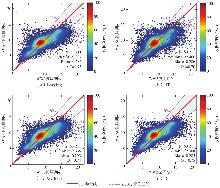
Fig. 8
Scatter density plot of estimated values based on fused data and WW3 spectral peak period"

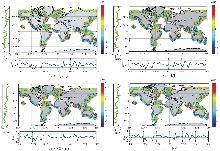
Fig. 9
Deviation between estimated values based on fused data and WW3 spectral peak period"

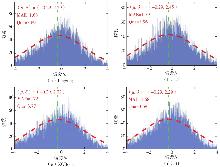
Fig. 10
Estimated values between estimated values based on fused data and WW3 spectral peak period"

Tab. 5
Statistics of multiple dataset results based on WW3 spectral peak period for various models"
| 模型 | 升轨 | 降轨 | 升轨+降轨 | ||||||
|---|---|---|---|---|---|---|---|---|---|
| RMSE/s | CC | Bias/s | RMSE/s | CC | Bias/s | RMSE/s | CC | Bias/s | |
| Bagging | 2.233 | 0.74 | -0.099 | 2.285 | 0.75 | -0.325 | 2.307 | 0.75 | -0.286 |
| DT | 2.348 | 0.70 | -0.113 | 2.488 | 0.69 | -0.328 | 2.466 | 0.70 | -0.286 |
| XGBoost | 2.195 | 0.75 | -0.118 | 2.337 | 0.74 | -0.331 | 2.336 | 0.74 | -0.293 |
| RF | 2.234 | 0.74 | -0.099 | 2.286 | 0.75 | -0.325 | 2.308 | 0.75 | -0.285 |
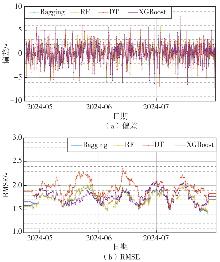
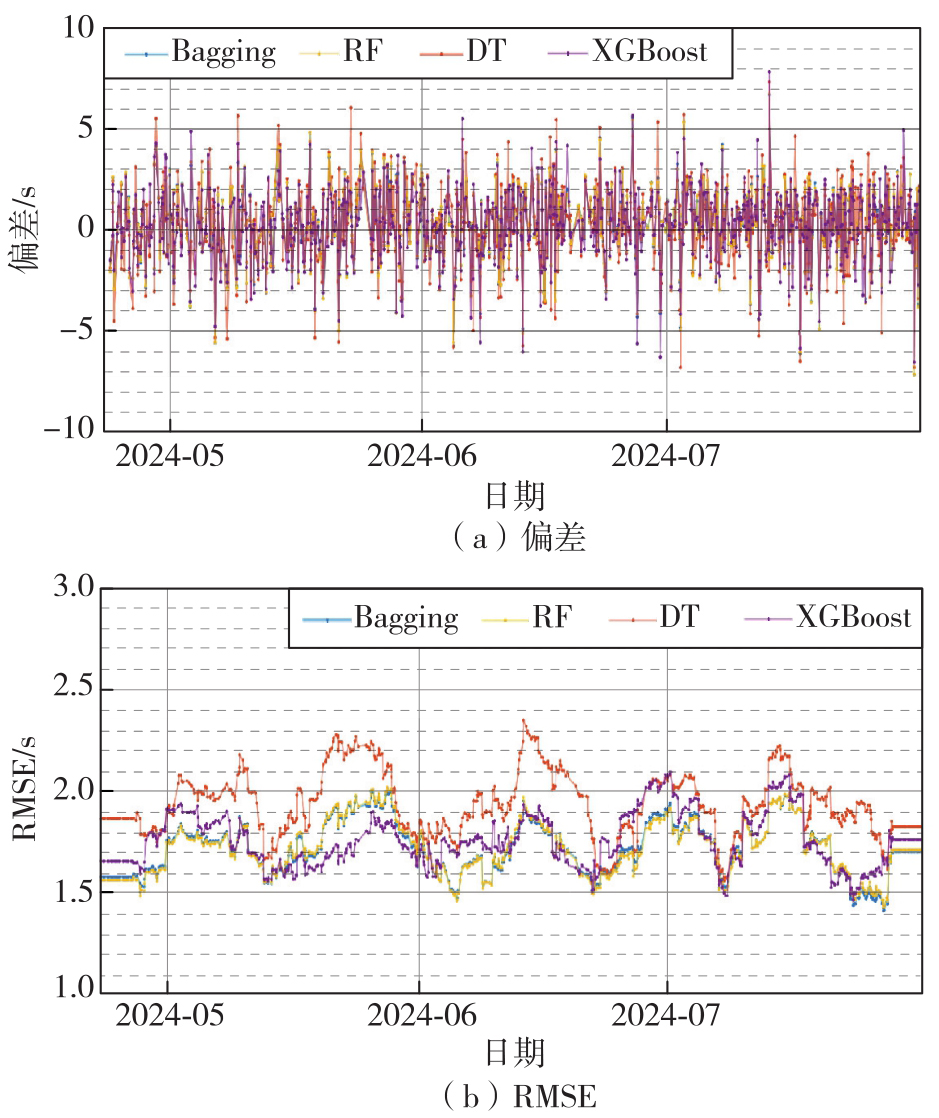
Fig. 11
Comparison of daily Bias and RMSE of model inverted wave period on SMAP-R upward and downward orbit dataset"
Tab. 6
Results of retrieval performance in different regions"
| 海域 | Bagging | DT | XGBoost | RF | ||||
|---|---|---|---|---|---|---|---|---|
| RMSE/s | CC | RMSE/s | CC | RMSE/s | CC | RMSE/s | CC | |
| 太平洋 | 1.819 | 0.82 | 2.039 | 0.76 | 1.872 | 0.81 | 1.820 | 0.82 |
| 大西洋 | 1.622 | 0.88 | 1.790 | 0.84 | 1.705 | 0.86 | 1.612 | 0.88 |
| 印度洋 | 1.768 | 0.82 | 2.031 | 0.75 | 1.839 | 0.80 | 1.764 | 0.82 |
| 南大洋 | 1.779 | 0.82 | 2.000 | 0.76 | 1.840 | 0.80 | 1.779 | 0.82 |
| 北冰洋 | 1.736 | 0.85 | 1.947 | 0.80 | 1.770 | 0.84 | 1.732 | 0.85 |
| [1] |
布金伟, 余科根, 汪秋兰, 等. 融合星载GNSS-R数据和多变量参数全球海洋有效波高深度学习反演法[J]. 测绘学报, 2024, 53(7): 1321-1335. DOI .
doi: 10.11947/j.AGCS.2024.20230050 |
|
Bu Jinwei, Yu Kegen, Wang Qiulan, et al. Deep learning retrieval method for global ocean significant wave height by integrating spaceborne GNSS-R data and multivariable parameters[J]. Acta Geodaetica et Cartographica Sinica, 2024, 53(7): 1321-1335. DOI .
doi: 10.11947/j.AGCS.2024.20230050 |
|
| [2] | Liang Bingchen, Shao Zhuxiao, Wu Guoxiang, et al. New equations of wave energy assessment accounting for the water depth[J]. Applied Energy, 2017, 188: 130-139. |
| [3] | Bu Jinwei, Liu Xinyu, Wang Qiulan, et al. Ocean remote sensing using spaceborne GNSS-reflectometry: a review[J]. IEEE Journal of Selected Topics in Applied Earth Observations and Remote Sensing, 2024, 17: 13047-13076. |
| [4] | Qiao Xin, Huang Weimin. WaveTransNet: a transformer-based network for global significant wave height retrieval from spaceborne GNSS-R data[J]. IEEE Transactions on Geoscience and Remote Sensing, 2024, 62: 4208011. |
| [5] | Bu Jinwei, Wang Qiulan, Ni Jun. Estimating sea surface swell height using a hybrid model combining CNN, ConvLSTM, and FCN based on spaceborne GNSS-R data from the CYGNSS mission[J]. GPS Solutions, 2024, 28(3): 133. |
| [6] | Perez-Portero A, Rodriguez-Alvarez N, Munoz-Martin J F, et al. Estimating backward scattering using GNSS-reflectometry measurements for soil moisture retrieval[J]. IEEE Access, 2024, 12: 73608-73619. |
| [7] | Rodriguez-Alvarez N, Munoz-Martin J F, Bosch-Lluis X, et al. The first polarimetric GNSS-Reflectometer instrument in space improves the SMAP mission's sensitivity over densely vegetated areas[J]. Scientific Reports, 2023, 13: 3722. |
| [8] | Rodriguez-Alvarez N, Munoz-Martin J F, Bosch-Lluis X, et al. Full polarimetric GNSS-R assessment of the freeze and thaw states of the terrestrial cryosphere[J]. IEEE Transactions on Geoscience and Remote Sensing, 2024, 62: 4301711. |
| [9] | 宋春艳, 刘攀, 王远坤, 等. 基于Copula函数的波浪周期-波高联合分布研究[J]. 太阳能学报, 2022, 43(4): 375-379. |
| Song Chunyan, Liu Pan, Wang Yuankun, et al. Joint distribution of wave period and height based on copula function[J]. Acta Energiae Solaris Sinica, 2022, 43(4): 375-379. | |
| [10] | 刘含, 王素悦, 张清河, 等. 融合随机森林与线性回归的相干X波段雷达平均波周期反演[J]. 遥感学报, 2026, 30(1): 132-143. |
| Liu Han, Wang Suyue, Zhang Qinghe, et al. Fusion of random forest and linear regression for mean wave period retrieval using coherent X-band radar[J]. National Remote Sensing Bulletin, 2026, 30(1): 132-143. | |
| [11] | Gambarelli L, Pasta E, Cecioni C, et al. On the inference of the peak wave period using satellite altimetry measurements[C]//Proceedings of 2025 IEEE International Workshop on Metrology for the Sea; Learning to Measure Sea Health Parameters. Genoa: IEEE, 2025: 12-17. |
| [12] | Wang Xiaolei, He Xiufeng, Shi Jian, et al. Estimating sea level, wind direction, significant wave height, and wave peak period using a geodetic GNSS receiver[J]. Remote Sensing of Environment, 2022, 279: 113135. |
| [13] | Maheshwari M, Chakraborty A, Kumar A, et al. Investigation of the relationship of CYGNSS observables with ocean wave parameters[C]//Proceedings of 2021 IEEE International India Geoscience and Remote Sensing Symposium. Ahmedabad: IEEE, 2021: 102-106. |
| [14] | Bu Jinwei, Yu Kegen, Ni Jun, et al. Combining ERA5 data and CYGNSS observations for the joint retrieval of global significant wave height of ocean swell and wind wave: a deep convolutional neural network approach[J]. Journal of Geodesy, 2023, 97(8): 81. |
| [15] | Munoz-Martin J F, Rodriguez-Alvarez N, Bosch-Lluis X, et al. Stokes parameters retrieval and calibration of hybrid compact polarimetric GNSS-R signals[J]. IEEE Transactions on Geoscience and Remote Sensing, 2022, 60: 5113911. |
| [16] | Bosch-Lluis X, Rodriguez-Alvarez N, Oudrhiri K. Full polarimetric GNSS-R sensitivity assessment of ocean roughness[J]. IEEE Transactions on Geoscience and Remote Sensing, 2025, 63: 1001107. |
| [17] | Huang Feixiong, Garrison J L, Leidner S M, et al. A forward model for data assimilation of GNSS ocean reflectometry delay-Doppler maps[J]. IEEE Transactions on Geoscience and Remote Sensing, 2021, 59(3): 2643-2656. |
| [18] | Chen-Zhang D D, Ruf C S, Ardhuin F, et al. GNSS-R nonlocal sea state dependencies: model and empirical verification[J]. Journal of Geophysical Research: Oceans, 2016, 121(11): 8379-8394. |
| [19] | Sarkar A, Kumar R, Mohan M. Estimation of ocean wave periods by spaceborne altimeters[J]. Indian Journal of Marine Sciences, 1998, 27(1): 43-45. |
| [20] | Gommenginger C P, Srokosz M A, Challenor P G, et al. Measuring ocean wave period with satellite altimeters: a simple empirical model[J]. Geophysical Research Letters, 2003, 30(22): 2150. |
| [21] | Bu Jinwei, Liu Shuhui, Xu Shunshuang, et al. A preliminary assessment of ocean wave parameter retrieval and wave energy estimation using spaceborne BDS-R data[J]. Ocean Engineering, 2026, 355: 124886. |
| [22] |
布金伟, 刘淑慧, 徐顺双, 等. 星载GNSS-R全球海浪波周期估计的经验模型构建[J]. 测绘学报, 2026, 55(4): 684-697. DOI .
doi: 10.11947/j.AGCS.2026.20250239 |
|
Bu Jinwei, Liu Shuhui, Xu Shunshuang, et al. Construction of an empirical model for estimating the global wave period of spaceborne GNSS-R[J]. Acta Geodaetica et Cartographica Sinica, 2026, 55(4): 684-697. DOI .
doi: 10.11947/j.AGCS.2026.20250239 |
|
| [23] | NASA. SMAP handbook: soil moisture active passive: mapping soil moisture and freeze/thaw from space[R]. Pasadena: Jet Propulsion Laboratory, 2014: 180. |
| [24] | Carreno-Luengo H, Lowe S, Zuffada C, et al. Spaceborne GNSS-R from the SMAP mission: first assessment of polarimetric scatterometry over land and cryosphere[J]. Remote Sensing, 2017, 9(4): 362. |
| [25] | Liu Xinyu, Bu Jinwei, Zuo Xiaoqing, et al. Performance validation of sea surface wind speed retrieval algorithms and products from the Chinese Tianmu-1 constellation GNSS-R: first results on comparison with other wind speed products[J]. IEEE Journal of Selected Topics in Applied Earth Observations and Remote Sensing, 2025, 18: 5189-5203. |
| [26] | Pang Xiaoping, Pu Jian, Zhao Xi, et al. Comparison between AMSR2 sea ice concentration products and pseudo-ship observations of the Arctic and Antarctic Sea ice edge on cloud-free days[J]. Remote Sensing, 2018, 10(2): 317. |
| [27] | Breiman L. Bagging predictors[J]. Machine Learning, 1996, 24(2): 123-140. |
| [28] | Wang Changyang, Yu Kegen, Qu Fangyu, et al. Spaceborne GNSS-R wind speed retrieval using machine learning methods[J]. Remote Sensing, 2022, 14(14): 3507. |
| [29] | MacKay E B L, Retzler C H, Challenor P G, et al. A parametric model for ocean wave period from Ku band altimeter data[J]. Journal of Geophysical Research: Oceans, 2008, 113(C3): 2007JC004438. |
| [1] | Zhanjun He, Yina Hu, Wantong Meng. A spatial prediction method for street crimes by integrating causal discovery [J]. Acta Geodaetica et Cartographica Sinica, 2026, 55(9): 1641-1652. |
| [2] | Cheng Zhang, Bao Zhang, Yibin Yao, Chengchang Zhu. GNSS-based terrestrial water storage inversion using physics-informed neural networks [J]. Acta Geodaetica et Cartographica Sinica, 2026, 55(7): 1141-1157. |
| [3] | Haopeng FAN, Bojiao ZHANG, Zhongmiao SUN, Jinkai FENG. Prediction method of regional tropospheric wet delay based on Conv-LSTM network [J]. Acta Geodaetica et Cartographica Sinica, 2025, 54(5): 795-804. |
| [4] | DU Jiawei, WU Fang, ZHU Li, LIU Chengyi, WANG Andong. An ensemble learning simplification approach based on multiple machine-learning algorithms with the fusion using of raster and vector data and a use case of coastline simplification [J]. Acta Geodaetica et Cartographica Sinica, 2022, 51(3): 373-387. |
| [5] | WANG Chenhui, ZHAO Yijiu, GUO Wei, MENG Qingjia, LI Bin. Displacement prediction model of landslide based on ensemble empirical mode decomposition and support vector regression [J]. Acta Geodaetica et Cartographica Sinica, 2022, 51(10): 2196-2204. |
| [6] | XIAO Xiangwen, SHEN Xiaoyi, KE Changqing, ZHOU Xinghua. Comparison of machine learning algorithms based on Sentinel-1A data to detect icebergs [J]. Acta Geodaetica et Cartographica Sinica, 2020, 49(4): 509-521. |
| Viewed | ||||||
|
Full text |
|
|||||
|
Abstract |
|
|||||
