

Acta Geodaetica et Cartographica Sinica ›› 2026, Vol. 55 ›› Issue (9): 1641-1652.doi: 10.11947/j.AGCS.2026.20260124
• Cartography and Geographic Information • Previous Articles Next Articles
Zhanjun He( ), Yina Hu(), Wantong Meng
Received:2026-04-03
Revised:2026-08-24
Online:2026-10-28
Published:2026-10-28
Contact:
Yina Hu
E-mail:hezj@cug.edu.cn;yinahu@cug.edu.cn
About author:He Zhanjun (1987—), male, PhD, professor, majors in spatio-temporal data mining. E-mail: hezj@cug.edu.cn
Supported by:CLC Number:
Zhanjun He, Yina Hu, Wantong Meng. A spatial prediction method for street crimes by integrating causal discovery[J]. Acta Geodaetica et Cartographica Sinica, 2026, 55(9): 1641-1652.
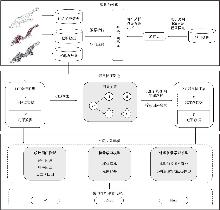
Fig. 1
Workflow of the proposed methodology"
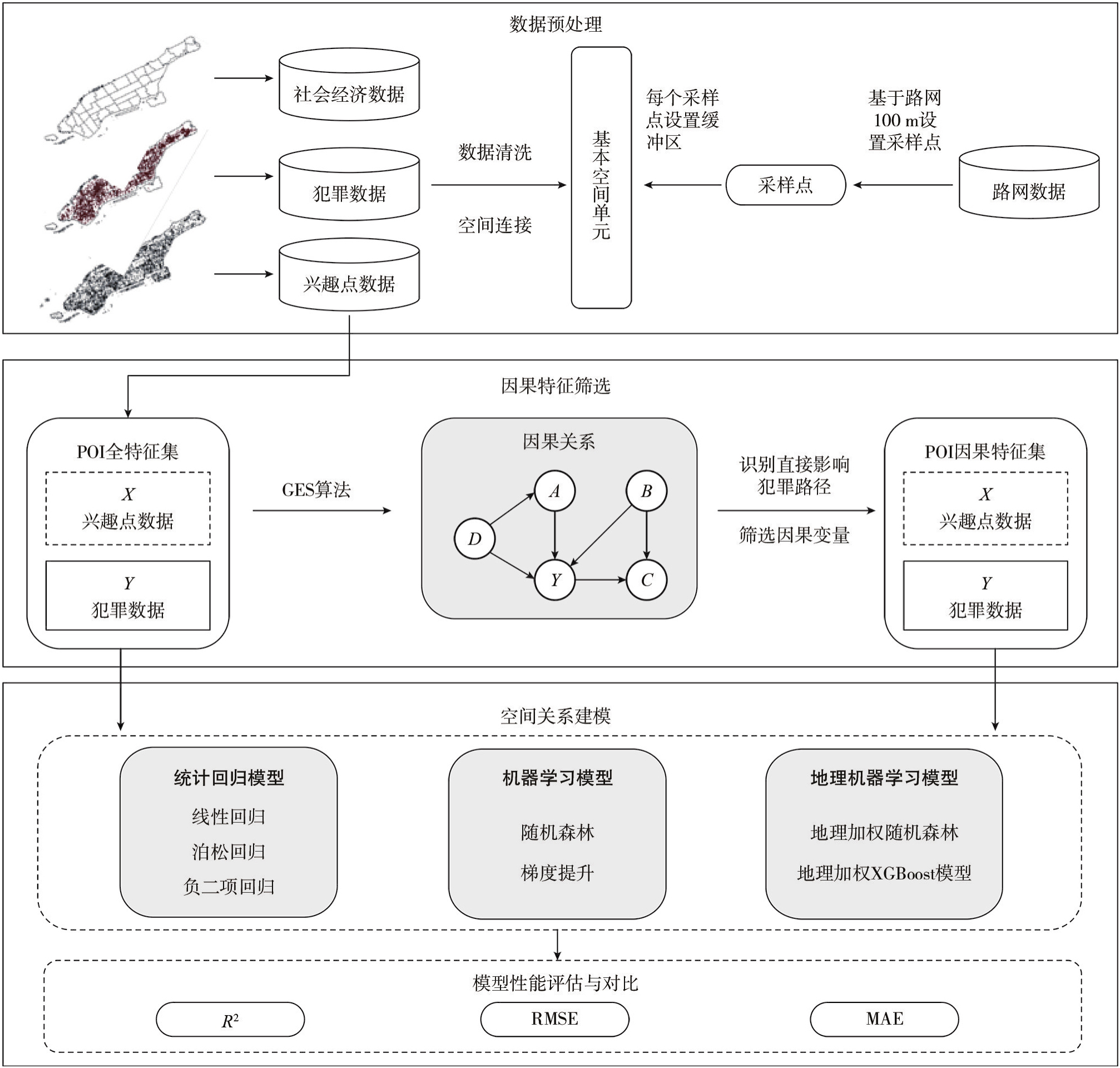
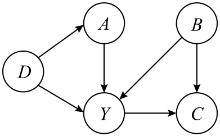
Fig. 2
Completed partially directed acyclic graph"
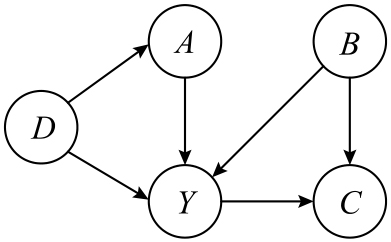
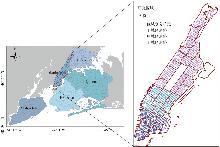
Fig. 3
Study area: Manhattan main peninsula"

Tab. 1
Description of data"
| 数据名称 | 数据来源 | 数据内容 |
|---|---|---|
| 道路网络数据 | Open Street Map( | 研究区域的道路路网数据,包括道路等级,道路类别以及道路名称等信息 |
| 抢劫犯罪数据 | 纽约市公开数据平台( | 2022年纽约市记录的接警数据,包括犯罪地点、犯罪类别以及时间等信息 |
| 兴趣点数据 | Open Street Map | 研究区域的兴趣点数据,包括设施类型、设施位置以及设施名称等信息 |
| 社会人口统计数据 | 纽约市公开数据平台 | 纽约市的社会人口区域,包括人口数量、社区面积以及各种族占比等信息 |
| 社会经济数据 | 2020年美国人口普查( | 涉及就业状况、收入、家庭类型、住房和教育等诸多信息 |
Tab. 2
Description of POI data"
| 兴趣点类 | 兴趣点子类 |
|---|---|
| Accomodation(住宿) | hostel、hotel、shelte |
| Leisure(休闲) | nightclub、sport_centre、tennis_court、cinema、theatre、pitch、ice_rink、park、playground |
| Miscpoi(其他) | tower_cooms、camera_surveillance、bench、toilet、fountain、drinking_water |
| Money(金融) | bank、ATM |
| Public(公共设施) | university、school、college、fire_station、police、library、post_box、courthouse、post_office、kindergarten、telephone、community_centre、arts_centre |
| Shopping(购物) | bakery、beverages、bookshop、butcher、car_dealership、car_rental、car_repair、chemist、clothes、convenience、department_store、florist、general、gift_shop、hair、jeweller、kiosk、laundry、mall、optician、shoes_shop、sports_shop、supermarket |
| Tourism(旅游) | museum、monument、attraction、memorial、ruins、viewpoint |
| Health(医疗) | doctors、veterinary、clinic、dentist、pharmacy、hospital |
| Catering(餐饮) | bar、fast-food、restaurant、food_court、pub、cafe |
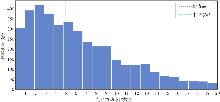
Fig. 4
Robbery cases count per block"
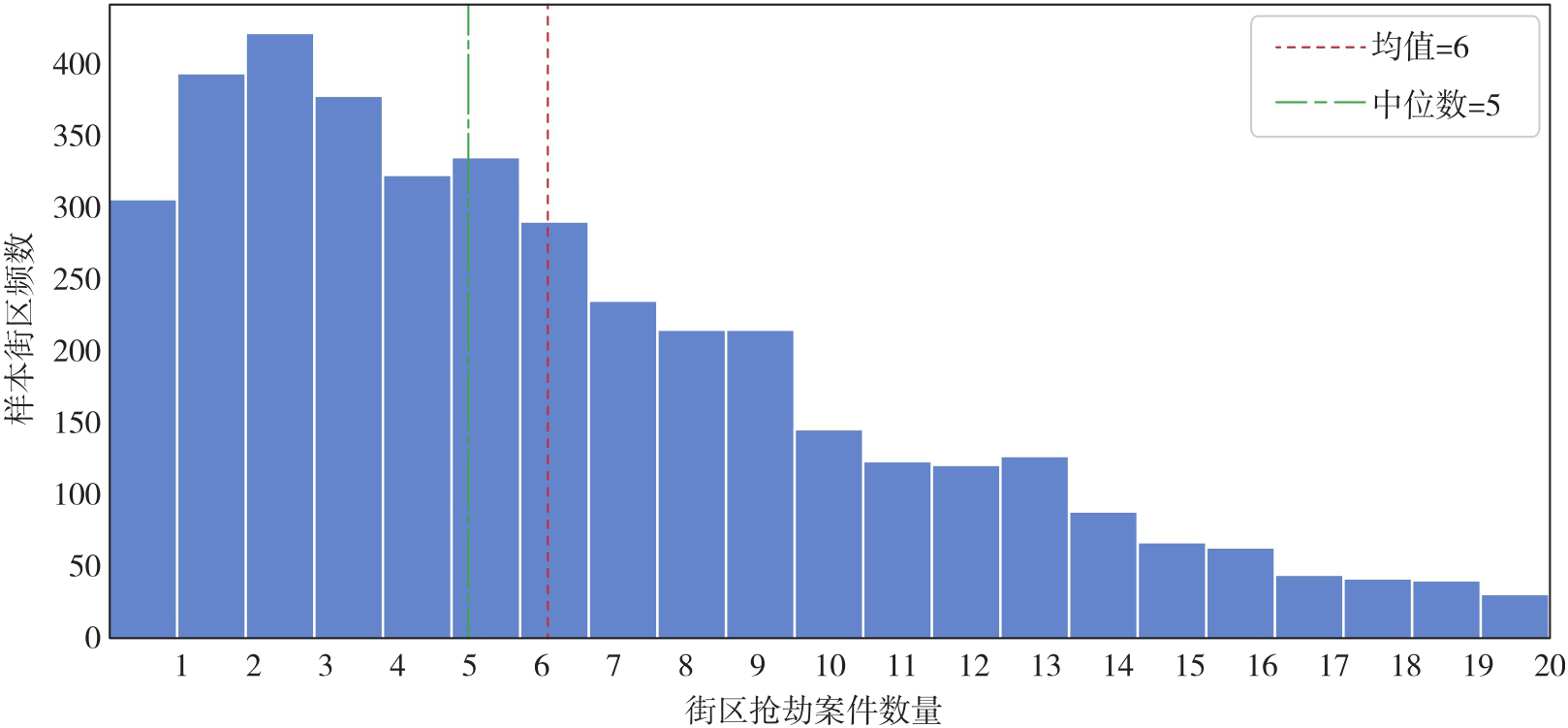
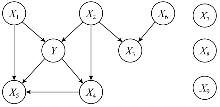
Fig. 5
Causal structure between leisure POIs and street robbery"
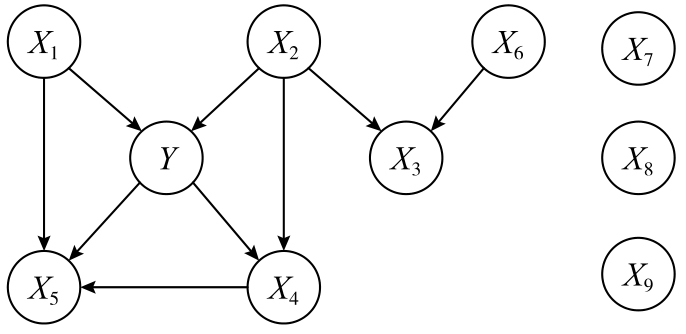
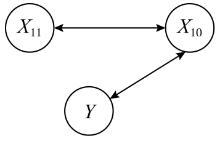
Fig. 6
Causal structure between money POIs and street robbery"
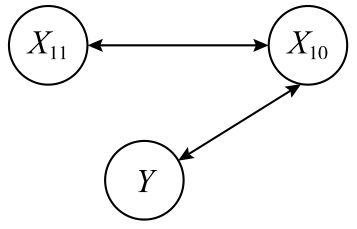
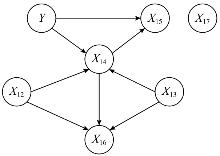
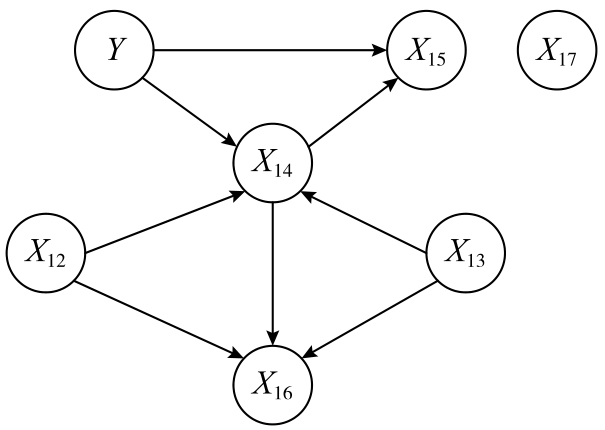
Fig. 7
Causal structure between health POIs and street robbery"
Tab. 3
Causal POI types"
| 兴趣点类 | 兴趣点子类 |
|---|---|
| Catering(餐饮) | bar、fast_food、restaurant |
| Leisure(休闲) | night_club、sport_centre |
| Miscpoi(其他) | bench、camera_surveillance、tower_rooms |
| Money(金融) | bank |
| Public(公共设施) | telephone、arts_center、post_office |
| Shopping(购物) | bakery、clothes、convenience、hairdresser、shoe_shop、departments |
| Tourism(旅游) | attraction、memorial |
Tab. 4
Comparison of performance for different feature combinations and model architectures"
| 算法类别 | 具体算法 | POI因果特征集 | POI因果特征集+社会经济指标 | POI全特征集 | POI全特征集+社会经济指标 | ||||||||
|---|---|---|---|---|---|---|---|---|---|---|---|---|---|
| MAE | RMSE | R2 | MAE | RMSE | R2 | MAE | RMSE | R2 | MAE | RMSE | R2 | ||
| 统计回归模型 | 线性回归 | 5.25 | 7.86 | 0.11 | 5.03 | 7.66 | 0.16 | 5.25 | 7.96 | 0.09 | 5.03 | 7.76 | 0.14 |
| 泊松回归 | 5.28 | 7.96 | 0.09 | 5.05 | 7.77 | 0.13 | 5.27 | 8.03 | 0.075 | 5.08 | 7.86 | 0.11 | |
| 负二项回归 | 5.32 | 8.06 | 0.06 | 5.18 | 8.08 | 0.06 | 5.29 | 8.13 | 0.051 | 5.32 | 8.16 | 0.04 | |
| 机器学习模型 | 随机森林 | 5.48 | 8.61 | -0.06 | 3.87 | 6.29 | 0.48 | 5.52 | 8.62 | -0.005 | 3.83 | 6.22 | 0.49 |
| 梯度提升 | 5.18 | 7.96 | 0.09 | 4.06 | 6.12 | 0.47 | 4.88 | 8.17 | 0.04 | 4.01 | 6.12 | 0.46 | |
| 地理机器学习模型 | 地理加权 | 2.88 | 4.41 | 0.72 | 3.18 | 4.87 | 0.65 | 2.91 | 4.61 | 0.69 | 3.01 | 4.73 | 0.67 |
| 随机森林 | |||||||||||||
| 地理加权 | 3.11 | 4.93 | 0.65 | 3.38 | 5.47 | 0.57 | 3.13 | 4.95 | 0.64 | 3.37 | 5.35 | 0.58 | |
| XGBoost | |||||||||||||
Tab. 5
VIF multicollinearity analysis with different feature sets"
| 特征分组 | 最大VIF值 | 共线性程度 |
|---|---|---|
| 仅POI因果特征 | 1.749 | 无共线性 |
| POI+社会经济特征 | 12.522 | 严重多重共线性 |
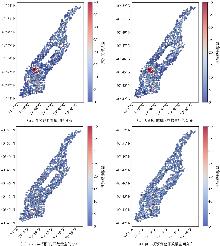
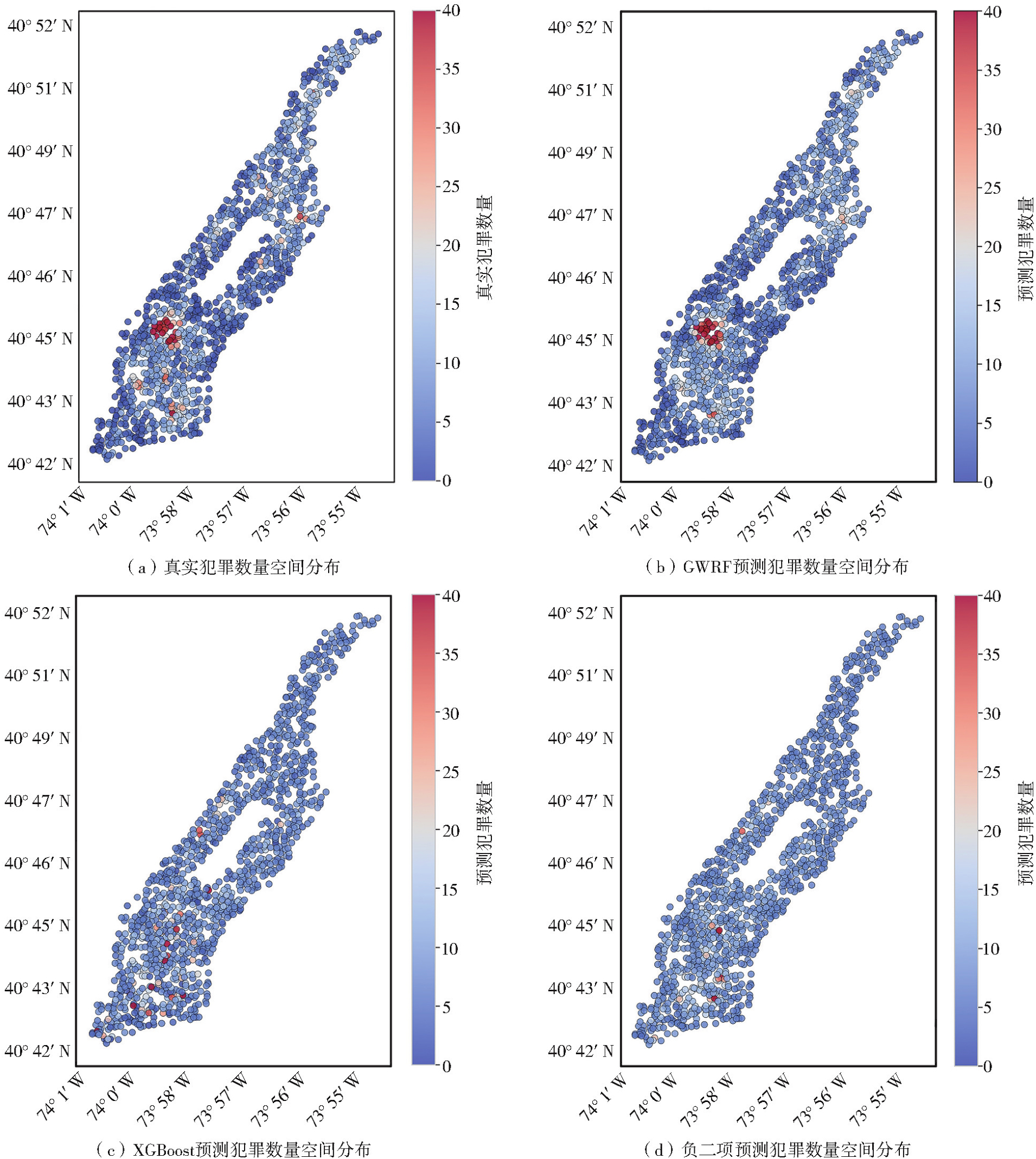
Fig. 8
Visual comparison of spatial prediction performance"
| [1] | 毛媛媛, 戴慎志. 犯罪空间分布与环境特征:以上海市为例[J]. 城市规划学刊, 2006(3): 85-93. |
| Mao Yuanyuan, Dai Shenzhi. Research on spatial and environmental characters of crimes: case study of Shanghai[J]. Urban Planning Forum, 2006(3): 85-93. | |
| [2] | 王发曾. 城市空间环境对城市犯罪的影响[J]. 人文地理, 2001, 16(2): 1-6, 11. |
| Wang Fazeng. The urban spatial environment's influences on urban crime[J]. Human Geography, 2001, 16(2): 1-6, 11. | |
| [3] | Hipp J R, Lee S, Ki D, et al. Measuring the built environment with Google street view and machine learning: consequences for crime on street segments[J]. Journal of Quantitative Criminology, 2022, 38(3): 537-565. |
| [4] | 贺力, 陈晨, 王忠民, 等. 城市微环境与盗窃犯罪关系研究进展[J]. 地理研究, 2022, 41(11): 2912-2931. |
| He Li, Chen Chen, Wang Zhongmin, et al. A review on the relationship between urban micro-environment and theft[J]. Geographical Research, 2022, 41(11): 2912-2931. | |
| [5] | 张延吉, 秦波, 朱春武. 北京城市建成环境对犯罪行为和居住安全感的影响[J]. 地理学报, 2019, 74(2): 238-252. |
| Zhang Yanji, Qin Bo, Zhu Chunwu. The impact of urban built environment on criminal behavior and residential security in Beijing[J]. Acta Geographica Sinica, 2019, 74(2): 238-252. | |
| [6] | 顾海硕, 陈鹏, 李慧波. 犯罪时空预测方法研究综述与展望[J]. 地球信息科学学报, 2021, 23(1): 43-57. |
| Gu Haishuo, Chen Peng, Li Huibo. Overview and prospect for spatial-temporal prediction of crime[J]. Journal of Geo-information Science, 2021, 23(1): 43-57. | |
| [7] | Altman N, Krzywinski M. Simple linear regression[J]. Nature Methods, 2015, 12(11): 999-1000. |
| [8] | Nelder J A, Wedderburn R W M. Generalized linear models[J]. Journal of the Royal Statistical Society Series A (General), 1972, 135(3): 370. |
| [9] | Lawless J F. Negative binomial and mixed Poisson regression[J]. Canadian Journal of Statistics, 1987, 15(3): 209-225. |
| [10] | Luo Liang, Deng Min, Shi Yan, et al. Associating street crime incidences with geographical environment in space using a zero-inflated negative binomial regression model[J]. Cities, 2022, 129: 103834. |
| [11] | Chen Jianguo, Liu Lin, Zhou Suhong, et al. Modeling spatial effect in residential burglary: a case study from ZG city, China[J]. ISPRS International Journal of Geo-Information, 2017, 6(5): 138. |
| [12] | Xu Pengpeng, Huang Helai. Modeling crash spatial heterogeneity: random parameter versus geographically weighting[J]. Accident Analysis & Prevention, 2015, 75: 16-25. |
| [13] | O'Sullivan D. Geographically weighted regression: the analysis of spatially varying relationships, by A. S.fotheringham, C.brunsdon, and M.charlton[J]. Geographical Analysis, 2003, 35(3): 272-275. |
| [14] | Da Silva A R, Rodrigues T C V. Geographically weighted negative binomial regression: incorporating overdispersion[J]. Statistics and Computing, 2014, 24(5): 769-783. |
| [15] | 徐冲, 柳林, 周素红, 等. 微观空间因素对街头抢劫影响的空间异质性:以DP半岛为例[J]. 地理研究, 2017, 36(12): 2492-2504. |
| Xu Chong, Liu Lin, Zhou Suhong, et al. Spatial heterogeneity of micro-spatial factors'effects on street robberies: a case study of DP peninsula[J]. Geographical Research, 2017, 36(12): 2492-2504. | |
| [16] | Chen Jianguo, Liu Lin, Xiao Luzi, et al. Integrative analysis of spatial heterogeneity and overdispersion of crime with a geographically weighted negative binomial model[J]. ISPRS International Journal of Geo-Information, 2020, 9(1): 60. |
| [17] | Breiman L. Random forests[J]. Machine Learning, 2001, 45(1): 5-32. |
| [18] | Chen T Q, Guestrin C. XGBoost: a scalable tree boosting system[C]//Proceedings of the 22nd ACM SIGKDD International Conference on Knowledge Discovery and Data Mining. San Francisco: ACM Press, 2016: 785-794. |
| [19] | Zhang Zhongheng. Introduction to machine learning: k-nearest neighbors[J]. Annals of Translational Medicine, 2016, 4(11): 218. |
| [20] | De Maris A. A tutorial in logistic regression[J]. Journal of Marriage and the Family, 1995, 57(4): 956. |
| [21] | 孙菲菲, 曹卓, 肖晓雷. 基于随机森林的分类器在犯罪预测中的应用研究[J]. 情报杂志, 2014, 33(10): 148-152. |
| Sun Feifei, Cao Zhuo, Xiao Xiaolei. Application of an improved random forest based classifier in crime prediction domain[J]. Journal of Intelligence, 2014, 33(10): 148-152. | |
| [22] | 王梓蒙, 刘艳芳, 罗璇, 等. 基于多源数据的城市活力与建成环境非线性关系研究:以双休日武汉市主城区为例[J]. 地理科学进展, 2023, 42(4): 716-729. |
| Wang Zimeng, Liu Yanfang, Luo Xuan, et al. Nonlinear relationship between urban vitality and the built environment based on multi-source data: a case study of the main urban area of Wuhan city at the weekend[J]. Progress in Geography, 2023, 42(4): 716-729. | |
| [23] | 王为久, 徐敏亚, 徐博希, 等. 基于XGBoost算法的非法经营罪量刑预测模型构建及应用[J]. 情报探索, 2022(9): 20-28. |
| Wang Weijiu, Xu Minya, Xu Boxi, et al. Crime of illegal business operations sentencing prediction based on text mining and XGBoost model[J]. Information Research, 2022(9): 20-28. | |
| [24] | Xie Huafang, Liu Lin, Yue Han. Modeling the effect of streetscape environment on crime using street view images and interpretable machine-learning technique[J]. International Journal of Environmental Research and Public Health, 2022, 19(21): 13833. |
| [25] | Georganos S, Kalogirou S. A forest of forests: a spatially weighted and computationally efficient formulation of geographical random forests[J]. ISPRS International Journal of Geo-Information, 2022, 11(9): 471. |
| [26] | Khosravi Y, Ouarda T B M J. A geographically weighted XGBoost framework for pixel-level modeling of vegetation responses using multi-source Earth observation data[J]. ISPRS Journal of Photogrammetry and Remote Sensing, 2026, 235: 105-132. |
| [27] | Zhang Wantao, Ji Jingyi, Li Binbin, et al. Integrating genetic algorithm and geographically weighted approaches into machine learning improves soil pH prediction in China[J]. Remote Sensing, 2025, 17(6): 1086. |
| [28] | 李兰晖, 黄聪聪, 张镱锂, 等. 基于地理加权随机森林的青藏地区放牧强度时空格局模拟[J]. 地理科学, 2023, 43(3): 398-410. |
| Li Lanhui, Huang Congcong, Zhang Yili, et al. Mapping the multi-temporal grazing intensity on the Qinghai-Tibet Plateau using geographically weighted random forest[J]. Scientia Geographica Sinica, 2023, 43(3): 398-410. | |
| [29] | Gao B B, Wang J F, Stein A, et al. Causal inference in spatial statistics[J]. Spatial Statistics, 2022, 50: 100621. |
| [30] | Akbari K, Winter S, Tomko M. Spatial causality: a systematic review on spatial causal inference[J]. Geographical Analysis, 2023, 55(1): 56-89. |
| [31] | Pearl J. Causality: models, reasoning, and inference[M]. 2nd ed. Cambridge: Cambridge University Press, 2009. |
| [32] | 苏建宾, 陈都鑫, 郑东海, 等. 追索为什么?地球系统科学中的因果推理[J]. 中国科学:地球科学, 2023, 53(10): 2199-2216. |
| Su Jianbin, Chen Duxin, Zheng Donghai, et al. The insight of why: causal inference in Earth system science[J]. Science China Earth Sciences, 2023, 66(10): 2169-2186. | |
| [33] | 龙锦颖, 张春霞, 宋广文, 等. 警察盘查时空模式对街面盗窃的因果效应:以ZG市CBD为例[J]. 地理科学进展, 2024, 43(11): 2284-2297. |
| Long Jinying, Zhang Chunxia, Song Guangwen, et al. Causal effect of spatiotemporal patterns of police stops on street thefts: a case study of the central business district of ZG city[J]. Progress in Geography, 2024, 43(11): 2284-2297. | |
| [34] | He Zhanjun, Meng Wantong, Yao Jing, et al. Measuring the causal effect of urban environments on crime with street view images and points of interest[J]. Cities, 2026, 168: 106399. |
| [35] | Vachuska K. Urban mobility and crime: causal inference using street closures as an instrumental variable[J]. Frontiers in Big Data, 2025, 8: 1579332. |
| [36] | Chickering D M. Learning equivalence classes of Bayesian-network structures[J]. Journal of Machine Learning Research, 2002, 2: 445-498. |
| [37] | He Zhanjun, Deng Min, Xie Zhong, et al. Discovering the joint influence of urban facilities on crime occurrence using spatial co-location pattern mining[J]. Cities, 2020, 99: 102612. |
| [38] | Wang Wenji, Song Yang, Kong Jie, et al. Exploring the spatial relationship between crime and urban places in Austin: a geographically weighted regression approach[J]. Urban Science, 2025, 9(9): 359. |
| [39] | He Zhanjun, Gu Yu, Gong Yuejian, et al. Analyzing the joint influence of urban facilities and street perception characteristics on street robbery[J]. Journal of Geovisualization and Spatial Analysis, 2025, 9(1): 22. |
| [40] | Brantingham P L, Brantingham P J. Criminality of place[J]. European Journal on Criminal Policy and Research, 1995, 3(3): 5-26. |
| [41] | Hart T C, Miethe T D. Configural behavior settings of crime event locations: toward an alternative conceptualization of criminogenic microenvironments[J]. Journal of Research in Crime and Delinquency, 2015, 52(3): 373-402. |
| [42] | Kurland J, Johnson S D, Tilley N. Offenses around stadiums: a natural experiment on crime attraction and generation[J]. Journal of Research in Crime and Delinquency, 2014, 51(1): 5-28. |
| [43] | 黄邓楷, 赖文波, 薛蕊. 基于CPTED理论的大学校园环境安全评价研究:以华南理工大学五山校区为例[J]. 风景园林, 2018, 25(7): 36-41. |
| Huang Dengkai, Lai Wenbo, Xue Rui. Environmental safety evaluation of university campus based on CPTED theory: South China U-niversity of technology (Wushan) as an example[J]. Landscape Architecture, 2018, 25(7): 36-41. | |
| [44] | 张艺鸽, 杨芳绒, 王梦瑶. 基于CPTED理论和空间句法的城市公园犯罪防控分析:以郑州市人民公园、紫荆山公园为例[J]. 西南大学学报(自然科学版), 2022, 44(1): 202-212. |
| Zhang Yige, Yang Fangrong, Wang Mengyao. Investigation of urban park crime prevention based on CPTED theory and space syntax: taking People's park and Zijingshan park in Zhengzhou as examples[J]. Journal of Southwest University (Natural Science), 2022, 44(1): 202-212. | |
| [45] | Wang Tao, Chen Peng, Shan Miaoxuan. Crime spatiotemporal prediction through urban region representation by using building footprints[J]. Big Data and Cognitive Computing, 2025, 9(12): 301. |
| [46] | Yue Han, Chen Jianguo. Interpretable spatial machine learning for understanding spatial heterogeneity in factors affecting street theft crime[J]. Applied Geography, 2025, 175: 103503. |
| [47] | Yao Yao, Dong Anning, Liu Zhiqian, et al. Extracting the pickpocketing information implied in the built environment by treating it as the anomalies[J]. Cities, 2023, 143: 104575. |
| [48] | Zhang Xu, Liu Lin, Lan Minxuan, et al. Interpretable machine learning models for crime prediction[J]. Computers, Environment and Urban Systems, 2022, 94: 101789. |
| [49] | Tutak M, Brodny J. A smart city is a safe city: analysis and evaluation of the state of crime and safety in Polish cities[J]. Smart Cities, 2023, 6(6): 3359-3392. |
| [1] | Zhigang Zhao, Siyao Jiang, Yebin Chen, Yongli Chen, Renzhong Guo. Conceptual framework and construction mechanism of the pan-map symbol system [J]. Acta Geodaetica et Cartographica Sinica, 2026, 55(9): 1653-1665. |
| [2] | Xiechun Lu, Peiyang Hou, Kai Ma, Zhanlong Chen, Yongyang Xu. Building shape encoding model integrating skeleton and contour features [J]. Acta Geodaetica et Cartographica Sinica, 2026, 55(9): 1679-1694. |
| [3] | Runze Chai, Jingzhong Li, Haowen Yan, Xiaolong Wang, Zhenyue Liu, Ling Wang. A graph Transformer method for river network pattern recognition incorporating three-dimensional terrain features [J]. Acta Geodaetica et Cartographica Sinica, 2026, 55(9): 1695-1705. |
| [4] | Shengjun Tang, Hanyu Li, Weixi Wang, Linfu Xie, Xiaoming Li, Renzhong Guo. A no-reference method for face-level defect detection and quality assessment of oblique photogrammetric 3D mesh models [J]. Acta Geodaetica et Cartographica Sinica, 2026, 55(8): 1382-1399. |
| [5] | Wanzeng Liu, Jun Chen, Jiaxin Ren, Feng Zhang, Lina Huang, Xinpeng Wang, Ye Zhang, Fuxun Liang, Xiaoyu Liu. Research directions and core tasks for cognitive understanding of spatio-temporal scenes [J]. Acta Geodaetica et Cartographica Sinica, 2026, 55(8): 1465-1481. |
| [6] | Yali Li, Yuezhu Hao, Longgang Xiang, Caili Zhang, Maohua Liu. Fine structure extraction method of overpass based on trajectory and remote sensing image fusion [J]. Acta Geodaetica et Cartographica Sinica, 2026, 55(8): 1482-1495. |
| [7] | Ke Zhang, Wenyue Guo, Xin Chen, Liuxin Ren, Junming Chen, Zheng Zhang. A method for restoring road centerlines based on semantic recognition of skeleton point topology [J]. Acta Geodaetica et Cartographica Sinica, 2026, 55(8): 1496-1510. |
| [8] | Lin Liu, Dongmei Pei, Wanwu Li, Xiutao Tang, Bin Wu, Yan Jin. Construction and solution of a multi-objective hierarchical fuzzy optimization model for fire station location considering risk levels [J]. Acta Geodaetica et Cartographica Sinica, 2026, 55(7): 1293-1305. |
| [9] | Weiting Xiong. Research on spatial structure pattern and deconstruction mechanism of urban shadow areas from a dynamic network perspective [J]. Acta Geodaetica et Cartographica Sinica, 2026, 55(7): 1322-1322. |
| [10] | Jie Yang. Spatial compound variable theory and Yang Chizhong methods for three-dimensional spatial structure analysis of mineralization [J]. Acta Geodaetica et Cartographica Sinica, 2026, 55(7): 1323-1323. |
| [11] | Shuai Zeng. Remote sensing inversion and application of particulate phosphorus concentration in lakes of the Yangtze River Plain [J]. Acta Geodaetica et Cartographica Sinica, 2026, 55(7): 1328-1328. |
| [12] | Qinghua GUO, Zekun YANG, Zhiyong QI, Yixuan ZHANG, Zhixin CHENG, Kang LIU, Kai CHENG, Ang CHEN, Luyi YANG. Geospatial information empowering the low-altitude economy: key technological breakthroughs and industrial development [J]. Acta Geodaetica et Cartographica Sinica, 2026, 55(6): 975-989. |
| [13] | Bing HAN. A research on spatialtemporal characteristics of pre-hospital care and first-aid station layout based on multi-source big data——taking Nanjing city as example [J]. Acta Geodaetica et Cartographica Sinica, 2026, 55(6): 1131-1131. |
| [14] | Manxing SHI. Research on the influencing factors and modeling of kilometer scale thunderstorm hours in Central China [J]. Acta Geodaetica et Cartographica Sinica, 2026, 55(6): 1133-1133. |
| [15] | Wanzeng LIU, Jun CHEN, Wei ZHANG. On the technical logic of geographic information confidentiality [J]. Acta Geodaetica et Cartographica Sinica, 2026, 55(5): 826-837. |
| Viewed | ||||||
|
Full text |
|
|||||
|
Abstract |
|
|||||
