

Acta Geodaetica et Cartographica Sinica ›› 2026, Vol. 55 ›› Issue (8): 1465-1481.doi: 10.11947/j.AGCS.2026.20250471
• Cartography and Geographic Information • Previous Articles
Wanzeng Liu1,2( ), Jun Chen1,2,3, Jiaxin Ren3,4(), Feng Zhang4, Lina Huang5, Xinpeng Wang1,2, Ye Zhang1,2, Fuxun Liang6, Xiaoyu Liu7
Received:2025-11-10
Revised:2026-08-15
Published:2026-09-09
Contact:
Jiaxin Ren
E-mail:luwnzg@163.com;jaycecd@foxmail.com
About author:Liu Wanzeng (1970—), male, PhD, professor level senior engineer, majors in geographic information security and intelligentized surveying and mapping. E-mail: luwnzg@163.com
Supported by:CLC Number:
Wanzeng Liu, Jun Chen, Jiaxin Ren, Feng Zhang, Lina Huang, Xinpeng Wang, Ye Zhang, Fuxun Liang, Xiaoyu Liu. Research directions and core tasks for cognitive understanding of spatio-temporal scenes[J]. Acta Geodaetica et Cartographica Sinica, 2026, 55(8): 1465-1481.
Tab. 1
Key differences between traditional spatial analysis and spatio-temporal scene cognition"
| 比较维度 | 传统空间分析 | 时空场景认知 |
|---|---|---|
| 对象范围 | 地理要素、空间场、网络及其几何、属性和拓扑关系 | 具有明确地理语义、内部结构和演化规律的复杂动态系统,包括宏观遥感场景、动态视频场景和三维实景场景 |
| 基本构成 | 几何、属性、位置和拓扑 | 要素、状态、关系、结构和功能 |
| 输入数据 | 矢量、栅格、属性、统计及专题数据 | 遥感影像、视频、实景三维、专题数据、传感器数据及领域知识 |
| 认知过程 | 查询、量测、叠加、缓冲、网络分析和空间统计 | 场景感知、要素识别、关系计算、结构推理、功能判断 |
| 输出内容 | 几何量测结果、空间分布、统计指标及专题图 | 对象、关系、事件、行为、功能效应及演化规律等时空知识 |
| 服务对象 | 空间数据处理、专题分析及辅助决策 | 自然资源监管、城市治理、规划决策、应急响应及时空知识服务 |
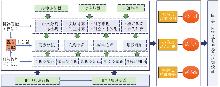
Fig. 1
Computing framework for cognition of spatio-temporal scenes"
Tab. 2
Psychological cognitive mechanisms and their computational mappings in spatio-temporal scene cognition"
| 心理学认知 | 可计算抽象 | 对应的模型实现及作用 |
|---|---|---|
| 知觉组织 | 相似性、邻近性、连续性和闭合性约束 | 构建要素关联权重、图邻接关系或结构一致性损失,支持局部要素聚合与整体结构识别 |
| 认知地图 | 对象、位置和关系构成的拓扑图式 | 将场景要素表示为节点,将空间、时间和语义关系表示为边,构建场景图或时空知识图谱 |
| 预测编码 | 先验预测与实际观测之间的误差修正 | 设置预测误差、时序一致性损失或异常分数,用于变化识别和动态场景诊断 |
| 注意选择 | 面向任务目标的信息选择与资源分配 | 通过注意力权重、显著性区域和目标门控机制突出关键要素及重要关系 |
| 记忆联想 | 历史经验、场景原型与当前信息的关联 | 通过记忆库、历史状态缓存和知识检索支持跨时态关联、案例匹配与推理决策 |
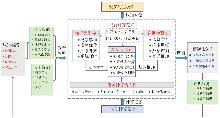
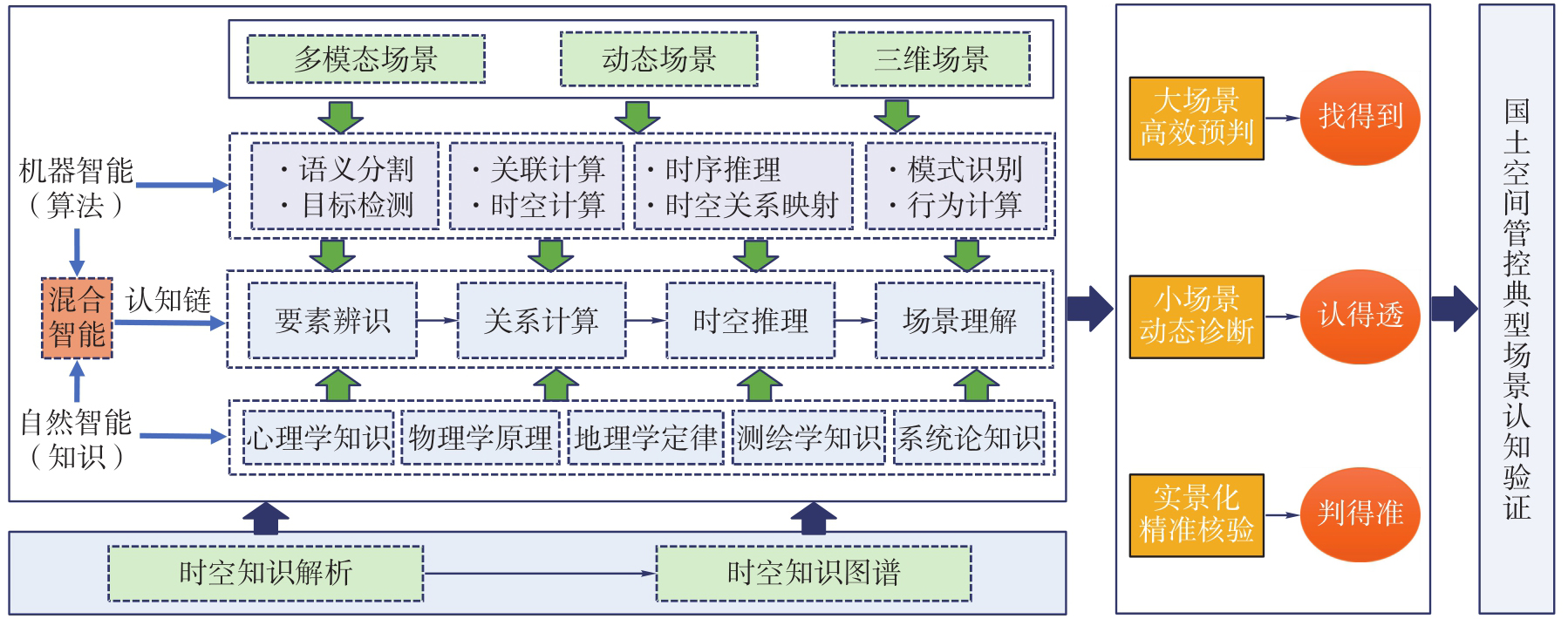
Fig. 2
Technical architecture of cognition of spatio-temporal scenes"
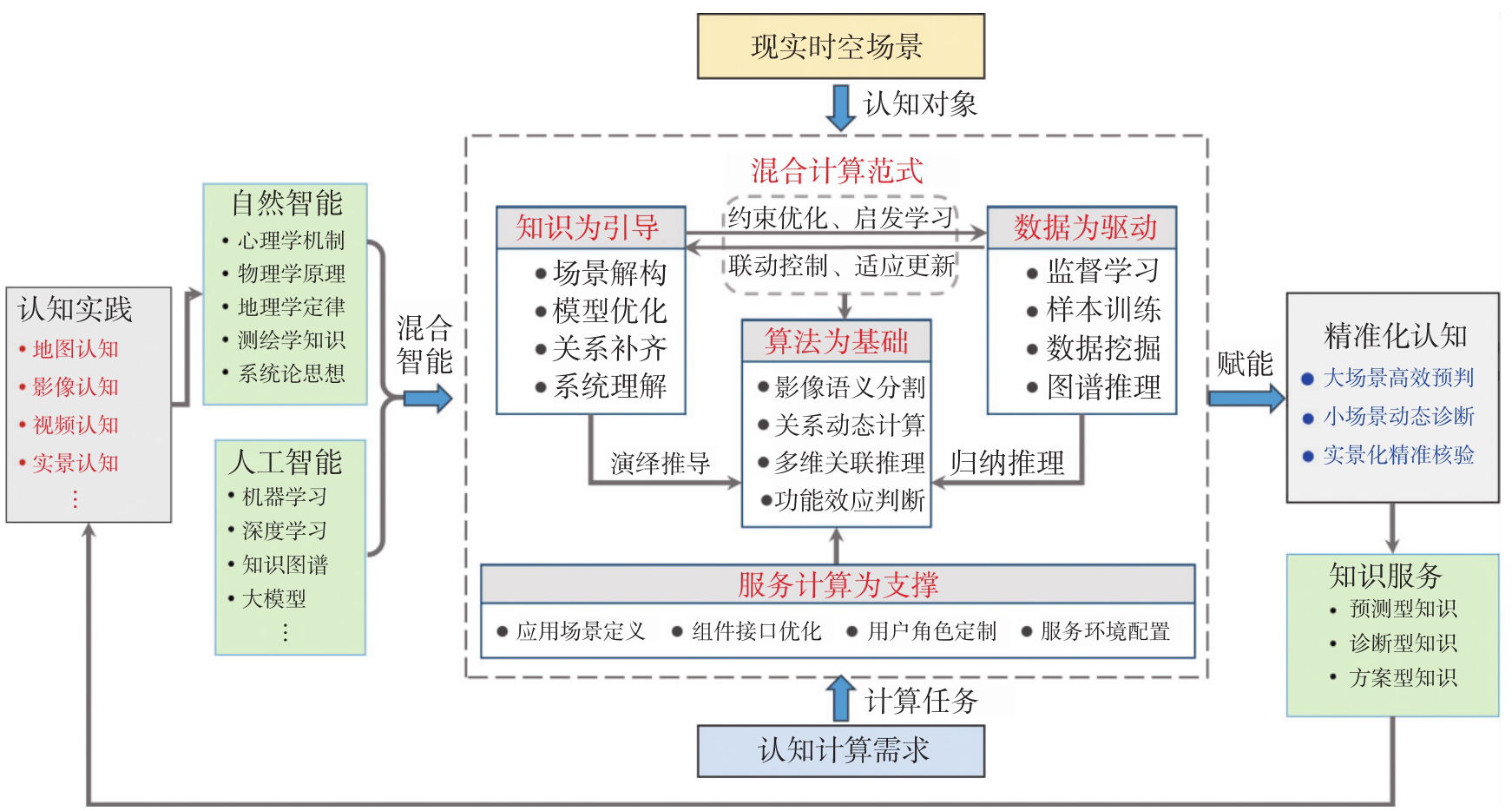
Fig. 3
Computing model of cognition of spatio-temporal scenes"
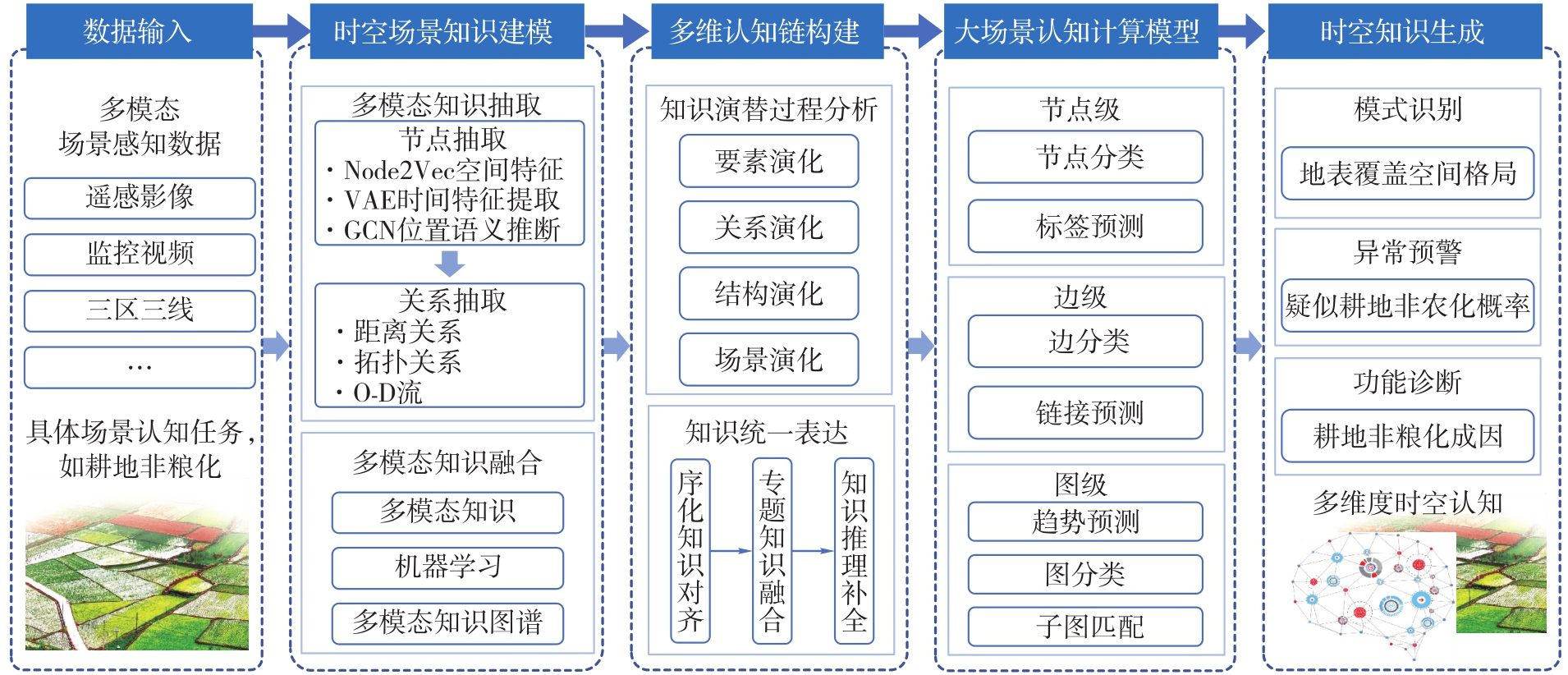
Fig. 4
Cognitive computation for dynamic spatio-temporal scenes"
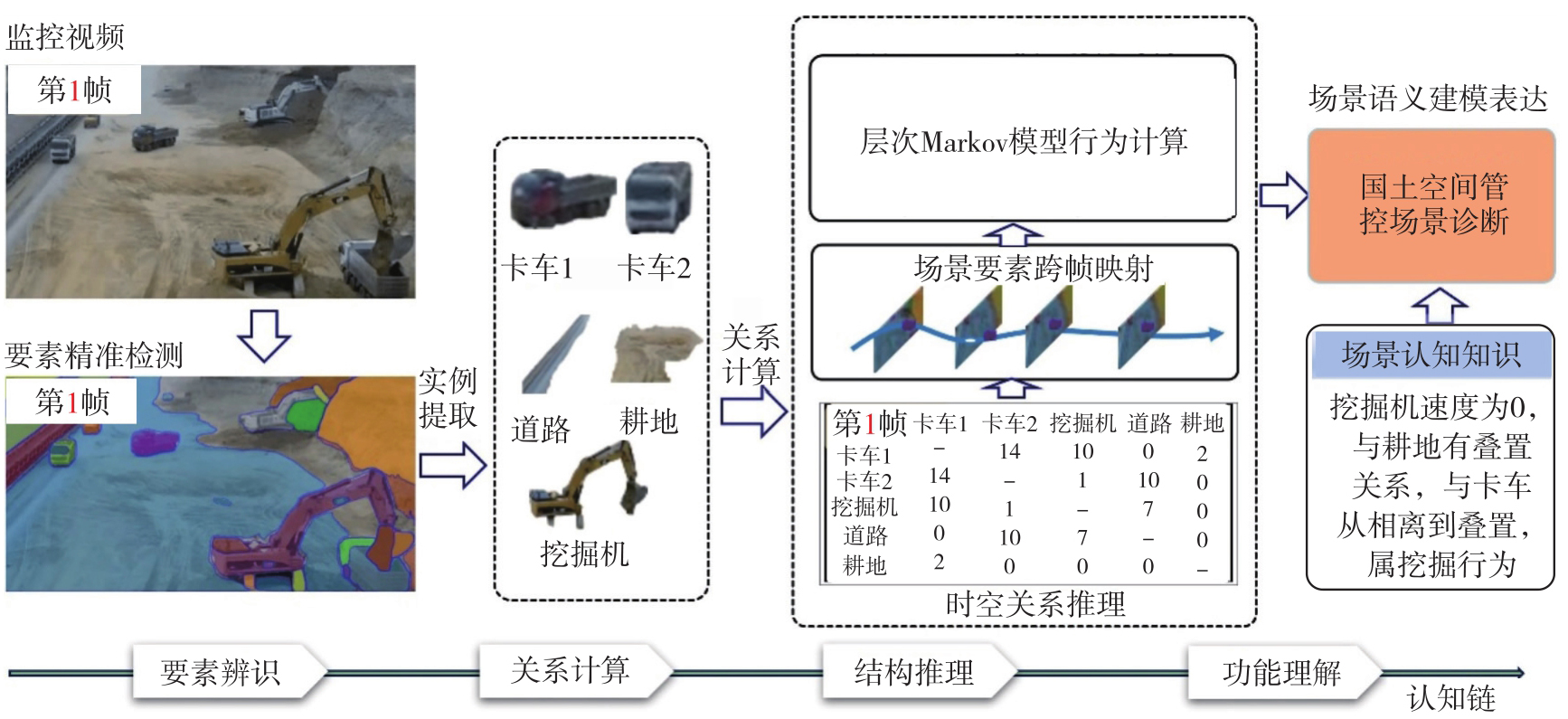
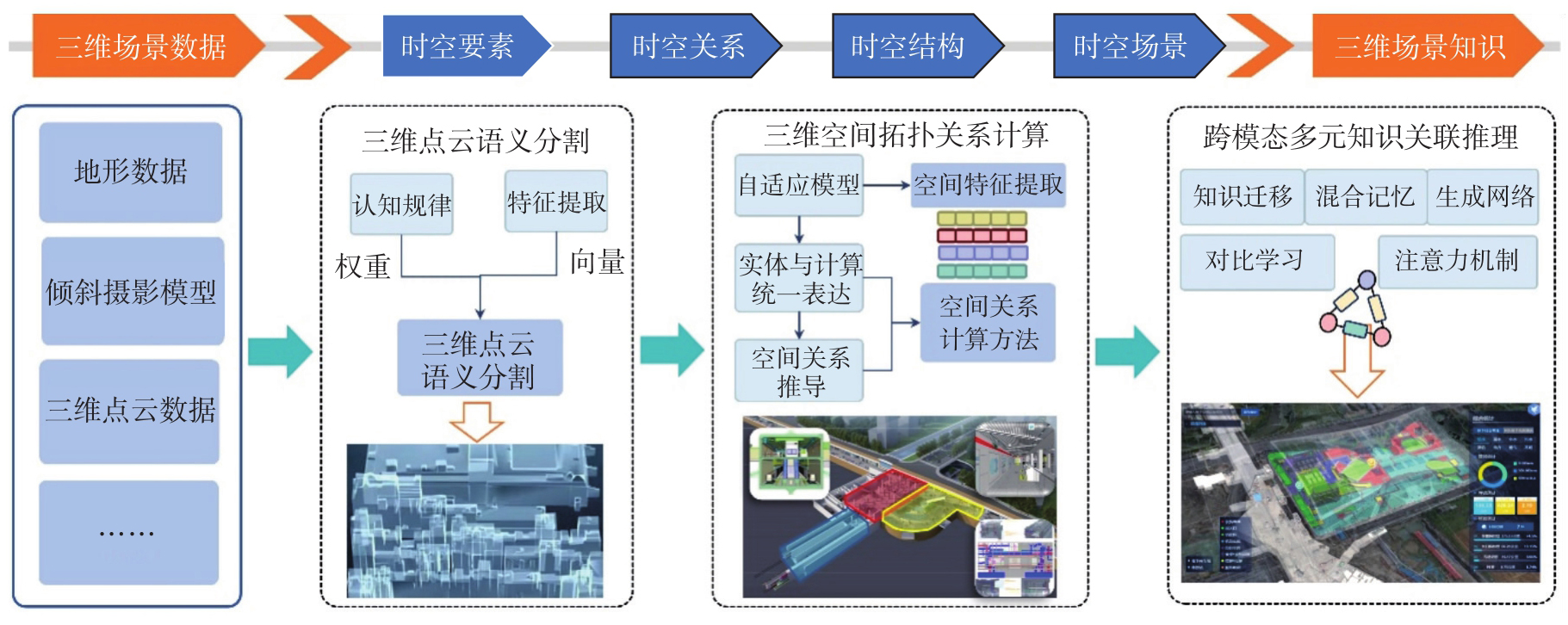
Fig. 5
Cognitive computation for 3D spatio-temporal scenes"
Tab. 3
Performance comparison of different models for dynamic cognition of unauthorized farmland excavation scenes"
| 模型 | Precision | Recall | mAP@50 | mAP@50-95 |
|---|---|---|---|---|
| YOLOv5n | 82.65 | 85.10 | 91.15 | 75.55 |
| YOLOv6n | 86.15 | 81.56 | 90.08 | 76.30 |
| YOLOv8n | 81.76 | 86.98 | 90.44 | 75.70 |
| YOLOv9t | 81.31 | 84.86 | 90.02 | 75.92 |
| YOLOv10n | 80.47 | 82.58 | 89.16 | 74.50 |
| YOLO11n | 85.31 | 85.04 | 90.90 | 74.76 |
| RT-DETR | 77.11 | 81.85 | 82.07 | 69.13 |
| Mask RCNN | 87.55 | 88.47 | 92.91 | 74.51 |
| Mask2former | 84.69 | 85.47 | 86.88 | 74.25 |
| HIUFE | 88.17 | 88.69 | 94.47 | 78.66 |
| [1] | Lü Guonian, Chen Min, Yuan Linwang, et al. Geographic scenario: a possible foundation for further development of virtual geographic environments[J]. International Journal of Digital Earth, 2018, 11(4): 356-368. |
| [2] | 闾国年, 俞肇元, 袁林旺, 等. 地图学的未来是场景学吗?[J]. 地球信息科学学报, 2018, 20(1): 1-6. |
| Lü Guonian, Yu Zhaoyuan, Yuan Linwang, et al. Is the future of cartography the scenario science?[J]. Journal of Geo-information Science, 2018, 20(1): 1-6. | |
| [3] | Dey A K. Understanding and using context[J]. Personal and ubiquitous computing, 2001, 5(1): 4-7. |
| [4] | Warden T, Visser U. Real-time spatio-temporal analysis of dynamic scenes[J]. Knowledge and Information Systems, 2012, 32(2): 243-279. |
| [5] | Ren Jiaxin, Liu Wanzeng, Chen Jun, et al. HI4HC and AAAAD: exploring a hierarchical method and dataset using hybrid intelligence for remote sensing scene captioning[J]. International Journal of Applied Earth Observation and Geoinformation, 2025, 139: 104491. |
| [6] | Yin Shunxi, Liu Wanzeng, Chen Jun, et al. HIUFE: hybrid intelligence-based unauthorized farmland excavation scene cognition[J]. ISPRS Journal of Photogrammetry and Remote Sensing, 2025, 227: 276-296. |
| [7] |
陈军, 刘万增, 武昊, 等. 智能化测绘的基本问题与发展方向[J]. 测绘学报, 2021, 50(8): 995-1005. DOI: .
doi: 10.11947/j.AGCS.2021.20210235 |
|
Chen Jun, Liu Wanzeng, Wu Hao, et al. Smart surveying and mapping: fundamental issues and research agenda[J]. Acta Geodaetica et Cartographica Sinica, 2021, 50(8): 995-1005. DOI: .
doi: 10.11947/j.AGCS.2021.20210235 |
|
| [8] | 郑磊. 数字治理的效度、温度和尺度[J]. 治理研究, 2021, 37(2): 5-16. |
| Zheng Lei. The validity, temperature and scale of digital governance[J]. Governance Studies, 2021, 37(2): 5-16. | |
| [9] | 刘万增, 陈军. 时空信息的基本内涵与赋能机理[J]. 地理学报, 2024, 79(5): 1099-1114. |
| Liu Wanzeng, Chen Jun. The basic connotation and empowerment mechanism of spatio-temporal information[J]. Acta Geographica Sinica, 2024, 79(5): 1099-1114. | |
| [10] | 陈军, 刘万增, 武昊, 等. 基础地理知识服务的基本问题与研究方向[J]. 武汉大学学报(信息科学版), 2019, 44(1): 38-47. |
| Chen Jun, Liu Wanzeng, Wu Hao, et al. Basic issues and research agenda of geospatial knowledge service[J]. Geomatics and Information Science of Wuhan University, 2019, 44(1): 38-47. | |
| [11] | 邓敏, 王达. 自然资源时空大数据挖掘与知识服务研究进展[J]. 地球信息科学学报, 2025, 27(1): 27-40. |
| Deng Min, Wang Da. Research progress in spatio-temporal big data mining and knowledge services for natural resources[J]. Journal of Geo-information Science, 2025, 27(1): 27-40. | |
| [12] | 刘万增, 陈军, 任加新, 等. 基于混合智能的地图自动审核技术框架[J]. 武汉大学学报(信息科学版), 2022, 47(12): 2038-2046. |
| Liu Wanzeng, Chen Jun, Ren Jiaxin, et al. Hybrid intelligence-based framework for automatic map inspecting technology[J]. Geomatics and Information Science of Wuhan University, 2022, 47(12): 2038-2046. | |
| [13] |
陈军, 艾廷华, 闫利, 等. 智能化测绘的混合计算范式与方法研究[J]. 测绘学报, 2024, 53(6): 985-998. DOI: .
doi: 10.11947/j.AGCS.2024.20240131 |
|
Chen Jun, Ai Tinghua, Yan Li, et al. Hybrid computational paradigm and methods for intelligentized surveying and mapping[J]. Acta Geodaetica et Cartographica Sinica, 2024, 53(6): 985-998. DOI: .
doi: 10.11947/j.AGCS.2024.20240131 |
|
| [14] |
任加新, 刘万增, 陈军, 等. 知识引导的碎片化栅格地形图比例尺智能识别[J]. 测绘学报, 2024, 53(1): 146-157. DOI: .
doi: 10.11947/j.AGCS.2024.20230005 |
|
Ren Jiaxin, Liu Wanzeng, Chen Jun, et al. Knowledge-guided intelligent recognition of the scale for fragmented raster topographic maps[J]. Acta Geodaetica et Cartographica Sinica, 2024, 53(1): 146-157. DOI: .
doi: 10.11947/j.AGCS.2024.20230005 |
|
| [15] | 黄龙. 一种快速挖掘互联网问题地图图片的方法[J]. 测绘与空间地理信息, 2017, 40(11): 92-93, 96. |
| Huang Long. Research on the method of fast mining Internet problem map picture[J]. Geomatics & Spatial Information Technology, 2017, 40(11): 92-93, 96. | |
| [16] | Ren Jiaxin, Liu Wanzeng, Chen Jun, et al. SAFE: sensitive annotation finding and extraction from multi-type Chinese maps via hybrid intelligence and knowledge graph[J]. Geo-spatial Information Science, 2026: 1-26. |
| [17] | 任加新, 刘万增, 陈军, 等. 问题地图自动识别的关键问题与应对策略[J]. 时空信息学报, 2025, 32(6): 606-619. |
| Ren Jiaxin, Liu Wanzeng, Chen Jun, et al. Key challenges and countermeasures for automated recognition of problematic maps[J]. Journal of Spatio-Temporal Information, 2025, 32(6): 606-619. | |
| [18] |
刘万增, 陈军, 章炜. 论地理信息保密的技术逻辑[J]. 测绘学报, 2026, 55(5): 826-837. DOI: .
doi: 10.11947/j.AGCS.2026.20250540 |
|
Liu Wanzeng, Chen Jun, Zhang Wei. On the technical logic of geographic information confidentiality[J]. Acta Geodaetica et Cartographica Sinica, 2026, 55(5): 826-837. DOI: .
doi: 10.11947/j.AGCS.2026.20250540 |
|
| [19] | 陈军, 武昊, 张继贤, 等. 自然资源调查监测技术体系构建的方向与任务[J]. 地理学报, 2022, 77(5): 1041-1055. |
| Chen Jun, Wu Hao, Zhang Jixian, et al. Building natural resources surveying and monitoring technological system: direction and research agenda[J]. Acta Geographica Sinica, 2022, 77(5): 1041-1055. | |
| [20] |
陈军, 武昊, 刘万增, 等. 自然资源时空信息的技术内涵与研究方向[J]. 测绘学报, 2022, 51(7): 1130-1140. DOI: .
doi: 10.11947/j.AGCS.2022.20210643 |
|
Chen Jun, Wu Hao, Liu Wanzeng, et al. Technical connotation and research agenda of natural resources spatio-temporal information[J]. Acta Geodaetica et Cartographica Sinica, 2022, 51(7): 1130-1140. DOI: .
doi: 10.11947/j.AGCS.2022.20210643 |
|
| [21] | Tolman E C. Cognitive maps in rats and men[J]. Psychological Review, 1948, 55(4): 189-208. |
| [22] | O'Keefe J, Dostrovsky J. The hippocampus as a spatial map: preliminary evidence from unit activity in the freely-moving rat[J]. Brain Research, 1971, 34(1): 171-175. |
| [23] | Moser E I, Moser M B, McNaughton B L. Spatial representation in the hippocampal formation: a history[J]. Nature Neuroscience, 2017, 20(11): 1448-1464. |
| [24] | Rueckemann J W, Sosa M, Giocomo L M, et al. The grid code for ordered experience[J]. Nature Reviews Neuroscience, 2021, 22(10): 637-649. |
| [25] | Bowler J C, Losonczy A. Direct cortical inputs to hippocampal area CA1 transmit complementary signals for goal-directed navigation[J]. Neuron, 2023, 111(24): 4071-4085. |
| [26] | Wang Rubin, Wang Yihong, Xu Xuying, et al. Brain works principle followed by neural information processing: a review of novel brain theory[J]. Artificial Intelligence Review, 2023, 56(1): 285-350. |
| [27] | Chen D, Axmacher N, Wang L. Grid codes underlie multiple cognitive maps in the human brain[J]. Progress in Neurobiology, 2024, 233: 102569. |
| [28] | Dong L L, Fiete I R. Grid cells in cognition: mechanisms and function[J]. Annual Review of Neuroscience, 2024, 47: 345-368. |
| [29] | Hermansen E, Klindt D A, Dunn B A. Uncovering 2-D toroidal representations in grid cell ensemble activity during 1-D behavior[J]. Nature Communications, 2024, 15: 5429. |
| [30] | Nguyen D, Wang G, Wafa T, et al. The medial entorhinal cortex encodes multisensory spatial information[J]. Cell Reports, 2024, 43(10): 114813. |
| [31] | Wang C, Lee H, Rao G, et al. Multiplexing of temporal and spatial information in the lateral entorhinal cortex[J]. Nature Communications, 2024, 15: 10533. |
| [32] | Wen J H, Sorscher B, Jones E A, et al. One-shot entorhinal maps enable flexible navigation in novel environments[J]. Nature, 2024, 635(8040): 943-950. |
| [33] | Khona M, Chandra S, Fiete I. Global modules robustly emerge from local interactions and smooth gradients[J]. Nature, 2025, 640(8057): 155-164. |
| [34] | Whittington J C R, McCaffary D, Bakermans J J W, et al. How to build a cognitive map[J]. Nature Neuroscience, 2022, 25(10): 1257-1272. |
| [35] | Bai Qianqian, Chen Zhongpu, Luo Ling, et al. Endowing embodied agents with spatial reasoning capabilities for vision-and-language navigation[PP/OL]. V2. arXiv (2026-03-02) [2026-04-15]. https://doi.org/10.48550/arXiv.2504.08806. |
| [36] | Giuliari F. Spatial reasoning with graph neural networks[D]. Genoa: University of Genoa, 2024. |
| [37] | Gornet J, Thomson M. Automated construction of cognitive maps with visual predictive coding[J]. Nature Machine Intelligence, 2024, 6(7): 820-833. |
| [38] | Momennejad I. Memory, space, and planning: multiscale predictive representations[PP/OL]. V2. arXiv (2024-02-19) [2026-04-15]. https://doi.org/10.48550/arXiv.2401.09491. |
| [39] | Tao Yuan, Liu Wanzeng, Chen Jun, et al. A self-supervised learning approach for extracting China physical urban boundaries based on multi-source data[J]. Remote Sensing, 2023, 15(12): 3189. |
| [40] | Zhang Y, Liu P, Biljecki F. Knowledge and topology: a two layer spatially dependent graph neural networks to identify urban functions with time-series street view image[J]. ISPRS Journal of Photogrammetry and Remote Sensing, 2023, 198: 153-168. |
| [41] |
刘春, 贾守军, 吴杭彬, 等. 点云场景认知模式:泛化点云[J]. 测绘学报, 2022, 51(4): 556-567. DOI: .
doi: 10.11947/j.AGCS.2022.20220019 |
|
Liu Chun, Jia Shoujun, Wu Hangbin, et al. Scene cognition pattern of point cloud-generalization point cloud[J]. Acta Geodaetica et Cartographica Sinica, 2022, 51(4): 556-567. DOI: .
doi: 10.11947/j.AGCS.2022.20220019 |
|
| [42] | 郭舟, 杜世宏, 张方利. 基于高分辨率遥感影像的城市建设区提取[J]. 北京大学学报(自然科学版), 2013, 49(4): 635-642. |
| Guo Zhou, Du Shihong, Zhang Fangli. Extracting municipal construction zones from high-resolution remotely sensed image[J]. Acta Scientiarum Naturalium Universitatis Pekinensis, 2013, 49(4): 635-642. | |
| [43] | Torres R N, Fraternali P. Learning to identify illegal landfills through scene classification in aerial images[J]. Remote Sensing, 2021, 13(22): 4520. |
| [44] | Chen Yuting, Zhao Pengjun, Lin Yi, et al. Semantic-enhanced graph convolutional neural networks for multi-scale urban functional-feature identification based on human mobility[J]. ISPRS International Journal of Geo-Information, 2024, 13(1): 27. |
| [45] | Lü Qingzhou, Liu Wanzeng, Li Ran, et al. Classification of seismaesthesia information and seismic intensity assessment by multi-model coupling[J]. ISPRS International Journal of Geo-Information, 2023, 12(2): 46. |
| [46] | 任加新. 基于卷积神经网络的多尺度特征融合自适应智能“问题地图”识别[D]. 成都: 西南交通大学, 2019. |
| Ren Jiaxin. Adaptive intelligent recognition of“problematic map”based on multi-scale feature fusion and convolutional neural network[D]. Chengdu: Southwest Jiaotong University, 2019. | |
| [47] | 任加新, 刘万增, 李志林, 等. 利用卷积神经网络进行“问题地图”智能检测[J]. 武汉大学学报(信息科学版), 2021, 46(4): 570-577. |
| Ren Jiaxin, Liu Wanzeng, Li Zhilin, et al. Intelligent detection of“problematic map”using convolutional neural network[J]. Geomatics and Information Science of Wuhan University, 2021, 46(4): 570-577. | |
| [48] | Xiong Shuping, Zhang Xiuyuan, Wang Haoyu, et al. Mapping the first dataset of global urban land uses with Sentinel-2 imagery and POI prompt[J]. Remote Sensing of Environment, 2025, 327: 114824. |
| [49] | Tao Yuan, Liu Wanzeng, Chen Jun, et al. A graph-based multimodal data fusion framework for identifying urban functional zone[J]. International Journal of Applied Earth Observation and Geoinformation, 2025, 136: 104353. |
| [50] | Xu Yongyang, Zhou Bo, Jin Shuai, et al. A framework for urban land use classification by integrating the spatial context of points of interest and graph convolutional neural network method[J]. Computers, Environment and Urban Systems, 2022, 95: 101807. |
| [51] | OpenAI, Achiam J, Adler S, et al. GPT-4 technical report[PP/OL]. V6. arXiv (2024-03-04) [2026-04-15]. https://doi.org/10.48550/arXiv.2303.08774. |
| [52] | Devlin J, Chang M, Lee K, et al. BERT: pre-training of deep bidirectional transformers for language understanding[C]//Proceedings of 2019 Conference of the North American Chapter of the Association for Computational Linguistics: Human Language Technologies. Minneapolis: Minnesota Association for Computational Linguistics, 2019: 4171-4186. |
| [53] | Alayrac J, Donahue J, Luc P, et al. Flamingo: a visual language model for few-shot learning[J]. Advances in neural information processing systems, 2022, 35: 23716-23736. |
| [54] | Kirillov A, Mintun E, Ravi N, et al. Segment anything[C]//Proceedings of 2023 IEEE/CVF International Conference on Computer Vision. Paris: IEEE, 2023: 3992-4003. |
| [55] | Ravi N, Gabeur V, Hu Y, et al. SAM 2: segment anything in images and videos[PP/OL]. V2. arXiv (2024-10-28) [2026-04-15]. https://doi.org/10.48550/arXiv.2408.00714. |
| [56] | Chen Keyan, Liu Chenyang, Chen Hao, et al. RSPrompter: learning to prompt for remote sensing instance segmentation based on visual foundation model[PP/OL]. V2. arXiv (2023-11-29) [2026-04-15]. https://doi.org/10.48550/arXiv.2306.16269. |
| [57] | Ren Jiaxin, Liu Wanzeng, Chen Jun, et al. Word2Scene: efficient remote sensing image scene generation with only one word via hybrid intelligence and low-rank representation[J]. ISPRS Journal of Photogrammetry and Remote Sensing, 2024, 218: 231-257. |
| [58] |
刘万增, 陈杭, 任加新, 等. 基于混合智能的街景影像知识提取方法[J]. 测绘学报, 2024, 53(9): 1817-1828. DOI: .
doi: 10.11947/j.AGCS.2024.20220720 |
|
Liu Wanzeng, Chen Hang, Ren Jiaxin, et al. Research on knowledge extraction from street scene images based on hybrid intelligence[J]. Acta Geodaetica et Cartographica Sinica, 2024, 53(9): 1817-1828. DOI: .
doi: 10.11947/j.AGCS.2024.20220720 |
|
| [59] | Ren Jiaxin, Liu Wanzeng, Chen Jun, et al. HI-CMAIM: hybrid intelligence-based multi-source unstructured Chinese map annotation interpretation model[J]. Remote Sensing, 2025, 17(2): 204. |
| [60] | 武寒波. 基于深度学习的视频人体行为识别算法研究[D]. 济南: 山东大学, 2022. |
| Wu Hanbo. Human action recognition in videos with deep learning[D]. Jinan: Shandong University, 2022. | |
| [61] | Wang Cailing, Yan Jingjing. A comprehensive survey of RGB-based and skeleton-based human action recognition[J]. IEEE Access, 2023, 11: 53880-53898. |
| [62] | Nguyen H C, Nguyen T H, Scherer R, et al. Deep learning for human activity recognition on 3D human skeleton: survey and comparative study[J]. Sensors, 2023, 23(11): 5121. |
| [63] | Lovanshi M, Tiwari V. Human skeleton pose and spatio-temporal feature-based activity recognition using ST-GCN[J]. Multimedia Tools and Applications, 2024, 83(5): 12705-12730. |
| [64] | Shafizadegan F, Naghsh-Nilchi A R, Shabaninia E. Multimodal vision-based human action recognition using deep learning: a review[J]. Artificial Intelligence Review, 2024, 57(7): 178. |
| [65] | Wu Zhize, Sun Pengpeng, Chen Xin, et al. SelfGCN: graph convolution network with self-attention for skeleton-based action recognition[J]. IEEE Transactions on Image Processing, 2024, 33: 4391-4403. |
| [66] | Xing Yuling, Zhu Jia. Deep learning-based action recognition with 3D skeleton: a survey[J]. CAAI Transactions on Intelligence Technology, 2021, 6(1): 80-92. |
| [67] | Benmessabih T, Slama R, Havard V, et al. Online human motion analysis in industrial context: a review[J]. Engineering Applications of Artificial Intelligence, 2024, 131: 107850. |
| [68] | Ren Bin, Liu Mengyuan, Ding Runwei, et al. A survey on 3D skeleton-based action recognition using learning method[J]. Cyborg and Bionic Systems, 2024, 5: 100. |
| [69] | Wang Quanyu, Zhang Kaixiang, Asghar M A. Skeleton-based ST-GCN for human action recognition with extended skeleton graph and partitioning strategy[J]. IEEE Access, 2022, 10: 41403-41410. |
| [70] | Aote S S, Panpaliya S, Hedaoo N, et al. Object detection and trajectory prediction of unmanned aerial vehicle using deep learning[C]//Proceedings of 2024 Smart Trends in Computing and Communications. Singapore: Springer Nature Singapore, 2024: 225-235. |
| [71] | Rao M K, Ashok Kumar P M. Advanced object tracking in video surveillance systems with adaptive deep SORT enhancement[J]. Engineering, Technology & Applied Science Research, 2025, 15(2): 20871-20877. |
| [72] | Luo Xiaoyue, Wang Yanhui, Dong Junwu, et al. Complete trajectory extraction for moving targets in traffic scenes that considers multi-level semantic features[J]. International Journal of Geographical Information Science, 2023, 37(4): 913-937. |
| [73] | Yang Jiawei, Rahardja S, Fränti P. Mean-shift outlier detection and filtering[J]. Pattern Recognition, 2021, 115: 107874. |
| [74] | Wang Hong, Shao Wenbo, Sun Chen, et al. A survey on an emerging safety challenge for autonomous vehicles: safety of the intended functionality[J]. Engineering, 2024, 33: 17-34. |
| [75] | Nie Jisheng, Guo Xu. A target tracking method based on improved camshift algorithm[C]//Proceedings of 2020 IEEE 5th Information Technology and Mechatronics Engineering Conference (ITOEC). Chongqing: IEEE, 2020: 254-258. |
| [76] | Nayak V, Sonar B, Marali N, et al. Comparative analysis of neural trajectory prediction models for vehicle tracking[C]//Proceedings of the 5th International Conference on Recent Trends in Machine Learning, IoT, Smart Cities and Applications. Singapore: Springer Nature Singapore, 2025: 37-50. |
| [77] | Gil J P D A. Pedestrian tracking in image sequences with DeepSORT and YOLOv8: a comprehensive study and performance analysis[D]. Porto: University of Porto, 2024. |
| [78] | Zheng Binshuang, Zhou Jing, Hong Zhengqiang, et al. Vehicle recognition and driving information detection with UAV video based on improved YOLOv5-DeepSORT algorithm[J]. Sensors, 2025, 25(9): 2788. |
| [79] | Johnson J, Krishna R, Stark M, et al. Image retrieval using scene graphs[C]//Proceedings of 2015 IEEE Conference on Computer Vision and Pattern Recognition. Boston: IEEE, 2015: 3668-3678. |
| [80] | 张成华. 基于场景图的图像描述生成方法研究[D]. 大连: 大连理工大学, 2022. |
| Zhang Chenghua. Research on image captioning algorithm based on scene graphs[D]. Dalian: Dalian University of Technology, 2022. | |
| [81] | 李浩晨, 曹付元, 乔世昌. 基于自适应正则化的无偏场景图生成方法[J]. 计算机科学, 2023, 50(10): 104-111. |
| Li Haochen, Cao Fuyuan, Qiao Shichang. Unbiased scene graph generation based on adaptive regularization algorithm[J]. Computer Science, 2023, 50(10): 104-111. | |
| [82] | 李建辛, 司冠南, 田鹏新, 等. 多模态知识图谱的3D场景识别与表达方法综述[J]. 计算机工程与应用, 2023, 59(20): 35-50. |
| Li Jianxin, Si Guannan, Tian Pengxin, et al. Survey of 3D scene recognition and representation methods of multimodal knowledge[J]. Computer Engineering and Applications, 2023, 59(20): 35-50. | |
| [83] | Ost J, Mannan F, Thuerey N, et al. Neural scene graphs for dynamic scenes[C]//Proceedings of 2021 IEEE/CVF Conference on Computer Vision and Pattern Recognition. Nashville: IEEE, 2021: 2855-2864. |
| [84] | Lin Zhiyuan, Zhu Feng, Wang Qun, et al. RSSGG_CS: remote sensing image scene graph generation by fusing contextual information and statistical knowledge[J]. Remote Sensing, 2022, 14(13): 3118. |
| [85] | 康慷, 杨有, 张汝荟, 等. 无偏差场景图生成方法综述[J]. 伊犁师范大学学报(自然科学版), 2022, 16(3): 55-66. |
| Kang Kang, Yang You, Zhang Ruhui, et al. A survey of unbiased scene graph generation methods[J]. Journal of Ili Normal University (Natural Science Edition), 2022, 16(3): 55-66. | |
| [86] | 曾军英, 陈运雄, 秦传波, 等. 基于增强语义信息理解的场景图生成[J]. 电子技术应用, 2023, 49(5): 52-56. |
| Zeng Junying, Chen Yunxiong, Qin Chuanbo, et al. Scene graph generation based on enhanced semantic information understanding[J]. Application of Electronic Technique, 2023, 49(5): 52-56. | |
| [87] | Zhang Yong, Pan Yingwei, Yao Ting, et al. Learning to generate language-supervised and open-vocabulary scene graph using pre-trained visual-semantic space[C]//Proceedings of 2023 IEEE/CVF Conference on Computer Vision and Pattern Recognition (CVPR). Vancouver: IEEE, 2023: 2915-2924. |
| [88] | Chen Guikun, Li Jin, Wang Wenguan. Scene graph generation with role-playing large language models[J]. Advances in Neural Information Processing Systems, 2024, 37: 132238-132266. |
| [89] | Elharrouss O, Himeur Y, Mahmood Y, et al. ViTs as backbones: leveraging vision transformers for feature extraction[J]. Information Fusion, 2025, 118: 102951. |
| [90] | Sortino R, Palazzo S, Rundo F, et al. Transformer-based image generation from scene graphs[J]. Computer Vision and Image Understanding, 2023, 233: 103721. |
| [91] | Amuche C I, Zhang X L, Monday H N, et al. Advancements, challenges, and future directions in scene-graph-based image generation: a comprehensive review[J]. Electronics, 2025, 14(6): 1158. |
| [92] | Hassan M U, Alaliyat S, Hameed I A. Image generation models from scene graphs and layouts: a comparative analysis[J]. Journal of King Saud University Computer and Information Sciences, 2023, 35(5): 101543. |
| [93] | Monesh S. Review on scene graph generation methods[J]. Multiagent and Grid Systems, 2024, 20(2): 129-160. |
| [94] | 陈军, 高崟, 沈体雁, 等. 实景三维经济的基本内涵与发展方向[J]. 时空信息学报, 2026, 33(2): 141-154. |
| Chen Jun, Gao Yin, Shen Tiyan, et al. 3D economy: connotation and directions[J]. Journal of Spatio-Temporal Information, 2026, 33(2): 141-154. | |
| [95] | Wu Zongwei, Zhou Zhuyun, Allibert G, et al. Transformer fusion for indoor RGB-D semantic segmentation[J]. Computer Vision and Image Understanding, 2024, 249: 104174. |
| [96] | Ali Alnaggar Y, Afifi M, Amer K, et al. Multi projection fusion for real-time semantic segmentation of 3D LiDAR point clouds[C]//Proceedings of 2021 IEEE Winter Conference on Applications of Computer Vision. Waikoloa: IEEE, 2021: 1799-1808. |
| [97] | Zhou Y, Tuzel O. VoxelNet: end-to-end learning for point cloud based 3D object detection[C]//Proceedings of 2018 IEEE/CVF Conference on Computer Vision and Pattern Recognition. Salt Lake City: IEEE, 2018: 4490-4499. |
| [98] | Charles R Q, Hao S, Mo K C, et al. PointNet: deep learning on point sets for 3D classification and segmentation[C]//Proceedings of 2017 IEEE Conference on Computer Vision and Pattern Recognition (CVPR). Honolulu: IEEE, 2017: 77-85. |
| [99] | Qi C R, Yi L, Su H, et al. PointNet++: deep hierarchical feature learning on point sets in a metric space[C]//Proceedings of 2017 Advances in Neural Information Processing Systems 30. New Yor: Curran Associates, 2017. |
| [100] | Zhao Hengshuang, Jiang Li, Jia Jiaya, et al. Point transformer[C]//Proceedings of 2021 IEEE/CVF International Conference on Computer Vision (ICCV). Montreal: IEEE, 2021: 16239-16248. |
| [101] | Fan Siqi, Dong Qiulei, Zhu Fenghua, et al. SCF-net: learning spatial contextual features for large-scale point cloud segmentation[C]//Proceedings of 2021 IEEE/CVF Conference on Computer Vision and Pattern Recognition. Nashville: IEEE, 2021: 14499-14508. |
| [102] | Zeng Ziyin, Xu Yongyang, Xie Zhong, et al. Large-scale point cloud semantic segmentation via local perception and global descriptor vector[J]. Expert Systems with Applications, 2024, 246: 123269. |
| [103] | Zhang Rongting, Zhang Guangyun, Yin Jihao, et al. Mesh-based DGCNN: semantic segmentation of textured 3-D urban scenes[J]. IEEE Transactions on Geoscience and Remote Sensing, 2023, 61: 4402812. |
| [104] | Zheng X, Liu Y, Wang P, et al. SDF-StyleGAN: implicit SDF-based StyleGAN for 3D shape generation[J]. Computer Graphics Forum, 2022, 41(5): 52-63. |
| [105] | Yariv L, Puny O, Gafni O, et al. Mosaic-SDF for 3D generative models[C]//Proceedings of 2024 IEEE/CVF Conference on Computer Vision and Pattern Recognition. Seattle: IEEE, 2024: 4630-4639. |
| [106] | Shi Wenzhong, Yang Bisheng, Li Qingquan. An object-oriented data model for complex objects in three-dimensional geographical information systems[J]. International Journal of Geographical Information Science, 2003, 17(5): 411-430. |
| [107] | Yuan Linwang, Yu Zhaoyuan, Luo Wen, et al. A 3D GIS spatial data model based on conformal geometric algebra[J]. Science China Earth Sciences, 2011, 54(1): 101-112. |
| [108] | Li Lin, Luo Feng, Zhu Haihong, et al. A two-level topological model for 3D features in CityGML[J]. Computers, Environment and Urban Systems, 2016, 59: 11-24. |
| [109] | Zlatanova S. On 3D topological relationships[C]//Proceedings of the 11th International Workshop on Database and Expert Systems Applications. London: IEEE, 2000: 913-919. |
| [110] | 陈杰, 戴欣宜, 周兴, 等. 双LSTM驱动的高分遥感影像地物目标空间关系语义描述[J]. 遥感学报, 2021, 25(5): 1085-1094. |
| Chen Jie, Dai Xinyi, Zhou Xing, et al. Semantic understanding of geo-objects' relationship in high resolution remote sensing image driven by dual LSTM[J]. National Remote Sensing Bulletin, 2021, 25(5): 1085-1094. | |
| [111] | 高松. 地理空间人工智能的近期研究总结与思考[J]. 武汉大学学报(信息科学版), 2020, 45(12): 1865-1874. |
| Gao Song. A review of recent researches and reflections on geospatial artificial intelligence[J]. Geomatics and Information Science of Wuhan University, 2020, 45(12): 1865-1874. | |
| [112] | Huang Weiming, Wang Jing, Cong Gao. Zero-shot urban function inference with street view images through prompting a pretrained vision-language model[J]. International Journal of Geographical Information Science, 2024, 38(7): 1414-1442. |
| [113] | 刘伟. 人机融合:超越人工智能[M]. 北京: 清华大学出版社, 2021. |
| Liu Wei. Human-machine fusion: beyond artificial intelligence[M]. Beijing: Tsinghua University Press, 2021. | |
| [114] | 游雄, 田江鹏. 面向无人自主平台的战场地理环境模型研究[J]. 系统仿真学报, 2020, 32(9): 1645-1653. |
| You Xiong, Tian Jiangpeng. Research on geographical battlefield environment model facing autonomous platform[J]. Journal of System Simulation, 2020, 32(9): 1645-1653. | |
| [115] | 诸云强, 徐柱, 邓敏, 等. 时空知识图谱构建与服务关键问题研究进展[J]. 时空信息学报, 2025, 32(6): 593-605. |
| Zhu Yunqiang, Xu Zhu, Deng Min, et al. Research advances in key issues of spatiotemporal knowledge graph construction and service[J]. Journal of Spatio-Temporal Information, 2025, 32(6): 593-605. | |
| [116] | 陈军, 武昊, 刘万增. 自然资源“一张图”的技术内涵与发展方向[J]. 时空信息学报, 2026, 33(1): 1-12. |
| Chen Jun, Wu Hao, Liu Wanzeng. Technical connotation and research agenda of China's“One Map”for natural resources[J]. Journal of Spatio-Temporal Information, 2026, 33(1): 1-12. | |
| [117] | Zhang Jiadong, Hou Miaole, Chen Jun, et al. A CityGML ADE for modeling ancient Chinese timber architecture in 3D with semantic information[J]. Heritage Science, 2026, 14: 271. |
| [118] | Zhang Jiadong, Chen Jun, Fan Hongchao, et al. Shp2gml: semantic 3D model generation for Ming and Qing historical buildings at multiple LoDs using domain knowledge and multi-source data[J]. International Journal of Digital Earth, 2025, 18(2): 2564910. |
| [119] | Yin Shunxi, Liu Wanzeng, Chen Jun, et al. TopoFarm: a topology-annotated panoptic dataset for unauthorized farmland excavation scene representation[J]. ISPRS International Journal of Geo-Information, 2026, 15(3): 93. |
| [1] | Wenhao YU, Ziyi ZENG, Yifan ZHANG, Haizhong QIAN. Road network grid pattern analysis using a pre-trained model fusing spatial and topological information [J]. Acta Geodaetica et Cartographica Sinica, 2026, 55(3): 415-424. |
| [2] | Xiaomin LU, Zhiyi ZHANG, Haowen YAN, Yi HE, Xiaoning SU. A recognition method for building group pattern integrating deep graph infomax and multilayer perceptron [J]. Acta Geodaetica et Cartographica Sinica, 2026, 55(3): 425-438. |
| [3] | Yongcan YU, Jianhu ZHAO, Bingmo LI, Ziyang HE. Class-incremental update method for target recognition models in sidescan sonar images [J]. Acta Geodaetica et Cartographica Sinica, 2026, 55(3): 502-514. |
| [4] | Songwen LIU, Lina HUANG. Dynamic parameter configuration of emergency navigation symbols for virtual-real fusion and its cognitive ergonomics analysis [J]. Acta Geodaetica et Cartographica Sinica, 2025, 54(2): 385-396. |
| [5] | Zhenghua ZHANG, Guoliang CHEN. A lightweight rotation-invariant network for LiDAR-based place recognition [J]. Acta Geodaetica et Cartographica Sinica, 2025, 54(1): 90-103. |
| [6] | Wanzeng LIU, Hang CHEN, Jiaxin REN, Zhaojiang ZHANG, Ran LI, Tingting ZHAO, Xi ZHAI, Xiuli ZHU. Research on knowledge extraction from street scene images based on hybrid intelligence [J]. Acta Geodaetica et Cartographica Sinica, 2024, 53(9): 1817-1828. |
| [7] | Fubing ZHANG, Qun SUN, Jingzhen MA, Shijie SUN, Bowei WEN. An intelligent classification method for building shape based on fusion of global and local features [J]. Acta Geodaetica et Cartographica Sinica, 2024, 53(9): 1842-1852. |
| [8] | Jun CHEN, Tinghua AI, Li YAN, Wanzeng LIU, Zhilin LI, Qiang ZHU, Jingxiang GAO, Hong XIE, Hao WU, Jun ZHANG. Hybrid computational paradigm and methods for intelligentized surveying and mapping [J]. Acta Geodaetica et Cartographica Sinica, 2024, 53(6): 985-998. |
| [9] | ZHANG Caili, XIANG Longgang, LI Yali, GAO Songfeng, PAN Chuanjiao. Road section navigation attribute mining [J]. Acta Geodaetica et Cartographica Sinica, 2024, 53(2): 367-378. |
| [10] | Mengjun KANG, Shuying CHEN, Min WENG, Shiliang SU, Qingyun DU, Shaoyi WANG. Conceptual framework and practice of scene-based electronic map design [J]. Acta Geodaetica et Cartographica Sinica, 2024, 53(11): 2064-2074. |
| [11] | Huafei YU, Tianqi QIU, Zhe ZHOU, Chongya GONG, Tianyuan XIAO, Min YANG, Tinghua AI. Drainage pattern recognition supported by graph Transformer [J]. Acta Geodaetica et Cartographica Sinica, 2024, 53(11): 2075-2085. |
| [12] | Piao LUO, Junkui XU, Fang WU, Yakun LÜ, Qingwen ZHUANG. A generative neural network method for road simplification [J]. Acta Geodaetica et Cartographica Sinica, 2024, 53(10): 2007-2020. |
| [13] | ZHANG Hongjuan, QIAN Chuang, ZHAO Qianying, LI Wenzhuo, LI Bijun. Vehicle high-precision positioning considering communication delay for intelligent vehicle-infrastructure cooperation system [J]. Acta Geodaetica et Cartographica Sinica, 2024, 53(1): 101-117. |
| [14] | REN Jiaxin, LIU Wanzeng, CHEN Jun, ZHANG Lan, TAO Yuan, ZHU Xiuli, ZHAO Tingting, LI Ran, ZHAI Xi, WANG Haiqing, ZHOU Xiaoguang, HOU Dongyang, WANG Yong. Knowledge-guided intelligent recognition of the scale for fragmented raster topographic maps [J]. Acta Geodaetica et Cartographica Sinica, 2024, 53(1): 146-157. |
| [15] | ZHANG Yunfei, QIU Zehang. Grid patterns recognition in urban road networks using multi-level mesh features and VAE-PNN model [J]. Acta Geodaetica et Cartographica Sinica, 2024, 53(1): 189-198. |
| Viewed | ||||||
|
Full text |
|
|||||
|
Abstract |
|
|||||
