

Acta Geodaetica et Cartographica Sinica ›› 2026, Vol. 55 ›› Issue (2): 206-221.doi: 10.11947/j.AGCS.2026.20250340
• Spatial Artificial Intelligence and Smart Cities • Previous Articles Next Articles
Lizeng WANG1,2( ), Shifen CHENG1,2(), Yitao YANG3, Peixiao WANG1,2, Feng LU1,2,4,5
Received:2025-08-26
Revised:2025-12-18
Online:2026-03-13
Published:2026-03-13
Contact:
Shifen CHENG
E-mail:wanglz@lreis.ac.cn;chengsf@lreis.ac.cn
About author:WANG Lizeng (2001—), male, PhD candidate, majors in spatio-temporal data mining and geospatial artificial intelligence. E-mail: wanglz@lreis.ac.cn
Supported by:CLC Number:
Lizeng WANG, Shifen CHENG, Yitao YANG, Peixiao WANG, Feng LU. LGA-EL: a spatio-temporal adaptive ensemble method with local-global awareness for traffic prediction[J]. Acta Geodaetica et Cartographica Sinica, 2026, 55(2): 206-221.
Fig. 1
The LGA-EL model"
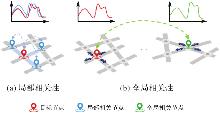
Fig. 2
Illustration of local and global correlation"
Fig. 3
Spatial distribution of traffic monitoring sites and the temporal variation of monitoring values at example monitoring sites on TR-Wuhan dataset"
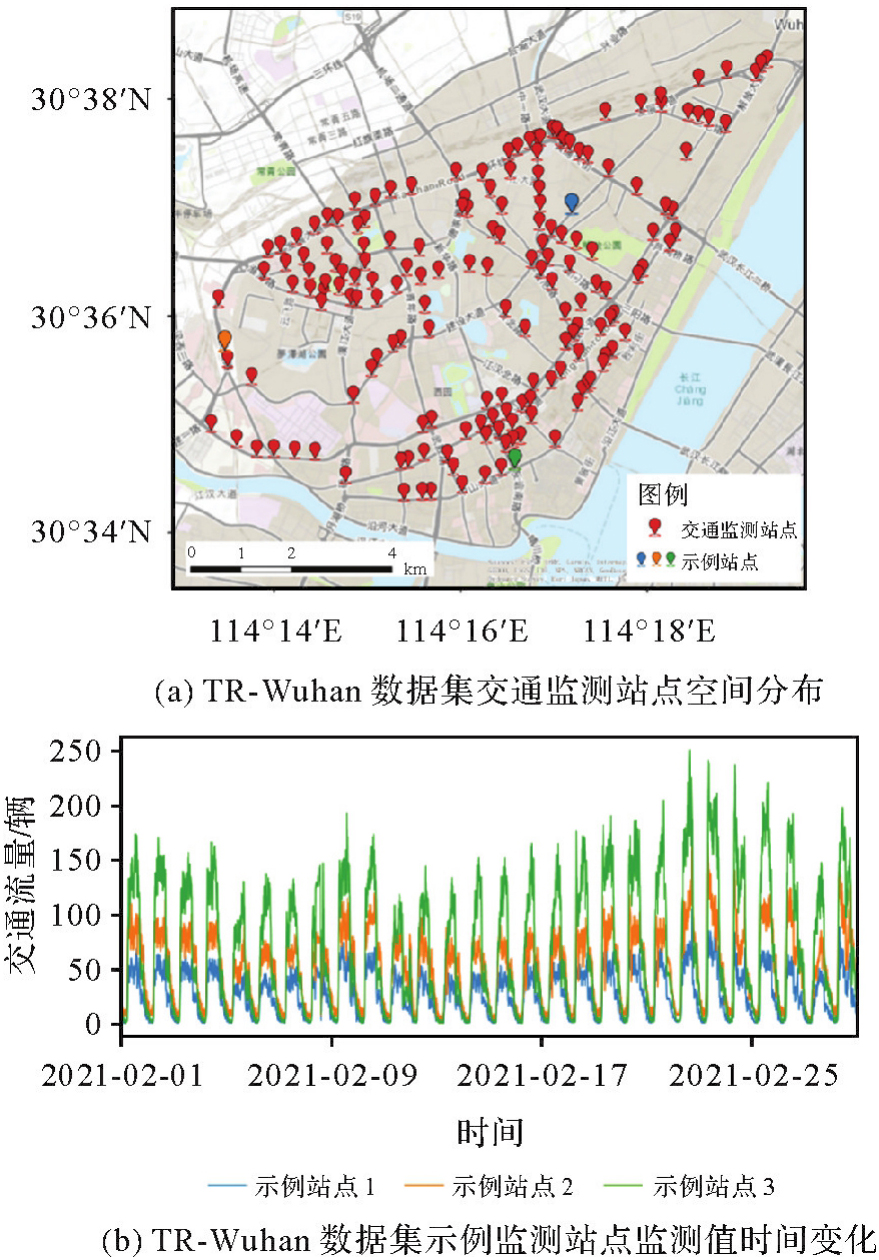
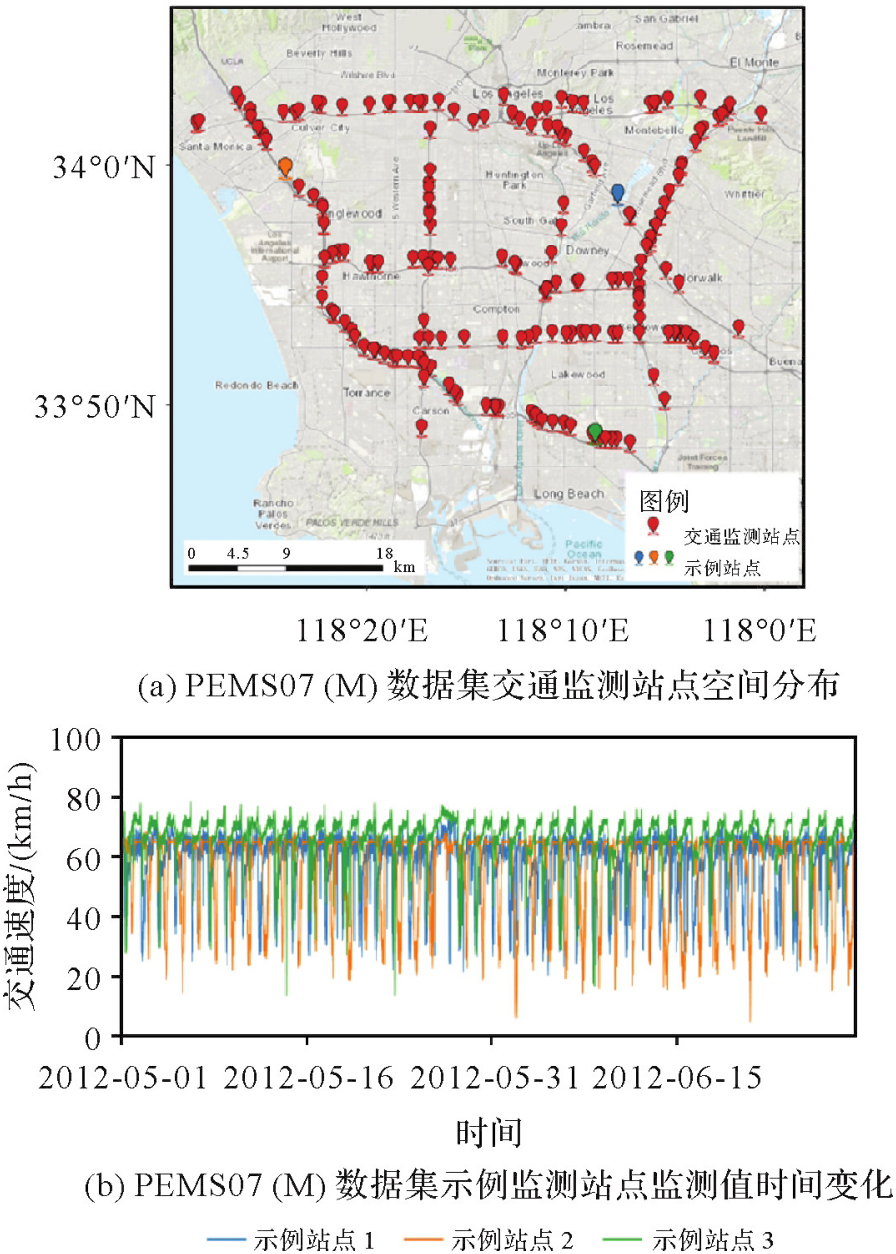
Fig. 4
Spatial distribution of traffic monitoring sites and the temporal variation of monitoring values at example monitoring sites on PEMS07(M) dataset"

Tab. 1
Descriptive statistics of the datasets"
| 数据集名称 | 预测变量 | 研究区域 | 时间间隔/min | 监测站点数量 | 时间步数量 | 时间跨度 |
|---|---|---|---|---|---|---|
| TR-Wuhan | 交通流量/辆 | 中国武汉市 | 5 | 175 | 8064 | 2021-02-01—2021-02-28 |
| PEMS07(M) | 交通速度/(km/h) | 美国加利福尼亚州 | 5 | 228 | 12 672 | 2012-05-01—2012-06-30 |
Tab. 2
Parameter setting of LGA-EL"
| 模型结构 | 参数名称 | 最优设置 |
|---|---|---|
| 局部-全局时空感知模块 | 局部嵌入向量维度el | 24/24 |
| 全局嵌入向量维度eg | 32/48 | |
| 多尺度时空融合层结构 | (64)/(64) | |
| 时空自适应加权模块 | 时空自适应加权网络结构 | (128,32)/(256,64) |
| 训练策略 | 损失函数超参数δ | 0.1/10 |
| 优化器 | Adam | |
| 随机失活率 | 0.2/0.1 | |
| 批处理大小 | 64 | |
| 学习率 | 5×10⁻⁵/1×10-4 |
Tab. 3
Comparison results of prediction performance across different methods on TR-Wuhan dataset"
| 类型 | 方法 | 短期预测任务(15 min) | 长期预测任务(60 min) | ||||
|---|---|---|---|---|---|---|---|
| MAE/辆 | RMSE/辆 | MAPE/(%) | MAE/辆 | RMSE/辆 | MAPE/(%) | ||
| 基模型 | STGCN | 4.079 | 7.445 | 16.869 | 7.756 | 15.259 | 28.210 |
| DCRNN | 4.353 | 8.041 | 17.065 | 7.155 | 14.348 | 27.062 | |
| GMAN | 4.862 | 8.926 | 18.887 | 7.558 | 14.831 | 28.201 | |
| 其他单一模型 | MTGNN | 4.014 | 7.551 | 16.812 | 7.070 | 14.133 | 26.402 |
| ASTGCN | 3.992 | 7.313 | 16.755 | 6.986 | 13.799 | 25.931 | |
| AGCRN | 3.963 | 7.271 | 16.193 | 6.891 | 13.151 | 25.314 | |
| 集成方法 | Avg-EL | 4.063 | 7.438 | 15.866 | 6.731 | 13.296 | 24.749 |
| AW-EL | 4.053 | 7.420 | 15.835 | 6.717 | 13.259 | 24.747 | |
| LinReg-EL | 4.010 | 7.379 | 15.856 | 6.689 | 13.316 | 24.792 | |
| GTWR-EL | 3.969 | 7.280 | 15.653 | 6.651 | 13.185 | 24.660 | |
| DDPG-EL | 3.962 | 7.292 | 15.711 | 6.647 | 13.232 | 24.772 | |
| MI-EL | 3.941 | 7.228 | 15.406 | 6.606 | 13.082 | 24.563 | |
| LGA-EL | 3.915 | 7.166 | 15.283 | 6.495 | 12.785 | 23.615 | |
Tab. 4
Comparison results of prediction performance across different methods on PEMS07(M) dataset"
| 类型 | 方法 | 短期预测任务(15 min) | 长期预测任务(60 min) | ||||
|---|---|---|---|---|---|---|---|
| MAE/(km/h) | RMSE/(km/h) | MAPE/(%) | MAE/(km/h) | RMSE/(km/h) | MAPE/(%) | ||
| 基模型 | STGCN | 1.799 | 3.286 | 4.133 | 2.984 | 5.825 | 7.315 |
| DCRNN | 1.780 | 3.386 | 4.023 | 2.993 | 6.094 | 7.364 | |
| GMAN | 1.826 | 3.264 | 4.206 | 2.837 | 5.257 | 7.028 | |
| 其他单一模型 | MTGNN | 1.716 | 3.144 | 4.170 | 2.758 | 5.291 | 6.723 |
| ASTGCN | 1.765 | 3.221 | 4.288 | 3.190 | 5.693 | 7.957 | |
| AGCRN | 1.683 | 3.160 | 3.958 | 2.696 | 5.371 | 6.708 | |
| 集成方法 | Avg-EL | 1.718 | 3.164 | 3.930 | 2.813 | 5.273 | 6.790 |
| AW-EL | 1.720 | 3.169 | 3.927 | 2.802 | 5.224 | 6.768 | |
| LinReg-EL | 1.723 | 3.158 | 3.927 | 2.797 | 5.204 | 6.635 | |
| GTWR-EL | 1.703 | 3.147 | 3.901 | 2.740 | 5.196 | 6.601 | |
| DDPG-EL | 1.695 | 3.122 | 3.859 | 2.771 | 5.193 | 6.624 | |
| MI-EL | 1.681 | 3.114 | 3.856 | 2.718 | 5.122 | 6.599 | |
| LGA-EL | 1.664 | 3.091 | 3.776 | 2.658 | 5.038 | 6.480 | |
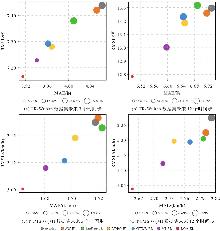
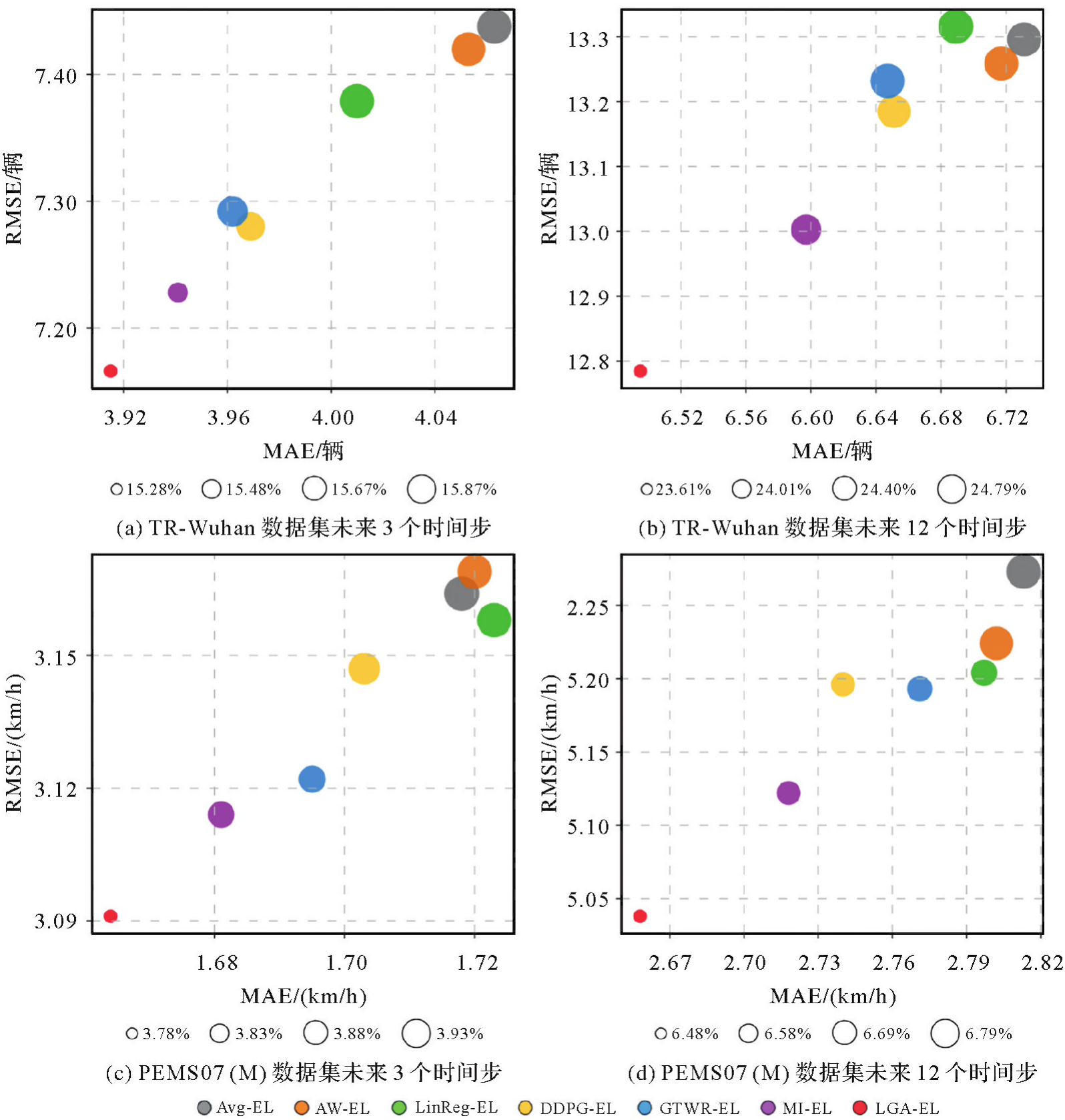
Fig. 5
Comparison of prediction errors between different ensemble methods"
Tab. 5
The improving percentages of LGA-EL compared to other ensemble methods"
| 数据集 | 方法 | 短期预测任务(15 min) | 长期预测任务(60 min) | ||||
|---|---|---|---|---|---|---|---|
| MAE | RMSE | MAPE | MAE | RMSE | MAPE | ||
| TR-Wuhan | Avg-EL | 3.645 | 3.654 | 3.675 | 3.499 | 3.848 | 4.583 |
| AW-EL | 3.395 | 3.414 | 3.486 | 3.302 | 3.577 | 4.575 | |
| LinReg-EL | 2.368 | 2.885 | 3.613 | 2.889 | 3.989 | 4.749 | |
| GTWR-EL | 1.355 | 1.567 | 2.363 | 2.338 | 3.035 | 4.238 | |
| DDPG-EL | 1.181 | 1.728 | 2.724 | 2.280 | 3.379 | 4.671 | |
| MI-EL | 0.654 | 0.853 | 0.798 | 1.532 | 1.679 | 3.473 | |
| 平均提升 | 2.100 | 2.350 | 2.776 | 2.640 | 3.251 | 4.382 | |
| PEMS07(M) | Avg-EL | 3.135 | 2.306 | 3.939 | 5.504 | 4.471 | 4.567 |
| AW-EL | 3.218 | 2.456 | 3.865 | 5.134 | 3.569 | 4.252 | |
| LinReg-EL | 3.414 | 2.140 | 3.846 | 4.975 | 3.200 | 2.330 | |
| GTWR-EL | 2.261 | 1.787 | 3.213 | 2.987 | 3.046 | 1.830 | |
| DDPG-EL | 1.800 | 1.001 | 2.160 | 4.072 | 2.990 | 2.171 | |
| MI-EL | 0.982 | 0.746 | 2.083 | 2.202 | 1.646 | 1.801 | |
| 平均提升 | 2.468 | 1.740 | 3.184 | 4.146 | 3.154 | 2.825 | |
Tab. 6
Computation cost of LGA-EL compared to other ensemble methods"
| 数据集名称 | 方法 | 参数量 | 训练时间/s | 预测时间/s |
|---|---|---|---|---|
| TR-Wuhan | DDPG-EL | 398 128 | 108.672 | 1.081 |
| MI-EL | 322 110 | 62.985 | 0.728 | |
| LGA-EL | 177 424 | 15.344 | 0.498 | |
| PEMS07(M) | DDPG-EL | 519 368 | 185.344 | 1.734 |
| MI-EL | 525 510 | 122.849 | 1.662 | |
| LGA-EL | 434 656 | 63.047 | 1.123 |
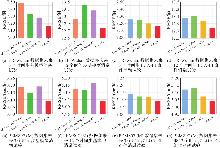
Fig. 6
Comparison results of ablation experiments for LGA-EL on the two datasets"
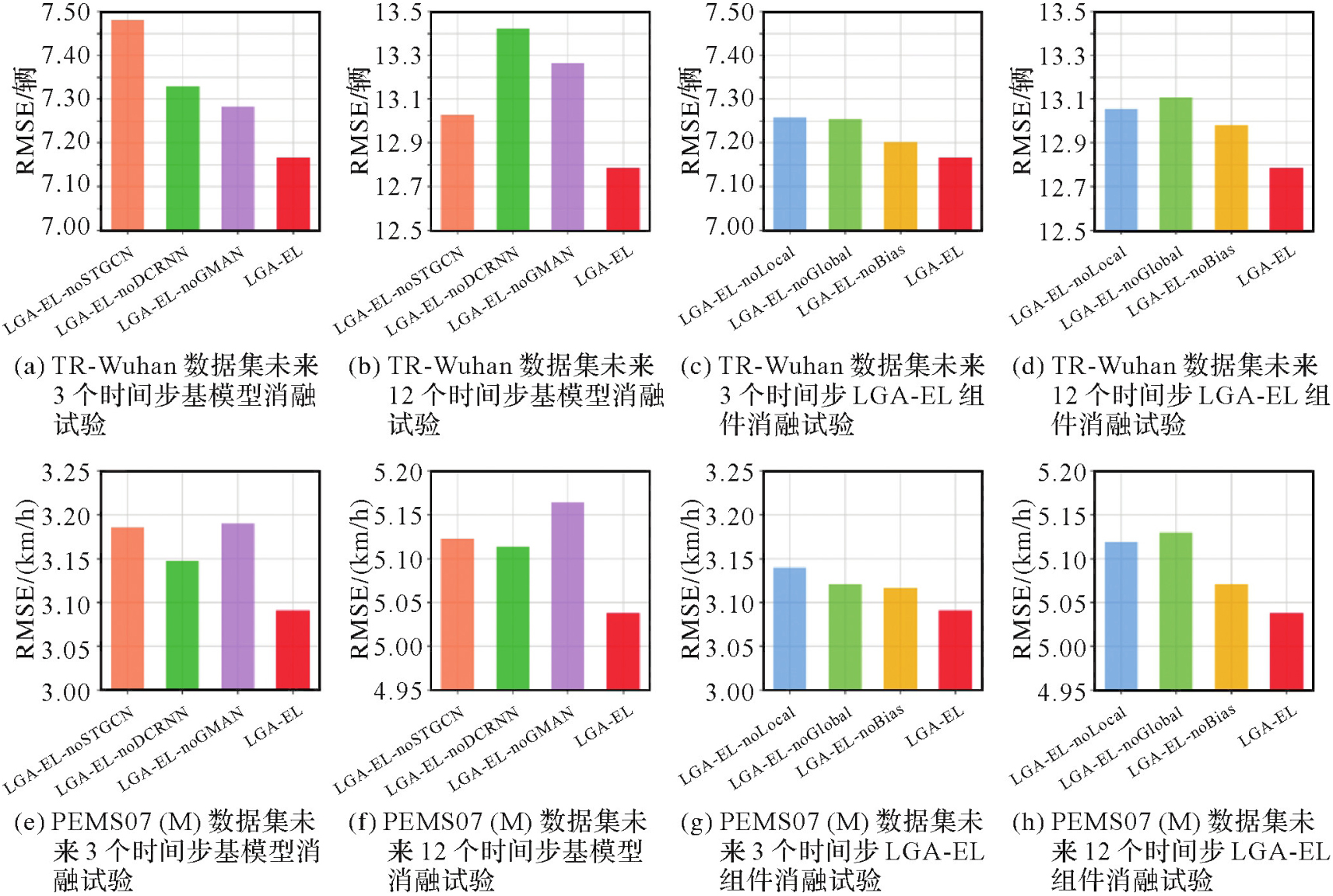
Fig. 7
Analysis of spatio-temporal context in ensemble process on TR-Wuhan dataset"
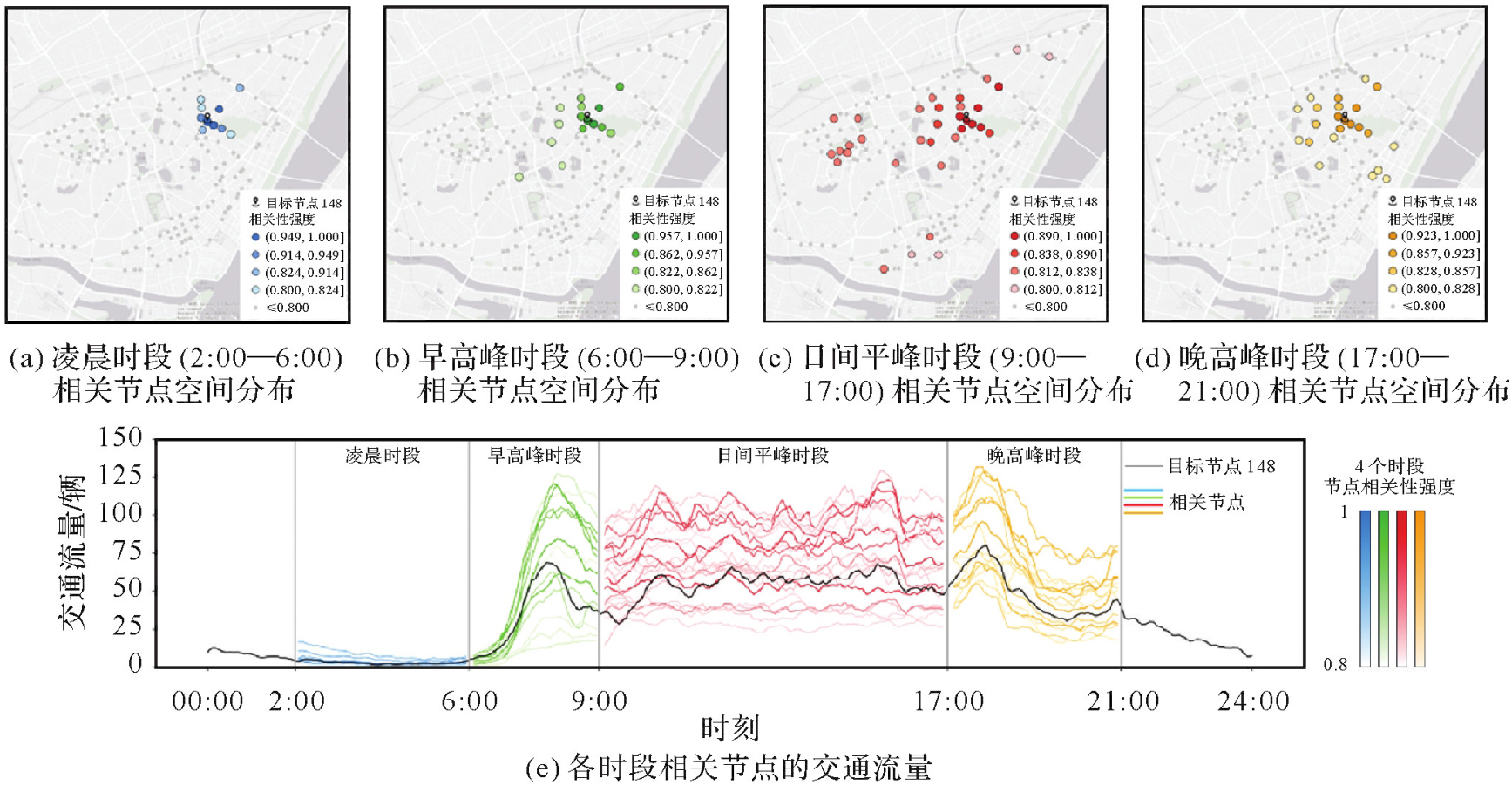
Fig. 8
Analysis of spatio-temporal context in ensemble process on PEMS07(M) dataset"
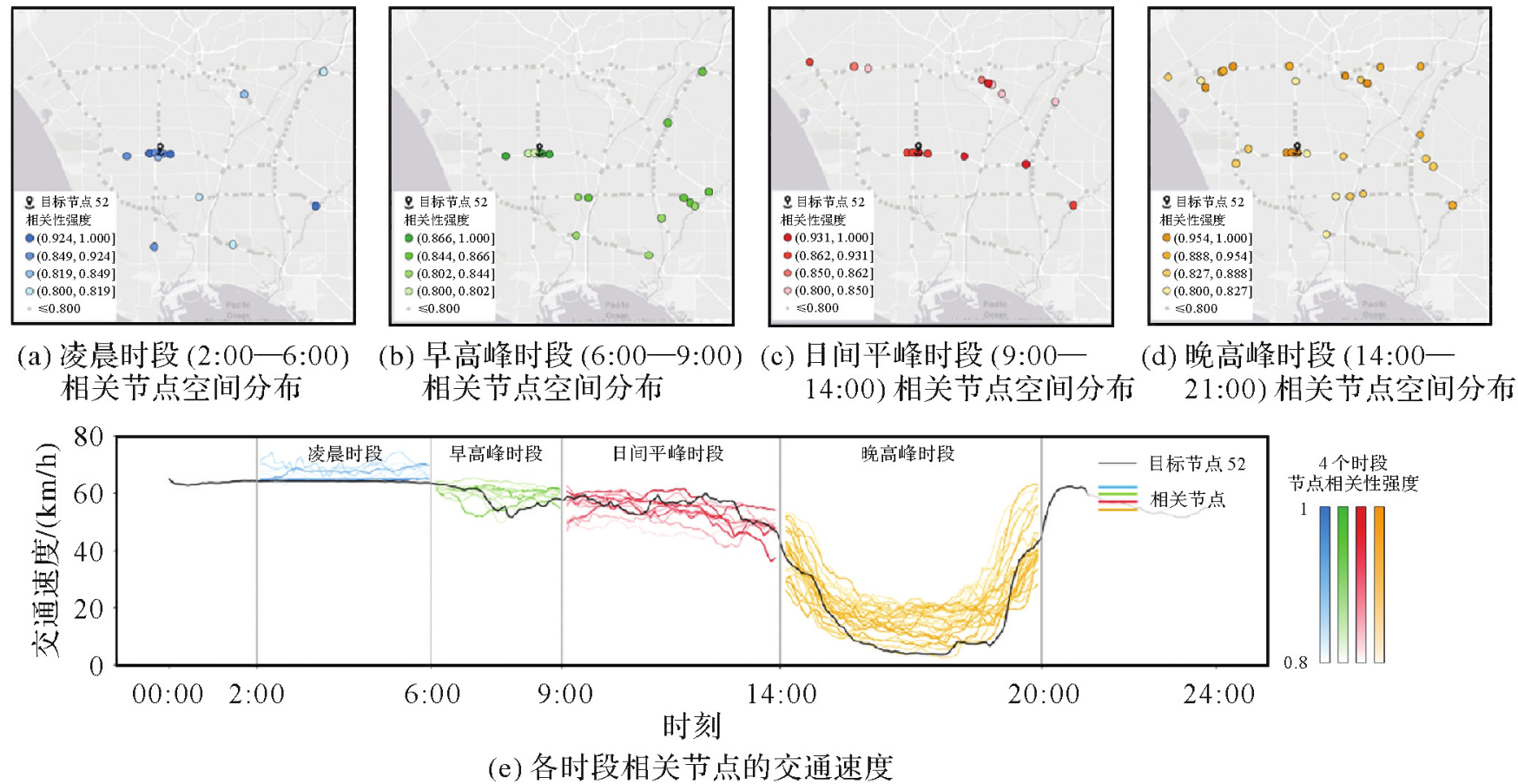
Fig. 9
Spatial analysis of adaptive ensemble weights for different graph nodes"
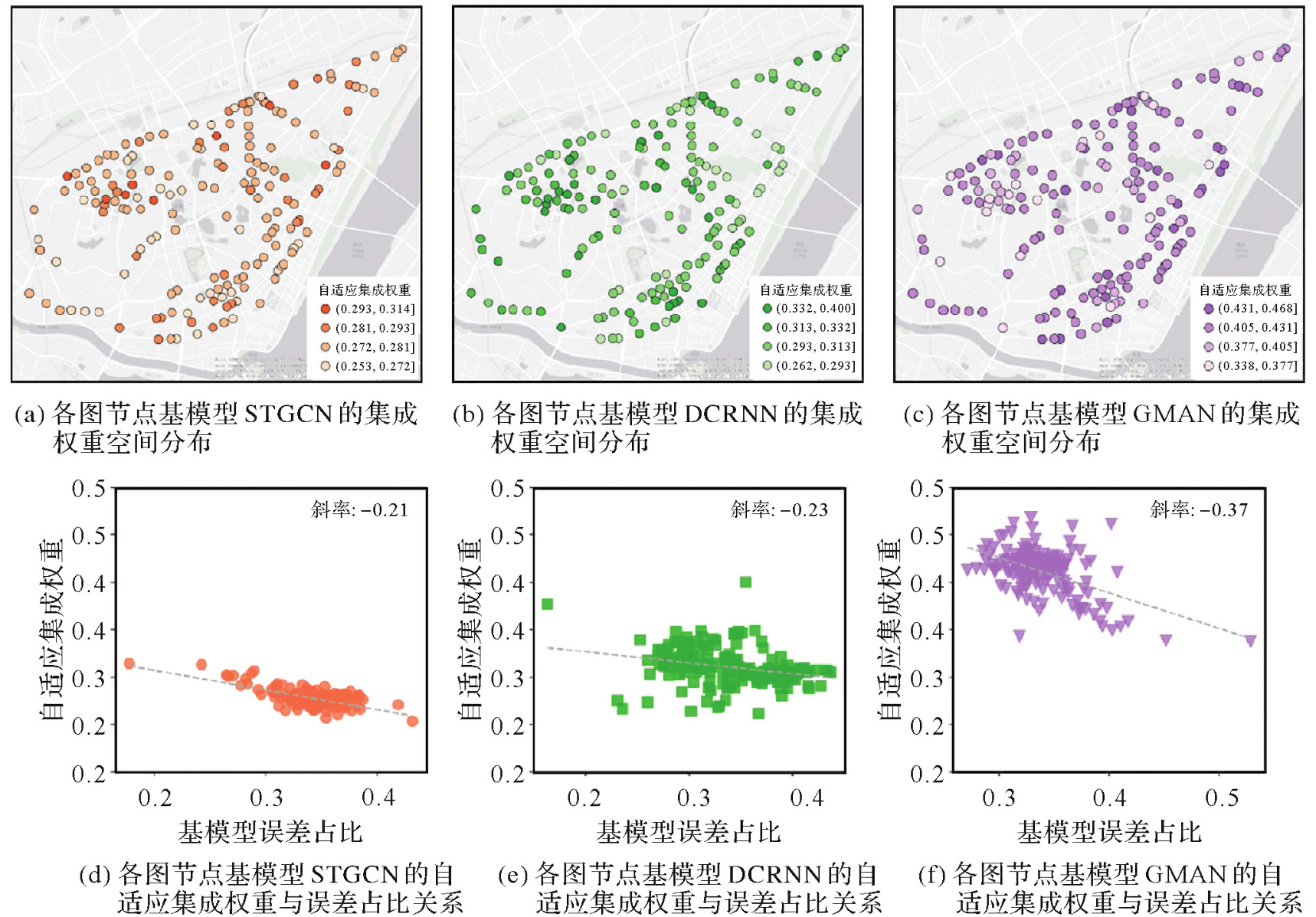
Fig. 10
Temporal analysis of adaptive ensemble weights for different prediction step"
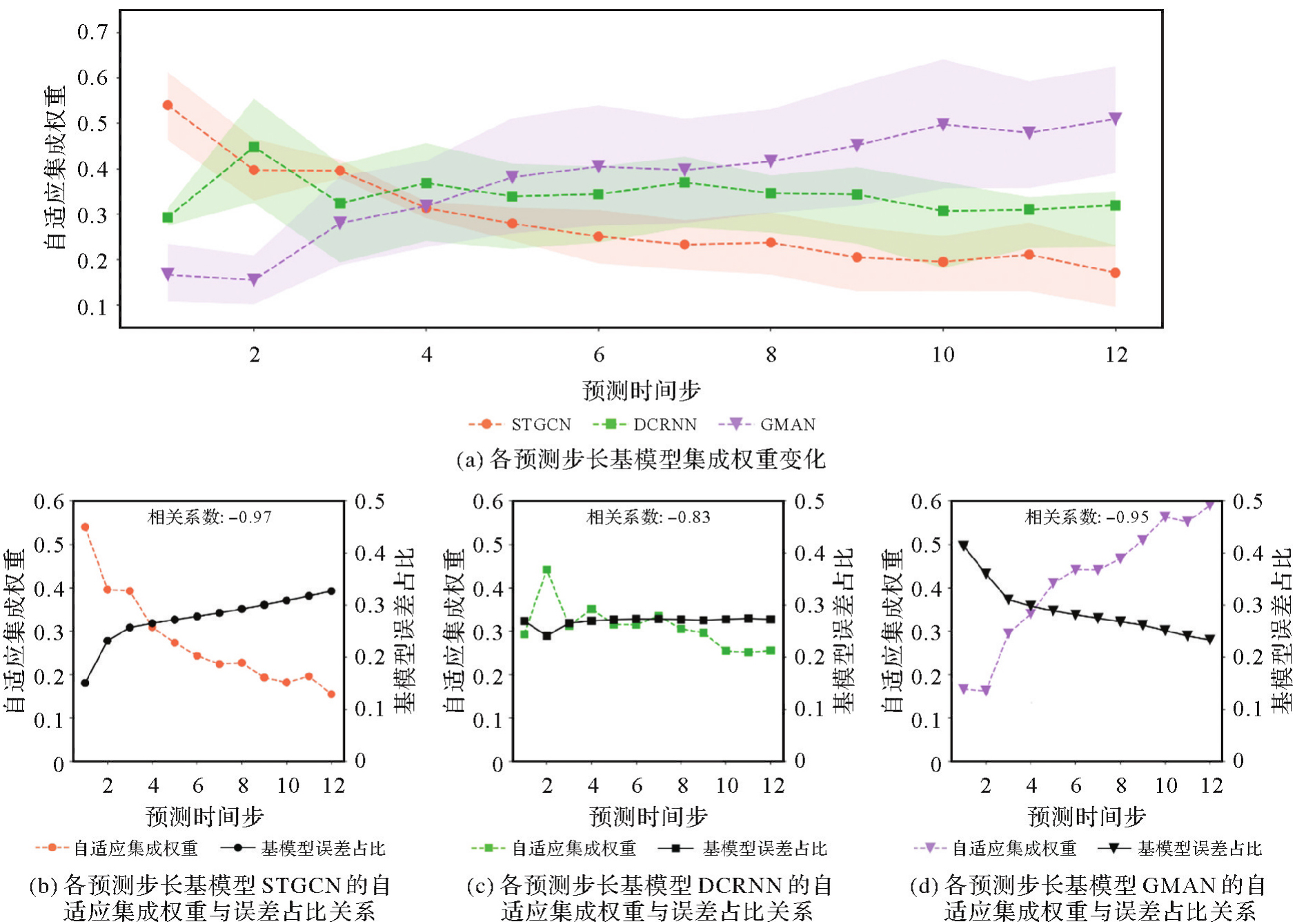
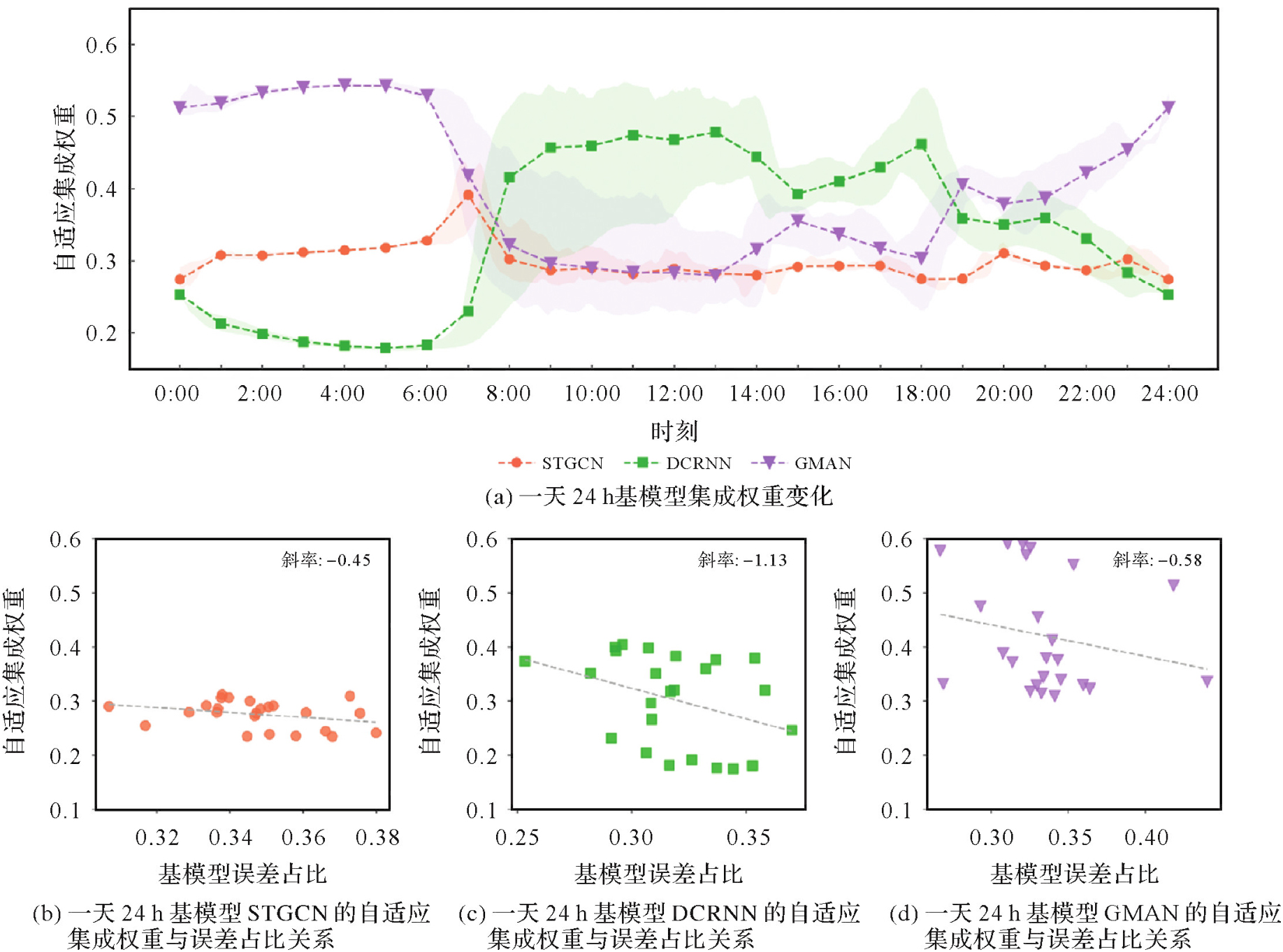
Fig. 11
Temporal analysis of adaptive ensemble weights for 24 h of a day"
| [1] | RAHMANI S, BAGHBANI A, BOUGUILA N, et al. Graph neural networks for intelligent transportation systems: a survey[J]. IEEE Transactions on Intelligent Transportation Systems, 2023, 24(8): 8846-8885. |
| [2] |
王建龙. 基于图过程神经网络的城市道路拥堵时空预测[J]. 测绘学报, 2024, 53(8): 1657. DOI: .
doi: 10.11947/j.AGCS.2024.20230167 |
|
WANG Jianlong. Spatio-temporal prediction of urban road congestion based on graph process neural network[J]. Acta Geodaetica et Cartographica Sinica, 2024, 53(8): 1657. DOI: .
doi: 10.11947/j.AGCS.2024.20230167 |
|
| [3] |
程涛, 张洋, James Haworth. 基于网络和图的时空智能:概念、方法和应用[J]. 测绘学报, 2022, 51(7): 1629-1639. DOI: .
doi: 10.11947/j.AGCS.2022.20220236 |
|
CHENG Tao, ZHANG Yang, HAWORTH James. Network and graph-based SpaceTimeAI: conception, method and applications[J]. Acta Geodaetica et Cartographica Sinica, 2022, 51(7): 1629-1639. DOI: .
doi: 10.11947/j.AGCS.2022.20220236 |
|
| [4] | CUI Haipeng, MENG Qiang, TENG T H, et al. Spatiotemporal correlation modelling for machine learning-based traffic state predictions: state-of-the-art and beyond[J]. Transport Reviews, 2023, 43(4): 780-804. |
| [5] | 王培晓, 张恒才, 张岩, 等. 地理空间智能预测研究进展与发展趋势[J]. 地球信息科学学报, 2025, 27(1): 60-82. |
| WANG Peixiao, ZHANG Hengcai, ZHANG Yan, et al. GeoAI-driven spatiotemporal prediction: progress and prospects[J]. Journal of Geo-information Science, 2025, 27(1): 60-82. | |
| [6] | WOLPERT D H, MACREADY W G. No free lunch theorems for optimization[J]. IEEE Transactions on Evolutionary Computation, 1997, 1(1): 67-82. |
| [7] | DU Zhenhong, WU Sensen, KWAN M P, et al. A spatiotemporal regression-Kriging model for space-time interpolation: a case study of Chlorophyll-a prediction in the coastal areas of Zhejiang, China[J]. International Journal of Geographical Information Science, 2018, 32(10): 1927-1947. |
| [8] |
邓敏, 彭翀, 谌恺祺. 顾及地理空间特性的空间面板数据可预测性评估理论与方法[J]. 测绘学报, 2025, 54(7): 1305-1317. DOI: .
doi: 10.11947/j.AGCS.2025.20240448 |
|
DENG Min, PENG Chong, CHEN Kaiqi. A predictability measurement methodology for spatial panel data considering geo-spatial effects[J]. Acta Geodaetica et Cartographica Sinica, 2025, 54(7): 1305-1317. DOI: .
doi: 10.11947/j.AGCS.2025.20240448 |
|
| [9] | 郭浩, 董磊, 邬伦, 等. 空间异质性建模方法[J]. 地理学报, 2025, 80(3): 567-585. |
| GUO Hao, DONG Lei, WU Lun, et al. Tackling spatial heterogeneity in geographical analysis: an overview[J]. Acta Geographica Sinica, 2025, 80(3): 567-585. | |
| [10] | MALLICK T, MACFARLANE J, BALAPRAKASH P. Uncertainty quantification for traffic forecasting using deep-ensemble-based spatiotemporal graph neural networks[J]. IEEE Transactions on Intelligent Transportation Systems, 2024, 25(8): 9141-9152. |
| [11] | LUO Yun, SU Shiliang. Spatiotemporal random forest and spatiotemporal stacking tree: a novel spatially explicit ensemble learning approach to modeling non-linearity in spatiotemporal non-stationarity[J]. International Journal of Applied Earth Observation and Geoinformation, 2025, 136: 104315. |
| [12] | SHAFIZADEH-MOGHADAM H, VALAVI R, SHAHABI H, et al. Novel forecasting approaches using combination of machine learning and statistical models for flood susceptibility mapping[J]. Journal of Environmental Management, 2018, 217: 1-11. |
| [13] | YAO Ronghan, ZHANG Wensong, ZHANG Lihui. Hybrid methods for short-term traffic flow prediction based on ARIMA-GARCH model and wavelet neural network[J]. Journal of Transportation Engineering, Part A: Systems, 2020, 146(8): 04020086. |
| [14] | GU Yuanli, LU Wenqi, XU Xinyue, et al. An improved Bayesian combination model for short-term traffic prediction with deep learning[J]. IEEE Transactions on Intelligent Transportation Systems, 2020, 21(3): 1332-1342. |
| [15] | CHEN Yuanyuan, CHEN Hongyu, YE Peijun, et al. Acting as a decision maker: traffic-condition-aware ensemble learning for traffic flow prediction[J]. IEEE Transactions on Intelligent Transportation Systems, 2022, 23(4): 3190-3200. |
| [16] | SHANG Pan, LIU Xinwei, YU Chengqing, et al. A new ensemble deep graph reinforcement learning network for spatio-temporal traffic volume forecasting in a freeway network[J]. Digital Signal Processing, 2022, 123: 103419. |
| [17] | MI Xiwei, YU Chengqing, LIU Xinwei, et al. A dynamic ensemble deep deterministic policy gradient recursive network for spatiotemporal traffic speed forecasting in an urban road network[J]. Digital Signal Processing, 2022, 129: 103643. |
| [18] | LIU Yang, LIU Zhiyuan, VU H L, et al. A spatio-temporal ensemble method for large-scale traffic state prediction[J]. Computer-Aided Civil and Infrastructure Engineering, 2020, 35(1): 26-44. |
| [19] | WANG Lizeng, CHENG Shifen, LU Feng. Decomposing spatio-temporal heterogeneity: matrix-informed ensemble learning for interpretable prediction[J]. Knowledge-Based Systems, 2025, 309: 112906. |
| [20] | 程诗奋, 彭澎, 张恒才, 等. 异质稀疏分布时空数据插值、重构与预测方法探讨[J]. 武汉大学学报(信息科学版), 2020, 45(12): 1919-1929. |
| CHENG Shifen, PENG Peng, ZHANG Hengcai, et al. Review of interpolation, reconstruction and prediction methods for heterogeneous and sparsely distributed geospatial data[J]. Geomatics and Information Science of Wuhan University, 2020, 45(12): 1919-1929. | |
| [21] | CHENG Shifen, WANG Lizeng, WANG Peixiao, et al. An ensemble spatial prediction method considering geospatial heterogeneity[J]. International Journal of Geographical Information Science, 2024, 38(9): 1856-1880. |
| [22] | LI Longxiang, BLOMBERG A J, STERN R A, et al. Predicting monthly community-level domestic radon concentrations in the greater Boston area with an ensemble learning model[J]. Environmental Science & Technology, 2021, 55(10): 7157-7166. |
| [23] | GUO Fangce, POLAK J W, KRISHNAN R. Predictor fusion for short-term traffic forecasting[J]. Transportation Research Part C: Emerging Technologies, 2018, 92: 90-100. |
| [24] | 朱阿兴, 闾国年, 周成虎, 等. 地理相似性:地理学的第三定律?[J]. 地球信息科学学报, 2020, 22(4): 673-679. |
| ZHU Axing, LÜ Guonian, ZHOU Chenghu, et al. Geographic similarity: third law of geography?[J]. Journal of Geo-information Science, 2020, 22(4): 673-679. | |
| [25] | LI Longxiang, BLOMBERG A J, LAWRENCE J, et al. A spatiotemporal ensemble model to predict gross beta particulate radioactivity across the contiguous United States[J]. Environment International, 2021, 156: 106643. |
| [26] | WANG Jingyuan, JIANG Jiawei, JIANG Wenjun, et al. LibCity: an open library for traffic prediction[C]//Proceedings of the 29th International Conference on Advances in Geographic Information Systems. New York: ACM Press, 2021: 145-148. |
| [27] | YU Bing, YIN Haoteng, ZHU Zhanxing. Spatio-temporal graph convolutional networks: a deep learning framework for traffic forecasting[C]//Proceedings of the 27th International Joint Conference on Artificial Intelligence. Stockholm: [s.n.], 2018: 3634-3640. |
| [28] | LI Yaguang, YU R, SHAHABI C, et al. Diffusion convolutional recurrent neural network: data-driven traffic forecasting[EB/OL]. [2025-12-18]. https://arxiv.org/abs/1707.0192. |
| [29] | ZHENG Chuanpan, FAN Xiaoliang, WANG Cheng, et al. GMAN: a graph multi-attention network for traffic prediction[J]. Proceedings of the AAAI Conference on Artificial Intelligence, 2020, 34(1): 1234-1241. |
| [30] | BELKIN M, NIYOGI P. Laplacian eigenmaps and spectral techniques for embedding and clustering[C]//Proceedings of 2001 Neural Information Processing Systems Conference. Cambridge: The MIT Press, 2001: 585-591. |
| [31] | HUBER P J. Robust estimation of a location parameter[M]//Breakthroughs in statistics: methodology and distribution. New York: Springer, 1992: 492-518. |
| [32] | XU Yi, HAN Liangzhe, ZHU Tongyu, et al. Generic dynamic graph convolutional network for traffic flow forecasting[J]. Information Fusion, 2023, 100: 101946. |
| [33] | SHEN Jinxing, LIU Qinxin, FENG Xuejun. Hourly PM2.5 concentration prediction for dry bulk port clusters considering spatiotemporal correlation: a novel deep learning blending ensemble model[J]. Journal of Environmental Management, 2024, 370: 122703. |
| [34] | WU Zonghan, PAN Shirui, LONG Guodong, et al. Connecting the dots: multivariate time series forecasting with graph neural networks[C]//Proceedings of the 26th ACM SIGKDD International Conference on Knowledge Discovery & Data Mining. New York: ACM Press, 2020: 753-763. |
| [35] | GUO Shengnan, LIN Youfang, FENG Ning, et al. Attention based spatial-temporal graph convolutional networks for traffic flow forecasting[C]//Proceedings of the 33rd AAAI Conference on Artificial Intelligence and 31st Innovative Applications of Artificial Intelligence Conference and 9th AAAI Symposium on Educational Advances in Artificial Intelligence. New York: ACM Press, 2019: 922-929. |
| [36] | BAI Lei, YAO Lina, LI Can, et al. Adaptive graph convolutional recurrent network for traffic forecasting[C]//Proceedings of the 34th International Conference on Neural Information Processing Systems. New York: ACM Press, 2020: 17804-17815. |
| [37] | FANG Zhice, WANG Yi, PENG Ling, et al. A comparative study of heterogeneous ensemble-learning techniques for landslide susceptibility mapping[J]. International Journal of Geographical Information Science, 2021, 35(2): 321-347. |
| [1] | Chao WU, Yongxiang LIANG, Han YUE, Yuanzheng CUI, Bo HUANG. Geographically and temporally weighted Poisson regression for count data [J]. Acta Geodaetica et Cartographica Sinica, 2025, 54(11): 2026-2039. |
| [2] | Yating LIU, Chuanfa CHEN. Landslide susceptibility evaluation method considering spatial heterogeneity and feature selection [J]. Acta Geodaetica et Cartographica Sinica, 2024, 53(7): 1417-1428. |
| [3] | Xuetao LI, Pancheng WANG, Yongnian ZENG. Urban impervious surface extraction based on the deep features of high-resolution remote sensing image and ensemble learning [J]. Acta Geodaetica et Cartographica Sinica, 2024, 53(4): 700-711. |
| [4] | FANG Mengyuan, TANG Luliang, YANG Xue, HU Chun. Fine-grained traffic information prediction at the turning-level based on low-frequency GNSS trajectory data [J]. Acta Geodaetica et Cartographica Sinica, 2021, 50(11): 1469-1477. |
| [5] | GU Yu, XU Ying, GUO Baofeng. Hyperspectral Image Classification by Combination of Spatial-spectral Features and Ensemble Extreme Learning Machines [J]. Acta Geodaetica et Cartographica Sinica, 2018, 47(9): 1238-1249. |
| Viewed | ||||||
|
Full text |
|
|||||
|
Abstract |
|
|||||
