

Acta Geodaetica et Cartographica Sinica ›› 2025, Vol. 54 ›› Issue (2): 334-344.doi: 10.11947/j.AGCS.2025.20230329
• Cartography and Geoinformation • Previous Articles Next Articles
Wei TU1,2,3( ), Xiangyuan CHI1,2,3, Tianhong ZHAO1,4(), Jian YANG5, Shiping ZHU6, Deli CHEN6
Received:2023-08-10
Online:2025-03-11
Published:2025-03-11
Contact:
Tianhong ZHAO
E-mail:tuwei@szu.edu.cn;zhaotianhong@sztu.edu.cn
About author:TU Wei (1984—), male, PhD, professor, majors in urban spatio-temporal big data analysis methods and applications. E-mail: tuwei@szu.edu.cn
Supported by:CLC Number:
Wei TU, Xiangyuan CHI, Tianhong ZHAO, Jian YANG, Shiping ZHU, Deli CHEN. Multi-view spatio-temporal graph convolutional networks model for urban drainage networks flow prediction[J]. Acta Geodaetica et Cartographica Sinica, 2025, 54(2): 334-344.
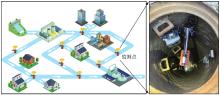
Fig. 1
The urban drainage network system"
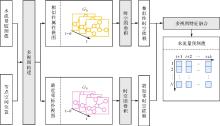
Fig. 2
Framework of the MVSTGCN model"
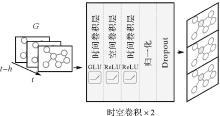
Fig. 3
Architecture of the spatio-temporal graph convolution module"
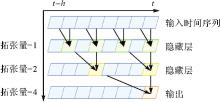
Fig. 4
Dilated causal convolution architecture for temporal dependency capture"
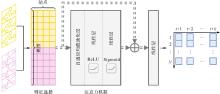
Fig. 5
The multi-view feature fusion module"
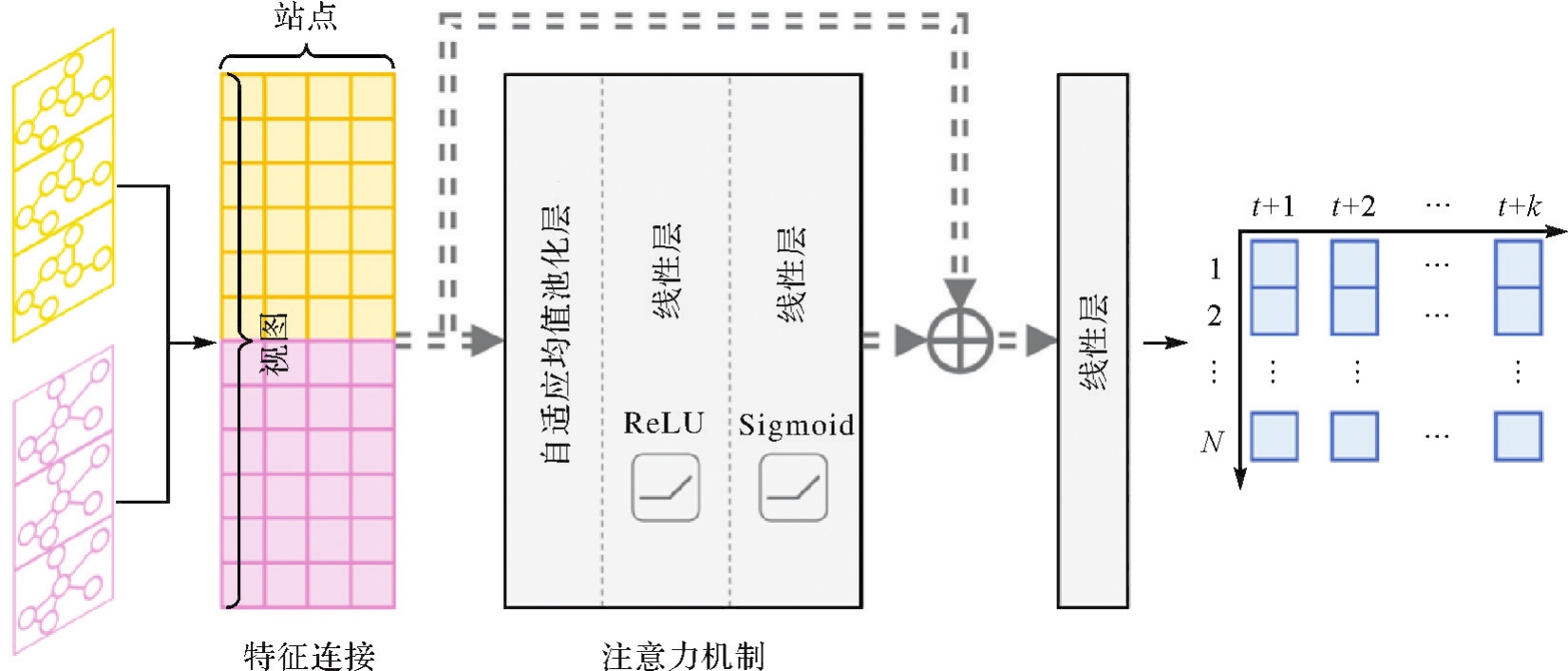
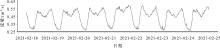
Fig. 6
The water flow monitoring value of station No.30 during a week"
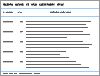
Tab. 1
Test dataset flow prediction accuracy"
| 未来时间跨度/min | MAPE | RMSE/(m3/s) |
|---|---|---|
| 15 | 0.097 | 0.075 |
| 30 | 0.102 | 0.078 |
| 45 | 0.106 | 0.080 |
| 60 | 0.111 | 0.083 |
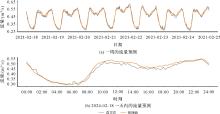
Fig. 7
Predict results for station No.30 during a week and its first day"

Tab. 2
Comparison of prediction accuracy results for different models"
| 模型 | MAPE | RMSE/(m3/s) | ||||||
|---|---|---|---|---|---|---|---|---|
| 15 min | 30 min | 45 min | 60 min | 15 min | 30 min | 45 min | 60 min | |
| ARIMA | 0.176 | 0.238 | 0.258 | 0.276 | 0.107 | 0.141 | 0.153 | 0.165 |
| RFR | 0.146 | 0.161 | 0.175 | 0.190 | 0.090 | 0.095 | 0.101 | 0.110 |
| LSTM | 0.155 | 0.152 | 0.155 | 0.149 | 0.106 | 0.108 | 0.109 | 0.112 |
| AutoEncoder | 0.142 | 0.138 | 0.146 | 0.152 | 0.105 | 0.104 | 0.103 | 0.106 |
| GWNet | 0.099 | 0.118 | 0.128 | 0.139 | 0.075 | 0.080 | 0.084 | 0.089 |
| AGCRN | 0.095 | 0.104 | 0.118 | 0.118 | 0.081 | 0.085 | 0.087 | 0.090 |
| MVSTGCN | 0.097 | 0.102 | 0.106 | 0.111 | 0.075 | 0.078 | 0.080 | 0.083 |
Tab. 3
Comparison of flow prediction accuracy results for different view combinations in MVSTGCN"
| 模型 | MAPE | RMSE/(m3/s) | ||||||
|---|---|---|---|---|---|---|---|---|
| 15 min | 30 min | 45 min | 60 min | 15 min | 30 min | 45 min | 60 min | |
| MVSTGCN | 0.097 | 0.102 | 0.106 | 0.111 | 0.075 | 0.078 | 0.080 | 0.083 |
| MVSTGCN-P | 0.104 | 0.105 | 0.111 | 0.118 | 0.082 | 0.082 | 0.084 | 0.089 |
| MVSTGCN-S | 0.104 | 0.104 | 0.108 | 0.117 | 0.080 | 0.081 | 0.082 | 0.087 |
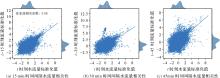
Fig. 8
The dependency of water flow on different time intervals"
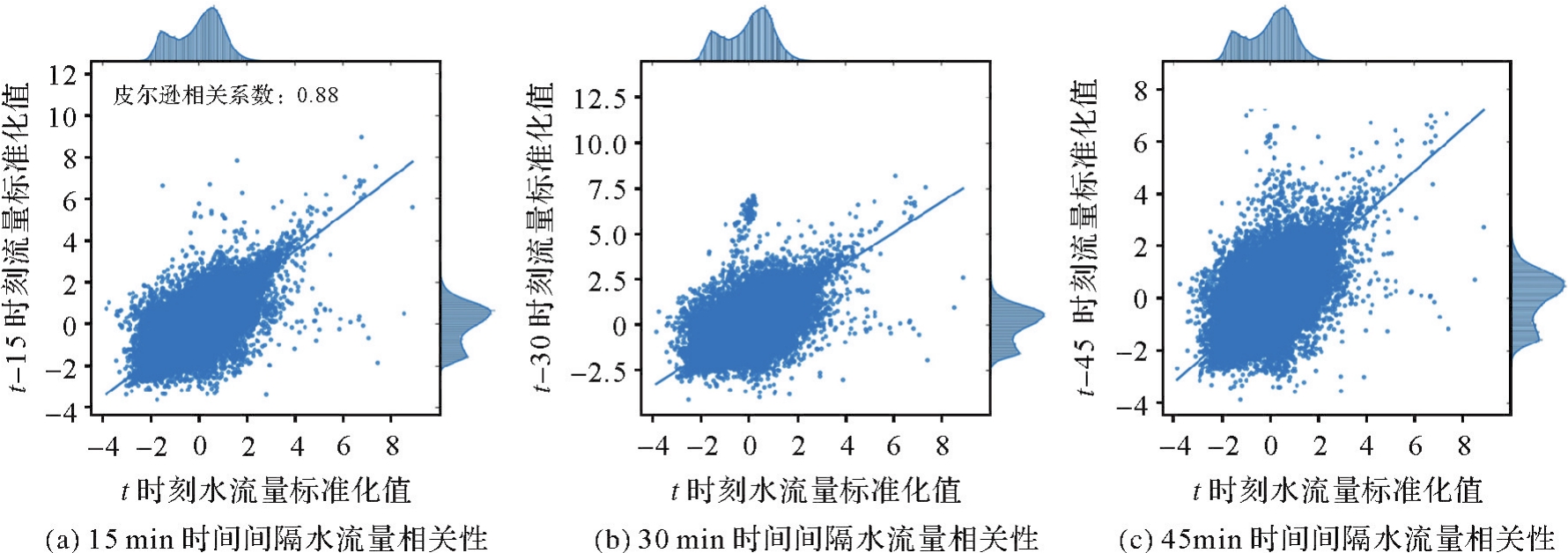
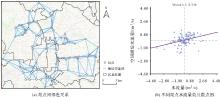
Fig. 9
The dependency of water flow between different observation stations"

| [1] | HUANG Dong, LIU Xiuhong, JIANG Songzhu, et al. Current state and future perspectives of sewer networks in urban China[J]. Frontiers of Environmental Science & Engineering, 2018, 12(3): 2. |
| [2] |
李清泉, 张德津, 汪驰升, 等. 动态精密工程测量技术及应用[J]. 测绘学报, 2021, 50(9): 1147-1158. DOI:.
doi: 10.11947/j.AGCS.2021.20210172 |
|
LI Qingquan, ZHANG Dejin, WANG Chisheng, et al. Technology and applications of dynamic and precise engineering surveying[J]. Acta Geodaetica et Cartographica Sinica, 2021, 50(9): 1147-1158. DOI:.
doi: 10.11947/j.AGCS.2021.20210172 |
|
| [3] | KHODASHENAS S R, TAJBAKHSH M. Management of urban drainage system using integrated MIKE SWMM and GIS[J]. Journal of Water Resource and Hydraulic Engineering, 2016, 5(1): 36-45. |
| [4] | VAN DER VOORT M, DOUGHERTY M, WATSON S. Combining Kohonen maps with ARIMA time series models to forecast traffic flow[J]. Transportation Research Part C: Emerging Technologies, 1996, 4(5): 307-318. |
| [5] | WANG Hao, SONG Lixiang. Water level prediction of rainwater pipe network using an SVM-based machine learning method[J]. International Journal of Pattern Recognition and Artificial Intelligence, 2020, 34(2): 2051002. |
| [6] | KARIMI H S, NATARAJAN B, RAMSEY C L, et al. Comparison of learning-based wastewater flow prediction methodologies for smart sewer management[J]. Journal of Hydrology, 2019, 577: 123977. |
| [7] | ZHANG Duo, LINDHOLM G, RATNAWEERA H. Use long short-term memory to enhance Internet of Things for combined sewer overflow monitoring[J]. Journal of Hydrology, 2018, 556: 409-418. |
| [8] | 夏巍, 汪石, 梁祥莹. 基于改进GRU的城市供水管网流量预测研究[J]. 安徽建筑大学学报, 2023, 31(2): 51-54. |
| XIA Wei, WANG Shi, LIANG Xiangying. Research on flow forecasting methods for urban water supply network based on improved GRU[J]. Journal of Anhui Jianzhu University, 2023, 31(2): 51-54. | |
| [9] | 李双宇, 张明凯, 刘艳臣, 等. 基于LSTM模型的排水系统流量预测研究[J]. 中国给水排水, 2022, 38(5): 59-64. |
| LI Shuangyu, ZHANG Mingkai, LIU Yanchen, et al. Flow prediction of drainage system based on long short time memory model[J]. China Water & Wastewater, 2022, 38(5): 59-64. | |
| [10] | NGUYEN L V, TORNYEVIADZI H M, BUI D T, et al. Predicting discharges in sewer pipes using an integrated long short-term memory and entropy A-TOPSIS modeling framework[J]. Water, 2022, 14(3): 300. |
| [11] | SHENG Zheng, CAI Zhikai. GAT-GRU based model for water network flow prediction[C]//Proceedings of the 9th International Conference on Water Resource and Environment. Singapore: Springer, 2024: 151-162. |
| [12] | REN Yibin, CHEN Huanfa, HAN Yong, et al. A hybrid integrated deep learning model for the prediction of citywide spatio-temporal flow volumes[J]. International Journal of Geographical Information Science, 2020, 34(4): 802-823. |
| [13] |
于洋洋, 贺康杰, 武芳, 等. 面状居民地形状分类的图卷积神经网络方法[J]. 测绘学报, 2022, 51(11): 2390-2402. DOI:.
doi: 10.11947/j.AGCS.2022.20210134 |
|
YU Yangyang, HE Kangjie, WU Fang, et al. Graph convolution neural network method for shape classification of areal settlements[J]. Acta Geodaetica et Cartographica Sinica, 2022, 51(11): 2390-2402. DOI:.
doi: 10.11947/j.AGCS.2022.20210134 |
|
| [14] |
李静, 刘海砚, 郭文月, 等. 基于深度学习的人群活动流量时空预测模型[J]. 测绘学报, 2021, 50(4): 522-531. DOI:.
doi: 10.11947/j.AGCS.2021.20200230 |
|
LI Jing, LIU Haiyan, GUO Wenyue, et al. A spatio-temporal network for human activity prediction based on deep learning[J]. Acta Geodaetica et Cartographica Sinica, 2021, 50(4): 522-531. DOI:.
doi: 10.11947/j.AGCS.2021.20200230 |
|
| [15] | 井佩光, 田雨豆, 汪少初, 等. 基于动态扩散图卷积的交通流量预测算法[J]. 吉林大学学报(工学版), 2024, 54(6): 1582-1592. |
| JING Peiguang, TIAN Yudou, WANG Shaochu, et al. Traffic flow prediction algorithm based on dynamic diffusion graph convolution[J]. Journal of Jilin University (Engineering and Technology Edition), 2024, 54(6): 1582-1592. | |
| [16] | LIAO Ziyi, LIU Minghui, DU Bowen, et al. A temporal and spatial prediction method for urban pipeline network based on deep learning[J]. Physica A: Statistical Mechanics and Its Applications, 2022, 608: 128299. |
| [17] | YU Bing, YIN Haoteng, ZHU Zhanxing. Spatio-temporal graph convolutional networks: a deep learning framework for traffic forecasting[EB/OL]. [2023-05-04]. https://arxiv.org/abs/1709.04875v4. |
| [18] | WU Shaofei. Spatiotemporal dynamic forecasting and analysis of regional traffic flow in urban road networks using deep learning convolutional neural network[J]. IEEE Transactions on Intelligent Transportation Systems, 2022, 23(2): 1607-1615. |
| [19] | LIU Zhichen, LIU Zhiyuan, FU Xiao. Dynamic origin-destination flow prediction using spatial-temporal graph convolution network with mobile phone data[J]. IEEE Intelligent Transportation Systems Magazine, 2022, 14(5): 147-161. |
| [20] | RAWAT W, WANG Zenghui. Deep convolutional neural networks for image classification: a comprehensive review[J]. Neural Computation, 2017, 29(9): 2352-2449. |
| [21] | DAUPHIN Y N, FAN A, AULI M, et al. Language modeling with gated convolutional networks[C]//Proceedings of the 34th International Conference on Machine Learning. Sydney: JMLR, 2017: 933-941. |
| [22] | KIPF T N, WELLING M. Semi-supervised classification with graph convolutional networks[EB/OL]. [2023-05-04]. https://arxiv.org/abs/1609.02907v4. |
| [23] | VASWANI A, SHAZEER N, PARMAR N, et al. Attention is all you need[C]//Proceedings of the 31st International Conference on Neural Information Processing Systems. Red Hook: Curran Associates Inc., 2017: 1-11. |
| [24] | GUO Shengnan, LIN Youfang, FENG Ning, et al. Attention based spatial-temporal graph convolutional networks for traffic flow forecasting[C]//Proceedings of 2019 AAAI Conference on Artificial Intelligence. Honolulu: AAAI Press, 2019: 922-929. |
| [25] | NGUYEN N, QUANZ B. Temporal latent auto-encoder: a method for probabilistic multivariate time series forecasting[EB/OL]. [2023-05-04]. https://ojs.aaai.org/index.php/AAAI/article/download/17101/16908. |
| [26] | WU Zonghan, PAN Shirui, LONG Guodong, et al. Graph wavenet for deep spatial-temporal graph modeling[C]//Proceedings of the 28th International Joint Conference on Artificial Intelligence. Macao: ACM Press, 2019: 1907-1913. |
| [27] | BAI Lei, YAO Lina, LI Can, et al. Adaptive graph convolutional recurrent network for traffic forecasting[C]//Proceedings of the 34th International Conference on Neural Information Processing Systems. Vancouver: ACM Press, 2020: 17804-17815. |
| [28] | WUNSCH A, LIESCH T, BRODA S. Forecasting groundwater levels using nonlinear autoregressive networks with exogenous input (NARX)[J]. Journal of Hydrology, 2018, 567: 743-758. |
| [1] | Mingguang WU, Ziming CHENG. Color generation method for green maps considering use contexts [J]. Acta Geodaetica et Cartographica Sinica, 2026, 55(3): 390-403. |
| [2] | Min YANG, Hongran MA, Bo KONG, Pengcheng LIU, Tinghua AI. A pre-trained model-based method for discriminating morphological patterns of vector-based coastlines [J]. Acta Geodaetica et Cartographica Sinica, 2026, 55(3): 404-414. |
| [3] | Wenhao YU, Ziyi ZENG, Yifan ZHANG, Haizhong QIAN. Road network grid pattern analysis using a pre-trained model fusing spatial and topological information [J]. Acta Geodaetica et Cartographica Sinica, 2026, 55(3): 415-424. |
| [4] | Xiaomin LU, Zhiyi ZHANG, Haowen YAN, Yi HE, Xiaoning SU. A recognition method for building group pattern integrating deep graph infomax and multilayer perceptron [J]. Acta Geodaetica et Cartographica Sinica, 2026, 55(3): 425-438. |
| [5] | Xiaoqiang CHENG, Jiawei ZHAO, Pengcheng LIU. Spatial interaction visualization based on the distance-similarity metaphor [J]. Acta Geodaetica et Cartographica Sinica, 2026, 55(3): 536-547. |
| [6] | Zejiao WANG, Longgang XIANG, Meng WANG, Xingjuan WANG, Qing LIU. Hierarchical feature and diversified attention fusion network for collaborative extraction of road surface and centerline [J]. Acta Geodaetica et Cartographica Sinica, 2026, 55(3): 548-563. |
| [7] | Zhibang XU. Hierarchical boundary identification, pattern analysis and expansion simulation of physical cities [J]. Acta Geodaetica et Cartographica Sinica, 2026, 55(3): 566-566. |
| [8] | Yunbo RAN, Xue YANG, Wenhao ZHOU, Chengen WU, Baoding ZHOU, Luliang TANG, Qingquan LI. Pedestrian path planning driven by preference-enhanced adversarial deep reinforcement learning [J]. Acta Geodaetica et Cartographica Sinica, 2026, 55(2): 191-205. |
| [9] | Lizeng WANG, Shifen CHENG, Yitao YANG, Peixiao WANG, Feng LU. LGA-EL: a spatio-temporal adaptive ensemble method with local-global awareness for traffic prediction [J]. Acta Geodaetica et Cartographica Sinica, 2026, 55(2): 206-221. |
| [10] | Shaohua WANG, Haojian LIANG, Cheng SU, Dachuan XU, Liang ZHOU, Kun QIN. Advances and prospects in urban facility allocation optimization through coupling spatio-temporal big data and artificial intelligence [J]. Acta Geodaetica et Cartographica Sinica, 2026, 55(2): 222-235. |
| [11] | Xiao FU, Sirui ZHU, Xudong LI, Guonian LÜ. An optimization method for the layout of urban vertiports in long-distance commuting scenarios [J]. Acta Geodaetica et Cartographica Sinica, 2026, 55(2): 236-248. |
| [12] | Junhao GUO, Mingzhi WU, Peixiao WANG, Hengcai ZHANG. A dual-threshold stay point detection method based on adaptive extended density peak clustering for sparse fixed-point trajectories [J]. Acta Geodaetica et Cartographica Sinica, 2026, 55(2): 249-260. |
| [13] | Guannan LI. Method for automatic construction of three dimensional real scene model of the road [J]. Acta Geodaetica et Cartographica Sinica, 2026, 55(2): 378-378. |
| [14] | Pengcheng LIU, Xiaoqiang CHENG, Tianyuan XIAO, Min YANG, Tinghua AI. A Transformer model for building polygon simplification in map generalization [J]. Acta Geodaetica et Cartographica Sinica, 2026, 55(1): 124-137. |
| [15] | Biao HE, Haojia LIN, Renzhong GUO, Xi KUAI, Ding MA, Chen ZHANG. Visual perception-based quantitative calculation of 3D spatial similarity relations [J]. Acta Geodaetica et Cartographica Sinica, 2026, 55(1): 138-153. |
| Viewed | ||||||
|
Full text |
|
|||||
|
Abstract |
|
|||||
