

Acta Geodaetica et Cartographica Sinica ›› 2025, Vol. 54 ›› Issue (11): 2081-2096.doi: 10.11947/j.AGCS.2025.20250202
• Cartography and Geoinformation • Previous Articles Next Articles
Xinyu YE1,2( ), Shenghua XU1(), Jiping LIU1, Hongyu CHEN1,2, Zhuolu WANG3, Weilian LI2,4
Received:2025-06-12
Revised:2025-10-30
Online:2025-12-15
Published:2025-12-15
Contact:
Shenghua XU
E-mail:yxy01@my.swjtu.edu.cn;xushh@casm.ac.cn
About author:YE Xinyu (2001—), male, postgraduate, majors in POI recommendation. E-mail: yxy01@my.swjtu.edu.cn
Supported by:CLC Number:
Xinyu YE, Shenghua XU, Jiping LIU, Hongyu CHEN, Zhuolu WANG, Weilian LI. Next point of interest recommendation based on spatio-temporal causal inference[J]. Acta Geodaetica et Cartographica Sinica, 2025, 54(11): 2081-2096.
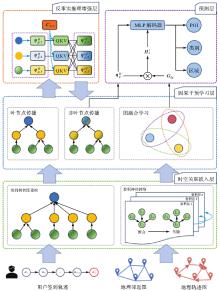
Fig. 1
Framework of STCIN model"

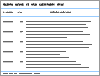
Tab. 1
Nodes symbol"
| 符号 | 描述 |
|---|---|
 | 用户签到记录 |
 | 时空动态特征 |
 | 用户偏好特征 |
 | 上下文特征 |
 | 用户时空状态 |
 | 预测目标 |
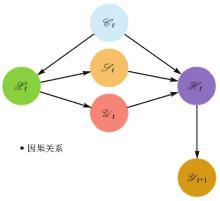
Fig. 2
Directed acyclic graph for the next POI recommendation"
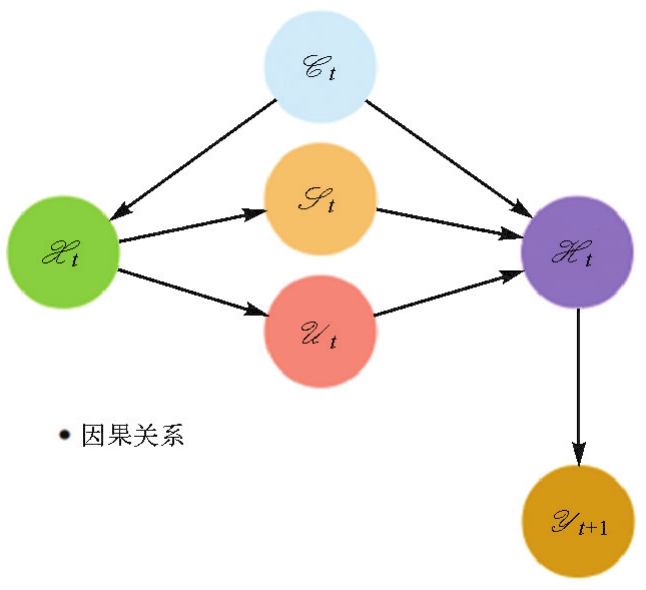
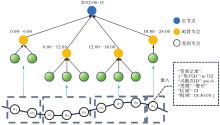
Fig. 3
Tree-structured check-in graph embedding"

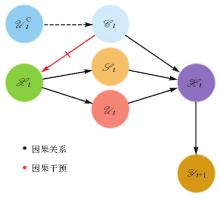
Fig. 4
Directed acyclic graph with causal intervention"
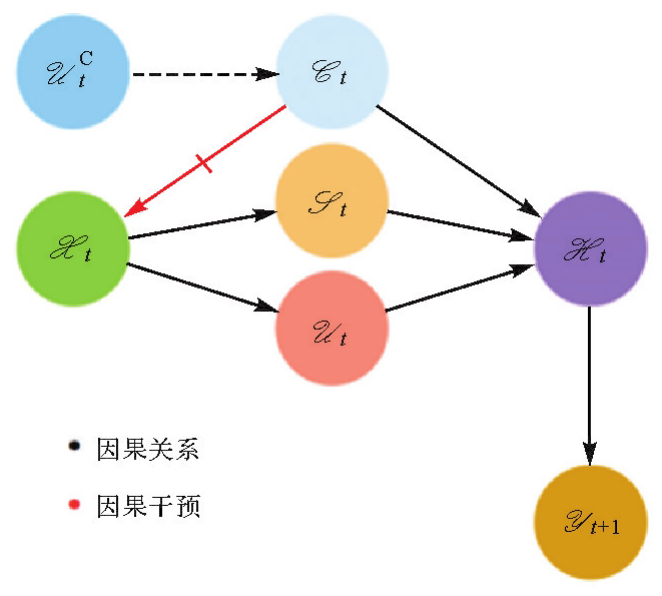

Fig. 5
Propagation of node information"


Fig. 6
Directed acyclic graph with causal intervention and counterfactual reasoning"
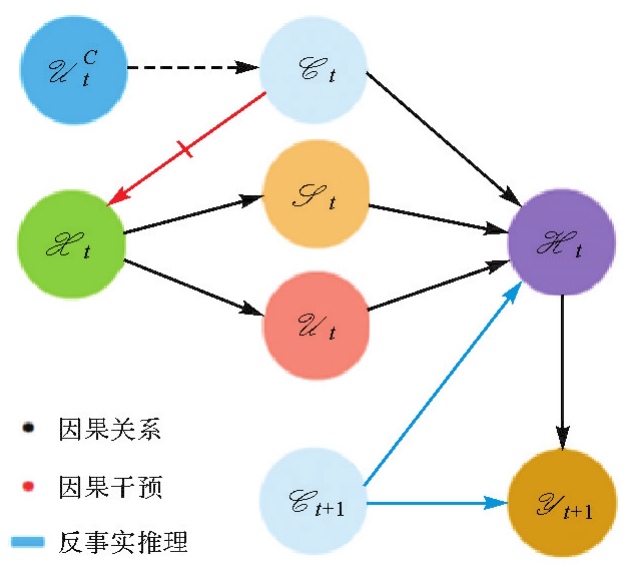
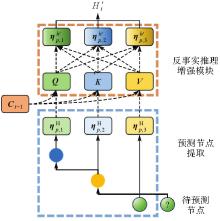
Fig. 7
Enhancement layer of counterfactual reasoning"
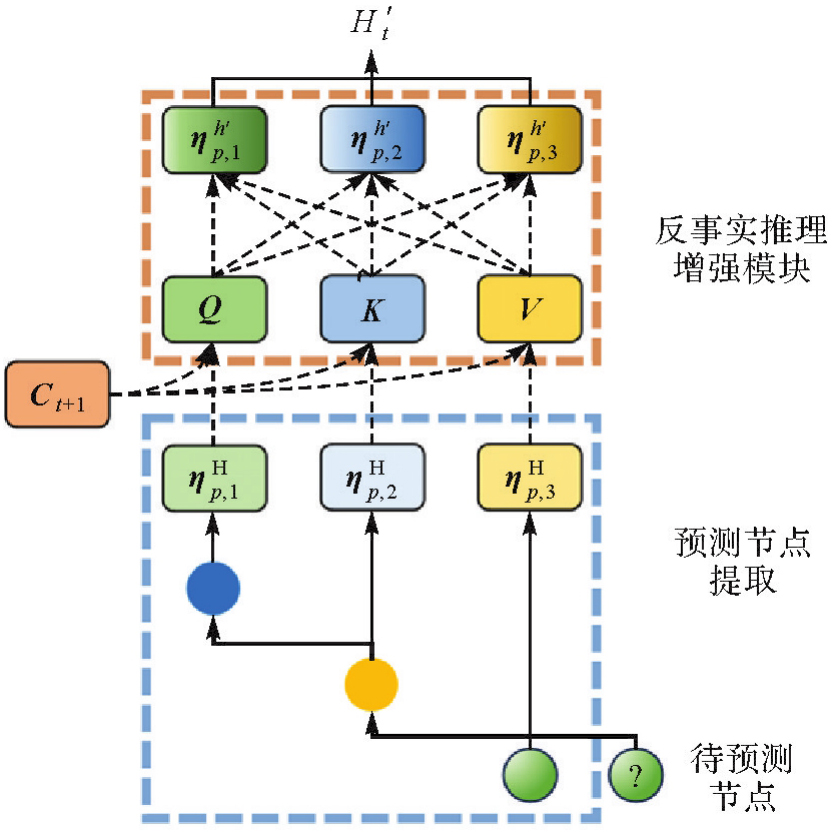
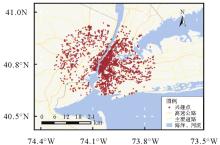
Fig. 8
POI distribution of NYC dataset"


Fig. 9
POI distribution of TKY dataset"

Tab. 2
Dataset example"
| 用户 | POI | POI类别 | POI类别名称 | 签到时间戳 | 经度 | 纬度 |
|---|---|---|---|---|---|---|
| 71 | 481dfa3af964a5207f4f1fe3 | 4bf58dd8d48988d1fa931735 | Hotel(酒店) | 2012-04-03 | 73.99°W | 40.75°N |
| 20:08:03 | ||||||
| 65 | 4d66b1ef84f28cfa548a6e69 | 4bf58dd8d48988d153941735 | Burrito Place(卷饼店) | 2012-04-03 | 73.99°W | 40.81°N |
| 20:09:55 | ||||||
| 592 | 4b44a049f964a5201cf825e3 | 4bf58dd8d48988d1fd931735 | Subway(地铁) | 2012-04-03 | 74.01°W | 40.71°N |
| 20:11:13 | ||||||
| 267 | 4e2bada17d8b7deda6d3fda6 | 4f2a25ac4b909258e854f55f | Neighborhood(街区) | 2012-04-03 | 73.83°W | 40.87°N |
| 20:11:28 | ||||||
| 976 | 4b5ca9dcf964a520f83c29e3 | 4bf58dd8d48988d1fd931735 | Subway(地铁) | 2012-04-03 | 73.93°W | 40.70°N |
| 20:11:45 |
Tab. 3
Statistical information of datasets"
| 数据集 | 用户数 | POI类别数 | POI数 | 签到数 | 轨迹数 |
|---|---|---|---|---|---|
| NYC数据集 | 1075 | 318 | 5099 | 104 074 | 14 160 |
| TKY数据集 | 2281 | 291 | 7844 | 361 430 | 44 692 |
Tab. 4
Performance comparison of comparative models on the accuracy (Acc@k) and mean reciprocal rank (MRR) metrics"
| 模型 | NYC数据集 | TKY数据集 | ||||||
|---|---|---|---|---|---|---|---|---|
| Acc@1 | Acc@5 | Acc@10 | MRR | Acc@1 | Acc@5 | Acc@10 | MRR | |
| FPMC | 0.100 3 | 0.212 6 | 0.297 0 | 0.170 1 | 0.081 4 | 0.204 5 | 0.274 6 | 0.134 4 |
| PRME | 0.115 9 | 0.223 6 | 0.310 5 | 0.171 2 | 0.105 2 | 0.272 8 | 0.294 4 | 0.178 6 |
| LSTM | 0.130 5 | 0.271 9 | 0.328 3 | 0.185 7 | 0.133 5 | 0.272 8 | 0.327 7 | 0.183 4 |
| ST-RNN | 0.148 3 | 0.292 3 | 0.362 2 | 0.219 8 | 0.140 9 | 0.302 2 | 0.357 7 | 0.221 2 |
| STGN | 0.171 6 | 0.338 1 | 0.412 2 | 0.259 8 | 0.168 9 | 0.339 1 | 0.384 8 | 0.242 2 |
| CFPRec | 0.169 2 | 0.386 7 | 0.489 4 | 0.268 0 | 0.205 2 | 0.402 8 | 0.476 9 | 0.296 3 |
| STAN | 0.223 1 | 0.458 2 | 0.573 4 | 0.325 3 | 0.196 3 | 0.379 8 | 0.446 4 | 0.285 2 |
| GETNext | 0.243 5 | 0.508 9 | 0.614 3 | 0.362 1 | 0.225 4 | 0.441 7 | 0.528 7 | 0.326 2 |
| MTNet | 0.262 0 | 0.538 1 | 0.632 1 | 0.385 5 | 0.257 5 | 0.497 7 | 0.584 8 | 0.365 9 |
| STCIN | 0.360 5 | 0.603 3 | 0.701 0 | 0.473 1 | 0.342 1 | 0.568 3 | 0.658 0 | 0.441 4 |
| 提升/(%) | 37.60 | 12.12 | 10.90 | 22.72 | 32.84 | 14.18 | 12.52 | 20.63 |
Tab. 5
Composition of experimental group modules"
| 试验组名称 | 时空关联嵌入 | 循环神经网络 | 图神经网络 | 反事实推理增强 |
|---|---|---|---|---|
| STCIN | √ | √ | √ | √ |
| STCIN-P | √ | × | √ | √ |
| STCIN-GEO | √ | √ | × | √ |
| STCIN-R | √ | √ | √ | × |
| STCIN-C | √ | × | × | × |
Tab. 6
Ablation study on NYC"
| 试验组名称 | Acc@1 | Acc@5 | Acc@10 | MRR |
|---|---|---|---|---|
| STCIN | 0.360 5 | 0.603 3 | 0.701 0 | 0.473 1 |
| STCIN-P | 0.338 3 | 0.598 8 | 0.689 1 | 0.455 6 |
| STCIN-GEO | 0.351 6 | 0.595 1 | 0.684 7 | 0.462 7 |
| STCIN-R | 0.272 4 | 0.569 9 | 0.718 7 | 0.410 5 |
| STCIN-C | 0.261 3 | 0.525 5 | 0.624 0 | 0.386 0 |
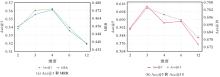
Fig. 10
Recommendation results under various dimensions of multi-branch trees"

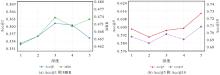
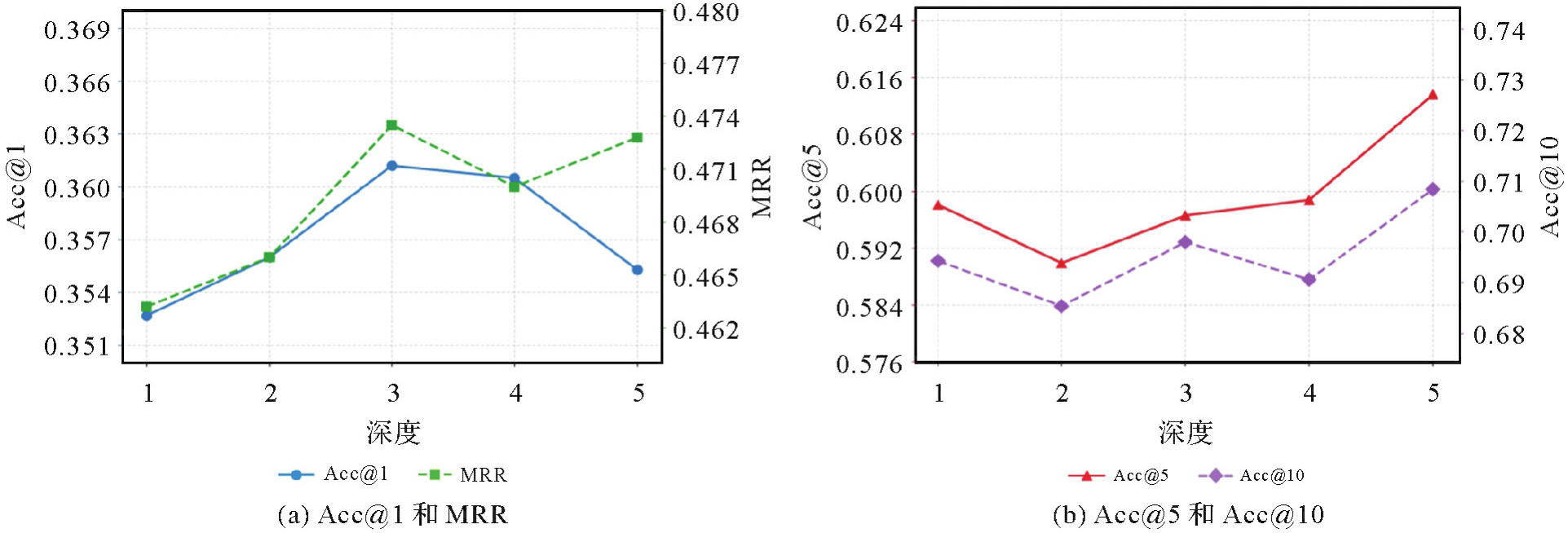
Fig. 11
Recommendation results with various convolution depths"
| [1] | 王勇, 马钰, 徐胜华, 等. 兴趣点推荐方法研究进展与展望[J]. 测绘科学, 2023, 48(12): 217-224. |
| WANG Yong, MA Yu, XU Shenghua, et al. Research progress and prospects of point of interest recommendation methods[J]. Science of Surveying and Mapping, 2023, 48(12): 217-224. | |
| [2] | 郭旦怀, 张鸣珂, 贾楠, 等. 融合深度学习技术的用户兴趣点推荐研究综述[J]. 武汉大学学报(信息科学版), 2020, 45(12): 1890-1902. |
| GUO Danhuai, ZHANG Mingke, JIA Nan, et al. Survey of point-of-interest recommendation research fused with deep learning[J]. Geomatics and Information Science of Wuhan University, 2020, 45(12): 1890-1902. | |
| [3] | ZHOU Zhengyang, YANG Kuo, LIANG Yuxuan, et al. Predicting collective human mobility via countering spatiotemporal heterogeneity[J]. IEEE Transactions on Mobile Computing, 2024, 23(5): 4723-4738. |
| [4] | YAO Di, ZHANG Chao, HUANG Jianhui, et al. SERM: a recurrent model for next location prediction in semantic trajectories[C]//Proceedings of 2017 ACM on Conference on Information and Knowledge Management. Singapore: ACM Press, 2017: 2411-2414. |
| [5] | SÁNCHEZ P, BELLOGÍN A. Point-of-interest recommender systems based on location-based social networks: a survey from an experimental perspective[J]. ACM Computing Surveys, 2022, 54(11s): 1-37. |
| [6] | YE Ziming, ZHANG Xiao, CHEN Xu, et al. Adaptive clustering based personalized federated learning framework for next POI recommendation with location noise[J]. IEEE Transactions on Knowledge and Data Engineering, 2024, 36(5): 1843-1856. |
| [7] | SARKAR J L, MAJUMDER A, PANIGRAHI C R, et al. MULTITOUR: a multiple itinerary tourists recommendation engine[J]. Electronic Commerce Research and Applications, 2020, 40: 100943. |
| [8] | PANG Guangyao, WANG Xiaoming, HAO Fei, et al. Efficient point-of-interest recommendation with hierarchical attention mechanism[J]. Applied Soft Computing, 2020, 96: 106536. |
| [9] | 李曼文, 张月琴, 张晨威, 等. 异质图嵌入的地理不敏感时空兴趣点推荐方法[J]. 计算机科学与探索, 2024, 18(3): 755-767. |
| LI Manwen, ZHANG Yueqin, ZHANG Chenwei, et al. Geographically insensitive spatial-temporal POI recommendation based on heterogeneous graph embedding[J]. Journal of Frontiers of Computer Science and Technology, 2024, 18(3): 755-767. | |
| [10] | 孟祥武, 李瑞昌, 张玉洁, 等. 基于用户轨迹数据的移动推荐系统研究[J]. 软件学报, 2018, 29(10): 3111-3133. |
| MENG Xiangwu, LI Ruichang, ZHANG Yujie, et al. Survey on mobile recommender systems based on user trajectory data[J]. Journal of Software, 2018, 29(10): 3111-3133. | |
| [11] | 李鹏飞, 贺洋, 毋建宏. 融合全局特征的时空网络兴趣点推荐算法[J]. 计算机工程与应用, 2024, 60(11): 75-83. |
| LI Pengfei, HE Yang, WU Jianhong. Spatio-temporal network interest point recommendation algorithm fusing global features[J]. Computer Engineering and Applications, 2024, 60(11): 75-83. | |
| [12] | ZHAO Shengjin, ZHAO Tong, YANG Haiqin, et al. STELLAR: spatial-temporal latent ranking for successive point-of-interest recommendation[J]. Proceedings of the AAAI Conference on Artificial Intelligence, 2016, 30(1): 315-321. |
| [13] | LIU Qiang, WU Shu, WANG Liang, et al. Predicting the next location: a recurrent model with spatial and temporal contexts[J]. Proceedings of the AAAI Conference on Artificial Intelligence, 2016, 30(1): 194-200. |
| [14] | LI Xixi, HU Ruimin, WANG Zheng. Beyond fixed time and space: next POI recommendationvia multi-grained context and correlation[J]. Neural Computing and Applications, 2023, 35(1): 907-920. |
| [15] | ACHARYA M, MOHBEY K K. Exploring the evolution, progress, and future of point-of-interest recommendation over location-based social network: a comprehensive review[J]. GeoInformatica, 2025, 29(3): 305-350. |
| [16] | 刘广腾, 王峰, 吴中博. 下一个兴趣点推荐算法综述[J]. 计算机科学与探索, 2025, 19(7): 1747-1770. |
| LIU Guangteng, WANG Feng, WU Zhongbo. Survey on next point-of-interest recommendation algorithms[J]. Journal of Frontiers of Computer Science and Technology, 2025, 19(7): 1747-1770. | |
| [17] | ZHAO Pengfei. Optimization of LSTM ship trajectory prediction based on hybrid genetic algorithm[J]. Journal of Geodesy and Geoinformation Science, 2024, 7(3): 89-102. |
| [18] | ZHAO Pengpeng, ZHU Haifeng, LIU Yanchi, et al. Where to go next: a spatio-temporal gated network for next POI recommendation[J]. Proceedings of the AAAI Conference on Artificial Intelligence, 2019, 33(1): 5877-5884. |
| [19] | LAI Yantong, SU Yijun, WEI Lingwei, et al. Adaptive spatial-temporal hypergraph fusion learning for next POI recommendation[C]//Proceedings of 2024 IEEE International Conference on Acoustics, Speech and Signal Processing. Seoul: IEEE, 2024: 7320-7324. |
| [20] | DAI Shaojie, YU Yanwei, FAN Hao, et al. Spatio-temporal representation learning with social tie for personalized POI recommendation[J]. Data Science and Engineering, 2022, 7(1): 44-56. |
| [21] | FENG Shanshan, LI Xutao, ZENG Yifeng, et al. Personalized ranking metric embedding for next new POI recommendation[C]//Proceedings of the 24th International Conference on Artificial Intelligence. [S.l.]: IACM Press, 2015: 2069-2075. |
| [22] | XU Xiaohang, SUZUMURA T, YONG Jiawei, et al. Revisiting mobility modeling with graph: a graph transformer model for next point-of-interest recommendation[C]//Proceedings of the 31st ACM International Conference on Advances in Geographic Information Systems. Hamburg: ACM Press, 2023: 1-10. |
| [23] | SONG Weiping, XIAO Zhiping, WANG Yifan, et al. Session-based social recommendation via dynamic graph attention networks[C]//Proceedings of the 12th ACM International Conference on Web Search and Data Mining. Melbourne: ACM Press, 2019: 555-563. |
| [24] | YAO Liuyi, CHU Zhixuan, LI Sheng, et al. A survey on causal inference[J]. ACM Transactions on Knowledge Discovery from Data, 2021, 15(5): 41-46. |
| [25] | DE HAAN P, JAYARAMAN D, LEVINE S. Causal confusion in imitation learning[J]. Advances in Neural Information Processing Systems, 2019, 32: 451-458. |
| [26] | DENG Pan, ZHAO Yu, LIU Junting, et al. Spatio-temporal neural structural causal models for bike flow prediction[J]. Proceedings of the AAAI Conference on Artificial Intelligence, 2023, 37(4): 4242-4249. |
| [27] | 杨新新, 刘真, 卢思博, 等. 基于因果推断的推荐系统去偏研究综述[J]. 计算机学报, 2024, 47(10): 2307-2332. |
| YANG Xinxin, LIU Zhen, LU Sibo, et al. A survey on debiasing recommendation based on causal inference[J]. Chinese Journal of Computers, 2024, 47(10): 2307-2332. | |
| [28] | ZHANG Yang, FENG Fuli, HE Xiangnan, et al. Causal intervention for leveraging popularity bias in recommendation[C]//Proceedings of the 44th International ACM SIGIR Conference on Research and Development in Information Retrieval. [S.l.]: ACM Press, 2021: 11-20. |
| [29] | THOMAS C K, CHACCOUR C, SAAD W, et al. Causal reasoning: charting a revolutionary course for next-generation AI-native wireless networks[J]. IEEE Vehicular Technology Magazine, 2024, 19(1): 16-31. |
| [30] | SUN Guohao, HUA Huirong, LU Jinhu, et al. A novel causal discovery model for recommendation system[M]//Web and Big Data. Singapore: Springer, 2024: 261-276. |
| [31] | GAO Chongming, WANG Shiqi, LI Shijun, et al. CIRS: bursting filter bubbles by counterfactual interactive recommender system[J]. ACM Transactions on Information Systems, 2024, 42(1): 1-27. |
| [32] | VASWANI A, SHAZEER N, PARMAR N, et al. Attention is all you need[J]. Advances in Neural Information Processing Systems, 2017(30): 151-163. |
| [33] | QIN Yanjun, FANG Yuchen, LUO Haiyong, et al. Next point-of-interest recommendation with auto-correlation enhanced multi-modal transformer network[C]//Proceedings of the 45th International ACM SIGIR Conference on Research and Development in Information Retrieval. Madrid: ACM Press, 2022: 2612-2616. |
| [34] | YANG Song, LIU Jiamou, ZHAO Kaiqi. GETNext: trajectory flow map enhanced transformer for next POI recommendation[C]//Proceedings of the 45th International ACM SIGIR Conference on Research and Development in Information Retrieval. Madrid: ACM Press, 2022: 1144-1153. |
| [35] | WANG Xinfeng, FUKUMOTO F, LI Jiyi, et al. STaTRL: Spatial-temporal and text representation learning for POI recommendation[J]. Applied Intelligence, 2023, 53(7): 8286-8301. |
| [36] | XU Shuqiang, HUANG Qunying, ZOU Zhiqiang. Spatio-temporal transformer recommender: next location recommendation with attention mechanism by mining the spatio-temporal relationship between visited locations[J]. ISPRS International Journal of Geo-Information, 2023, 12(2): 79. |
| [37] | HE Yuhang, ZHOU Wei, LUO Fengji, et al. Feature-based POI grouping with transformer for next point of interest recommendation[J]. Applied Soft Computing, 2023, 147: 110754. |
| [38] | KONG Xiangjie, CHEN Zhiyu, LI Jianxin, et al. KGNext: knowledge-graph-enhanced transformer for next POI recommendation with uncertain check-ins[J]. IEEE Transactions on Computational Social Systems, 2024, 11(5): 6637-6648. |
| [39] | SCARSELLI F, GORI M, TSOI A C, et al. The graph neural network model[J]. IEEE Transactions on Neural Networks, 2009, 20(1): 61-80. |
| [40] | KIM J, JEONG S, PARK G, et al. DynaPosGNN: dynamic-positional GNN for next POI recommendation[C]//Proceedings of 2021 International Conference on Data Mining Workshops. Auckland: IEEE, 2021: 36-44. |
| [41] | MENG Lingqiang, LIU Zhizhong, CHU Dianhui, et al. POI recommendation for occasional groups based on hybrid graph neural networks[J]. Expert Systems with Applications, 2024, 237: 121583. |
| [42] | FANG Jinfeng, MENG Xiangfu, QI Xueyue. A top-k POI recommendation approach based on LBSN and multi-graph fusion[J]. Neurocomputing, 2023, 518: 219-230. |
| [43] | WANG Zhaobo, ZHU Yanmin, WANG Chunyang, et al. Adaptive graph representation learning for next POI recommendation[C]//Proceedings of the 46th International ACM SIGIR Conference on Research and Development in Information Retrieval. Taipei: ACM Press, 2023: 393-402. |
| [44] | LIU Jiawei, GAO Haihan, YANG Cheng, et al. Heterogeneous spatio-temporal graph contrastive learning for point-of-interest recommendation[J]. Tsinghua Science and Technology, 2025, 30(1): 186-197. |
| [45] | ZHANG Dong, ZHANG Hanwang, TANG Jinhui, et al. Causal intervention for weakly-supervised semantic segmentation[J]. Advances in Neural Information Processing Systems, 2020, 33: 655-666. |
| [46] | SCHöLKOPF B. Causality for machine learning[DB/OL]. [2025-09-02]. https://dl.acm.org/doi/abs/10.1145/3501714.3501755. |
| [47] | LIN Xiangru, CHEN Yuyang, LI Guanbin, et al. A causal inference look at unsupervised video anomaly detection[J]. Proceedings of the AAAI Conference on Artificial Intelligence, 2022, 36(2): 1620-1629. |
| [48] | HE Ming, CHEN Xin, HU Xinlei, et al. Causal intervention for sentiment de-biasing in recommendation[C]//Proceedings of the 31st ACM International Conference on Information & Knowledge Management. Atlanta: ACM Press, 2022: 4014-4018. |
| [49] | LIU Bo, ZENG Jun, WEN Junhao, et al. CBRec: a causal way balancing multidimensional attraction effect in POI recommendations[J]. Knowledge-Based Systems, 2024, 305: 112607. |
| [50] | YANG Mengyue, DAI Quanyu, DONG Zhenhua, et al. Top-N recommendation with counterfactual user preference simulation[C]//Proceedings of the 30th ACM International Conference on Information & Knowledge Management. Queensland: ACM Press, 2021: 2342-2351. |
| [51] | RENDLE S, FREUDENTHALER C, SCHMIDT-THIEME L. Factorizing personalized Markov chains for next-basket recommendation[C]//Proceedings of the 19th International Conference on World Wide Web. Raleigh: ACM Press, 2010: 811-820. |
| [52] | HOCHREITER S, SCHMIDHUBER J. Long short-term memory[J]. Neural Computation, 1997, 9(8): 1735-1780. |
| [53] | ZHANG Lu, SUN Zhu, WU Ziqing, et al. Next point-of-interest recommendation with inferring multi-step future preferences[C]//Proceedings of the 31th International Joint Conference on Artificial Intelligence. Vienna: [s.n.], 2022: 3751-3757. |
| [54] | LUO Yingtao, LIU Qiang, LIU Zhaocheng. STAN: spatio-temporal attention network for next location recommendation[C]//Proceedings of 2021 Web Conference. Ljubljana: ACM Press, 2021: 2177-2185. |
| [55] | HUANG Tianhao, PAN Xuan, CAI Xiangrui, et al. Learning time slot preferences via mobility tree for next POI recommendation[J]. Proceedings of the AAAI Conference on Artificial Intelligence, 2024, 38(8): 8535-8543. |
| [1] | Mingguang WU, Ziming CHENG. Color generation method for green maps considering use contexts [J]. Acta Geodaetica et Cartographica Sinica, 2026, 55(3): 390-403. |
| [2] | Min YANG, Hongran MA, Bo KONG, Pengcheng LIU, Tinghua AI. A pre-trained model-based method for discriminating morphological patterns of vector-based coastlines [J]. Acta Geodaetica et Cartographica Sinica, 2026, 55(3): 404-414. |
| [3] | Wenhao YU, Ziyi ZENG, Yifan ZHANG, Haizhong QIAN. Road network grid pattern analysis using a pre-trained model fusing spatial and topological information [J]. Acta Geodaetica et Cartographica Sinica, 2026, 55(3): 415-424. |
| [4] | Xiaomin LU, Zhiyi ZHANG, Haowen YAN, Yi HE, Xiaoning SU. A recognition method for building group pattern integrating deep graph infomax and multilayer perceptron [J]. Acta Geodaetica et Cartographica Sinica, 2026, 55(3): 425-438. |
| [5] | Xiaoqiang CHENG, Jiawei ZHAO, Pengcheng LIU. Spatial interaction visualization based on the distance-similarity metaphor [J]. Acta Geodaetica et Cartographica Sinica, 2026, 55(3): 536-547. |
| [6] | Zejiao WANG, Longgang XIANG, Meng WANG, Xingjuan WANG, Qing LIU. Hierarchical feature and diversified attention fusion network for collaborative extraction of road surface and centerline [J]. Acta Geodaetica et Cartographica Sinica, 2026, 55(3): 548-563. |
| [7] | Zhibang XU. Hierarchical boundary identification, pattern analysis and expansion simulation of physical cities [J]. Acta Geodaetica et Cartographica Sinica, 2026, 55(3): 566-566. |
| [8] | Yunbo RAN, Xue YANG, Wenhao ZHOU, Chengen WU, Baoding ZHOU, Luliang TANG, Qingquan LI. Pedestrian path planning driven by preference-enhanced adversarial deep reinforcement learning [J]. Acta Geodaetica et Cartographica Sinica, 2026, 55(2): 191-205. |
| [9] | Lizeng WANG, Shifen CHENG, Yitao YANG, Peixiao WANG, Feng LU. LGA-EL: a spatio-temporal adaptive ensemble method with local-global awareness for traffic prediction [J]. Acta Geodaetica et Cartographica Sinica, 2026, 55(2): 206-221. |
| [10] | Shaohua WANG, Haojian LIANG, Cheng SU, Dachuan XU, Liang ZHOU, Kun QIN. Advances and prospects in urban facility allocation optimization through coupling spatio-temporal big data and artificial intelligence [J]. Acta Geodaetica et Cartographica Sinica, 2026, 55(2): 222-235. |
| [11] | Xiao FU, Sirui ZHU, Xudong LI, Guonian LÜ. An optimization method for the layout of urban vertiports in long-distance commuting scenarios [J]. Acta Geodaetica et Cartographica Sinica, 2026, 55(2): 236-248. |
| [12] | Junhao GUO, Mingzhi WU, Peixiao WANG, Hengcai ZHANG. A dual-threshold stay point detection method based on adaptive extended density peak clustering for sparse fixed-point trajectories [J]. Acta Geodaetica et Cartographica Sinica, 2026, 55(2): 249-260. |
| [13] | Guannan LI. Method for automatic construction of three dimensional real scene model of the road [J]. Acta Geodaetica et Cartographica Sinica, 2026, 55(2): 378-378. |
| [14] | Pengcheng LIU, Xiaoqiang CHENG, Tianyuan XIAO, Min YANG, Tinghua AI. A Transformer model for building polygon simplification in map generalization [J]. Acta Geodaetica et Cartographica Sinica, 2026, 55(1): 124-137. |
| [15] | Biao HE, Haojia LIN, Renzhong GUO, Xi KUAI, Ding MA, Chen ZHANG. Visual perception-based quantitative calculation of 3D spatial similarity relations [J]. Acta Geodaetica et Cartographica Sinica, 2026, 55(1): 138-153. |
| Viewed | ||||||
|
Full text |
|
|||||
|
Abstract |
|
|||||
