

Acta Geodaetica et Cartographica Sinica ›› 2025, Vol. 54 ›› Issue (12): 2142-2152.doi: 10.11947/j.AGCS.2025.20250091
• Geodesy and Navigation • Previous Articles Next Articles
Shoujian ZHANG1( ), Xinyun CAO2,3,4(), Yulong GE5, Fei SHEN2,3,4
Received:2025-03-12
Revised:2025-11-04
Online:2026-01-15
Published:2026-01-15
Contact:
Xinyun CAO
E-mail:shjzhang@sgg.whu.edu.cn;xycao@njnu.edu.cn
About author:ZHANG Shoujian (1980—), male, PhD, associate professor, majors in multi-source integrated navigation and intelligent navigation. E-mail: shjzhang@sgg.whu.edu.cn
Supported by:CLC Number:
Shoujian ZHANG, Xinyun CAO, Yulong GE, Fei SHEN. Yaw attitude modeling of GLONASS-K and GLONASS-M+ satellites and its impact on satellite clock estimation and precise point positioning[J]. Acta Geodaetica et Cartographica Sinica, 2025, 54(12): 2142-2152.
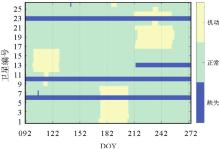
Fig. 1
Eclipsing status of GLONASS satellites"
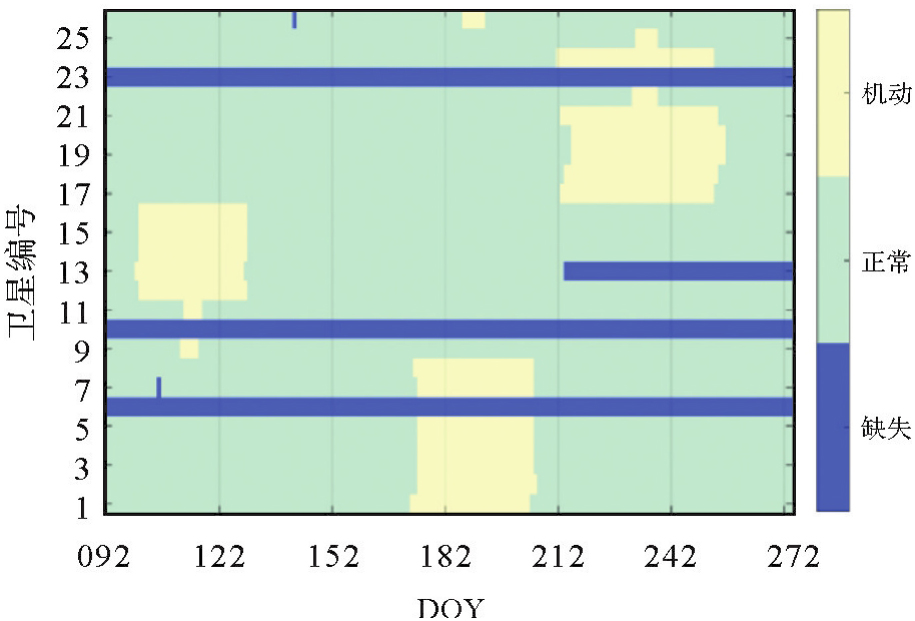
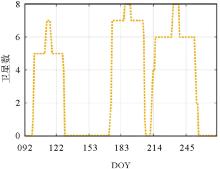
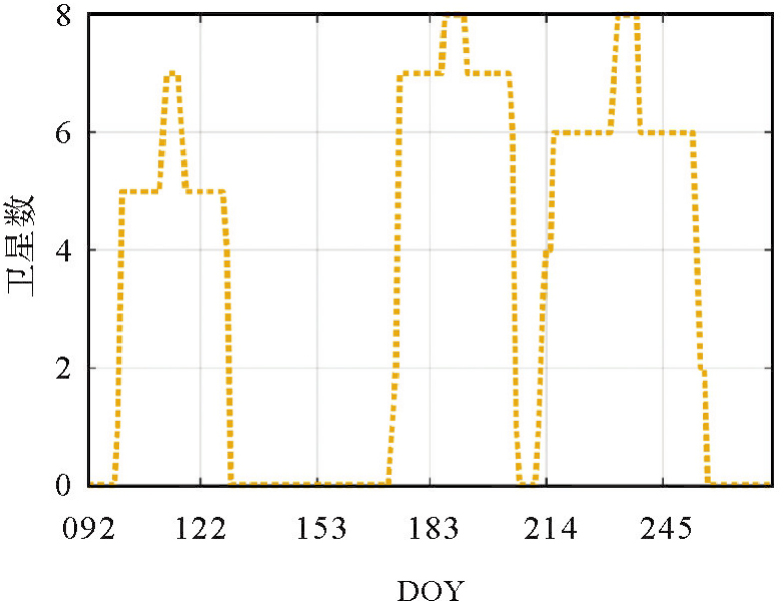
Fig. 2
Number of GLONASS eclipsing satellites"
Tab. 1
Strategy of error processing and parameter estimation"
| 模型与误差 | 钟差估计策略 | PPP策略 |
|---|---|---|
| 估计模型 | 钟差非差模型 | 无电离层组合模型 |
| 滤波器 | 迭代Kalman滤波[ | |
| 卫星轨道 | CODE精密轨道产品 | |
| 卫星钟差 | 模拟实时估计 | 采用估计的钟差 |
| 先验对流层模型 | GPT2+VMF投影函数[ | |
| PCO | IGS20[ | |
| 潮汐改正 | 固体潮+海潮+极潮[ | |
| 相位缠绕 | 模型改正[ | |
| 测站坐标 | 固定为IGS周解 | 动态白噪声估计 |
| 卫星姿态 | 策略S1:GLONASS-M/M+和GLONASS-K分别采用各自姿态模型 | |
| 策略S2:所有卫星均采用GLONASS-M/M+姿态模型 | ||
| 策略S3:所有卫星均采用名义姿态模型 | ||
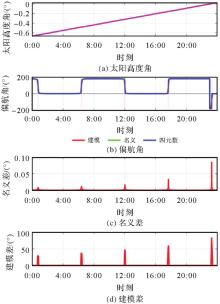
Fig. 3
Yaw attitude of R25 on DOY 235 of 2024 (CODE)"

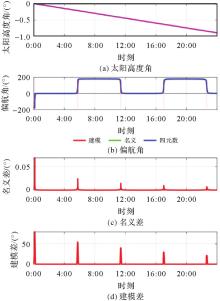
Fig. 4
Yaw attitude of R26 on DOY 190 of 2024 (CODE)"
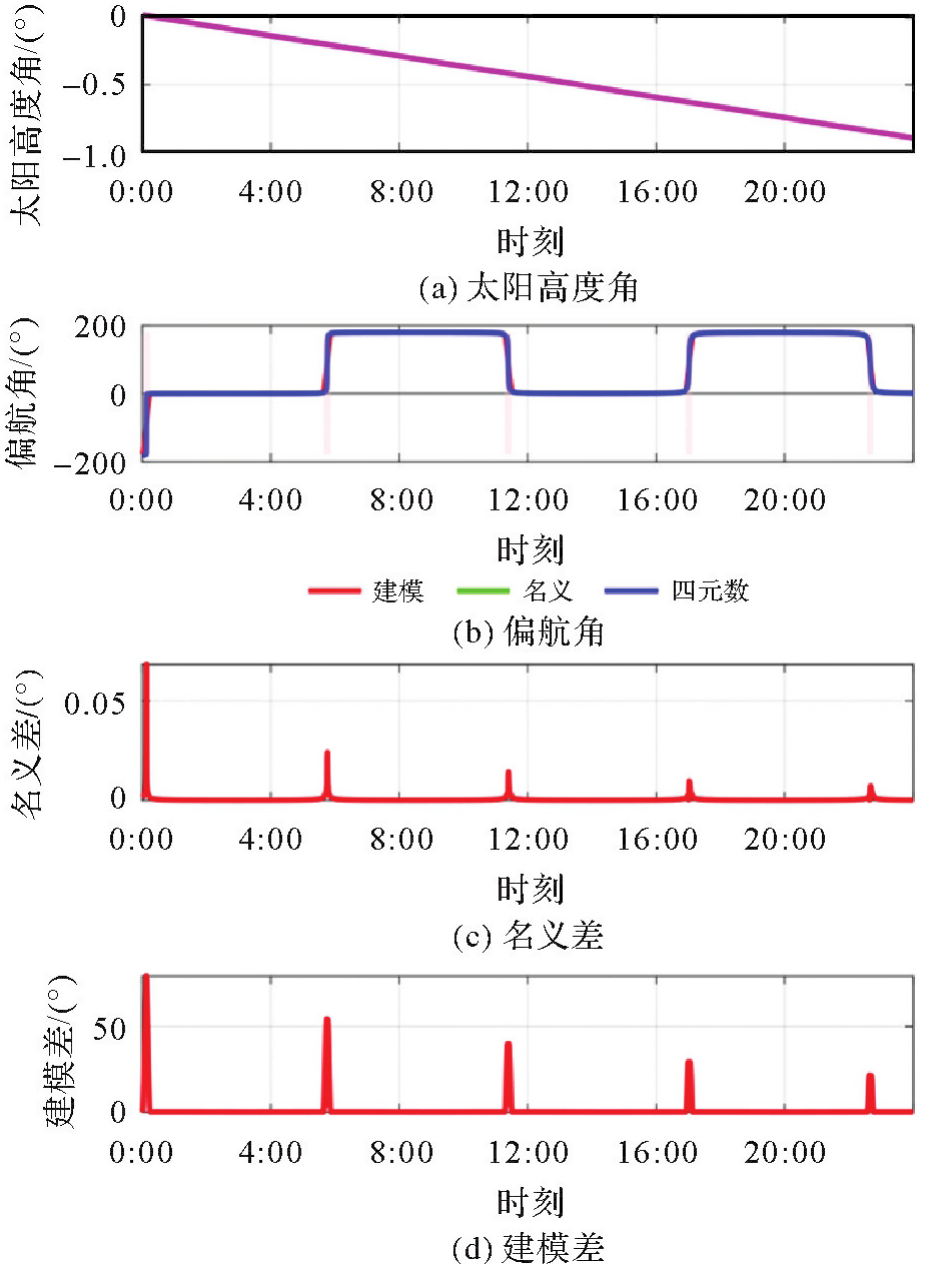
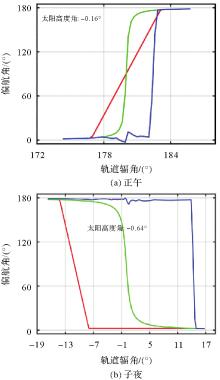
Fig. 5
Noon and night maneuver of R25 on DOY 235 of 2024 (GFZ)"
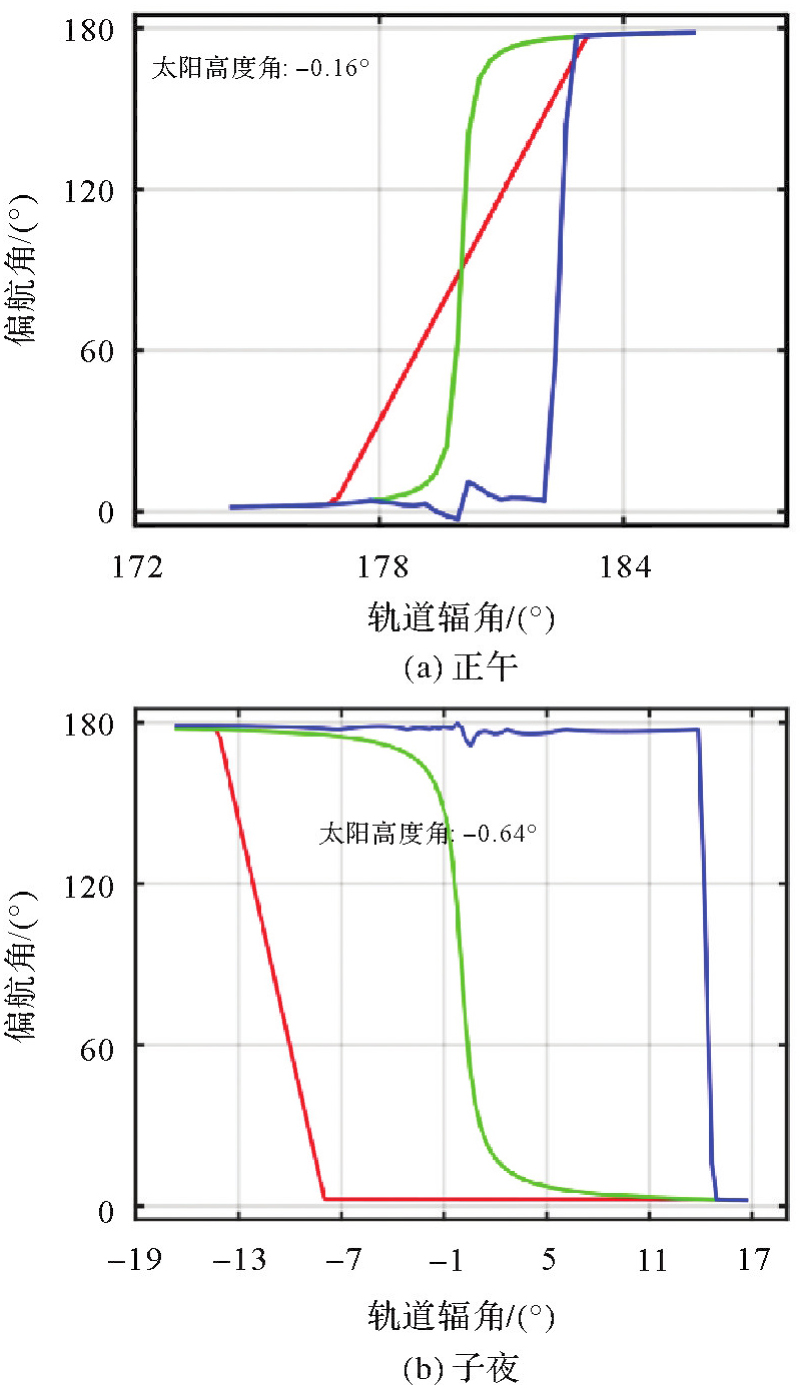
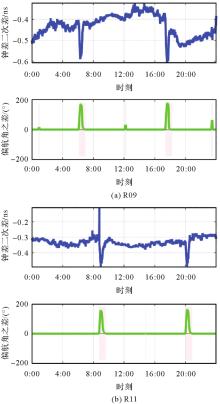
Fig. 6
Double-differenced clock and difference in yaw angle of R09 and R11 on DOY 113 of 2024"
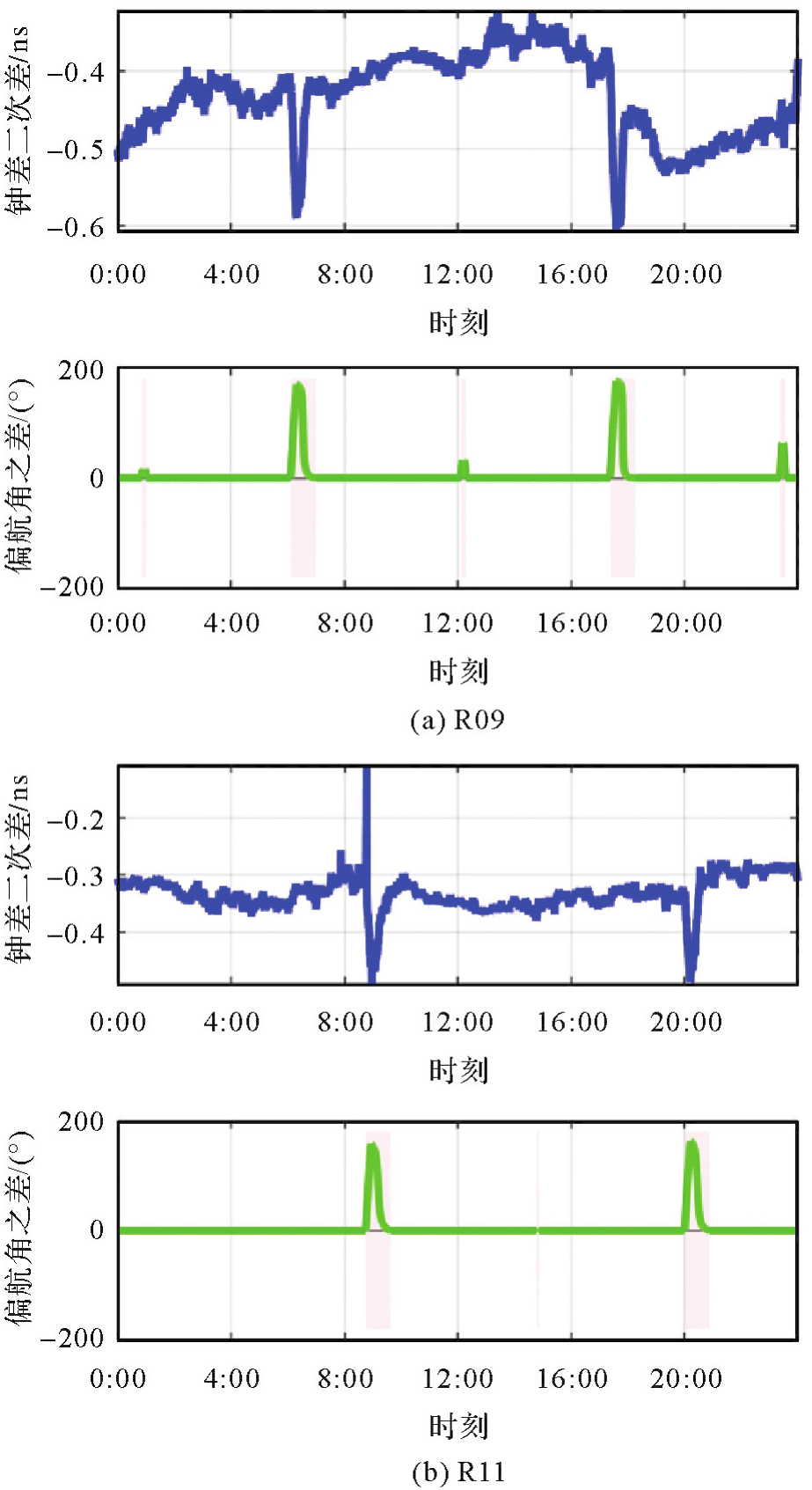
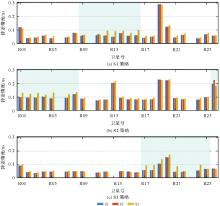
Fig. 7
GLONASS satellite clock precision under different strategies"

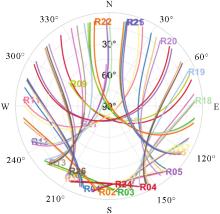
Fig. 8
Sky plot on station MAC1"
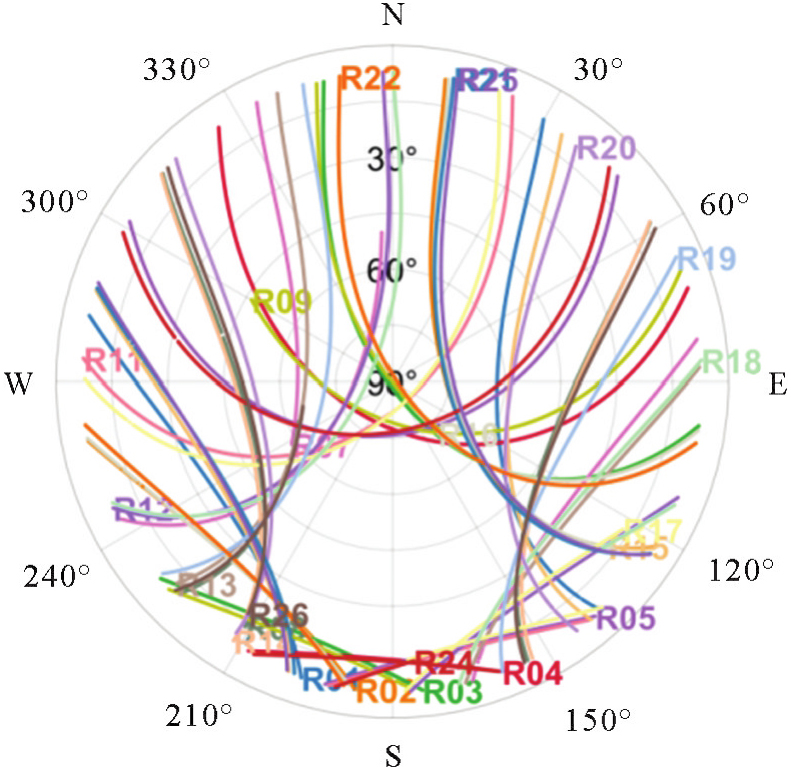
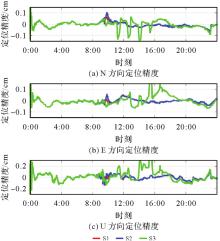
Fig. 9
Kinematic PPP positioning series on station MAC1 under different strategies"
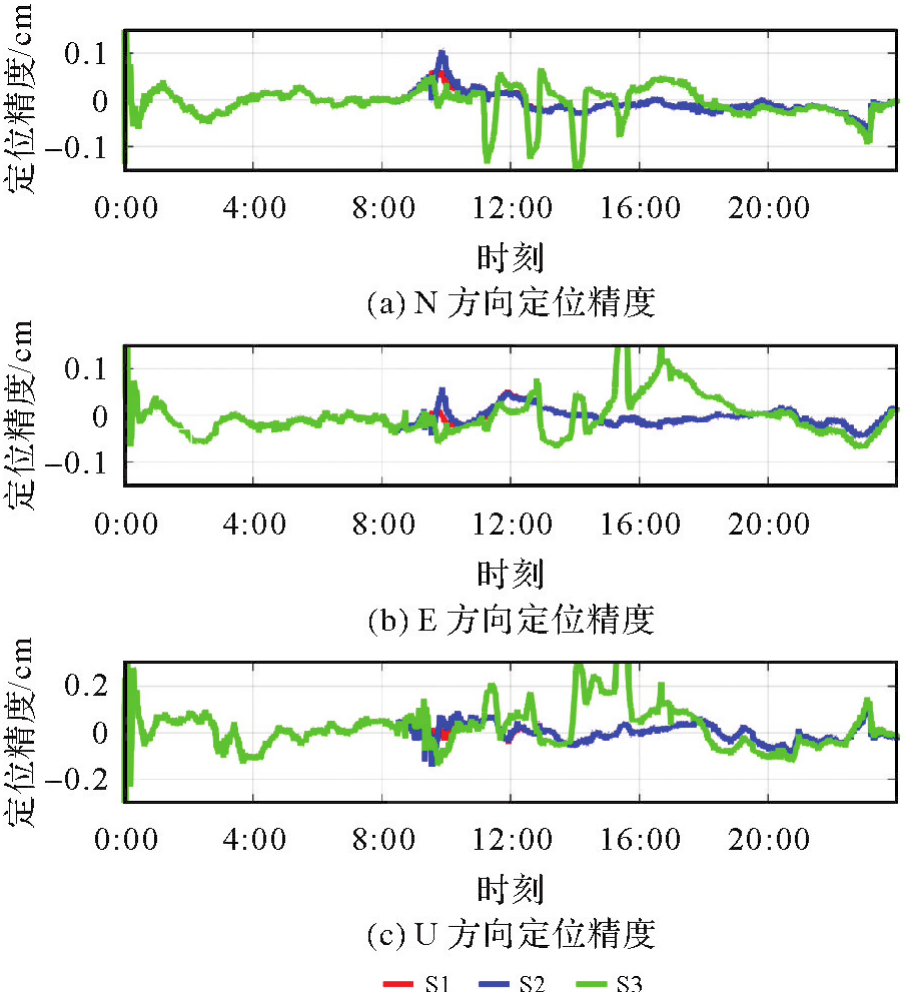
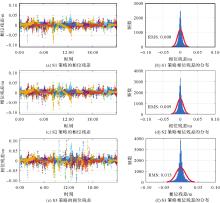
Fig. 10
Phase observation residuals of kinematic PPP on station MAC1 under different strategies"

Tab. 2
Accuracy of GLONASS kinematic PPP under different strategies"
| 钟差姿态 | PPP姿态 | 时段1 | 时段2 | 时段3 | ||||||
|---|---|---|---|---|---|---|---|---|---|---|
| N | E | U | N | E | U | N | E | U | ||
| S1 | S1 | 4.37 | 6.89 | 11.14 | 3.99 | 6.24 | 10.80 | 4.72 | 7.49 | 11.67 |
| S1 | S2 | 4.46 | 6.98 | 11.37 | 4.05 | 6.47 | 10.96 | 4.75 | 7.52 | 11.91 |
| S1 | S3 | 5.00 | 7.83 | 12.82 | 4.51 | 7.10 | 12.46 | 5.36 | 8.27 | 13.43 |
| S2 | S2 | 4.38 | 6.93 | 11.25 | 4.04 | 6.50 | 10.95 | 4.73 | 7.53 | 11.95 |
| S3 | S3 | 4.86 | 7.77 | 12.67 | 4.55 | 7.20 | 12.16 | 5.28 | 8.22 | 13.50 |
| [1] | BAR-SEVER Y E. A new model for GPS yaw attitude[J]. Journal of Geodesy, 1996, 70(11): 714-723. |
| [2] | MONTENBRUCK O, SCHMID R, MERCIER F, et al. GNSS satellite geometry and attitude models[J]. Advances in Space Research, 2015, 56(6): 1015-1029. |
| [3] | KUANG D, RIM H J, SCHUTZ B E, et al. Modeling GPS satellite attitude variation for precise orbit determination[J]. Journal of Geodesy, 1996, 70(9): 572-580. |
| [4] | ZHAO Qile, WANG Chen, GUO Jing, et al. Precise orbit and clock determination for BeiDou-3 experimental satellites with yaw attitude analysis[J]. GPS Solutions, 2017, 22(1): 4. |
| [5] | CHEN Qiuli, YANG Hui, CHEN Zhonggui, et al. Solar radiation pressure modeling and application of BDS satellites[J]. Journal of Geodesy and Geoinformation Science, 2020, 3(2): 45-52. |
| [6] | CAO Xinyun, ZHANG Shoujian, KUANG Kaifa, et al. The impact of eclipsing GNSS satellites on the precise point positioning[J]. Remote Sensing, 2018, 10(1): 94. |
| [7] | LI Xingxing, YUAN Yongqiang, ZHU Yiting, et al. Improving BDS-3 precise orbit determination for medium earth orbit satellites[J]. GPS Solutions, 2020, 24(2): 6109-6131. |
| [8] | YANG Nannan, XU Aigong, XU Zongqiu, et al. Effect of WHU/GFZ/CODE satellite attitude quaternion products on the GNSS kinematic PPP during the eclipse season[J]. Advances in Space Research, 2025, 75(1): 1-15. |
| [9] | KOUBA J. A simplified yaw-attitude model for eclipsing GPS satellites[J]. GPS Solutions, 2009, 13(1): 1-12. |
| [10] | DILSSNER F. GPS IIF-1 satellite antenna phase center and attitude modeling[J]. Inside GNSS, 2010, 5(6): 59-64. |
| [11] | DAI Xiaolei, GE Maorong, LOU Yidong, et al. Estimating the yaw-attitude of BDS IGSO and MEO satellites[J]. Journal of Geodesy, 2015, 89(10): 1005-1018. |
| [12] | HAUSCHILD A. GNSS yaw attitude estimation: results for the Japanese quasi-zenith satellite system Block-Ⅱ satellites using single- or triple-frequency signals from two antennas[J]. Navigation, 2019, 66(4): 719-728. |
| [13] |
刘天骏, 陈渠森, 姜卫平, 等. 地影期间卫星姿态四元数产品对北斗精密单点定位的影响分析[J]. 测绘学报, 2023, 52(4): 550-558. DOI: .
doi: 10.11947/j.AGCS.2023.20220245 |
|
LIU Tianjun, CHEN Qusen, JlANG Weiping, et al. Effect of satellite attitude quaternions on BeiDou precise point positioning during the eclipse season[J]. Acta Geodaetica et Cartographica Sinica, 2023, 52(4): 550-558, DOI: .
doi: 10.11947/j.AGCS.2023.20220245 |
|
| [14] | ZAMINPARDAZ S, TEUNISSEN P J G, KHODABANDEH A. GLONASS-only FDMA+CDMA RTK: performance and outlook[J]. GPS Solutions, 2021, 25(3): 96. |
| [15] |
侯鹏宇, 张宝成, 刘腾, 等. CDMA+FDMA非差非组合区域PPP-RTK[J]. 测绘学报, 2023, 52(2): 183-194. DOI: .
doi: 10.11947/j.AGCS.2023.20210422 |
|
HOU Pengyu, ZHANG Baocheng, LIU Teng, et al. Regional PPP-RTK with CDMA+FDMA data at undifferenced and uncombined level[J], Acta Geodaetica et Cartographica Sinica, 2023, 52(2): 183-194. DOI: .
doi: 10.11947/j.AGCS.2023.20210422 |
|
| [16] | DILSSNER F, SPRINGER T, GIENGER G, et al. The GLONASS-M satellite yaw-attitude model[J]. Advances in Space Research, 2011, 47(1): 160-171. |
| [17] | DILSSNER F, SPRINGER T. GLONASS-K attitude: rapid turning maneuvers and other deviations from ideal yaw steering[J]. GPS Solutions, 2024, 28(3): 144. |
| [18] | STEIGENBERGER P, MONTENBRUCK O, HAUSCHILD A. Antenna and attitude modeling of modernized GLONASS satellites[J]. Advances in Space Research, 2024, 74(7): 3045-3059. |
| [19] | YUAN Yongqiang, LI Xingxing, YAO Yibin, et al. Estimation of phase center corrections for BDS satellites aligned to the IGS20 frame[J]. GPS Solutions, 2024, 28(2): 63. |
| [20] | CAO Xinyun, KUANG Kaifa, GE Yulong, et al. An efficient method for undifferenced BDS-2/BDS-3 high-rate clock estimation[J]. GPS Solutions, 2022, 26(3): 66. |
| [21] | LAGLER K, SCHINDELEGGER M, BÖHM J, et al. GPT2: empirical slant delay model for radio space geodetic techniques[J]. Geophysical Research Letters, 2013, 40(6): 1069-1073. |
| [22] | 乔晨昊, 王利, 舒宝, 等. GNSS天线相位中心模型更新对PPP的影响分析[J]. 导航定位学报, 2024, 12(4): 45-57. |
| QIAO Chenhao, WANG Li, SHU Bao, et al. Analysis of differences between GNSS antenna phase center correction models and their effects on precise point positioning[J]. Journal of Navigation and Positioning, 2024, 12(4): 45-57. | |
| [23] | PETIT G, LUZUM B. IERS conventions (2010) Bureau International des Poids et Mesures Sevres[EB/OL]. [2025-07-05]. https://www.iers.org/IERS/EN/Publications/TechnicalNotes/tn36.html. |
| [24] | WU J, WU S, HAJJ G, et al. Effects of antenna orientation on GPS carrier phase[C]//Proceedings of 1992 AAS/AIAA Astrodynamics Conference. San Diego: IEEE, 1992. |
| [25] | 耿涛, 赵普, 谢新, 等. GPS/BDS-3卫星姿态产品评估及对精密数据处理的影响[J]. 武汉大学学报(信息科学版)[2025-03-01]. http://doi.org/10.13203/j.whugis20240155. |
| GENG Tao, ZHAO Pu, XIE Xin, et al. Evaluation of GPS/BDS-3 satellite attitude products and impact on precise data processing[J]. Geomatics and Information Science of Wuhan University[2025-03-01]. http://doi.org/10.13203/j.whugis20240155. | |
| [26] | 耿江辉, 闫哲, 温强. 多系统GNSS卫星钟差和偏差产品综合:IGS第3次重处理[J]. 武汉大学学报(信息科学版), 2023, 48(7): 1070-1081. |
| GENG Jianghui, YAN Zhe, WEN Qiang. Multi-GNSS satellite clock and bias product combination: the third IGS reprocessing campaign[J]. Geomatics and Information Science of Wuhan University, 2023, 48(7): 1070-1081. | |
| [27] | LIU Tianjun, CHEN Hua, CHEN Qusen, et al. Characteristics of phase bias from CNES and its application in multi-frequency and multi-GNSS precise point positioning with ambiguity resolution[J]. GPS Solutions, 2021, 25(2): 58. |
| [1] | LIU Tianjun, CHEN Qusen, JIANG Weiping, CHEN Hua, XIA Fengyu, FAN Caoming. Effect of satellite attitude quaternions on BeiDou precise point positioning during the eclipse season [J]. Acta Geodaetica et Cartographica Sinica, 2023, 52(4): 550-558. |
| [2] | YUAN Yunbin, LIU Shuai, TAN Bingfeng. Modeling and effects analysis of GNSS precise point positioning ambiguity resolution based on the decoupled clock method [J]. Acta Geodaetica et Cartographica Sinica, 2022, 51(8): 1669-1679. |
| [3] | LIU Genyou, GAO Ming, YIN Xiangfei, XIAO Gongwei, LÜ Dong, WANG Shengliang, WANG Run. High-precision cloud platform timing based on GNSS precise point positioning [J]. Acta Geodaetica et Cartographica Sinica, 2022, 51(8): 1736-1743. |
| [4] | ZHOU Feng, YANG Yuze, WANG Lei, XU Tianhe. GNSS carrier phase integer equivariant estimator and its application in improving PPP performance [J]. Acta Geodaetica et Cartographica Sinica, 2022, 51(8): 1779-1786. |
| [5] | JIN Shuanggen, WANG Qisheng, SHI Qiqi. Parameters estimation and applications from single- to five-frequency multi-GNSS precise point positioning [J]. Acta Geodaetica et Cartographica Sinica, 2022, 51(7): 1239-1248. |
| [6] | YANG Kaichun, LV Zhiping, LI Linyang, KUANG Yingcai, XU Wei, ZHENG Xi. Sliding window single-frequency real time precise point positioning algorithm with epoch constraints [J]. Acta Geodaetica et Cartographica Sinica, 2022, 51(5): 648-657. |
| [7] | FANG Yanan, ZHU Jun, LI Jie, WANG Chong, WANG Jiasong, ZHANG Shaoyu. Precise orbit determination method for BeiDou mixed constellations with layered constraints [J]. Acta Geodaetica et Cartographica Sinica, 2021, 50(4): 466-474. |
| [8] | ZHANG Bingbing, NIU Jiqiang, WANG Zhengtao, XU Feng, TIAN Kunjun. Centimeter precise orbit determination for the Swarm satellites via undifferenced kinematic method [J]. Acta Geodaetica et Cartographica Sinica, 2021, 50(1): 27-36. |
| [9] | ZHOU Feng, XU Tianhe. Modeling and assessment of GPS/BDS/Galileo triple-frequency precise point positioning [J]. Acta Geodaetica et Cartographica Sinica, 2021, 50(1): 61-70. |
| [10] | ZHANG Xiaohong, HU Jiahuan, REN Xiaodong. New progress of PPP/PPP-RTK and positioning performance comparison of BDS/GNSS PPP [J]. Acta Geodaetica et Cartographica Sinica, 2020, 49(9): 1084-1100. |
| [11] | SU Ke, JIN Shuanggen. Analysis and comparisons of the BDS/Galileo quad-frequency PPP models performances [J]. Acta Geodaetica et Cartographica Sinica, 2020, 49(9): 1189-1201. |
| [12] | DU Zhenqiang, CHAI Hongzhou, XIANG Minzhi, YIN Xiao, LIU Chunhe. Unified ambiguity resolution method based on three PPP Models [J]. Acta Geodaetica et Cartographica Sinica, 2020, 49(7): 824-832. |
| [13] | CHEN Junping, WANG Ahao, ZHANG Yize, ZHOU Jianhua, WANG Binghao, WANG Jiexian. PPP algorithm using BDS new SBAS differential corrections [J]. Acta Geodaetica et Cartographica Sinica, 2019, 48(7): 822-830. |
| [14] | LÜ Daqian, ZENG Fangling, OUYANG Xiaofeng, YU Heli. Time and frequency transfer based on modified integer phase clock method [J]. Acta Geodaetica et Cartographica Sinica, 2019, 48(7): 889-897. |
| [15] | HU Yifan, ZHANG Shuai. The impacts of different satellite antenna parameters on BDS precise orbit determination and precise point positioning accuracy [J]. Acta Geodaetica et Cartographica Sinica, 2019, 48(7): 908-918. |
| Viewed | ||||||
|
Full text |
|
|||||
|
Abstract |
|
|||||
