

Acta Geodaetica et Cartographica Sinica ›› 2025, Vol. 54 ›› Issue (12): 2129-2141.doi: 10.11947/j.AGCS.2025.20250226
• Geodesy and Navigation • Previous Articles Next Articles
Tao GENG1( ), Qiang LI1,2(), Lingyue CHENG2, Jingnan LIU1
Received:2025-06-04
Revised:2025-12-25
Online:2026-01-15
Published:2026-01-15
Contact:
Qiang LI
E-mail:gt_gengtao@whu.edu.cn;lq_liqiang@whu.edu.cn
About author:GENG Tao (1982—), male, PhD, professor, majors in satellite geodesy and procise orbit determination. E-mail: gt_gengtao@whu.edu.cn
Supported by:CLC Number:
Tao GENG, Qiang LI, Lingyue CHENG, Jingnan LIU. The correction method of relativistic effects for GNSS and LEO satellites[J]. Acta Geodaetica et Cartographica Sinica, 2025, 54(12): 2129-2141.
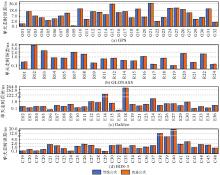
Fig. 1
One-day clock offset due to the frequency-constant term in the relativistic effects correction residuals of conventional and modified formulas"

Tab. 1
Statistical classification of GNSS satellites based on orbital eccentricity"
| 偏心率e的数值范围 | GNSS卫星 |
|---|---|
| 0.000<e<0.002 | G01、G11 |
| R01、R04、R05、R09、R11、R12、R14、R15、R16、R17、R18、R19、R20、R21、R22、R24 | |
| E02、E03、E04、E05、E06、E07、E08、E09、E10、E11、E12、E13、E15、E16、E19、E21、E23、E24、E25、E26、E27、E29、E30、E31、E33、E34、E36 | |
| C19、C20、C21、C22、C23、C24、C25、C26、C27、C28、C29、C30、C32、C33、C34、C35、C36、C37、C41、C42、C43、C44、C45、C48 | |
| 0.002≤e<0.005 | G04、G06、G09、G18、G20、G29 |
| R02、R03、R07、R08 | |
| C38、C39、C40 | |
| 0.005≤e<0.010 | G03、G05、G12、G13、G14、G23、G26、G30、G32 |
| 0.010≤e<0.100 | G02、G07、G08、G10、G15、G16、G17、G19、G21、G22、G24、G25、G27、G31 |
| 0.100≤e<0.200 | E14、E18 |
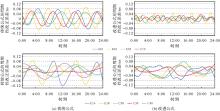
Fig. 2
Periodic error series of relativistic correction approximate formulas"
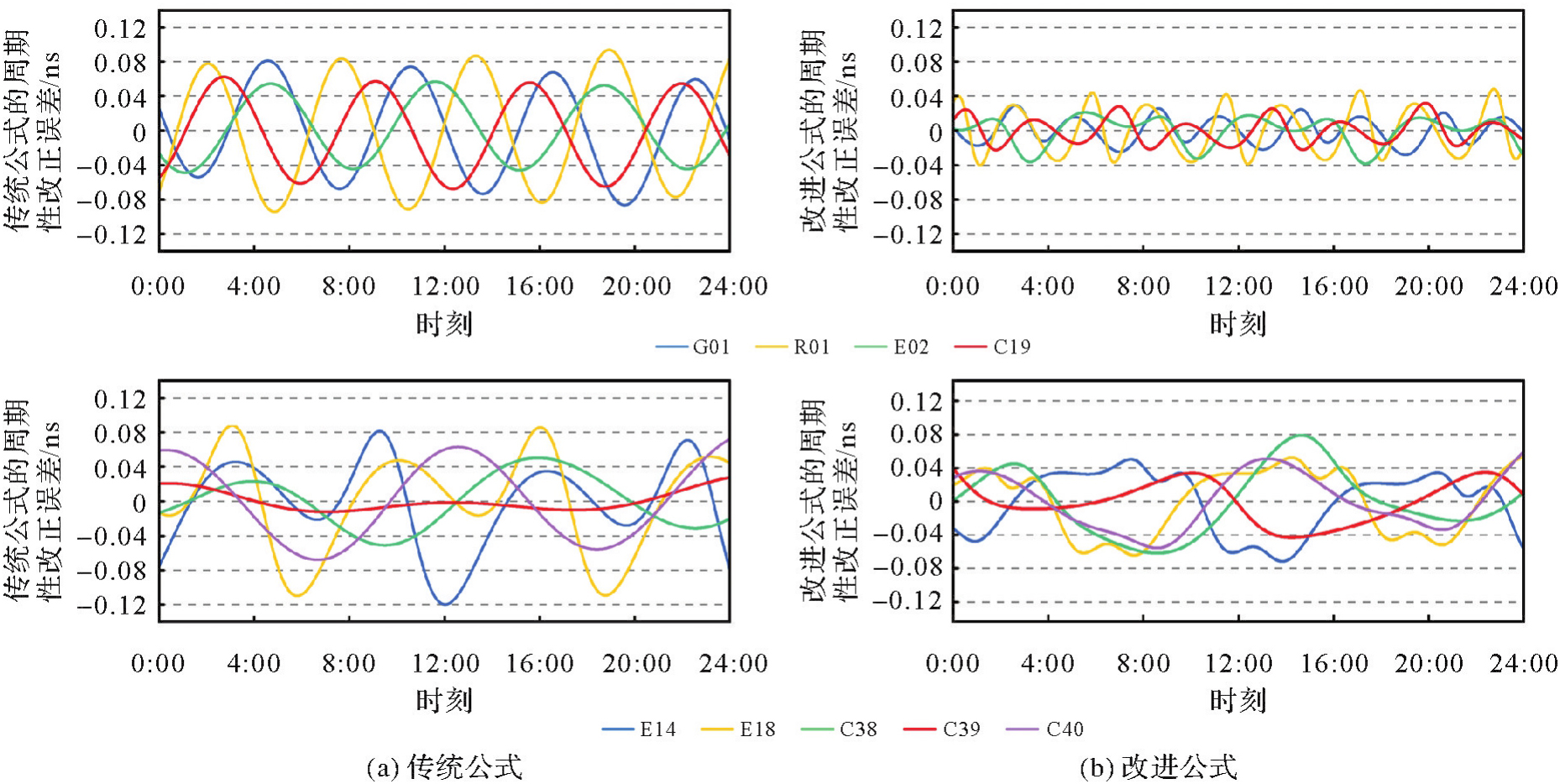
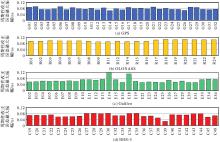
Fig. 3
Maximum amplitude of periodic error of conventional formulas for GPS、GLONASS、Galileo、BDS-3 satellites"

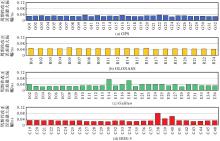
Fig. 4
Maximum amplitude of periodic error of modified formulas for GPS、GLONASS、Galileo、BDS-3 satellites"

Tab. 2
Correction accuracy of approximation formulas for periodic relativistic effects"
| 卫星 | 传统公式 | 改进公式 |
|---|---|---|
| GPS | 0.09 | 0.04 |
| GLONASS | 0.11 | 0.05 |
| Galileo(除E14、E18外) | 0.08 | 0.04 |
| BDS-3 MEO | 0.08 | 0.04 |
| Galileo E14、E18 | 0.12 | 0.07 |
| BDS-3 IGSO | 0.05 | 0.06 |
Tab. 3
Configuration information for LEO satellites orbital simulation"
| 轨道参数 | 仿真数值 |
|---|---|
| 高度/km | 500、750、1000、1250、1500 |
| 偏心率 | 0.001、0.01、0.02 |
| 轨道倾角/(°) | 20、40、60、89 |
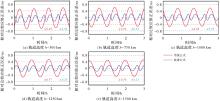
Fig. 5
Relativistic effect correction periodic errors for LEO satellites at different orbital altitudes (for an inclination of 60° and an eccentricity of 0.01)"

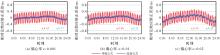
Fig. 6
Relativistic effect correction periodic errors for LEO satellites at different orbital eccentricities (for an altitude of 1500 km and an inclination of 40°)"
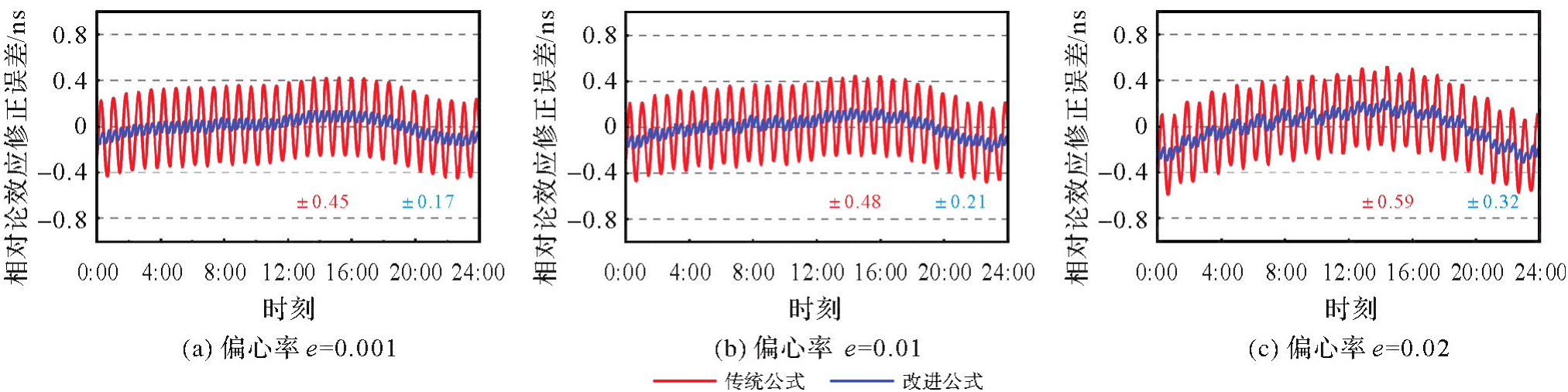
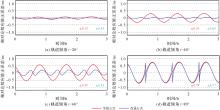
Fig. 7
Relativistic effect correction periodic errors for LEO satellites at different orbital inclinations (for an altitude of 1000 km and an eccentricity of 0.001)"

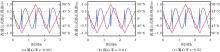
Fig. 8
Periodic error series of modified formula for LEO satellites at an orbital altitude of 1000 km, orbital inclination of 89°, and varying eccentricities, together with latitude series of LEO satellites"
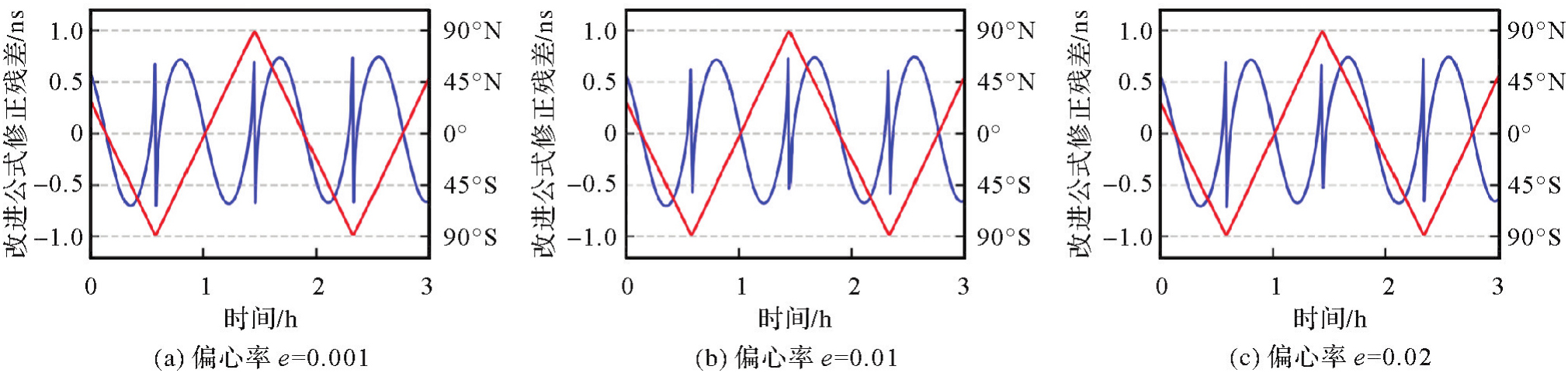
Fig. 9
Periodic relativistic effects correction accuracy of the conventional formula for LEO satellites"
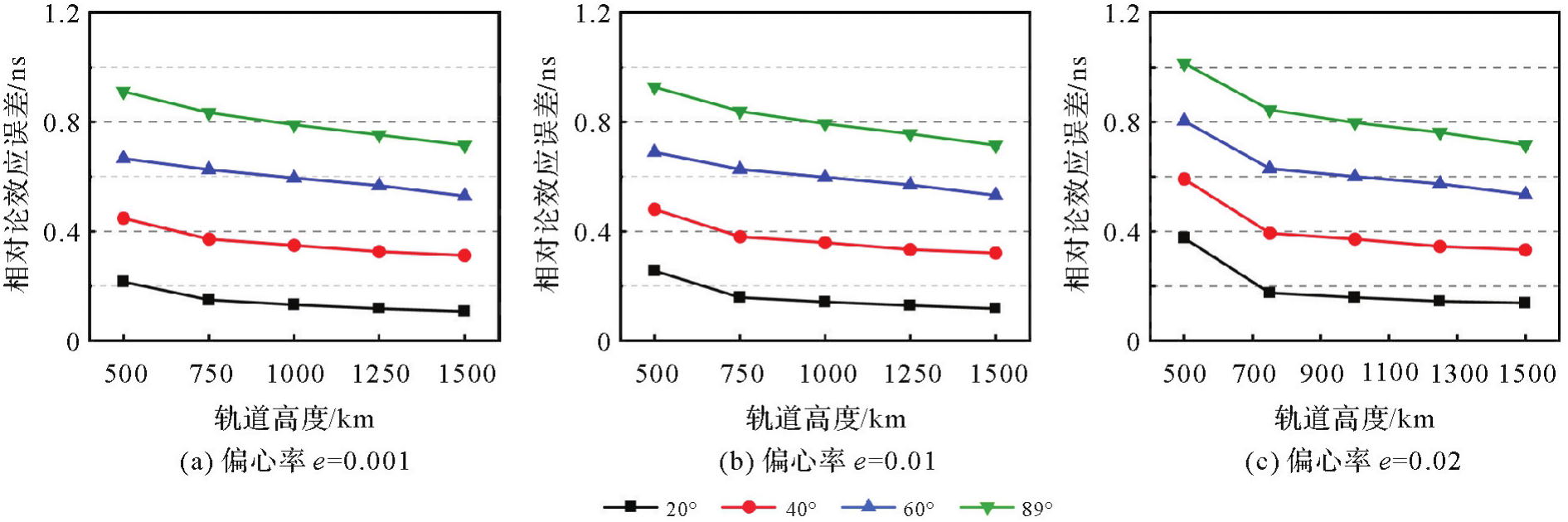
Fig. 10
Periodic relativistic effects correction accuracy of the modified formula for LEO satellites"
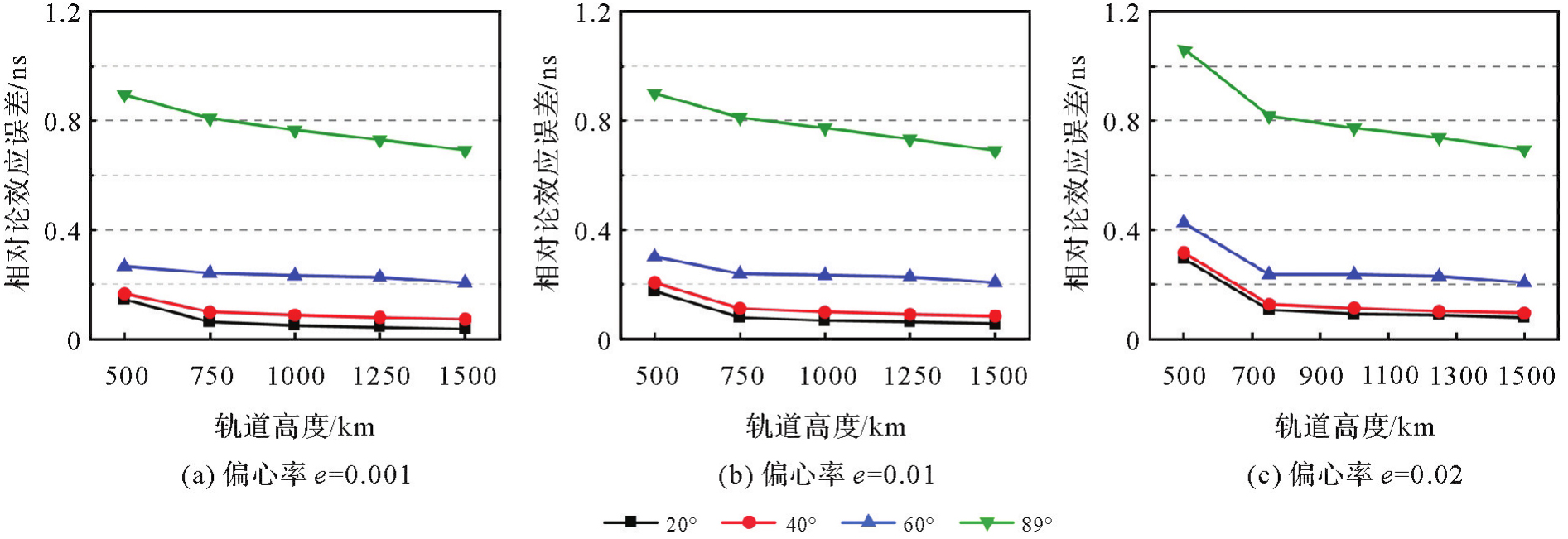
Tab. 4
The improvement in accuracy of the modified formula relative to the traditional formula"
| 偏心率 | 轨道高度/km | 轨道倾角 | |||||||
|---|---|---|---|---|---|---|---|---|---|
| 精度提高/ns | 精度提高比例/(%) | ||||||||
| 20° | 40° | 60° | 89° | 20° | 40° | 60° | 89° | ||
| 0.001 | 500 | 0.07 | 0.28 | 0.40 | 0.02 | 33 | 63 | 60 | 2 |
| 750 | 0.09 | 0.27 | 0.38 | 0.03 | 58 | 73 | 62 | 3 | |
| 1000 | 0.08 | 0.26 | 0.36 | 0.02 | 62 | 75 | 61 | 3 | |
| 1250 | 0.08 | 0.25 | 0.34 | 0.02 | 64 | 76 | 60 | 3 | |
| 1500 | 0.07 | 0.24 | 0.32 | 0.02 | 65 | 77 | 61 | 3 | |
| 0.01 | 500 | 0.08 | 0.27 | 0.39 | 0.03 | 32 | 57 | 56 | 3 |
| 750 | 0.08 | 0.27 | 0.39 | 0.03 | 50 | 71 | 62 | 3 | |
| 1000 | 0.08 | 0.26 | 0.36 | 0.02 | 53 | 72 | 61 | 3 | |
| 1250 | 0.07 | 0.24 | 0.34 | 0.02 | 52 | 73 | 60 | 3 | |
| 1500 | 0.06 | 0.24 | 0.33 | 0.02 | 53 | 74 | 61 | 3 | |
| 0.02 | 500 | 0.08 | 0.27 | 0.38 | -0.05 | 22 | 46 | 47 | -5 |
| 750 | 0.07 | 0.27 | 0.39 | 0.03 | 39 | 68 | 63 | 3 | |
| 1000 | 0.07 | 0.26 | 0.36 | 0.02 | 42 | 70 | 61 | 3 | |
| 1250 | 0.06 | 0.24 | 0.34 | 0.02 | 40 | 70 | 60 | 3 | |
| 1500 | 0.06 | 0.24 | 0.33 | 0.02 | 43 | 71 | 61 | 3 | |
Tab. 5
LEO satellites orbit information"
| 卫星 | 轨道高度/km | 轨道倾角/(°) | 偏心率 |
|---|---|---|---|
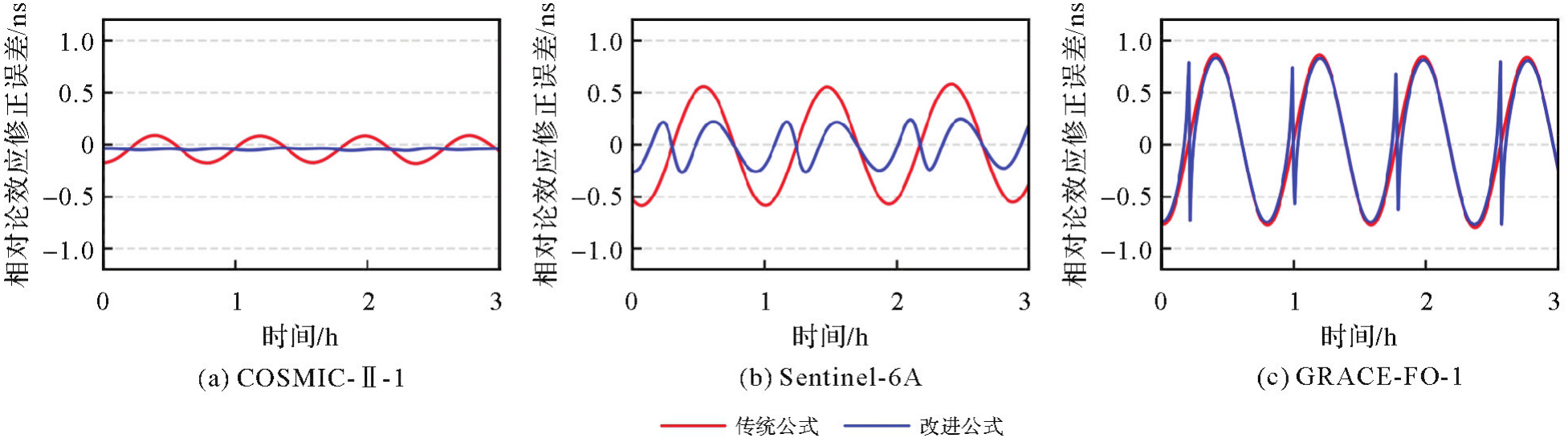
| COSMIC-Ⅱ-1 | 700 | 24 | ~0.001 |
| Sentinel-6A | 1336 | 66 | <0.001 |
| GRACE-FO-1 | 500 | 89 | <0.005 |
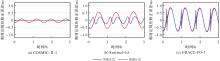
Fig. 11
Relativistic effects periodic errors for COSMIC-Ⅱ-1, Sentinel-6A and GRACE-FO-1 satellites using conventional and modified formulas"
| [1] | ASHBY N. Relativity and the global positioning system[J]. Physics Today, 2002, 55(5): 41-47. |
| [2] | SPILKER J J, AXELRAD P, PARKINSON B W, et al. Global positioning system: theory and applications, volume I[M]. Washington, D. C.: American Institute of Aeronautics and Astronautics, 1996: 623-625. |
| [3] | KOUBA J. Improved relativistic transformations in GPS[J]. GPS Solutions, 2004, 8(3): 170-180. |
| [4] | GAO Weiguang, XIE Xin, MENG Yinan, et al. Performance analysis of LEO augmented GNSS precise point positioning from in-orbitCENTISPACETM satellites[J]. Measurement Science and Technology, 2025, 36(1): 016338. |
| [5] | REID T G R. Orbital diversity for global navigation satellite systems[D]. Stanford: Stanford University, 2017. |
| [6] | XIE Xin, GENG Tao, ZHAO Qile, et al. Precise orbit determination for BDS-3 satellites using satellite-ground and inter-satellite link observations[J]. GPS Solutions, 2019, 23(2): 40. |
| [7] | LÜ Yifei, GENG Tao, ZHAO Qile, et al. Initial assessment of BDS-3 preliminary system signal-in-space range error[J]. GPS Solutions, 2019, 24(1): 16. |
| [8] | KOUBA J. Relativistic time transformations in GPS[J]. GPS Solutions, 2002, 5(4): 1-9. |
| [9] | HAN Chunhao, CAI Zhiwu. Relativistic effects to the onboard BeiDou satellite clocks[J]. NAVIGATION, 2019, 66(1): 49-53. |
| [10] | FORMICHELLA V. The J2 relativistic periodic component of GNSS satellite clocks[C]//Proceedings of 2018 IEEE International Frequency Control Symposium (IFCS). Olympic Valley: IEEE, 2018: 1-7. |
| [11] | 王棣星, 李江伟, 陶清瑞. 部分相对论效应对北斗原子钟性能影响分析[J]. 测绘科学, 2022, 47(3): 29-36, 64. |
| WANG Dixing, LI Jiangwei, TAO Qingrui. Analysis of the influence of partial relativistic effect on the performance of BDS atomic clock[J]. Science of Surveying and Mapping, 2022, 47(3): 29-36, 64. | |
| [12] | WANG Dixing, LI Min, XUE Huijie, et al. Analysis of the J2 relativistic effect on the performance of on-board atomic clocks[J]. GPS Solutions, 2023, 27(3): 114. |
| [13] | FANG Shanchuan, DU Lan, GAO Yunpeng, et al. Orbital elements ephemerides and interfaces design of LEO satellites[J]. Journal of Geodesy and Geoinformation Science, 2019, 2(4): 44-52. |
| [14] | REN Xia, YANG Yuanxi. Development of comprehensive PNT and resilient PNT[J]. Journal of Geodesy and Geoinformation Science, 2023, 6(3): 1-8. |
| [15] | YANG Yuanxi. Resilient PNT concept frame[J]. Journal of Geodesy and Geoinformation Science, 2019, 2(3): 1-7. |
| [16] | GE Haibo, WU Tianhao, LI Bofeng. Characteristics analysis and prediction of low Earth orbit (LEO) satellite clock corrections by using least-squares harmonic estimation[J]. GPS Solutions, 2022, 27(1): 38. |
| [17] | LI Wenwen, YANG Qiangwen, DU Xiaodong, et al. LEO augmented precise point positioning using real observations from two CENTISPACETM experimental satellites[J]. GPS Solutions, 2023, 28(1): 44. |
| [18] | ARSON K M, ASHBY N, HACKMAN C, et al. An assessment of relativistic effects for low Earth orbiters: the GRACE satellites[J]. Metrologia, 2007, 44(6): 484-490. |
| [19] | WU Meifang, WANG Kan, LIU Jiawei, et al. Relativistic effects of LEO satellite and its impact on clock prediction[J]. Measurement Science and Technology, 2023, 34(9): 095005. |
| [20] | IAU. IAU transactions. Vol. 11B[M]. Dordrecht: Kluwer Academic Publishers, 1991. |
| [21] | IERS. IERS conventions (2003): IERS technical note 32[R]. Frankfurt am Main: International Earth Rotation and Reference Systems Service, 2003. |
| [22] | PETIT G. Importance of a common framework for the realization of space-time reference systems[M]//Towards an integrated global geodetic observing system (IGGOS). Berlin: Springer, 2000: 3-7. |
| [23] | Global Positioning System Joint Program Office. Interface control document: NAVSTAR GPS space segment/navigation user interface: ICD-GPS-200[S]. [S. l.]: Global Positioning System Joint Program Office, 1993. |
| [24] | ASHBY N, SPILKER J J. Introduction to relativistic effects on the global positioning system[M]//Global positioning system: theory and applications, Vol. I. Washington: American Institute of Aeronautics and Astronautics, 1996: 623-697. |
| [25] | KOUBA J. Testing of general relativity with two Galileo satellites in eccentric orbits[J]. GPS Solutions, 2021, 25(4): 139. |
| [26] | KOUBA J. Relativity effects of Galileo passive hydrogen maser satellite clocks[J]. GPS Solutions, 2019, 23(4): 117. |
| [27] |
张小红, 马福建. 低轨导航增强GNSS发展综述[J]. 测绘学报, 2019, 48(9): 1073-1087. DOI: .
doi: 10.11947/j.AGCS.2019.20190176 |
|
ZHANG Xiaohong, MA Fujian. Review of the development of LEO navigation-augmented GNSS[J]. Acta Geodaetica et Cartographica Sinica, 2019, 48(9): 1073-1087. DOI: .
doi: 10.11947/j.AGCS.2019.20190176 |
|
| [28] | YANG Yuanxi, MAO Yue, REN Xia, et al. Demand and key technology for a LEO constellation as augmentation of satellite navigation systems[J]. Satellite Navigation, 2024, 5(1): 11. |
| [29] |
袁俊军, 李凯, 唐成盼, 等. 面向精密位置服务的低轨卫星轨道预报精度分析[J]. 测绘学报, 2022, 51(5): 640-647. DOI: .
doi: 10.11947/j.AGCS.2022.20210473 |
|
YUAN Junjun, LI Kai, TANG Chengpan, et al. Accuracy analysis of LEO satellites orbit prediction for precise position service[J]. Acta Geodaetica et Cartographica Sinica, 2022, 51(5): 640-647. DOI: .
doi: 10.11947/j.AGCS.2022.20210473 |
|
| [30] | 刘林, 胡松杰, 王歆. 航天动力学引论[M]. 南京: 南京大学出版社, 2006. |
| LIU Lin, HU Songjie, WANG Xin. An introduction of astrodynamics[M]. Nanjing: Nanjing University Press, 2006. | |
| [31] | FOLCIK Z J, CEFOLA P J. A general solution to the second order J2 contribution in a mean equinoctial element semianalytic satellite theory[C]//Proceedings of 2012 Advanced Maui Optical and Space Surveillance Technologies Conference. Wailea: The Maui Economic Development Board, 2012: 45. |
| [32] | VASHKOV'YAK M A. Constructive-analytical solution of the problem of the secular evolution of polar satellite orbits[J]. Solar System Research, 2017, 51(4): 315-326. |
| [33] | WANG Yuan, SUN Xiucong, HE Lixuan, et al. An accurate and efficient second-order J2 model for the draper semianalytic satellite theory[J]. Acta Astronautica, 2024, 225: 169-185. |
| [1] | Jinwei BU, Shuhui LIU, Shunshuang XU, Tongsu XIANG, Qiulan WANG, Chaoying JI, Xiaoqing ZUO. Construction of an empirical model for estimating the global wave period of spaceborne GNSS-R [J]. Acta Geodaetica et Cartographica Sinica, 2026, 55(4): 684-697. |
| [2] | Tangting WU, Xinyu LUO, Liguo LU, Zhanke LIU, Nengfang CHAO. Assessment of water resource changes and drought characteristics in the Shaanxi, Gansu and Ningxia region based on GNSS and GRACE/GRACE-FO [J]. Acta Geodaetica et Cartographica Sinica, 2026, 55(3): 439-450. |
| [3] | Zhongmin MA, Shuangcheng ZHANG, Xin ZHOU, Qi LIU, Ning LIU, Hengli WANG. A flood monitoring method using FY-3 GNSS-R accounting for surface reflectivity uncertainty: a case study of the August 2 Guangdong rainstorm disaster [J]. Acta Geodaetica et Cartographica Sinica, 2026, 55(3): 451-464. |
| [4] | Qingyun YAN, Zixuan GUO, Yuanjin PAN, Yan JIA, Shuanggen JIN. Quantitative driving factors and zoning patterns of GNSS-R land surface reflectivity spatial heterogeneity [J]. Acta Geodaetica et Cartographica Sinica, 2026, 55(2): 315-327. |
| [5] | Qingzhi ZHAO, Duoduo JIANG, Yibin YAO, Zhi MA, Yongjie MA, Haojie LI, Ruirui XUE. An adaptive method for selecting the optimal GNSS satellite signal for water vapor tomography [J]. Acta Geodaetica et Cartographica Sinica, 2026, 55(1): 25-35. |
| [6] | Deying YU, Houpu LI, Yi LIU, Shuguang WU, Deyan LI, Mingchao LI, Wenkui LI, Shaofeng BIAN. A DBSCAN-based RAIM algorithm for multiple gross error identification [J]. Acta Geodaetica et Cartographica Sinica, 2026, 55(1): 59-72. |
| [7] | Dongliang CHENG, Lingqiu CHEN, Zhiyong HUANG, Shubo QIAO, Dandan WANG, Yaming YAN. Performance evaluation of COATS-based multi-mode and multi-frequency iGNSS-R altimetry [J]. Acta Geodaetica et Cartographica Sinica, 2026, 55(1): 73-89. |
| [8] | Cong SHEN, Guocheng WANG, Lintao LIU, Huiwen HU, Zhiwu CAI. Kalman filter-based satellite clock bias prediction algorithm with frequency difference estimation correction [J]. Acta Geodaetica et Cartographica Sinica, 2025, 54(9): 1596-1607. |
| [9] | Yarong LUO, Wentao LU, Chi GUO, Jingnan LIU. Left-handed symmetry equivariant filtering model and algorithm for GNSS/INS integrated navigation [J]. Acta Geodaetica et Cartographica Sinica, 2025, 54(8): 1389-1403. |
| [10] | Yangyi CHEN, Kai ZHENG, Xiaohong ZHANG, Mingkui WU, Pengxu WANG, Wenju FU, Kezhong LIU. GPS/Galileo/BDS overlapping frequencies multipath error analysis and modeling [J]. Acta Geodaetica et Cartographica Sinica, 2025, 54(8): 1427-1438. |
| [11] | Jianzhang LI, Haowen YAN, Weifang YANG, Xiaoning SU. GNSS pseudo trigonometric leveling method [J]. Acta Geodaetica et Cartographica Sinica, 2025, 54(7): 1170-1177. |
| [12] | Qingzhi ZHAO, Lulu CHANG, Yibin YAO, Haojie LI. A method for constructing a hydrological drought index integrated with GNSS and meteorological data [J]. Acta Geodaetica et Cartographica Sinica, 2025, 54(7): 1192-1205. |
| [13] | Qianxin WANG, Chao HU, Tong CHENG. A method for satellite ultra-rapid orbit and clock offset estimation based on the prior information of the GNSS clock parameters [J]. Acta Geodaetica et Cartographica Sinica, 2025, 54(6): 982-994. |
| [14] | Yang SHEN, Guangyun LI, Mingjian CHEN, Linyang LI, Xingyu SHI, Wei CAI, Weifeng HAO. Assessment of GNSS ionosphere models based on FY-3 TEC in polar regions [J]. Acta Geodaetica et Cartographica Sinica, 2025, 54(6): 995-1008. |
| [15] | Shunqiang HU, Kejie CHEN, Xiaoxing HE, Hai ZHU, Tan WANG. The impact of environmental loading on nonlinear variations of 3D coordinate time series of GNSS stations in Sichuan and Yunnan region [J]. Acta Geodaetica et Cartographica Sinica, 2025, 54(5): 805-818. |
| Viewed | ||||||
|
Full text |
|
|||||
|
Abstract |
|
|||||
