

Acta Geodaetica et Cartographica Sinica ›› 2025, Vol. 54 ›› Issue (2): 233-247.doi: 10.11947/j.AGCS.2025.20240183
• Geodesy and Navigation • Previous Articles Next Articles
Yangyang LU( ), Huizhong ZHU(), Bo LI, Jun LI, Aigong XU
Received:2024-04-28
Online:2025-03-11
Published:2025-03-11
Contact:
Huizhong ZHU
E-mail:471820580@stu.lntu.edu.cn;zhuhuizhong@lntu.edu.cn
About author:LU Yangyang (1995—), male, PhD, majors in GNSS precise positioning. E-mail: 471820580@stu.lntu.edu.cn
Supported by:CLC Number:
Yangyang LU, Huizhong ZHU, Bo LI, Jun LI, Aigong XU. PPP algorithm for multi-frequency GPS/Galileo/BDS-3 with IFCB time-varying characteristic constraints[J]. Acta Geodaetica et Cartographica Sinica, 2025, 54(2): 233-247.
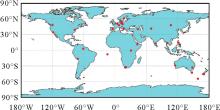
Fig. 1
Distribution of stations"
Tab. 1
Multi-GNSS multi-frequency PPP data processing strategy"
| 选项 | 处理策略 |
|---|---|
| 观测值 | 非组合观测值 |
| 频率 | BDS-3:B1、B3、B2a;GPS:L1、L2、L5;GA L:E1、E5a、E5b |
| 参数估计 | EKF |
| 采样率/s | 30 |
| 权重方案 | 高度角定权模型 |
| 截止高度角/(°) | 7 |
| 卫星轨道 | WH U精密星历 |
| 卫星钟差 | WH U精密钟差 |
| PCO | IGS14.atx |
| PCV | GPS/Galileo |
| 相位缠绕 | 模型改正 |
| 地球固体潮 | |
| 海洋潮汐 | |
| 极移 | |
| 相对论效应 | |
| 对流层延迟 | 干延迟(Saastamoinen模型改正)+湿延迟(随机游走估计) |
| 电离层延迟 | 随机游走 |
| ISB | 白噪声 |
| IFB | |
| 测站坐标 | 动态,白噪声估计 |
| 接收机钟差 | 白噪声 |
| 模糊度 | 弧段内常数估计 |
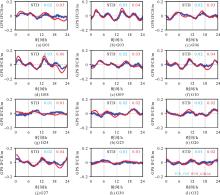
Fig. 2
CNES and iGMAS GPS Block ⅡF L5 phase products (DOY 21, 2022)"

Tab. 2
CNES and iGMAS GPS Block ⅡF L5 phase product wave amplitude averages (DOY 18—DOY 31, 2022)"
| PRN | IFCB_CNT/m | IFCB_iGMAS/m |
|---|---|---|
| G01 | 0.10 | 0.13 |
| G03 | 0.13 | 0.17 |
| G06 | 0.11 | 0.12 |
| G08 | 0.18 | 0.22 |
| G09 | 0.14 | 0.12 |
| G10 | 0.13 | 0.14 |
| G24 | 0.09 | 0.05 |
| G25 | 0.11 | 0.11 |
| G26 | 0.12 | 0.10 |
| G27 | 0.15 | 0.19 |
| G30 | 0.08 | 0.06 |
| G32 | 0.09 | 0.10 |
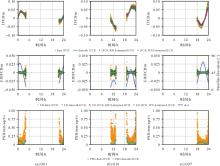
Fig. 3
Station VILL GPS Block ⅡF L5 IFCB and PSD for IFCB (DOY 21, 2022)"

Tab. 3
Average and amplify GPS Block ⅡF L5 IFCB power spectral density at VILL station (DOY 21, 2022)"
| PRN | PSD均值 | PSD振幅 |
|---|---|---|
| G01 | 0.07 | 0.13 |
| G03 | 0.19 | 1.24 |
| G06 | 0.09 | 0.61 |
| G08 | 0.16 | 0.88 |
| G09 | 0.08 | 0.25 |
| G10 | 0.05 | 0.20 |
| G24 | 0.04 | 0.17 |
| G25 | 0.16 | 0.37 |
| G26 | 0.13 | 0.39 |
| G27 | 0.06 | 0.09 |
| G30 | 0.03 | 0.12 |
| G32 | 0.13 | 0.28 |
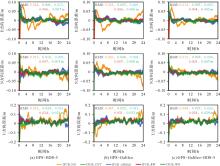
Fig. 4
Station VILL multi-GNSS multi-frequency PPP positioning error (DOY 24, 2022)"

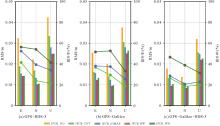
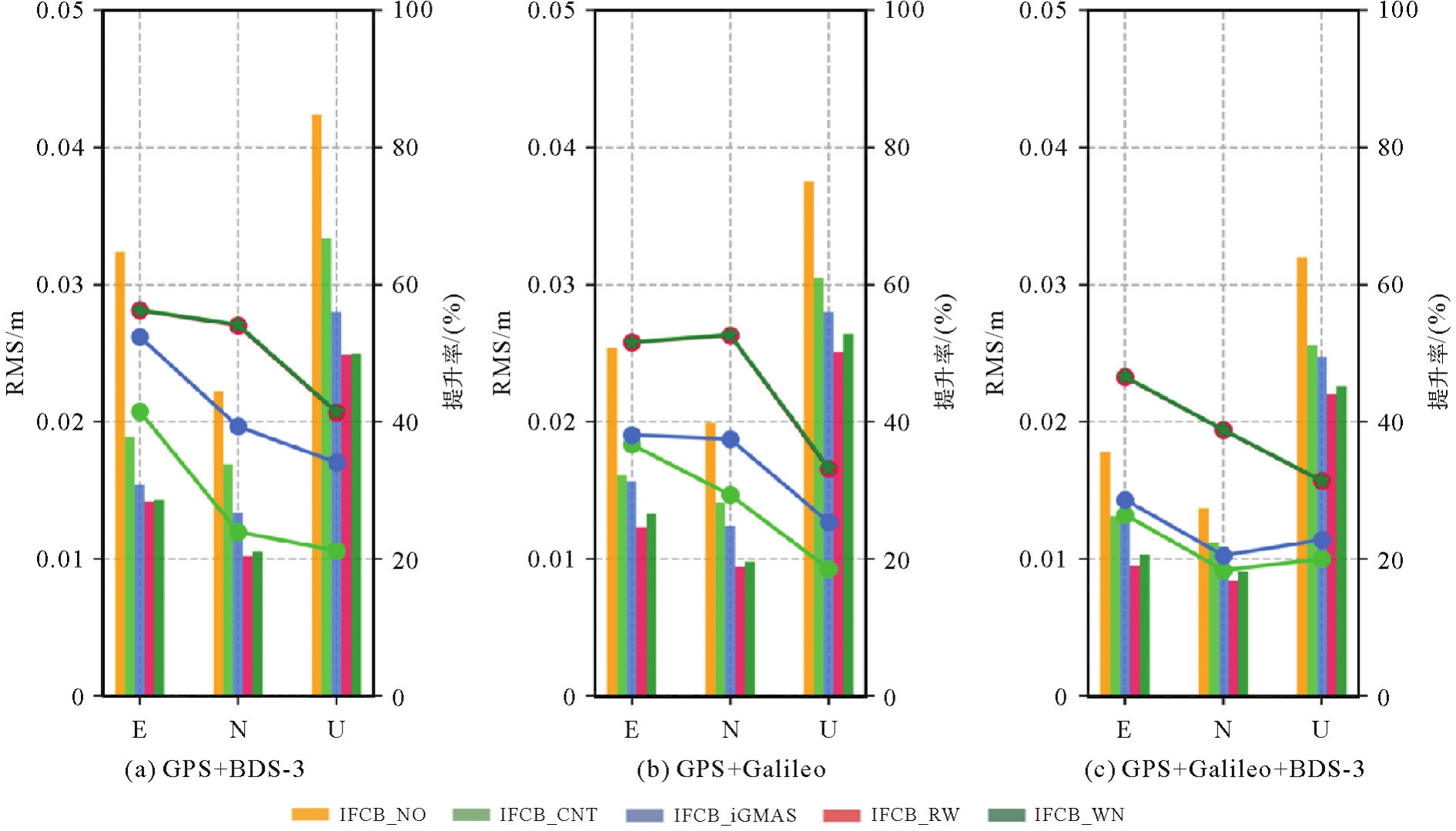
Fig. 5
RMS (bar graph) and promote (line graph) of multi-GNSS PPP solutions among different IFCB handling schemes at 29 stations (DOY 18—DOY 31, 2022)"
Tab. 4
RMS average and promotion rate of PPP positioning results for different IFCB schemes at 29 stations (DOY 18—DOY 31, 2022)"
| 参数 | IFCB方案 | E | N | U | 3D |
|---|---|---|---|---|---|
| RMS/m | NO | 0.025 2 | 0.018 6 | 0.037 3 | 0.048 7 |
| CNT | 0.016 0 | 0.014 0 | 0.029 8 | 0.036 7 | |
| iGMAS | 0.014 6 | 0.012 3 | 0.026 9 | 0.033 0 | |
| RW | 0.012 0 | 0.009 3 | 0.024 0 | 0.028 4 | |
| WN | 0.012 6 | 0.009 5 | 0.024 6 | 0.029 2 | |
| 提升率/(%) | CNT | 36.51 | 24.73 | 20.11 | 24.64 |
| iGMAS | 42.06 | 33.87 | 27.88 | 32.24 | |
| RW | 52.38 | 50.00 | 35.66 | 41.68 | |
| WN | 50.00 | 48.92 | 34.05 | 40.04 |
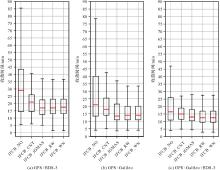
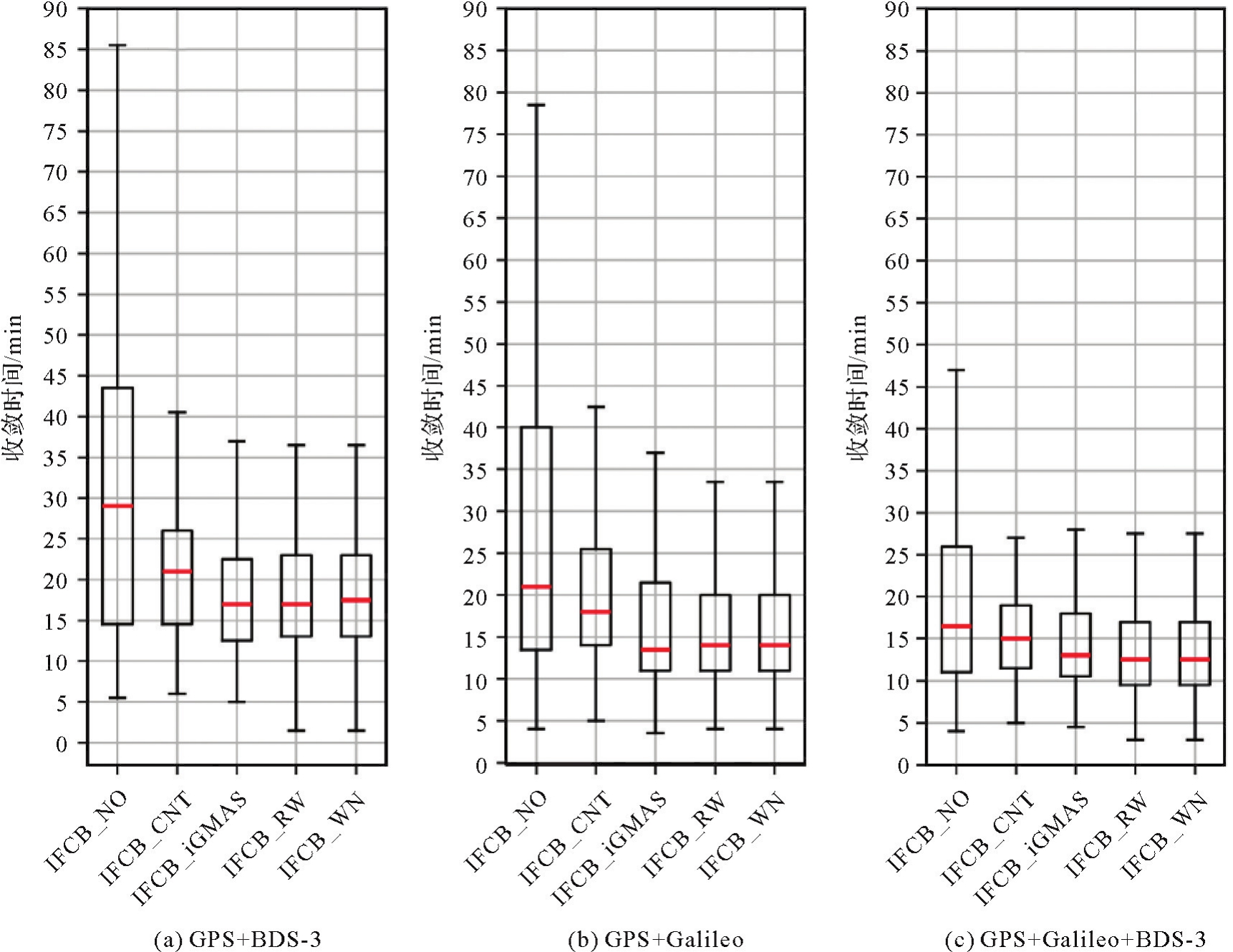
Fig. 6
Box plot of multi-GNSS multi-frequency PPP convergence time for 29 stations with different IFCB schemes (DOY 18—DOY 31, 2022)"
Tab. 5
Average multi-GNSS multi-frequency PPP convergence time and mean values for 29 stations with different IFCB schemes (DOY 18—DOY 31, 2022)"
| IFCB方案 | 收敛时间平均数/min | 收敛时间中位数/min |
|---|---|---|
| NO | 30.64 | 22.26 |
| CNT | 20.07 | 17.94 |
| iGMAS | 17.30 | 14.82 |
| RW | 16.39 | 14.64 |
| WN | 16.42 | 14.92 |
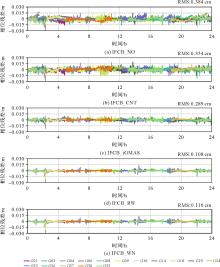
Fig. 7
VILL station GPS+BDS-3 combined system with different IFCB schemes GPS L5 phase residuals (DOY 24, 2022)"

Tab. 6
Average of three GNSS combined systems (GPS+BDS-3, GPS+Galileo and GPS+Galileo+BDS-3) IFCB scheme GPS L5 phase residuals for 29 stations (DOY 18—DOY 31, 2022)"
| IFCB方案 | GPS L5相位残差RMS/cm |
|---|---|
| NO | 0.355 8 |
| CNT | 0.332 4 |
| iGMAS | 0.249 1 |
| RW | 0.075 1 |
| WN | 0.075 8 |
| [1] |
周锋, 徐天河. GPS/BDS/Galileo三频精密单点定位模型及性能分析[J]. 测绘学报, 2021, 50(1): 61-70. DOI:.
doi: 10.11947/j.AGCS.2021.20200146 |
|
ZHOU Feng, XU Tianhe. Modeling and assessment of GPS/BDS/Galileo triple-frequency precise point positioning[J]. Acta Geodaetica et Cartographica Sinica, 2021, 50(1): 61-70. DOI:.
doi: 10.11947/j.AGCS.2021.20200146 |
|
| [2] |
金双根, 汪奇生, 史奇奇. 单频到五频多系统GNSS精密单点定位参数估计与应用[J]. 测绘学报, 2022, 51(7): 1239-1248. DOI:.
doi: 10.11947/j.AGCS.2022.20220129 |
|
JIN Shuanggen, WANG Qisheng, SHI Qiqi. Parameters estimation and applications from single- to five-frequency multi-GNSS precise point positioning[J]. Acta Geodaetica et Cartographica Sinica, 2022, 51(7): 1239-1248. DOI:.
doi: 10.11947/j.AGCS.2022.20220129 |
|
| [3] | 张宝成, 欧吉坤, 袁运斌, 等. 利用非组合精密单点定位技术确定斜向电离层总电子含量和站星差分码偏差[J]. 测绘学报, 2011, 40(4): 447-453. |
| ZHANG Baocheng, OU Jikun, YUAN Yunbin, et al. Calibration of slant total electron content and satellite-receiver's differential code biases with uncombined precise point positioning technique[J]. Acta Geodaetica et Cartographica Sinica, 2011, 40(4): 447-453. | |
| [4] | KOUBA J, HÉROUX P. Precise point positioning using IGS orbit and clock products[J]. GPS Solutions, 2001, 5(2): 12-28. |
| [5] |
潘林. GNSS多频融合精密单点定位频率间卫星钟偏差研究[J]. 测绘学报, 2020, 49(5): 668. DOI:.
doi: 10.11947/j.AGCS.2020.20190195 |
|
PAN Lin. Research on inter-frequency clock bias for GNSS multi-frequency integrated precise point positioning[J]. Acta Geodaetica et Cartographica Sinica, 2020, 49(5): 668. DOI:.
doi: 10.11947/j.AGCS.2020.20190195 |
|
| [6] | GUO Jiang, GENG Jianghui. GPS satellite clock determination in case of inter-frequency clock biases for triple-frequency precise point positioning[J]. Journal of Geodesy, 2018, 92(10): 1133-1142. |
| [7] | MONTENBRUCK O, HUGENTOBLER U, DACH R, et al. Apparent clock variations of the Block ⅡF-1 (SVN62) GPS satellite[J]. GPS Solutions, 2012, 16(3): 303-313. |
| [8] | LI Haojun, LI Bofeng, XIAO Guolei, et al. Improved method for estimating the inter-frequency satellite clock bias of triple-frequency GPS[J]. GPS Solutions, 2016, 20(4): 751-760. |
| [9] |
柳根. 多频多模PPP非组合模糊度固定方法和关键技术研究[J]. 测绘学报, 2020, 49(6): 798. DOI:.
doi: 10.11947/j.AGCS.2020.20200116 |
|
LIU Gen. Research on methodology and the key technology of uncombined ambiguity resolution for multi-frequency and multi-GNSS precise point positioning[J]. Acta Geodaetica et Cartographica Sinica, 2020, 49(6): 798. DOI:.
doi: 10.11947/j.AGCS.2020.20200116 |
|
| [10] | ZHANG Yize, KUBO N, CHEN Junping, et al. An improved method for BDS inter-frequency clock bias estimation[C]//Proceedings of 2019 China Satellite Navigation Conference. Singapore: Springer, 2019: 39-48. |
| [11] | PAN Lin, ZHANG Xiaohong, LI Xingxing, et al. Characteristics of inter-frequency clock bias for Block ⅡF satellites and its effect on triple-frequency GPS precise point positioning[J]. GPS Solutions, 2017, 21(2): 811-822. |
| [12] | LI Haojun, ZHOU Xuhua, WU Bin. Fast estimation and analysis of the inter-frequency clock bias for Block ⅡF satellites[J]. GPS Solutions, 2013, 17(3): 347-355. |
| [13] | MONTENBRUCK O, HAUSCHILD A, STEIGENBERGER P, et al. Three's the challenge: a close look at GPS SVN62 triple-frequency signal combinations finds carrier-phase variations on the new L5[J]. GPS World, 2010, 21: 8-19. |
| [14] | THOELERT S, STEIGENBERGER P, MONTENBRUCK O, et al. Signal analysis of the first GPS Ⅲ satellite[J]. GPS Solutions, 2019, 23(4): 92. |
| [15] | GONG Xiaopeng, GU Shengfeng, LOU Yidong, et al. Research on empirical correction models of GPS Block ⅡF and BDS satellite inter-frequency clock bias[J]. Journal of Geodesy, 2020, 94(3): 36. |
| [16] | LI Pan, JIANG Xinyuan, ZHANG Xiaohong, et al. GPS+Galileo+BeiDou precise point positioning with triple-frequency ambiguity resolution[J]. GPS Solutions, 2020, 24(3): 78. |
| [17] | LI Xingxing, LI Xin, LIU Gege, et al. Triple-frequency PPP ambiguity resolution with multi-constellation GNSS: BDS and Galileo[J]. Journal of Geodesy, 2019, 93(8): 1105-1122. |
| [18] | PAN Lin, ZHANG Xiaohong, GUO Fei, et al. GPS inter-frequency clock bias estimation for both uncombined and ionospheric-free combined triple-frequency precise point positioning[J]. Journal of Geodesy, 2019, 93(4): 473-487. |
| [19] | ZHANG Fan, CHAI Hongzhou, LI Linyang, et al. Estimation and analysis of GPS inter-fequency clock biases from long-term triple-frequency observations[J]. GPS Solutions, 2021, 25(4): 126. |
| [20] | LU Yangyang, ZHU Huizhong, TANG Longjiang, et al. Influence of stochastic modeling for inter-frequency clock biases on multi-frequency precise point positioning[J]. Remote Sensing, 2023, 15(18): 4507. |
| [21] | ZHANG Fan, CHAI Hongzhou, WANG Min, et al. Considering inter-frequency clock bias for GLONASS FDMA+CDMA precise point positioning[J]. GPS Solutions, 2022, 27(1): 10. |
| [22] | AI Qingsong, LIU Teng, ZHANG Baocheng, et al. Simultaneous estimation of inter-frequency clock biases and clock offsets with triple-frequency GPS data: undifferenced and uncombined methodology and impact analysis[J]. GPS Solutions, 2023, 27(3): 145. |
| [23] | KRZAN G, PRZESTRZELSKI P. GPS/GLONASS precise point positioning with IGS real-time service products[J]. Acta Geodynamica et Geomaterialia, 2016, 13(1): 69-81. |
| [24] | LIU Teng, ZHANG Baocheng, YUAN Yunbin, et al. Multi-GNSS triple-frequency differential code bias (DCB) determination with precise point positioning (PPP)[J]. Journal of Geodesy, 2019, 93: 765-784. |
| [25] |
陈良, 胡志刚, 耿长江, 等. GNSS增强系统中精密实时钟差高频估计及应用研究[J]. 测绘学报, 2016, 45(S2): 12-21. DOI:.
doi: 10.11947/j.AGCS.2016.F021 |
|
CHEN Liang, HU Zhigang, GENG Changjiang, et al. Study on a high-frequency multi-GNSS real-time precise clock estimation algorithm and application in GNSS augment system[J]. Acta Geodaetica et Cartographica Sinica, 2016, 45(S2): 12-21. DOI:.
doi: 10.11947/j.AGCS.2016.F021 |
|
| [26] | ZHOU Feng, DONG Danan, LI Weiwei, et al. GAMP: an open-source software of multi-GNSS precise point positioning using undifferenced and uncombined observations[J]. GPS Solutions, 2018, 22(2): 1-10. |
| [27] | ZHOU Feng, DONG Danan, LI Pan, et al. Influence of stochastic modeling for inter-system biases on multi-GNSS undifferenced and uncombined precise point positioning[J]. GPS Solutions, 2019, 23(3): 59. |
| [28] | LOU Yidong, ZHENG Fu, GU Shengfeng, et al. Multi-GNSS precise point positioning with raw single-frequency and dual-frequency measurement models[J]. GPS Solutions, 2016, 20(4): 849-862. |
| [1] | Mingtao ZHU, Yi ZHANG, Xian MA, Linsong WANG. Simulation and verification of regional hydrological gravity effect considering undulating terrain: a case study of the head region of Three Gorges Reservoir [J]. Acta Geodaetica et Cartographica Sinica, 2025, 54(5): 819-830. |
| [2] | Xinrui LI, Xuanyu QU, Qin ZHANG, Bao SHU, Lingen MENG, Hao XU, Shuangcheng ZHANG, Guanwen HUANG, Hanwen WU, Li WANG. A data-driven multipath error mitigation method for PPP-RTK and its application in deformation monitoring [J]. Acta Geodaetica et Cartographica Sinica, 2025, 54(12): 2168-2181. |
| [3] | Chuang SHI, Chenlong DENG, Lei FAN, Fu ZHENG, Tao ZHANG, Yuan TIAN, Guifei JING, Jie MA. Positioning performance analysis and evaluation for standalone BDS receivers [J]. Acta Geodaetica et Cartographica Sinica, 2025, 54(1): 1-13. |
| [4] | Jianhua CHENG, Sicheng CHEN, Nan ZANG, Sixiang CHENG, Guojing ZHAO, Zifan MA. PPP/INS tightly integrated enhancement model considering adaptive short-term height variation rate constraint [J]. Acta Geodaetica et Cartographica Sinica, 2024, 53(9): 1761-1776. |
| [5] | Liang LI, Liuqi WANG, Ningbo WANG, Min LI, Zishen LI, Fengze DU, Shuai PANG, Zhibo NA. Vectorized integrity monitoring method for PPP-RTK correction products [J]. Acta Geodaetica et Cartographica Sinica, 2024, 53(9): 1777-1789. |
| [6] | Yingzong LIN, Xiaomin LUO, Junfeng DU. Fitting improvement of PPP receiver tracking error stochastic model for high latitudes [J]. Acta Geodaetica et Cartographica Sinica, 2024, 53(4): 666-676. |
| [7] | Jianghui GENG, Jihang LIN, Qiyuan ZHANG, Qiang WEN, Jing ZENG, Biao JIN. Phase clock/bias estimation for GNSS all-frequency undifferenced ambiguity resolution [J]. Acta Geodaetica et Cartographica Sinica, 2024, 53(12): 2254-2267. |
| [8] | ZHA Jiuping, ZHANG Baocheng, LIU Teng, ZHANG Xiao, HOU Pengyu, YUAN Yunbin, LI Zishen. Undifferenced and uncombined PPP-RTK aided by BDS-3 PPP-B2b precise orbits [J]. Acta Geodaetica et Cartographica Sinica, 2023, 52(9): 1449-1459. |
| [9] | LI Jun, ZHU Huizhong, XU Aigong, LU Yangyang, LEI Xiaoting. BDS long-range RTK positioning algorithm considering the time-varying properties of ionosphere [J]. Acta Geodaetica et Cartographica Sinica, 2023, 52(3): 383-396. |
| [10] | HOU Pengyu, ZHANG Baocheng, LIU Teng, ZHA Jiuping. Regional PPP-RTK with CDMA+FDMA data at undifferenced and uncombined level [J]. Acta Geodaetica et Cartographica Sinica, 2023, 52(2): 183-194. |
| [11] | SHU Bao, LIU Hui, WANG Li, ZHANG Qin, HUANG Guanwen. PPP and RTK integrated service method and performance based on regional reference station network [J]. Acta Geodaetica et Cartographica Sinica, 2022, 51(9): 1870-1880. |
| [12] | ZHANG Baocheng, KE Cheng, ZHA Jiuping, HOU Pengyu, LIU Teng, YUAN Yunbin, LI Zishen. Undifferenced and uncombined PPP-RTK:algorithmic models,prototype terminals and field-test results [J]. Acta Geodaetica et Cartographica Sinica, 2022, 51(8): 1725-1735. |
| [13] | LI Yang, GUO Jinyun, SUN Yu, YUAN Jiajia, CHANG Xiaotao, ZHANG Hongri. Inversion of global sea level change and its component contributions by combining time-varying gravity data and altimetry data [J]. Acta Geodaetica et Cartographica Sinica, 2022, 51(8): 1768-1778. |
| [14] | SHI Chuang, GU Shengfeng, LOU Yidong, ZHENG Fu, SONG Wei, ZHANG Dong, MAO Feiyu. Real-time wide-area precise positioning and precise timing service system [J]. Acta Geodaetica et Cartographica Sinica, 2022, 51(7): 1206-1214. |
| [15] | YUAN Yunbin, HOU Pengyu, ZHANG Baocheng. GNSS undifferenced and uncombined data processing and PPP-RTK high-precision positioning [J]. Acta Geodaetica et Cartographica Sinica, 2022, 51(7): 1225-1238. |
| Viewed | ||||||
|
Full text |
|
|||||
|
Abstract |
|
|||||
