

Acta Geodaetica et Cartographica Sinica ›› 2026, Vol. 55 ›› Issue (4): 708-720.doi: 10.11947/j.AGCS.2026.20250515
• Geodesy and Navigation • Previous Articles Next Articles
Xiaolei YANG1,2( ), Yun XIAO2,3(), Liqing YANG1,2, Xiaodong HONG4, Enze GUO1,2, Han WANG1,2
Received:2025-12-08
Revised:2026-03-05
Online:2026-05-11
Published:2026-05-11
Contact:
Yun XIAO
E-mail:1281733212@qq.com;2262164268@qq.com
About author:YANG Xiaolei (2002—), male, master, majors in time-varying gravity field inversion. E-mail: 1281733212@qq.com
Supported by:CLC Number:
Xiaolei YANG, Yun XIAO, Liqing YANG, Xiaodong HONG, Enze GUO, Han WANG. Improved baseline method for time-variable gravity field recovery[J]. Acta Geodaetica et Cartographica Sinica, 2026, 55(4): 708-720.
Tab. 1
Solution strategy"
| 力模型 | 数据说明 |
|---|---|
| 静态重力场模型 | GOCO06S |
| 地球自转 | IERS 2010 |
| 固体潮汐 | IERS 2010 |
| 海洋潮汐 | FES2014b |
| 固体极潮 | IERS 2010 |
| 海洋极潮 | Desai 2004 |
| 大气潮汐 | AOD1B RL06 |
| 大气和海洋去混频模型 | AOD1B RL06 |
| 月球太阳行星星历表 | JPL DE432 |
| 相对论效应 | IERS 2010 |
| 卫星初始状态 | 位置和速度、局部参数、每弧段估计 |
| 加速度计尺度 | 全填充尺度矩阵、局部参数、每月估计 |
| 加速度计偏差 | 常数、局部参数、每天估计 |
| 天线相位中心变化 | 估计y和z轴方向参数、局部参数、每月估计 |
| 短时变参数 | 40阶次,局部参数,每天估计 |
| 时变重力场 | 60、96、120阶次,全局参数,每月估计 |
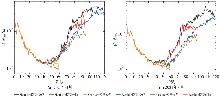
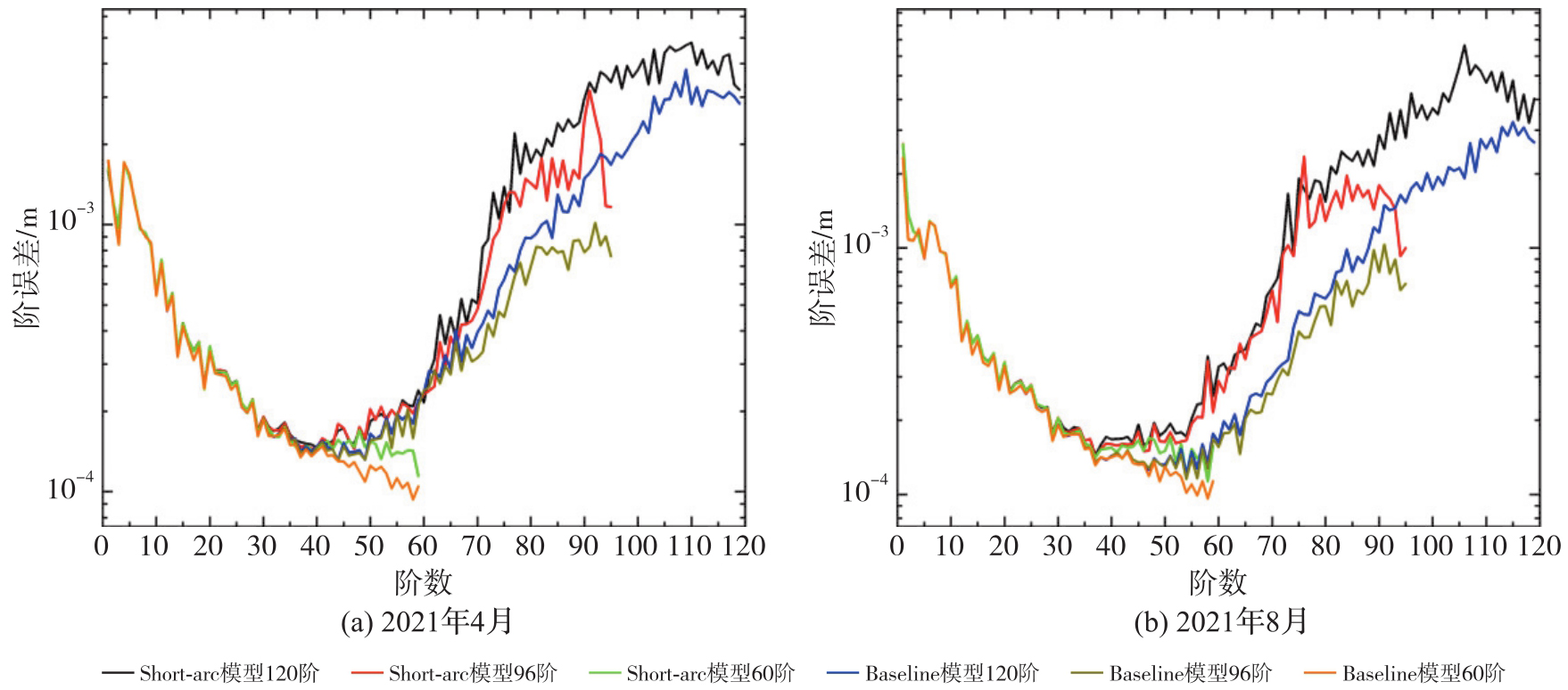
Fig. 1
Degree errors of the Baseline method and Short-arc method time-variable gravity field models at the degrees 60, 96 and 120"
Tab. 2
Cumulative errors of two models"
| 月份 | 模型 | 累计误差/cm | 精度提升/(%) | ||||
|---|---|---|---|---|---|---|---|
| 60阶 | 96阶 | 120阶 | 60阶 | 96阶 | 120阶 | ||
| 4月 | Baseline | 2.16 | 4.32 | 11.87 | 3.57 | 32.81 | 33.28 |
| Short-arc | 2.24 | 6.43 | 17.79 | — | — | — | |
| 8月 | Baseline | 2.20 | 3.99 | 10.34 | 6.38 | 38.14 | 44.97 |
| Short-arc | 2.35 | 6.45 | 18.79 | — | — | — | |
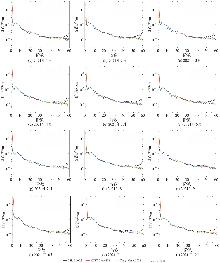
Fig. 2
Degree errors of the 60th degree time-variable gravity field model in 2021"

Fig. 3
Degree errors of the 96th degree time-variable gravity field model in 2021"
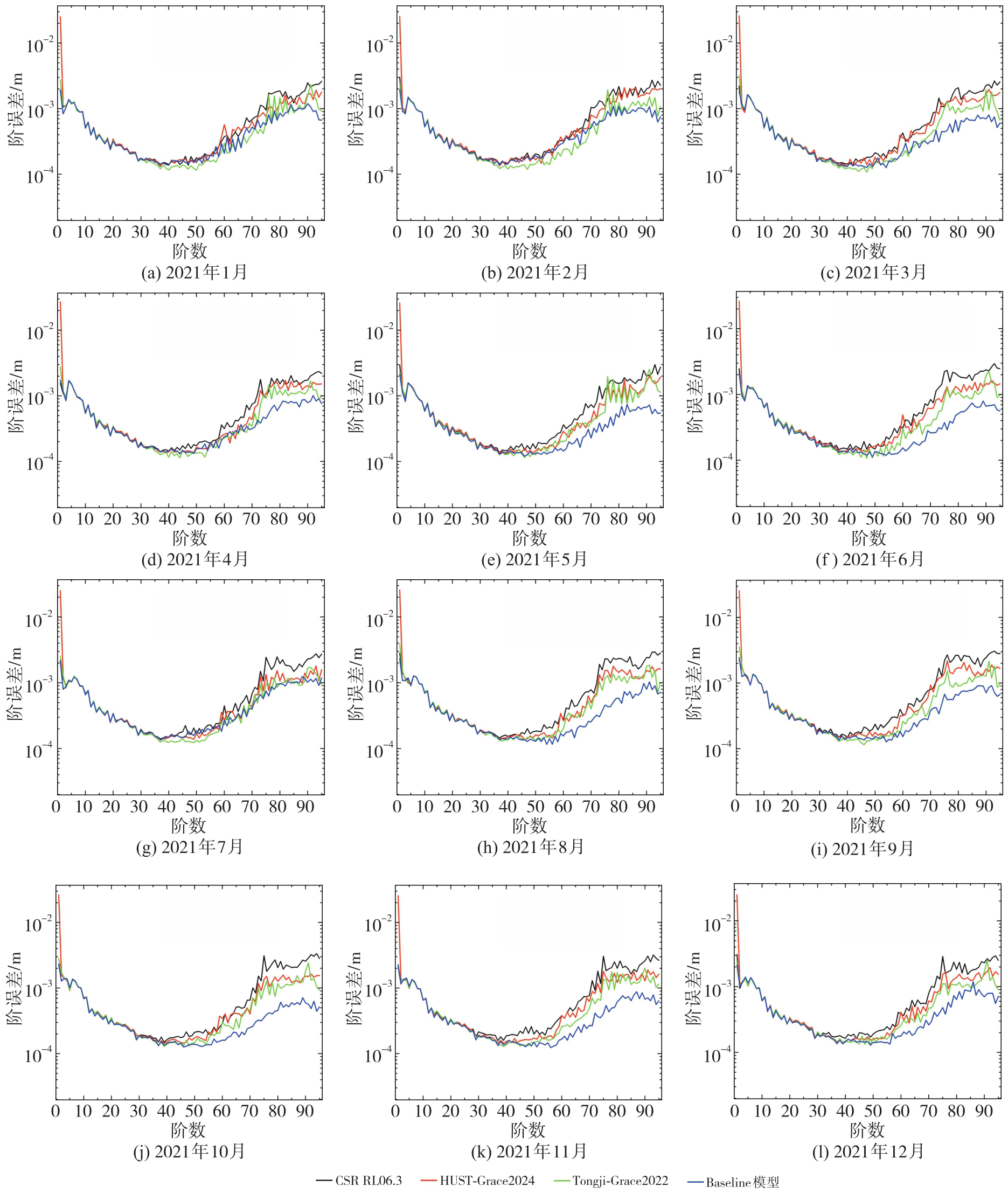
Fig. 4
Degree errors of the 120th degree time-variable gravity field model in 2021"
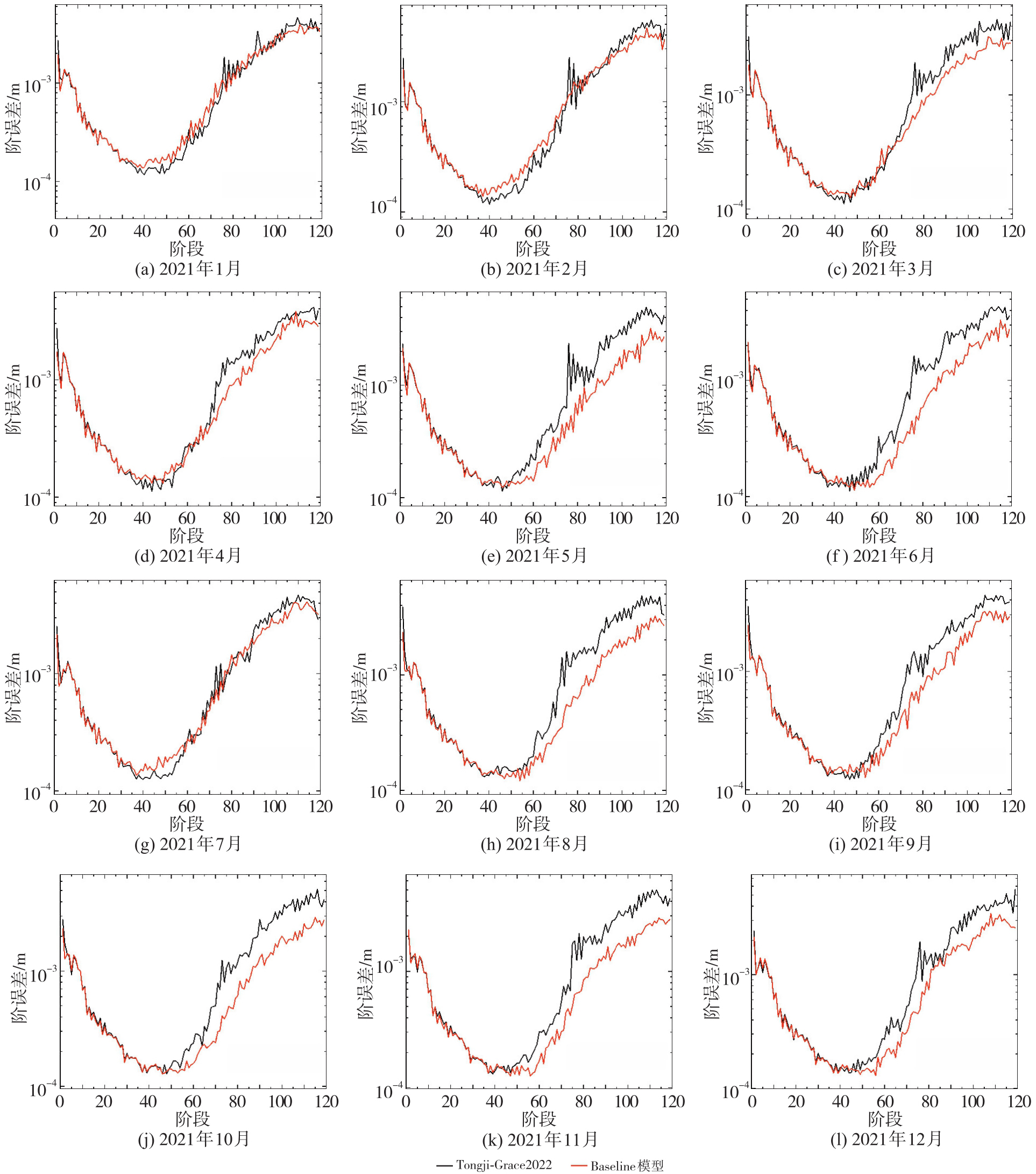
Fig. 5
Global equivalent water height distribution in August 2021"
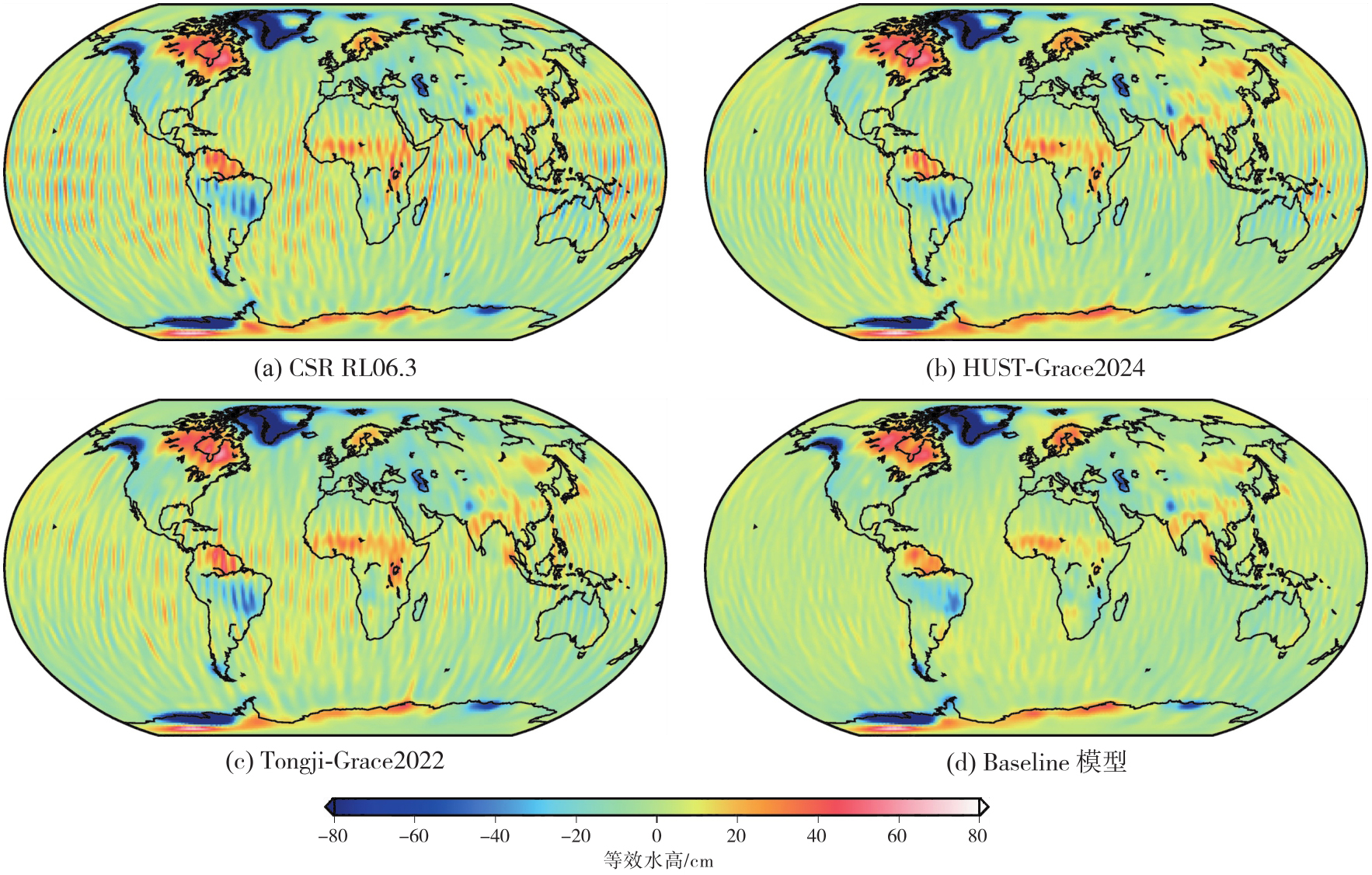
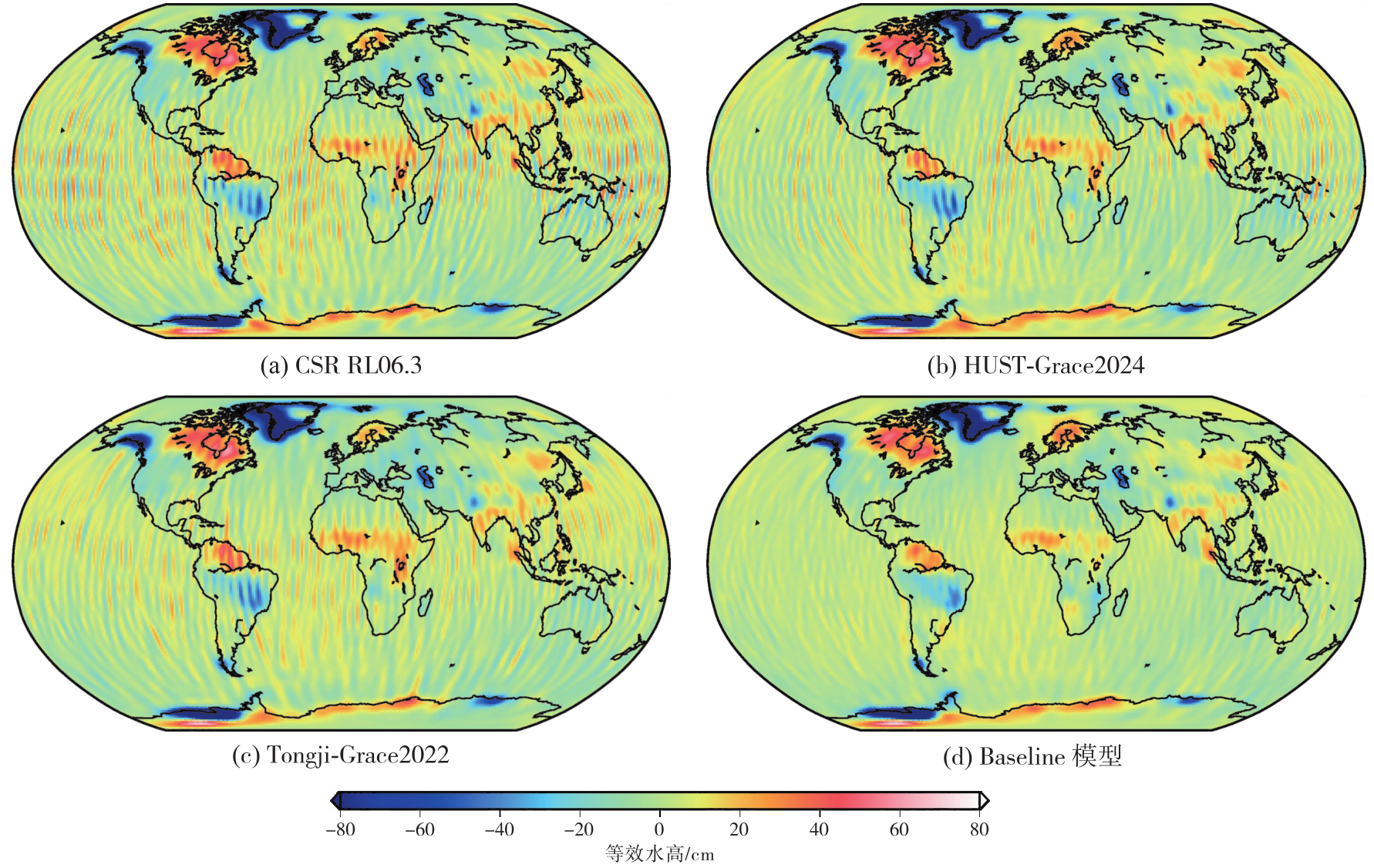
Fig. 6
Global equivalent water height distribution in September 2021"
Tab. 3
Statistics of RMSE and SNR of equivalent water height for different models"
| 时间 | 模型 | RMSE/cm | RMSE降低比率/(%) | 信噪比 | 信噪比提升比率/(%) |
|---|---|---|---|---|---|
| 2021年8月 | CSR RL06.3 | 12.94 | 29.52 | 1.84 | 29.35 |
| HUST-Grace2024 | 10.62 | 14.12 | 2.15 | 10.70 | |
| Tongji-Grace2022 | 11.01 | 17.17 | 2.09 | 13.88 | |
| Baseline模型 | 9.12 | — | 2.38 | — | |
| 2021年9月 | CSR RL06.3 | 13.12 | 26.98 | 1.89 | 26.46 |
| HUST-Grace2024 | 11.26 | 14.92 | 2.02 | 18.32 | |
| Tongji-Grace2022 | 10.88 | 11.95 | 2.11 | 13.27 | |
| Baseline模型 | 9.58 | — | 2.39 | — |
| [1] | TAPLEY B D, BETTADPUR S, WATKINS M, et al. The gravity recovery and climate experiment: mission overview and early results[J]. Geophysical Research Letters, 2004, 31(9): 2004GL019920. |
| [2] | TAPLEY B D, WATKINS M M, FLECHTNER F, et al. Contributions of GRACE to understanding climate change[J]. Nature Climate Change, 2019, 9(5): 358-369. |
| [3] | KORNFELD R P, ARNOLD B W, GROSS M A, et al. GRACE-FO: the gravity recovery and climate experiment follow-on mission[J]. Journal of Spacecraft and Rockets, 2019, 56(3): 931-951. |
| [4] | REIGBER C. Gravity field recovery from satellite tracking data[C]//Proceedings of 1989 Theory of Satellite Geodesy and Gravity Field Determination. Berlin: Springer, 1989: 197-234. |
| [5] | MAYER-GÜRR T. Gravitationsfeldbestimmung aus der analyse kurzer bahnbö gen am beispiel der satellitenmissionen CHAMP und GRACE[D]. Bonn: University of Bonn, 2006. |
| [6] | DITMAR P, VAN ECK VAN DER SLUIJS A A. A technique for modeling the Earth's gravity field on the basis of satellite accelerations[J]. Journal of Geodesy, 2004, 78(1): 12-33. |
| [7] | VISSER P N A M, SNEEUW N, GERLACH C. Energy integral method for gravity field determination from satellite orbit coordinates[J]. Journal of Geodesy, 2003, 77(3): 207-216. |
| [8] |
陈秋杰, 沈云中, 张兴福, 等. 基于GRACE卫星数据的高精度全球静态重力场模型[J]. 测绘学报, 2016, 45(4): 396-403. DOI: .
doi: 10.11947/j.AGCS.2016.20150422 |
|
CHEN Qiujie, SHEN Yunzhong, ZHANG Xingfu, et al. GRACE data-based high accuracy global static Earth's gravity field model[J]. Acta Geodaetica et Cartographica Sinica, 2016, 45(4): 396-403. DOI: .
doi: 10.11947/j.AGCS.2016.20150422 |
|
| [9] | ZHOU Hao, LUO Zhicai, ZHOU Zebing, et al. HUST-Grace2016s: a new GRACE static gravity field model derived from a modified dynamic approach over a 13-year observation period[J]. Advances in Space Research, 2017, 60(3): 597-611. |
| [10] | 罗志才, 周浩, 钟波, 等. 顾及多方向观测值权比反演地球重力场的动力积分法[J]. 地球物理学报, 2015, 58(9): 3061-3071. |
| LUO Zhicai, ZHOU Hao, ZHONG Bo, et al. Dynamic integral approach based on weighted multi-direction observations for inversion of the earth's gravity field[J]. Chinese Journal of Geophysics, 2015, 58(9): 3061-3071. | |
| [11] |
陈秋杰. 基于改进短弧积分法的GRACE重力反演理论、方法及应用[J]. 测绘学报, 2017, 46(1): 130. DOI: .
doi: 10.11947/j.AGCS.2017.20160470 |
|
CHEN Qiujie. Theory, methodology and application of GRACE gravity recovery using modified short arc approach[J]. Acta Geodaetica et Cartographica Sinica, 2017, 46(1): 130. DOI: .
doi: 10.11947/j.AGCS.2017.20160470 |
|
| [12] | CHEN Qiujie, SHEN Yunzhong, ZHANG Xingfu, et al. Monthly gravity field models derived from GRACE Level 1B data using a modified short-arc approach[J]. Journal of Geophysical Research: Solid Earth, 2015, 120(3): 1804-1819. |
| [13] | MAYER-GÜRR T, EICKER A, ILK K H. Gravity field recovery from GRACE-SST data of short arcs[M]//Observation of the Earth System from Space. Berlin: Springer-Verlag, 2006: 131-148. |
| [14] | 苏勇, 范东明. 利用短弧积分法和GOCE轨道数据确定地球重力场模型[J]. 地球物理学进展, 2014, 29(5): 2072-2076. |
| SU Yong, FAN Dongming. Gravity field modeling by using the short-arc integral approach and GOCE orbits[J]. Progress in Geophysics, 2014, 29(5): 2072-2076. | |
| [15] | 郭美杉, 陈秋杰, 沈云中, 等. 基于优化短弧边值法的GRACE Level-1B全球Mascon时变重力场反演[J]. 地球物理学报, 2025, 68(8): 3069-3084. |
| GUO Meishan, CHEN Qiujie, SHEN Yunzhong, et al. Global Mascon time-variable gravity field estimated from GRACE Level-1B data by using an optimized short-arc approach[J]. Chinese Journal of Geophysics, 2025, 68(8): 3069-3084. | |
| [16] | 陈鑑华, 张兴福, 陈秋杰, 等. 融合GOCE和GRACE卫星数据的无约束重力场模型Tongji-GOGR2019S[J]. 地球物理学报, 2020, 63(9): 3251-3262. |
| CHEN Jianhua, ZHANG Xingfu, CHEN Qiujie, et al. Unconstrained gravity field model Tongji-GOGR2019S derived from GOCE and GRACE data[J]. Chinese Journal of Geophysics, 2020, 63(9): 3251-3262. | |
| [17] |
胡少彬, 陈秋杰, 沈云中, 等. 基于Adams和KSG的短弧积分方程快速离散化方法[J]. 测绘学报, 2025, 54(8): 1416-1426. DOI: .
doi: 10.11947/j.AGCS.2025.20240361 |
|
HU Shaobin, CHEN Qiujie, SHEN Yunzhong, et al. An efficient discretization approach for the short-arc integral equation based on Adams andKSGintegrators[J]. ActaGeodaeticaetCartographicaSinica, 2025, 54(8): 1416-1426. DOI: .
doi: 10.11947/j.AGCS.2025.20240361 |
|
| [18] |
周浩, 罗志才, 钟波, 等. 利用最小二乘直接法反演卫星重力场模型的MPI并行算法[J]. 测绘学报, 2015, 44(8): 833-839, 857. DOI: .
doi: 10.11947/j.AGCS.2015.20140396 |
|
ZHOU Hao, LUO Zhicai, ZHONG Bo, et al. MPI parallel algorithm in satellite gravity field model inversion on the basis of least square method[J]. Acta Geodaetica et Cartographica Sinica, 2015, 44(8): 833-839, 857. DOI: .
doi: 10.11947/j.AGCS.2015.20140396 |
|
| [19] | 冉将军, 许厚泽, 钟敏, 等. 利用GRACE重力卫星观测数据反演全球时变地球重力场模型[J]. 地球物理学报, 2014, 57(4): 1032-1040. |
| RAN Jiangjun, XU Houze, ZHONG Min, et al. Global temporal gravity filed recovery using GRACE data[J]. Chinese Journal of Geophysics, 2014, 57(4): 1032-1040. | |
| [20] | 肖云, 夏哲仁, 孙中苗, 等. 基线法在卫星重力数据处理中的应用[J]. 武汉大学学报(信息科学版), 2011, 36(3): 280-284. |
| XIAO Yun, XIA Zheren, SUN Zhongmiao, et al. Application of an improved dynamic method baseline method to satellite gravtimetry data processing[J]. Geomatics and Information Science of Wuhan University, 2011, 36(3): 280-284. | |
| [21] | KVAS A, MAYER-GÜRR T. GRACE gravity field recovery with background model uncertainties[J]. Journal of Geodesy, 2019, 93(12): 2543-2552. |
| [22] | MAYER-GÜRR T, BEHZADPOUR S, EICKER A, et al. GROOPS: a software toolkit for gravity field recovery and GNSS processing[J]. Computers & Geosciences, 2021, 155: 104864. |
| [23] | 张佳辉, 游为, 万祥禹, 等. GRACE-FO动力学一步法时变重力场反演[J]. 地球物理学报, 2025, 68(9): 3338-3352. |
| ZHANG Jiahui, YOU Wei, WAN Xiangyu, et al. GRACE-FO time-variable gravity recovery by dynamic one-step method[J]. Chinese Journal of Geophysics, 2025, 68(9): 3338-3352. | |
| [24] | 王长青, 许厚泽, 钟敏, 等. 利用动力学方法解算GRACE时变重力场研究[J]. 地球物理学报, 2015, 58(3): 756-766. |
| WANG Changqing, XU Houze, ZHONG Min, et al. An investigation on GRACE temporal gravity field recovery using the dynamic approach[J]. Chinese Journal of Geophysics, 2015, 58(3): 756-766. | |
| [25] | CHEN Qiujie, SHEN Yunzhong, CHEN Wu, et al. An optimized short-arc approach: methodology and application to develop refined time series of Tongji-Grace2018 GRACE monthly solutions[J]. Journal of Geophysical Research: Solid Earth, 2019, 124(6): 6010-6038. |
| [1] | Wentao HOU, Yun XIAO, Jie CAO, Yukang WANG, Chunting CAO, Han WANG. A downscaling method for gravity satellite derived groundwater storage changes based on a feature-weighted CatBoost model [J]. Acta Geodaetica et Cartographica Sinica, 2026, 55(3): 490-501. |
| [2] | Tangting WU, Xinyu LUO, Liguo LU, Zhanke LIU, Nengfang CHAO. Assessment of water resource changes and drought characteristics in the Shaanxi, Gansu and Ningxia region based on GNSS and GRACE/GRACE-FO [J]. Acta Geodaetica et Cartographica Sinica, 2026, 55(3): 439-450. |
| [3] | Lei LIANG, Changqing WANG, Lingyong HUANG, Zhiyong HUANG, Yaoyao YU, Min ZHONG, Yihao YAN, Qinglu MU. GRACE-FO attitude data determination with consideration of star camera alignment matrix calibration [J]. Acta Geodaetica et Cartographica Sinica, 2026, 55(2): 287-300. |
| [4] | Haichao WANG, Changqing WANG, Dinghao GUO, Zitong ZHU, Wei FENG, Min ZHONG. Detection of atmospheric density in the thermosphere and satellite orbital decay variations triggered by different intensities of geomagnetic storms using the GRACE-FO satellite [J]. Acta Geodaetica et Cartographica Sinica, 2025, 54(2): 248-261. |
| [5] | Xinghai YANG, Linguo YUAN, Zhongshan JIANG, Miao TANG. Joint inversion of GNSS and GRACE/GRACE-FO data for terrestrial water storage changes in Southwest China [J]. Acta Geodaetica et Cartographica Sinica, 2024, 53(5): 813-822. |
| [6] | ZHANG Yupeng, ZHANG Yonghong, WU Hongan, LIU Qinghao, WEI Jujie, KANG Yonghui. Study on elastic skeleton storage coefficient in Beijing-Tianjin-Hebei region combining satellite and ground data [J]. Acta Geodaetica et Cartographica Sinica, 2023, 52(4): 660-669. |
| [7] | SHAO Kai, YI Bin, ZHANG Houzhe, GU Defeng. Integer phase clock method with single-satellite ambiguity fixing and its application in LEO satellite orbit determination [J]. Acta Geodaetica et Cartographica Sinica, 2021, 50(4): 487-495. |
| [8] | CHAO Nengfang, WANG Zhengtao, SUN Jian. The Inversion of Terrestrial Water Storage Changes by Non-isotropic Combination Filter [J]. Acta Geodaetica et Cartographica Sinica, 2015, 44(2): 174-182. |
| Viewed | ||||||
|
Full text |
|
|||||
|
Abstract |
|
|||||
