

Acta Geodaetica et Cartographica Sinica ›› 2026, Vol. 55 ›› Issue (10): 1829-1838.doi: 10.11947/j.AGCS.2026.20260187
• Photogrammetry and Remote Sensing • Previous Articles Next Articles
He Huang( ), Xintai Zhang, Yidan Zhang, Junxing Yang()
Received:2026-05-13
Revised:2026-06-16
Online:2026-11-16
Published:2026-11-16
Contact:
Junxing Yang
E-mail:huanghe@bucea.edu.cn;yangjunxing@bucea.edu.cn
About author:Huang He (1977—), male, PhD, professor, majors in navigation and positioning. E-mail: huanghe@bucea.edu.cn
Supported by:CLC Number:
He Huang, Xintai Zhang, Yidan Zhang, Junxing Yang. Long-sequence geometry enhancement network for large-scale LiDAR point cloud semantic segmentation[J]. Acta Geodaetica et Cartographica Sinica, 2026, 55(10): 1829-1838.
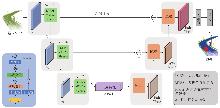
Fig. 1
Overall architecture of GradMamba-Net"
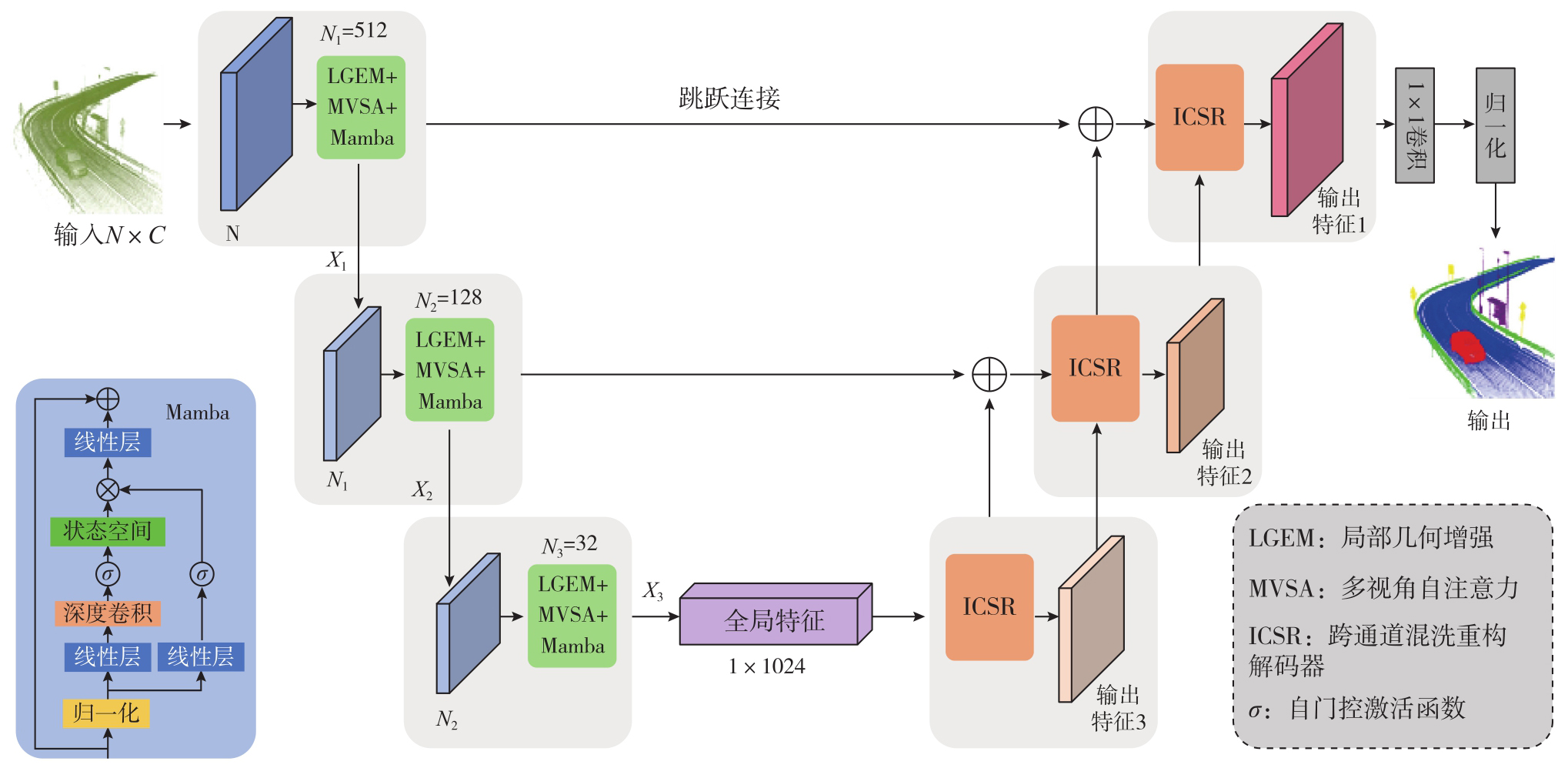
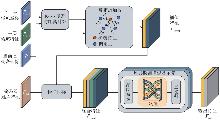
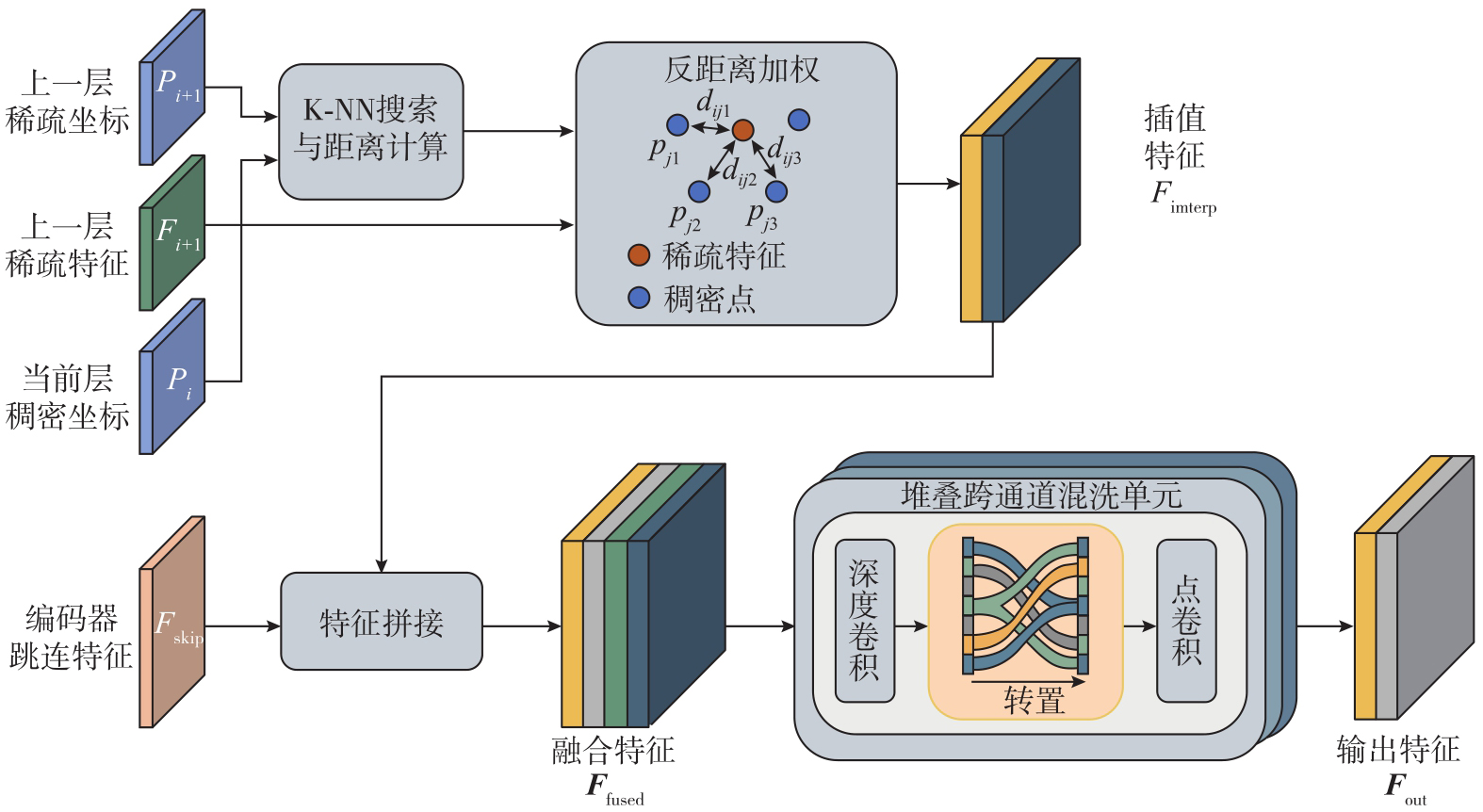
Fig. 2
Architecture of inter-channel shuffle reconstruction decoder"
Tab. 1
Semantic segmentation results of different methods on the Toronto-3D dataset"
| 模型 | IoU | mIoU | OA | |||||||
|---|---|---|---|---|---|---|---|---|---|---|
| 道路 | 路面标记 | 自然地物 | 建筑物 | 公用设施线 | 杆状物 | 车辆 | 围栏 | |||
| PointNet++[ | 92.9 | 0.0 | 86.1 | 82.2 | 61.0 | 62.8 | 76.4 | 14.4 | 59.5 | 92.6 |
| KPConv[ | 94.6 | 0.0 | 96.0 | 91.5 | 87.6 | 81.5 | 85.6 | 15.7 | 69.1 | 95.3 |
| PointTransformerV3[ | 96.8 | 50.1 | 89.9 | 98.5 | 84.1 | 76.1 | 89.1 | 27.1 | 69.4 | 93.1 |
| PointMamba[ | 96.2 | 65.0 | 92.7 | 87.5 | 71.7 | 60.4 | 93.5 | 10.6 | 72.2 | 95.6 |
| PointCloudMamba[ | 95.5 | 60.9 | 94.2 | 88.8 | 81.4 | 70.0 | 91.9 | 36.5 | 77.3 | 96.1 |
| 3D-UMamba[ | 97.7 | 66.3 | 94.3 | 87.6 | 83.0 | 71.2 | 89.5 | 36.0 | 78.2 | 96.3 |
| GradMamba-Net | 97.5 | 70.4 | 95.9 | 93.5 | 84.2 | 76.4 | 94.6 | 46.5 | 82.3 | 97.6 |
Tab. 2
Segmentation results on the MLS-S scenarios of the WHU-Urban3D dataset"
| 模型 | IoU | mIoU | OA | |||||||
|---|---|---|---|---|---|---|---|---|---|---|
| 树木 | 建筑物 | 行车道 | 围栏 | 杆状物 | 道路标线 | 电线杆 | 路灯 | |||
| PointMamba[ | 84.2 | 78.4 | 83.2 | 62.8 | 57.9 | 34.5 | 0.0 | 49.6 | 50.8 | 81.7 |
| PointCloudMamba[ | 85.5 | 79.6 | 84.3 | 63.7 | 58.2 | 34.8 | 0.1 | 50.2 | 51.5 | 82.3 |
| PointTransformerV3[ | 89.1 | 90.3 | 82.9 | 61.2 | 57.5 | 34.1 | 1.2 | 48.3 | 57.4 | 85.6 |
| 3D-UMamba[ | 88.4 | 85.2 | 85.1 | 66.5 | 60.3 | 36.4 | 3.4 | 52.4 | 58.9 | 86.2 |
| GradMamba-Net | 87.9 | 86.3 | 88.6 | 70.4 | 64.2 | 37.5 | 4.5 | 56.7 | 61.2 | 87.4 |
Tab. 3
Segmentation results on the ALS-S scenarios of the WHU-Urban3D dataset"
| 模型 | IoU | mIoU | OA | |||||||
|---|---|---|---|---|---|---|---|---|---|---|
| 植被 | 低矮植物 | 电线 | 地面 | 其他类别 | 建筑物 | 树木 | 路灯 | |||
| PointMamba[ | 64.7 | 39.6 | 61.2 | 64.8 | 28.4 | 81.4 | 36.2 | 63.0 | 53.5 | 77.6 |
| PointCloudMamba[ | 67.5 | 67.5 | 64.5 | 67.0 | 32.4 | 84.0 | 38.8 | 63.8 | 56.2 | 78.9 |
| PointTransformerV3[ | 73.4 | 73.4 | 68.0 | 71.2 | 36.8 | 91.2 | 43.6 | 68.1 | 61.4 | 82.1 |
| 3D-UMamba[ | 75.8 | 75.8 | 70.0 | 73.4 | 40.6 | 88.8 | 46.8 | 65.6 | 62.8 | 82.8 |
| GradMamba-Net | 76.4 | 76.4 | 72.8 | 74.1 | 39.9 | 89.5 | 49.2 | 74.1 | 64.5 | 84.1 |
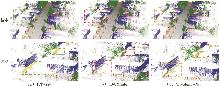
Fig. 3
Visualization results of semantic segmentation on the Toronto-3D dataset"

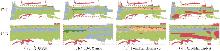
Fig. 4
Visual comparison of semantic segmentation on the WHU-Urban3D dataset"

Tab. 4
Ablation results of GradMamba-Net component"
| 模型 | IoU | mIoU | OA | |||
|---|---|---|---|---|---|---|
| 围栏 | 杆状物 | 路面标记 | 公用设施线 | |||
| 3D-UMamba | 36.0 | 71.2 | 66.3 | 83.0 | 78.2 | 96.3 |
| 组合1 | 41.8 | 73.4 | 67.6 | 83.5 | 79.9 | 97.0 |
| 组合2 | 43.1 | 74.2 | 68.4 | 83.7 | 80.6 | 97.0 |
| 组合3 | 44.7 | 75.5 | 69.5 | 84.0 | 81.5 | 97.3 |
| GradMamba-Net | 46.5 | 76.4 | 70.4 | 84.2 | 82.3 | 97.6 |
Tab. 5
Ablation results of different local geometric encoding strategies"
| 模型 | IoU | 边界区域mIoU | mIoU | |||
|---|---|---|---|---|---|---|
| 围栏 | 杆状物 | 路面标记 | 公用设施线 | |||
| 3D-UMamba | 36.0 | 71.2 | 66.3 | 83.0 | 68.2 | 78.2 |
| Relative-Only | 42.1 | 74.0 | 66.8 | 81.2 | 68.8 | 80.5 |
| EdgeConv[ | 44.2 | 75.1 | 68.5 | 82.8 | 69.6 | 81.6 |
| GradMamba-Net | 46.5 | 76.4 | 70.4 | 84.2 | 76.8 | 82.3 |
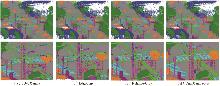
Fig. 5
Visual comparison of local geometric encoding strategies"

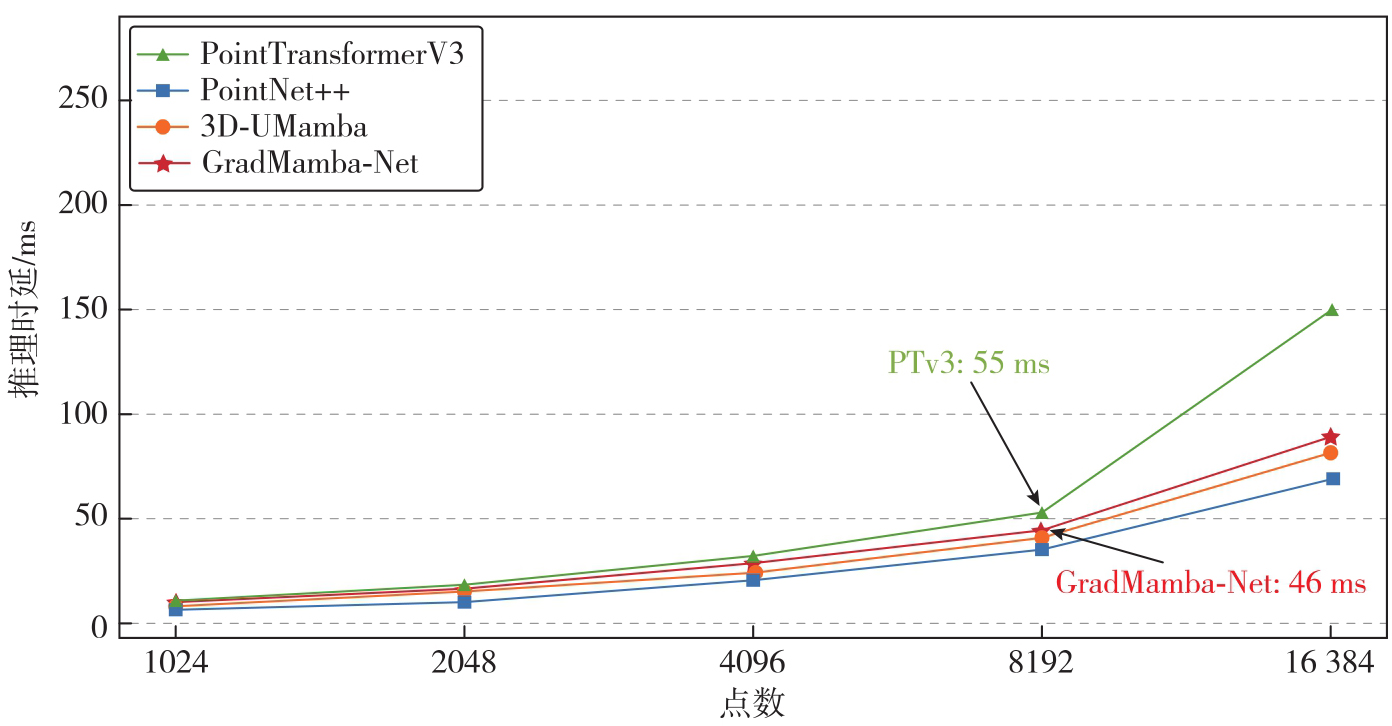
Fig. 6
Comparison of inference latency among different methods under different numbers of points"
| [1] |
杨必胜, 梁福逊, 黄荣刚. 三维激光扫描点云数据处理研究进展、挑战与趋势[J]. 测绘学报, 2017, 46(10): 1509-1516. DOI .
doi: 10.11947/j.AGCS.2017.20170351 |
|
Yang Bisheng, Liang Fuxun, Huang Ronggang. Progress, challenges and perspectives of 3D LiDAR point cloud processing[J]. Acta Geodaetica et Cartographica Sinica, 2017, 46(10): 1509-1516. DOI .
doi: 10.11947/j.AGCS.2017.20170351 |
|
| [2] |
杨必胜, 董震. 点云智能研究进展与趋势[J]. 测绘学报, 2019, 48(12): 1575-1585. DOI .
doi: 10.11947/j.AGCS.2019.20190465 |
|
Yang Bisheng, Dong Zhen. Progress and perspective of point cloud intelligence[J]. Acta Geodaetica et Cartographica Sinica, 2019, 48(12): 1575-1585. DOI .
doi: 10.11947/j.AGCS.2019.20190465 |
|
| [3] |
Sarker S, Sarker P, Stone G, et al. A comprehensive overview of deep learning techniques for 3D point cloud classification and semantic segmentation[J]. Machine Vision and Applications, 2024, 35: 67. DOI .
doi: 10.1007/s00138-024-01543-1 |
| [4] |
杨必胜, 韩旭, 董震. 适用于城市场景大规模点云语义标识的深度学习网络[J]. 测绘学报, 2021, 50(8): 1059-1067. DOI .
doi: 10.11947/j.AGCS.2021.20210093 |
|
Yang Bisheng, Han Xu, Dong Zhen. A deep learning network for semantic labeling of large-scale urban point clouds[J]. Acta Geodaetica et Cartographica Sinica, 2021, 50(8): 1059-1067. DOI .
doi: 10.11947/j.AGCS.2021.20210093 |
|
| [5] | Dong Z, Yang B, Hu P, et al. An efficient global energy optimization approach for robust 3D plane segmentation of point clouds[J]. ISPRS Journal of Photogrammetry and Remote Sensing, 2018, 137: 112-133. |
| [6] | Liang F, Yang B, Dong Z, et al. A hierarchical method for multi-class object extraction from mobile laser scanning point clouds[J]. Acta Geodaetica et Cartographica Sinica, 2015, 44(9): 987-996. |
| [7] | Wu B, Wan A, Yue X, et al. SqueezeSeg: convolutional neural nets with recurrent CRF for real-time road-object segmentation from 3D LiDAR point cloud[C]//Proceedings of 2018 IEEE International Conference on Robotics and Automation. Brisbane: IEEE, 2018: 1887-1893. |
| [8] | Milioto A, Vizzo I, Behley J, et al. RangeNet++: fast and accurate LiDAR semantic segmentation[C]//Proceedings of 2019 IEEE/RSJ International Conference on Intelligent Robots and Systems. Macao: IEEE, 2019: 4213-4220. |
| [9] | Graham B, Engelcke M, Van Der Maaten L. 3D semantic segmentation with submanifold sparse convolutional networks[C]//Proceedings of 2018 IEEE Conference on Computer Vision and Pattern Recognition. Salt Lake City: IEEE, 2018: 9224-9232. |
| [10] | Choy C, Gwak J, Savarese S. 4D spatio-temporal ConvNets: minkowski convolutional neural networks[C]//Proceedings of 2019 IEEE/CVF Conference on Computer Vision and Pattern Recognition. Long Beach: IEEE, 2019: 3075-3084. |
| [11] | Zhu X, Zhou H, Wang T, et al. Cylindrical and asymmetrical 3D convolution networks for LiDAR segmentation[C]//Proceedings of 2021 IEEE/CVF Conference on Computer Vision and Pattern Recognition. Nashville: IEEE, 2021: 9939-9948. |
| [12] | Qi C R, Su H, Mo K, et al. PointNet: deep learning on point sets for 3D classification and segmentation[C]//Proceedings of 2017 IEEE Conference on Computer Vision and Pattern Recognition. Honolulu: IEEE, 2017: 652-660. |
| [13] | Qi C R, Yi L, Su H, et al. PointNet++: deep hierarchical feature learning on point sets in a metric space[C]//Proceedings of 2017 Advances in Neural Information Processing Systems. Long Beach: Curran Associates, 2017: 5099-5108. |
| [14] | Wang Y, Sun Y, Liu Z, et al. Dynamic graph CNN for learning on point clouds[J]. ACM Transactions on Graphics, 2019, 38(5): 1-12. |
| [15] | Thomas H, Qi C R, Deschaud J E, et al. KPConv: flexible and deformable convolution for point clouds[C]//Proceedings of 2019 IEEE/CVF International Conference on Computer Vision. Seoul: IEEE, 2019: 6411-6420. |
| [16] | Guo M H, Cai J X, Liu Z N, et al. PCT: point cloud transformer[J]. Computational Visual Media, 2021, 7(2): 187-199. |
| [17] | Zhao H, Jiang L, Jia J, et al. Point Transformer[C]//Proceedings of 2021 IEEE/CVF International Conference on Computer Vision. Montreal: IEEE, 2021: 16259-16268. |
| [18] | Lai X, Liu J, Jiang L, et al. Stratified Transformer for 3D point cloud segmentation[C]//Proceedings of 2022 IEEE/CVF Conference on Computer Vision and Pattern Recognition. New Orleans: IEEE, 2022: 8500-8509. |
| [19] | Wu X, Jiang L, Wang P S, et al. Point Transformer V3: simpler, faster, stronger[PP/OL]. arXiv[2026-06-14]. http://doi.org/10.48550/arXiv.2312.10035. |
| [20] | Gu A, Goel K, Ré C. Efficiently modeling long sequences with structured state spaces[C]//Proceedings of 2022 International Conference on Learning Representations. Amherst: OpenReview.net, 2022. |
| [21] | Gu A, Dao T. Mamba: linear-time sequence modeling with selective state spaces[PP/OL]. arXiv[2026-05-11]. https://arxiv.org/abs/2312.00752. |
| [22] | Liang D, Zhou X, Xu W, et al. PointMamba: a simple state space model for point cloud analysis[C]//Proceedings of 2024 Advances in Neural Information Processing Systems. Vancouver: NeurlIPS, 2024. |
| [23] | Zhang T, Yuan H, Qi L, et al. Point cloud Mamba: point cloud learning via state space model[C]//Proceedings of 2025 AAAI Conference on Artificial Intelligence. Washington, DC: AAAI Press, 2025, 39(10): 10121-10130. |
| [24] | Lu D, Xu L, Zhou J, et al. 3D-UMamba: 3D U-Net with state space model for semantic segmentation of multi-source LiDAR point clouds[J]. International Journal of Applied Earth Observation and Geoinformation, 2025, 136: 104401. |
| [25] | Tan W, Qin N, Ma L, et al. Toronto-3D: a large-scale mobile LiDAR dataset for semantic segmentation of urban roadways[C]//Proceedings of 2020 IEEE/CVF Conference on Computer Vision and Pattern Recognition Workshops. Seattle: IEEE, 2020. |
| [26] |
Han X, Liu C, Zhou Y, et al. WHU-Urban3D: an urban scene LiDAR point cloud dataset for semantic instance segmentation[J]. ISPRS Journal of Photogrammetry and Remote Sensing, 2024, 209: 500-513. DOI .
doi: 10.1016/j.isprsjprs.2024.02.007 |
| [27] | Zhang X, Zhou X, Lin M, et al. ShuffleNet: an extremely efficient convolutional neural network for mobile devices[C]//Proceedings of 2018 IEEE Conference on Computer Vision and Pattern Recognition. Salt Lake City: IEEE, 2018: 6848-6856. |
| [1] | Xijiang Chen, Minkun Zeng, Wei Xuan, Jingui Zou, Xianghong Hua. Multi-scale supervoxel feature aggregation network for three-dimensional point cloud semantic segmentation [J]. Acta Geodaetica et Cartographica Sinica, 2026, 55(8): 1414-1424. |
| [2] | Yongqi Sun, Chenguang Dai, Zhenchao Zhang, Jinchun Qin, Yu Su. A cross-domain semantic segmentation framework fusing relative depth for high-resolution optical satellite remote sensing imagery [J]. Acta Geodaetica et Cartographica Sinica, 2026, 55(8): 1425-1438. |
| [3] | Xiangyu Zhao, Chunju Zhang, Yifan Pei, Chenxi Li, Jun Zhang, Wei Xu, Chun Lan, Linfeng Lü, Hongbo Liang. SCA-SAM: semantic segmentation for remote sensing images based on scale context attention and efficient SAM transfer [J]. Acta Geodaetica et Cartographica Sinica, 2026, 55(8): 1452-1464. |
| [4] | Zejiao WANG, Longgang XIANG, Meng WANG, Xingjuan WANG, Qing LIU. Hierarchical feature and diversified attention fusion network for collaborative extraction of road surface and centerline [J]. Acta Geodaetica et Cartographica Sinica, 2026, 55(3): 548-563. |
| [5] | Rui Liu, Dongchen Yao, Qi Zhou. DC-LightSeg: a lightweight landslide semantic segmentation model based on deformable convolutions [J]. Acta Geodaetica et Cartographica Sinica, 2026, 55(10): 1839-1851. |
| [6] | Jie WAN, Zhong XIE, Yongyang XU, Liufeng TAO. A U-shaped graph convolution network method for semantic segmentation of vehicle LiDAR point clouds towards urban road scenes [J]. Acta Geodaetica et Cartographica Sinica, 2025, 54(7): 1280-1293. |
| [7] | Yongjun ZHANG, Changjun ZHU, Siyuan ZOU, Xinyi LIU, Qingzhou MAO, Yi WAN. Registration of aerial images and LiDAR point clouds based on distance field and plane constraints [J]. Acta Geodaetica et Cartographica Sinica, 2025, 54(1): 64-74. |
| [8] | Bo HU, Hanxin CHEN, Song REN, Yinghao QU, Qingyi LIU, Xinyue TU, Datao WANG. A post-processing algorithm for automatic recognition of tunnel crack diseases based on segmentation masks [J]. Acta Geodaetica et Cartographica Sinica, 2024, 53(9): 1715-1724. |
| [9] | Tao XU, Yuanwei YANG, Xianjun GAO, Zhiwei WANG, Yue PAN, Shaohua LI, Lei XU, Yanjun WANG, Bo LIU, Jing YU, Fengmin WU, Haoyu SUN. Integrated graph convolution and multi-scale features for the overhead catenary system point cloud semantic segmentation [J]. Acta Geodaetica et Cartographica Sinica, 2024, 53(8): 1624-1633. |
| [10] | LIN Yunhao, WANG Yanjun, LI Shaochun, CAI Hengfan. A coupled DeepLab and Transformer approach for fine classification of crop cultivation types in remote sensing [J]. Acta Geodaetica et Cartographica Sinica, 2024, 53(2): 353-366. |
| [11] | Genyun SUN, Chao SUN, Aizhu ZHANG. Road extraction networks fusing multiscale and edge features [J]. Acta Geodaetica et Cartographica Sinica, 2024, 53(12): 2233-2243. |
| [12] | Yinsheng ZHANG, Ge CHEN, Xiuxian DUAN, Junyi TONG, Mengjiao SHAN, Huilin SHAN. Landslide image segmentation model based on multi-layer feature information fusion [J]. Acta Geodaetica et Cartographica Sinica, 2024, 53(11): 2201-2212. |
| [13] | Jiaxing LIU, Yuchun HUANG, Wenxuan SHI, Xi YE, He YANG. Road markings extraction considering topological structure [J]. Acta Geodaetica et Cartographica Sinica, 2024, 53(11): 2213-2227. |
| [14] | HU Gongming, YANG Chuncheng, XU Li, SHANG Haibin, WANG Zefan, QIN Zhilong. Improved U-Net remote sensing image semantic segmentation method [J]. Acta Geodaetica et Cartographica Sinica, 2023, 52(6): 980-989. |
| [15] | LIU Shuai, LI Xiaoying, YU Meng, XING Guanglong. Dual decoupling semantic segmentation model for high-resolution remote sensing images [J]. Acta Geodaetica et Cartographica Sinica, 2023, 52(4): 638-647. |
| Viewed | ||||||
|
Full text |
|
|||||
|
Abstract |
|
|||||
