


测绘学报 ›› 2025, Vol. 54 ›› Issue (3): 397-409.doi: 10.11947/j.AGCS.2025.20230493
• 综述 • 下一篇
李罡1,2( ), 解放3, 吴一凡3, 卢鋆1,2, 郭树人1,2, 刘迎春3, 宿晨庚1,2, 杨晓珩1,2
收稿日期:2023-12-24
出版日期:2025-04-11
发布日期:2025-04-11
作者简介:李罡(1982—),男,博士,副研究员,研究方向为卫星导航、卫星通信、星间链路、应急搜救等。 E-mail:ligang8212@126.com
Gang LI1,2(), Fang XIE3, Yifan WU3, Jun LU1,2, Shuren GUO1,2, Yingchun LIU3, Chengeng SU1,2, Xiaoheng YANG1,2
Received:2023-12-24
Online:2025-04-11
Published:2025-04-11
About author:LI Gang (1982—), male, PhD, associate researcher, majors in satellite navigation, satellite communication, intersatellite link, search and rescue, et al. E-mail: ligang8212@126.com
摘要:
深空导航是保障各类深空任务高效实施的基础要素,随着地月、火星等深空任务数量大幅增长及行星际任务距离极大延伸,航天器巡航、掠飞、绕飞、下降着陆及星表面有人、无人活动等场景对导航提出了越来越高的要求。常用的深空网等手段难以全面满足多任务、高实时、自主性等导航需求。本文分析了深空任务数量快速增长、目标聚焦月球和火星、性质由探索向开发转变、距离不断延伸的特点,归纳了地月转移、月球和火星近星体空间及表面、超远深空3类典型深空导航需求,梳理了在用、可用及研究3类深空导航技术手段的主要特征和趋势,最后提出了深空导航技术发展建议,包括持续提升在用类技术性能,积极推动可用类技术试验部署,以及加强研究类技术的基础性研究。本文的研究成果可为深空导航相关技术研究提供参考。
中图分类号:
李罡, 解放, 吴一凡, 卢鋆, 郭树人, 刘迎春, 宿晨庚, 杨晓珩. 深空导航技术发展展望[J]. 测绘学报, 2025, 54(3): 397-409.
Gang LI, Fang XIE, Yifan WU, Jun LU, Shuren GUO, Yingchun LIU, Chengeng SU, Xiaoheng YANG. Prospects for the development of deep space navigation technologies[J]. Acta Geodaetica et Cartographica Sinica, 2025, 54(3): 397-409.
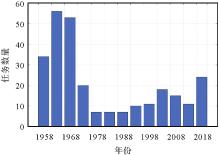
图1
深空任务数量统计(1958—2023,以5年为周期统计)[31-36]"

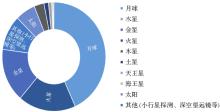
图2
太阳系深空探测器数量按探测目标分布情况[31-36]"
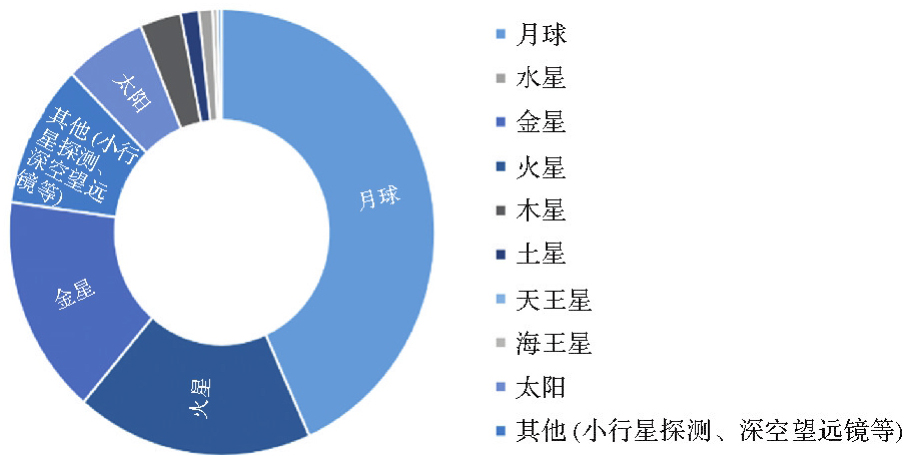
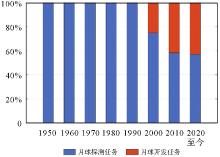
图3
月球探测任务和开发任务的比例[31-36]"
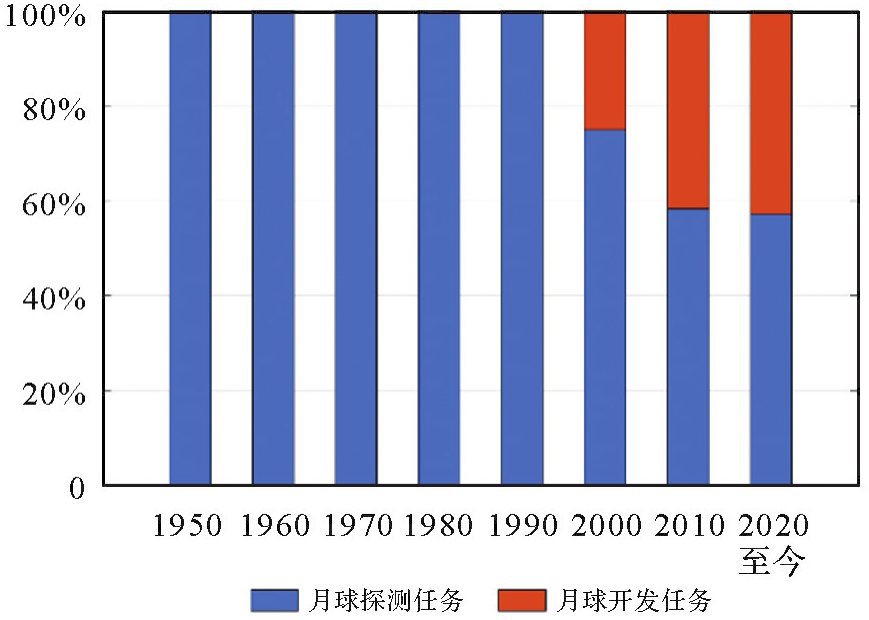
图4
距离最远的典型深空探测任务[31-36]"
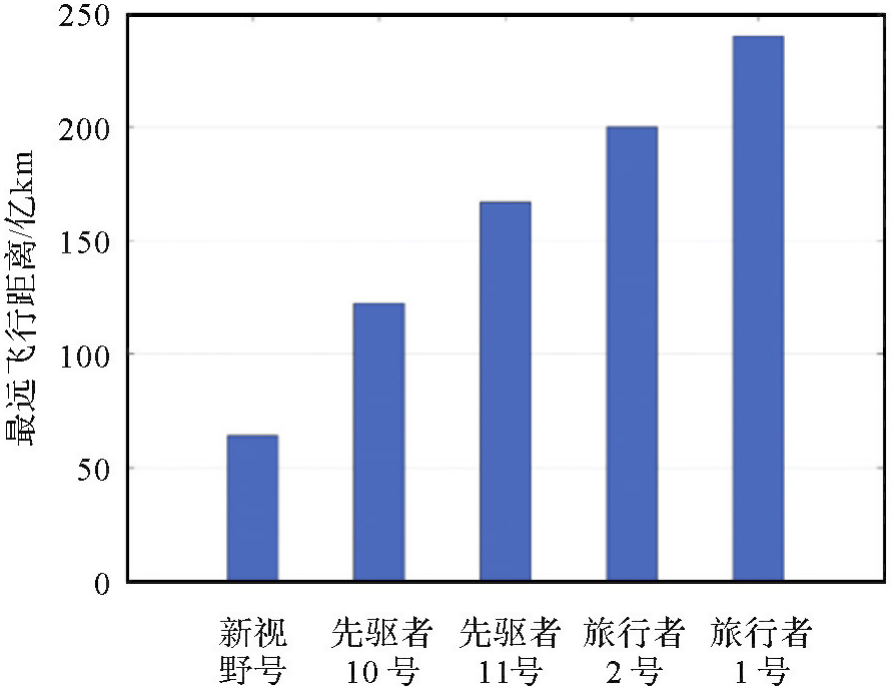
表1
深空导航技术手段特点"
| 序号类别 | 技术手段 | 观测量 | 作用域 | 自主性 | 基准源 | 性能指标 | 优点 | 局限性 | |
|---|---|---|---|---|---|---|---|---|---|
| 1 | 在用类 | 深空网[ | 测距、测速和干涉测量 | 深空 | 被动 | 人造 | 定轨精度 1 km(地月转移轨道) 200 m(环月轨道) | 观测距离远 | 覆盖范围取决于地面深空站能力,系统容量有限 |
| 2 | 星光导航[ | 测角 | 深空 | 自主 | 自然天体 | 定轨精度10 km | 测角精度较低,独立导航能力较差 | ||
| 3 | 惯性导航[ | 测加速度 | 深空 | 自主 | — | 定位精度100 m(航天器着落阶段,与测距等手段联合使用) | 实现完全自主 | 需要外部不断校准 | |
| 4 | 可用类 | 导航信号[ | 单程测距 | 地月空间 | 半自主 | 人造 | 定位精度50 m、授时精度50μs | 用户数量不受限 | 覆盖范围受限,对接收机要求较高 |
| 5 | 星间链路[ | 双程测距 | 远至月球 | 半自主 | 人造 | 定轨精度120 m、授时精度20 ns | 测距精度高 | 单链路定轨需累积观测及初始轨道 | |
| 6 | 导航通信一体化卫星系统[ | 单程测距 | 月球等近星体空间及表面 | 半自主 | 人造 | 定位精度10 m、授时精度20 ns | 精度高,可覆盖星体外部空间及表面 | 建设成本较高,覆盖范围难以扩展至其他星体 | |
| 7 | 导航信标[ | 测距+信息增强 | 月球等星体表面 | 半自主 | 人造 | 定位精度50 m(星体表面局域范围) | 局域精度高,可按需扩展 | 局域导航,需已知信标精确坐标 | |
| 8 | 研究类 | 脉冲星导航[ | 单程测距 | 深空 | 自主 | 自然天体 | 定轨精度5 km授时精度100 ns | 实现完全自主 | 技术成熟度较低 |
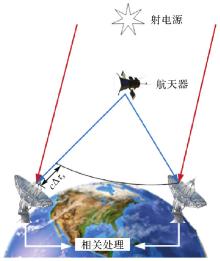
图5
深空站DOR测定轨技术原理[45]"

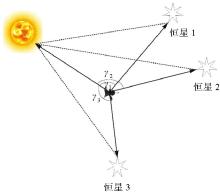
图6
星光导航技术原理[47]"
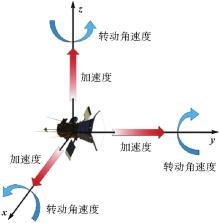
图7
惯性导航原理[48]"
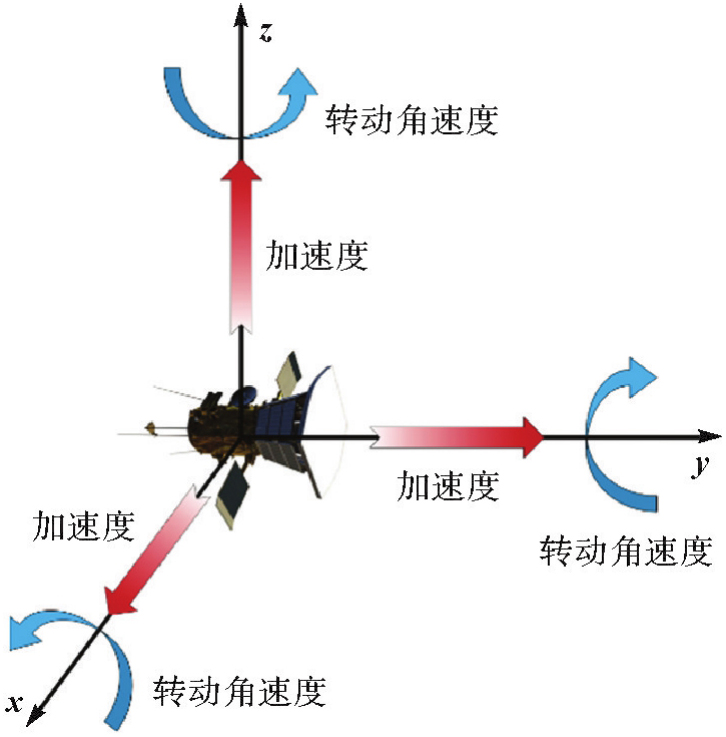
图8
GNSS漏信号导航技术原理[51]"
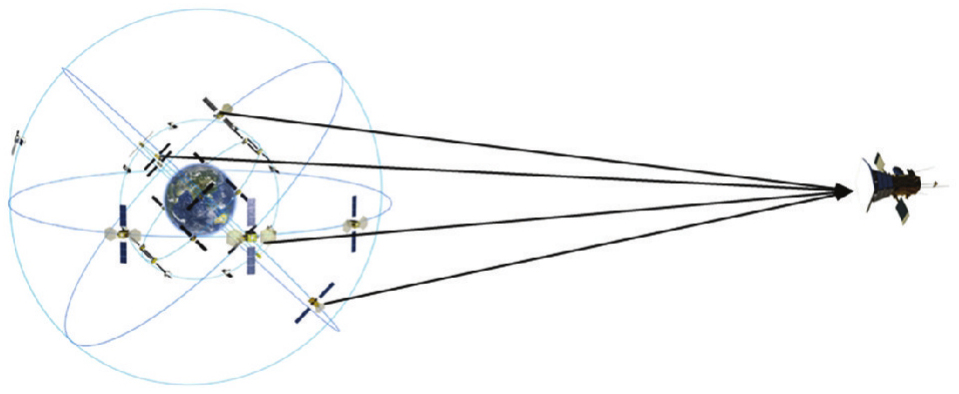
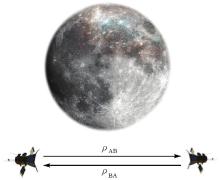
图9
星间链路导航技术原理[54]"
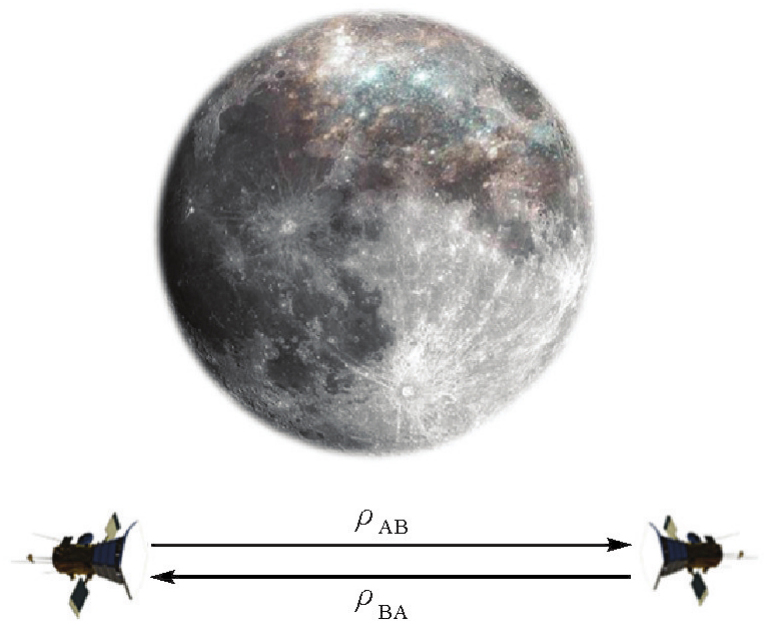
图10
基于2颗ELFO卫星的月球导航系统[57]"
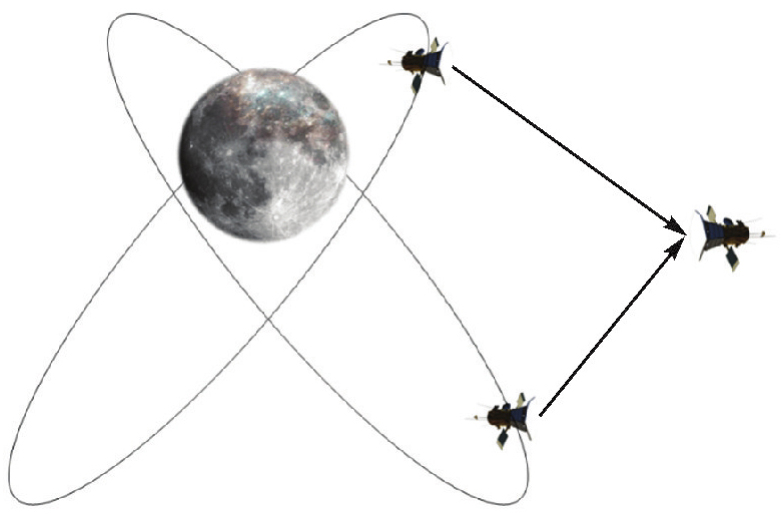
图11
月面信标导航原理[61]"
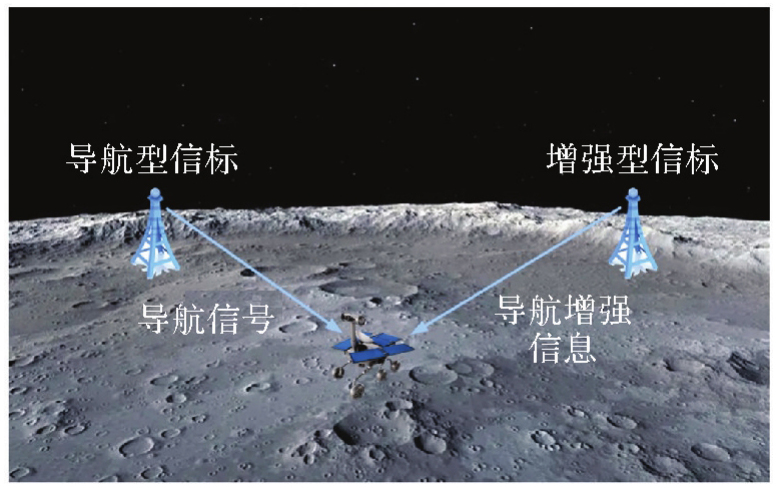
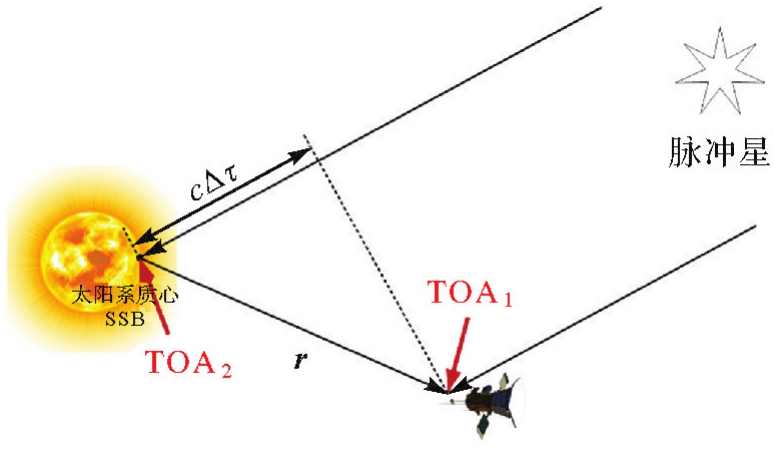
图12
脉冲星导航技术原理[62]"
| [1] | 叶培建, 于登云, 孙泽洲, 等. 中国月球探测器的成就与展望[J]. 深空探测学报, 2016, 3(4): 323-333. |
| YE Peijian, YU Dengyun, SUN Zezhou, et al. Achievements and prospect of Chinese lunar probes[J]. Journal of Deep Space Exploration, 2016, 3(4): 323-333. | |
| [2] | CRUSAN J, BLEACHER J, CARAM J, et al. NASA's gateway: an update on progress and plans for extending human presence to cislunar space[C]//Proceedings of 2019 IEEE Aerospace Conference. Big Sky: IEEE, 2019: 1-19. |
| [3] | BOLLIGER M J. Cislunar mission design: transfers linking near rectilinear halo orbits and the butterfly family[D]. West Lafayette: Purdue University, 2019. |
| [4] | CHEETHAM B. Cislunar autonomous positioning system technology operations and navigation experiment (CAPSTONE)[C]//Proceedings of 2021 ASCEND. Las Vegas: AIAA, 2021. |
| [5] | FLORES G, HARRIS D, MCCAULEY R, et al. Deep space habitation: establishing a sustainable human presence on the Moon and beyond[C]//Proceedings of 2021 IEEE Aerospace Conference. Big Sky: IEEE, 2021: 1-7. |
| [6] | FARLEY K A, WILLIFORD K H, STACK K M, et al. Mars 2020 mission overview[J]. Space Science Reviews, 2020, 216(8): 142. |
| [7] | EDWARDS C S, CHRISTENSEN P R, MEHALL G L, et al. The emirates Mars mission (EMM) emirates Mars infrared spectrometer (EMIRS) instrument[J]. Space Science Reviews, 2021, 217(7): 77. |
| [8] | LIM D S S, ABERCROMBY A F J, KOBS NAWOTNIAK S E, et al. The BASALT research program: designing and developing mission elements in support of human scientific exploration of Mars[J]. Astrobiology, 2019, 19(3): 245-259. |
| [9] | LIU Kai, HAO Xinjun, LI Yiren, et al. Mars orbiter magnetometer of China's first Mars mission Tianwen-1[J]. Earth and Planetary Physics, 2020, 4(4): 384-389. |
| [10] | 耿言, 周继时, 李莎, 等. 我国首次火星探测任务[J]. 深空探测学报, 2018, 5(5): 399-405. |
| GENG Yan, ZHOU Jishi, LI Sha, et al. A brief introduction of the first Mars exploration mission in China[J]. Journal of Deep Space Exploration, 2018, 5(5): 399-405. | |
| [11] | 于登云, 孙泽洲, 孟林智, 等. 火星探测发展历程与未来展望[J]. 深空探测学报, 2016, 3(2): 108-113. |
| YU Dengyun, SUN Zezhou, MENG Linzhi, et al. The development process and prospects for Mars exploration[J]. Journal of Deep Space Exploration, 2016, 3(2): 108-113. | |
| [12] | ZOU Yongliao, ZHU Yan, BAI Yunfei, et al. Scientific objectives and payloads of Tianwen-1, China's first Mars exploration mission[J]. Advances in Space Research, 2021, 67(2): 812-823. |
| [13] | SMITH M, CRAIG D, HERRMANN N, et al. The Artemis program: an overview of NASA's activities to return humans to the moon[C]//Proceedings of 2020 IEEE Aerospace Conference. Big Sky: IEEE, 2020: 1-10. |
| [14] | ISRAEL D J, MAULDIN K D, ROBERTS C J, et al. LunaNet: a flexible and extensible lunar exploration communications and navigation infrastructure[C]//Proceedings of 2020 IEEE Aerospace Conference. Big Sky: IEEE, 2020: 1-14. |
| [15] | GIORDANO P, GRENIER A, ZOCCARATO P, et al. Moonlight navigation service-how to land on peaks of eternal light[C]//Proceedings of the 72nd International Astronautical Congress. Dubai: United Arab Emirates, 2021: 25-29. |
| [16] | PALMER C. SpaceX starship lands on earth, but manned missions to Mars will require more[J]. Engineering, 2021, 7(10): 1345-1347. |
| [17] | FLETCHER L N, CAVALIÉ T, GRASSI D, et al. Jupiter science enabled by ESA's Jupiter icy moons explorer[J]. Space Science Reviews, 2023, 219(7): 53. |
| [18] | 万卫星, 魏勇, 郭正堂, 等. 从深空探测大国迈向行星科学强国[J]. 中国科学院院刊, 2019, 34(7): 748-755. |
| WAN Weixing, WEI Yong, GUO Zhengtang, et al. Toward a power of planetary science from a gaint of deep space exploration[J]. Bulletin of Chinese Academy of Sciences, 2019, 34(7): 748-755. | |
| [19] | JI Jianghui, WANG Su. China's future missions for deep space exploration and exoplanet space survey by 2030[J]. Chinese Journal of Space Science, 2020, 40(5): 729-731. |
| [20] | 吴伟仁, 于登云. 深空探测发展与未来关键技术[J]. 深空探测学报, 2014, 1(1): 5-17. |
| WU Weiren, YU Dengyun. Development of deep space exploration and its future key technologies[J]. Journal of Deep Space Exploration, 2014, 1(1): 5-17. | |
| [21] | 蒋栋荣, 洪晓瑜. 甚长基线干涉测量技术在深空导航中的应用[J]. 科学, 2008, 60(1): 10-14,4. |
| JIANG Dongrong, HONG Xiaoyu. VLBI for deep-space navigation[J]. Science, 2008, 60(1): 10-14,4. | |
| [22] | 李海涛, 周欢, 郝万宏, 等. 深空导航无线电干涉测量技术的发展历程和展望[J]. 飞行器测控学报, 2013, 32(6): 470-478. |
| LI Haitao, ZHOU Huan, HAO Wanhong, et al. Development of radio interferometry and its prospect in deep space navigation[J]. Journal of Spacecraft TT&C Technology, 2013, 32(6): 470-478. | |
| [23] | 韩来辉. 美国地基深空探测网现状及对我国发展的启示[J]. 现代雷达, 2020, 42(5): 1-8. |
| HAN Laihui. Status of ground-based deep space exploration network of USA and its revelation for China[J]. Modern Radar, 2020, 42(5): 1-8. | |
| [24] | 王大轶, 黄翔宇. 深空探测自主导航与控制技术综述[J]. 空间控制技术与应用, 2009, 35(3): 6-12,43. |
| WANG Dayi, HUANG Xiangyu. Survey of autonomous navigation and control for deep space exploration[J]. Aerospace Control and Application, 2009, 35(3): 6-12,43. | |
| [25] | 张伟, 许俊, 黄庆龙, 等. 深空天文自主导航技术发展综述[J]. 飞控与探测, 2020, 3(4): 8-16. |
| ZHANG Wei, XU Jun, HUANG Qinglong, et al. Survey of autonomous celestial navigation technology for deep space[J]. Flight Control & Detection, 2020, 3(4): 8-16. | |
| [26] | 强祺昌, 林宝军, 刘迎春, 等. 深空探测自主导航技术综述[J]. 导航与控制, 2023, 22(1): 19-32. |
| QIANG Qichang, LIN Baojun, LIU Yingchun, et al. Review of autonomous navigation technology for deep space exploration[J]. Navigation and Control, 2023, 22(1): 19-32. | |
| [27] | TURAN E, SPERETTA S, GILL E. Autonomous navigation for deep space small satellites: scientific and technological advances[J]. Acta Astronautica, 2022, 193: 56-74. |
| [28] | MUDGWAY D J. Uplink-downlink: a history of the NASA deep space network, 1957—1997[M]. Washington, D.C.: National Aeronautics and Space Administration, 2001. |
| [29] | ALESSI N, CAINI C, DE COLA T, et al. DTN performance in complex deep-space networks[C]//Proceedings of the 9th Advanced Satellite Multimedia Systems Conference and the 15th Signal Processing for Space Communications Workshop. Berlin: IEEE, 2018: 1-7. |
| [30] | MUKHERJEE J, RAMAMURTHY B. Communication technologies and architectures for space network and interplanetary internet[J]. IEEE Communications Surveys & Tutorials, 2013, 15(2): 881-897. |
| [31] | TURAN E, SPERETTA S, GILL E. Autonomous navigation for deep space small satellites: scientific and technological advances[J]. Acta Astronautica, 2022, 193: 56-74. |
| [32] | 张众, 武迪, 宝音贺西. 深空探测任务进展与展望[J]. 上海航天(中英文), 2024, 41(5): 52-68. |
| ZHANG Zhong, WU Di, BAO Yinhexi. Progress and prospects of deep space exploration missions[J]. Aerospace Shanghai (Chinese & English), 2024, 41(5): 52-68. | |
| [33] | 张扬眉. 2023年国外深空探测领域发展综述[J]. 国际太空, 2024(3): 11-15. |
| ZHANG Yangmei. A summary of the development of deep space exploration abroad in 2023[J]. Space International, 2024(3): 11-15. | |
| [34] | 葛平, 康焱, 张天馨, 等. 2023年深空探测进展与展望[J]. 中国航天, 2024(2): 7-15. |
| GE Ping, KANG Yan, ZHANG Tianxin, et al. Progress and prospects of global deep space exploration in 2023[J]. Aerospace China, 2024(2): 7-15. | |
| [35] | MITROFANOV I G, ZELENYI L M, TRET’ YAKOV V I, et al. Luna-25: the first polar mission to the moon[J]. Solar System Research, 2021, 55(6): 485-495. |
| [36] | KARANAM D P, BHATT M, AMITABH A, et al. Contextual characterization study of Chandrayaan-3 primary landing site[J]. Monthly Notices of the Royal Astronomical Society: Letters, 2023, 526(1): 116-123. |
| [37] | 彭德云, 谢剑锋, 赵凤才, 等. 月球采样返回飞控任务多目标协同规划设计[J]. 深空探测学报, 2022, 9(2): 191-201. |
| PENG Deyun, XIE Jianfeng, ZHAO Fengcai, et al. Collaborative planning design of multi-targets for lunar sampling return flight control task[J]. Journal of Deep Space Exploration (Chinese & English), 2022, 9(2): 191-201. | |
| [38] | ENTRENA UTRILLA C M. Establishing a framework for studying the emerging cislunar economy[J]. Acta Astronautica, 2017, 141: 209-218. |
| [39] | TOKLU Y C, AKPINAR P. Lunar soils, simulants and lunar construction materials: an overview[J]. Advances in Space Research, 2022, 70(3): 762-779. |
| [40] | 王平, 于晓强, 郭继峰. 月球大范围探测巡视器及GNC技术发展综述[J]. 宇航学报, 2022, 43(5): 548-562. |
| WANG Ping, YU Xiaoqiang, GUO Jifeng. A survey of lunar wide-range exploration rover and GNC technology[J]. Journal of Astronautics, 2022, 43(5): 548-562. | |
| [41] | 贾阳, 孙泽洲, 郑旸, 等. 星球车技术发展综述[J]. 深空探测学报, 2020, 7(5): 419-427. |
| JIA Yang, SUN Zezhou, ZHENG Yang, et al. Overview on development of planetary rover technology[J]. Journal of Deep Space Exploration (Chinese & English), 2020, 7(5): 419-427. | |
| [42] | 董光亮, 李海涛, 郝万宏, 等. 中国深空测控系统建设与技术发展[J]. 深空探测学报, 2018, 5(2): 99-114. |
| DONG Guangliang, LI Haitao, HAO Wanhong, et al. Development and future of China's deep space TT & C system[J]. Journal of Deep Space Exploration, 2018, 5(2): 99-114. | |
| [43] | 于登云, 马继楠. 中国深空探测进展与展望[J]. 前瞻科技, 2022, 1(1): 17-27. |
| YU Dengyun, MA Jinan. Progress and prospect of deep space exploration in China[J]. Science and Technology Foresight, 2022, 1(1): 17-27. | |
| [44] | 吴季. 深空探测的现状、展望与建议[J]. 科技导报, 2021, 39(3): 80-87. |
| WU Ji. Deep space exploration: status, expectation and suggestion[J]. Science & Technology Review, 2021, 39(3): 80-87. | |
| [45] | 吴伟仁, 李海涛, 李赞, 等. 中国深空测控网现状与展望[J]. 中国科学:信息科学, 2020, 50(1): 87-108. |
| WU Weiren, LI Haitao, LI Zan, et al. Status and prospect of China's deep space TT & C network[J]. Scientia Sinica (Informationis), 2020, 50(1): 87-108. | |
| [46] | 孔静, 张宇, 任天鹏, 等. 深空网干涉测量数据对嫦娥五号定轨能力分析[J]. 宇航学报, 2022, 43(2): 183-188. |
| KONG Jing, ZHANG Yu, REN Tianpeng, et al. Orbit determination ability of Chang' E-5 based on CDSN tracking data[J]. Journal of Astronautics, 2022, 43(2): 183-188. | |
| [47] | HOLT G N, D'SOUZA C N, SALEY D W. Orion optical navigation progress toward exploration mission 1[C]//Proceedings of 2018 Space Flight Mechanics Meeting. Kissimmee: AIAA, 2018. |
| [48] | 袁利, 李骥. 航天器惯性及其组合导航技术发展现状[J]. 导航与控制, 2020, 19(S1): 53-63. |
| YUAN Li, LI Ji. The development of inertial and integrated navigation technology for spacecraft[J]. Navigation and Control, 2020, 19(S1): 53-63. | |
| [49] | MENG Yansong, LEI Wenying, BIAN Lang, et al. One-way deep space navigation with radiometric and inertial data fusion[C]//Proceedings of the 20th International Conference on Information Fusion. Xi'an: IEEE, 2017: 1-5. |
| [50] | 叶培建, 邹乐洋, 王大轶, 等. 中国深空探测领域发展及展望[J]. 国际太空, 2018(10): 4-10. |
| YE Peijian, ZOU Leyang, WANG Dayi, et al. Development and prospect of Chinese deep space exploration[J]. Space International, 2018(10): 4-10. | |
| [51] | WINTERNITZ L B, BAMFORD W A, PRICE S R. New high-altitude GPS navigation results from the magnetospheric multiscale spacecraft and simulations at Lunar distances[C]//Proceedings of the 30th International Technical Meeting of the Satellite Division of the Institute of Navigation. Portland: Institute of Navigation, 2017: 1114-1126. |
| [52] | WINTERNITZ L B, BAMFORD W A, PRICE S R, et al. Global positioning system navigation above 76, 000 km for NASA'S magnetospheric multiscale mission[J]. Navigation, 2017, 64(2): 289-300. |
| [53] | FAN Min, HU Xiaogong, DONG Guangliang, et al. Orbit improvement for Chang' E-5T lunar returning probe with GNSS technique[J]. Advances in Space Research, 2015, 56(11): 2473-2482. |
| [54] | 孟轶男, 樊士伟, 李罡, 等. 利用GNSS星间链路对中高轨航天器测定轨的可行性研究[J]. 武汉大学学报(信息科学版), 2014, 39(4): 445-449. |
| MENG Yinan, FAN Shiwei, LI Gang, et al. Orbit determination of medium-high earth orbital satellite using GNSS crosslink ranging observations[J]. Geomatics and Information Science of Wuhan University, 2014, 39(4): 445-449. | |
| [55] | 黄勇, 杨鹏, 陈艳玲, 等. 地月空间探测器星间测距自主定轨[J]. 中国科学:物理学 力学 天文学, 2023, 53(2): 132-144. |
| HUANG Yong, YANG Peng, CHEN Yanling, et al. Orbit determination of a cislunar space probe using inter-satellite link data[J]. Scientia Sinica (Physica, Mechanica & Astronomica), 2023, 53(2): 132-144. | |
| [56] | ŠPRLÁK M, HAN S C, FEATHERSTONE W E. Integral inversion of GRAIL inter-satellite gravitational accelerations for regional recovery of the lunar gravitational field[J]. Advances in Space Research, 2020, 65(1): 630-649. |
| [57] | 杨长风. 进入全球服务新时代的北斗系统[J]. 卫星应用, 2022(4): 8-9. |
| YANG Changfeng. BeiDou system entering a new era of global service[J]. Satellite Application, 2022(4): 8-9. | |
| [58] | 杨元喜, 任夏, 贾小林, 等. 以北斗系统为核心的国家安全PNT体系发展趋势[J]. 中国科学:地球科学, 2023, 53(5): 917-927. |
| YANG Yuanxi, REN Xia, JIA Xiaolin, et al. Development trends of the national secure PNT system based on BDS[J]. Scientia Sinica (Terrae), 2023, 53(5): 917-927. | |
| [59] |
郭树人, 蔡洪亮, 孟轶男, 等. 北斗三号导航定位技术体制与服务性能[J]. 测绘学报, 2019, 48(7): 810-821. DOI:.
doi: 10.11947/j.AGCS.2019.20190091 |
|
GUO Shuren, CAI Hongliang, MENG Yinan, et al. BDS-3 RNSS technical characteristics and service performance[J]. Acta Geodaetica et Cartographica Sinica, 2019, 48(7): 810-821. DOI:.
doi: 10.11947/j.AGCS.2019.20190091 |
|
| [60] | MURATA M, KOGA M, NAKAJIMA Y, et al. Lunar navigation satellite system: mission, system overview, and demonstration[J]. IET Conference Proceedings, 2023, 29: 12-15. |
| [61] | FEINBERG E H, GABRIEL J, LACHANCE Z, et al. Lunar navigation beacons: technology development and mission applications[C]//Proceedings of 2022 ASCEND. Las Vegas: AIAA, 2022. |
| [62] | 李连升, 梅志武, 吕政欣, 等. X射线脉冲星导航探测技术发展综述[J]. 兵器装备工程学报, 2017, 38(5): 1-9. |
| LI Liansheng, MEI Zhiwu, LÜ Zhengxin, et al. Overview of the development of X-ray pulsar navigation detection technology[J]. Journal of Ordnance Equipment Engineering, 2017, 38(5): 1-9. | |
| [63] | WITZE A. NASA test proves pulsars can function as a celestial GPS[J]. Nature, 2018, 553(7688): 261-262. |
| [64] | ZHENG Shijie, ZHANG Shuangnan, LU Fangjun, et al. In-orbit demonstration of X-ray pulsar navigation with the insight-HXMT satellite[J]. The Astrophysical Journal Supplement Series, 2019, 244(1): 1-18. |
| [65] | SUN Haifeng, SU Jianyu, DENG Zhongwen, et al. Grouping bi-Chi-squared method for pulsar navigation experiment using observations of Rossi X-ray timing explorer[J]. Chinese Journal of Aeronautics, 2023, 36(1): 386-395. |
| [66] | 樊士伟, 孟轶男, 高为广, 等. 航天器测定轨技术发展综述[J]. 测绘科学技术学报, 2013, 30(6): 549-554. |
| FAN Shiwei, MENG Yinan, GAO Weiguang, et al. Summarizing on the development of spacecraft orbit determination technology[J]. Journal of Geomatics Science and Technology, 2013, 30(6): 549-554. | |
| [67] | YANG Yuanxi. Resilient PNT concept frame[J]. Journal of Geodesy and Geoinformation Science, 2019, 2(3): 1-7. |
| [68] | REN Xia, YANG Yuanxi. Development of comprehensive PNT and resilient PNT[J]. Journal of Geodesy and Geoinformation Science, 2023, 6(3): 1-8. |
| [69] | LI Xingxing, ZHANG Xiaohong, NIU Xiaoji, et al. Progress and achievements of multi-sensor fusion navigation in China during 2019—2023[J]. Journal of Geodesy and Geoinformation Science, 2023, 6(3): 102-114. |
| [70] | SCHIER J, RUSH J, VROTSOS P, et al. Space communication architecture supporting exploration and science: plans & studies for 2010—2030[C]//Proceedings of the 1st Space Exploration Conference: Continuing the Voyage of Discovery. Orlando: AIAA, 2005. |
| [71] | LI Gang, GUO Shuren, GONG Wenbin, et al. The communication and measurement architecture of BDS-3 global operations and services[J]. Discover Applied Sciences, 2024, 6(4): 180. |
| [72] | LI Gang, GUO Shuren, LÜ Jing, et al. Introduction to global short message communication service of BeiDou-3 navigation satellite system[J]. Advances in Space Research, 2021, 67(5): 1701-1708. |
| [73] | 王巍, 邢朝洋, 冯文帅. 自主导航技术发展现状与趋势[J]. 航空学报, 2021, 42(11): 525049. |
| WANG Wei, XING Chaoyang, FENG Wenshuai. State of the art and perspectives of autonomous navigation technology[J]. Acta Aeronautica et Astronautica Sinica, 2021, 42(11): 525049. | |
| [74] | 房建成, 宁晓琳, 马辛, 等. 深空探测器自主天文导航技术综述[J]. 飞控与探测, 2018, 1(1): 1-15. |
| FANG Jiancheng, NING Xiaolin, MA Xin, et al. A survey of autonomous astronomical navigation technology for deep space detectors[J]. Flight Control & Detection, 2018, 1(1): 1-15. | |
| [75] | CHRISTIAN J A. StarNAV: autonomous optical navigation of a spacecraft by the relativistic perturbation of starlight[J]. Sensors, 2019, 19(19): 4064-4124. |
| [76] | WANG Jian, HAN Houzeng, LIU Fei, et al. Performance analysis of GNSS/MIMU tight fusion positioning model with complex scene feature constraints[J]. Journal of Geodesy and Geoinformation Science, 2021, 4(2): 1-13. |
| [77] | ZHAO Dineng, WU Ziyin, ZHOU Jieqiong, et al. Parameter group optimization by combining CUBE with surface filtering and its application[J]. Journal of Geodesy and Geoinformation Science, 2020, 3(2): 81-92. |
| [78] | JIANG Chen, ZHANG Shubi, CAO Yizhi, et al. A robust fault detection algorithm for the GNSS/INS integrated navigation systems[J]. Journal of Geodesy and Geoinformation Science, 2020, 3(1): 12-24. |
| [79] | MA Xin, FANG Jiancheng, NING Xiaolin. An overview of the autonomous navigation for a gravity-assist interplanetary spacecraft[J]. Progress in Aerospace Sciences, 2013, 63: 56-66. |
| [80] | 李亮, 王广利, 郭丽, 等. 脉冲星导航的天体测量考虑[J]. 深空探测学报, 2018, 5(3): 235-240. |
| LI Liang, WANG Guangli, GUO Li, et al. Some discussion on X-ray pulsar navigation in astrometry[J]. Journal of Deep Space Exploration, 2018, 5(3): 235-240. |
| [1] | 叶晨鸣, 康志忠, 才谨豪, 左秉正, 邵帅, 李彦. 形态特征引导的月表地理实体实景三维建模方法[J]. 测绘学报, 2026, 55(3): 525-535. |
| [2] | 童小华, 黄荣, 曹佳瑞, 刘宸, 王蓉, 徐聿升, 叶真, 金雁敏, 刘世杰, 柳思聪, 冯永玖, 谢欢. 月球与近地行星三维形貌重建的智能方法综述:研究进展与未来挑战[J]. 测绘学报, 2025, 54(11): 1917-1933. |
| [3] | 张宇, 曹建峰, 孔静, 段建锋, 李翠兰, 慎千慧, 宋辰, 梁猛. 基于稀疏同波束测量的天问一号火星着陆点定位方法[J]. 测绘学报, 2024, 53(1): 91-100. |
| [4] | 曹子龙, 童小华, 许雄, 叶真, 肖长江. 基于空地影像多层级匹配的火星巡视器定位与地面验证[J]. 测绘学报, 2023, 52(4): 579-587. |
| [5] | 童小华, 刘世杰, 谢欢, 许雄, 叶真, 冯永玖, 王超, 柳思聪, 金雁敏, 陈鹏, 洪中华, 栾奎峰. 从地球测绘到地外天体测绘[J]. 测绘学报, 2022, 51(4): 488-500. |
| [6] | 邸凯昌, 王镓, 邢琰, 刘召芹, 万文辉, 彭嫚, 王晔昕, 刘斌, 于天一, 李立春, 刘传凯. 深空探测车环境感知与导航定位技术进展与展望[J]. 测绘学报, 2021, 50(11): 1457-1468. |
| [7] | 叶茂, 李斐, 鄢建国, 郝卫峰, 杨轩, 金炜桐, 曲春凯. 深空探测器精密定轨与重力场解算系统(WUDOGS)及其应用分析[J]. 测绘学报, 2017, 46(3): 288-296. |
| [8] | 詹银虎, 郑勇, 张超. 测日定位中病态问题的有偏估计及精度分析[J]. 测绘学报, 2016, 45(8): 911-918. |
| [9] | 周欢, 童锋贤, 李海涛, 郑为民, 董光亮, 李培佳, 舒逢春. 深空探测器同波束相位参考成图相对定位方法[J]. 测绘学报, 2015, 44(6): 634-640. |
| [10] | 鄢建国,李斐,平劲松. 基于MGS测图段部分弧段的精密定轨及火星重力场模型解算[J]. 测绘学报, 2010, 39(5): 484-490. |
| 阅读次数 | ||||||
|
全文 |
|
|||||
|
摘要 |
|
|||||
