


测绘学报 ›› 2025, Vol. 54 ›› Issue (6): 1054-1070.doi: 10.11947/j.AGCS.2025.20240347
林浩嘉1,2,3,4( ), 郭仁忠1,3,4, 贺彪1,3,4(), 蒯希1,3,4, 马丁1,3,4, 李程鹏1,3,4
收稿日期:2024-08-26
修回日期:2025-04-14
发布日期:2025-07-14
通讯作者:
贺彪
E-mail:linhaojia@szu.edu.cn;hebiao@szu.edu.cn
作者简介:林浩嘉(1993—),男,博士,研究方向为地图学、三维GIS、智慧城市等。E-mail:linhaojia@szu.edu.cn
基金资助:
Haojia LIN1,2,3,4(), Renzhong GUO1,3,4, Biao HE1,3,4(), Xi KUAI1,3,4, Ding MA1,3,4, Chengpeng LI1,3,4
Received:2024-08-26
Revised:2025-04-14
Published:2025-07-14
Contact:
Biao HE
E-mail:linhaojia@szu.edu.cn;hebiao@szu.edu.cn
About author:LIN Haojia (1993—), male, PhD, majors in cartography, 3D GIS, smart cities, et al. E-mail: linhaojia@szu.edu.cn
Supported by:摘要:
三维模型多分辨率表征(LOD)是三维场景可视化的重要技术。然而,对于具有真实程度高、尺度跨度大、数据规模大等特点的实景三维建筑场景可视化,仍存在可视化质量度量不准确、层次切换不连续、渲染效率不稳定等问题,难以在视点变换过程中保持视觉舒适性。本文提出了视觉感知导向的三维建筑场景LOD自适应可视化方法。首先,综合考虑三维渲染与视觉感知的过程与机理,对LOD可视化的视觉感知过程与特性进行归纳总结;然后,基于“三维空间-屏幕空间-视觉感知”的变换过程,对LOD可视化中简化模型误差的视觉感知进行量化表征,提出了基于视觉感知的LOD可视化质量度量方法;最后,将LOD可视化质量度量运用至LOD调度,综合考虑视觉关注和视点运动对可视化质量度量的影响,建立LOD层次选择准则,结合多线程调度技术,提出了顾及视觉感知特性的LOD自适应调度方法。试验结果表明,本文方法可以保持LOD切换过程的视觉舒适性,在可视化质量与效率之间保持动态平衡,实现了符合人眼视觉感知的三维建筑场景LOD自适应调度与渲染。
中图分类号:
林浩嘉, 郭仁忠, 贺彪, 蒯希, 马丁, 李程鹏. 视觉感知导向的实景三维建筑场景LOD自适应可视化[J]. 测绘学报, 2025, 54(6): 1054-1070.
Haojia LIN, Renzhong GUO, Biao HE, Xi KUAI, Ding MA, Chengpeng LI. Visual-perception-oriented LOD adaptive visualization for realistic 3D building scenes[J]. Acta Geodaetica et Cartographica Sinica, 2025, 54(6): 1054-1070.
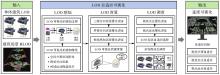
图1
总体研究框架"

图2
LOD可视化的视觉感知过程"

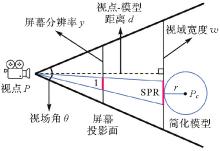
图3
模型屏幕像素分辨率计算"
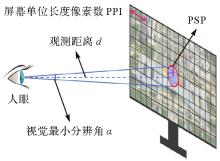
图4
最小可感像素数计算"
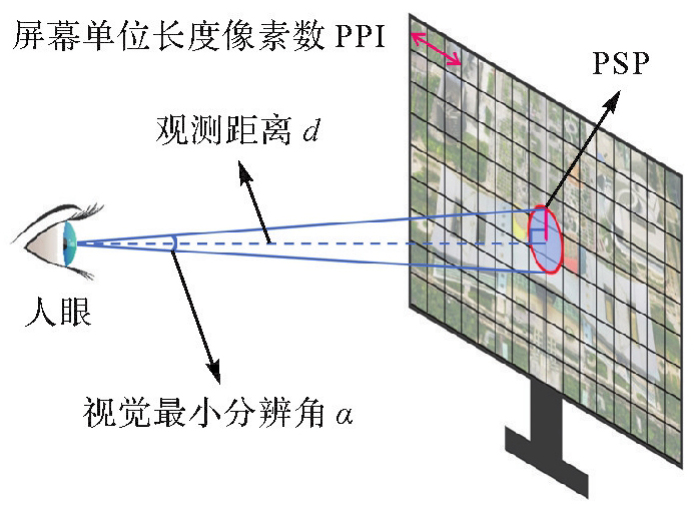
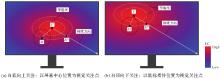
图5
模型视域位置中心度计算原理注:M为模型中心(model center);V为视觉关注点(visual focus);F为最远角(farthest corner)。"

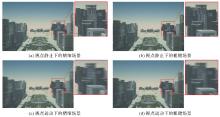
图6
视点运动对视觉感知分辨力的影响"

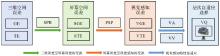
图7
顾及视觉关注机制与视点运动效应的LOD层次自适应选择准则技术流程"
图8
多线程动态调度"
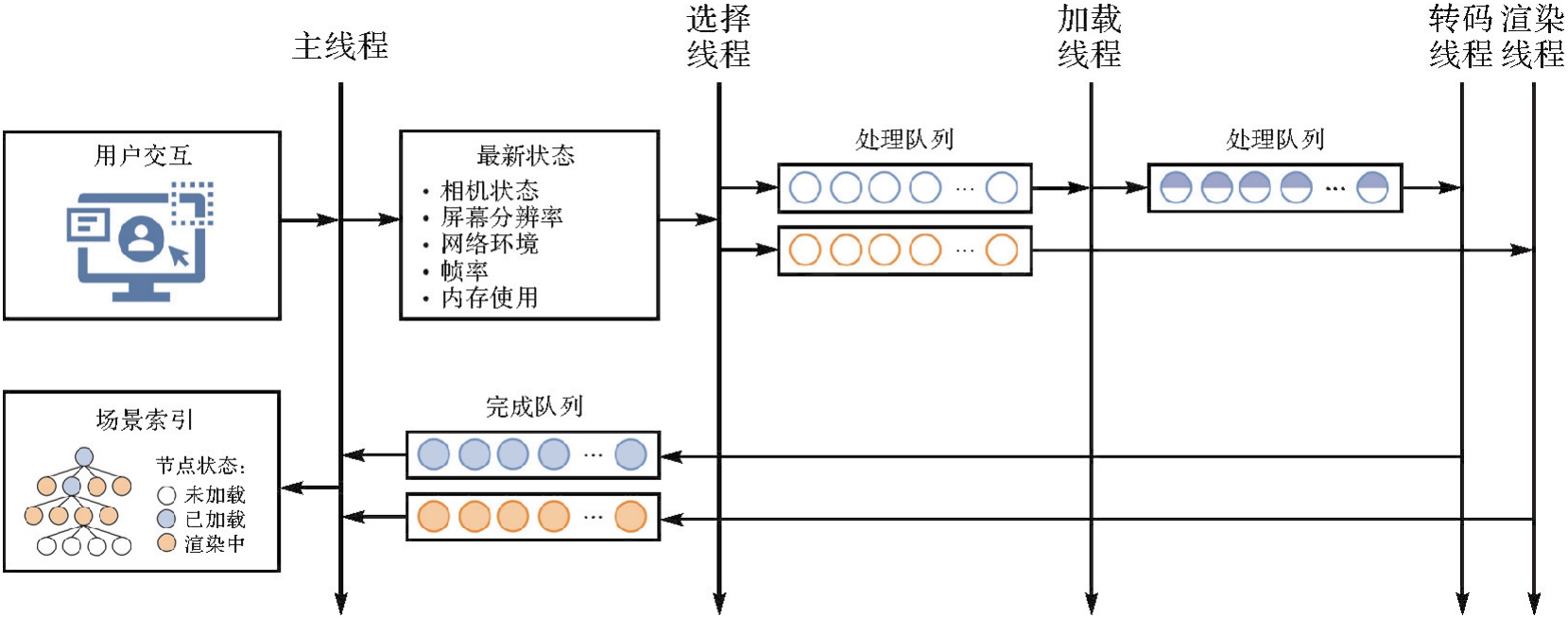

表1
单体三维模型LOD信息表"
| LOD | M1 | M2 | M3 | M4 | ||||||||
|---|---|---|---|---|---|---|---|---|---|---|---|---|
| TN | GE | PR | TN | GE | PR | TN | GE | PR | TN | GE | PR | |
| 0 | 4084 | 0 | 0.05 | 4325 | 0 | 0.04 | 9409 | 0 | 0.05 | 10607 | 0 | 0.05 |
| 1 | 2041 | 0.15 | 0.08 | 2161 | 0.18 | 0.09 | 4703 | 0.14 | 0.07 | 5302 | 0.20 | 0.10 |
| 2 | 1020 | 0.30 | 0.15 | 1080 | 0.36 | 0.18 | 2417 | 0.28 | 0.14 | 2651 | 0.40 | 0.20 |
| 3 | 780 | 0.61 | 0.30 | 539 | 0.72 | 0.36 | 1845 | 0.56 | 0.28 | 1793 | 0.79 | 0.40 |
| 4 | 596 | 1.21 | 0.61 | 447 | 1.44 | 0.72 | 1296 | 1.12 | 0.56 | 1204 | 1.59 | 0.79 |
| 5 | 417 | 2.42 | 1.21 | 374 | 2.87 | 1.44 | 885 | 2.25 | 1.12 | 817 | 3.17 | 1.59 |
| 6 | 298 | 4.84 | 2.42 | 267 | 5.75 | 2.87 | 577 | 4.49 | 2.25 | 412 | 6.34 | 3.17 |
| 7 | 198 | 9.69 | 4.84 | 132 | 11.49 | 5.75 | 333 | 8.99 | 4.49 | 207 | 12.69 | 6.34 |
| 8 | 104 | 19.37 | 9.69 | 66 | 22.98 | 11.49 | 168 | 17.98 | 8.99 | 103 | 25.37 | 12.69 |
| 9 | — | — | — | — | — | — | 83 | 35.96 | 17.98 | — | — | — |
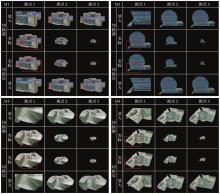
图9
单体LOD随视点由近到远的可视化效果注:图片为可视化视频的截图。"

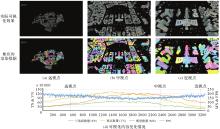
图10
随视点由远到近的可视化内容变化情况注:HLOD模型以不同的随机颜色进行表示,以区分各模型的空间范围,范围越大则该模型精细程度越低,反之则越高。"

表2
随视点由远到近的可视化内容对照"
| 视点 | MN | TN | VN | FPS |
|---|---|---|---|---|
| 远 | 80 | 425 201 | 903 219 | 171 |
| 中 | 180 | 420 860 | 804 008 | 152 |
| 近 | 98 | 161 287 | 255 213 | 163 |
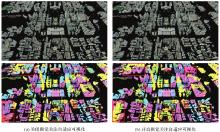
图11
视觉关注自适应效果对比注:HLOD模型以不同的随机颜色进行表示,以区分各模型的空间范围,范围越大则该模型精细程度越低,反之则越高。"
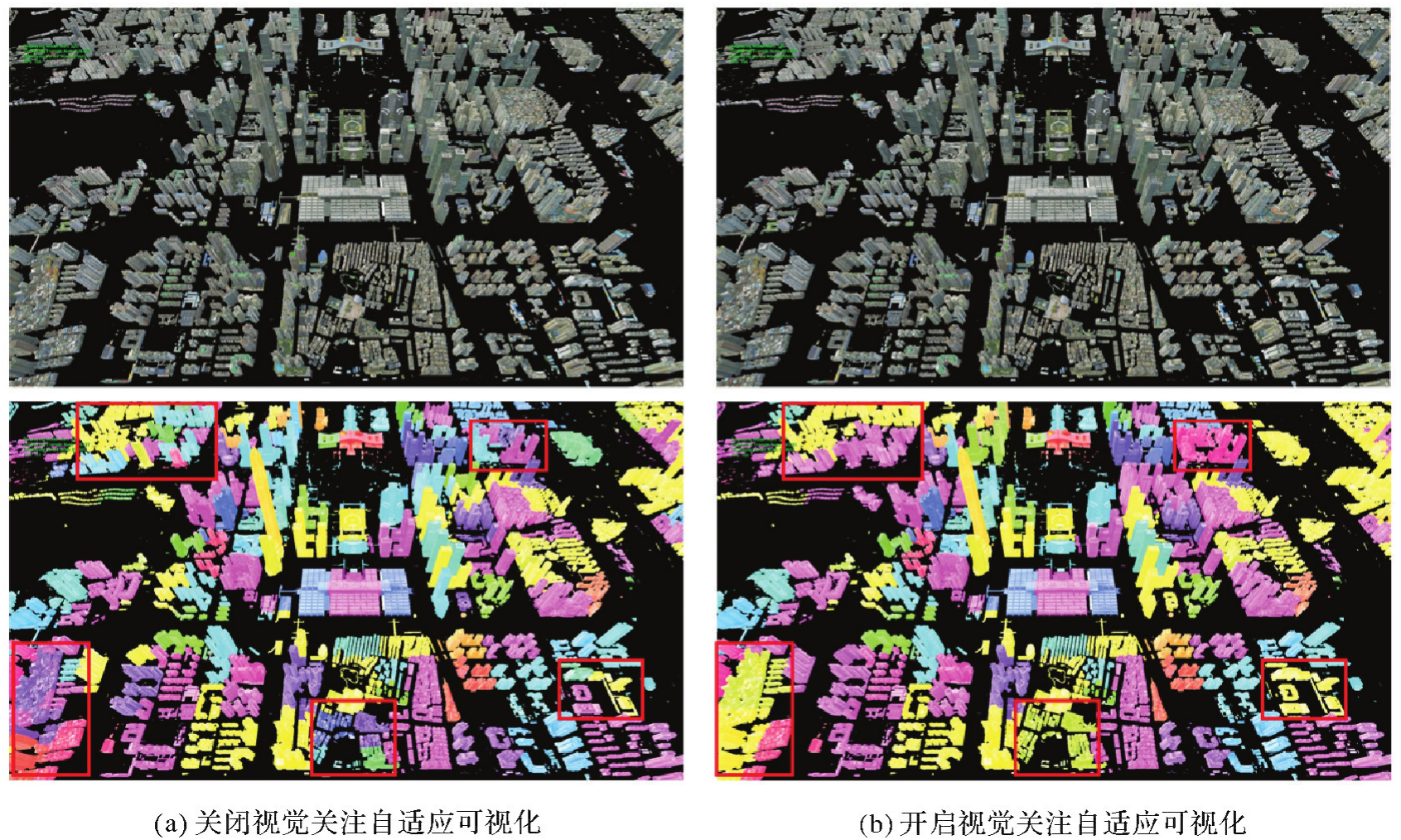
表3
视觉关注自适应效果信息表"
| 状态 | MN | TN | VN | FPS |
|---|---|---|---|---|
| 关闭 | 210 | 528 127 | 876 602 | 155 |
| 开启 | 156 | 491 051 | 820 502 | 166 |
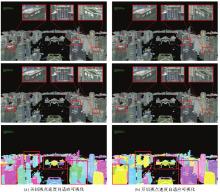
图12
视点运动自适应效果对比注:HLOD模型以不同的随机颜色进行表示,以区分各模型的空间范围,范围越大则该模型精细程度越低,反之则越高。"
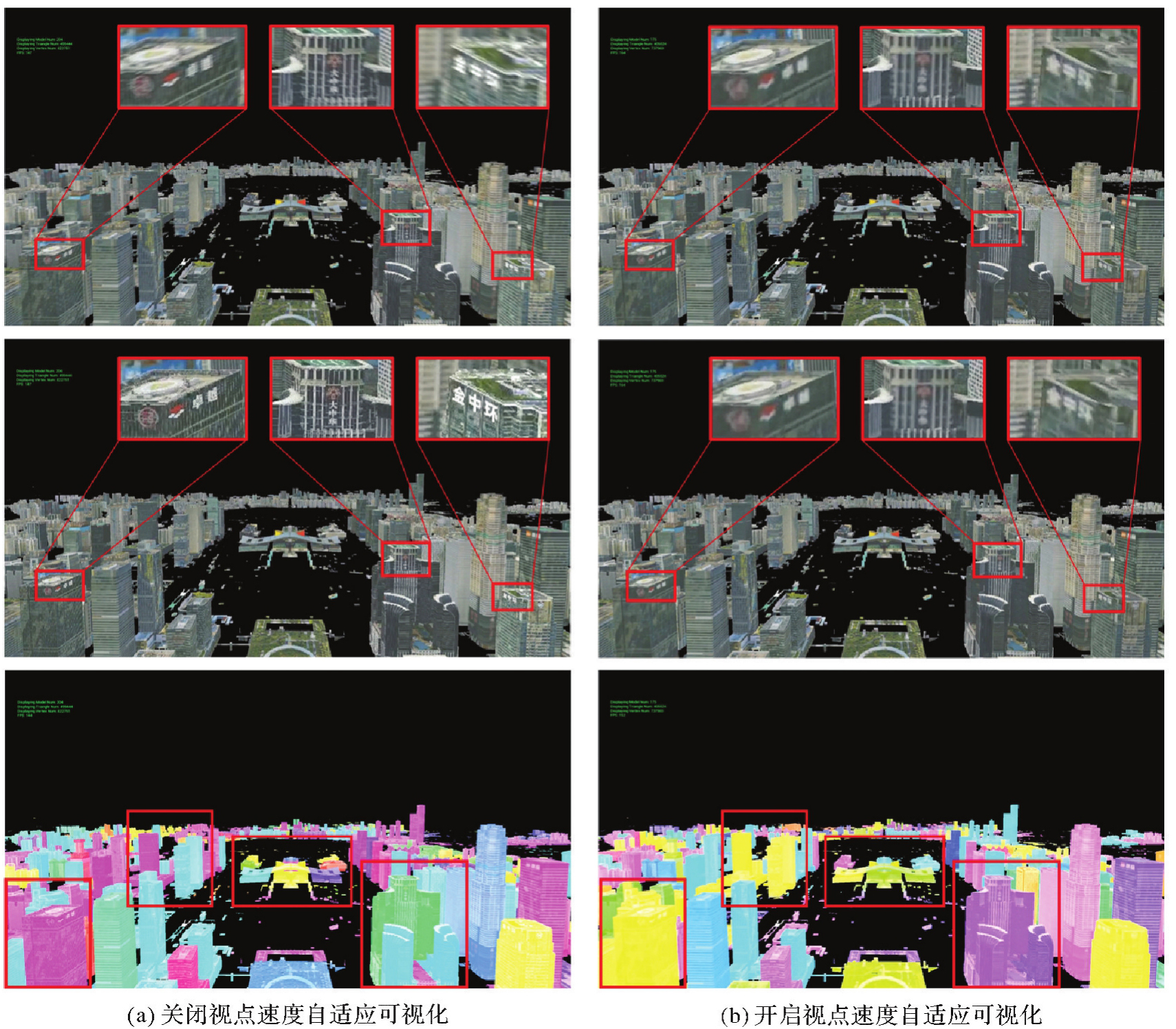
表4
视点运动自适应效果"
| 状态 | MN | TN | VN | FPS |
|---|---|---|---|---|
| 关闭 | 204 | 499 444 | 822 751 | 147 |
| 开启 | 175 | 405 524 | 737 903 | 164 |
| [1] | 郭仁忠, 陈业滨, 应申, 等. 三元空间下的泛地图可视化维度[J]. 武汉大学学报(信息科学版), 2018, 43(11): 1603-1610. |
| GUO Renzhong, CHEN Yebin, YING Shen, et al. Geographic visualization of pan-map with the context of ternary spaces[J]. Geomatics and Information Science of Wuhan University, 2018, 43(11): 1603-1610. | |
| [2] | 张新长, 李少英, 周启鸣, 等. 建设数字孪生城市的逻辑与创新思考[J]. 测绘科学, 2021, 46(3): 147-152, 168. |
| ZHANG Xinchang, LI Shaoying, ZHOU Qiming, et al. The rationale and innovative thinking of building digital twin city[J]. Science of Surveying and Mapping, 2021, 46(3): 147-152, 168. | |
| [3] |
朱庆, 张利国, 丁雨淋, 等. 从实景三维建模到数字孪生建模[J]. 测绘学报,2022, 51(6): 1040-1049. DOI: .
doi: 10.11947/j.AGCS.2022.20210640 |
|
ZHU Qing, ZHANG Liguo, DING Yulin, et al. From real 3D modeling to digital twin modeling[J]. Acta Geodaetica et Cartographica Sinica, 2022, 51(6): 1040-1049. DOI: .
doi: 10.11947/j.AGCS.2022.20210640 |
|
| [4] | WANG Ruisheng, HUANG Shangfeng, YANG Hongxin. Building3D: an urban-scale dataset and benchmarks for learning roof structures from point clouds[C]//Proceedings of 2023 IEEE/CVF International Conference on Computer Vision. Paris: IEEE, 2023: 20019-20029. |
| [5] | 郭仁忠, 林浩嘉, 贺彪, 等. 面向智慧城市的GIS框架[J]. 武汉大学学报(信息科学版), 2020, 45(12): 1829-1835. |
| GUO Renzhong, LIN Haojia, HE Biao, et al. GIS framework for smart cities[J]. Geomatics and Information Science of Wuhan University, 2020, 45(12): 1829-1835. | |
| [6] | LIN Haojia, GUO Renzhong, MA Ding, et al. Digital-twin-based multi-scale simulation supports urban emergency management: a case study of urban epidemic transmission[J]. International Journal of Digital Earth, 2024, 17(1):2421950. |
| [7] | ZHANG Yunhao, ZHU Jun, ZHU Qing, et al. The construction of personalized virtual landslide disaster environments based on knowledge graphs and deep neural networks[J]. International Journal of Digital Earth, 2020, 13(12): 1637-1655. |
| [8] | YOU Jigang, ZHU Jun, LI Weilian, et al. ROI-constrained visualization of flood scenes to improve perception efficiency[J]. International Journal of Digital Earth, 2023, 16(1): 3065-3084. |
| [9] | CLARK J H. Hierarchical geometric models for visible surface algorithms[J]. Communications of the ACM, 1976, 19(10): 547-554. |
| [10] | MASON A E W, BLAKE E H. Automatic hierarchical level of detail optimization in computer animation[C]//Proceedings of 1997 Computer Graphics Forum. Oxford: Blackwell Publishers Ltd., 1997, 16(3): C191-C199. |
| [11] | 朱庆, 龚俊, 杜志强, 等. 三维城市模型的多细节层次描述方法[J]. 武汉大学学报(信息科学版), 2005, 30(11): 965-969. |
| ZHU Qing, GONG Jun, DU Zhiqiang, et al. LODs description of 3D city model[J]. Geomatics and Information Science of Wuhan University, 2005, 30(11): 965-969. | |
| [12] | LUEBKE D, REDDY M, COHEN J D, et al. Level of detail for 3D graphics[M]. Amsterdam: Elsevier, 2002. |
| [13] | GIEGL M, WIMMER M. Unpopping: solving the image-space blend problem for smooth discrete LOD transitions[J]. Computer Graphics Forum, 2007, 26(1): 46-49. |
| [14] | KADA M, WICHMANN A, HERMES T. Smooth transformations between generalized 3D building models for visualization purposes[J]. Cartography and Geographic Information Science, 2015, 42(4): 306-314. |
| [15] | 陈博, 佘江峰, 谈俊忠, 等. 三维场景中建筑物模型简化研究进展[J]. 武汉大学学报(信息科学版), 2020, 45(9): 1429-1437. |
| CHEN Bo, SHE Jiangfeng, TAN Junzhong, et al. Research progress on simplification of building models in 3D scenes[J]. Geomatics and Information Science of Wuhan University, 2020, 45(9): 1429-1437. | |
| [16] | AKENINE-MOLLER T, HAINES E, HOFFMAN N. Real-time rendering[M]. 4th ed. AK Peters/CRC Press, 2018. |
| [17] | CABRAL M, LEFEBVRE S, DACHSBACHER C, et al. Structure-preserving reshape for textured architectural scenes[J]. Computer Graphics Forum, 2009, 28(2): 469-480. |
| [18] | LIU Po, LI Chengming, LI Fei. Texture-cognition-based 3D building model generalization[J]. ISPRS International Journal of Geo-Information, 2017, 6(9): 260. |
| [19] | ZHANG Man, ZHANG Liqiang, TAKIS M P, et al. A geometry and texture coupled flexible generalization of urban building models[J]. ISPRS Journal of Photogrammetry and Remote Sensing, 2012, 70: 1-14. |
| [20] | SHE Jiangfeng, CHEN Bo, TAN Junzhong, et al. 3D building model simplification method considering both model mesh and building structure[J]. Transactions in GIS, 2022, 26(3): 1182-1203. |
| [21] | XIANG Hanyu, HUANG Xianfeng, LAN Feng, et al. A shape-preserving simplification method for urban building models[J]. ISPRS International Journal of Geo-Information, 2022, 11(11): 562. |
| [22] | 杨必胜, 姜少波. 基于切割环分解的三维建筑物细节层次模型构造[J]. 测绘学报, 2011, 40(5): 575-581. |
| YANG Bisheng, JIANG Shaobo. Generating levels of detail of 3D building models based on cutting loops decomposition[J]. Acta Geodaetica et Cartographica Sinica, 2011, 40(5): 575-581. | |
| [23] |
张春森, 张会, 郭丙轩, 等. 城市场景结构感知的网格模型简化算法[J]. 测绘学报,2020, 49(3): 334-342. DOI: .
doi: 10.11947/j.AGCS.2020.20190068 |
|
ZHANG Chunsen, ZHANG Hui, GUO Bingxuan, et al. Structure-aware simplified algorithm of mesh model for urban scene[J]. Acta Geodaetica et Cartographica Sinica, 2020, 49(3): 334-342. DOI: .
doi: 10.11947/j.AGCS.2020.20190068 |
|
| [24] | SHE Jiangfeng, GU Xiaoyan, TAN Junzhong, et al. An appearance-preserving simplification method for complex 3D building models[J]. Transactions in GIS, 2019, 23(2): 275-293. |
| [25] | CHEN Kan, JOHAN H, ERDT M. Appearance-driven conversion of polygon soup building models with level of detail control for 3D geospatial applications[J]. Advanced Engineering Informatics, 2020, 44: 101049. |
| [26] |
程昫, 葛亮, 张帆, 等. 倾斜摄影建筑物模型自动纹理重建[J]. 测绘学报,2023, 52(9): 1528-1537. DOI: .
doi: 10.11947/j.AGCS.2023.20220165 |
|
CHENG Xu, GE Liang, ZHANG Fan, et al. Automated texture mapping of reality CSG building model with oblique aerial imagery[J]. Acta Geodaetica et Cartographica Sinica, 2023, 52(9): 1528-1537. DOI: .
doi: 10.11947/j.AGCS.2023.20220165 |
|
| [27] | BAI Haoyuan, SHEN Tao, HUO Liang, et al. Improved edge folding algorithm for 3D building models taking into account the visual features[J]. Buildings, 2023, 13(11): 2739. |
| [28] | 殷智慧, 李朝奎, 吴柏燕, 等. 保持视觉特征的LoD模型简化算法研究[J]. 武汉大学学报(信息科学版), 2014, 39(7): 772-776. |
| YIN Zhihui, LI Chaokui, WU Baiyan, et al. Simplification method for LoD model with the visual features preserved[J]. Geomatics and Information Science of Wuhan University, 2014, 39(7): 772-776. | |
| [29] | WANG Chaoli, SHEN Hanwei. LOD map: a visual interface for navigating multiresolution volume visualization[J]. IEEE Transactions on Visualization and Computer Graphics, 2006, 12(5): 1029-1036. |
| [30] | CHE Li, KANG Fengju, HOU Xueli. Novel hierarchical level of detail combinatorial optimization method for large-scale 3D scene[J]. Journal of System Simulation, 2017, 29(9): 2073-2080. |
| [31] | FUNKHOUSER T A, SÉQUIN C H. Adaptive display algorithm for interactive frame rates during visualization of complex virtual environments[C]//Proceedings of the 20th Annual Conference on Computer Graphics and Interactive Techniques. Anaheim: ACM Press, 1993: 247-254. |
| [32] | HUANG Wumeng, CHEN Jing. A virtual globe-based time-critical adaptive visualization method for 3D city models[J]. International Journal of Digital Earth, 2018, 11(9): 939-955. |
| [33] | LI Jing, WU Huayi, YANG Chaowei, et al. Visualizing dynamic geosciences phenomena using an octree-based view-dependent LOD strategy within virtual globes[J]. Computers & Geosciences, 2011, 37(9): 1295-1302. |
| [34] | COZZI P, RING K. 3D engine design for virtual globes[M]. New York: AK Peters/CRC Press, 2011. |
| [35] | 朱庆, 陈兴旺, 丁雨淋, 等. 视觉感知驱动的三维城市场景数据组织与调度方法[J]. 西南交通大学学报, 2017, 52(5): 869-876. |
| ZHU Qing, CHEN Xingwang, DING Yulin, et al. Organization and scheduling method of 3D urban scene data driven by visual perception[J]. Journal of Southwest Jiaotong University, 2017, 52(5): 869-876. | |
| [36] | 徐海, 贺彪, 蒯希, 等. 融合分层层次细节和潜在可见集的三维城市场景高效可视化[J]. 测绘通报, 2024(1): 102-108. |
| XU Hai, HE Biao, KUAI Xi, et al. Efficient visualization of 3D city scenes combining hierarchical level of details and potential visible sets[J]. Bulletin of Surveying and Mapping, 2024(1): 102-108. | |
| [37] | NEHMÉ Y, DELANOY J, DUPONT F, et al. Textured mesh quality assessment: large-scale dataset and deep learning-based quality metric[J]. ACM Transactions on Graphics, 2023, 42(3): 1-20. |
| [38] | NEHMÉ Y, DUPONT F, FARRUGIA J P, et al. Visual quality of 3D meshes with diffuse colors in virtual reality: subjective and objective evaluation[J]. IEEE Transactions on Visualization and Computer Graphics, 2021, 27(3): 2202-2219. |
| [39] | KANDEL E R, SCHWARTZ J H, JESSELL T M, et al. (Eds.). Principles of neural science[M]. 5th ed. New York: McGraw-hill, 2013. |
| [40] | KASCHKE D M, DONNERHACKE D K, RILL M S. Optical devices in ophthalmology and optometry: technology, design principles, and clinical applications[M]. New York: John Wiley & Sons, 2014. |
| [41] | CARRASCO M. Visual attention: the past 25 years[J]. Vision Research, 2011, 51(13): 1484-1525. |
| [42] | CONNOR C E, EGETH H E, YANTIS S. Visual attention: bottom-up versus top-down[J]. Current Biology, 2004, 14(19): R850-R852. |
| [43] | RENNINGER L W, VERGHESE P, COUGHLAN J. Where to look next? eye movements reduce local uncertainty[J]. Journal of Vision, 2007, 7(3): 6. |
| [44] | BACHMANN T, FRANCIS G. Visual masking: studying perception, attention, and consciousness[M]. Oxford: Elsevier Academic Press, 2014. |
| [1] | 叶晨鸣, 康志忠, 才谨豪, 左秉正, 邵帅, 李彦. 形态特征引导的月表地理实体实景三维建模方法[J]. 测绘学报, 2026, 55(3): 525-535. |
| [2] | 贺彪, 林浩嘉, 郭仁忠, 蒯希, 马丁, 张琛. 基于视觉感知的三维空间相似关系量化计算[J]. 测绘学报, 2026, 55(1): 138-153. |
| [3] | 季顺平, 刘瑾, 高建, 龚健雅. 多视影像深度学习密集匹配三维重建智能框架[J]. 测绘学报, 2025, 54(9): 1633-1646. |
| [4] | 陈军, 田海波, 高崟, 张元杰, 刘万增, 武昊, 张宏伟, 黄蔚, 刘建军. 实景三维中国的总体架构与主体技术[J]. 测绘学报, 2025, 54(4): 636-649. |
| [5] | 刘纪平, 周婷婷, 刘坡, 徐胜华, 王勇, 翟亮, 王琢璐, 祁俊杰, 马梦赫. 实景三维地理实体建模的思考与实践[J]. 测绘学报, 2025, 54(4): 650-660. |
| [6] | 王庆栋, 王腾飞, 张力. 面向实景三维的点云跨模态对比掩码自编码预训练方法[J]. 测绘学报, 2025, 54(4): 675-687. |
| [7] | 苏友能, 徐青, 孙群, 朱新铭, 张付兵, 刘波. 邻近边约束下的建筑物自动合并方法[J]. 测绘学报, 2025, 54(3): 563-576. |
| [8] | 赵学胜, 谢文澜, 孙文彬. 空间格网互操作的研究进展与关键问题[J]. 测绘学报, 2025, 54(10): 1727-1740. |
| [9] | 马威, 涂强, 潘建平, 赵立都, 涂伟, 李清泉. 桥梁实景三维高斯辐射场建模[J]. 测绘学报, 2024, 53(9): 1694-1705. |
| [10] | 魏东, 刘欣怡, 张永军. 多视影像三维线云重建技术及其智能化发展展望[J]. 测绘学报, 2024, 53(6): 1025-1036. |
| [11] | 肖腾, 王鑫, 梅熙, 叶志伟, 颜青松, 邓非. 摄影测量局部场景稳健合并的并行式运动恢复结构方法[J]. 测绘学报, 2024, 53(2): 332-343. |
| [12] | 张荣庭, 张广运, 尹继豪. 复杂城市动态图卷积网络三维场景语义分割法[J]. 测绘学报, 2023, 52(10): 1703-1713. |
| [13] | 艾廷华, 张翔. 地理信息科学中尺度概念的诠释与表达[J]. 测绘学报, 2022, 51(7): 1640-1652. |
| [14] | 朱庆, 张利国, 丁雨淋, 胡翰, 葛旭明, 刘铭崴, 王玮. 从实景三维建模到数字孪生建模[J]. 测绘学报, 2022, 51(6): 1040-1049. |
| [15] | 李清泉, 黄惠, 姜三, 胡庆武, 于文率. 优视摄影测量方法及精度分析[J]. 测绘学报, 2022, 51(6): 996-1007. |
| 阅读次数 | ||||||
|
全文 |
|
|||||
|
摘要 |
|
|||||
