

Acta Geodaetica et Cartographica Sinica ›› 2024, Vol. 53 ›› Issue (12): 2328-2337.doi: 10.11947/j.AGCS.2024.20230551
• Marine Survey • Previous Articles Next Articles
Jie ZHOU1,2( ), Shuqiang XUE1,3(), Zhen XIAO4, Ying XU2, Kaiming WANG1, Jingsen LI1
Received:2023-11-27
Online:2025-01-06
Published:2025-11-06
Contact:
Shuqiang XUE
E-mail:202282020044@sdust.edu.cn;xuesq@casm.ac.cn
About author:ZHOU Jie (2000—), male, master, majors in marine geodesy. E-mail: 202282020044@sdust.edu.cn
Supported by:CLC Number:
Jie ZHOU, Shuqiang XUE, Zhen XIAO, Ying XU, Kaiming WANG, Jingsen LI. Impact of the horizontal gradient of sound speed on seafloor geodetic positioning[J]. Acta Geodaetica et Cartographica Sinica, 2024, 53(12): 2328-2337.

Fig. 1
Seafloor positioning model diagram"

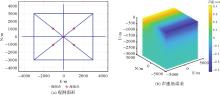
Fig. 2
Observation pattern and sound speed field error"

Tab. 1
Simulation parameter configuration"
| 参数种类 | 参数配置 |
|---|---|
| 海面网半径/m |  |
| 海底控制网半径/m | 1500 |
| 海底点深度/m | 3000 |
| 观测时长/min | 80 |
| 观测历元 | 1200 |
| 水平格网间隔/m | 200 |
| 垂直格网间隔/m | 100 |
| 参考声速剖面间隔/m | 100 |
| 水平梯度方向 | N方向 |
| 其他误差 | 无 |
Tab. 2
Positioning error in the static sound speed case"
| 海底点 | 坐标真值 | 解算策略 | 定位误差 | ||||
|---|---|---|---|---|---|---|---|
| E | N | U | ΔE | ΔN | ΔU | ||
| M01 | 0 | 0 | -3000 | Model1 | -0.001 0 | 0.217 5 | -0.000 5 |
| Model2 | -0.001 6 | -0.001 1 | 0.003 3 | ||||
| Model3 | 0.000 5 | 0.008 6 | -0.000 2 | ||||
| M02 | 1 060.660 2 | 1 060.660 2 | -3000 | Model1 | -0.012 7 | 0.210 2 | 0.063 5 |
| Model2 | -0.005 1 | -0.002 7 | 0.001 6 | ||||
| Model3 | 0.012 1 | 0.022 7 | -0.037 3 | ||||
| M03 | -1 060.660 2 | -1 060.660 2 | -3000 | Model1 | -0.012 8 | 0.211 2 | -0.064 0 |
| Model2 | 0.000 2 | 0.001 9 | 0.004 9 | ||||
| Model3 | 0.012 1 | 0.022 7 | 0.037 0 | ||||
| M04 | 1 060.660 2 | -1 060.660 2 | -3000 | Model1 | 0.011 0 | 0.210 0 | -0.064 3 |
| Model2 | -0.005 1 | 0.001 1 | 0.003 7 | ||||
| Model3 | -0.011 1 | 0.022 9 | 0.038 2 | ||||
| M05 | -1 060.660 2 | 1 060.660 2 | -3000 | Model1 | 0.010 4 | 0.211 0 | 0.064 2 |
| Model2 | -0.000 1 | 0.006 0 | 0.002 6 | ||||
| Model3 | -0.011 6 | 0.022 6 | -0.038 5 | ||||
Tab. 3
Parameter estimation result in the static sound speed case"
| 方向 | 仿真平均梯度 | 模型3估计 |
|---|---|---|
| E方向 | 0 | -2.481 1×10⁻⁷ |
| N方向 | 2.15×10⁻⁵ | 3.230 2×10⁻⁵ |
Tab. 4
Positioning error in the dynamic sound speed case"
| 海底点 | Model1定位误差 | Model3定位误差 | ||||
|---|---|---|---|---|---|---|
| ΔE | ΔN | ΔU | ΔE | ΔN | ΔU | |
| M01 | -0.034 4 | 0.089 1 | 0.267 2 | 0.001 7 | 0.007 5 | -0.004 4 |
| M02 | -0.131 5 | -0.004 5 | 0.256 3 | 0.002 2 | 0.013 1 | -0.010 8 |
| M03 | 0.055 1 | 0.188 4 | 0.228 2 | 0.004 3 | 0.008 1 | 0.001 6 |
| M04 | -0.121 2 | 0.179 9 | 0.215 8 | 0.008 8 | 0.004 8 | 0.003 1 |
| M05 | 0.061 0 | -0.003 2 | 0.274 3 | -0.006 5 | 0.013 6 | -0.007 0 |
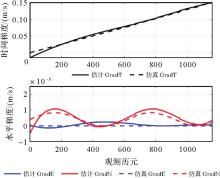
Fig. 3
Statistics of parameter estimation results in the dynamic sound speed field"
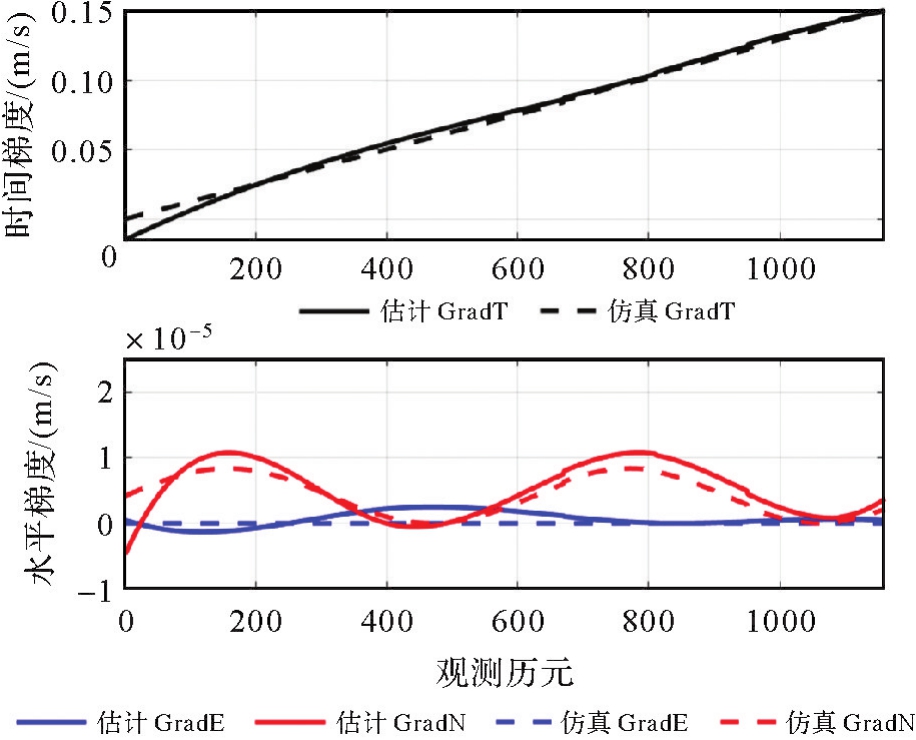
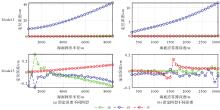
Fig. 4
Positioning error analysis"

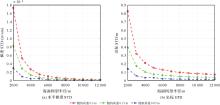
Fig. 5
STD of horizontal gradient and coordinate"

Tab. 5
Parameter settings for Model3"
| 参数名称 | 参数设置 |
|---|---|
| B样条阶数 | 3 |
| B样条节点间隔 | kt:15 min |
| ke、kn:15、15 min | |
| B样条平滑因子 | kt:1 |
| ke、kn:1、1 |
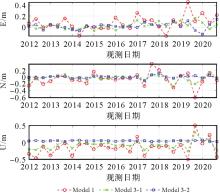
Fig. 6
Positioning error of different models"

Tab. 6
Comparison of positioning accuracy of different models"
| 模型 | STD | 最大偏差 | ||||
|---|---|---|---|---|---|---|
| ΔE | ΔN | ΔU | ΔE | ΔN | ΔU | |
| Model1 | 0.129 8 | 0.186 8 | 0.251 3 | 0.162 5 | 0.611 1 | 0.622 5 |
| Model3-1 | 0.060 6 | 0.084 5 | 0.137 7 | 0.067 1 | 0.285 6 | 0.343 2 |
| Model3-2 | 0.058 4 | 0.039 4 | 0.012 7 | 0.128 8 | 0.112 8 | 0.023 0 |
| GARPOS | 0.019 1 | 0.023 5 | 0.014 8 | 0.053 2 | 0.045 5 | 0.028 1 |
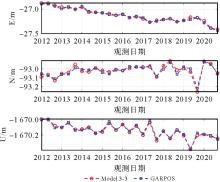
Fig. 7
Comparison between Model3-3 and GARPOS"
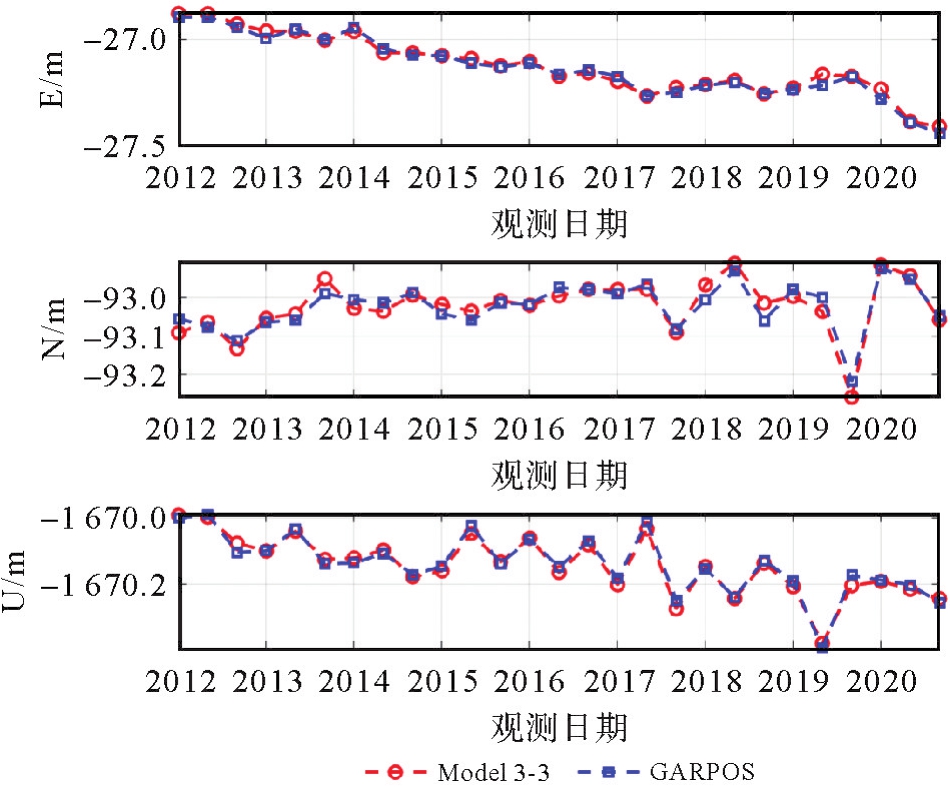
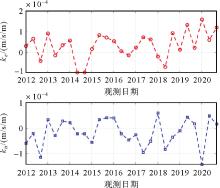
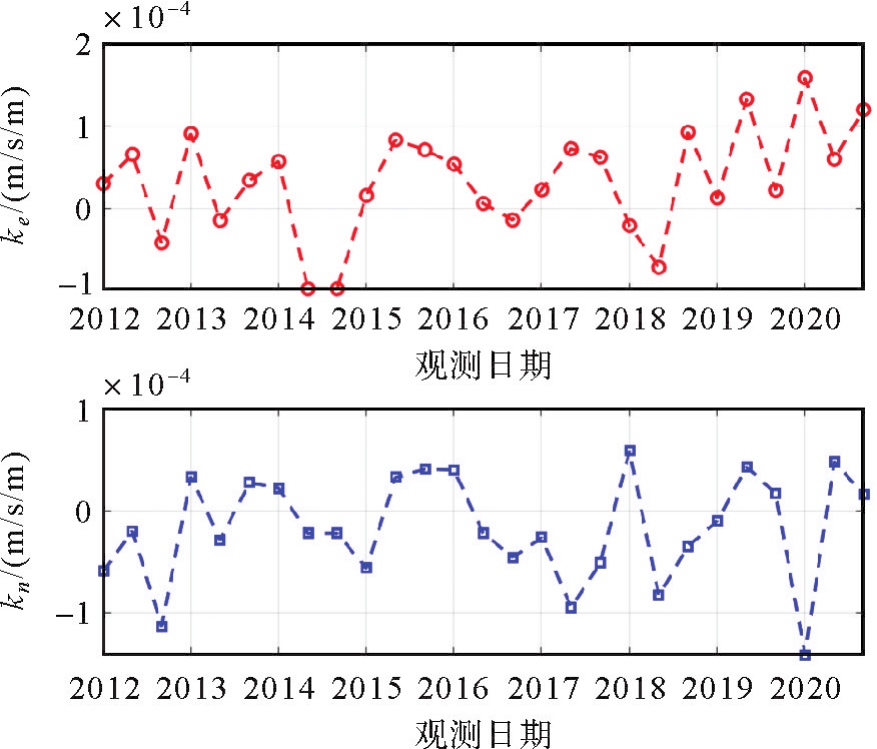
Fig. 8
Parameter estimation results of Model3-3"
| [1] | SPIESS F N, CHADWELL C D, HILDEBRAND J A, et al. Precise GPS/acoustic positioning of seafloor reference points for tectonic studies[J]. Physics of the Earth and Planetary Interiors, 1998, 108(2): 101-112. |
| [2] | YANG Yuanxi, QIN Xianping. Resilient observation models for seafloor geodetic positioning[J]. Journal of Geodesy, 2021, 95(7): 79. |
| [3] |
杨元喜. 弹性PNT基本框架[J]. 测绘学报, 2018, 47(7): 893-898. DOI:.
doi: 10.11947/j.AGCS.2018.20180149 |
|
YANG Yuanxi. Resilient PNT concept frame[J]. Acta Geodaetica et Cartographica Sinica, 2018, 47(7): 893-898. DOI:.
doi: 10.11947/j.AGCS.2018.20180149 |
|
| [4] | 陈冠旭, 刘杨, 李梦昊, 等. GNSS-声学海底定位的声速误差处理方法综述[J]. 武汉大学学报(信息科学版), 2022, 47(9): 1349-1363. |
| CHEN Guanxu, LIU Yang, LI Menghao, et al. Review on the processing methods of sound speed errors in GNSS-acoustic seafloor positioning[J]. Geomatics and Information Science of Wuhan University, 2022, 47(9): 1349-1363. | |
| [5] |
党亚民, 蒋涛, 杨元喜, 等. 中国大地测量研究进展(2019—2023)[J]. 测绘学报, 2023, 52(9): 1419-1436. DOI:.
doi: 10.11947/j.AGCS.2023.20230343 |
|
DANG Yamin, JIANG Tao, YANG Yuanxi, et al. Research progress of geodesy in China(2019—2023)[J]. Acta Geodaetica et Cartographica Sinica, 2023, 52(9): 1419-1436. DOI:.
doi: 10.11947/j.AGCS.2023.20230343 |
|
| [6] | 刘经南, 赵建虎, 马金叶. 通导遥一体化深远海PNT基准及服务网络构想[J]. 武汉大学学报(信息科学版), 2022, 47(10): 1523-1534. |
| LIU Jingnan, ZHAO Jianhu, MA Jinye. Concept of constructing the underwater PNT network with the abilities of communication, navigation and remote sensing in the deep sea[J]. Geomatics and Information Science of Wuhan University, 2022, 47(10): 1523-1534. | |
| [7] |
杨元喜, 徐天河, 薛树强. 我国海洋大地测量基准与海洋导航技术研究进展与展望[J]. 测绘学报, 2017, 46(1): 1-8. DOI:.
doi: 10.11947/j.AGCS.2017.20160519 |
|
YANG Yuanxi, XU Tianhe, XUE Shuqiang. Progresses and prospects in developing marine geodetic datum and marine navigation of China[J]. Acta Geodaetica et Cartographica Sinica, 2017, 46(1): 1-8. DOI:.
doi: 10.11947/j.AGCS.2017.20160519 |
|
| [8] | 杨元喜, 刘焱雄, 孙大军, 等. 海底大地基准网建设及其关键技术[J]. 中国科学:地球科学, 2020, 50(7): 936-945. |
| YANG Yuanxi, LIU Yanxiong, SUN Dajun, et al. Seafloor geodetic network establishment and key technologies[J]. Scientia Sinica (Terrae), 2020, 50(7): 936-945. | |
| [9] | 刘焱雄, 李梦昊, 刘杨, 等. 海底大地基准建设技术及其研究进展[J]. 海洋科学进展, 2022, 40(4): 684-700. |
| LIU Yanxiong, LI Menghao, LIU Yang, et al. Research progress of seafloor geodetic datum construction technology[J]. Advances in Marine Science, 2022, 40(4): 684-700. | |
| [10] |
赵建虎, 梁文彪. 海底控制网测量和解算中的几个关键问题[J]. 测绘学报, 2019, 48(9): 1197-1202. DOI:.
doi: 10.11947/j.AGCS.2019.20190157 |
|
ZHAO Jianhu, LIANG Wenbiao. Some key points of submarine control network measurement and calculation[J]. Acta Geodaetica et Cartographica Sinica, 2019, 48(9): 1197-1202. DOI:.
doi: 10.11947/j.AGCS.2019.20190157 |
|
| [11] | XUE Shuqiang, YANG Yuanxi, YANG Wenlong. Single-differenced models for GNSS-acoustic seafloor point positioning[J]. Journal of Geodesy, 2022, 96(5): 38. |
| [12] |
赵爽, 王振杰, 聂志喜, 等. 顾及声速结构时域变化的海底基准站高精度定位方法[J]. 测绘学报, 2023, 52(1): 41-50. DOI:.
doi: 10.11947/j.AGCS.2023.20210326 |
|
ZHAO Shuang, WANG Zhenjie, NIE Zhixi, et al. Precise positioning method for seafloor geodetic stations based on the temporal variation of sound speed structure[J]. Acta Geodaetica et Cartographica Sinica, 2023, 52(1): 41-50. DOI:.
doi: 10.11947/j.AGCS.2023.20210326 |
|
| [13] | 张盛秋, 杨元喜, 徐天河. 基于GNSS-A的海洋声速变化估计及其对定位的影响[J]. 地球物理学报, 2023, 66(3): 961-972. |
| ZHANG Shengqiu, YANG Yuanxi, XU Tianhe. Estimation of ocean sound velocity variation based on GNSS-A and its influence on positioning[J]. Chinese Journal of Geophysics, 2023, 66(3): 961-972. | |
| [14] | CHADWELL C D, SWEENEY A D. Acoustic ray-trace equations for seafloor geodesy[J]. Marine Geodesy, 2010, 33(2/3): 164-186. |
| [15] |
辛明真, 阳凡林, 薛树强, 等. 顾及波束入射角的常梯度声线跟踪水下定位算法[J]. 测绘学报, 2020, 49(12): 1535-1542. DOI:.
doi: 10.11947/j.AGCS.2020.20190518 |
|
XIN Mingzhen, YANG Fanlin, XUE Shuqiang, et al. A constant gradient sound ray tracing underwater positioning algorithm considering incident beam angle[J]. Acta Geodaetica et Cartographica Sinica, 2020, 49(12): 1535-1542. DOI:.
doi: 10.11947/j.AGCS.2020.20190518 |
|
| [16] | YANG Wenlong, XUE Shuqiang, LIU Yixu. P-order secant method for rapidly solving the ray inverse problem of underwater acoustic positioning[J]. Marine Geodesy, 2023, 46(1): 3-15. |
| [17] |
赵爽, 王振杰, 刘慧敏. 顾及声线入射角的水下定位随机模型[J]. 测绘学报, 2018, 47(9): 1280-1289. DOI:.
doi: 10.11947/j.AGCS.2018.20170026 |
|
ZHAO Shuang, WANG Zhenjie, LIU Huimin. Investigation on underwater positioning stochastic model based on sound ray incidence angle[J]. Acta Geodaetica et Cartographica Sinica, 2018, 47(9): 1280-1289. DOI:.
doi: 10.11947/j.AGCS.2018.20170026 |
|
| [18] | LIU Yixu, XUE Shuqiang, QU Guoqing, et al. Influence of the ray elevation angle on seafloor positioning precision in the context of acoustic ray tracing algorithm[J]. Applied Ocean Research, 2020, 105: 102403. |
| [19] |
王薪普, 薛树强, 曲国庆, 等. 水下定位声线扰动分析与分段指数权函数设计[J]. 测绘学报, 2021, 50(7): 982-989. DOI:.
doi: 10.11947/j.AGCS.2021.20200424 |
|
WANG Xinpu, XUE Shuqiang, QU Guoqing, et al. Disturbance analysis of underwater positioning acoustic ray and design of piecewise exponential weight function[J]. Acta Geodaetica et Cartographica Sinica, 2021, 50(7): 982-989. DOI:.
doi: 10.11947/j.AGCS.2021.20200424 |
|
| [20] |
闫凤池, 王振杰, 赵爽, 等. 顾及双程声径的常梯度声线跟踪水下定位算法[J]. 测绘学报, 2022, 51(1): 31-40. DOI:.
doi: 10.11947/j.AGCS.2022.20210234 |
|
YAN Fengchi, WANG Zhenjie, ZHAO Shuang, et al. A layered constant gradient acoustic ray tracing underwater positioning algorithm considering round-trip acoustic path[J]. Acta Geodaetica et Cartographica Sinica, 2022, 51(1): 31-40. DOI:.
doi: 10.11947/j.AGCS.2022.20210234 |
|
| [21] | LIU Yang, LIU Yanxiong, CHEN Guanxu, et al. Seafloor single point positioning using GNSS-acoustic technique with horizontal sound speed gradient estimation[C]//Proceedings of 2021 Scientific Assembly of the International Association of Geodesy. Beijing: [s.n.], 2021. |
| [22] | 王凯明, 薛树强, 韩保民, 等. 海洋内波对海底精密定位的影响[J]. 哈尔滨工程大学学报, 2023, 44(11): 2054-2061. |
| WANG Kaiming, XUE Shuqiang, HAN Baomin, et al. Effect of ocean internal waves on high-precision seafloor geodetic positioning[J]. Journal of Harbin Engineering University, 2023, 44(11): 2054-2061. | |
| [23] | TOMITA F, KIDO M. An approximate travel time calculation and a robust GNSS-acoustic positioning method using an MCMC technique[J]. Earth, Planets and Space, 2022, 74(1): 176. |
| [24] | SAKIC P, BALLU V, CRAWFORD W C, et al. Acoustic ray tracing comparisons in the context of geodetic precise off-shore positioning experiments[J]. Marine Geodesy, 2018, 41(4): 315-330. |
| [25] | 李林洋, 徐天河, 王君婷, 等. 联合匹配场和神经网络的声速时间场构建方法[J]. 哈尔滨工程大学学报, 2023, 44(11): 2044-2053. |
| LI Linyang, XU Tianhe, WANG Junting, et al. A method for constructing a sound velocity time field by combining a matched field and neural network[J]. Journal of Harbin Engineering University, 2023, 44(11): 2044-2053. | |
| [26] |
曾安敏, 杨元喜, 明锋, 等. 海底大地基准点圆走航模式定位模型及分析[J]. 测绘学报, 2021, 50(7): 939-952. DOI:.
doi: 10.11947/j.AGCS.2021.20200529 |
|
ZENG Anmin, YANG Yuanxi, MING Feng, et al. Positioning model and analysis of the sailing circle mode of seafloor geodetic datum points[J]. Acta Geodaetica et Cartographica Sinica, 2021, 50(7): 939-952. DOI:.
doi: 10.11947/j.AGCS.2021.20200529 |
|
| [27] | 李景森, 薛树强, 徐莹, 等. 声速剖面测量误差对水下定位的影响[J]. 哈尔滨工程大学学报, 2023, 44(11): 2062-2070. |
| LI Jingshen, XUE Shuqiang, XU Ying, et al. Effects of sound speed profile measurement error on underwater positioning[J]. Journal of Harbin Engineering University, 2023, 44(11): 2062-2070. | |
| [28] | 薛树强, 杨元喜, 肖圳, 等. 全球导航卫星系统-声呐组合观测模型分类体系[J]. 哈尔滨工程大学学报, 2023, 44(11): 1857-1868. |
| XUE Shuqiang, YANG Yuanxi, XIAO Zhen, et al. Global navigation satellite system-acoustic combined observation model classification system[J]. Journal of Harbin Engineering University, 2023, 44(11): 1857-1868. | |
| [29] | KIDO M. Detecting horizontal gradient of sound speed in ocean[J]. Earth, Planets and Space, 2007, 59(8): e33-e36. |
| [30] | YASUDA K, TADOKORO K, TANIGUCHI S, et al. Interplate locking condition derived from seafloor geodetic observation in the shallowest subduction segment at the Central Nankai Trough, Japan[J]. Geophysical Research Lellers, 2017, 44(8): 3572-3579. |
| [31] | HONSHO C, KIDO M. Comprehensive analysis of travel time data collected through GPS-acoustic observation of seafloor crustal movements[J]. Journal of Geophysical Research: Solid Earth, 2017, 122(10): 8583-8599. |
| [32] | YOKOTA Y, ISHIKAWA T, WATANABE S I. Gradient field of undersea sound speed structure extracted from the GNSS-a oceanography[J]. Marine Geophysical Research, 2019, 40(4): 493-504. |
| [33] | YOKOTA Y, ISHIKAWA T, WATANABE S I, et al. Kilometer-scale sound speed structure that affects GNSS-a observation: case study off the kii channel[J]. Frontiers in Earth Science, 2020, 8: 331. |
| [34] | WATANABE S I, ISHIKAWA T, YOKOTA Y, et al. GARPOS: analysis software for the GNSS-a seafloor positioning with simultaneous estimation of sound speed structure[J]. Frontiers in Earth Science, 2020, 8: 508. |
| [35] | WATANABE S I, ISHIKAWA T, NAKAMURA Y, et al. Full-bayes GNSS-A solutions for precise seafloor positioning with single uniform sound speed gradient layer assumption[J]. Journal of Geodesy, 2023, 97(10): 89. |
| [36] | TOMITA F, KIDO M, HONSHO C, et al. Development of a kinematic GNSS-Acoustic positioning method based on a state-space model[J]. Earth, Planets and Space, 2019, 71: 102. |
| [37] | 明锋, 杨元喜, 曾安敏. 基于贝叶斯估计的深海GNSS-A定位精度[J]. 地球物理学报, 2023, 66(3): 951-960. |
| MING Feng, YANG Yuanxi, ZENG Anmin. Positioning accuracy of GNSS-A in deep sea based on Bayesian estimation[J]. Chinese Journal of Geophysics, 2023, 66(3): 951-960. | |
| [38] | XUE Shuqiang, YANG Yuanxi, YANG Wenlong, et al. GNSS-A network solution with zenith acoustic delay estimation[J]. Marine Geodesy, 2021, 47(3): 237-268. |
| [39] | XUE Shuqiang, LI Baojin, XIAO Zhen, et al. Centimeter-level-precision seafloor geodetic positioning model with self-structured empirical sound speed profile[J]. Satellite Navigation, 2023, 4(1): 30. |
| [40] | 肖圳, 薛树强, 韩保民, 等. 参考声速剖面误差对主动式声呐定位影响仿真分析[J]. 地球物理学报, 2023, 66(12): 4889-4899. |
| XIAO Zhen, XUE Shuqiang, HAN Baomin, et al. Simulation analysis on reference sound velocity profile error influence on active acoustic positioning[J]. Chinese Journal of Geophysics, 2023, 66(12): 4889-4899. |
| [1] | ZHANG Jixian, GU Haiyan, YANG Yi, ZHANG He, LI Haitao, HAN Wenli, SHEN Jing. Research progress and trend of intelligent interpretation for natural resources features [J]. Acta Geodaetica et Cartographica Sinica, 2022, 51(7): 1606-1617. |
| [2] | WANG Xinpu, XUE Shuqiang, QU Guoqing, LIU Yixu, YANG Wenlong. Disturbance analysis of underwater positioning acoustic ray and design of piecewise exponential weight function [J]. Acta Geodaetica et Cartographica Sinica, 2021, 50(7): 982-989. |
| [3] | ZHAO Shuang, WANG Zhenjie, LIU Huimin. Investigation on Underwater Positioning Stochastic Model Based on Sound Ray Incidence Angle [J]. Acta Geodaetica et Cartographica Sinica, 2018, 47(9): 1280-1289. |
| Viewed | ||||||
|
Full text |
|
|||||
|
Abstract |
|
|||||
