

Acta Geodaetica et Cartographica Sinica ›› 2025, Vol. 54 ›› Issue (9): 1596-1607.doi: 10.11947/j.AGCS.2025.20250055
• Geodesy and Navigation • Previous Articles Next Articles
Cong SHEN1,2( ), Guocheng WANG1(), Lintao LIU1, Huiwen HU1,2, Zhiwu CAI3
Received:2025-02-13
Revised:2025-07-08
Online:2025-10-10
Published:2025-10-10
Contact:
Guocheng WANG
E-mail:shencong@apm.ac.cn;guocheng96@apm.ac.cn
About author:SHEN Cong (1996—), male, PhD candidate, majors in clock bias processing and analysis. E-mail: shencong@apm.ac.cn
Supported by:CLC Number:
Cong SHEN, Guocheng WANG, Lintao LIU, Huiwen HU, Zhiwu CAI. Kalman filter-based satellite clock bias prediction algorithm with frequency difference estimation correction[J]. Acta Geodaetica et Cartographica Sinica, 2025, 54(9): 1596-1607.
Tab. 1
The status of GPS satellite in orbit"
| 卫星类型 | 原子钟类型 | 卫星钟编号 |
|---|---|---|
| ⅡR | Rb | G02、G13、G16、G19、G20、G21、G22 |
| ⅡRM | Rb | G05、G07、G12、G15、G17、G29、G31 |
| IIF | Rb | G01、G03、G06、G09、G10、G25、G26、G27、G30、G32 |
| IIF | Cs | G08、G24 |
| ⅢA | Rb | G04、G11、G14、G18、G23、G28 |

Fig. 1
Frequency response of KF"

Tab. 2
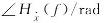
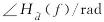
Amplitude-frequency response and phase-frequency response of 24, 12 and 6 h periodic terms"
| 频率响应 | f=1/86 400 Hz | f=1/43 200 Hz | f=1/21 600 Hz |
|---|---|---|---|
 | 0.004 5 | 0.005 0 | 0.004 9 |
 | -90.760 7 | -90.234 0 | -90.091 9 |
 | -218.925 5 | -218.398 2 | -218.258 7 |
 | -0.001 2 | -0.002 7 | -0.005 5 |
 | 0.399 6 | 0.206 0 | 0.101 9 |
 | 0.404 9 | 0.208 7 | 0.103 3 |

Fig. 2
Estimates of time difference, frequency difference and frequency drift"


Fig. 3
Average RMS of GPS satellite clocks at 3, 6, 12 and 24 h prediction durations"

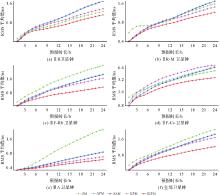
Fig. 4
Average RMS of five models at different prediction horizons"

Tab. 3
STD of different types of satellite clocks in 24 h prediction duration"
| 模型 | ⅡR | ⅡR-M | ⅡF-Rb | ⅡF-Cs | ⅢA | 均值 |
|---|---|---|---|---|---|---|
| GM | 0.604 6 | 0.837 3 | 1.744 7 | 2.702 7 | 1.501 7 | 1.311 1 |
| QPM | 0.953 4 | 0.995 3 | 1.110 4 | 3.693 3 | 0.399 0 | 1.078 9 |
| SAM | 0.953 3 | 0.996 0 | 1.099 9 | 3.633 6 | 0.393 7 | 1.071 0 |
| KFM | 0.670 8 | 0.740 2 | 0.804 3 | 3.594 6 | 0.277 2 | 0.836 6 |
| IKFM | 0.575 3 | 0.639 0 | 0.543 1 | 1.836 2 | 0.236 2 | 0.594 4 |
| 均值 | 0.751 5 | 0.841 6 | 1.060 5 | 3.092 1 | 0.561 6 |
Tab. 4
RMS statistics and comparative analysis results of different models"
| 统计指标 | 模型 | 3 h预报 | 6 h预报 | 12 h预报 | 24 h预报 |
|---|---|---|---|---|---|
| RMS/ns | GM | 0.644 1 | 0.783 3 | 1.185 4 | 2.391 1 |
| QPM | 0.541 2 | 0.695 3 | 1.027 5 | 1.957 6 | |
| SAM | 0.528 6 | 0.681 3 | 1.004 2 | 1.936 1 | |
| KFM | 0.557 1 | 0.724 8 | 1.033 3 | 1.687 1 | |
| IKFM | 0.509 6 | 0.611 8 | 0.783 6 | 1.144 8 | |
| 预报提升率/(%) | IKFM vs. GM | 20.87 | 21.89 | 33.89 | 52.12 |
| IKFM vs. QPM | 5.82 | 12.01 | 23.73 | 41.51 | |
| IKFM vs. SAM | 3.57 | 10.20 | 21.97 | 40.87 | |
| IKFM vs. KFM | 8.51 | 15.59 | 24.16 | 32.14 |

Fig. 5
Positioning errors of real-time kinematic PPP in the north, east, and up directions"

Tab. 5
Real-time dynamic PPP precision metrics"
| 测站 | E方向RMS | N方向RMS | U方向RMS | ||||||
|---|---|---|---|---|---|---|---|---|---|
| IGUP | KFM | IKFM | IGUP | KFM | IKFM | IGUP | KFM | IKFM | |
| FALK | 9.5 | 5.7 | 2.9 | 9.7 | 7.0 | 7.3 | 7.4 | 6.9 | 5.8 |
| LROC | 12.9 | 12.9 | 6.2 | 5.4 | 8.7 | 6.0 | 11.3 | 16.9 | 11.0 |
| MAR6 | 9.4 | 8.5 | 7.9 | 4.5 | 9.1 | 4.4 | 8.6 | 9.6 | 5.2 |
| [1] | 伍贻威, 杨斌, 肖胜红, 等. 原子钟模型和频率稳定度分析方法[J]. 武汉大学学报(信息科学版), 2019, 44(8): 1226-1232. |
| WU Yiwei, YANG Bin, XIAO Shenghong, et al. Atomic clock models and frequency stability analyses[J]. Geomatics and Information Science of Wuhan University, 2019, 44(8): 1226-1232. | |
| [2] | 樊礼谦, 焦文海, 孟轶男. 基于Kalman滤波的导航星座集中式守时算法研究[J]. 时间频率学报, 2023, 46(1): 21-31. |
| FAN Liqian, JIAO Wenhai, MENG Yinan. Research on centralized time-keeping algorithm for navigation constellations based on Kalman filter[J]. Journal of Time and Frequency, 2023, 46(1): 21-31. | |
| [3] | FORMICHELLA V, GALLEANI L, SIGNORILE G, et al. Time-frequency analysis of the Galileo satellite clocks: looking for the J2 relativistic effect and other periodic variations[J]. GPS Solutions, 2021, 25(2): 56. |
| [4] | LIANG Yifeng, XU Jiangning, LI Fangneng, et al. A VMD-PE-SG denoising method based on K-L divergence for satellite atomic clock[J]. Measurement Science and Technology, 2023, 34(5): 55012. |
| [5] |
胡超, 王潜心et al.. 顾及BDS-3/GNSS星钟状态的超快速钟差参数估计模型[J]. 测绘学报, 2024, 53(12): 2268-2281. DOI: .
doi: 10.11947/j.AGCS.2024.20240112 |
|
HU Chao, WANG Qianxinet al.. BDS-3/GNSS satellite ultra-rapid clock offsets estimation model with the aid of onboard clock states solution[J]. Acta Geodaetica et Cartographica Sinica, 2024, 53(12): 2268-2281. DOI: .
doi: 10.11947/j.AGCS.2024.20240112 |
|
| [6] | JIANG Weiping, ZHAO Qile, LI Min, et al. The progress of IGS analysis center at Wuhan university[J]. Journal of Geodesy and Geoinformation Science, 2023, 6(3): 46-57. |
| [7] | 潘雄, 赵万卓, 张龙杰, 等. 联合半参数与优化BiLSTM的BDS-3钟差超短期预报[J]. 中国惯性技术学报, 2024, 32(10): 985-993. |
| PAN Xiong, ZHAO Wanzhuo, ZHANG Longjie, et al. Ultra-short-term prediction method for BDS-3 clock offset by combined semi-parametric and improved BiLSTM models[J]. Journal of Chinese Inertial Technology, 2024, 32(10): 985-993. | |
| [8] | 蒋春华, 朱美珍, 薛慧杰, 等. 基于长短时记忆神经网络的Multi-GNSS卫星钟差建模预报[J]. 大地测量与地球动力学, 2024, 44(3): 257-262. |
| JIANG Chunhua, ZHU Meizhen, XUE Huijie, et al. Multi-GNSS satellite clock offset prediction model based on long short-term memory neural network[J]. Journal of Geodesy and Geodynamics, 2024, 44(3): 257-262. | |
| [9] | TAN Xiaorong, XU Jiangning, HE Hongyang, et al. Short-term satellite clock bias forecast based on complementary ensemble empirical mode decomposition and quadratic polynomial[J]. Survey Review, 2023, 55(389): 127-136. |
| [10] | 雷雨, 赵丹宁. 附加周期项与随机项补偿的卫星钟差预报算法[J]. 中国惯性技术学报, 2024, 32(10): 994-1000. |
| LEI Yu, ZHAO Danning. Satellite clock offset prediction algorithm with additional periodic and stochastic terms compensated[J]. Journal of Chinese Inertial Technology, 2024, 32(10): 994-1000. | |
| [11] | SHEN Cong, WANG Guocheng, LIU Lintao, et al. Extraction of periodic terms in satellite clock bias based on Fourier basis pursuit bandpass filter[J]. Remote Sensing, 2025, 17(5): 827. |
| [12] | XUE Huijie, XU Tianhe, NIE Wenfeng, et al. An enhanced prediction model for BDS ultra-rapid clock offset that combines singular spectrum analysis, robust estimation and gray model[J]. Measurement Science and Technology, 2021, 32(10): 105002. |
| [13] | 朱祥维, 肖华, 雍少为, 等. 卫星钟差预报的Kalman算法及其性能分析[J]. 宇航学报, 2008, 29(3): 966-970, 1052. |
| ZHU Xiangwei, XIAO Hua, YONG Shaowei, et al. The Kalman algorithm used for satellite clock offset prediction and its performance analysis[J]. Journal of Astronautics, 2008, 29(3): 966-970, 1052. | |
| [14] | 杨旭, 王潜心, 吕伟才, 等. 顾及卫星间相关性的Kalman短期钟差预报[J]. 导航定位学报, 2022, 10(3): 59-68. |
| YANG Xu, WANG Qianxin, LÜ Weicai, et al. A method of Kalman filter multi-satellite clock offset short-term prediction based on inter-satellite correlation[J]. Journal of Navigation and Positioning, 2022, 10(3): 59-68. | |
| [15] | 郭海荣, 杨元喜, 何海波, 等. 导航卫星原子钟Kalman滤波中噪声方差-协方差的确定[J]. 测绘学报, 2010, 39(2): 146-150. |
| GUO Hairong, YANG Yuanxi, HE Haibo, et al. Determination of covariance matrix of Kalman filter used for time prediction of atomic clocks of navigation satellites[J]. Acta Geodaetica et Cartographica Sinica, 2010, 39(2): 146-150. | |
| [16] | 宋会杰, 董绍武, 屈俐俐, 等. 基于Sage窗的自适应Kalman滤波用于钟差预报研究[J]. 仪器仪表学报, 2017, 38(7): 1809-1816. |
| SONG Huijie, DONG Shaowu, QU Lili, et al. Research on clock difference prediction using adaptive Kalman filter based on Sage window[J]. Chinese Journal of Scientific Instrument, 2017, 38(7): 1809-1816. | |
| [17] | 林旭, 罗志才. 一种新的卫星钟差Kalman滤波噪声协方差估计方法[J]. 物理学报, 2015, 64(8): 18-23. |
| LIN Xu, LUO Zhicai. A new noise covariance matrix estimation method of Kalman filter for satellite clock errors[J]. Acta Physica Sinica, 2015, 64(8): 18-23. | |
| [18] | 谭小容, 许江宁, 何泓洋, 等. GM(1, 1)模型初始条件优化及其在GNSS钟差预报中的应用[J]. 大地测量与地球动力学, 2022, 42(9): 919-924. |
| TAN Xiaorong, XU Jiangning, HE Hongyang, et al. Optimized initial condition of GM(1, 1) model and its application in GNSS clock offset prediction[J]. Journal of Geodesy and Geodynamics, 2022, 42(9): 919-924. | |
| [19] | 袁德宝, 张建, 张振超, 等. 基于SAFA-FDGM(1, 1)模型的BDS钟差预报[J]. 大地测量与地球动力学, 2021, 41(7): 672-675. |
| YUAN Debao, ZHANG Jian, ZHANG Zhenchao, et al. BDS clock error prediction based on SAFA-FDGM(1, 1) model[J]. Journal of Geodesy and Geodynamics, 2021, 41(7): 672-675. | |
| [20] | WU Yiwei. Determination of theoretical Kalman filter performance for atomic clock estimation through equivalent linear time-invariant systems[J]. IEEE Transactions on Aerospace and Electronic Systems, 2023, 59(6): 7908-7922. |
| [21] | 王宇谱, 薛申辉, 王威, 等. 基于一次差分预报原理的常用钟差预报模型效果分析[J]. 大地测量与地球动力学, 2021, 41(4): 336-341. |
| WANG Yupu, XUE Shenhui, WANG Wei, et al. Effect analysis of common prediction models specific to satellite clock bias based on the principle of single difference prediction[J]. Journal of Geodesy and Geodynamics, 2021, 41(4): 336-341. | |
| [22] | WANG Guocheng, LIU Lintao, XU Aigong, et al. On the capabilities of the inaction method for extracting the periodic components from GPS clock data[J]. GPS Solutions, 2018, 22(4): 92. |
| [23] | WU Yiwei, GONG Hang, ZHU Xiangwei, et al. A clock steering method: using a third-order type 3 DPLL equivalent to a Kalman filter with a delay[J]. Metrologia, 2015, 52(6): 864. |
| [24] | WANG Jian, HAN Houzeng, LIU Fei, et al. Performance analysis of GNSS/MIMU tight fusion positioning model with complex scene feature constraints[J]. Journal of Geodesy and Geoinformation Science, 2021, 4(2): 1-13. |
| [25] | 伍贻威, 龚航, 朱祥维, 等. 原子钟两级驾驭算法及在建立GNSS时间基准中的应用[J]. 电子学报, 2016, 44(7): 1742-1750. |
| WU Yiwei, GONG Hang, ZHU Xiangwei, et al. Twice atomic clock steering algorithm and its application in forming a GNSS time reference[J]. Acta Electronica Sinica, 2016, 44(7): 1742-1750. | |
| [26] | WU Yiwei, GONG Hang, ZHU Xiangwei, et al. A DPLL method applied to clock steering[J]. IEEE Transactions on Instrumentation and Measurement, 2016, 65(6): 1331-1342. |
| [27] | LI Fangneng, LIANG Yifeng, XU Jiangning, et al. Advances in satellite atomic clock technologies for the GNSS[J]. Measurement Science and Technology, 2024, 35(1): 015027. |
| [28] | XIE Xin, GENG Tao, ZHAO Qile, et al. Orbit and clock analysis of BDS-3 satellites using inter-satellite link observations[J]. Journal of Geodesy, 2020, 94(7): 64. |
| [29] | WANG Xu, CHAI Hongzhou. Developing an innovative high-precision approach to predict medium-term and long-term satellite clock bias[J]. Journal of Geodesy and Geoinformation Science, 2023, 6(1): 47-58. |
| [30] | GLANER M F, WEBER R. An open-source software package for precise point positioning: raPPPid[J]. GPS Solutions, 2023, 27(4): 174. |
| [1] | Siyuan BAI, Hongzhou CHAI, Qing WU, Gen LI, Yuhao YE, Honglei MA. Buoys-aided integrated navigation method for UUV under ice with sea ice drift compensation [J]. Acta Geodaetica et Cartographica Sinica, 2026, 55(4): 698-707. |
| [2] | Lei LIANG, Changqing WANG, Lingyong HUANG, Zhiyong HUANG, Yaoyao YU, Min ZHONG, Yihao YAN, Qinglu MU. GRACE-FO attitude data determination with consideration of star camera alignment matrix calibration [J]. Acta Geodaetica et Cartographica Sinica, 2026, 55(2): 287-300. |
| [3] | Weitong WU, Chi CHEN, Bisheng YANG, Xiufeng HE. Robust multi-sensor fusion-based odometry method of LiDAR, millimeter-wave radar and IMU in degraded scenes [J]. Acta Geodaetica et Cartographica Sinica, 2025, 54(9): 1677-1686. |
| [4] | Kefan SHAO, Zengke LI, Meng SUN, Zhenbin LIU, Qi WU. A geomagnetic SLAM method enhanced by multi-source data fusion based on smartphones [J]. Acta Geodaetica et Cartographica Sinica, 2025, 54(10): 1812-1825. |
| [5] | SUN Chuanmeng, WEI Yu, LI Xinyu, MA Tiehua, WU Zhibo. Intelligent detection method of image water level inversion for water level without water scale in complex scenes [J]. Acta Geodaetica et Cartographica Sinica, 2024, 53(3): 558-568. |
| [6] | WANG Junsen, JIN Shaohua, BIAN Gang, CUI Yang, LONG Zhenyu. A multi-beam outlier automatic filtering algorithm combining uncertainty and density clustering method [J]. Acta Geodaetica et Cartographica Sinica, 2023, 52(10): 1669-1678. |
| [7] | LI Bofeng, QIN Yuanyang, CHEN Guang'e. BDS-3 cycle slip and data gap repair based on the geometry-free ionosphere-filter model [J]. Acta Geodaetica et Cartographica Sinica, 2022, 51(4): 501-510. |
| [8] | ZHAO Leyang, YAN Li. Advanced quaternion unscented Kalman filter based on SLAM of mobile robot pose estimation [J]. Acta Geodaetica et Cartographica Sinica, 2022, 51(2): 212-223. |
| [9] | SHI Qiang, DAI Wujiao, YAN Huineng, LIU Ning. Research on application of spatio-temporal Kalman filter in deformation analysis [J]. Acta Geodaetica et Cartographica Sinica, 2022, 51(10): 2125-2138. |
| [10] | JIN Kaidi, CHAI Hongzhou, SU Chuhan, XIANG Minzhi. Adaptive Kalman filter method with colored noise for fiber optic gyroscope random drift [J]. Acta Geodaetica et Cartographica Sinica, 2022, 51(1): 80-86. |
| [11] | ZHUANG Hanyang, WANG Xiaoliang, WANG Chunxiang, YANG Ming. Vehicle tracking enhancement based on the lane orientation priori from digital maps [J]. Acta Geodaetica et Cartographica Sinica, 2021, 50(11): 1522-1533. |
| [12] | XIE Xianming, SUN Yuzheng, LIANG Xiaoxing, ZENG Qingning, ZHENG Zhanheng. Recursive estimation method of cubature Kalman filtering local polynomial coefficients for phase unwrapping [J]. Acta Geodaetica et Cartographica Sinica, 2020, 49(8): 1023-1031. |
| [13] | JIA Song, XU Tianhe, YANG Honglei. Two Improved Algorithms for LS+AR Prediction Model of the Polar Motion [J]. Acta Geodaetica et Cartographica Sinica, 2018, 47(S0): 71-77. |
| [14] | DI Kaichang, WAN Wenhui, ZHAO Hongying, LIU Zhaoqin, WANG Runzhi, ZHANG Feizhou. Progress and Applications of Visual SLAM [J]. Acta Geodaetica et Cartographica Sinica, 2018, 47(6): 770-779. |
| [15] | YU Hang, WANG Jian, WANG Leyang, NING Yipeng, LIU Zhiping. Total Kalman Filter Method of Dynamic EIV Model [J]. Acta Geodaetica et Cartographica Sinica, 2018, 47(4): 480-489. |
| Viewed | ||||||
|
Full text |
|
|||||
|
Abstract |
|
|||||
