

Acta Geodaetica et Cartographica Sinica ›› 2026, Vol. 55 ›› Issue (5): 866-880.doi: 10.11947/j.AGCS.2026.20250549
• Geodesy and Navigation • Previous Articles Next Articles
Pengcheng WEI1,2( ), Guiyu JIANG1,2, Hangyi SHEN1,2, Haifeng HUANG1,2, Rongling ZHANG3()
Received:2025-12-29
Revised:2026-05-10
Online:2026-06-23
Published:2026-06-23
Contact:
Rongling ZHANG
E-mail:weipengcheng@ctgu.edu.cn;rongling.zhang@connect.polyu.hk
About author:WEI Pengcheng (1993—), male, PhD, lecturer, majors in spatio-temporal data processing and 3D reconstruction. E-mail: weipengcheng@ctgu.edu.cn
Supported by:CLC Number:
Pengcheng WEI, Guiyu JIANG, Hangyi SHEN, Haifeng HUANG, Rongling ZHANG. Millimeter-level surface deformation detection method based on high-precision laser point cloud registration[J]. Acta Geodaetica et Cartographica Sinica, 2026, 55(5): 866-880.
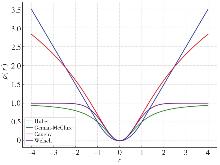
Fig. 1
Performances comparison of Welsch function with other loss functions"
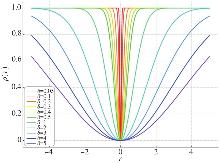
Fig. 2
Welsch function values under different σ values"
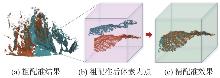
Fig. 3
Point cloud results form coarse registration to fine registation"
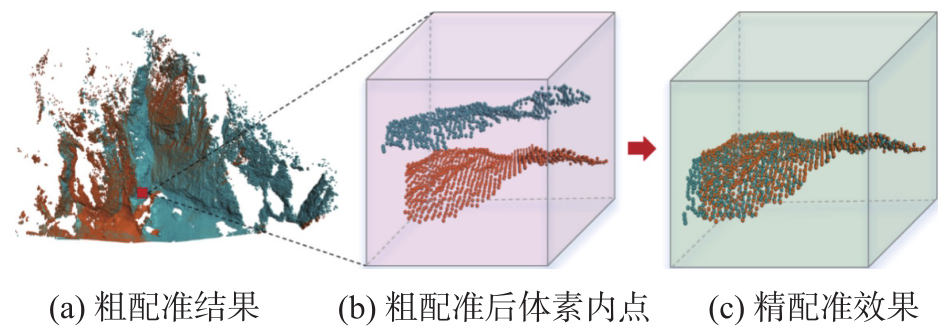
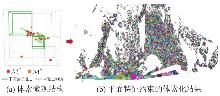
Fig. 4
Construction of voxel microstructure based on planar features"
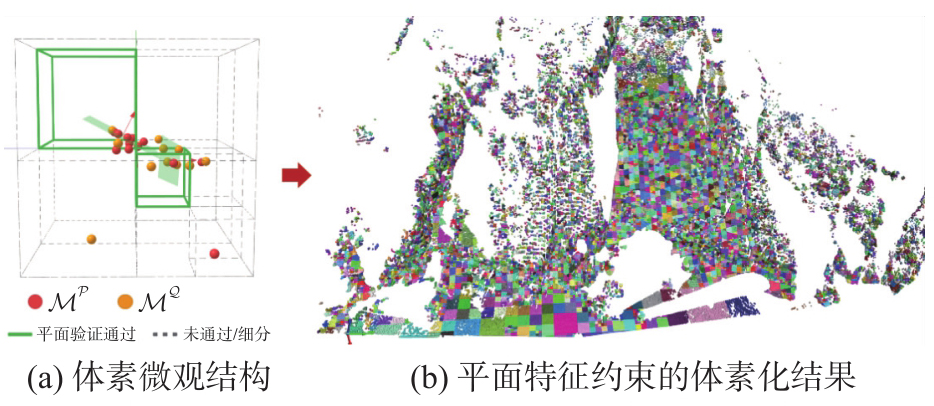
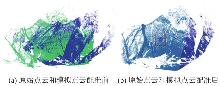
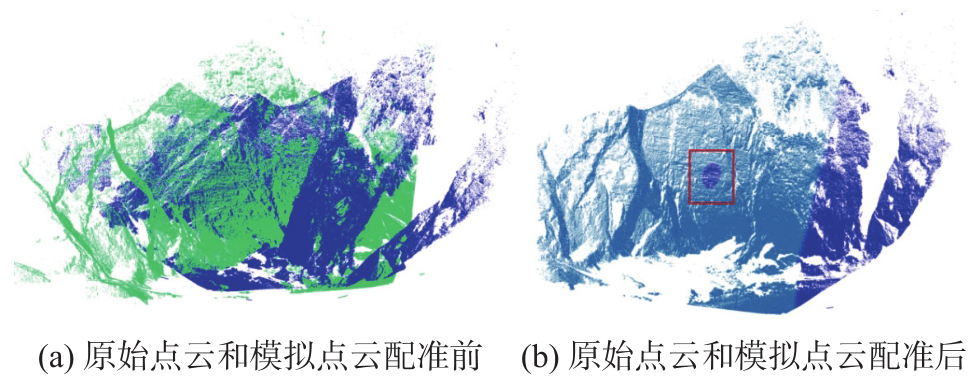
Fig. 5
Simulated experimental data"
Tab. 1
Method performance evaluation results under different deformation magnitude parameters"
| dmax/m | 分类性能 | 形变检测精度 | ||||
|---|---|---|---|---|---|---|
| 精确度/(%) | 召回率/(%) | F1值/(%) | IoU/(%) | MAE/mm | RMSE/mm | |
| 0.005 | 100 | 75.60 | 86.11 | 75.60 | 0.33 | 0.52 |
| 0.006 | 100 | 83.68 | 91.11 | 83.68 | 0.33 | 0.52 |
| 0.007 | 100 | 88.77 | 94.05 | 88.77 | 0.34 | 0.52 |
| 0.008 | 100 | 91.19 | 95.39 | 91.19 | 0.34 | 0.52 |
| 0.01 | 100 | 91.49 | 95.56 | 91.49 | 0.33 | 0.52 |
| 0.02 | 100 | 96.45 | 98.19 | 96.45 | 0.35 | 0.54 |
| 0.05 | 100 | 98.49 | 99.24 | 98.49 | 0.33 | 0.53 |
| 0.1 | 100 | 98.39 | 99.19 | 98.39 | 0.35 | 0.61 |
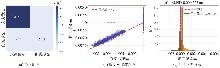
Fig. 6
Result comparison under 8 mm simulated deformation"
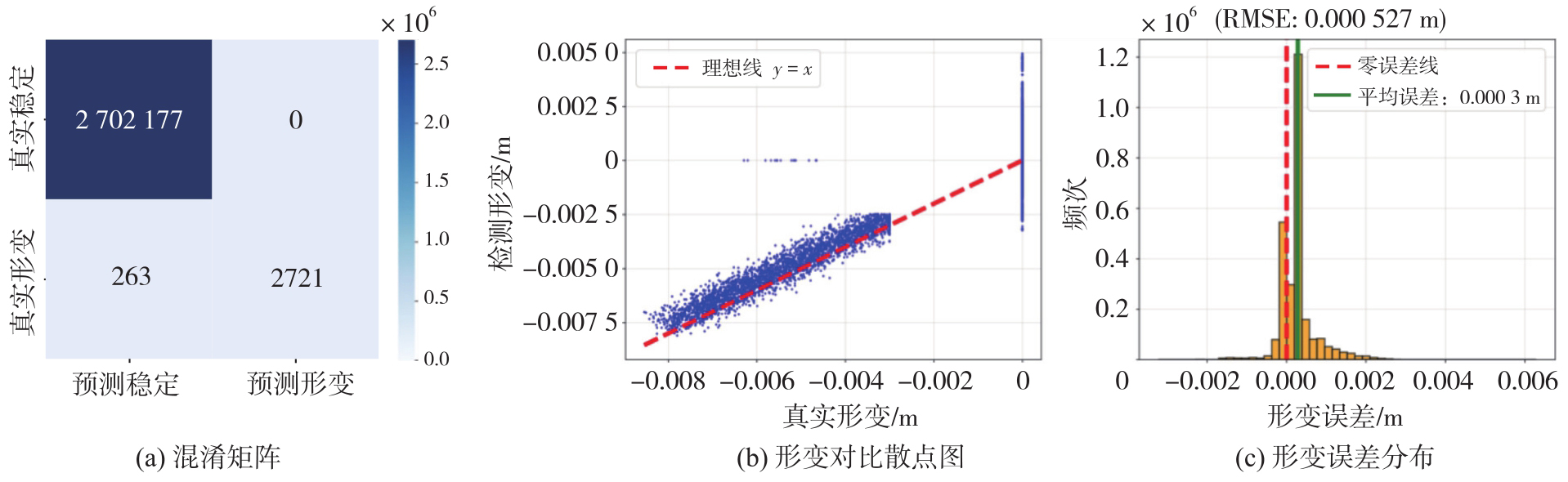
Fig. 7
Experimental sites and deformation setup"

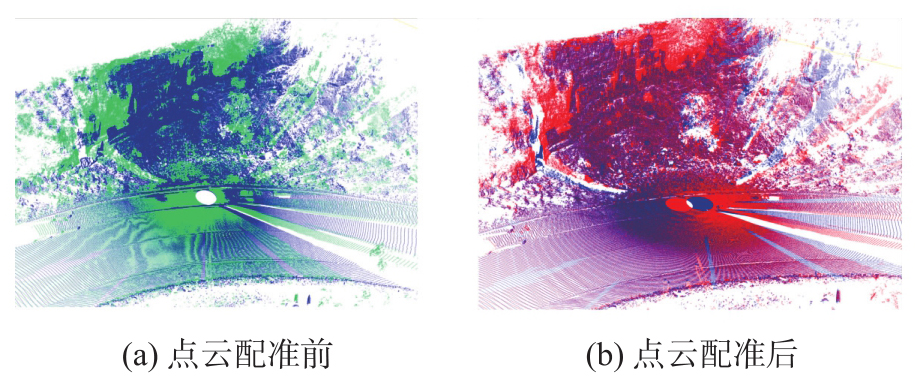
Fig. 8
Real scanned point clouds registration"
Tab. 2
Quantitative validation results of deformation clusters in real slope experiment"
| 聚类ID | 点数 | 平均位移/mm | 面积/m2 | 紧致度 | 位移标准差比例 | 梯度最大值 | 空间连续性 | 综合置信度/(%) | 验证结果 |
|---|---|---|---|---|---|---|---|---|---|
| S-0 | 895 | -15.0 | 0.112 | 18.3 | 0.182 | 3.6 | 0.101 | 63.6 | 通过 |
| S-1 | 707 | -15.1 | 0.089 | 19.7 | 0.143 | 3.9 | 0.124 | 63.2 | 通过 |
| S-2 | 646 | -168.0 | 0.026 | - | - | - | - | 0 | 拒绝 |
| U-0 | 810 | 17.3 | 0.095 | 21.5 | 0.217 | 6.8 | 0.068 | 54.3 | 拒绝 |
| U-1 | 566 | 22.6 | 0.073 | 17.6 | 0.220 | 4.2 | 0.150 | 66.4 | 通过 |
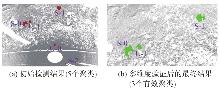
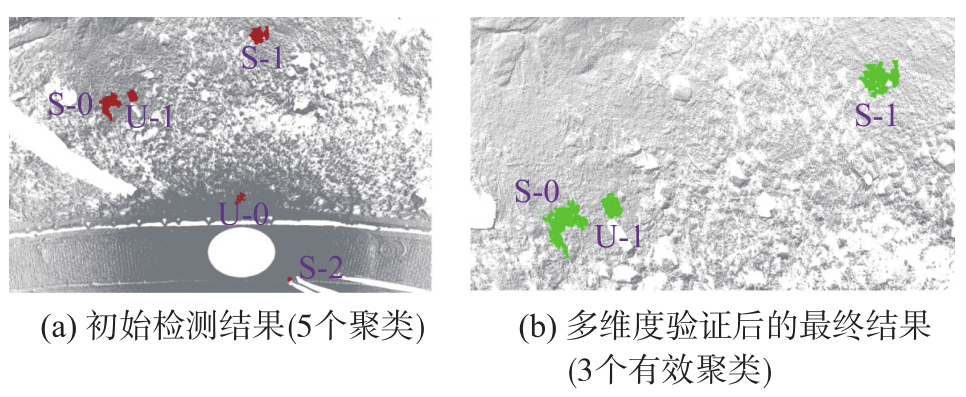
Fig. 9
Comparison of deformation detection results"
Tab. 3
Computational times for each stage of the complete processing pipeline"
| 统计指标 | 耗时/s | 占比/(%) |
|---|---|---|
| 预处理 | 14.52 | 45.8 |
| 粗配准 | 0.19 | 0.6 |
| 精配准 | 0.05 | 0.2 |
| 形变计算 | 16.77 | 52.9 |
| 多维验证 | 0.14 | 0.4 |
| 全流程总计 | 31.68 | 100 |
Tab. 4
Quantitative results of ablation experiments"
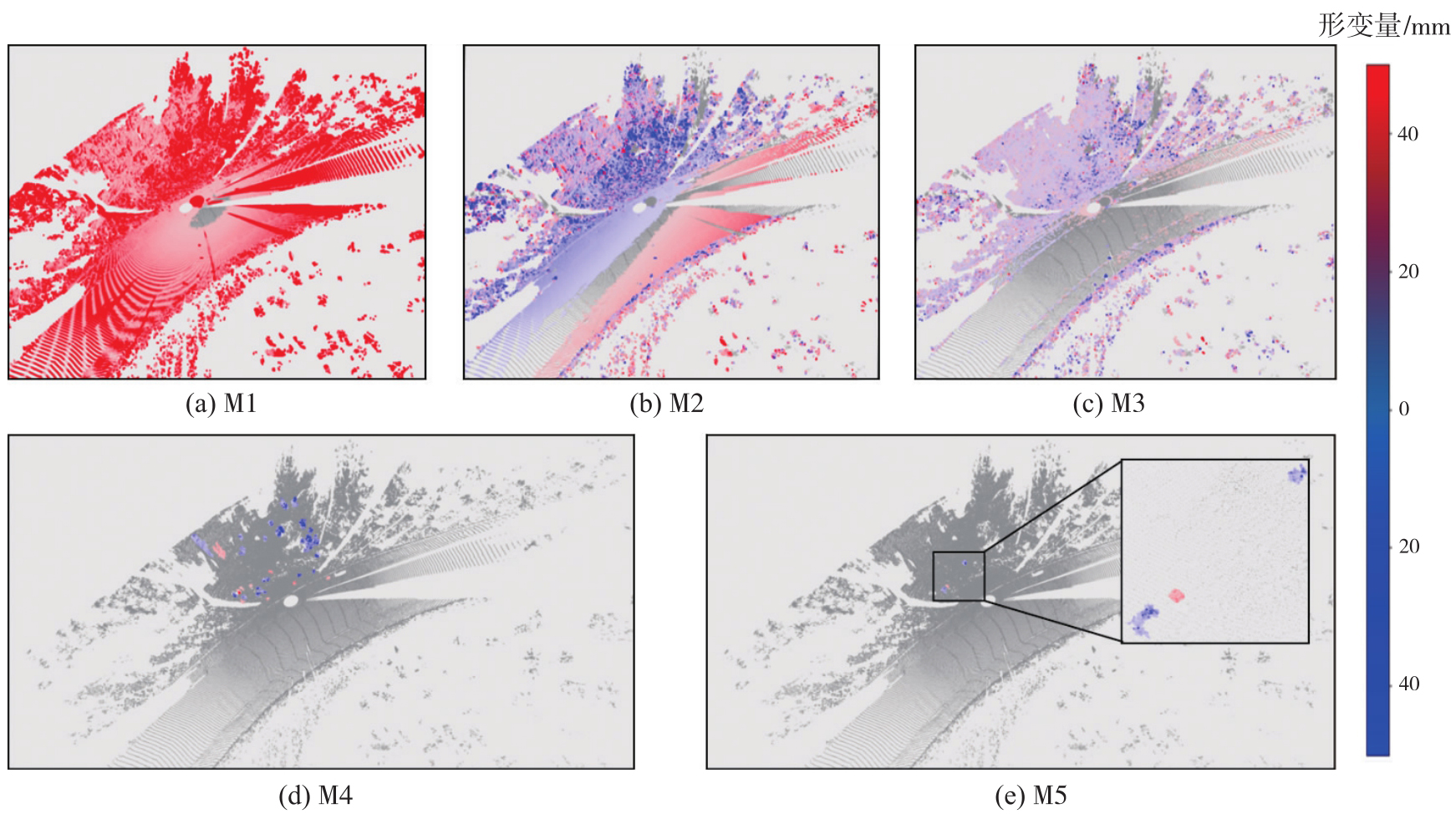
| 方法 | 配准重叠率/(%) | 重叠区均值P2Pl/mm | 初始形变点数 | 有效聚类数 | 有效形变点数 |
|---|---|---|---|---|---|
| M1 | 47.21 | 5.06 | 3 115 409 | - | - |
| M2 | 47.21 | 5.06 | 3 076 770 | - | - |
| M3 | 47.21 | 5.06 | 3 076 770 | 35 | 40 218 |
| M4 | 81.87 | 1.73 | 383 734 | - | - |
| M5 | 81.87 | 1.73 | 129 011 | 3 | 2168 |
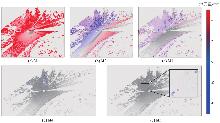
Fig. 10
Deformation detection results of five ablation experiment groups"
Tab. 5
Z-direction difference and point-to-plane distance statistics of multi-epoch scans in the 2 m×2 m stable reference region"
| 有效样本点数 | Z向差值均值/mm | Z向差值标准差/mm | 95%置信区间/mm | 点-平面距离均值/mm | 点-平面距离标准差/mm |
|---|---|---|---|---|---|
| 429 801 | -0.099 | ±0.723 | ±1.417 | 0.707 | ±0.752 |
| [1] | 许强, 董秀军, 李为乐. 基于天-空-地一体化的重大地质灾害隐患早期识别与监测预警[J]. 武汉大学学报(信息科学版), 2019, 44(7): 957-966. |
| XU Qiang, DONG Xiujun, LI Weile. Integrated space-air-ground early detection, monitoring and warning system for potential catastrophic geohazards[J]. Geomatics and Information Science of Wuhan University, 2019, 44(7): 957-966. | |
| [2] | 邵芸, 张茗, 谢酬. 地质灾害遥感综合监测现状与展望[J]. 地质与资源, 2022, 31(3): 381-394. |
| SHAO Yun, ZHANG Ming, XIE Chou. Present situation and prospect of comprehensive monitoring in geological hazard by remote sensing[J]. Geology and Resources, 2022, 31(3): 381-394. | |
| [3] |
孙文潇, 王健, 靳奉祥, 等. 变形分析中点云虚拟基准的确定方法[J]. 测绘学报, 2023, 52(6): 956-965. DOI: .
doi: 10.11947/j.AGCS.2023.20210463 |
|
SUN Wenxiao, WANG Jian, JIN Fengxiang, et al. Point cloud virtual datum determination method in deformation analysis[J]. Acta Geodaetica et Cartographica Sinica, 2023, 52(6): 956-965. DOI: .
doi: 10.11947/j.AGCS.2023.20210463 |
|
| [4] | SHEN Nan, WANG Bin, MA Hongyang, et al. A review of terrestrial laser scanning (TLS)-based technologies for deformation monitoring in engineering[J]. Measurement, 2023, 223: 113684. |
| [5] | WU Chao, YUAN Yongbo, TANG Yang, et al. Application of terrestrial laser scanning (TLS) in the architecture, engineering and construction (AEC) industry[J]. Sensors, 2022, 22(1): 265. |
| [6] | TENG Jinlong, SHI Yufeng, WANG Helong, et al. Review on the research and applications of TLS in ground surface and constructions deformation monitoring[J]. Sensors, 2022, 22(23): 9179. |
| [7] | MUKUPA W, ROBERTS G W, HANCOCK C M, et al. A review of the use of terrestrial laser scanning application for change detection and deformation monitoring of structures[J]. Survey Review, 2016, 49(353): 99-116. |
| [8] | ZHAO Lidu, MA Xiaping, XIANG Zhongfu, et al. Landslide deformation extraction from terrestrial laser scanning data with weighted least squares regularization iteration solution[J]. Remote Sensing, 2022, 14(12): 2897. |
| [9] | 陈弘奕, 胡晓斌, 李崇瑞. 地面三维激光扫描技术在变形监测中的应用[J]. 测绘通报, 2014(12): 74-77. |
| CHEN Hongyi, HU Xiaobin, LI Chongrui. Application of terrestrial 3D laser scanning technology in deformation monitoring[J]. Bulletin of Surveying and Mapping, 2014(12): 74-77. | |
| [10] | YAN Li, WEI Pengcheng, XIE Hong, et al. A new outlier removal strategy based on reliability of correspondence graph for fast point cloud registration[J]. IEEE Transactions on Pattern Analysis and Machine Intelligence, 2023, 45(7): 7986-8002. |
| [11] | CHAN D O, XIAO Hang, XIA Linyuan, et al. Optimization of the use of spherical targets for point cloud registration using Monte Carlo simulation[J]. Journal of Geodesy and Geoinformation Science, 2024, 7(2): 18-36. |
| [12] | 王英, 张云生. 一种由粗到精的地面激光点云多层级配准方法[J]. 测绘与空间地理信息, 2020, 43(2): 156-159. |
| WANG Ying, ZHANG Yunsheng. A multi-level registration method for terrestrial laser point cloud from coarse to fine[J]. Geomatics & Spatial Information Technology, 2020, 43(2): 156-159. | |
| [13] | RUSU R B, BLODOW N, BEETZ M. Fast point feature histograms (FPFH) for 3D registration[C]//Proceedings of 2009 IEEE International Conference on Robotics and Automation. Kobe: IEEE, 2009: 3212-3217. |
| [14] | XU Yusheng, HUANG Rong, TONG Xiaohua, et al. Exploiting robust estimators in phase correlation of 3D point clouds for 6 DoF pose estimation[J]. Journal of Geodesy and Geoinformation Science, 2021, 4(3): 72-90. |
| [15] |
李加元, 张永军, 艾明耀, 等. 渐进性优化的尺度自适应Cauchy稳健估计模型及其应用[J]. 测绘学报, 2023, 52(1): 61-70. DOI: .
doi: 10.11947/j.AGCS.2023.20210415 |
|
LI Jiayuan, ZHANG Yongjun, AI Mingyao, et al. Scale-adaptive Cauchy robust estimation based on progressive optimization and its applications[J]. Acta Geodaetica et Cartographica Sinica, 2023, 52(1): 61-70. DOI: .
doi: 10.11947/j.AGCS.2023.20210415 |
|
| [16] | FISCHLER M A, BOLLES R C. Random sample consensus: a paradigm for model fitting with applications to image analysis and automated cartography[J]. Communications of the ACM, 1981, 24(6): 381-395. |
| [17] | YANG Heng, ANTONANTE P, TZOUMAS V, et al. Graduated non-convexity for robust spatial perception: from non-minimal solvers to global outlier rejection[J]. IEEE Robotics and Automation Letters, 2020, 5(2): 1127-1134. |
| [18] | BESL P J, MCKAY N D. A method for registration of 3D shapes[J]. IEEE Transactions on Pattern Analysis and Machine Intelligence, 1992, 14(2): 239-256. |
| [19] | CHEN Yang, MEDIONI G. Object modelling by registration of multiple range images[J]. Image and Vision Computing, 1992, 10(3): 145-155. |
| [20] | BAI Xuyang, LUO Zixin, ZHOU Lei, et al. PointDSC: robust point cloud registration using deep spatial consistency[C]//Proceedings of 2021 IEEE/CVF Conference on Computer Vision and Pattern Recognition. Nashville: IEEE, 2021: 15854-15864. |
| [21] | LAGUE D, BRODU N, LEROUX J. Accurate 3D comparison of complex topography with terrestrial laser scanner: application to the Rangitikei canyon (N-Z)[J]. ISPRS Journal of Photogrammetry and Remote Sensing, 2013, 82: 10-26. |
| [22] | WINIWARTER L, ANDERS K, HÖFLE B. M3C2-EP: pushing the limits of 3D topographic point cloud change detection by error propagation[J]. ISPRS Journal of Photogrammetry and Remote Sensing, 2021, 178: 240-258. |
| [23] | ZAHS V, WINIWARTER L, ANDERS K, et al. Correspondence-driven plane-based M3C2 for lower uncertainty in 3D topographic change quantification[J]. ISPRS Journal of Photogrammetry and Remote Sensing, 2022, 183: 541-559. |
| [24] | YANG Yihui, SCHWIEGER V. Patch-based M3C2: towards lower-uncertainty and higher-resolution deformation analysis of 3D point clouds[J]. International Journal of Applied Earth Observation and Geoinformation, 2023, 125: 103535. |
| [25] | 荣延祥, 龚正, 陈泽权, 等. 一种由粗到精的边坡形变检测方法[J]. 测绘通报, 2021(6): 93-97. |
| RONG Yanxiang, GONG Zheng, CHEN Zequan, et al. A coarse-to-fine method for slope deformation detection[J]. Bulletin of Surveying and Mapping, 2021(6): 93-97. | |
| [26] | ARUN K S, HUANG T S, BLOSTEIN S D. Least-squares fitting of two 3D point sets[J]. IEEE Transactions on Pattern Analysis and Machine Intelligence, 1987, 9(5): 698-700. |
| [27] | BLACK M J, RANGARAJAN A. On the unification of line processes, outlier rejection, and robust statistics with applications in early vision[J]. International Journal of Computer Vision, 1996, 19(1): 57-91. |
| [28] | ANDERSON D G. Iterative procedures for nonlinear integral equations[J]. Journal of the ACM, 1965, 12(4): 547-560. |
| [29] | TOTH A, KELLEY C T. Convergence analysis for Anderson acceleration[J]. SIAM Journal on Numerical Analysis, 2015, 53(2): 805-819. |
| [30] | ZHENG Jinjun, XIANG Man, ZHANG Tao, et al. An improved adaptive grid-based progressive triangulated irregular network densification algorithm for filtering airborne LiDAR data[J]. Remote Sensing, 2024, 16(20): 3846. |
| [31] | 王凯, 支煜, 陈浩, 等. 一种基于Graham扫描算法的空间点云结构化算法研究[J]. 现代电子技术, 2018, 41(14): 139-142, 146. |
| WANG Kai, ZHI Yu, CHEN Hao, et al. Research on space point cloud structuring algorithm based on Graham scanning algorithm[J]. Modern Electronics Technique, 2018, 41(14): 139-142, 146. | |
| [32] | DAS B M. Principles of foundation engineering[M]. 8th ed. Stamford: Cengage Learning, 2016. |
| [33] | ABELLÁN A, JABOYEDOFF M, OPPIKOFER T, et al. Detection of millimetric deformation using a terrestrial laser scanner: experiment and application to a rockfall event[J]. Natural Hazards and Earth System Sciences, 2009, 9(2): 365-372. |
| [34] | KROMER R A, ABELLÁN A, HUTCHINSON D J, et al. A 4D filtering and calibration technique for small-scale point cloud change detection with a terrestrial laser scanner[J]. Remote Sensing, 2015, 7(10): 13029-13052. |
| [35] | ABDEL-MAKSOUD H, AZIZ T A, ELSHARKAWY A S, et al. Advanced techniques for precision assessment in UAV LiDAR systems[J]. Journal of Geodesy and Geoinformation Science, 2025, 8(2): 90-107. |
| [1] | Jiachao BIAN, Shuqiang XUE, Shuang ZHAO, Jixing ZHU, Jinlai GAO, Baojin LI. Multi-window joint robust estimation for marine acoustic navigation [J]. Acta Geodaetica et Cartographica Sinica, 2026, 55(3): 515-524. |
| [2] | Chaolong YAO, Hongrui YOU, Xuanhui HE, Junya LU, Yiqian XIE, Qiong LI, Shuang ZHU, Zhicai LUO. A composite drought index derived from a combination of GNSS PWV/vertical deformation and GRACE/GRACE-FO data [J]. Acta Geodaetica et Cartographica Sinica, 2025, 54(10): 1757-1768. |
| [3] | Gen LI, Hongzhou CHAI, Kaidi JIN, Zhao ZHAN. Underwater terrain matching method based on robust particle filter [J]. Acta Geodaetica et Cartographica Sinica, 2025, 54(10): 1841-1851. |
| [4] | ZHANG Guangyun, HAN Yi, ZHANG Rongting, LI Mingfeng, JI Wenlai. A spatial consistency-based point cloud registration method for the same platform [J]. Acta Geodaetica et Cartographica Sinica, 2023, 52(5): 789-797. |
| [5] | KUANG Yingcai, Lü Zhiping, LI Linyang, WANG Fangchao, XU Guochang. Dynamic nolinear Gauss-Helmert model and its robust total Kalman filter algorithm for GNSS-acoustic underwater positioning [J]. Acta Geodaetica et Cartographica Sinica, 2023, 52(4): 559-570. |
| [6] | LI Haoran, MEI Tiancan, GAO Zhi. 3D face reconstruction based on global ICP and improved Poisson [J]. Acta Geodaetica et Cartographica Sinica, 2023, 52(3): 454-463. |
| [7] | WANG Zeming, LI Haojun, SUN Yafeng. Robust estimation of GNSS-R tide level monitoring [J]. Acta Geodaetica et Cartographica Sinica, 2023, 52(2): 195-205. |
| [8] | SUN Yue, XUE Shuqiang, HAN Baomin, XIAO Zhen. Multi-station joint processing model for seafloor geodetic coordinate time series [J]. Acta Geodaetica et Cartographica Sinica, 2023, 52(11): 1835-1843. |
| [9] | LI Jiayuan, ZHANG Yongjun, AI Mingyao, HU Qingwu. Scale-adaptive Cauchy robust estimation based on progressive optimization and its applications [J]. Acta Geodaetica et Cartographica Sinica, 2023, 52(1): 61-70. |
| [10] | HAO Yushi, SUN Jianwei, SUI Xin, XU Aigong, SHI Chuang. Multi-GNSS RTK/INS tightly coupled integrated navigation method considering ISB/IFB estimation [J]. Acta Geodaetica et Cartographica Sinica, 2022, 51(11): 2265-2272. |
| [11] | YANG Gaochao, WANG Qing, YU Baoguo, LIU Pengfei, LI Shuang. High-precision indoor positioning based on robust LM visual inertial odometer and pseudosatellite [J]. Acta Geodaetica et Cartographica Sinica, 2022, 51(1): 18-30. |
| [12] | LI Shuaixin, LI Jiuren, TIAN Bin, CHEN Long, WANG Li, LI Guangyun. A laser SLAM method for unmanned vehicles in point cloud degenerated tunnel environments [J]. Acta Geodaetica et Cartographica Sinica, 2021, 50(11): 1487-1499. |
| [13] | SUN Xiliang, GUAN Hongcan, SU Yanjun, XU Guangcai, GUO Qinghua. A tightly coupled SLAM method for precise urban mapping [J]. Acta Geodaetica et Cartographica Sinica, 2021, 50(11): 1585-1593. |
| [14] | GUO Yinggang, LI Zongchun, HE Hua, WANG Zhiying. A simplex search algorithm for the optimal weight of common point of 3D coordinate transformation [J]. Acta Geodaetica et Cartographica Sinica, 2020, 49(8): 1004-1013. |
| [15] | BU Lijing, ZHENG Xinjie, ZHANG Zhengpeng. Super-resolution reconstruction of “straring” satellite video motion scene considering motion estimation error [J]. Acta Geodaetica et Cartographica Sinica, 2020, 49(2): 214-224. |
| Viewed | ||||||
|
Full text |
|
|||||
|
Abstract |
|
|||||
