

Acta Geodaetica et Cartographica Sinica ›› 2026, Vol. 55 ›› Issue (7): 1254-1265.doi: 10.11947/j.AGCS.2026.20250327
• Geodesy and Navigation • Previous Articles
Wanjun Ma1,2,3( ), Xing Zhou1,2(), Zhenyu Li1,3, Liyang Wang1,2, Liang Zhao1,2, Gongwei Xiao4, Genyou Liu5
Received:2025-08-14
Revised:2026-05-18
Published:2026-08-18
Contact:
Xing Zhou
E-mail:mawanjun18@mails.ucas.ac.cn;37547452@qq.com
About author:Ma Wanjun (1994—), male, master, engineer, majors in satellite navigation and positioning and geodetic data processing. E-mail: mawanjun18@mails.ucas.ac.cn
Supported by:CLC Number:
Wanjun Ma, Xing Zhou, Zhenyu Li, Liyang Wang, Liang Zhao, Gongwei Xiao, Genyou Liu. Analysis of the impact of different geomagnetic activity levels and high-order ionospheric corrections on PPP[J]. Acta Geodaetica et Cartographica Sinica, 2026, 55(7): 1254-1265.
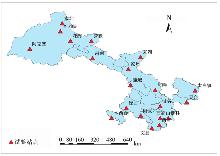
Fig. 1
Distribution of CORS stations"
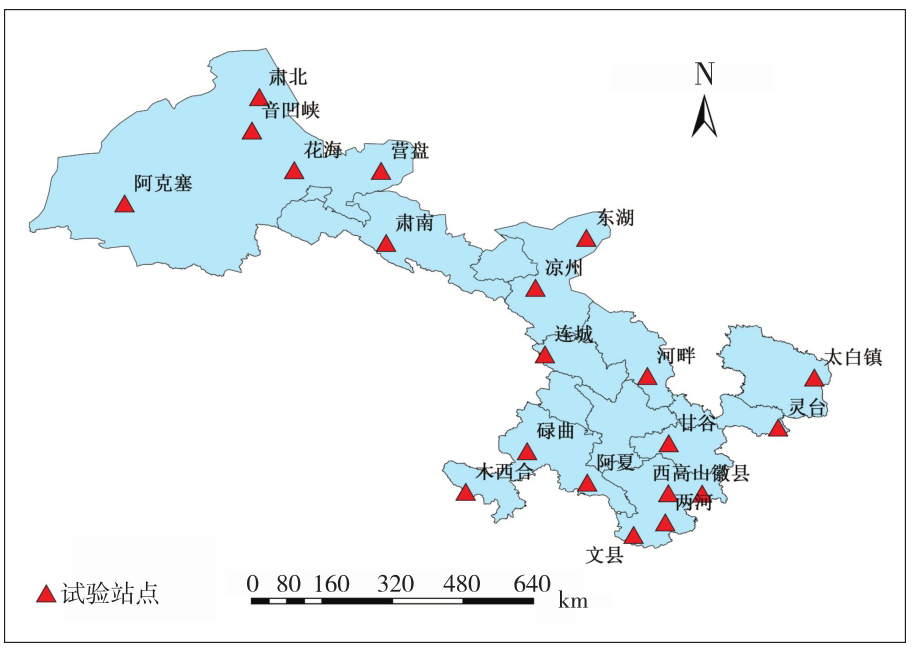
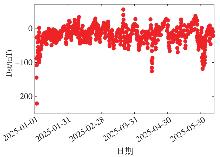
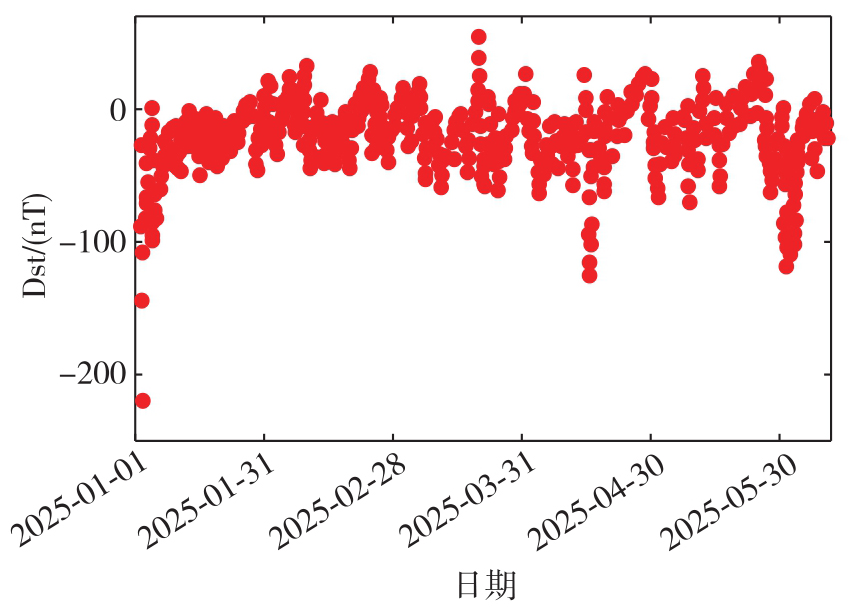
Fig. 2
Dst index for the first half of 2025"
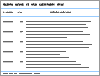
Tab. 1
PPP data process strategy"
| 误差模型 | 处理策略 |
|---|---|
| 观测模型 | 双频消电离层组合 |
| 卫星轨道和钟差 | WUM(武汉大学)产品 |
| 截止高度角 | 10° |
| 观测值权 | P=sin2e/σ2(σ2是伪距或载波的方差) |
| 接收机和系统间偏差 | 白噪声估计 |
| 卫星、接收机天线改正 | igs20.atx PCO:转换到距离,PCV:双线性插值 |
| 相位缠绕模型 | 卫星天线相位缠绕改正 |
| 对流层天顶湿延迟 | 随机游走估计 |
| 电离层产品 | 全球电离层格网产品(GIM) |
| 模糊度参数 | 浮点模糊度 |
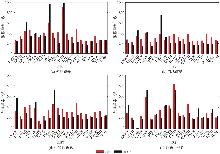
Fig. 3
Statistics of abnormal data at each station under different geomagmetic storms"

Tab. 2
Number of anomalies during geomagnetic storms"
| 地磁活跃强度 | 卫星星座 | 最大值 | 平均值 | 总平均值 |
|---|---|---|---|---|
| 强地磁暴(DOY001) | GPS | 908 | 385.7 | 370.2 |
| BDS-3 | 984 | 354.8 | ||
| 中等地磁暴(DOY106) | GPS | 480 | 326.4 | 295.5 |
| BDS-3 | 725 | 264.7 | ||
| 弱地磁暴(DOY067) | GPS | 402 | 309.6 | 282.6 |
| BDS-3 | 754 | 255.7 | ||
| 地磁平稳期(DOY149) | GPS | 832 | 313.8 | 308.5 |
| BDS-3 | 729 | 303.3 |
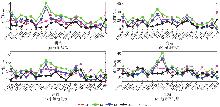
Fig. 4
Frequency point multi-path errors at various stations during different geomagmetic storm intensities"

Tab. 3
Statistical of multi-path errors at different frequencies"
| 地磁活跃强度 | GPS | BDS-3 | |||
|---|---|---|---|---|---|
| L1 | L2 | L5 | B1C | B3I | |
| 强地磁暴(DOY001) | 17.3 | 23.6 | 19.2 | 15.4 | 20.2 |
| 中等地磁暴(DOY106) | 15.9 | 21.3 | 16.9 | 15.3 | 19.9 |
| 弱地磁暴(DOY067) | 16.4 | 21.7 | 16.9 | 15.2 | 20.2 |
| 地磁平稳期(DOY149) | 15.4 | 19.8 | 16.2 | 15.2 | 20.1 |
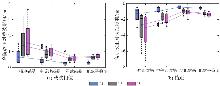
Fig. 5
Impact of ionospheric higher-order term correction on GPS constellation ranging"
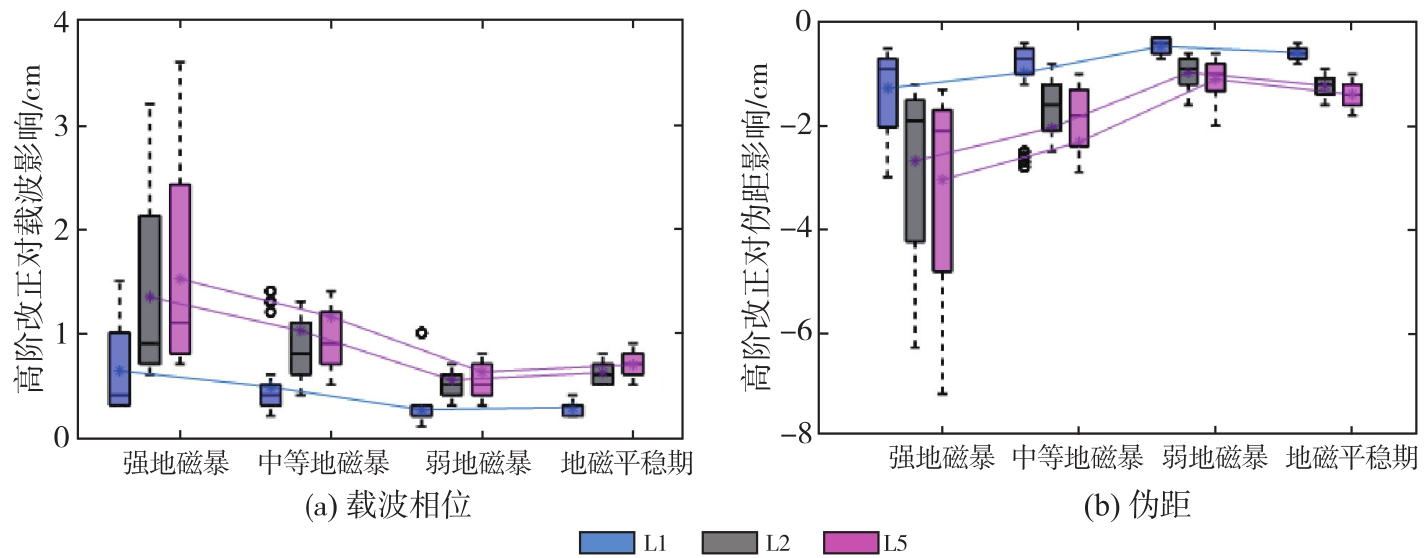
Fig. 6
Impact of ionospheric higher-order term correction on BDS-3 constellation ranging"
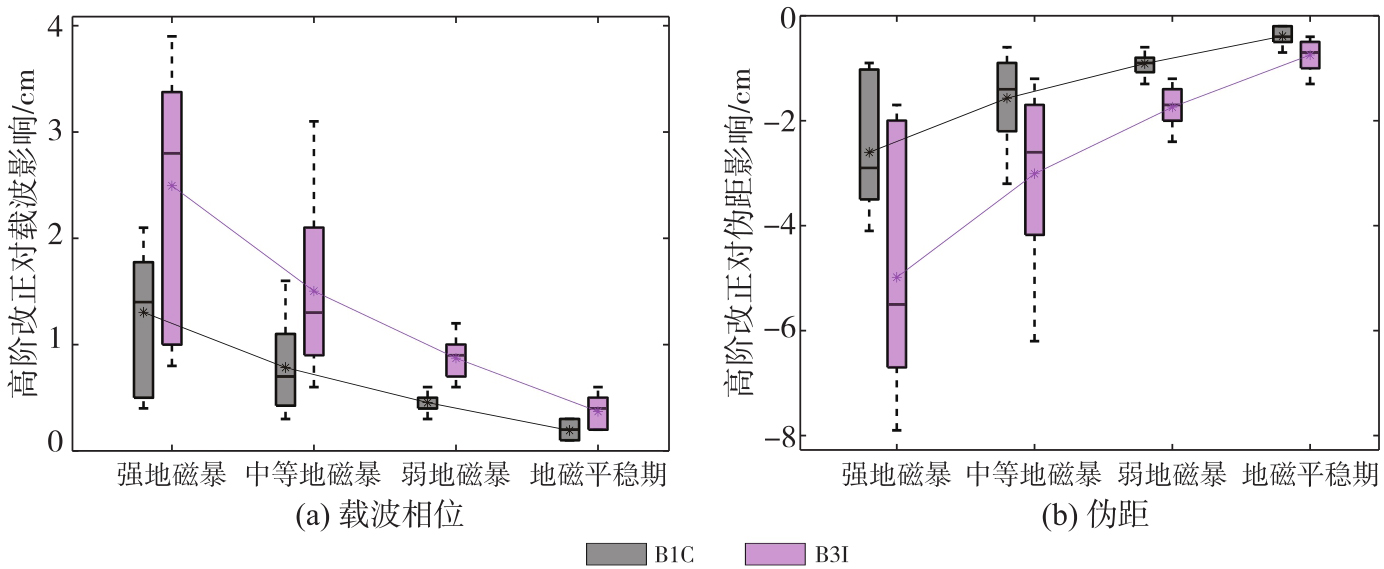
Fig. 7
Comparison of RMS with and without ionospheric higher-order term correction"
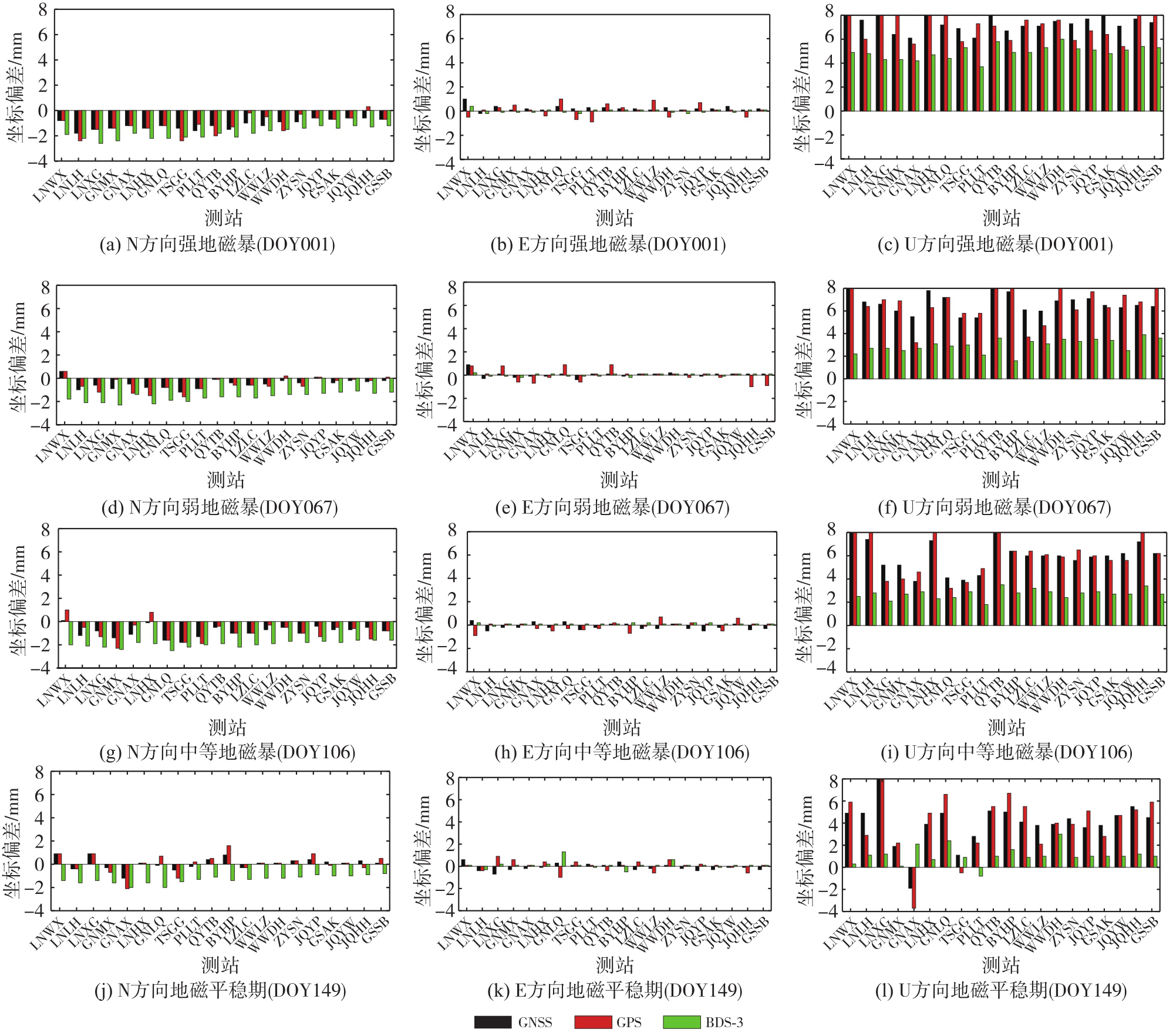
Fig. 8
Impact of different geomagnetic environments on GNSS positioning"
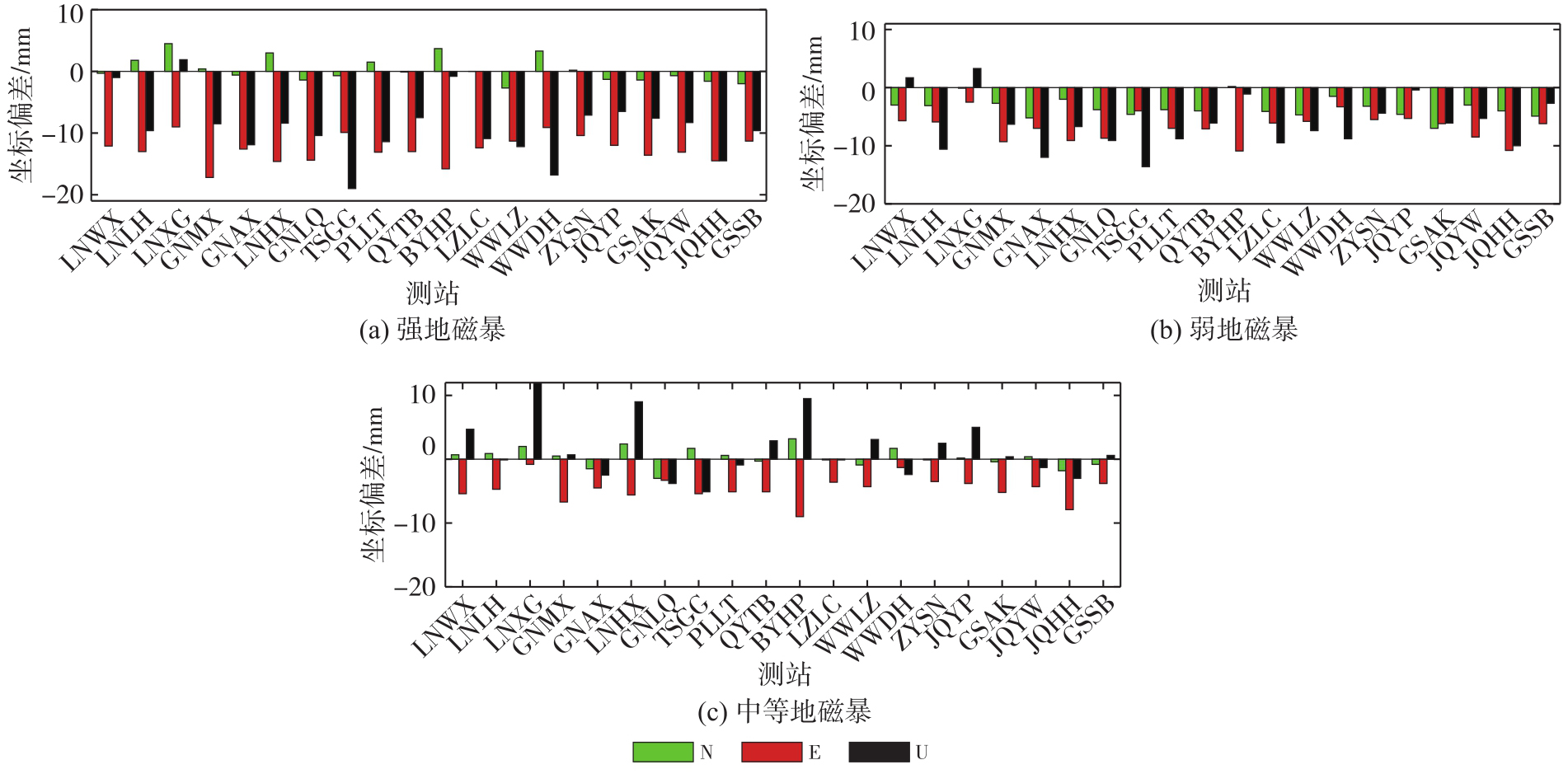
Fig. 9
Impact of different geomagnetic environments on GPS, BDS-3 positioning"
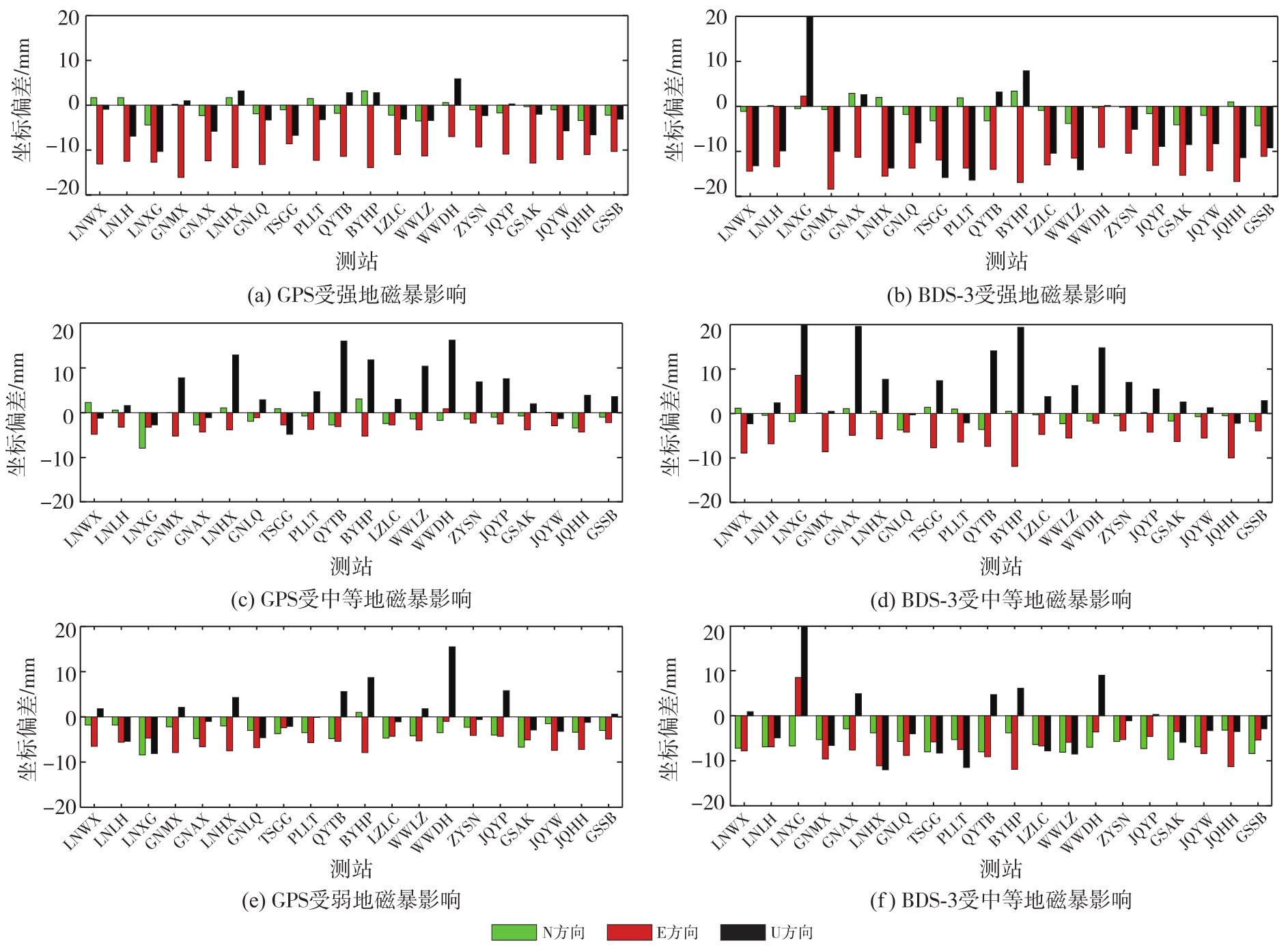
Tab. 4
Statistics of the impact of different ionospheric activity degrees"
| 地磁活跃强度 | 统计值 | GNSS | GPS | BDS-3 | ||||||
|---|---|---|---|---|---|---|---|---|---|---|
| N方向 | E方向 | U方向 | N方向 | E方向 | U方向 | N方向 | E方向 | U方向 | ||
| 强地磁暴 | 最大值 | 4.5 | -17.2 | -19.0 | -4.4 | -16.1 | -10.3 | -4.3 | -18.4 | -16.4 |
| 平均值 | 0.3 | -12.6 | -9.0 | -0.8 | -11.8 | -2.4 | -0.8 | -12.8 | -6.4 | |
| 中等地磁暴 | 最大值 | 3.2 | -9.0 | -5.1 | -7.9 | -5.2 | 16.2 | -3.7 | -11.9 | 35.5 |
| 平均值 | 0.3 | -4.7 | 1.6 | -1.0 | -3.2 | 5.0 | -0.7 | -5.5 | 7.2 | |
| 弱地磁暴 | 最大值 | -7.0 | -10.9 | -13.6 | -8.4 | -7.9 | -8.1 | -9.7 | -11.9 | -12.0 |
| 平均值 | -3.5 | -6.7 | -6.2 | -3.4 | -5.5 | 0.8 | -6.3 | -6.6 | -1.2 | |
Fig. 10
Daily ionospheric activity indicator"
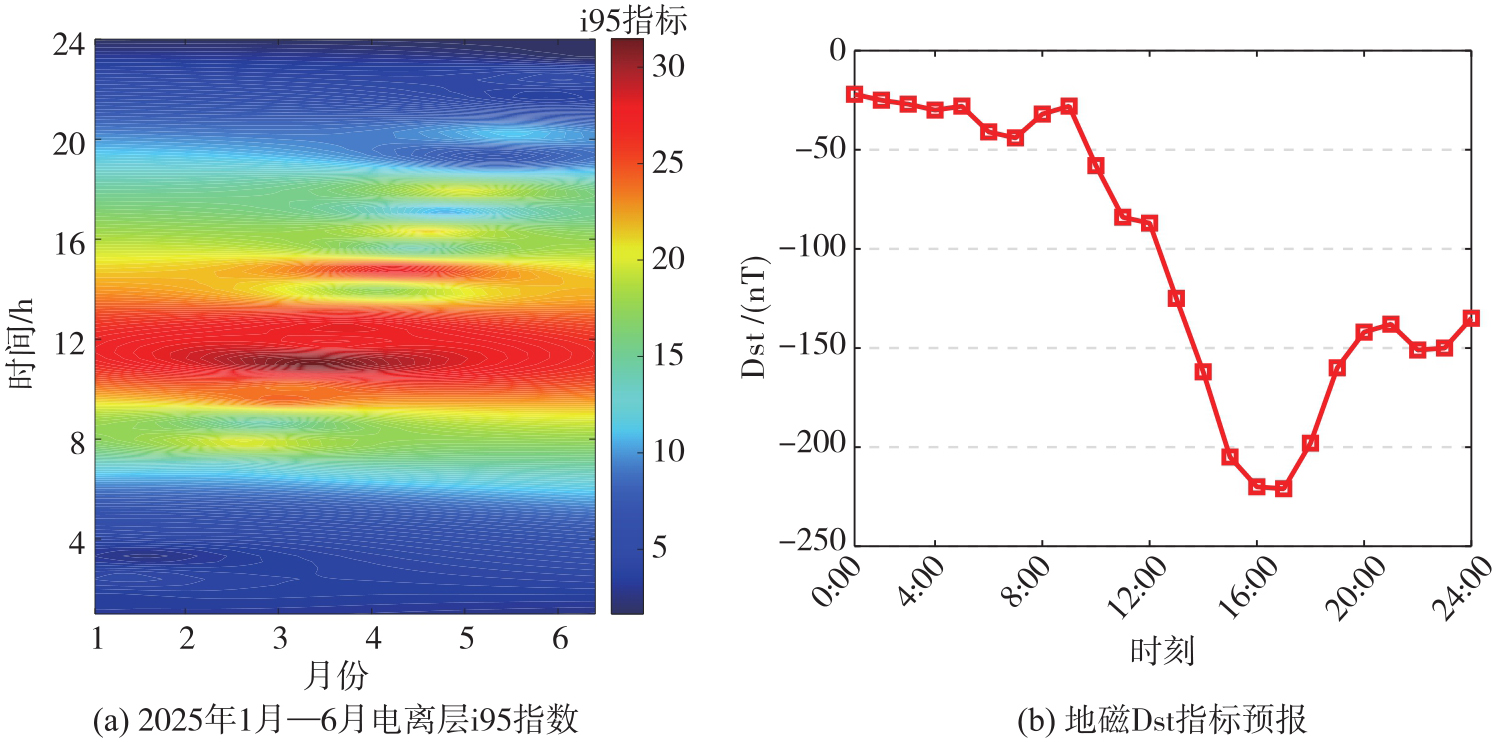
Fig. 11
Impact of ionospheric activity on positioning under different geomagnetic intensities (horizon)"
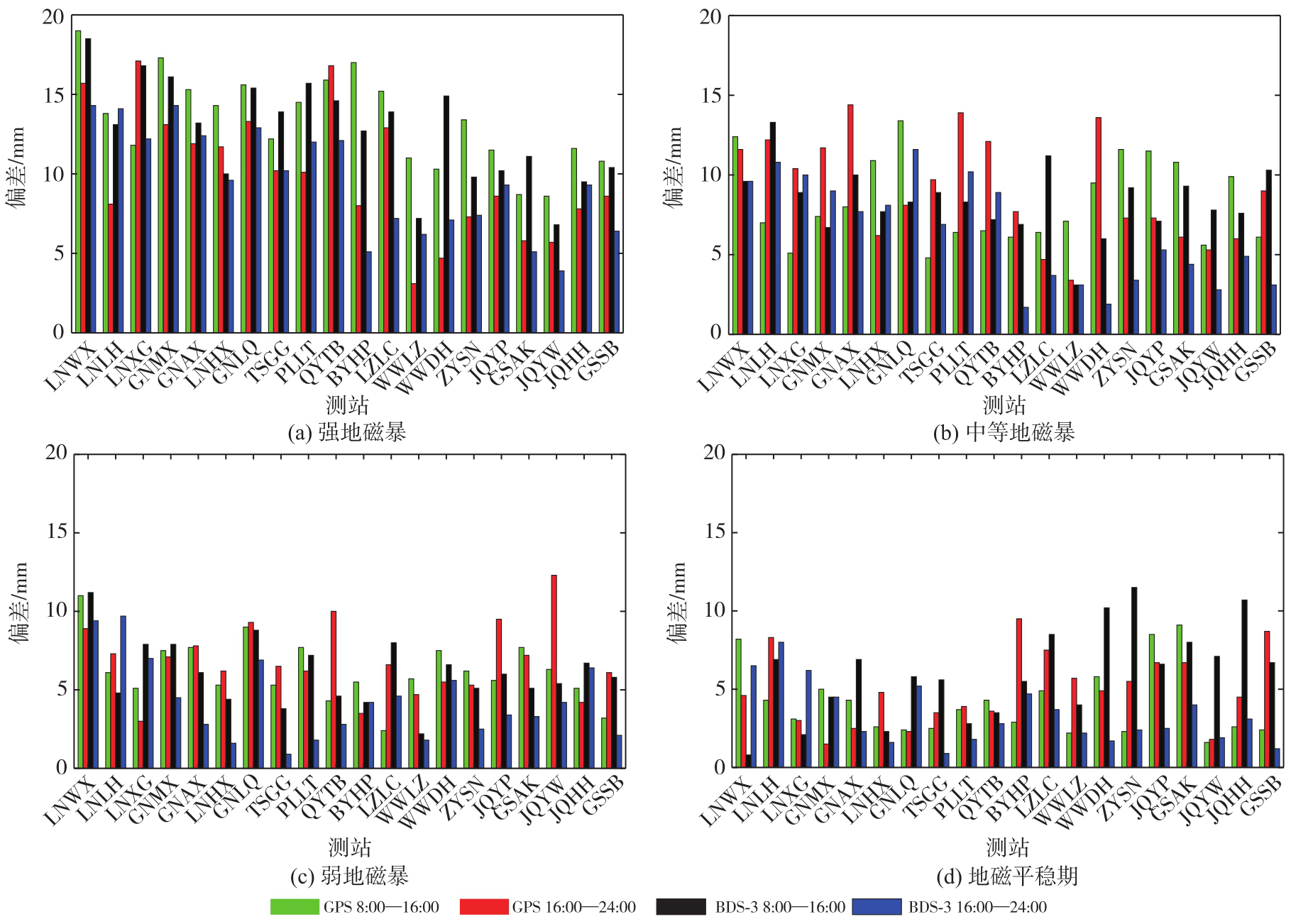
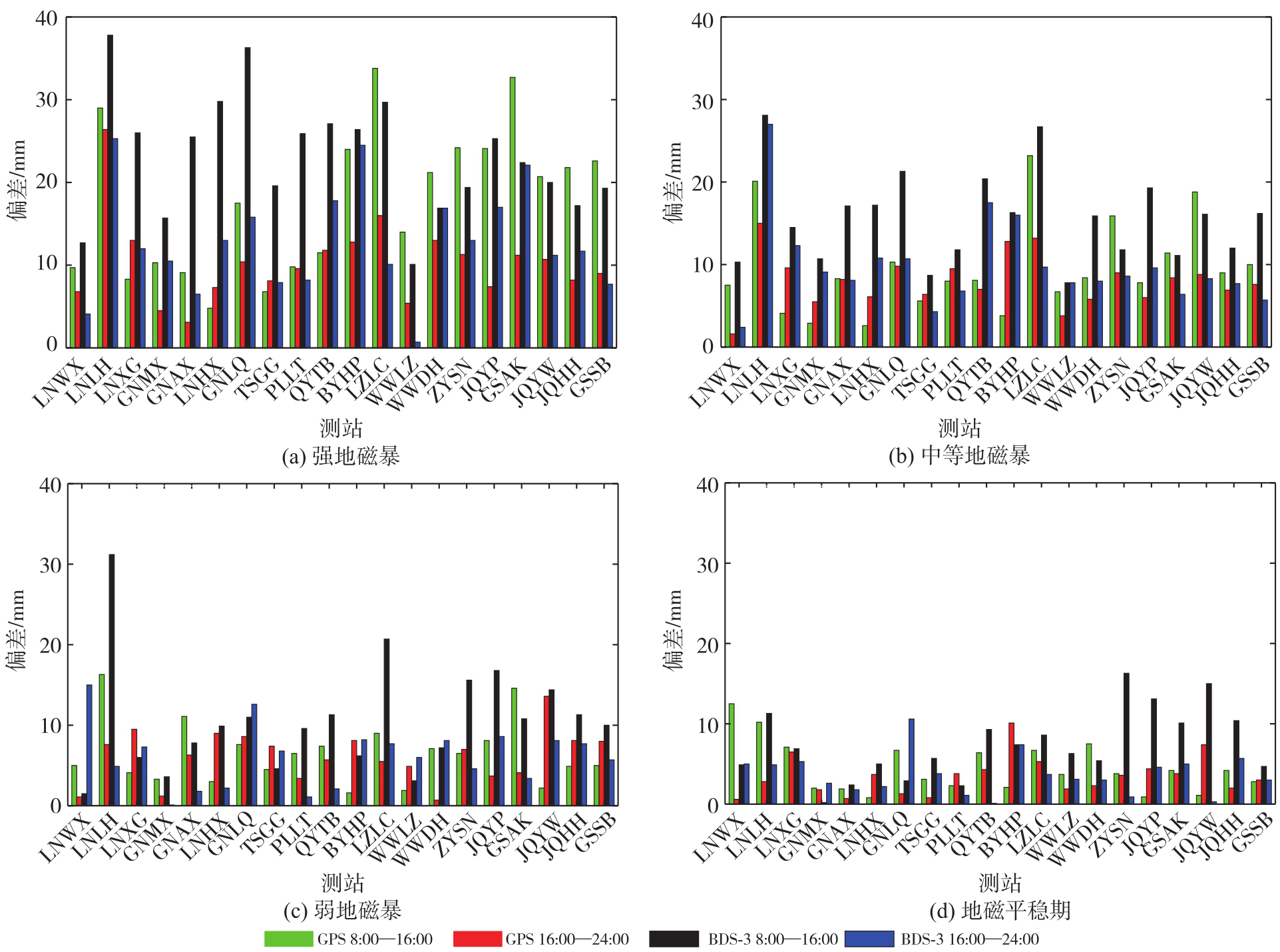
Fig. 12
Impact of ionospheric activity on positioning under different geomagnetic intensities (height)"
| [1] |
袁运斌, 霍星亮, 张宝成. 近年来我国GNSS电离层延迟精确建模及修正研究进展[J]. 测绘学报, 2017, 46(10): 1364-1378. DOI: .
doi: 10.11947/j.AGCS.2017.20170349 |
|
Yuan Yunbin, Huo Xingliang, Zhang Baocheng. Research progress of precise models and correction for GNSS ionospheric delay in China over recent years[J]. Acta Geodaetica et Cartographica Sinica, 2017, 46(10): 1364-1378. DOI: .
doi: 10.11947/j.AGCS.2017.20170349 |
|
| [2] |
张宝成. GNSS非差非组合精密单点定位的理论方法与应用研究[J]. 测绘学报, 2014, 43(10): 1099. DOI: .
doi: 10.13485/j.cnki.11-2089.2014.0155 |
|
Zhang Baocheng. Study on the theoretical methodology and applications of precise point positioning using undifferenced and uncombined GNSS data[J]. Acta Geodaetica et Cartographica Sinica, 2014, 43(10): 1099. DOI: .
doi: 10.13485/j.cnki.11-2089.2014.0155 |
|
| [3] | Li Zishen, Wang Ningbo, Liu Ang, et al. Progress of geodesy related ionosphere from Chinese scientists in the period of 2019—2023[J]. Journal of Geodesy and Geoinformation Science, 2023, 6(3): 115-123. |
| [4] | Yuan Yunbin, Wang Ningbo, Li Zishen, et al. The BeiDou global broadcast ionospheric delay correction model (BDGIM) and its preliminary performance evaluation results[J]. Navigation, 2019, 66(1): 55-69. |
| [5] | Wu Xiaoli, Hu Xiaogong, Wang Gang, et al. Evaluation of COMPASS ionospheric model in GNSS positioning[J]. Advances in Space Research, 2013, 51(6): 959-968. |
| [6] | Zhang Xiaohong, Ren Xiaodong, Wu Fengbo, et al. Short-term prediction of ionospheric TEC based on ARIMA model[J]. Journal of Geodesy and Geoinformation Science, 2019, 2(1): 9-16. |
| [7] | 李航. 卫星导航定位中电离层高阶项影响研究[D]. 武汉: 武汉大学, 2018: 65-77. |
| Li Hang. Study on higher-order ionospheric terms effects in global navigation satellite systems[D]. Wuhan: Wuhan University, 2018: 65-77. | |
| [8] | 姜卫平, 李昭, 邓连生, 等. 高阶电离层延迟对GPS坐标时间序列的影响分析[J]. 科学通报, 2014, 59(10): 913-923. |
| Jiang Weiping, Li Zhao, Deng Liansheng, et al. Impact of higher order ionospheric delay on continuous GPS coordinate time series[J]. Chinese Science Bulletin, 2014, 59(10): 913-923. | |
| [9] | 吴志文, 詹艳春, 唐国礼, 等. 不同地磁暴强度下非差非组合PPP定位性能分析[J]. 测绘科学, 2024, 49(1): 41-49. |
| Wu Zhiwen, Zhan Yanchun, Tang Guoli, et al. Analysis of undifferenced and uncombined precise point positioning performance under different geomagnetic storm intensities[J]. Science of Surveying and Mapping, 2024, 49(1): 41-49. | |
| [10] | Zhang Shaocheng, Fang Lei, Wang Guangxing, et al. The impact of second-order ionospheric delays on the ZWD estimation with GPS and BDS measurements[J]. GPS Solutions, 2020, 24(2): 41. |
| [11] | Xi Kewei, Wang Xiaoya. Higher order ionospheric error correction in BDS precise orbit determination[J]. Advances in Space Research, 2021, 67(12): 4054-4065. |
| [12] | 宋佳明, 刘志强, 王虎, 等. 基于Kalman滤波的实时电离层产品综合及精度分析[J]. 导航定位学报, 2024, 12(5): 115-124. |
| Song Jiaming, Liu Zhiqiang, Wang Hu, et al. Real-time ionospheric product combination based on Kalman filter and its accuracy analysis[J]. Journal of Navigation and Positioning, 2024, 12(5): 115-124. | |
| [13] | Zhang Hongping, Lü Haixia, Li Min, et al. Global modeling 2nd-order ionospheric delay and its effects on GNSS precise positioning[J]. Science China Physics, Mechanics and Astronomy, 2011, 54(6): 1059-1067. |
| [14] | Hoque M M, Jakowski N. Higher order ionospheric effects in precise GNSS positioning[J]. Journal of Geodesy, 2007, 81(4): 259-268. |
| [15] | 徐宗秋, 黄天舒, 徐爱功, 等. 电离层二阶项改正对BDS精密单点定位的影响[J]. 测绘科学, 2022, 47(12): 8-15. |
| Xu Zongqiu, Huang Tianshu, Xu Aigong, et al. Impact of second-order ionospheric delay for BDS precise point positioning[J]. Science of Surveying and Mapping, 2022, 47(12): 8-15. | |
| [16] | Garcia-Fernandez M, Desai S D, Butala M D, et al. Evaluation of different approaches to modeling the second-order ionospheric delay on GPS measurements[J]. Journal of Geophysical Research: Space Physics, 2013, 118(12): 7864-7873. |
| [17] | Hernández-Pajares M, Juan J M, Sanz J, et al. Second-order ionospheric term in GPS: implementation and impact on geodetic estimates[J]. Journal of Geophysical Research: Solid Earth, 2007, 112(B8): 2006JB004707. |
| [18] | Banville S, Sieradzki R, Hoque M, et al. On the estimation of higher-order ionospheric effects in precise point positioning[J]. GPS Solutions, 2017, 21(4): 1817-1828. |
| [19] | Zhang Zhiyu, Guo Fei, Zhang Xiaohong. The effects of higher-order ionospheric terms on GPS tropospheric delay and gradient estimates[J]. Remote Sensing, 2018, 10(10): 1561. |
| [20] |
刘根友, 高铭, 尹翔飞, 等. 基于GNSS精密单点定位的高精度云平台授时[J]. 测绘学报, 2022, 51(8): 1736-1743. DOI: .
doi: 10.11947/j.AGCS.2022.20210441 |
|
Liu Genyou, Gao Ming, Yin Xiangfei, et al. High-precision cloud platform timing based on GNSS precise point positioning[J]. Acta Geodaetica et Cartographica Sinica, 2022, 51(8): 1736-1743. DOI: .
doi: 10.11947/j.AGCS.2022.20210441 |
|
| [21] | Fritsche M, Dietrich R, Knö fel C, et al. Impact of higher-order ionospheric terms on GPS estimates[J]. Geophysical Research Letters, 2005, 32(23): L23311. |
| [22] |
张小红, 胡家欢, 任晓东. PPP/PPP-RTK新进展与北斗/GNSS PPP定位性能比较[J]. 测绘学报, 2020, 49(9): 1084-1100. DOI: .
doi: 10.11947/j.AGCS.2020.20200328 |
|
Zhang Xiaohong, Hu Jiahuan, Ren Xiaodong. New progress of PPP/PPP-RTK and positioning performance comparison of BDS/GNSS PPP[J]. Acta Geodaetica et Cartographica Sinica, 2020, 49(9): 1084-1100. DOI: .
doi: 10.11947/j.AGCS.2020.20200328 |
|
| [23] | 崔汪安寅. 磁暴期间亚澳扇区电离层响应特征以及GNSS定位精度研究[D]. 南京: 南京信息工程大学, 2024: 6-20. |
| Cui Wanganyin. Study on ionospheric response characteristics in the Asia-Australian sector and GNSS positioning accuracy during magnetic storms[D]. Nanjing: Nanjing University of Information Science & Technology, 2024: 6-20. | |
| [24] | Luo Xiaomin, Du Junfeng, Lou Yidong, et al. A method to mitigate the effects of strong geomagnetic storm on GNSS precise point positioning[J]. Space Weather, 2022, 20: e2021SW002908. |
| [25] |
侯鹏宇, 张宝成, 刘腾, 等. CDMA+FDMA非差非组合区域PPP-RTK[J]. 测绘学报, 2023, 52(2): 183-194. DOI: .
doi: 10.11947/j.AGCS.2023.20210422 |
|
Hou Pengyu, Zhang Baocheng, Liu Teng, et al. Regional PPP-RTK with CDMA+FDMA data at undifferenced and uncombined level[J]. Acta Geodaetica et Cartographica Sinica, 2023, 52(2): 183-194. DOI: .
doi: 10.11947/j.AGCS.2023.20210422 |
|
| [26] | 毛悦, 贾小林, 宋小勇, 等. 北斗三号基本系统空间信号性能分析[J]. 测绘科学技术学报, 2019, 36(2): 111-115. |
| Mao Yue, Jia Xiaolin, Song Xiaoyong, et al. Analysis of space signal performance of basic BDS-3 navigation satellite system[J]. Journal of Geomatics Science and Technology, 2019, 36(2): 111-115. | |
| [27] | Xiao Gongwei, Liu Genyou, Ou Jikun, et al. MG-APP: an open-source software for multi-GNSS precise point positioning and application analysis[J]. GPS Solutions, 2020, 24(3): 66. |
| [1] | Xuexi LIU, Guanghan LIU, Chao YANG, Nanshan ZHENG, Fudong GUO, Kefei ZHANG, Shimao DOU. Phase Wind-up and precise point positioning considering GNSS satellite attitude [J]. Acta Geodaetica et Cartographica Sinica, 2026, 55(6): 1018-1030. |
| [2] | Jingzhu ZHAO, Chuang SHI, Lei FAN, Shiwei GUO, Tao ZHANG. Unified estimation and correction method for multi-form code bias using BDS-3 data [J]. Acta Geodaetica et Cartographica Sinica, 2026, 55(6): 1047-1057. |
| [3] | Shoujian ZHANG, Xinyun CAO, Yulong GE, Fei SHEN. Yaw attitude modeling of GLONASS-K and GLONASS-M+ satellites and its impact on satellite clock estimation and precise point positioning [J]. Acta Geodaetica et Cartographica Sinica, 2025, 54(12): 2142-2152. |
| [4] | Jian CHEN, Jiahui WANG, Xingwang ZHAO, Chao LIU, Chunyang LIU, Xuexiang YU. Single-epoch RTK positioning optimization method based on BDS-3/Galileo multi-frequency ionosphere-reduced combinations [J]. Acta Geodaetica et Cartographica Sinica, 2025, 54(12): 2153-2167. |
| [5] | Chuang SHI, Chenlong DENG, Lei FAN, Fu ZHENG, Tao ZHANG, Yuan TIAN, Guifei JING, Jie MA. Positioning performance analysis and evaluation for standalone BDS receivers [J]. Acta Geodaetica et Cartographica Sinica, 2025, 54(1): 1-13. |
| [6] | Yang LIU, Guang YANG, Xiaohui CHENG, Xiao ZHANG. Rapid single point positioning enhancement service and application based on urban CORS [J]. Acta Geodaetica et Cartographica Sinica, 2024, 53(9): 1706-1714. |
| [7] | Chuang SHI, Wei SONG, Fu ZHENG, Haoyuan WANG, Yuzhuo WANG, Aimin ZHANG, Weiming TANG. BDS real-time 100 picosecond level single difference time and frequency synchronization method [J]. Acta Geodaetica et Cartographica Sinica, 2024, 53(5): 869-878. |
| [8] | Xiaoyong SONG, Yuanxi YANG, Yue MAO, Rengui RUAN, Long WANG. Schmidt Kalman filter in autonomous orbit determination of navigation satellites [J]. Acta Geodaetica et Cartographica Sinica, 2024, 53(5): 879-888. |
| [9] | Tian HE, Guojie MENG, Weiwei WU, Xiaoning SU, Guoqiang ZHAO, Congmin WEI, Zhihua DONG. Preliminary analysis to positioning precision and crustal movement of BDS-3 data recorded by the China seismic experiment site [J]. Acta Geodaetica et Cartographica Sinica, 2024, 53(4): 653-665. |
| [10] | HU Chao, WANG Qianxin. GNSS ultra-rapid orbit and clock offset estimation method with the aid of the constraint of BDS-3 onboard clock [J]. Acta Geodaetica et Cartographica Sinica, 2024, 53(3): 413-424. |
| [11] | Chao HU, Qianxin WANG. BDS-3/GNSS satellite ultra-rapid clock offsets estimation model with the aid of onboard clock states solution [J]. Acta Geodaetica et Cartographica Sinica, 2024, 53(12): 2268-2281. |
| [12] | QU Weijing, HUANG Yong, XU Junyi, SUN Shuxian, ZHOU Shanshi, YANG Yufei, HE Bing, HU Xiaogong. Precise orbit determination using satellite laser ranging and inter-satellite link observations for BDS-3 satellites [J]. Acta Geodaetica et Cartographica Sinica, 2023, 52(9): 1437-1448. |
| [13] | ZHA Jiuping, ZHANG Baocheng, LIU Teng, ZHANG Xiao, HOU Pengyu, YUAN Yunbin, LI Zishen. Undifferenced and uncombined PPP-RTK aided by BDS-3 PPP-B2b precise orbits [J]. Acta Geodaetica et Cartographica Sinica, 2023, 52(9): 1449-1459. |
| [14] | LI Yang, WANG Ningbo, LI Zishen, WANG Liang, LI Zongyi. BDS-3 satellite difference code bias estimation with satellite phase center offset correction applied [J]. Acta Geodaetica et Cartographica Sinica, 2023, 52(9): 1460-1468. |
| [15] | YUAN Rong, XIE Shengli, GAO Feng, LI Zhenni, HUANG Hanjun. BDS multi-frequency observation minimum noise coefficient combination method [J]. Acta Geodaetica et Cartographica Sinica, 2023, 52(8): 1298-1304. |
| Viewed | ||||||
|
Full text |
|
|||||
|
Abstract |
|
|||||
